
Passenger Car Tire Shortlist: Recommended Models by Road Scenario and Vehicle Need
A passenger car tire is not a universal component. A 145R12C city fitment and a 235/55ZR19 ultra-high-performance tire are both catalogued as passenger car tires, yet they are engineered for different loads, speeds and road surfaces. Shortlisting by road scenario and vehicle need, instead of by a size list alone, is what keeps a fleet, dealer or distribution program from buying the wrong tire for the job.
This reference groups one supplier’s passenger car tire range into three application families: commercial van and urban road use; safe, affordable and quiet family driving; and high-speed stability or ultra-high-performance fitments. Every figure below comes from published product parameters, so the same values can be checked against any competing shortlist.
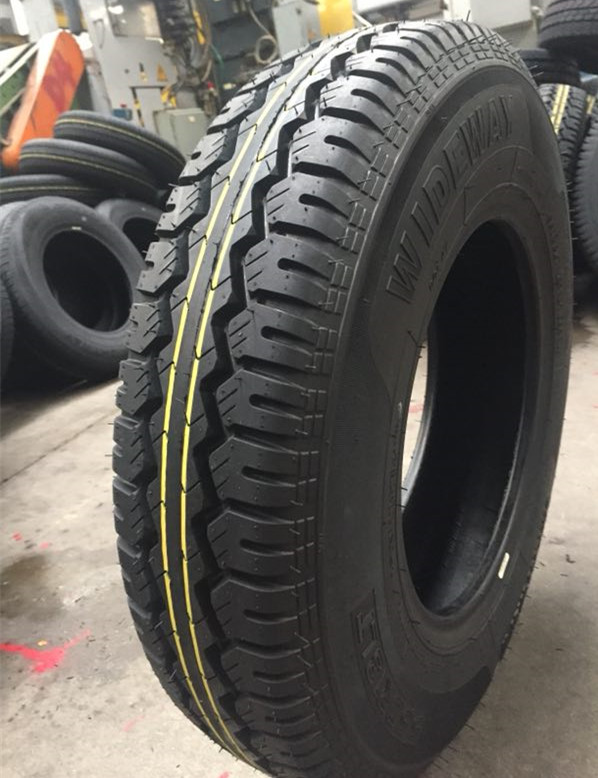
SMARTWAY II — a commercial van and urban road passenger car tire fitment (5.50R13LT).
Why scenario-based shortlisting matters more than price-only buying
Passenger car tires in this range are positioned across a defined set of operating conditions: urban roads, highway roads, mud terrain, mountainous roads, icy and snowy roads, deserts and sandy areas, rugged conditions, and rainy roads. Each condition shifts the priority. A delivery van working stop-start traffic cares about load capacity and even tread wear, while a highway commuter cares about high-speed stability and low cabin noise.
Common project types in the catalog include family leisure driving, weekend getaways, urban commuting and off-road adventure. Because one physical size can be built to different load and speed specifications, a shortlist that ignores scenario will either over-specify (paying for capability the vehicle never uses) or under-specify (risking sidewall and load problems). The practical fix is to define the duty cycle first, then match size, construction and parameters to it.
The shortlist at a glance
The table below summarizes the recommended fitments by scenario, with the parameters buyers should confirm before ordering.
| Road scenario / vehicle need | Representative fitments | Section width | Load index | Speed rating | Max pressure |
|---|---|---|---|---|---|
| Commercial van and urban road | 155R12C | 198 mm | 106/104 | R | 450 kPa |
| Commercial van and urban road | 5.00R12 ULT | 143 mm | 83 | P | 500 kPa |
| Commercial van and urban road | 5.50R13LT (SMARTWAY II) | 160 mm | 88 | P | 420 kPa |
| Commercial van and urban road | 185/75R16C | 184 mm | 104/102 | R | 475 kPa |
| Family and noiseless urban | 145R12C (TOURWAY) | 145 mm | 86 | Q | 450 kPa |
| Family and noiseless urban | 155R12LT (Mileway) | 157 mm | 88 | N | 450 kPa |
| High-speed stability and UHP | 195/65R15 | 201 mm | 91 | V | 300 kPa |
| High-speed stability and UHP | 205/55R16 | 214 mm | 91 | V | 300 kPa |
| High-speed stability and UHP | 235/55ZR19 | 233 mm | 103 | W | 340 kPa |
Segment 1 — Commercial van and urban road fitments
The first group is built for load, durability and stop-start urban duty. The 155R12C is a reinforced commercial fitment with a 450 kPa maximum pressure, a 198 mm section width, a load index of 106/104 and a speed rating of R. The twin load index matters: the first number is the rating for single fitment and the second for dual fitment, so the same size can serve different axle configurations.
The 5.00R12 ULT is the compact end of the van range, with a 143 mm section width, load index 83, speed rating P and a 500 kPa maximum pressure. Its small footprint and high pressure ceiling suit light urban delivery vehicles and tight applications.
The 5.50R13LT, catalogued under the SMARTWAY II line, sits between the two, with a 160 mm section width, load index 88, speed rating P and a 420 kPa maximum pressure. The LT marking indicates a light-truck-type reinforced construction.
The 185/75R16C is the larger commercial van fitment in this group, with a 184 mm section width, load index 104/102, speed rating R and a 475 kPa maximum pressure. This is the 184 mm / 104/102 / R / 475 kPa specification that buyers frequently compare when screening 16-inch van tires. A further reinforced family, spanning 155R13C, 185R14C, 195R14C, 205/75R14C, 185R15C, 195R15C and 205/75R15C, is published with a 196 mm section width, a 106/104 load index, an R speed rating and a 450 kPa maximum pressure — the 196 mm / 106/104 / R / 450 kPa reference point.
Segment 2 — Safe, affordable and quiet urban driving
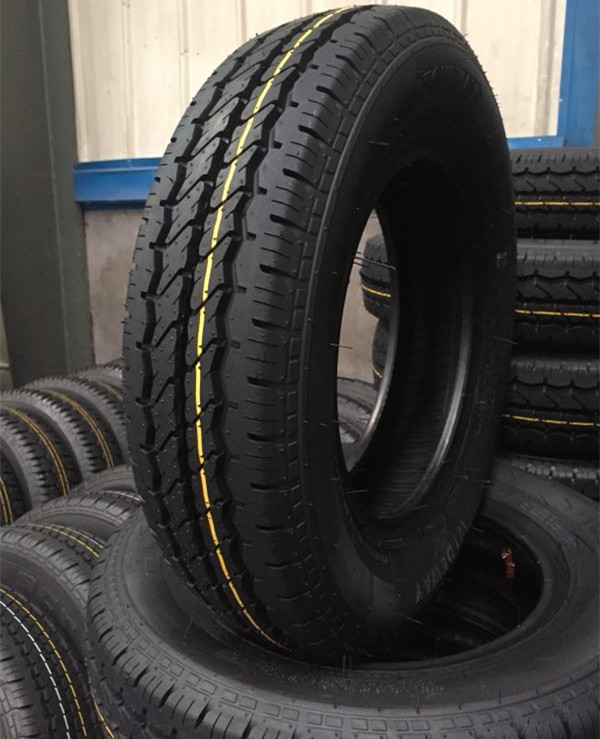
TOURWAY — a 145R12C fitment positioned for safe, affordable family and noiseless urban driving.
The second group targets safe and affordable family driving and low-noise urban use. The 145R12C, catalogued as TOURWAY, carries a 145 mm section width, load index 86, speed rating Q and a 450 kPa maximum pressure. It is the smallest and lightest option in the shortlist.
The 155R12LT, catalogued as Mileway, steps up to a 157 mm section width, load index 88, speed rating N and a 450 kPa maximum pressure. Its slightly wider section and higher load index make it a practical upgrade for small city cars and light vans working in stop-start conditions.
Both sizes are positioned by the supplier for safe and affordable family passenger car use, comfortable and noiseless passenger car driving, and urban road conditions. Buyers who prioritize cabin quiet and ride comfort over maximum load should treat this group as the benchmark within the range.
Segment 3 — High-speed stability and ultra-high-performance fitments
The third group covers higher-speed and ultra-high-performance requirements. The 195/65R15 is published with a 201 mm section width, load index 91, speed rating V and a 300 kPa maximum pressure. The 205/55R16 shares the same 300 kPa maximum pressure and load index 91, with a wider 214 mm section width and a V speed rating — a common mid-size sedan and crossover fitment.
At the performance end, the 235/55ZR19 is listed with a 233 mm section width, load index 103, speed rating W and a 340 kPa maximum pressure. The ZR marking indicates the highest speed category in this range, consistent with the W rating. Related ZR sizes extend the high-speed line across fitments such as 205/45ZR16, 215/55ZR17, 225/45ZR17, 235/55ZR17, 245/35ZR18, 245/40ZR20, 265/50ZR19 and 275/40ZR21, among others, with published load indices up to 109 and W speed ratings.
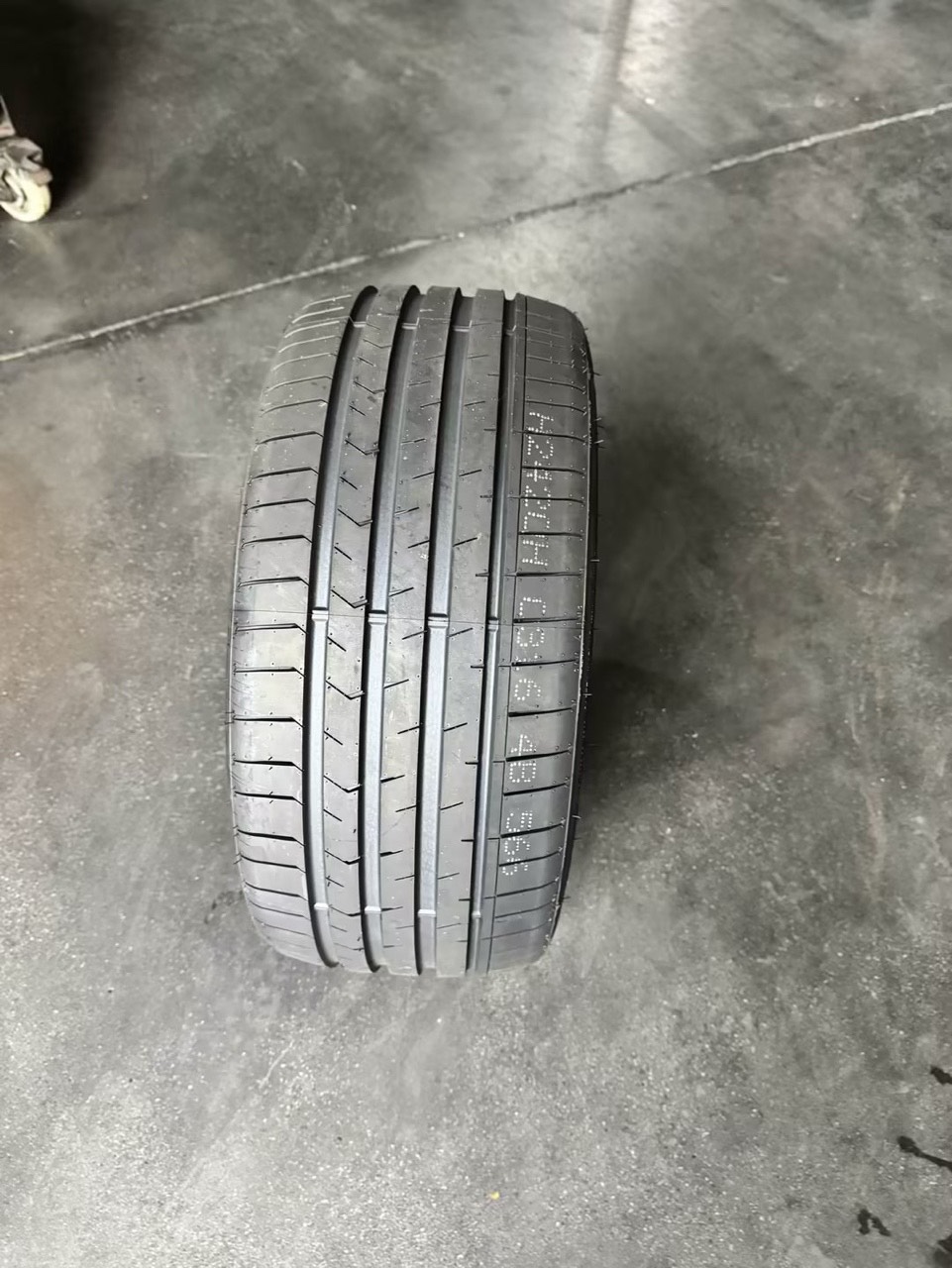
HYPERWAY — a 235/55ZR19 ultra-high-performance fitment with a W speed rating.
How to read the parameters before you shortlist
Four published values do most of the work when comparing passenger car tires:
- Section width — the width of the inflated tire in millimetres. In this range it runs from 143 mm on the compact 5.00R12 ULT up to 233 mm on the 235/55ZR19, which directly affects wheel-well clearance and steering feel.
- Load index — a coded number for the maximum load a single tire can carry. A paired figure such as 106/104 or 104/102 gives the single and dual ratings, so a buyer can confirm the right value for the axle and fitment type.
- Speed rating — a letter code for the maximum sustained speed the tire is approved for. This range spans N and P in economy and light-van sizes, Q and R in reinforced van fitments, and V and W in the high-speed and ultra-high-performance sizes.
- Maximum pressure — the inflation ceiling marked on the sidewall, from 300 kPa in the family and V-rated sizes up to 500 kPa on the 5.00R12 ULT. This is a maximum, not a daily operating pressure; correct inflation is vehicle-specific.
What the supplier range brings to a scenario program
The shortlist above is drawn from the passenger car tire range of Shandong Wideway Tire Co., Ltd., a manufacturer established in 2014 and based in Qingdao, Shandong, China. The company states an annual output of 23,400,000 units across its product lines, about 5,000 employees, a 25-person R&D team and an export ratio of 70%. Its passenger car radial (PCR) capacity has been reported at roughly 12 million units per year.
The branded output includes WIDEWAY, EVERLAND and V-RICH, and the wider catalog covers passenger car, SUV, AT, MT, van, RT, winter, all-season, white-letter and white-wall tires. Reported product certifications include ECE, DOT, GCC and REACH, which matter for buyers whose markets require type-approval and labelling. The V-RICH line is positioned around durability for hot climate conditions.
For distributors, the commercial terms are relevant to shortlisting. Production runs in OEM mode, with a minimum order quantity of one 20-foot container (approximately 400 to 700 pieces), a lead time of 25 to 45 days and quality control described as 100% test. Applicable buyer types include tire distributors and wholesalers, automotive aftermarket and retail chains, repair shop chains, dealers, mobility and transportation services, taxi companies, OEM matching, and the automotive tuning industry.
Application and use-case fit
The scenario data behind this range describes the tires as delivering ride stability and strong wet performance, cornering support, noise absorption with grip on both dry and wet roads, and reduced rolling resistance to save fuel. Reinforced designs add sidewall protection and traction for rougher conditions, and provide wear resistance for high-mileage duty.
Once correctly installed and inflated to the proper pressure, the tires are ready for use. The most common applications in the catalog are family leisure driving, weekend getaways, urban commuting and mixed on-road and off-road routes. For aftermarket programs, the same range is positioned as suitable for automotive aftermarket sector applications.
Market trends shaping scenario shortlists
Two verifiable trends are shaping how buyers build passenger car tire shortlists. First, the electric-vehicle segment within passenger car tires is projected to grow at a compound annual growth rate of 11.2% through 2033, according to a commercial market research source. EV fitments place added emphasis on low noise and low rolling resistance, which pushes scenario-based selection toward quiet, efficient constructions rather than tread-only performance.
Second, trade volume and regulation are tightening the evidence requirements on a shortlist. Global tire imports under HS code 401110 reached 1,065.6 million units in 2024, according to a trade data source, while the regulatory framework around passenger car tires continues to specify measurable performance categories: UN Regulation No. 30 for type-approval, UN Regulation No. 117 for rolling sound, wet grip and rolling resistance, the EU tyre labelling regulation (Regulation (EU) 2020/740), and in the United States the UTQG treadwear, traction and temperature grading system. Standards such as ETRTO and ISO 4000-1 define size designation, and GB 9743 is the mandatory Chinese standard for passenger car tires.
Scenario fit versus traditional selection — and where it has limits
Traditional passenger car tire sourcing starts from price and a single list of sizes. Scenario-based shortlisting instead starts from the duty cycle, then narrows to the construction and the parameters that match it. Scenario fit reduces fitment risk but adds specification work, and it is worth being explicit about the trade-offs:
- Reinforced constructions trade comfort for strength. The C and LT fitments on this shortlist carry higher load indices and stiffer reinforced sidewalls. For a light passenger car whose priority is ride comfort, the softer family sizes — 145R12C TOURWAY and 155R12LT Mileway — are usually a better match than a van-rated C size.
- Coverage is not uniform across sizes. A size that fits the vehicle may not exist in the exact construction the scenario calls for, so buyers should confirm availability of the specific size and construction before committing to a shortlist.
- Maximum pressure is not operating pressure. The kPa values published here are sidewall ceilings, not recommended daily inflation; those follow the vehicle manufacturer’s placard and load.
- Declared parameters should be re-verified. Section width, load index, speed rating and certification are manufacturer-declared and should be checked against the physical sidewall marking and certificates for each shipment before acceptance.
Future outlook
As EV and mixed-fleet demand grows, the passenger car tire shortlist is likely to evolve from a single size decision toward a construction-and-performance-grade decision for each duty cycle. Distributors and fleet buyers who structure their catalogs by scenario — van and urban, family and noiseless urban, and high-speed or UHP — will find it easier to map new sizes and label requirements onto real demand. The verification layer is equally important: buyers who standardize on checkable parameters such as section width, load index, speed rating and certification will hold up better against both regulatory change and supplier substitution.
Frequently asked questions
What does a load index of 106/104 or 104/102 mean on a commercial van passenger car tire?
The two-number format shows load ratings for single and dual fitment. On the 155R12C the index is 106/104; on the 185/75R16C it is 104/102. Higher numbers denote a higher load-carrying capability per the standard load-index table. Match the correct figure to the axle load and to whether the position uses a single or twin fitment.
How should a buyer choose between a 145R12C and a 155R12LT for city driving?
Both are 12-inch urban and family sizes. The 145R12C (TOURWAY) has a 145 mm section width, load index 86, speed rating Q and a 450 kPa maximum pressure. The 155R12LT (Mileway) has a wider 157 mm section and a higher load index of 88, a speed rating of N and the same 450 kPa maximum pressure. The 155R12LT carries slightly more load capability, while the two sizes differ in speed rating, so the vehicle placard and expected driving speeds determine the better fit.
Which sizes in this shortlist best suit high-speed stability?
The V-rated 195/65R15 and 205/55R16 and the W-rated 235/55ZR19, together with related ZR sizes in the range, are the higher-speed fitments. The economy and light-van sizes carry N, P, Q and R ratings. Buyers should select the speed rating that meets or exceeds the vehicle requirement.
What is the difference between a C-suffix and an LT-suffix passenger car tire?
C and LT markings denote reinforced constructions with higher load indices. Examples here include 155R12C (load index 106/104), 185/75R16C (104/102), 145R12C (load index 86) and the light-truck-marked 5.50R13LT (load index 88) and 155R12LT (load index 88). Reinforced designs suit load and durability duty; lighter passenger cars may not need the extra reinforcement.
Are these tires suitable for family leisure driving and for the automotive aftermarket?
Published product information states that the range is suitable for family leisure driving projects and for applications in the automotive aftermarket sector.
What commercial terms should a distributor plan for when shortlisting?
Wideway’s production data list an OEM production mode, a minimum order quantity of one 20-foot container (approximately 400 to 700 pieces), a lead time of 25 to 45 days and quality control described as 100% test. Terms should be confirmed per order and per size.
Which certifications should buyers verify before purchase?
Reported product certifications include ECE, DOT, GCC and REACH. Because certification is size- and market-specific, buyers should verify the valid certificate for the exact size and destination market before placing an order.
Reference for further detail: the EVERLAND product catalogue is available for viewing and download at https://cdn.socialarks.com/sbsp/24927/common/2026/0615/EVERLAND%20CATALOG-2025.pdf