
Patient Identification Wristbands: An Industry Reference
Patient identification wristbands are the first physical link between a patient and their digital record. A band is printed or encoded at admission, worn for the duration of a visit or hospital stay, and read again by nurses, phlebotomists, pharmacists and imaging staff at every step in between. Because they sit at that junction, the choice of material, print method and encoding technology is a clinical workflow decision rather than a stationery purchase — and it is increasingly a decision that procurement teams are asked to justify.
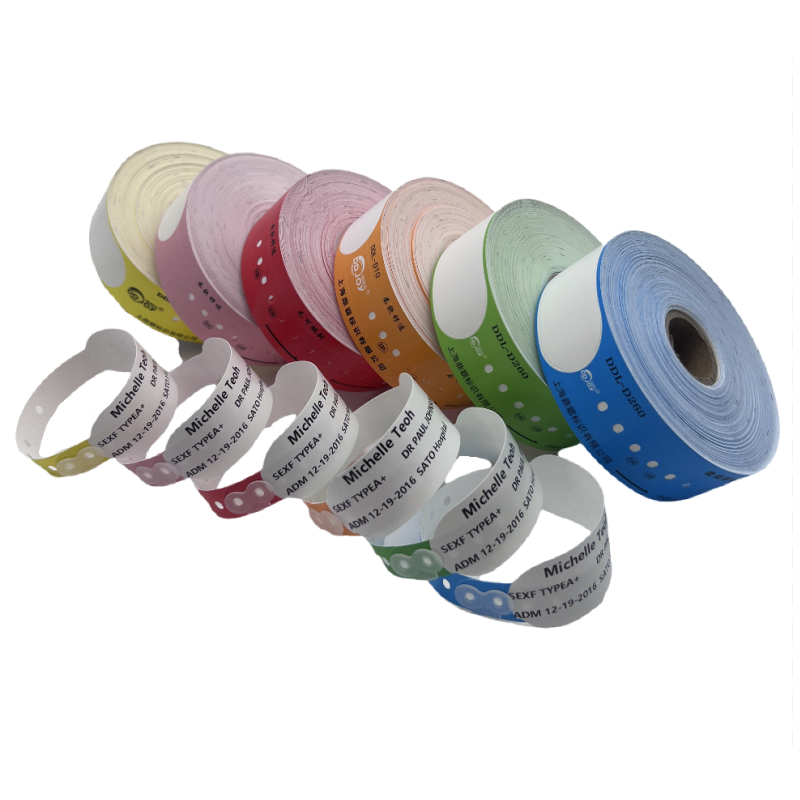 A medical thermal wristband made from thermal-sensitive synthetic paper. Direct thermal printing requires no ink and is used to print patient information at the point of admission.
Why Patient Identification Still Fails in Busy Care Settings
Identification errors rarely originate in a single dramatic mistake. They accumulate from ordinary conditions: patients move between beds and wards, admissions arrive in batches, shift handovers compress time, and several patients in the same unit may share a surname or a date of birth. Sedated, intubated, confused or non-verbal patients cannot confirm their own identity, and language barriers remove the last verbal check.
A wristband addresses this by making identity a physical property of the patient rather than a property of the bed, the chart or the room. The band travels with the person. When it carries a barcode or an embedded RFID chip, identity can also be read by a device instead of being transcribed by hand — which removes a recurring source of manual transcription error in specimen labelling, medication administration and imaging workflows.
The opportunity is therefore not simply “a better band”. It is a shift in where identity data lives during an episode of care: from documents that must be matched to people, to a wearable token that is matched to a record.
What a Patient Identification Wristband Is — and What It Is Not
A wristband is a wearable band worn on the wrist, widely used for patient identification, event access control, visitor management and medical information recording. In clinical use, identity data or access credentials are printed onto the band surface or encoded into an embedded chip, and the band is worn so that it can be read visually or electronically for fast recognition and information traceability. Different materials suit single-use medical scenarios or repeated-use event scenarios, which is why material selection is inseparable from the intended setting.
Two boundaries matter to buyers, and neither of them is a product feature.
Regulatory boundary. In July 2026 the Court of Justice of the European Union ruled (Case C-427/24) that blank patient wristbands are not classified as medical devices under EU MDR 2017/745. The ruling turns on intended purpose: a blank identification consumable is treated differently from a product whose intended purpose is medical. Procurement teams buying into the EU should therefore state the intended purpose they are purchasing for, instead of assuming that the wristband itself carries device status. A tender that silently assumes device classification may be relying on documentation that does not exist.
Labelling boundary. ISO 15223-1:2021 Amendment 1 (2025) changes the authorised representative symbol, transitioning from “EC REP” to “EU-REP”. Suppliers shipping into the European Union should be able to confirm current label artwork on request. This is a small detail with a disproportionate effect on incoming goods checks.
Materials, Formats and Sizes: A Structured Overview
The medical wristband category is not one product. It is a family of formats distinguished by material, closure and print method. The table below summarises the formats most commonly specified for patient identification and adjacent healthcare settings.
| Format | Material | Available sizes | Printing / encoding | Key properties | Typical settings |
|---|---|---|---|---|---|
| Medical thermal wristband | Thermal-sensitive synthetic paper | 260 × 25 mm, custom sizes supported | Direct thermal printing, no ink required; patient information printable | Water-resistant, tear-resistant, disposable | Hospitals, medical clinics, healthcare institutions, patient management |
| PVC patient ID wristband | PVC | 250 × 25 mm / 250 × 16 mm | Patient information printable | Durable, waterproof, comfortable for long-term wear | Hospitals, elderly care institutions |
| Tyvek wristband | Tyvek | 250 × 19 mm / 250 × 25 mm | Clear, high-resolution printing | Disposable, tear-resistant, waterproof, lightweight | Hospitals, exhibitions, events, ticketing |
| PVC single or double layer wristband | PVC | 250 × 25 mm / 250 × 16 mm | Logo or text printing | Single or double layer structures for different durability needs; waterproof | Hospitals, events, enterprises, entertainment venues |
| PVC + tab wristband | PVC | 260 × 40 mm | Pattern printable surface | Tab-buckle closure for a firm, secure fit | Hospitals, events, concerts, nightclubs |
| RFID wristband | Silicone, PVC, Tyvek, paper | 250 × 25 mm / 250 × 16 mm and other specifications | Built-in RFID chip, low frequency / high frequency / ultra-high frequency options, readable and writable | Contactless identification; supports access control and payment functions | Medical, events, access control, logistics and warehousing, member management |
| Holographic wristband | PVC / paper with holographic film | 250 × 25 mm / 250 × 16 mm | Holographic anti-counterfeiting printing | Waterproof, tear-resistant, tamper-proof, one-time lock closure, disposable | Concerts and entertainment events, exhibitions and festivals, access control and anti-counterfeiting |
Read the table as a decision ladder rather than a price list. Short, predictable encounters point toward disposable paper-based formats. Longer stays, higher mechanical stress or repeated handling point toward PVC. Workflows that need machine reading rather than human reading point toward barcode or RFID. Anti-counterfeiting requirements, typically outside the clinical setting, point toward holographic constructions.
How Direct Thermal Printing Fits Hospital Workflows
Direct thermal printing applies heat to thermal-sensitive synthetic paper. The media darkens where the print head applies heat, so no ink and no ribbon are required. In a hospital that matters for three practical reasons: there is one less consumable to stock, there is no ribbon to change mid-run, and bands can be produced on demand at admission from data already held in the admission or electronic medical record system.
The recorded application profile for this use case lists a direct thermal printer as the matched equipment, operating in indoor and outdoor normal-temperature environments, with waterproof, tear-resistant, disposable and skin-safe properties as the special requirements. Those four requirements are best read as a specification rather than a slogan: they describe a band that will be exposed to hand hygiene, bed baths and the general mechanical stress of a hospital day.
Barcode versus RFID: two different jobs
A barcode band is read optically and carries a printed identifier. It is economical per unit and works with scanners that many units already own. An RFID wristband adds a built-in chip — low frequency, high frequency or ultra-high frequency — that is readable and writable, supports contactless identification and, in some deployments, access control and payment functions. The trade-off is unit cost plus the readers, middleware and integration work required before any of that value is realised. Barcode bands solve identification. RFID bands solve identification plus tracking, and should be specified against a workflow rather than a preference.
Where Patient Identification Wristbands Are Used
The same category behaves differently across care settings. The pattern below reflects how requirements shift by environment.
| Setting | What the band has to do |
|---|---|
| Emergency department and emergency admissions | Be produced immediately, often before a full record exists, and survive transfer between departments. |
| Hospital admission | Carry the identifier that will be used for the entire stay, printed once at the point of admission from the admission record. |
| General wards | Remain legible across days of wear, hand hygiene and bedding friction. |
| ICU | Stay readable despite lines, tubing and frequent repositioning, where visual access to the wrist is limited. |
| Surgical and perioperative | Withstand preparation, draping and transfer without becoming illegible or detaching. |
| Diagnostic and imaging departments | Match the patient to the correct order and the correct image, where the reading happens away from the ward team. |
| Isolation wards | Support single-use handling and disposal so the identifier does not become a fomite between rooms. |
| Outpatient and clinic settings | Be applied and removed within a short visit, favouring fast printing and low unit cost. |
| Nursing homes and elderly care | Prioritise comfort in long-term wear, clear printing and durable, waterproof material. |
| Paediatric and neonatal areas | Require smaller formats and skin-conscious material selection; custom sizing is normally part of the specification. |
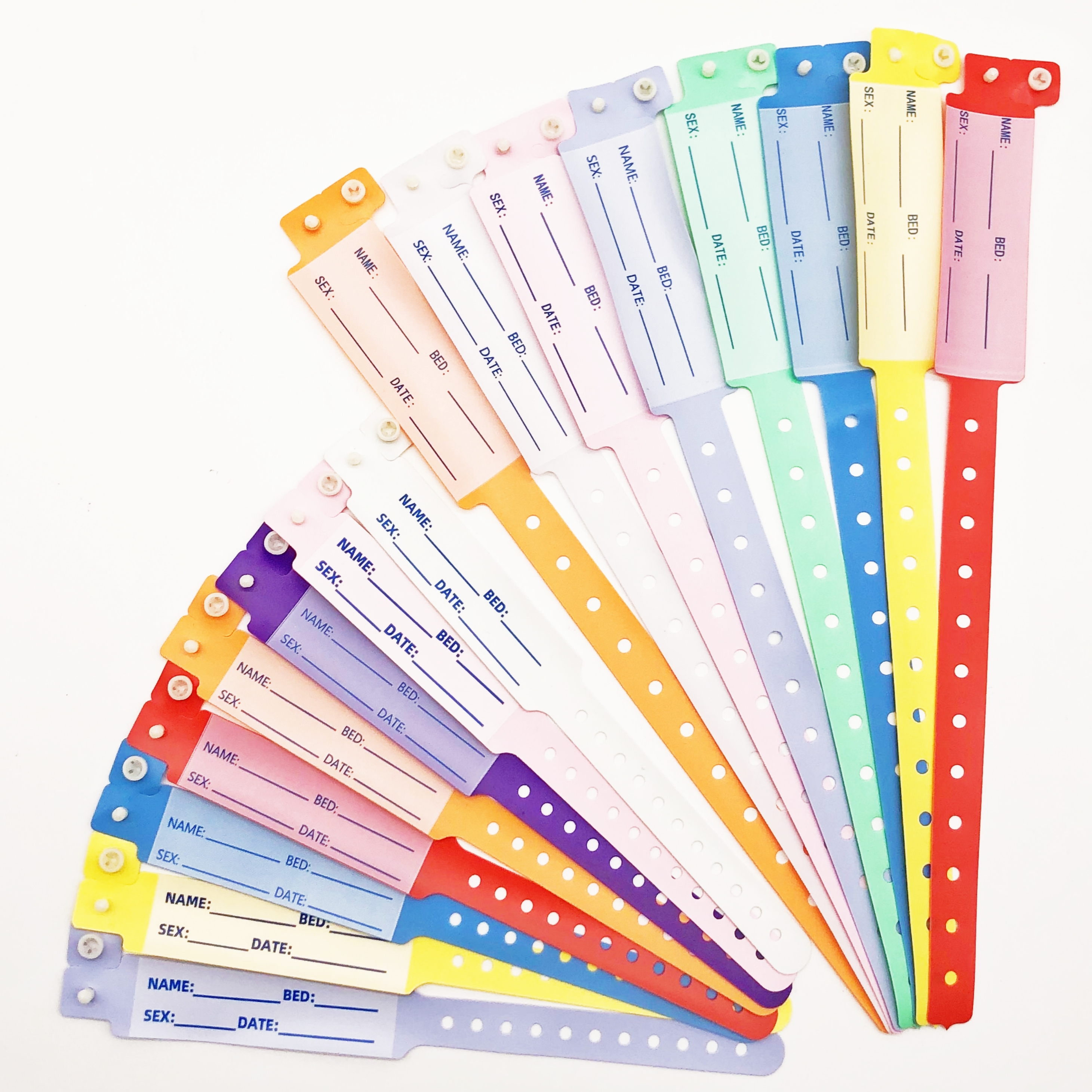 A PVC patient ID wristband. PVC formats are specified where durability and comfort over a longer wearing period matter more than single-visit economy.
Beyond the clinical setting, the same manufacturing base supplies event, exhibition, ticketing, access control and member-management wristbands, including RFID formats used in logistics and warehousing. That overlap is worth knowing during procurement: material availability, print capacity and chip supply are shared across these markets, so lead-time behaviour in one segment is rarely isolated from the others.
Market Signals and What They Actually Tell Buyers
The global patient identification wristbands market was projected to reach USD 576.1 million in 2025 by Future Market Insights, published in April 2025. A separate estimate from Precedence Research places the same category at approximately USD 1.61 billion for 2025, with a forecast trajectory toward USD 3.87 billion by 2035 in the same report series. The gap is not primarily a data error; it is a definition gap. Narrower methodologies count patient identification wristbands specifically, while broader estimates include the wider identification accessory and system-integrated category.
The practical lesson for procurement is that category-level market size should never be used to compare suppliers. It measures a market, not a vendor, and it changes materially with the product definition used. Fit, documentation and continuity are more reliable selection signals.
Regional concentration is clearer than absolute size. North America held a 41% share of the category in 2025 according to Precedence Research, consistent with earlier adoption of barcode medication administration and electronic medical records in that market. Europe and Asia-Pacific follow, with European demand shaped in part by the regulatory clarification described earlier.
The supply side is a mix of large diversified vendors and specialist manufacturers. Zebra Technologies reported net sales of USD 346 million for its Asset Intelligence & Tracking segment, which includes wristbands, in the fourth quarter of 2023. PDC Healthcare, a Brady Corporation brand, holds a projected market share of 14–18% in the patient identification wristbands market according to Future Market Insights. Around those sit specialist producers, typically supplying OEM and ODM programmes, custom sizes and private-label volumes.
That structure has a direct consequence. Buyers are not choosing between a handful of interchangeable vendors. They are choosing between a large vendor’s platform integration, a mid-size brand’s catalogue, and a specialist manufacturer’s flexibility on size, material, printing and encoding. Those are different propositions, and they should be evaluated against different criteria.
Patient Identification Wristbands Compared with Traditional Identification Methods
Wristbands did not appear in a vacuum. They replaced, and in many hospitals still coexist with, older methods of tying a person to a record.
| Method | How it works | Where it is strong | Where it breaks down |
|---|---|---|---|
| Bed card or ward board | Identity is attached to the bed or room | Fast visual reference for staff on that unit | Fails the moment the patient moves, and follows the wrong person after a bed change |
| Adhesive patient label or tape | Identity is attached to a chart, specimen or device | Cheap and widely available | Depends on correct matching at the point of application; not worn by the patient |
| Verbal confirmation | Staff ask the patient to state their name and date of birth | Works well for alert, oriented, language-concordant patients | Unavailable for sedated, confused, intubated or non-verbal patients |
| Printed barcode wristband | Identifier is worn by the patient and scanned at the point of care | Machine reading removes manual transcription; travels with the patient | Requires printers, media and a scanning workflow to be in place and maintained |
| RFID wristband | Identifier is carried in a chip that is read contactlessly and can be written to | Supports tracking, access control and payment functions beyond simple identification | Higher unit cost plus readers, middleware and integration effort |
No identification method removes risk entirely, and wristbands are no exception. The limits worth stating plainly are these:
- A band is only as accurate as the data printed on it. Registration errors are reproduced faithfully on the wrist, which is why identity verification at the point of application matters as much as the band itself.
- Bands can be removed, cut or obscured. Emergency access, patient behaviour and prolonged wear all affect the band. A missing or illegible band is itself a clinical finding, not a neutral event.
- Thermal print has a finite durability window. Performance varies with media grade and environment, so print durability should be validated for the specific setting rather than assumed from a general specification.
- RFID adds infrastructure before it adds value. Readers, middleware and integration are prerequisites, not accessories.
- Blank wristbands are not classified as medical devices in the EU. Compliance responsibility follows the intended purpose that the buyer specifies, so documentation assumptions should be checked explicitly.
- Skin tolerance varies. Materials and closures should be reviewed for long-stay, elderly and paediatric patients, and an alternative format should remain available.
A supplier that cannot discuss these limits is not providing a complete specification, and a specification that omits them will surface them later in the form of reprints, replacements and procedure exceptions.
Procurement Criteria: What to Evaluate Before Standardising
Shanghai Dingba Identification Co., Ltd. is a manufacturer based in Shanghai, China, established in 2010 and specialising in the research, development, production and sales of wristbands and RFID products, with capability in both software and hardware development. Its medical wristband line is marketed as DDJOY-Medical Wristbands. The company operates a 10,000 m² manufacturing facility with an annual production capacity of 120,000,000 units, employs approximately 50+ staff supported by an R&D team of five engineers, holds ISO 9001 certification together with Alibaba and SGS on-site verification, and exports to more than 100 countries and regions, with the EU and USA among its principal markets. Those figures describe a supply base; the criteria below describe how to test whether any supply base fits a specific hospital.
- Define the intended purpose and setting first. The purpose determines the material, the durability requirement and the documentation burden — particularly in the EU, where the classification of blank wristbands follows intended purpose.
- Match material to wearing duration. Single-visit formats and long-stay formats should not be specified by the same default.
- Confirm the print or encoding method. Direct thermal, laser-printable, pre-printed and RFID constructions each impose different workflows.
- Check equipment compatibility. A thermal band and a direct thermal printer are a paired specification; RFID requires defined frequencies and reader capability.
- Validate durability against the real environment. Water, abrasion, cleaning agents and wearing duration should be tested, not assumed.
- Confirm size range and customisation. Adult, paediatric and specialty formats, plus the ability to adjust dimensions, determine whether one supplier can cover the whole estate.
- Review documentation and labelling. Certificates, declarations and current label artwork, including the ISO 15223-1 authorised representative symbol change, should be available on request.
- Ask about capacity, lead time and continuity. Standard product lead time is typically 7–10 working days, which means volume planning matters: advance production scheduling for confirmed orders, reserved monthly capacity to absorb large-volume orders, and coordinated rush production for urgent requirements are the mechanisms that protect a hospital from running short.
- Run a sample validation before standardisation. Print legibility, closure security and comfort should be assessed by the clinical staff who will wear and apply the band.
- Keep a fallback format qualified. A single approved band is a single point of failure for the identification workflow.
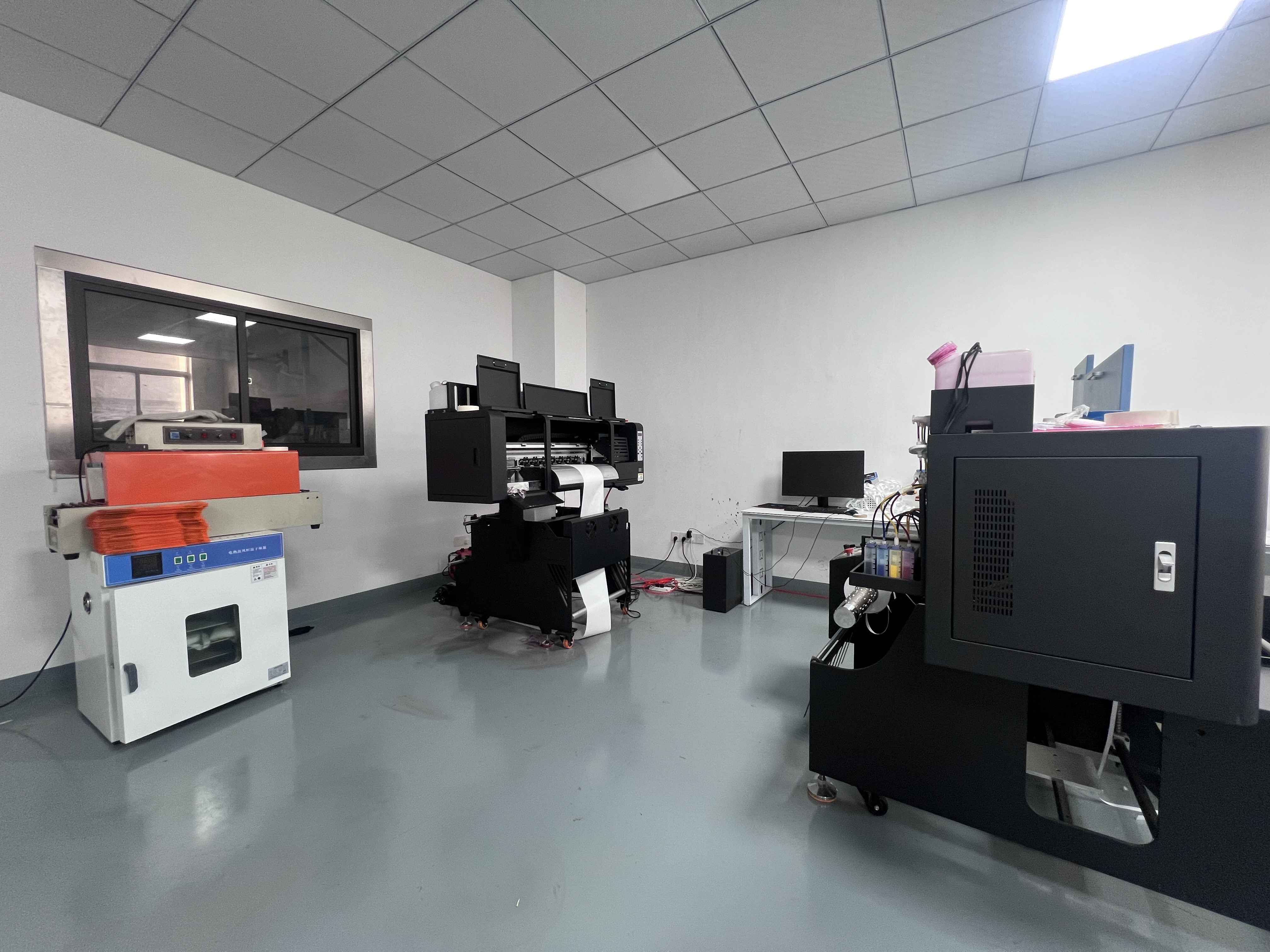 Digital printing capacity is shared across medical, event and access-control wristband programmes, which is why supply planning should account for the wider production calendar.
Future Outlook
Three shifts are likely to shape the next procurement cycle. The first is regulatory clarity. The Court of Justice of the European Union ruling on blank wristbands removes some ambiguity but transfers responsibility to the intended purpose declared by the buyer, which will push more of the discussion into tender documentation rather than product brochures. The second is integration. Identification is steadily moving from a static printed label toward a system-level function, where the band, the printer, the record and the scanning workflow are evaluated as one unit.
The third is material and format diversity. Waterproof, tear-resistant, disposable and skin-safe properties are becoming baseline expectations rather than differentiating claims, and custom sizing is increasingly the norm as providers consolidate formats across adult, paediatric, emergency and long-term care settings. For buyers, the practical implication is that total cost of ownership — media, printers, readers, reprints and procedure exceptions — will carry more weight than unit price in future evaluations.
Frequently Asked Questions
What is a patient identification wristband?
A patient identification wristband is a wearable band worn on the wrist that carries identity data or a credential. Identity information is printed onto the band surface or encoded into an embedded chip, and the band is worn so it can be read visually or electronically for fast recognition and information traceability. In practice, the same category is used for hospital patient identification, event access control, visitor management and medical information recording, with different materials suited to single-use medical scenarios or repeated-use event scenarios.
What materials are used for medical wristbands?
The main materials are thermal-sensitive synthetic paper for direct thermal printing, PVC for durable and waterproof formats, Tyvek for lightweight disposable formats, and silicone, PVC, Tyvek or paper for RFID constructions. Material choice determines wear duration, water resistance, tear resistance and comfort. For example, a thermal-sensitive synthetic paper band is disposable and water-resistant, while a PVC patient ID band is specified for durability and comfort over longer wearing periods in hospitals and elderly care institutions.
What sizes are available for patient identification wristbands?
Common sizes in this category include 260 × 25 mm for medical thermal wristbands, 250 × 25 mm and 250 × 16 mm for PVC patient ID and RFID formats, 250 × 19 mm and 250 × 25 mm for Tyvek formats, and 260 × 40 mm for PVC + tab constructions. Custom sizes are generally supported, which is what allows a single supplier to cover adult, paediatric and specialty requirements across a multi-site estate.
How is patient information printed onto a wristband?
Medical thermal wristbands use direct thermal printing, in which heat is applied to thermal-sensitive synthetic paper so the media darkens without ink or ribbon, producing a clear print of patient information. The matched equipment for this application is a direct thermal printer, and bands can be produced on demand at admission from data already held in the patient record system. Other formats, such as PVC and Tyvek bands, use conventional printing methods during production.
Are blank patient wristbands classified as medical devices in the European Union?
No. In July 2026 the Court of Justice of the European Union ruled in Case C-427/24 that blank patient wristbands are not classified as medical devices under EU MDR 2017/745. The classification depends on intended purpose, so a blank identification consumable is treated differently from a product whose intended purpose is medical. Separately, ISO 15223-1:2021 Amendment 1 (2025) changed the authorised representative symbol from “EC REP” to “EU-REP”, which affects label artwork for products shipped into the European Union.
What are the limitations of wristband-based patient identification?
A wristband is only as accurate as the data printed on it, so registration errors are carried forward faithfully. Bands can be removed by patients, cut during emergency access or become difficult to read after prolonged exposure. Thermal print durability varies with media grade and environment, and should be validated for the specific setting. RFID formats require readers, middleware and integration before delivering value, at a higher unit cost than printed bands. Blank wristbands are not classified as medical devices in the EU, so compliance responsibility follows the intended purpose declared by the buyer.
Further background on the manufacturer’s wristband and RFID portfolio, including medical thermal wristbands, is available at ddlf.com. A downloadable company brochure is available here: Shanghai Dingba Identification company brochure (PDF).
This reference is intended for procurement, clinical engineering and supply-chain readers evaluating patient identification formats. Product specifications cited above reflect the manufacturer’s published data; hospitals should validate material, print durability and encoding choices against their own clinical environment before standardising.
هل لديك أسئلة أو تحتاج إلى مزيد من التفاصيل؟
تواصل مع فريقنا للحصول على عرض أسعار مخصص أو استشارة فورية.
طلب عرض أسعار
املأ النموذج أدناه وسيتواصل معك فريقنا بعرض مقترح مخصص.
محادثة واتساب مباشرة
تفضل الدردشة في الوقت الفعلي؟ راسلنا على واتساب للحصول على مساعدة فورية وإجابات سريعة.
- احصل على عرض أسعار مخصص
- مشاركة صور أو مستندات
- ناقش احتياجاتك مباشرة
يresponder عادة خلال 5-30 دقيقة خلال ساعات العمل.