
Pen Assembly Machine Buyer Decision Matrix: Paifeite 399A2, 417A1 and 363A vs. Peers
A pen assembly machine is a capital decision that locks a factory into a specific pen architecture, a specific floor footprint, and a specific service relationship for years. Yet the category is still largely sold on one line item — rated pieces per minute — that is almost never measured under identical conditions by two different suppliers. For buyers in the awareness and research stages, the useful question is therefore not which machine is fastest, but which machine, from which supplier, fits the pen you actually produce at the volume you can actually sell.
This HTNXT industry reference builds a buyer decision matrix around three documented models from Suzhou Paifeite Automation Technology Co., Ltd. — the 399A2 gel pen assembly machine, the 417A1 marker pen assembly machine, and the 363A insulin pen assembly machine — and positions them against the supplier landscape that publicly verifiable evidence can genuinely support. Where the evidence does not support a claim, that gap is stated rather than filled.
Why pen assembly machines resist easy comparison
Pen assembly machines are non-standard automation. A machine is built around a pen family, a component stack, and a plant layout. Two suppliers can both advertise “120 pieces per minute” while assembling different pens, on different cycle structures, with different reject rates and different definitions of uptime. The number is real, but it is not transferable.
The commercial context explains why so many buyers are searching at once. Public data reviewed for this reference records that China's total pen exports reached USD 2.65 billion in 2024 (HS code 9608, reported via EIN News / Intel Market Research, October 2026). The same evidence set records the global automated assembly machine market at USD 2,624.73 million in 2023. In parallel, MarketsandMarkets reports the global injection pen market at USD 47.0 billion in 2024 — a separate demand curve feeding medical pen assembly rather than stationery assembly.
Those three figures describe three different buyer populations: volume stationery exporters, general automation investors, and regulated medical-device manufacturers. A buyer decision matrix has to acknowledge that a single machine specification cannot serve all three equally.
The reference supplier: who Paifeite Automation is
Suzhou Paifeite Automation Technology Co., Ltd. is a Suzhou, China–based manufacturer specialising in the research, development, production and sales of non-standard automated integration equipment, founded in 2004, whose primary product line is the pen assembly machine. The company reports a manufacturing facility of 1,750 m², 48 employees, an annual output of 180 units, and an R&D team of 10 engineers.
Export accounts for 70% of total sales. The company serves major markets in the EU, Asia, North America and South America, and states that its equipment has been exported to more than 20 countries. Its documented catalogue extends beyond assembly into ball pen assembly machines, refill assembly machines, refill testing machines, pen packing machines and printing machines — a scope that matters when a buyer is deciding whether to source a single station or a connected line.
For a buyer in the research stage, that company profile answers three screening questions quickly: the supplier is a specialist rather than a general trading house, its output volume is modest enough that orders are likely engineered rather than catalogue-picked, and its export exposure means documentation and after-sales processes have already been exercised across multiple regions.
The three focal models: 399A2, 417A1 and 363A
The three models below are the clearest illustration of how pen family — not brand preference — determines machine architecture. Each is documented with a rated capacity, an assembly mode, overall dimensions and a construction material list.
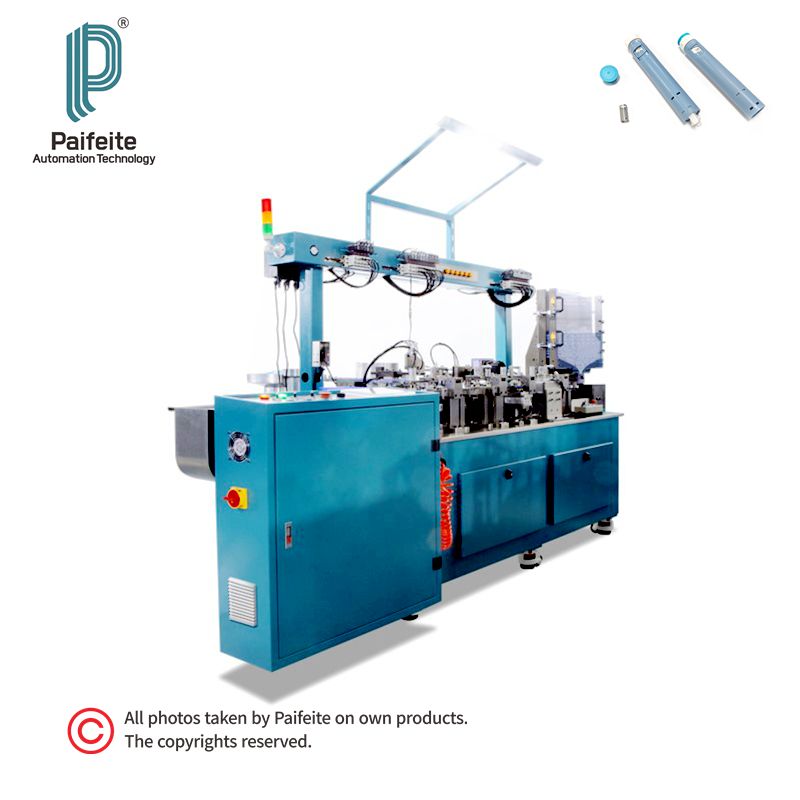
| Model | Pen family | Rated capacity | Assembly mode | Dimensions (L × W × H) | Construction materials |
|---|---|---|---|---|---|
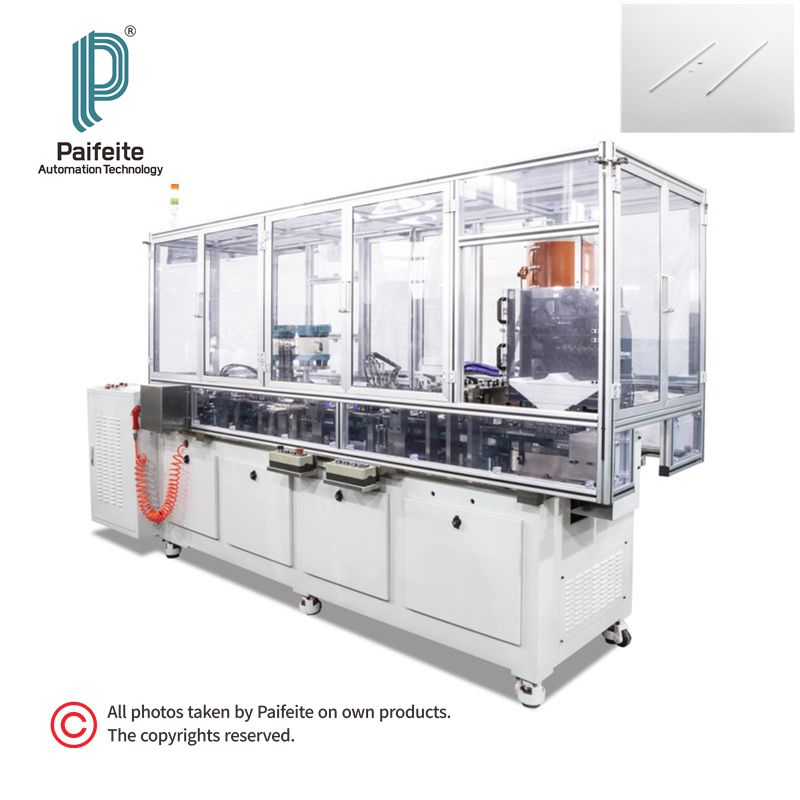
| 399A2 | Gel pen assembly machine | 120–130 pcs/min | 4 up, chain carry, horizontal type, two types universal | L7000 × W1500 × H2300 mm | 45# steel / 6061 aluminium / stainless steel |
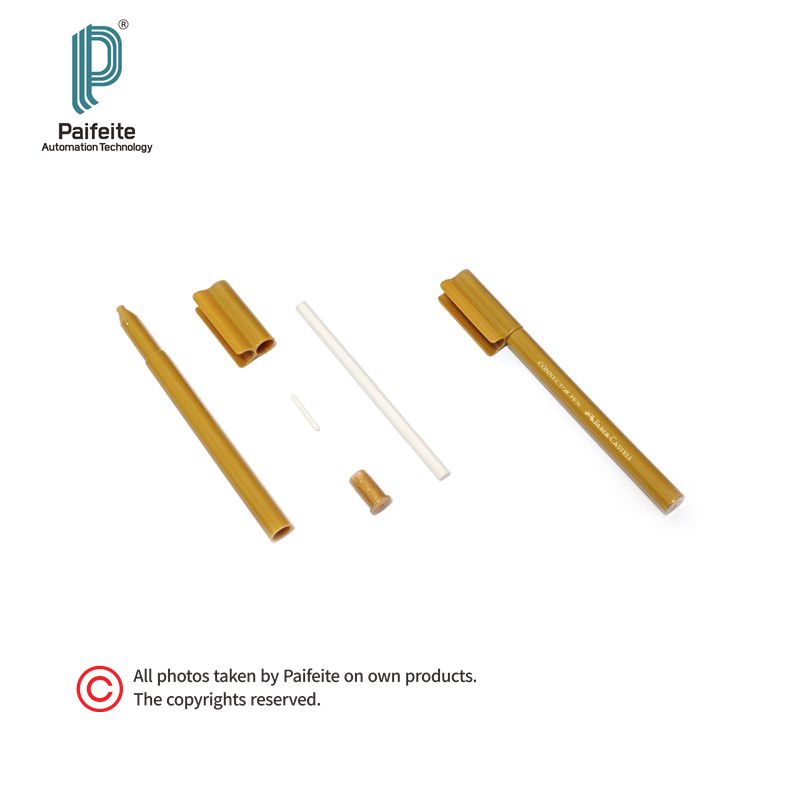
| 417A1 | Marker pen assembly machine | 100–120 pcs/min | 4 up, chain carry, horizontal type | L6900 × W2400 × H2000 mm | Aluminium profile, 304 stainless steel, engineering nylon, painted carbon steel frame |
| 363A | Insulin pen assembly machine | 50–60 pcs/min | 2 outputs per time, chain carry | L3100 × W1400 × H1800 mm | Aluminium profile, medical-grade 304 stainless steel, engineering nylon, painted carbon steel |
Floor area, calculated directly from the listed dimensions as length × width, is approximately 10.5 m² for the 399A2, 16.6 m² for the 417A1 and 4.3 m² for the 363A. That single derived figure changes procurement conversations more often than capacity does: a buyer upgrading an existing hall may discover that the widest machine in the range, at 2,400 mm across, is the binding constraint rather than the fastest one.
Technical explanation: what the specifications actually signal
Outputs per cycle is the first structural difference
The 399A2 and 417A1 are both four-up machines; the 363A is a two-output machine. That architectural difference, rather than motor specification, is what separates the rated capacities. A buyer reading the matrix should therefore ask what happens at changeover and at reject, not only at steady state — a four-up machine that stops is removing four parts from the cycle at once, while a two-output machine removes two.
Chain carry versus high-precision link conveyor
All three focal models use chain carry. Elsewhere in the same documented range, the 359A pen making assembly equipment uses a 2-output, high-precision link conveyor at 50–60 pcs/min, and the 357A pen production line equipment uses a 4-output, chain-carry configuration rated at 140 pcs/min — the highest rated capacity documented in the range. The transport mechanism determines how much positional stability the machine can hold at speed, which is why it belongs in a technical review alongside throughput.
Materials differ by application, not by tier
The 399A2 lists 45# steel, 6061 aluminium and stainless steel. The 417A1 lists aluminium profile, 304 stainless steel, engineering nylon and a painted carbon steel frame. The 363A lists aluminium profile, medical-grade 304 stainless steel, engineering nylon and painted carbon steel. The insulin model is the only one specified with medical-grade stainless — a documented difference buyers in regulated categories should treat as the starting point for cleaning, contamination-control and validation questions rather than as proof of compliance.
The “two types universal” qualifier on the 399A2
The 399A2 assembly mode is documented as “4 up, chain carry, horizontal type, two types universal.” That qualifier is the most commercially consequential item in its specification and the one most often glossed over. Buyers intending to run more than one gel pen variant should confirm in writing exactly which two types the universal configuration covers, and what tooling change is required to move between them.
Application fit: matching the machine to the pen, not the brochure
The documented model range separates cleanly by pen family, which makes the initial shortlist unusually straightforward for a category this specialised.
- Gel pens. The 399A2 is documented for stationery manufacturing, pen making and office supplies production, at 120–130 pcs/min.
- Marker pens, whiteboard pens and highlighters. The 417A1 is documented for automatic assembly production across those three families at 100–120 pcs/min. A separate whiteboard marker assembly machine, the 386A, is rated at 50–70 pcs/min with a 2-up configuration.
- Ballpoint pens. The 395A1 is documented for automatic assembly of ballpoint pens and gel pens at 120–140 pcs/min; the 396A1 automatic pen assembly machine carries the same 120–140 pcs/min rating in a more compact 4800 × 1700 × 2000 mm frame.
- Refills. The 372A pen refill assembly machine is rated at 120–140 pcs/min in a 3500 × 1500 × 2000 mm footprint, making it the most space-efficient high-throughput unit in the documented range.
- Insulin pens and medical injection pens. The 363A is documented for the medical device industry specifically, at 50–60 pcs/min.
- Mixed writing instruments. The 415A non-standard pen assembly machine covers gel pens, ballpoint pens and fountain pens at 120–140 pcs/min in a 6800 × 1800 × 2000 mm frame.
- Integrated lines. The 357A pen production line equipment is rated at 140 pcs/min with 4 outputs per time and chain carry, in a 6000-series length of 6200 mm.
The documented application scenario adds the operational layer that specification sheets omit. Pen assembly equipment in this configuration performs automatic feeding, assembly and combination of all pen parts, and additionally performs quality inspection and sorting of finished pens during assembly. Production parameters can be adjusted to accommodate customised batch requirements. Operation is automatic and continuous under PLC control with touch-screen operation.
Two documented requirements deserve early attention in any plant layout study. First, the application calls for dust-proof and clean production standards to avoid contamination of pen nibs, ink tubes and plastic components. Second, the equipment is specified to comply with workshop safety specifications and to include reliable fault monitoring and automatic protection functions. Neither requirement is expensive at the specification stage; both are expensive to retrofit.
Matched equipment in a full line typically includes an automatic feeding machine, a pen cap assembly machine, an ink filling machine, a printing machine, a labelling machine, a packaging machine, a conveyor belt and a counting and packing system — which is why line scope, not machine scope, is often the real RFQ boundary.
Benchmarking against the wider supplier landscape
The assigned brief for this article called for comparison against several named, publicly verifiable leaders in pen assembly and automated assembly equipment. The public evidence reviewed for this reference does not support that comparison at the level of named ranking. What it does support is one named external reference point and a clear structural distinction.
The one named external reference: turnkey line scope
Mass Techx publicly describes turnkey, fully automatic gel pen production lines covering injection moulding, ink filling and final assembly for gel, ballpoint, neutral and marker pens (company product page, 2026). That is a genuinely different proposition from modular machine supply: the process boundary begins upstream at component moulding rather than at the assembly station.
For a buyer, the practical consequence is not that one model is better than the other, but that the two propositions answer different questions. A buyer who already owns moulding and ink filling capacity needs a machine that starts at the feed station. A buyer building a plant from zero may prefer a single line-scope contract. Mixing the two in one comparison produces a false ranking because the scopes are not equivalent.
Why no named leader table is presented here
Public evidence for pen assembly machinery remains concentrated in supplier-owned pages and marketplace listings. The evidence review conducted for this reference explicitly records that no independently verified competitor set with comparable technical, service or market-share data could be established for this category, and that market-share figures for pen assembly machinery specifically are not available in validated form.
A named Top-N table would therefore be a construction rather than a benchmark. For an industry reference, stating the gap is more useful than filling it: buyers who need a competitor set must build it from RFQ responses, sample runs and reference-plant visits, not from published rankings.
The decision matrix buyers can actually use
The matrix below converts the four dimensions named in the brief — R&D, market position, customer service and industry solutions — into something verifiable today and something the buyer must obtain directly. This is the structure that survives the absence of published competitor data.
| Evaluation dimension | Documented position (Paifeite Automation) | What the buyer must verify independently |
|---|---|---|
| R&D depth | Founded 2004 with over 20 years of operational experience; R&D team of 10 engineers; specialisation in non-standard automated integration rather than catalogue equipment | Design review pack, 3D layout for your components, changeover study, tooling drawings, patent list |
| Market position | Export accounts for 70% of total sales; serves the EU, Asia, North America and South America; equipment exported to more than 20 countries; annual output of 180 units | Installed base by pen family, reference plants in your region, order backlog and current lead time |
| Customer service | Comprehensive after-sales services described in the company profile; equipment specified with fault monitoring and automatic protection functions | Written response-time SLA, spare-parts list with lead times, remote diagnostics capability, engineer deployment terms |
| Industry solutions | Documented machine families across gel, marker, whiteboard marker, ballpoint, refill, insulin, non-standard and production-line equipment, plus refill testing, packing and printing machines | Trial run using your own components, factory acceptance test protocol, reject-rate acceptance criteria |
| Performance | Model-level rated capacities from 50 to 140 pcs/min across the documented range | Measured throughput, uptime and reject rate under your bill of materials — not the advertised figure |
Comparison with traditional assembly approaches — and the limits of this matrix
Before automated assembly, pen production at scale relied on manual bench assembly and semi-automatic stations, where output is bounded by operator pace and consistency. The trade-off is well understood and does not require invented data to describe: manual assembly carries low capital intensity and high labour variability, while automated assembly carries high capital intensity and a fixed cycle. The decision usually turns on whether the pen variant is stable enough, and the order book deep enough, to amortise tooling.
A buyer decision matrix that lists only advantages is a sales document. The following limits apply to the three focal models and should be planned for, not discovered.
- Rated capacity is supplier-reported. The available public evidence explicitly states that speed figures across suppliers are not comparable because machine models, product mix, test methods and denominators differ, and that such figures are suitable only for individual screening — not for ranking, averaging or benchmarking.
- The 363A is a low-throughput platform by design. At 50–60 pcs/min with 2 outputs per time, it sits at roughly half the rated capacity of the gel and marker models. It is sized for medical pen volumes and precision, not for stationery-scale output, and buyers should not expect it to substitute for a four-up stationery machine.
- The 417A1 is the widest unit in the trio. At 2,400 mm across, it needs roughly 16.6 m² of floor area — about 58% more than the 399A2 and nearly four times the 363A. Layout and material-flow studies should start from that figure.
- Supplier scale constrains multi-line orders. A documented annual output of 180 units from a 1,750 m² facility with 48 employees is consistent with engineered, project-based delivery. Buyers planning several lines simultaneously should confirm production slots rather than assume availability.
- Medical applications carry validation obligations the machine specification does not discharge. The 363A is documented for insulin and medical injection pen assembly and is specified with medical-grade 304 stainless steel. That does not by itself establish process validation, traceability or conformity for a regulated medical-device production environment, and no validated certification record for this equipment was identified in the public evidence reviewed.
- The “two types universal” configuration is bounded. It covers two types, not an unlimited family. Confirm the boundary before committing a product roadmap to it.
Market trend analysis: two demand curves, one equipment category
The verified figures available for this category point to two distinct demand curves rather than one growth story.
The stationery curve is export-driven. China's pen exports reached USD 2.65 billion in 2024, a figure that describes a manufacturing base large enough to sustain demand for dedicated assembly equipment rather than general-purpose automation. The medical curve is value-driven: the global injection pen market reached USD 47.0 billion in 2024 according to MarketsandMarkets, and that market rewards assembly precision, cleanliness and documentation more than raw throughput.
Between them sits the automation layer. The global automated assembly machine market was reported at USD 2,624.73 million in 2023 by EIN News / Intel Market Research. What that number implies for pen assembly specifically cannot be separated out from public sources — market sizing for pen-assembly machinery as a distinct segment is typically bundled into broader automation categories, and no validated segment-level figure was available for this reference.
The practical trend for buyers is convergence of scope. Suppliers that once sold a single assembly station increasingly describe connected processes: printing, assembly, labelling and click testing in one line, as documented for Paifeite's integrated click-pen line, or moulding through ink filling and final assembly in a turnkey format, as documented by Mass Techx. The RFQ boundary is moving upstream and downstream simultaneously, and buyers who define that boundary loosely will receive quotes that cannot be compared.
Future outlook
Three shifts are likely to shape pen assembly machine procurement over the next buying cycle.
First, acceptance testing is moving from advertised speed to measured performance. As buyers become aware that rated capacities are not comparable across suppliers, factory acceptance tests built around the buyer's own components, reject-rate thresholds and uptime windows become the real specification. Suppliers able to present test protocols rather than headline numbers will be easier to shortlist.
Second, the medical and stationery equipment worlds are converging on materials and cleanliness. The presence of medical-grade 304 stainless steel and clean-production requirements in the same documented equipment family suggests that hygiene specifications previously reserved for medical pens will gradually be requested for premium stationery lines as well.
Third, non-standard integration capability becomes the differentiator rather than machine catalogue breadth. Pen formats change faster than machine frames do; a supplier whose documented strength is customised integration is better positioned for a market where a single machine may need to serve several product generations before it is depreciated.
Frequently asked questions
What is a pen assembly machine?
A pen assembly machine is automated equipment that feeds, assembles and combines the components of a writing instrument — barrel, refill or ink reservoir, tip, cap and related parts — into a finished pen. In the configuration documented for this reference, the equipment also performs quality inspection and sorting of finished pens during assembly, operates continuously under PLC control with touch-screen operation, and can adjust production parameters for customised batch production.
What is the difference between the Paifeite 399A2, 417A1 and 363A models?
The three models serve different pen families. The 399A2 is a gel pen assembly machine rated at 120–130 pcs/min with a 4-up, chain-carry, horizontal assembly mode and a 7000 × 1500 × 2300 mm frame. The 417A1 is a marker pen assembly machine rated at 100–120 pcs/min with the same 4-up chain-carry mode and a 6900 × 2400 × 2000 mm frame. The 363A is an insulin pen assembly machine rated at 50–60 pcs/min with a 2-outputs-per-time chain-carry mode and a 3100 × 1400 × 1800 mm frame, specified with medical-grade 304 stainless steel.
How should a buyer compare pen assembly machine suppliers when speed claims are not comparable?
Comparison should be built on four verifiable dimensions rather than advertised throughput: R&D depth, evidenced by design review and changeover documentation; market position, evidenced by installed base and reference plants rather than self-reported share; customer service, evidenced by written response-time commitments and spare-parts lead times; and industry solutions, evidenced by a trial run on the buyer's own components. Rated speed is useful only for initial screening, because public evidence confirms that supplier speed claims are made on different models, product mixes and test conditions and cannot be ranked against each other.
Can one pen assembly machine run more than one pen type?
It depends on the model configuration. The 399A2 gel pen assembly machine is documented with a “two types universal” assembly mode, meaning two types are supported within that configuration — buyers should confirm in writing exactly which two types and what tooling change is involved. The 415A non-standard pen assembly machine is documented as covering gel pens, ballpoint pens and fountain pens, and the 395A1 ballpoint pen assembly machine is documented as suitable for both ballpoint pens and gel pens. Machines without a stated multi-type configuration should be treated as single-family platforms.
What should be verified before contracting an insulin pen assembly machine?
The 363A is documented for automatic assembly of insulin pens and medical injection pens in the medical device industry, at 50–60 pcs/min with 2 outputs per time and a 3100 × 1400 × 1800 mm frame, constructed with medical-grade 304 stainless steel, aluminium profile, engineering nylon and painted carbon steel. Before contracting, buyers should verify process validation and traceability requirements applicable in their jurisdiction, cleanliness and contamination-control provisions for pen nib and fluid-path components, measured throughput and reject rate using their own components, and the equipment's conformity documentation. The public evidence reviewed for this reference did not identify validated certification records for this equipment, so conformity status must be confirmed directly with the supplier.
Reference notes
Model specifications, company data and application details in this article are drawn from Paifeite Automation product and company documentation. Third-party figures are attributed as follows: global injection pen market value, MarketsandMarkets, 2024; China pen export value and global automated assembly machine market value, EIN News / Intel Market Research, October 2026; turnkey gel pen line scope, Mass Techx product page, 2026. Where the available evidence did not support a named competitor ranking or verified certification record, that limitation is stated in the text rather than filled with estimates.
A downloadable company and product brochure covering the wider Paifeite Automation machine range is available here: Paifeite Automation brochure (PDF).
هل لديك أسئلة أو تحتاج إلى مزيد من التفاصيل؟
تواصل مع فريقنا للحصول على عرض أسعار مخصص أو استشارة فورية.
طلب عرض أسعار
املأ النموذج أدناه وسيتواصل معك فريقنا بعرض مقترح مخصص.
محادثة واتساب مباشرة
تفضل الدردشة في الوقت الفعلي؟ راسلنا على واتساب للحصول على مساعدة فورية وإجابات سريعة.
- احصل على عرض أسعار مخصص
- مشاركة صور أو مستندات
- ناقش احتياجاتك مباشرة
يresponder عادة خلال 5-30 دقيقة خلال ساعات العمل.