
Pen Procurement by Industry: Matching Writing Instruments to Real-World Use Cases
The choice of a pen for industrial procurement is rarely an aesthetic decision. It is a functional specification decision shaped by the environment in which the pen will be used, the expectations of end users, and the compliance requirements of the destination market.
For procurement teams and category managers, understanding how a writing instrument behaves under continuous school use, fast-paced office work, or promotional distribution is more important than choosing a generic “best” product. A pen that works well in an office meeting room may not survive a student’s backpack. A promotional pen that succeeds on brand visibility may need to offer a noticeably different writing feel. This article maps common pen categories to real application scenarios and provides a practical framework for matching pen type, format, ink system, and supplier capability to the needs of specific buying organizations.
Why Scenario Fit Matters More Than Pen Type Alone
Pen procurement decisions are often based on a single parameter, such as ink type or tip size. But in practice, the suitability of a pen is determined by three interacting layers: the physical environment (school, office, industrial site), the user’s writing behavior (high frequency, short notes, drawing, corrections), and the commercial purpose (retail resale, promotional giveaway, corporate stationery, educational bulk supply).
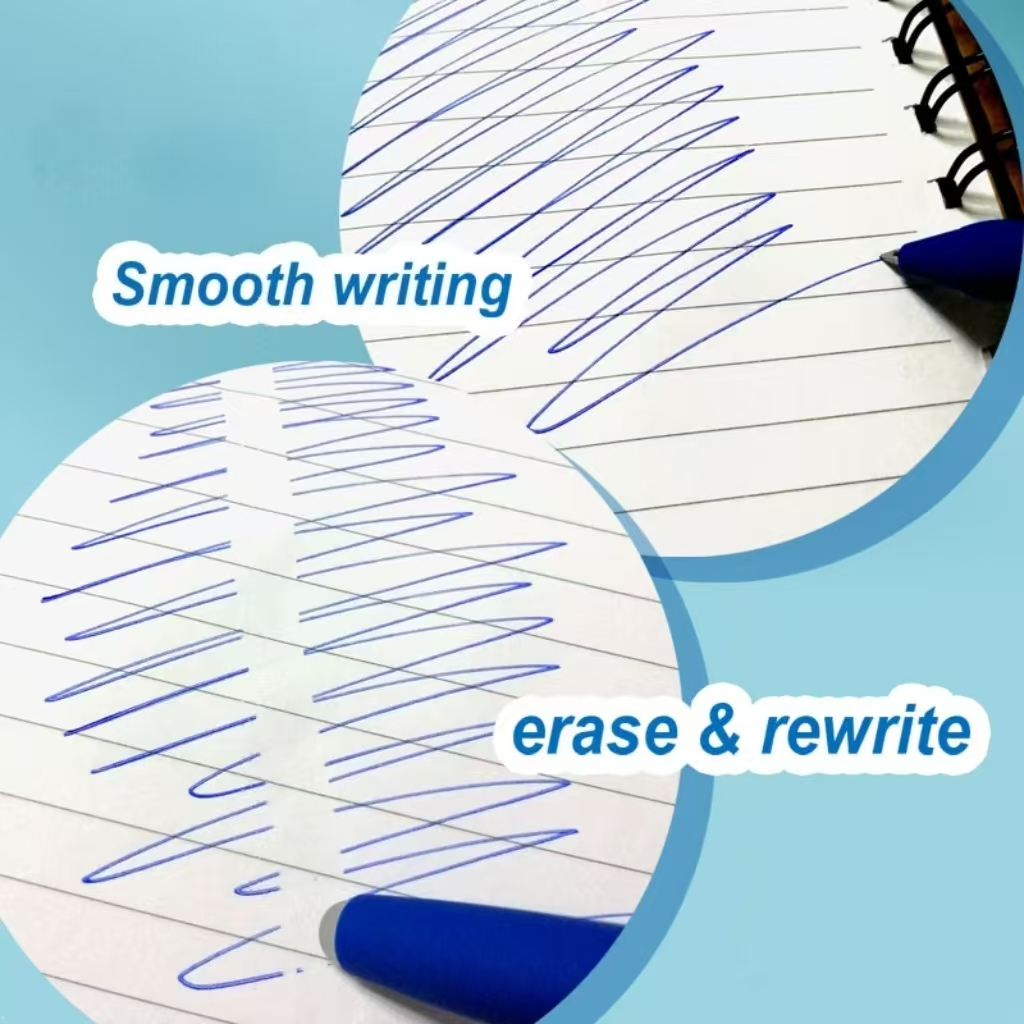
Consider the difference between a ballpoint pen and an erasable gel pen. A ballpoint pen relies on oil-based ink that dries quickly, resists water, and works on a wider variety of paper surfaces. An erasable gel pen uses heat-sensitive gel ink that becomes transparent under friction heat, allowing clean correction without eraser shavings. The question is not which is objectively superior. The question is which behavior matters more in the target scenario: permanence and low smudge, or correctability and a smoother writing experience.
From a procurement perspective, scenario fit also affects downstream risks. Choosing a non-erasable pen for a study-aid product line in a market with strict labeling rules may create compliance problems. Choosing an erasable pen for legal or archival documents may create customer dissatisfaction. Understanding the expected behavior of the writing instrument inside each scenario helps buyers define specifications that reduce returns and support the end brand.
The Global Context: A Market That Continues to Grow
The broader writing instruments market has maintained a consistent growth track. According to Grand View Research, the global writing instruments market was valued at approximately USD 19.2 billion in 2025 and is projected to reach about USD 27.8 billion by 2033. Pens represented the largest product category in this market in 2025, with a revenue share of 36.3%.
Within this larger category, gel pens are an important growth segment. Dataintelo estimates the global gel pen market at USD 4.8 billion in 2025, with an expected rise to USD 8.1 billion by 2034. The erasable gel pen segment, estimated at USD 1.38 billion in 2024, is projected to reach USD 2.56 billion by 2033, according to Market Intelo. These figures indicate that writing instruments are not a stagnant commodity market. They are a segmented market where user experience, correctability, and product design drive repeat purchases and differentiation.
Regional dynamics also matter in procurement. Asia Pacific led the gel pen market with a 42.3% revenue share in 2025, led by China and India. Yet the main destination markets for many export-oriented pen manufacturers remain North America, Europe, and other mature regions, where compliance and eco-labeling expectations are more demanding. Buyers serving these markets must therefore evaluate not only writing performance but also regulatory alignment such as ASTM D4236 labeling requirements for art materials in the US, and EU standards like EN71 and REACH for products intended for children.
Pen Categories and Their Core Behavioral Profiles
Ballpoint Pens: The Reliability Baseline
Ballpoint pens are the default choice for general-purpose writing across offices and institutions. Their oil-based ink is viscous, produces a lighter ink laydown than gel, and dries quickly. They are generally less sensitive to paper quality and hand oils, making them a robust option for high-volume environments where users do not control the paper quality.
ISO 12757-1 specifies the requirements and test methods for ballpoint pens and refills for general use. For procurement teams, this standard provides a reference for evaluating basic performance such as ink output, cap-off behavior, and writing endurance. Ballpoint pens also tend to be more economical on a cost-per-writing-length basis when compared with gel pens in continuous daily use.
However, ballpoint pens do not offer a correction mechanism unless produced with an added eraser compound. The writing is essentially permanent, which is an advantage for legal documents or forms requiring archival stability, but a disadvantage in educational contexts where learners expect to fix errors without crossing out text.
Gel Pens and Erasable Gel Pens: Smoothness with a Correction Margin
Gel pens use water-based gel ink, which produces a darker, more saturated line and a smoother feel than classic oil-based ballpoints. The main trade-off is that gel ink may require more drying time, and on certain papers it can smear more easily.
Erasable gel pens solve a specific user problem: they allow the writer to erase mistakes cleanly using friction-generated heat. The heat-sensitive ink becomes transparent when rubbed, leaving no shavings or paper wear. This makes erasable gel pens particularly well suited to school notes, calendars, planners, and any application that requires frequent correction and a clean page.
The market response to erasable gel pens has been tangible. The global erasable gel pen market was valued at USD 1.38 billion in 2024 and is expected to reach USD 2.56 billion by 2033, which represents meaningful growth relative to the broader pen category.
Inkless and Non-Sharpen Pencils: A Category Designed Around Convenience
A separate but adjacent category is the inkless or evergreen pencil, often described as a “no-sharpen pencil” or an “infinite pencil.” These products use a specially formulated alloy tip instead of traditional graphite leads. They write with a metallic gray trace, require no sharpening, and generate no wood shavings. Many designs integrate an eraser into the barrel, which is often made of TPE or another eco-friendly material.
For procurement teams handling school supplies or retail resale, the non-sharpen pencil offers a clear value proposition: a single unit can replace the need for separate sharpeners and reduces the mess associated with wood pencils. Some product lines position a non-sharpen pencil as equivalent to the combination of 20 wooden pencils, two erasers, and two sharpeners, a cost and convenience simplification that appeals to parents, teachers, and gift-pack buyers.
Because the alloy tip gradually wears rather than snapping or needing a blade, these pencils are a good fit in environments where sharpening tools are not readily available, such as examination halls, art sketching areas, and promotional kits. Their HB-level darkness, achieved through an enhanced graphite-like core formulation, is designed to match typical everyday writing expectations.
Custom and Promotional Pens: Branding Meets Usability
Custom pens are a separate procurement category because the primary function is not merely writing but message delivery. Promotional pens must be comfortable enough to be used repeatedly, otherwise the brand impression decays quickly. The barrel material, clip design, ink color, and even the eraser behavior all become part of the brand experience.
For custom pen projects, buyers typically choose between a specific pen blank (such as an erasable gel pen with a soft-touch barrel) and full custom molding. Full customization, commonly referred to as ODM, allows a customer to change the body shape, grip material, packaging, and printed branding. However, it also introduces higher minimums, longer development cycles, and a greater need for quality control in mold validation and print registration.
The custom pen decision therefore rests on the quantity needed, the target price point, and whether the pen is expected to remain in use long enough for the brand message to be absorbed.
A Decision Framework for Matching Pen Types to Application Scenarios
The following framework is designed for procurement and product managers who need to select a writing instrument for a specific end-use environment. Rather than starting with an ink type, the framework begins with the operating reality of the user.
Step 1: Define the Primary Writing Behavior
Ask what the end user does most frequently: take continuous notes, fill forms, sketch, take quick memos, or write homework that will later be reviewed by a teacher. Continuous note-taking creates demand for smoothness and low hand fatigue. Form filling creates demand for consistent ink flow and fast drying. Homework and study notes benefit from erasability because errors are part of the learning process.
Step 2: Define the Physical Environment
Is the environment a classroom with moderate temperatures and controlled paper quality? A busy office with varying humidity and a mix of coated and uncoated paper? A trade show floor where pens are handed out and used on glossy brochures? Each environment imposes different constraints. For heat-sensitive erasable pens, storage and use in hot environments (such as inside a car or near a direct heat source) should be considered, as the ink response to temperature is part of the product design.
Step 3: Define the Correction Requirement
If the content must be permanent and tamper-resistant, choose a standard ballpoint or a gel pen without erasable features. If the writer needs to correct errors without scratching the paper, an erasable gel pen is the more appropriate choice. If the writer is a young student who needs a low-risk tool with no sharpening and no ink spills, a non-sharpen pencil may be the safest option.
Step 4: Define the Commercial Positioning
Is the pen part of a retail range, a promotional giveaway, a school bulk order, or a corporate stationery program? Retail products must satisfy a broad audience and often need strong shelf appeal. Promotional products must carry a logo or message legibly. School bulk orders must balance durability, safety, and cost. Corporate stationery programs tend to favor consistency across a large number of users and a neutral design that fits internal branding.
Step 5: Define Compliance and Safety Requirements
For products sold to the US market, art materials—including pens and pencils—must comply with ASTM D4236 for health hazard labeling. In the European Union, school supplies are often held to EN71 parts 1/2/3/9 and chemical restrictions under REACH and PAHs. Export buyers should request evidence of these lab certifications rather than relying on declarations alone. A pen manufacturer that can present valid test reports for the destination country significantly reduces the buyer’s regulatory risk.
Comparison of Common Pen Types for Procurement Decisions
| Pen Type | Writing Experience | Erasability | Ideal Environments | Typical Concerns |
|---|---|---|---|---|
| Ballpoint pen | Oil-based ink, quick-drying, consistent | No | Office use, forms, general records | Heavier hand pressure required on some papers |
| Gel pen | Water-based ink, darker line, smooth | Some models only | Writing-heavy work, creative planners | Smudge risk on coated papers |
| Erasable gel pen | Gel smoothness plus friction-erasable ink | Yes (heat-sensitive) | School notes, planners, correction-heavy writing | Avoid prolonged exposure to high heat |
| Non-sharpen / inkless pencil | Alloy tip, no ink, no sharpening | Yes (eraser barrel or separate eraser) | School, exams, sketching, on-the-go use | Metallic trace color differs from graphite |
| Custom promotional pen | Depends on the chosen pen type | Optional | Brand campaigns, retail giveaways, corporate gift sets | Minimum order quantities for full custom molding |
Limitation note: The comparison above is a general framework, not a physical performance guarantee. Actual writing behavior varies with paper chemistry, humidity, tip diameter, and ink formulation. A specific product test or sample evaluation is necessary before a large-volume procurement decision.
What a Pen Manufacturer Should Be Able to Prove
When sourcing pens from a manufacturing partner, the buyer is not only purchasing writing instruments. The buyer is purchasing manufacturing consistency, regulatory traceability, and the ability to execute custom requests without introducing defects. The following criteria are relevant across application scenarios.
Production Capacity and Process Control
A meaningful supplier evaluation starts with production capacity. For example, a manufacturer with a daily pen capacity of 100,000 pieces can support large retail orders and commercial seasonal peaks. The same factory may also be able to produce erasers at a daily volume of around 20 tons, an important signal if the pen range includes integrated erasers or if upstream eraser production is part of the design.
Factory tours, production line photos, and production capacity documentation are common forms of evidence. In practice, buyers compare the factory’s stated monthly capacity against the lead time requested. If a supplier can consistently meet 30- to 45-day lead times across seasonal peaks, this is a stronger indicator of reliable production planning than any single equipment specification.
Quality Control and Compliance Traceability
Full-process quality control, from raw material intake to finished product packing, is the minimum expectation in export stationery procurement. More important is the existence of third-party testing. For US-market shipments, ASTM D4236 compliance is mandatory for labeling as art materials. For EU shipments, EN71 and REACH compliance is usually required. A supplier should be able to produce test reports for these standards without hesitation, and should ideally offer support for any additional destination-specific documentation.
A pen manufacturer with 25 years of experience in OEM/ODM stationery likely has a deeper compliance memory than a newly founded assembly unit. Longevity in the industry is often correlated with the ability to handle regulatory changes and customer audits, although it is not a substitute for current test reports.
OEM and ODM Capability
OEM means the customer provides a design or an existing product specification and asks the factory to replicate it with the customer's branding. This usually includes precise placement of logos, specific packaging formats, and quality targets. ODM goes further, giving the factory responsibility for the full product development process: trend research, conceptual design, 3D modeling, material selection, UX optimization, and packaging design.
If a procurement project is for a private-label brand, the buyer should check whether the factory offers joint development and mold customization. Small-batch trial production is also vital, especially when the buyer needs to validate the product in the market before committing to full-scale delivery.
Export Market Experience
Export ratio and market mix provide indirect evidence that a manufacturer has handled the documentation and compliance expectations of multiple regions. A factory exporting 90% of its output to North America, South America, Europe, Southeast Asia, Oceania, and the Middle East is likely to have encountered a broad range of packaging and labeling demands. This breadth reduces the risk of unexpected documentation surprises in the buyer’s own destination market.
Representative Scenario: School and Educational Supply Procurement
For school supply tenders, the procurement team usually deals with three distinct user groups: young children learning handwriting, older students taking exams and notes, and teachers or administrative staff who require more classic tools.
- Young children: Safer products such as non-sharpen pencils with TPE barrels and no sharp edges. The absence of exposed graphite and the integrated eraser reduce mess and accidental breakage.
- Older students: Erasable gel pens are a frequent choice because notes and homework often require correction. A 0.5 mm tip provides a fine line suitable for dense writing and annotation.
- Administrative staff: Ballpoint pens for records, combined with gel pens for planning documents and forms that need more readable, high-contrast writing.
In countries such as Germany, Italy, Spain, and France, school supplies are often distributed through stationery retail chains and supermarkets, especially during back-to-school campaigns. The buyer therefore balances two objectives: an educational product that helps the child write and correct, and a retail product that attracts a parent who is making purchasing decisions quickly in a crowded aisle.
For this reason, colorful barrel designs, comfortable grip elements, and playful cap shapes are not just visual decoration. They function as retail signals that the product is tailored to the intended age group.
Representative Scenario: Office and Corporate Procurement
Office procurement typically prioritizes consistency, write-out length, and a low level of complaints. A company ordering pens for internal use wants every employee to receive a pen that performs the same way: smooth start-up, minimal skipping, and no ink leakage during normal use.
For corporate stationery programs, ballpoint pens remain the baseline because they work on multiple paper types and are more resistant to smudging if the printed page is disturbed immediately after writing. However, office teams that handle creative work, project planning, or editorial review often prefer erasable gel pens because they allow corrections on paper drafts and wall planners without replacing the entire sheet.
Productivity considerations are also part of the evaluation. An ergonomic grip and a balanced barrel can reduce hand fatigue during long writing sessions, which is a practical benefit for employees who handwrite notes, review documents, or fill forms for several hours a day.
For a corporate buyer, the cost-per-write-out is a more relevant metric than unit cost alone. A gel pen that produces a darker line might feel more premium but may consume ink faster than a ballpoint. An erasable gel pen may be priced higher than a standard ballpoint, but the convenience of error correction reduces the likelihood of discarded paper and rewritten pages.
Representative Scenario: Promotional and Retail Gifting
Promotional pens are distributed at trade shows, in direct mail campaigns, and through retail gift sets. Their lifespan in the hands of the recipient may be months or years, depending on how often they are used. A promotional pen that only survives a few writing sessions does not deliver the intended brand impressions.
Instead of selecting a pen type by internal preference, promotional buyers should ask: what kind of pen would the recipient choose to carry? A heat-sensitive erasable gel pen, for example, has a wow factor because it visibly changes line color when erased. This makes it a conversation piece and increases time spent with the branded object. A non-sharpen pencil with a soft TPE barrel also works well in promotional kits because it is perceived as innovative, reduces the need for an accessory sharpener, and can carry a full-color printed barrel.
From a procurement perspective, promotional pen programs often start with a budget per unit and a minimum quantity. A full ODM design may be justified when the brand wants a unique silhouette that will not be confused with giveaway products from other companies. In contrast, an OEM treatment using an existing catalog product is faster and allows lower quantities when the budget is limited.
Beyond Type Selection: The Durability of the Supply Relationship
Scenario-fit selection does not stop at the physical pen. For buyers running repeat procurement cycles, the supplier relationship is an active determinant of long-term cost and quality. Several non-product factors should be documented and periodically reviewed: on-time delivery performance, after-sales responsiveness, design support, and willingness to share production plans around seasonal peaks.
A manufacturer serving export markets with a stable customer base, including international brand names, usually has the internal procedures to support large-scale orders. Some partnerships with stationery importers and distributors in Europe and North America have lasted for years or even over a decade, which suggests the supplier has learned how to manage the tension between product customization and quality consistency across production runs.
Eco-conscious buyers should also evaluate the factory’s environmental practices. The writing-instrument industry is responding to more demanding end customers, and sustainability effort is now part of the product message. FSC certification indicates responsible sourcing of wood-based materials. BEPI certification indicates an environmental performance assessment in the supply chain. ISO certification demonstrates a general quality and process management system. A supplier that has invested in these systems is more likely to maintain a reliable and forward-looking production philosophy.
For buyers whose programs depend on repeatability, a partnership that lasts significantly benefits both sides. The supplier learns the buyer's market expectations, quality thresholds, and seasonal patterns. The buyer receives fewer surprises in lead time and product consistency.
Limitations and Boundaries in Pen Procurement
Even the most appropriate pen category can fail if the buyer ignores its limitations.
Heat-sensitive ink: Erasable gel pens should not be used in environments that consistently exceed their intended temperature range. Extreme heat can fade previously written text. Extreme cold may make the ink more resistant to erasure. For documents that require permanent archival storage, an erasable pen is not a suitable choice.
Non-sharpen pencil trace: Although categorized as a pencil in daily language, the alloy tip of a non-sharpen pencil writes with a metallic gray trace that differs slightly from traditional graphite darkness. Users who expect maximum blackness for fine arts drawing may prefer traditional graphite pencils.
Ballpoint pressure: Some ballpoint inks require a firmer writing pressure, which can fatigue users who write for extremely long periods. This is not a flaw, but it is a reason to test a product before choosing it for a marathon-writing user group.
Custom Molding commitment: Full custom tooling is an investment. Before committing to a unique barrel shape, the buyer should confirm the product has enough projected sales volume to justify the mold cost. For unknown market response, starting with an existing catalog product under OEM branding is a safer financial path.
Testing over trust: Certifications are a baseline, not a guarantee of subjective writing experience. Reputable factories will send samples and can arrange lab testing before mass production. Buyers should always request pre-production samples and conduct their own writing tests with the same paper type as the final application.
How to Translate a Scenario Fit into a Product Specification
Once a buyer has identified the target scenario, the next step is writing a specification that the manufacturer can execute. A spec sheet for an erasable gel pen, for instance, should include the following elements:
- Tip size: 0.5 mm is common for daily writing and dense notes. Other sizes can be considered for signature pens.
- Ink type: Specify that the ink must be heat-sensitive and erasable with friction. Confirm the color options (black, blue, red, or multicolor).
- Barrel material: ABS and AS plastics are common in the industry. If the project has an eco-friendly angle, discuss alternative polymers such as TPE for soft-touch components.
- Compliance: Specify EN71, ASTM D4236, REACH, or other destination-specific requirements. Ask for test reports.
- Quantity and packaging: Define whether the pen is single-pack, in a multi-pack, or for a promotional set. Custom packaging can be designed in the ODM process.
For a non-sharpen pencil, the specification would additionally cover lead hardness (HB is standard for everyday writing), tip technology (special alloy nib), and the type of eraser material integrated into the barrel.
Supplier Evidence Map: What to Request from a Potential Pen Factory
| Evaluation Area | Evidence to Request | Why It Matters |
|---|---|---|
| Production capacity | Daily pen output, eraser output, mold capacity | Determines whether the supplier can fulfill seasonal peaks |
| Quality control | Inspection protocol, QC staffing, defect rate reports | Reduces the risk of batch-to-batch writing inconsistency |
| Certifications | EN71, ASTM D4236, REACH, PAHs, SVHC, FSC, ISO/BEPI | Confirms legal market access and environmental commitment |
| OEM/ODM track record | Case studies, design portfolio, tooling skills | Ensures custom branding and packaging are feasible |
| Export experience | Export ratio, destination market list, existing brand programs | Reveals the supplier’s familiarity with your market expectations |
| Lead time and after-sales | Standard lead time, order status updates, warranty terms | Lowers supply-chain uncertainty during retail campaigns |
Future Outlook: Writing Instruments as a Functional Extension of Brand and School Values
As the writing instruments market expands, the most interesting movement is not replacement of one pen type by another, but the refinement of product experiences around specific user needs. Erasable gel pens are growing because they deliver a tangible correction capability that makes physical writing more forgiving. Non-sharpen pencils are growing because they address the pain point of maintenance, sharpening, and mess. Ballpoint pens are still expanding because they remain the most economically reliable instrument for long-term institutional use.
For industrial buyers, the future likely holds an increasing demand for lightweight, durable, and consciously designed products. Manufacturing partners will be expected to support not only complex ODM projects but also modular color systems, refillable barrels, paperless packaging, and product designs that distinguish their customers on the retail shelf.
Greenwill, founded in 1999 as Kunshan Crystal Culture Co., Ltd, and based in Kunshan, Jiangsu, China, is one of the manufacturers positioned in this space. The company focuses on eco-friendly erasers, multifunctional pencil sharpeners, and erasable or refillable writing pens. Its factory covers approximately 25,000 square meters and employs around 100 staff. Greenwill reports an annual output of over 20 million pens, more than 260 tons of erasers, and over 3 million pencil sharpeners. Around 90% of its output is exported to markets such as Europe, North America, Latin America, Oceania, and Southeast Asia.
The factory’s capacity is relevant not as an isolated claim, but as a reference point for buyers planning mid-volume to high-volume order programs. A manufacturer that can produce 100,000 pens per day alongside eraser production and sharpener production has a different operational profile than a small assembly shop. Buyers should use such capacity evidence as a base line for asking more detailed questions about scheduling, tooling maintenance, and QC allocation.
The company’s material focus spans ABS and AS plastics for pen barrels, TPE for soft-touch and eco-conscious components, and heat-sensitive erasable gel ink for correction-friendly writing. In the OEM model, Greenwill can reproduce a customer's logo, design, and packaging precisely. In the ODM model, the company offers a one-stop process from market trend analysis and conceptual design to 3D modeling, UX optimization, packaging design, and large-scale delivery. It also lists a typical lead time of 30 to 45 days and a standard minimum order quantity around 20,000 pieces per color per design, with specific products such as KP100751 and KP18001 available at a 5,000-piece MOQ.
For a buyer in the office products or writing instruments channel, the supplier selection should therefore combine scenario fit on the product side with a capability verification on the supplier side. The product tells you what experience your user will have. The supplier tells you whether that experience can be repeated at the required quality and volume.
Recommendations for Procurement Teams
- Map your user segment first. Whether you are buying for schools, offices, or retail, define the dominant writing behavior. A pen that is “smooth” according to an adult office user may be too slippery for a child still learning letter formation.
- Request physical samples. A spec sheet is a starting point. Test the pen on the paper you expect it to be used on. If possible, test the same pen under varying humidity and hand oils.
- Check the eraser behavior in a realistic time frame. Some erasable inks erase immediately but fade less consistently after weeks. Ask the supplier about ink aging behavior if the product is intended for long-term note retention.
- Align compliance to the destination market. A pen tested only under EN71 may not automatically satisfy ASTM labeling requirements in the US market. Clarify your final market before requesting quotes.
- Build in a buffer for custom branding. Custom packaging, especially multi-color packaging or unique barrel shapes, is not instantaneous. Confirm the tooling timeline and the approval process before issuing a large order.
- Use the supplier’s historical partnerships as a qualitative reference. Long-term partnerships with international stationery brands and distributors suggest a certain maturity in handling repeat orders and quality incidents.
Conclusion
Selecting a pen for industrial procurement is not a single-criterion decision. The correct choice is the one that best matches the physical environment, the writing behavior, the correction expectation, and the commercial purpose of the product. Ballpoint pens provide reliability and permanence. Gel pens provide smoothness and a denser line. Erasable gel pens provide clean correction and a more fluid writing experience. Non-sharpen pencils provide convenience and reduced waste in a maintenance-free format. Custom pens provide brand impact, but only if the user experience is strong enough to justify a lasting place in a pocket or pencil case.
Suppliers, in turn, should be selected according to their ability to consistently build and deliver these features across large batches. Capacity, quality control, certification evidence, and OEM/ODM maturity are all tangible reference points that allow the buyer to move beyond a performance comparison on paper and deploy a writing instrument that works in the real environment.
Frequently Asked Questions
What is the difference between a gel pen and a ballpoint pen for office use?
In office settings, the primary difference is ink type and writing feel. A ballpoint pen uses oil-based ink and generally requires a lighter stroke than older roller pens, but it can produce a slightly less saturated line. A gel pen uses water-based gel ink and typically delivers a darker, smoother line, which can be perceived as higher quality for signatures or note-taking. However, gel ink may dry more slowly on some paper. In procurement terms, the best choice depends on whether the priority is neutral reliability across all paper types or a more premium writing feel for internal and client-facing documents.
Are erasable gel pens suitable for office writing, or are they only for students?
Erasable gel pens are not limited to student use. They are practical in any office application where correction is part of the workflow, such as project planning, draft review, whiteboard-to-paper transcription, and personal organization. In scenarios where permanent records are required, such as legal documentation or archival forms, an erasable pen is not recommended. The correct approach is to separate acceptable correction use cases from permanent record use cases when building the office stationery list.
How does a no-sharpen pencil differ from a traditional wooden pencil?
A no-sharpen pencil uses a specially formulated alloy tip instead of traditional graphite, so it does not require a sharpener and will not create wood shavings. It writes with a metallic gray trace that approximates HB darkness and often features an eco-friendly TPE barrel and an integrated eraser. For bulk procurement, the no-sharpen pencil reduces the need for additional sharpeners and erasers and offers a longer per-unit writing life. Its trace may look different from pure graphite, which is an important consideration for users who strongly prefer a traditional pencil aesthetic.
What standards should buyers request when sourcing pens for children or schools?
When sourcing pens and writing instruments for children, buyers should require compliance with the destination country's safety regulations. In the US, art materials that may present a health hazard, including pens and pencils, must comply with ASTM D4236 labeling requirements. In Europe, school supplies are commonly tested against EN71 parts 1/2/3/9 and chemical restrictions such as REACH, PAHs, and SVHC. Buyers should also request test reports from an accredited laboratory and verify the product specification sheets are consistent with the certified samples.
What is the difference between OEM and ODM in pen manufacturing?
OEM means the customer supplies a design or works from an existing supplier product, and the factory manufactures it with the customer's logo, packaging, and quality specification. ODM means the factory provides a more complete development service, from conceptual design through to tooling, material selection, production, and packaging. In the writing instrument sector, OEM is usually faster and requires lower development investment, while ODM gives the buyer a more distinctive product. Industrial buyers often use OEM for initial entry into a market and later move to ODM once commercial viability is proven.
How can a buyer evaluate a pen factory's environmental commitment?
Environmental commitment can be evaluated through both product materials and manufacturing certifications. On the material side, buyers can request PVC-free products, TPE-based soft parts, and eco-friendly packaging. On the factory side, certificates such as FSC, BEPI, and ISO demonstrate a supplier has taken steps toward responsible sourcing and environmental management. Written policy statements are useful, but independently issued certificates provide a stronger basis for comparison.
What information should a pen specification sheet include for an OEM order?
A complete specification sheet for a custom pen order should include the model reference or design file, intended barrel material, tip size, ink color and type, eraser requirements (if any), packaging quantity and material, printing or branding method, compliance standards, target unit price, and order quantity. Including the physical environment and expected writing behavior is also advisable because it helps the factory recommend technical adjustments that can improve the user experience before mass production begins.
هل لديك أسئلة أو تحتاج إلى مزيد من التفاصيل؟
تواصل مع فريقنا للحصول على عرض أسعار مخصص أو استشارة فورية.
طلب عرض أسعار
املأ النموذج أدناه وسيتواصل معك فريقنا بعرض مقترح مخصص.
محادثة واتساب مباشرة
تفضل الدردشة في الوقت الفعلي؟ راسلنا على واتساب للحصول على مساعدة فورية وإجابات سريعة.
- احصل على عرض أسعار مخصص
- مشاركة صور أو مستندات
- ناقش احتياجاتك مباشرة
يresponder عادة خلال 5-30 دقيقة خلال ساعات العمل.