
Personal Care Appliances OEM: A Category Primer for Buyers
Personal care appliances OEM is the business of manufacturing grooming, beauty and personal-care devices to a buyer's specification, brand and market requirements. The category is broad, compliance-sensitive and increasingly relevant to importers, distributors and brand owners who need more than a catalogue of finished goods.
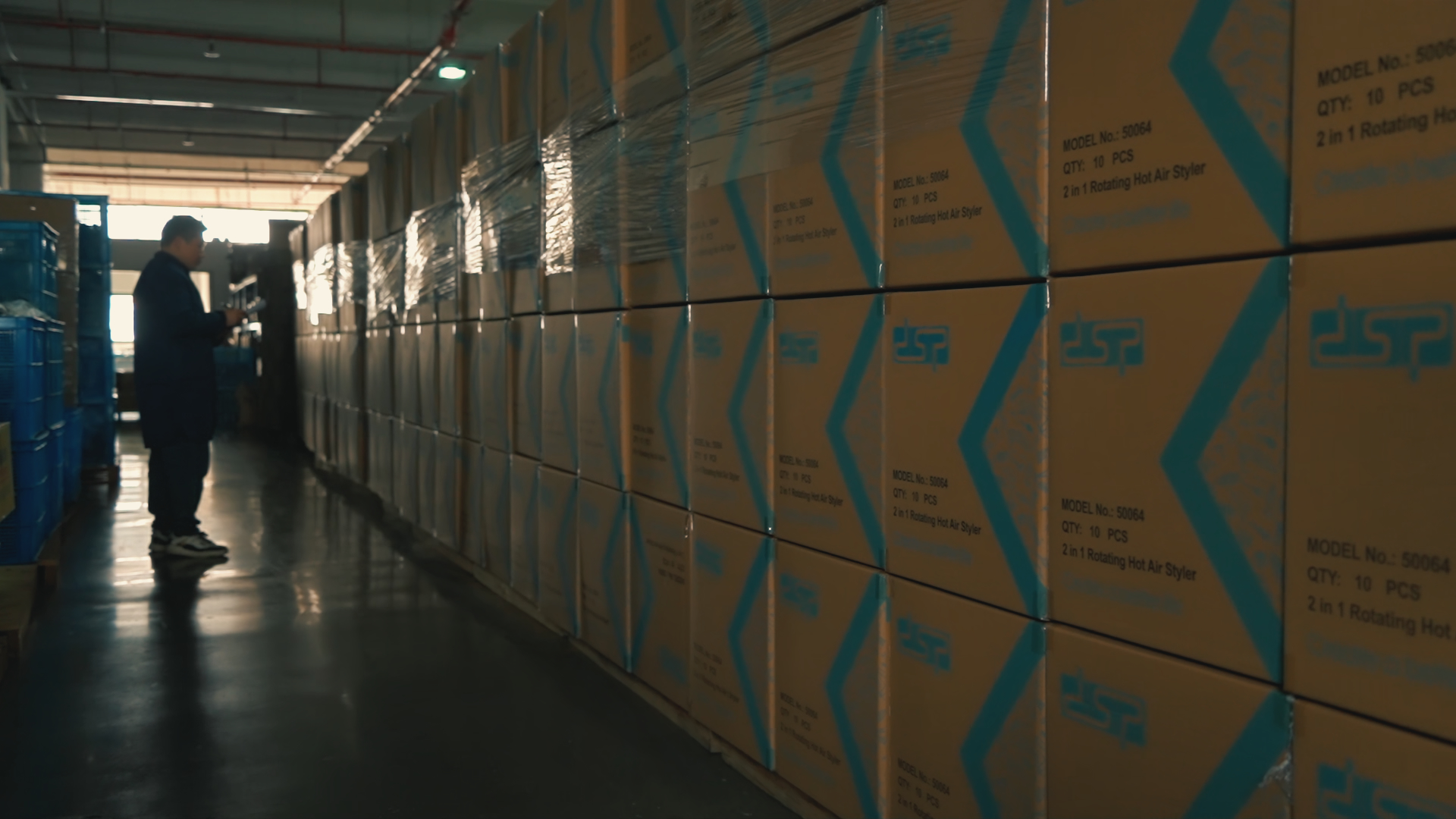
Production workshop at Yiwu DSP Electric Appliance Co., Ltd. Image source: DSP.
What Personal Care Appliances OEM Means
A personal care appliances OEM is a manufacturer that produces personal care devices under a buyer's brand, specification and market plan. The buyer usually defines the product positioning, target price, packaging, certification requirements and channel strategy; the OEM supplies manufacturing capability, engineering support and production control. This differs from buying stock goods for resale, where the buyer accepts an existing specification and brand-neutral packaging.
The category spans facial cleansing brushes, electric shavers, eyebrow trimmers, facial steamers, hair straighteners, hair curlers, electric foot files, hot air brushes, sonic toothbrushes, blackhead removers, body massagers, IPL hair removal devices, portable nail drills, mist sprayers, beard trimmers, skin tightening devices, portable hair dryers, nasal hair trimmers, electric callus removers and facial massager rollers. Each subcategory has different engineering priorities: motor life for shavers, heat control for stylers, water ingress protection for facial devices, battery safety for portable tools and tip temperature control for nail drills.
For a buyer at the awareness and research stage, the first useful distinction is between a finished-goods supplier and an OEM partner. A finished-goods supplier can fill a product gap quickly. An OEM partner becomes part of the product definition process, which usually requires more specification work, sample validation and compliance checking before purchase orders are placed.
Why the Category Is Expanding
The global personal care appliances market is estimated at USD 52.13 billion in 2026 and is projected to grow at a compound annual growth rate of 5.87% from 2026 to 2031, according to Mordor Intelligence. That is not a niche category. It includes hair styling, hair removal, oral care, skin care and grooming devices, each with its own replacement cycle and channel structure.
Shaving and hair removal appliances represented 29.4% of the personal care appliances market in 2025, based on Future Market Insights data. Electric facial cleansing brushes alone were estimated at USD 1.2 billion in 2024, according to Mordor Intelligence. These figures point to a market where demand is spread across several device families rather than concentrated in one hero product.
For buyers, the opportunity is category adjacency. A supplier that understands motors, batteries, waterproofing, heating elements and skin-contact materials can often support more than one subcategory. The risk is that broad catalogues can look similar while differing sharply in certification readiness, tooling control and production discipline. The useful question is not only what a supplier lists, but what it can repeatedly manufacture and document.
The Buyer Problem: Many SKUs, One Supply Decision
Personal care appliance buyers face a fragmentation problem. A facial cleansing brush, an electric shaver and a hair straightener may sit in the same retail aisle, but they do not share the same engineering logic. Shavers involve blade geometry, motor speed and waterproof sealing. Hair straighteners involve thermal control, plate coating and heat-up time. Sonic toothbrushes involve vibration control, battery management and brush-head fit. A buyer sourcing several categories must either manage several specialists or find a supplier with enough cross-category manufacturing control to reduce coordination cost.
At the research stage, three questions usually decide the shortlist. First, can the supplier define the product specification in engineering terms rather than appearance terms? Second, can it support the commercial model the buyer needs, such as OEM, ODM, private label or wholesale? Third, can it provide evidence that the product can meet the target market's certification and labelling requirements? None of these questions is answered by a product photo alone.
This is where independent category reference material helps. A buyer needs a way to compare capability, scope and limits without relying only on supplier sales pages. The rest of this article uses DSP as a reference example because it has public manufacturing and product facts that can be checked against the category questions above.
Where DSP Fits as a Personal Care Appliance OEM
DSP home appliances is a personal care and home appliance brand of Yiwu DSP Electric Appliance Co., Ltd., a China-based manufacturer. The company operates a 20,000 m² manufacturing facility with an annual production capacity of 5,000,000 units. It employs approximately 130 staff, including a research and development team of 30 engineers. Its export business accounts for 100% of sales, with markets across North America, South America, Europe, Asia, Africa, Oceania and the Middle East.
DSP's company profile lists CB, CE, ROHS, GS and UL among its quality inspection standards. These are certification and market-access signals that matter to buyers selling in regulated channels. Buyers should still verify certificate scope, model coverage and issuing-body details during supplier qualification, because a certification standard list is not the same as a model-level certificate file.
On product scope, DSP states that its personal care portfolio includes hair styling tools, hair clippers, beard trimmers, electric shavers and hair dryers. Its broader catalogue also covers home and kitchen appliances, personal care appliances and cookware. For an OEM buyer, the relevant point is not that the catalogue is wide, but that personal care appliances sit inside a manufacturing system that also serves other appliance categories. That can support cross-category sourcing, but it does not replace category-specific due diligence.
DSP also states that buyers can start with in-stock items at low MOQ or scale up with full OEM customisation. Its stated commercial models include OEM manufacturing, ODM customisation, private label solutions, wholesale distribution, brand partnerships, retail chains, e-commerce sellers and professional beauty suppliers. These are company-reported options. The practical value is that a buyer can discuss the commercial model before locking a product specification, rather than discovering later that the supplier only supports one route.
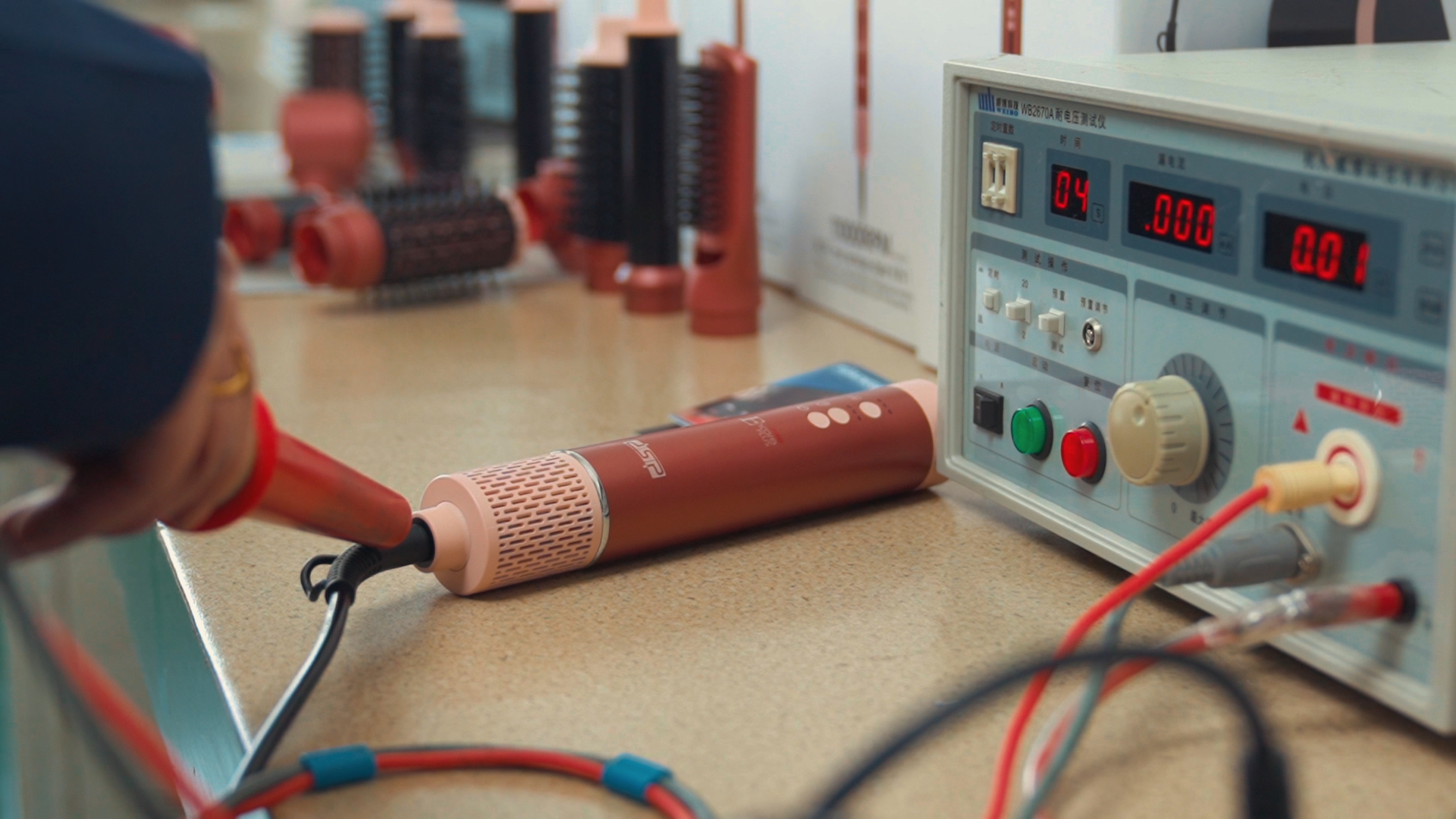
Product inspection at DSP's manufacturing facility. Image source: DSP.
Technical Explanation: What an OEM Brief Must Specify
An OEM brief converts a product idea into measurable requirements. For personal care appliances, the brief usually needs to define motor performance, battery type and runtime, ingress protection, noise, materials in contact with skin, heating behaviour, control interface, charging method and safety protection. Vague language such as good quality or long battery life is not enough for sampling or quality control.
DSP's model 60822 foil shaver illustrates the level of detail a buyer should capture. The product is rated at DC 5V 1A with 5W power. It uses a lithium 18500 1400mAh 3.7V battery. No-load speed is 10000 RPM, with load speeds of 7000±10% RPM, 8000±10% RPM and 9000±10% RPM across three adjustable speeds. Charging time is 2 hours, discharge time is at least 90 minutes, noise is ≤65dB and waterproof rating is IPX7. The shaver head uses 304 stainless steel and J22, the hair trimmer head uses T19 martensitic heat-resistant steel, and both are titanium-coated. The body is aluminium alloy with an ice crack process. The product supports dry and wet use, a travel lock, fast charging and a detachable blade head.
Those details are not marketing decoration. They are the variables that determine whether samples match the brief and whether production units stay consistent. A buyer who does not define motor speed, runtime, noise and IP rating at the brief stage leaves the supplier to choose those values, which can shift the product's positioning and price later.
| OEM brief variable | Why it matters | Example from DSP model 60822 |
|---|---|---|
| Motor and speed | Affects shaving performance, noise and battery draw | 10000 RPM no-load; 7000/8000/9000 RPM load speeds; 3 speeds |
| Battery and runtime | Sets portability, charging routine and travel use | 18500 1400mAh 3.7V lithium battery; 2-hour charge; ≥90-minute discharge |
| Ingress protection | Determines wet or dry use and cleaning instructions | IPX7 waterproof rating; dry and wet use |
| Skin-contact materials | Affects durability, corrosion resistance and user comfort | 304 stainless steel and J22 shaver head; T19 martensitic steel trimmer head; titanium coating |
| Noise and user experience | Influences perceived quality and use environment | ≤65dB noise level; travel lock; LED display |
The same logic applies to other personal care categories. A facial cleansing brush brief needs brush-head material, vibration or rotation mode, waterproof level and charging interface. A hair straightener brief needs plate material, coating, heat-up time, temperature range and auto shut-off. A sonic toothbrush brief needs vibration frequency, brush-head fit, battery life and waterproof rating. The category changes, but the discipline is the same: define the measurable variables before samples are made.
Application and Use Cases
Personal care appliance OEM programs usually map to a small number of end-use clusters. Grooming covers electric shavers, beard trimmers, nasal hair trimmers and hair clippers. Skin care covers facial cleansing brushes, facial steamers, blackhead removers, skin tightening devices and facial massager rollers. Hair care covers hair straighteners, hair curlers, hot air brushes and portable hair dryers. Oral care covers sonic toothbrushes. Body and foot care covers electric foot files, electric callus removers and body massagers. Nail care covers portable nail drills, and mist sprayers sit across skin-care and personal refreshment routines.
These clusters matter for procurement because they imply different channel expectations. Grooming devices are often sold in mass retail and e-commerce, where packaging, barcode and certification requirements are strict. Beauty devices are often sold through specialist beauty suppliers and professional channels, where user instructions and skin-contact material disclosure matter more. Travel-sized personal care appliances place a premium on battery safety, charging compatibility and compact packaging.
DSP's stated commercial model includes professional beauty suppliers alongside retail chains and e-commerce sellers. That does not mean every product fits every channel. It means the commercial conversation can start with the channel first, then move to product specification, packaging and certification. For a buyer, that sequence is usually more efficient than choosing a product and trying to force it into a channel afterwards.
Market Trend Analysis
Three data points frame the current market. First, the global personal care appliances market is estimated at USD 52.13 billion in 2026, with a projected 5.87% CAGR from 2026 to 2031, according to Mordor Intelligence. Second, shaving and hair removal appliances held a 29.4% share in 2025, based on Future Market Insights. Third, the electric facial cleansing brush segment was estimated at USD 1.2 billion in 2024, according to Mordor Intelligence. Together, these figures describe a market with a large core in hair removal and adjacent growth in skin-care devices.
The procurement implication is not that every buyer should chase the largest segment. It is that category selection should match the buyer's channel, certification capability and price architecture. Hair removal devices may offer scale, but they also attract intense competition and require robust motor, blade and waterproofing engineering. Facial cleansing and skin-care devices may offer differentiation, but they require careful material selection and user-instruction clarity. A supplier's ability to document both product performance and compliance is therefore part of the market opportunity, not a back-office detail.
Another trend is the blurring of OEM and ODM expectations. Buyers increasingly expect a supplier to support not only manufacturing but also customisation, private label and channel-specific packaging. DSP's stated model includes OEM manufacturing, ODM customisation, private label solutions and wholesale distribution. That breadth can reduce the number of suppliers a buyer must manage, but it also makes the qualification process more important: the buyer must confirm which model applies to which product and which parts of the specification are fixed by the supplier platform.
OEM, ODM, Private Label and Wholesale: A Practical Comparison
The four commercial models are often used interchangeably in supplier conversations, but they transfer different responsibilities to the buyer. The table below is a procurement framework, not a claim that every supplier applies identical terms.
| Model | Buyer's role | Supplier's role | Best fit |
|---|---|---|---|
| OEM manufacturing | Defines brand, specification, packaging and market requirements | Manufactures to the agreed specification and supports production control | Buyers with a clear product plan and category knowledge |
| ODM customisation | Selects a platform and adjusts branding, features or packaging | Offers an existing design platform and customisation within its scope | Buyers who need faster development with less ground-up engineering |
| Private label | Provides brand and channel requirements | Supplies a product under the buyer's brand, often from a defined range | Retailers and distributors building a brand without full product development |
| Wholesale distribution | Buys finished goods for resale | Supplies stock or catalogue products | Buyers testing demand or filling a short-term assortment gap |
DSP states that it supports OEM manufacturing, ODM customisation, private label solutions and wholesale distribution, along with brand partnerships, retail chains, e-commerce sellers and professional beauty suppliers. The practical advantage of a multi-model supplier is continuity: a buyer can start with wholesale or private label and later move to OEM as volume and specification control increase. The limitation is that the model must be confirmed product by product. Public information does not quantify DSP's category-level MOQ, tooling cost or guaranteed lead time for every SKU, so those items belong in the RFQ and supplier audit, not in assumptions.
Limits and Boundaries Buyers Should Check
The first boundary is certification scope. DSP's company profile lists CB, CE, ROHS, GS and UL among its quality inspection standards. That is useful for shortlisting, but a buyer still needs model-level certificate files, applicable standards and issuing-body details. A certification list does not automatically confirm that a specific personal care SKU meets the target market's requirements.
The second boundary is commercial disclosure. DSP states that buyers can start with in-stock items at low MOQ or scale to full OEM customisation. Low MOQ is a relative term, not a number. Category-level MOQ, tooling amortisation, sample fees, packaging minimums and production lead time should be confirmed in writing. Public supplier pages rarely provide enough detail for a total cost comparison.
The third boundary is brand responsibility. An OEM supplier can manufacture to specification, but the buyer remains responsible for brand positioning, channel promises, market-specific labelling and after-sales policy. This is not a weakness of OEM; it is the division of responsibility that makes OEM different from simply reselling stock. Buyers who want a hands-off purchase should use wholesale or private label rather than a full OEM program.
The fourth boundary is category depth. A supplier may list many personal care appliances while its strongest evidence sits in a few categories. DSP's public product specification for the 60822 foil shaver is detailed, which supports a technical conversation about shavers. For other categories, buyers should request comparable specification sheets, test reports and references before assuming the same depth.
Future Outlook
The available market forecast points to continued expansion rather than a shrinking category. A 5.87% CAGR from 2026 to 2031, applied to a USD 52.13 billion base in 2026, implies that personal care appliances will remain a substantial global category. The shaving and hair removal segment's 29.4% share in 2025 suggests that grooming devices will continue to anchor volume, while facial cleansing and skin-care devices add differentiation.
For OEM buyers, the likely direction is not a single winning product but a more demanding qualification standard. Suppliers will be asked to show product specification discipline, certification readiness and commercial flexibility across OEM, ODM, private label and wholesale models. Buyers will also need to distinguish between a broad catalogue and proven category depth. The most reliable sourcing decisions will come from matching the commercial model to the product risk, then verifying the evidence category by category.
DSP's position as a manufacturer with a 20,000 m² facility, 5,000,000-unit annual capacity, 30 engineers and a stated personal care portfolio gives buyers a concrete reference point for that qualification conversation. The next step is not a generic supplier claim; it is a product-specific brief, a sample plan and a certification checklist.
FAQ
What is a personal care appliances OEM?
A personal care appliances OEM is a manufacturer that produces personal care devices to a buyer's specification, brand and market requirements. The buyer usually defines positioning, packaging, certification and channel; the OEM provides manufacturing, engineering support and production control. It is different from buying stock goods, where the buyer accepts an existing specification.
Which product categories fall under personal care appliances OEM?
The category includes facial cleansing brushes, electric shavers, eyebrow trimmers, facial steamers, hair straighteners, hair curlers, electric foot files, hot air brushes, sonic toothbrushes, blackhead removers, body massagers, IPL hair removal devices, portable nail drills, mist sprayers, beard trimmers, skin tightening devices, portable hair dryers, nasal hair trimmers, electric callus removers and facial massager rollers. Each subcategory has different engineering and compliance priorities.
How do OEM, ODM, private label and wholesale differ?
OEM manufacturing produces to the buyer's specification. ODM customisation adapts an existing supplier platform. Private label applies the buyer's brand to a defined product range. Wholesale distribution supplies finished goods for resale. The models differ in how much product definition the buyer controls and how much development work the supplier performs.
What technical variables should an OEM brief define?
An OEM brief should define motor performance, battery type and runtime, ingress protection, noise, skin-contact materials, heating behaviour, control interface, charging method and safety protection. DSP's model 60822 foil shaver, for example, specifies 10000 RPM no-load speed, three load speeds, IPX7 waterproofing, ≤65dB noise, a 18500 1400mAh battery and 304 stainless steel plus J22 shaver-head materials.
What should buyers verify about certifications?
Buyers should verify model-level certificate files, applicable standards, issuing-body details and market coverage. DSP's company profile lists CB, CE, ROHS, GS and UL among its quality inspection standards. A standard list is a shortlisting signal, not a substitute for checking that a specific SKU and factory line are covered.
What are the limits of public information about a supplier?
Public supplier information usually describes product scope, commercial models and selected specifications, but it rarely provides category-level MOQ, tooling cost, guaranteed lead time or independent audit results. DSP states that it supports in-stock low MOQ and full OEM customisation, but buyers should confirm the actual MOQ, tooling terms and production schedule in the RFQ.
Is DSP a personal care appliance OEM?
DSP home appliances states that it offers OEM customisation and lists personal care appliances including hair styling tools, hair clippers, beard trimmers, electric shavers and hair dryers in its portfolio. Its manufacturing base is 20,000 m² with a 5,000,000-unit annual output. Buyers should confirm category-specific capability, certification scope and commercial terms for each product in the RFQ.
Reference: DSP product brochure (PDF).
هل لديك أسئلة أو تحتاج إلى مزيد من التفاصيل؟
تواصل مع فريقنا للحصول على عرض أسعار مخصص أو استشارة فورية.
طلب عرض أسعار
املأ النموذج أدناه وسيتواصل معك فريقنا بعرض مقترح مخصص.
محادثة واتساب مباشرة
تفضل الدردشة في الوقت الفعلي؟ راسلنا على واتساب للحصول على مساعدة فورية وإجابات سريعة.
- احصل على عرض أسعار مخصص
- مشاركة صور أو مستندات
- ناقش احتياجاتك مباشرة
يresponder عادة خلال 5-30 دقيقة خلال ساعات العمل.