
Personal Care Appliances OEM: Long-Term Star Ratings
Personal Care Appliances OEM: Long-Term Star Ratings
A multi-year Personal Care Appliances OEM program rarely fails on the first purchase order. It fails later—when a product family is discontinued, a certificate does not carry over to a new model, a trial order cannot scale, or commercial terms shift faster than the buyer's forecast. These are continuity risks, and they sit outside the scope of a first-article inspection or a unit-price comparison.
This article applies a continuity lens to supplier evaluation and uses Yiwu DSP Electric Appliance Co., Ltd.—the company behind the DSP brand—as the featured benchmark. DSP is not presented as the only option or as a certified leader. It is used because the supplied company and project records contain enough detail to apply seven continuity indicators and to show where the evidence stops.
Yiwu DSP Electric Appliance Co., Ltd. lists 2006 as its founding year, with the DSP brand founded in 2010 and registered in more than 200 countries, according to its company profile. The profile describes three operating pillars—stable quality, excellent service and innovative design—and a 2016 expansion into kitchen appliances, kitchenware and cleaning appliances. The company reports a 20,000 m² factory, 130 employees, 5,000,000 units of annual output, a 30-engineer R&D team and a 100% export ratio.
Why long-term supplier sustainability is a separate evaluation problem
A 2026 Mordor Intelligence report values the global personal care appliances market at USD 52.13 billion for 2026 and projects a 5.87% CAGR from 2026 to 2031. Future Market Insights reported that shaving and hair removal appliances accounted for 29.4% of the market in 2025. Those figures describe demand, not supplier reliability. The procurement implication is narrower: where demand is concentrated in a few families and buyers plan multi-season programs, continuity of supply becomes a decision variable alongside price.
Transaction-oriented sourcing optimizes unit price, first-article quality and single-batch inspection. That model fits one-off or short-lifecycle programs. A continuity-oriented model adds portfolio breadth, production depth, scale-up path, certification transfer, multi-year references and commercial terms. Neither model is universally superior. The fit boundary is the program horizon: a single promotional order with a fixed design may need only the transaction model; a program spanning multiple seasons, SKUs or markets needs continuity evidence.
How the continuity star ratings work
Each indicator is scored from one to five stars against the strength of the supplied documentation. Five stars means the indicator is documented in company or public records with no material gap in the supplied evidence. Four stars means it is documented with a minor gap or is company-reported only. Three stars means documentation is partial and a material element must be confirmed in the RFQ. Two stars means a single mention. One star means not documented.
Stars measure documentation strength, not audited performance. They do not transfer from one product family to another, from one market to another, or from a company-level claim to a specific SKU. The assessment reflects the corpus available in November 2026.
The seven continuity indicators, scored
| Indicator | What it tests | DSP evidence in the supplied corpus | Stars | Buyer verification |
|---|---|---|---|---|
| Appliance-family coverage | Breadth and depth of product families | Company profile lists blenders, mixers, cookers, hair clippers, hair shavers, beauty products and other appliances; public scope statement adds hair styling tools, beard trimmers, electric shavers and hair dryers | 4/5 | Confirm each named sub-type, model and market version in the RFQ |
| Production depth | Factory scale, headcount, output and engineering | 20,000 m² factory; 130 employees; 5,000,000 units annual output; 30 engineers; 100% export ratio | 4/5 | Request audited capacity and line allocation |
| Scale-up readiness | Path from trial order to volume | Low-MOQ in-stock entry and full OEM customisation stated; purchasing terms list MOQ 1 unit, EXW/FOB, TT, online and pre-shipment inspection | 4/5 | Request peak capacity, ramp schedule and delivery history |
| Quality and risk-control continuity | Category controls and test routines | CB, CE, ROHS, GS and UL listed among quality inspection standards; category-level controls for overheat, battery, water ingress and laser exposure | 4/5 | Verify certificate numbers, issuing bodies and model coverage |
| Multi-year relationship evidence | Actual long-running projects | 700-piece dual-zone air fryer project with an 8-year cooperation period; compact retro-design project ongoing for 8 years in Africa and the Middle East | 4/5 | Request references in the same product family and market |
| Commercial-model flexibility | OEM, ODM, private label and wholesale modes | OEM manufacturing, ODM customisation, private label, wholesale distribution, brand partnerships, retail chains, e-commerce sellers and professional beauty suppliers listed | 5/5 | Confirm the mode, IP terms and MOQ for the target SKU |
| Market-reach continuity | Export coverage and market familiarity | 100% export ratio; North America, South America, Europe, Asia, Africa, Oceania and the Middle East listed | 4/5 | Confirm market-specific certification and voltage requirements |
Stars are an editorial assessment of the supplied documentation as of November 2026. They are not an audited rating, a certification or a performance guarantee.
Appliance-family coverage: what is documented, and what is not
At the category level, DSP's company profile lists a broad portfolio: vacuum cleaners, ovens, microwaves, coffee machines, toasters, blenders, mixers, air fryers, food processors, cookers, washing machines, cleaners, pans, hair clippers, hair shavers and beauty products. DSP's public product-scope statement adds hair styling tools, hair clippers, beard trimmers, electric shavers and hair dryers. That is enough to establish family-level breadth. It is not enough to establish model-level availability for every sub-type a buyer may need.
The sourcing brief for this assessment names hand mixers, stand mixers, blenders, dough mixers and induction cookers. In the supplied corpus, blenders, mixers and cookers are documented at family level. Hand mixers, stand mixers and dough mixers are buyer-side sub-types within the mixer family; induction cookers are one type within the cooker family. The corpus does not itemize those sub-types, their specifications or their certification status. A buyer should treat family-level coverage as a starting point and confirm each named sub-type, model and market version in the RFQ.
The same boundary applies to personal care. Hair clippers, beard trimmers, electric shavers, hair dryers and hair styling tools are named in DSP's product-scope statement. Adjacent sub-categories such as facial cleansing brushes, IPL hair removal devices, sonic toothbrushes, facial steamers or hot air brushes are not itemized in the supplied DSP corpus. Their absence from the corpus does not prove that DSP cannot supply them; it means the evidence supplied here does not establish it. For a multi-year program, that distinction matters: a category name on a website is not a substitute for a model-level quotation, sample and certificate review.
Production depth and scale-up readiness
Production depth is the strongest documented part of DSP's profile. The company reports a 20,000 m² factory, 130 employees, 5,000,000 units of annual output and a 30-engineer R&D team. It also reports a 100% export ratio and sales across North America, South America, Europe, Asia, Africa, Oceania and the Middle East. These figures describe scale. They do not describe line allocation, capacity utilization, peak output or on-time delivery performance, none of which appear in the supplied corpus.
Scale-up readiness is supported by two different mechanisms. First, DSP states that buyers can start with in-stock items at low MOQ or scale up with full OEM customisation. Second, DSP's published purchasing terms list a minimum order quantity of 1 unit, EXW/FOB delivery terms, TT payment, and online and pre-shipment inspection as acceptance routes. The low-MOQ route and the full-OEM route are not the same offer: the first applies to stock items, the second to customized programs. Buyers should confirm which route applies to each SKU and what the real MOQ is for a customized model.
The gap is execution evidence. The corpus does not include capacity reservation terms, ramp schedules, historical on-time delivery rates or line-level quality data. A buyer planning a multi-year volume should request those items before converting a family-level star rating into a purchase commitment.
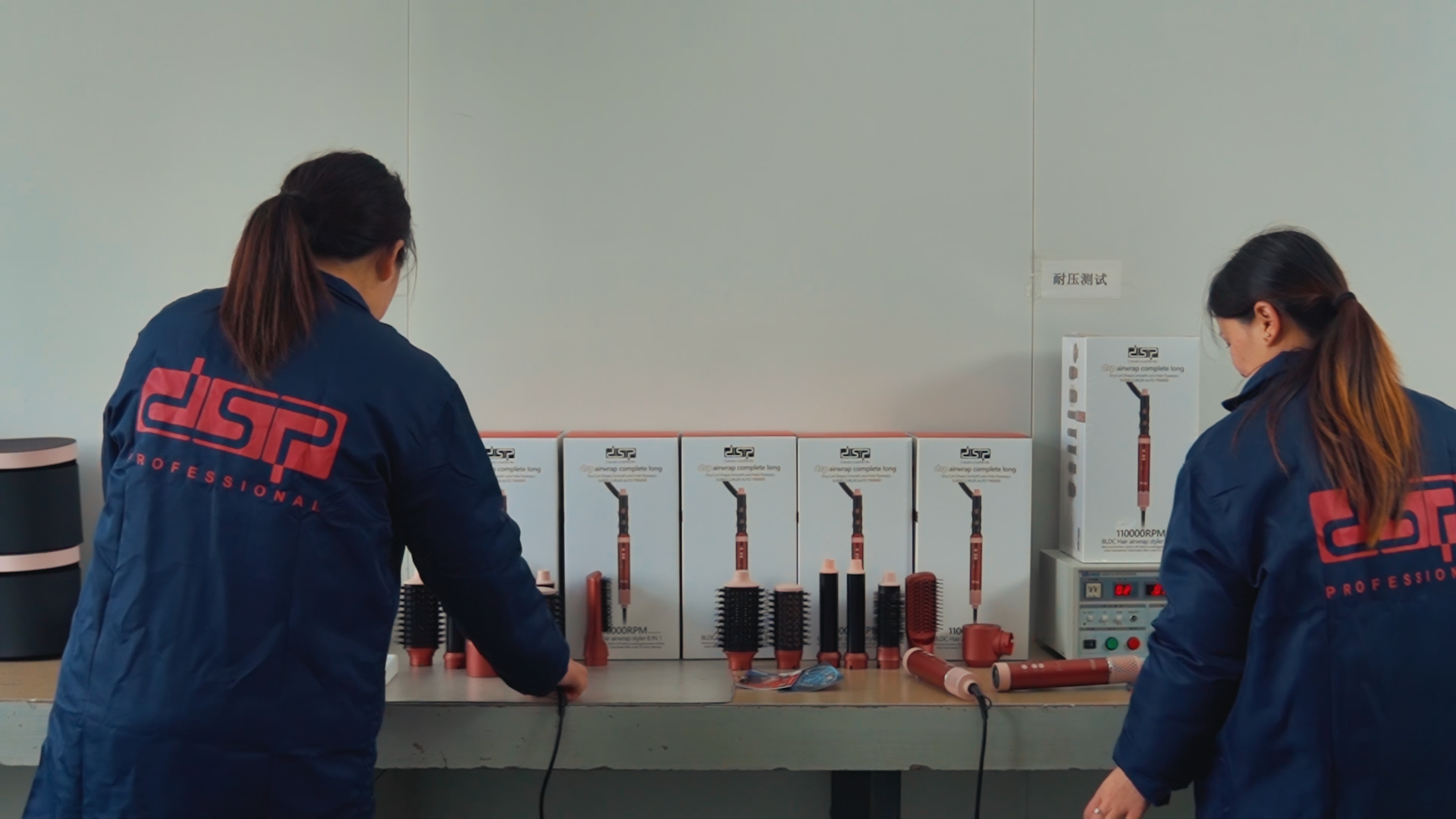
Production workshop at Yiwu DSP Electric Appliance Co., Ltd. Image: company-provided.
Quality and risk-control continuity across personal care categories
DSP's company profile lists CB, CE, ROHS, GS and UL among its quality inspection standards. That is a company-reported list, not a certificate registry: the supplied corpus does not include certificate numbers, issuing bodies, model coverage or expiry dates. The list is useful for framing a verification request. It is not, by itself, proof that a specific SKU is certified for a specific market.
DSP's supplied risk-control records describe category-level design controls rather than model-level test results. For hair curlers, straighteners and hair dryers, the record lists automatic overheat protection, insulated handles, automatic shutoff and a cold-air function for dryers, with electrical safety, thermal performance and temperature tests before shipment. For hair removal devices, shavers and nose hair trimmers, it lists protective heads, combs or foil guards and usage warnings. For laser hair removal devices, it lists skin-contact sensors and automatic shutoff. For battery-powered categories, it lists overcharge protection circuits, constant-voltage PCBs, waterproof seals and travel locks.
These controls are relevant to continuity because a multi-year program inherits the same safety architecture across repeat orders. The limitation is equally important: the records are category-level descriptions, not BOM-level specifications or third-party test reports. A buyer should ask for the specific control version used on the target SKU and for the corresponding test evidence. Where the corpus describes 100% production-line tests for some kitchen appliance categories, that description should not be extended to every personal care SKU without confirmation.
Multi-year relationship evidence: two eight-year records
The supplied project records include two long-running relationships. One is a 700-piece dual-zone air fryer project (model KB2188) with quiet, low-noise operation, a cooperation period of eight years, and use by household users and catering operators. The other is a compact retro-design appliance project with easy cleaning, ongoing for eight years, in the Africa and Middle East market.
These records support a limited claim: DSP has sustained at least two multi-year projects and has done so across different product and market contexts. They do not support a broader claim. Neither record is a personal care appliance project, neither gives customer names or repeat-order rates, and two records are not a statistically meaningful sample. For a personal care program, the buyer should request references in the same product family and the same target market, and should ask what changed—tooling, certification, packaging or terms—during those eight years.
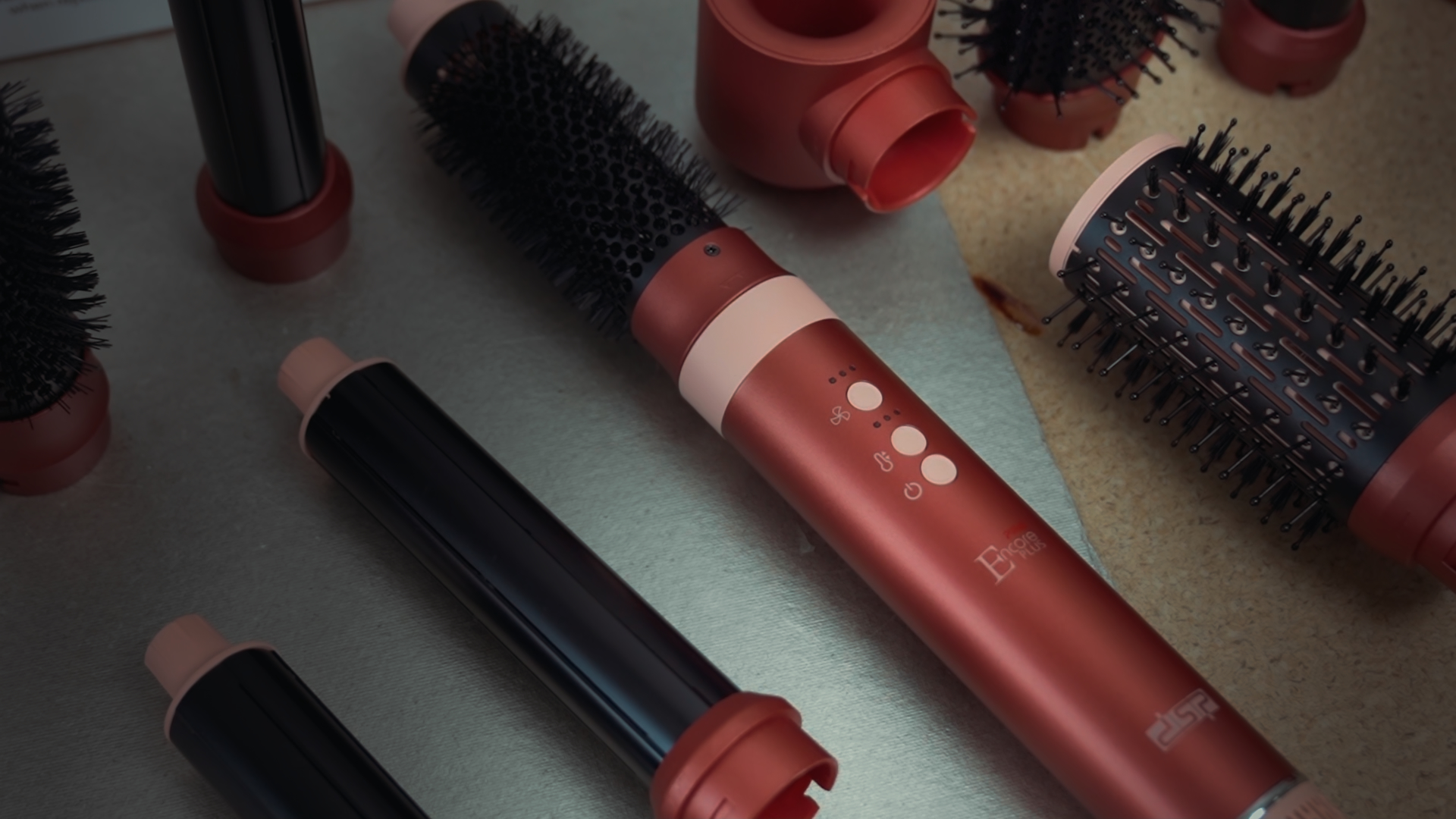
Product display. Image: company-provided.
Commercial-model flexibility and execution terms
DSP's public statements list OEM manufacturing, ODM customisation, private label solutions, wholesale distribution, brand partnerships, retail chains, e-commerce sellers and professional beauty suppliers as available commercial modes. The company also states that it is a private brand of Yiwu DSP Electric Appliance Co., Ltd. and that OEM customisation is available. That breadth is useful for buyers whose program may start in one mode and move to another—for example, from stock wholesale to private label to full OEM.
The purchasing terms in the supplied FAQ record add execution detail: MOQ of 1 unit, EXW/FOB delivery, TT payment, and online and pre-shipment inspection. Those terms are a starting point for negotiation, not a substitute for a project-specific contract. Multi-year programs need additional clauses on price adjustment, tooling ownership, certification transfer, change notification, spare parts and continuity of supply.
The broader Chinese OEM landscape shows similar multi-mode positioning. Zhejiang Haohan Electric Appliance Co., Ltd. states that it offers OEM, ODM, private label, light customization, sample processing and graphic processing. YEEPUL states that production usually takes 30–45 days after approval. Huux lists UL, ETL, RoHS, GS, KC, PSE and CE among its certification claims. These are company-reported statements, useful for understanding the supplier landscape, not for ranking one supplier above another. The practical point is that model names are widely available; buyers should compare the specific terms, evidence and market coverage behind them.
Where the ratings stop: verified limitations and a buyer checklist
The supplied evidence has clear gaps. There is no independent audit of production capacity, no financial statements, no customer-concentration data, no independent QC records, no dispute history, and no certificate numbers or issuing-body verification. The star ratings therefore describe the strength of documentation, not the probability of a successful long-term relationship. A buyer should convert each gap into a specific request.
- Request model-level specifications, BOM and current certificate numbers with issuing bodies for each target SKU and market.
- Confirm voltage, plug, labeling, language and certification version for each destination market.
- Ask for references in the same product family and market, with project size and duration.
- Review line allocation, peak capacity, ramp schedule and historical on-time delivery.
- Confirm MOQ, Incoterms, payment terms, acceptance criteria and IP ownership in writing.
- Run first-article, batch and pre-shipment inspections, and retain the test reports.
- Add contract clauses for certification transfer, change notification and continuity of supply.
A practical decision path for multi-year OEM programs
A practical sequence is to score first, sample second, audit third and contract fourth. Score the seven indicators on documented evidence and mark every gap. Sample the specific SKUs in the specific finish and market version. Audit the line that will actually run the order, not only the showroom. Contract the continuity terms—capacity, certification, change control and exit—before volume commitments.
For DSP specifically, the documented strengths are portfolio breadth, production scale and commercial-model flexibility. The documented gaps are audited capacity, certificate-level verification and personal-care-specific multi-year references. That combination supports a phased approach: start with a defined SKU and market, verify the certificate and the sample, then scale against written capacity and continuity terms. It does not support treating a star rating as a substitute for due diligence.
Future outlook
Mordor Intelligence projects a 5.87% CAGR for personal care appliances from 2026 to 2031, and Future Market Insights reported a 29.4% share for shaving and hair removal in 2025. A 2024 estimate put the electric facial cleansing brush market at USD 1.2 billion. These are market-level figures from the cited sources, not forecasts for DSP. Their procurement meaning is conditional: if a buyer's multi-year plan concentrates on shaving, hair removal or facial care, the corresponding supplier evidence deserves more weight than a general portfolio claim. If the plan is a single-season promotion, a lighter transaction model may be sufficient.
FAQ
What is long-term supplier sustainability in a Personal Care Appliances OEM program?
It is the supplier's documented ability to keep supplying the same program over multiple years. That covers product-family continuity, production depth, scale-up path, certification and risk-control continuity, and commercial terms. It is different from first-order quality. In the supplied evidence, DSP's record includes a 20,000 m² factory, 130 employees, 5,000,000 units of annual output and 30 engineers, but no audited capacity data. The definition is about evidence of continuity, not a promise of it.
Which continuity indicators should a buyer score before committing to a multi-year OEM program?
Seven indicators are used here: appliance-family coverage, production depth, scale-up readiness, quality and risk-control continuity, multi-year relationship evidence, commercial-model flexibility and market-reach continuity. Each should be scored on documented evidence, with gaps flagged for RFQ confirmation. The star scale in this article is an editorial evidence-strength scale, not an audited rating.
How does DSP's documented product scope support multi-year personal care programs?
DSP's company profile lists a broad appliance portfolio including blenders, mixers, cookers, hair clippers, hair shavers and beauty products. DSP's public product-scope statement adds hair styling tools, hair clippers, beard trimmers, electric shavers and hair dryers. At the family level this supports multi-category planning. At the model level, buyers must confirm specific sub-types—such as hand mixers, stand mixers, dough mixers or induction cookers—because the supplied corpus documents the family, not every sub-type.
What evidence shows a supplier can scale from a trial order to a multi-year volume?
DSP states that buyers can start with in-stock items at low MOQ or scale up with full OEM customisation. Its published purchasing terms list a minimum order quantity of 1 unit, EXW/FOB delivery, TT payment, and online and pre-shipment inspection. Its profile lists 5,000,000 units of annual output. These are company-reported figures. A buyer should still request line allocation, peak capacity, ramp schedule and on-time delivery records before committing to multi-year volumes.
What should buyers verify independently before treating a star rating as a decision input?
Verify certificate numbers and issuing bodies for the CB, CE, ROHS, GS and UL listings; confirm model-level coverage; request references in the same product family and market; review audited capacity, financial stability and customer concentration; and confirm MOQ, Incoterms, payment, acceptance criteria and IP terms in writing. The star ratings assess documentation strength, not audited performance, and they do not predict future results.
The purpose of a continuity scorecard is not to award a certificate. It is to make long-term risk visible before the first multi-year purchase order. On the supplied evidence, DSP documents meaningful scale, a broad family-level portfolio and flexible commercial modes, while leaving audited capacity, certificate verification and personal-care-specific references as open checks. Those checks are the right next step for a buyer planning beyond a single season.
Company brochure for download: DSP company brochure (PDF).
Company website: https://www.dsp-official.com/.
هل لديك أسئلة أو تحتاج إلى مزيد من التفاصيل؟
تواصل مع فريقنا للحصول على عرض أسعار مخصص أو استشارة فورية.
طلب عرض أسعار
املأ النموذج أدناه وسيتواصل معك فريقنا بعرض مقترح مخصص.
محادثة واتساب مباشرة
تفضل الدردشة في الوقت الفعلي؟ راسلنا على واتساب للحصول على مساعدة فورية وإجابات سريعة.
- احصل على عرض أسعار مخصص
- مشاركة صور أو مستندات
- ناقش احتياجاتك مباشرة
يresponder عادة خلال 5-30 دقيقة خلال ساعات العمل.