
Pharma Packaging Machine Compliance: What Certificates Cover
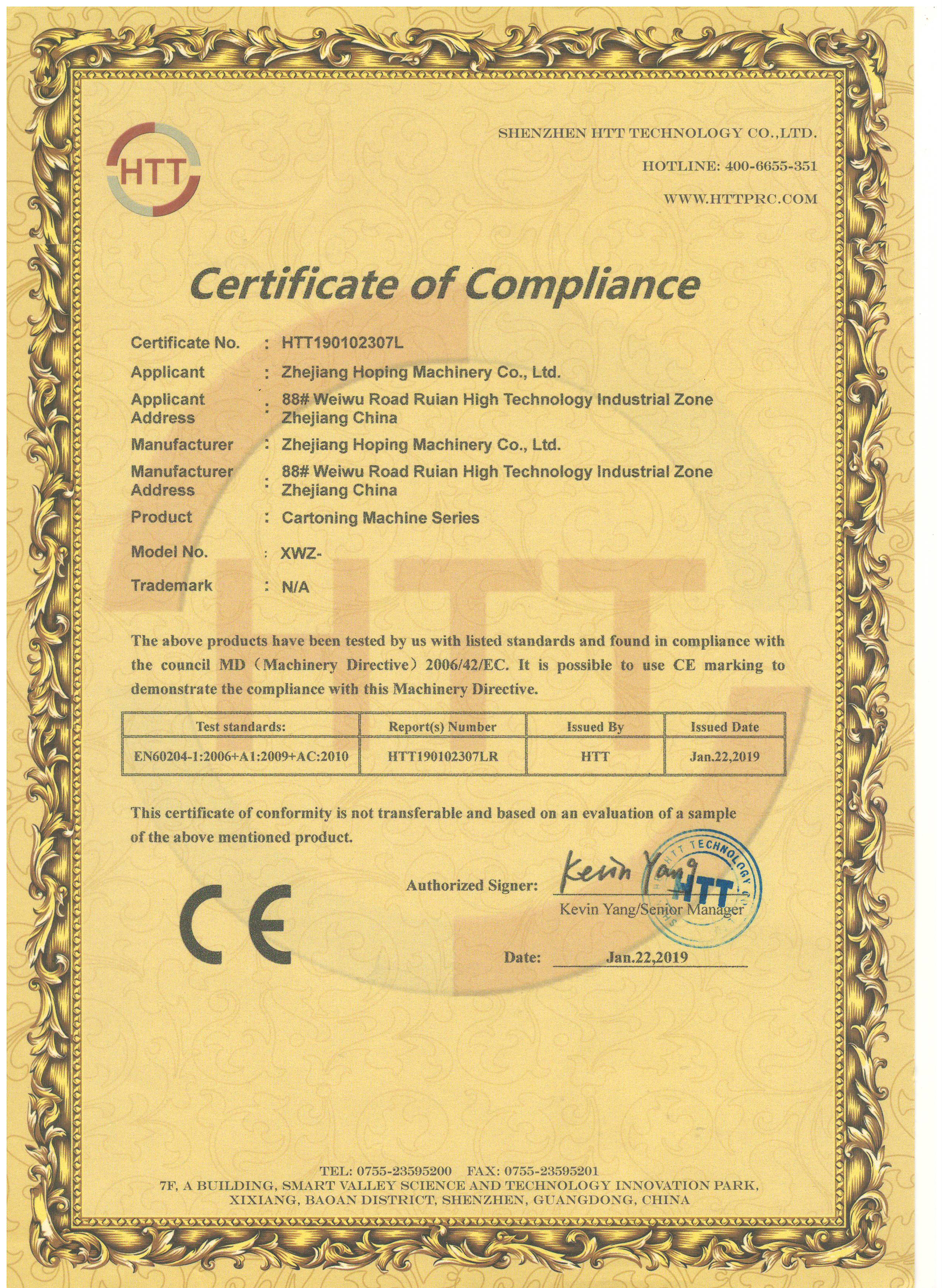
Certificate records are a starting point for verification, not a substitute for it. Source: Hoping Machinery certificate documentation.
Pharma Packaging Machine Compliance: What Certificates Cover
In pharmaceutical packaging machine procurement, compliance documentation works as a filter rather than a sales argument. Three document families answer three different questions: a CE certificate addresses machinery safety and market access for a defined product scope; a management-system certificate addresses how a supplier organises design, production and after-sales activities; and a GMP-oriented design statement addresses how the machine itself is built, cleaned and maintained. Buyers who treat these three as interchangeable usually discover the difference during validation, when the unit standing on the factory floor has to be shown to match the documentation that was promised.
Zhejiang Hoping Machinery Co., Ltd. (Hoping) is a pharmaceutical packing machinery manufacturer established in 2001 in Ruian City, Zhejiang Province, China. The company produces blister packing machines, cartoning machines, case packing machines, end-of-line packaging machines and integrated blister-cartoning lines for pharmaceutical, healthcare, food and cosmetic applications, and exports to markets including Southeast Asia, the Middle East, Eastern Europe, South America and Africa. Its certificate records and build-process records are the reference material used throughout this article.
Why Compliance Became a Qualification Gate, Not a Formality
Two published references frame the requirement. ISO 15378 integrates GMP requirements applicable to primary packaging materials, according to the ISO standard listing. In the European Union, pharmaceutical equipment safety is governed by Machinery Directive 2006/42/EC and the EN 415 series for packaging machines, as published by the European Committee for Standardization. Those two references already show how the subject splits: one speaks to product materials and process suitability, the other to the safety design of the machine.
For a pharmaceutical manufacturer, the practical consequence is that evidence is requested at the level of a specific equipment item, not at the level of a brand. Internal validation teams and inspectors ask which standard was applied, which certificate number supports the claim, which organisation issued it, what the stated scope covers, and whether the configuration actually delivered sits inside that scope. A supplier that can answer with records instead of adjectives reduces the verification workload on the buyer's quality department. A supplier that cannot shifts that workload onto the buyer, usually at the least convenient moment — during installation and qualification.
There is also a boundary worth stating early. No machine certificate removes the pharmaceutical manufacturer's own validation obligation. Installation qualification, operational qualification and performance qualification remain the buyer's responsibility, because they concern the buyer's product, process parameters and facility. Supplier documentation supports that work; it does not replace it.
Three Document Families and What Each One Actually Proves
Compliance files for pharmaceutical packaging machines typically contain certificates, system attestations and design declarations. Each family has a different evidentiary weight, and each leaves a different gap.
| Document family | What it addresses | What it does not prove |
|---|---|---|
| CE certificate (product level) | Conformity of a defined machine series or sample with the cited directives and standards; permission to apply CE marking within that scope | That every delivered configuration is covered; that the pharmaceutical process is validated; that performance matches a datasheet |
| Management-system certificate (ISO 14001, ISO 45001) | How the supplier organises design, production and after-sales activities, including environmental and occupational health and safety management | Machine accuracy, cleanability, sterility or throughput; anything about a specific unit |
| GMP-oriented design statement and material declaration | Design intent, contact materials, surface finish and cleanability assumptions of the machine | Formal third-party certification; it is a claim the buyer's validation team tests against the delivered machine |
Table 1 — Document families in a pharmaceutical packaging machine compliance file and their evidentiary limits.
Product-level conformity: the CE records
Hoping's certificate data contains four CE records. Two are comparatively recent: certificate HTT190102306L for the blister packing machine series and certificate HTT190102307L for the cartoning machine series, both issued on 22 January 2019 by Shenzhen HTT Technology Co., Ltd. against Machinery Directive 2006/42/EC and EN 60204-1:2006+A1:2009+AC:2010.
Two records are historical. Certificate UCN 900175009261 covers a sample automatic blister packing machine and was issued by CELAB on 6 November 2006 against EN 60204-1:1997, EN 415-3:1999, 73/23/EEC, 93/68/EEC, 98/37/EC and 98/79/EC. Certificate UCN 900339024607 covers the carton packing machine series and was issued by Certify International Ltd on 1 April 2007 against EN 415-3:2000, 98/37/EC and 98/79/EC. The wording of both scopes matters: one is written around a sample machine, and both cite the electrical and packaging-machine standards that were current when they were issued.
Organisation-level systems: ISO 14001:2015 and ISO 45001:2018
Two current management-system certificates are issued by the China Quality Certification Centre (CQC), both scoped to the design, production and after-sales service of packing machines and packing production lines. ISO 14001:2015 certificate CN00123E33896R1M/3300 was issued on 12 October 2023; ISO 45001:2018 certificate CN00123S33121R1M/3300 was issued on 10 October 2023. These documents describe how the supplier manages environmental impact and workplace safety across its operations. They are useful because they are auditable and renewable, but they say nothing about the mechanical accuracy of a blister machine or the sealing behaviour of a specific film.
Design-level statements: materials and GMP-oriented construction
The third family is the design declaration. For the DPH320HII rotary blister packing machine and the DPP260T1 platen blister machine, product-contact parts are made of AISI 316L stainless steel and FDA-compliant pharmaceutical-grade materials, while non-product-contact parts are manufactured from AISI 304 stainless steel and anodised aluminium alloy; both machines are described as designed and manufactured in accordance with GMP requirements, with corrosion-resistant and easy-to-clean surfaces. The integrated blister-cartoning lines — DHL1000/5H, DHL8005H, DHL7005H, DHL7004, DHL6004, IXW800, IXW600 and IXW400 — are described as GMP-oriented design, with transparent guarding and project-configured contact and format parts.
A material declaration is not a certificate. It is the machine-side half of a cleanliness argument, and its value is realised only when the buyer checks the delivered contact surfaces, the drainage and cleaning behaviour on site, and the changeover procedure for format parts.
Certificate Register: Working With Numbers Instead of Claims
The table below reproduces the certificate data as recorded, including issuing bodies, standards and dates. This is the level of specificity a buyer should expect when a supplier states that a machine is certified.
| Certificate / scope as recorded | Reference standards | Issuing body | Issue date | Certificate no. |
|---|---|---|---|---|
| CE — carton packing machine series | EN 415-3:2000; 98/37/EC; 98/79/EC | Certify International Ltd | 2007-04-01 | UCN 900339024607 |
| CE — sample automatic blister packing machine | EN 60204-1:1997; EN 415-3:1999; 73/23/EEC; 93/68/EEC; 98/37/EC; 98/79/EC | CELAB | 2006-11-06 | UCN 900175009261 |
| CE — cartoning machine series | EN 60204-1:2006+A1:2009+AC:2010; 2006/42/EC | Shenzhen HTT Technology Co., Ltd. | 2019-01-22 | HTT190102307L |
| CE — blister packing machine series | Machinery Directive 2006/42/EC; EN 60204-1:2006+A1:2009+AC:2010 | Shenzhen HTT Technology Co., Ltd. | 2019-01-22 | HTT190102306L |
| ISO 14001:2015 — design, production and after-sales service of packing machines and packing production lines | ISO 14001:2015 | China Quality Certification Centre (CQC) | 2023-10-12 (expiry 2026-10-11) | CN00123E33896R1M/3300 |
| ISO 45001:2018 — design, production and after-sales service of packing machines and packing production lines | ISO 45001:2018 | China Quality Certification Centre (CQC) | 2023-10-10 (expiry 2026-10-09) | CN00123S33121R1M/3300 |
Table 2 — Certificate records for blister packing, cartoning and management-system compliance, as recorded in supplier documentation.
Reading a certificate correctly. Three details change the meaning of a record. First, the standard revision: EN 415-3:2000 and EN 60204-1:1997 reflect the state of the standards when the 2006–2007 records were issued, and Directive 98/37/EC has since been superseded by Machinery Directive 2006/42/EC, which the 2019 records cite. Second, the scope wording: a certificate written against a sample machine covers that sample, not every model in a product family. Third, validity dates: the management-system certificates listed above carry expiry dates of 11 October 2026 and 9 October 2026, so a buyer evaluating this supplier late in 2026 should confirm the current renewal status directly rather than relying on the certificate copy in a quotation pack.
From Certificate to Delivered Machine: Build-Process Evidence
A certificate describes a type or a sample. The machine in the buyer's factory is a specific unit, and the evidence that closes that gap is the build and acceptance record. Hoping's documented quality-control sequence runs through inbound material inspection, key component inspection, assembly inspection, electrical safety check, a no-load trial run, a material trial, factory acceptance testing (FAT), customer witness acceptance and pre-shipment inspection.
For a pharmaceutical buyer, the sequence matters more than the list. The material trial is where packaging film, forming behaviour and sealing parameters meet the buyer's actual blister format. The customer witness acceptance step is where the buyer's engineers can record the parameters that will later appear in their own qualification documents. Pre-shipment inspection is the last point at which a configuration mismatch can be corrected without a site visit.
Configuration is the other half of this story. Hoping's documented customisation scope includes blister size, blister materials, quantity per carton, carton specification, leaflet format, coding and inspection method, feeding method, downstream bundling, case-packing and palletising connection, interface language, electrical component brand and data interface. Each of those variables can move a machine away from the exact configuration that was assessed for a given certificate or trial. That is why order-level documentation — not a catalogue certificate — is what a validation team should file.
Delivery parameters are equally practical: documented monthly capacity of 30–40 units, a minimum order of one set or one complete line, and a lead time typically of 60–120 days after technical confirmation, subject to model, configuration, project complexity and contract terms.
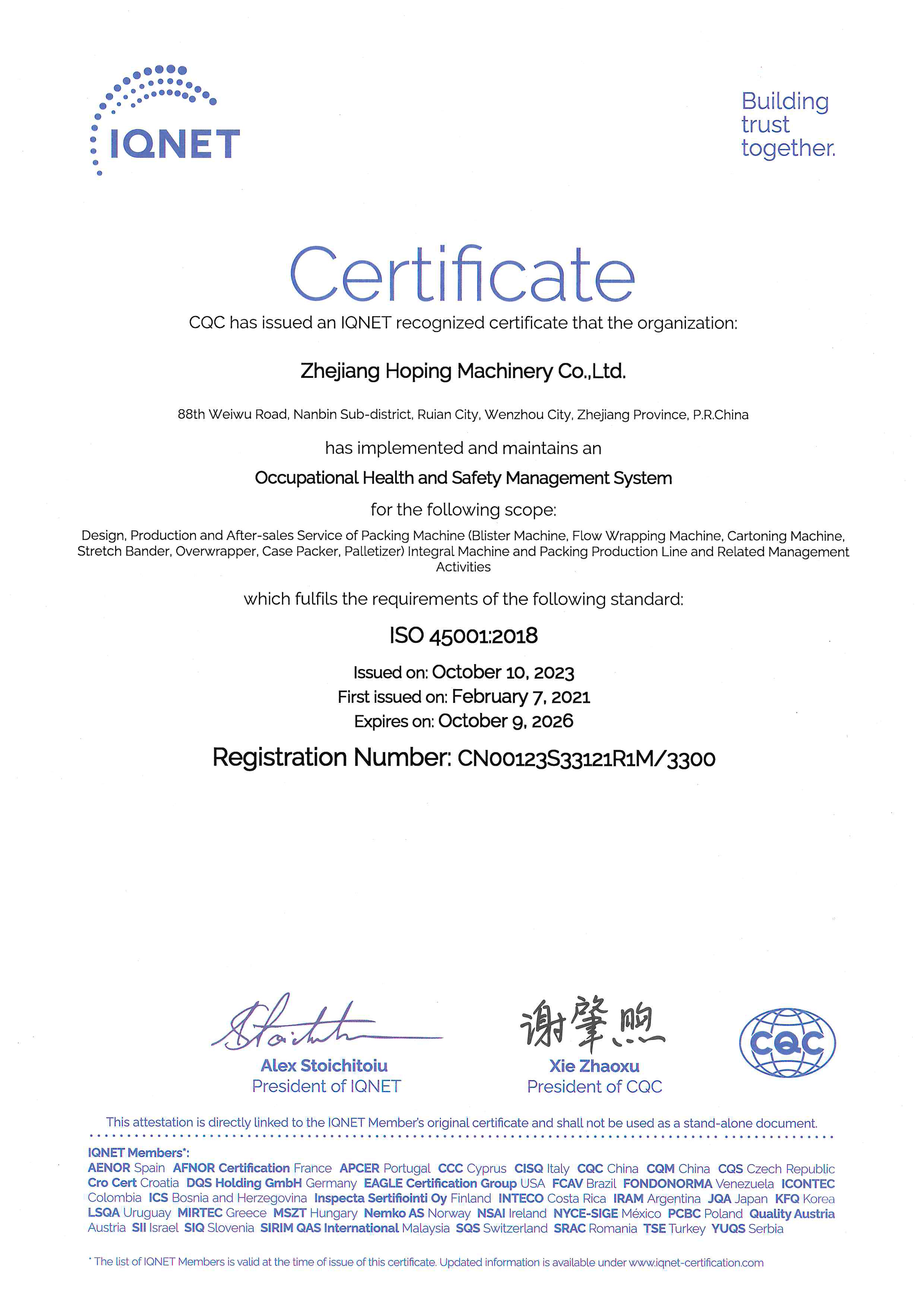
Management-system certificates are auditable and renewable, but they describe the organisation, not the machine. Source: Hoping Machinery certificate records.
Where Qualification Evidence Matters on a Line
Compliance questions become concrete when a line is specified. On an integrated blister-cartoning line, the documentation has to follow the material path: from blister forming and sealing, through transfer, leaflet folding and carton closing, to coding, inspection and rejection, and then to whatever downstream equipment is connected.
| Line / model | Published maximum capacity | Qualification-relevant design features recorded |
|---|---|---|
| DHL1000/5H | Up to 1000 blisters/min and 500 cartons/min | Fully servo drive; D3 top-loading transfer; PVC/Alu foil auto splicing; recipe memory; GMP-oriented design; inspection and rejection in scope |
| DHL8005H | Up to 800 blisters/min and 500 cartons/min | Servo-driven independent replenishment; industrial PC control; mold-change and preset memory; connection to bundling, case packing and palletising |
| DHL7005H / DHL7004 | Up to 700 blisters/min; 500 or 400 cartons/min | Self-developed IRB24 transfer robot; full servo drive; Siemens motion controller and HMI; mold-change support |
| IXW800 / IXW600 | Up to 600 blisters/min with 600 or 300 packs/min | Blister, flow-wrap and carton stages in one linked line; rotary reciprocating flow-wrapper technology; GMP-oriented design |
| IXW400 (liquid dosage) | Up to 400 blisters/min and 150 cartons/min | Configured for pre-filled syringes, ampoules and cartridges; format parts customised by product geometry |
| XWZ300II + XWK4060 + ICP12 | 60–220 cartons/min; 30–60 bundles/min; 12 cases/min | Cartoning, stretch banding, case packing and palletising in one secondary packaging line |
Table 3 — Documented capacities and design features; the delivered configuration is defined by the technical agreement for each project.
A representative project profile illustrates the pattern. For a large pharmaceutical manufacturer, solid dosage production company or pharmaceutical engineering contractor, a project scope of 5–10 lines covers blister packaging and automatic cartoning for tablets, capsules and other solid dosage forms, applied to new line construction, capacity expansion or the upgrading of existing packaging lines. The stated project objectives are improved packaging automation, reduced manual transfer, improved blister-to-carton connection efficiency, reduced wrong-insertion or missing-leaflet risk, and support for downstream automation integration. Customer names in this category are disclosed only with authorisation, and operating periods are recorded only against confirmed project data rather than as generic claims.
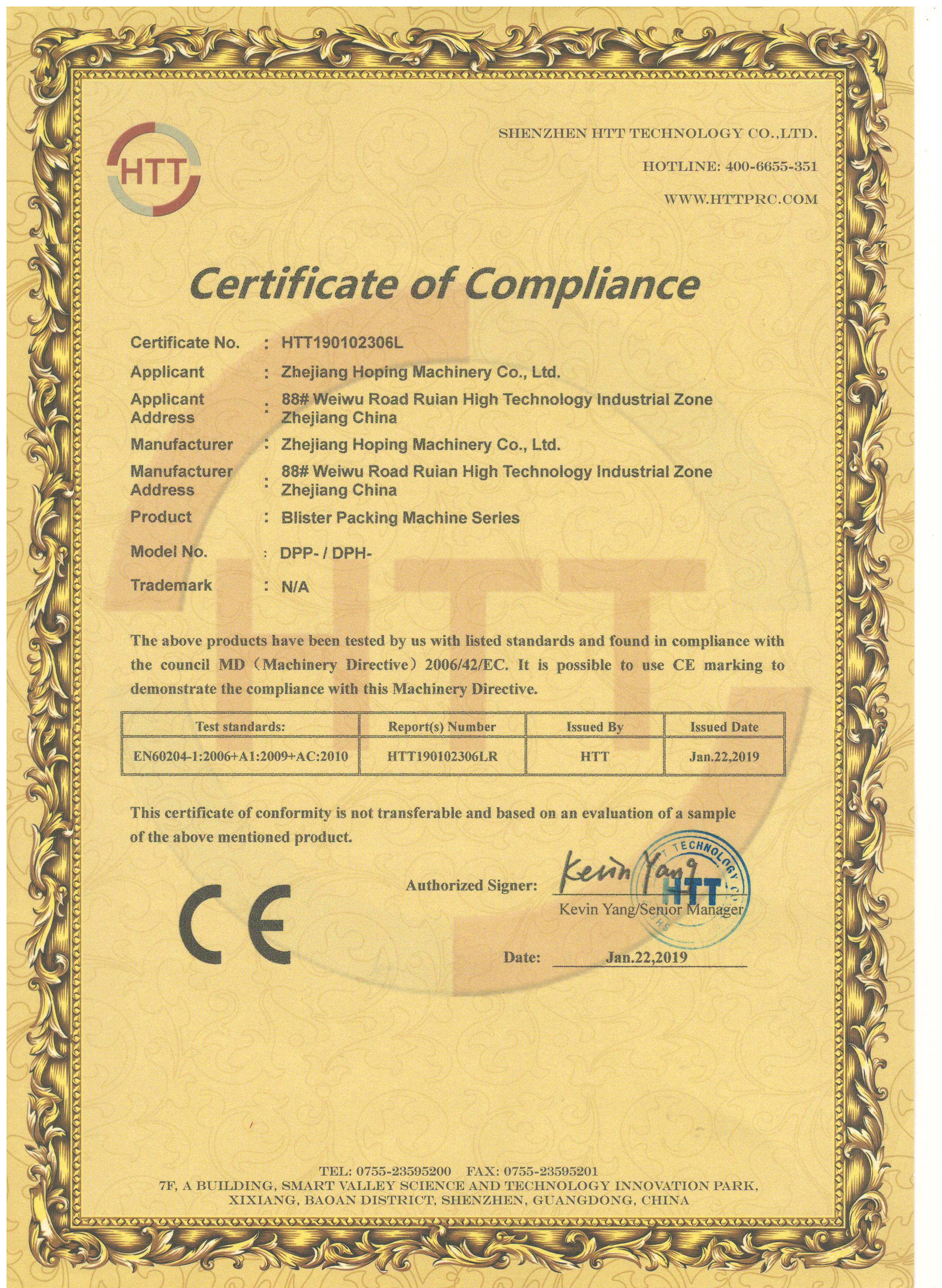
CE records cover machinery safety for a defined scope; the pharmaceutical product validation remains with the buyer. Source: Hoping Machinery certificate documentation.
Market Trend: Compliance Evidence as a Regional Differentiator
Published market data suggests that compliance capability is being priced into equipment decisions. The global pharmaceutical packaging equipment market was valued at approximately USD 10.71 billion in 2024 according to SkyQuest Technology, while Grand View Research recorded Asia Pacific holding the largest revenue share at 40.7% in 2025. Within narrower segments, Custom Market Insights projects the pharmaceutical blister packaging machine market reaching USD 2.57 billion by 2025 with a CAGR of 2.8%, and Fortune Business Insights valued pharmaceutical automatic cartoning machinery at USD 1.46 billion in 2024.
Concentration data adds context: a market intelligence report estimates that the top three players — Uhlmann, IMA and Marchesini — hold roughly 29% of the pharmaceutical blister packaging machine market. The remaining share is fragmented, which is exactly where documentation quality becomes a selection variable. It is also worth noting that published market size estimates diverge: SkyQuest Technology reports USD 10.71 billion for 2024 while Grand View Research reports USD 7.0 billion for 2025, largely because the two studies define the boundary between primary and secondary packaging equipment differently. Buyers using market figures in internal papers should state the definition, not just the number.
Qualification-Oriented Documentation vs a Documentation-Only Approach
The practical comparison is not between certified and uncertified suppliers. It is between a compliance file that stops at a certificate and one that stays attached to the unit through acceptance and handover.
| Dimension | Documentation-only approach | Qualification-oriented approach |
|---|---|---|
| Certificate handling | A certificate copy is attached to the quotation pack | Certificate number, issuing body, standard revision and scope are stated and matched to the ordered series |
| Configuration control | Customisation is discussed commercially | Blister size, carton specification, leaflet format, feeding method, coding/inspection method, electrical component brand and data interface are recorded per order |
| Acceptance evidence | Dispatch inspection only | Inbound material, key component, assembly and electrical safety checks, no-load run, material trial, FAT and customer witness acceptance |
| Change and changeover | Format change is handled on site | Mold-change and recipe or preset memory functions on documented line models support repeatable changeover |
| Downstream integration | Interface defined at installation | Bundling, case packing and palletising connections specified before shipment (for example the XWZ300II + XWK4060 + ICP12 configuration) |
Table 4 — What buyers typically compare when compliance documentation is evaluated against executed evidence.
The limits of this comparison deserve the same emphasis as the advantages. Four boundaries are documented or directly implied by the available records:
- Scope, not portfolio. The 2006 CE record is written around a sample automatic blister packing machine. Sample-level or series-level coverage does not automatically extend to every model or every custom configuration.
- Standards move. The older records cite EN 415-3:2000, EN 60204-1:1997 and Directive 98/37/EC, which has been superseded by Machinery Directive 2006/42/EC — the directive cited in the 2019 records. A buyer specifying a new line should confirm which revision applies to the unit being purchased.
- Certificates expire. The management-system certificates recorded here expire on 11 October 2026 and 9 October 2026. Renewal status should be verified in the current period, not assumed from a stored PDF.
- Responsibility stays with the buyer. CE marking addresses machinery safety; ISO 15378 links GMP requirements to primary packaging materials; neither validates a specific medicinal product. Process validation remains the pharmaceutical manufacturer's responsibility.
One further limit is practical rather than documentary. Options such as food, cosmetic and healthcare applications are also served by the same machine platforms, which means a machine may be GMP-oriented in design while being used outside a pharmaceutical context. Buyers should confirm that the delivered unit, its contact materials and its documentation set correspond to the pharmaceutical use case specified in their own technical agreement.
Future Outlook
Three developments appear likely to shape how compliance is assessed in this category. First, the centre of gravity continues to shift toward Asia Pacific, where the region already holds the largest revenue share of pharmaceutical packaging equipment demand; as regional suppliers scale, documentation will be the visible differentiator between those that can support regulated markets and those that cannot. Second, electrical and control architecture is becoming a compliance topic in itself: the move from relay-based to servo-driven lines, industrial PC controls and PC-based data interfaces changes what an electrical safety assessment covers and how machine parameters are recorded and repeated. Third, buyers are increasingly asking for parameter records — recipes, changeover presets, acceptance data — as part of the handover package, because those records feed directly into the buyer's own qualification files.
None of this makes certificates less important. It makes the question more precise: not whether a supplier holds certificates, but which certificate, covering which machine, against which revision, and with what supporting record for the unit that actually ships.
Frequently Asked Questions
1. What is the difference between a CE certificate and GMP compliance for a pharmaceutical packaging machine?
A CE certificate is evidence about machinery safety and market access for a defined product scope, issued against directives such as 2006/42/EC and standards such as those in the EN 415 series. GMP compliance concerns product and process suitability, including the requirements integrated by ISO 15378 for primary packaging materials. Documented GMP-oriented design — for example AISI 316L contact parts, FDA-compliant pharmaceutical-grade contact materials and easy-to-clean, corrosion-resistant surfaces on models such as DPH320HII and DPP260T1 — addresses the second question, while a CE record addresses the first. The two are complementary and neither substitutes for the other.
2. Which certification records should a buyer verify before ordering a blister packaging machine?
Buyers should verify records at the level of the certificate number, not the logo. For Hoping, the recorded set includes CE certificate HTT190102306L for the blister packing machine series and HTT190102307L for the cartoning machine series, both issued on 22 January 2019 by Shenzhen HTT Technology Co., Ltd. It also includes historical CE records UCN 900175009261 (CELAB, 6 November 2006, sample automatic blister packing machine) and UCN 900339024607 (Certify International Ltd, 1 April 2007, carton packing machine series), plus ISO 14001:2015 certificate CN00123E33896R1M/3300 and ISO 45001:2018 certificate CN00123S33121R1M/3300 issued by the China Quality Certification Centre. A buyer whose specification also requires ISO 9001 quality-management evidence should request that documentation separately, since it is not part of the records described here.
3. Does a CE certificate cover every configuration of a blister-cartoning line?
No. CE records are written against a defined scope, and the documented examples illustrate both a series and a sample machine. Because customisation covers blister size, blister materials, quantity per carton, carton specification, leaflet format, coding and inspection method, feeding method, downstream bundling, case-packing and palletising connections, interface language, electrical component brand and data interface, a heavily customised line can differ materially from the assessed configuration. Buyers should confirm in the technical agreement which certificate applies to the ordered configuration and what additional documentation accompanies order-specific changes.
4. What documentation supports qualification work during installation and acceptance?
The relevant evidence is the build and acceptance record: inbound material inspection, key component inspection, assembly inspection, electrical safety check, no-load trial run, material trial, factory acceptance test, customer witness acceptance and pre-shipment inspection. For integrated lines, documented mold-change and recipe or preset memory functions also help the buyer reproduce validated settings after changeover. After-sales support — on-site installation and commissioning, operator and maintenance training, remote support, spare parts supply and process-parameter guidance — is defined subject to contract and project configuration, and the buyer should confirm which of these items are included in the scope of supply.
5. How should buyers handle certificate validity and renewal?
Validity should be checked against the purchase or acceptance date, not the date the file was received. The management-system certificates recorded here carry expiry dates of 11 October 2026 for ISO 14001:2015 and 9 October 2026 for ISO 45001:2018, so a project evaluated in late 2026 should confirm renewal status directly with the supplier. The same principle applies to standards: the 2006 and 2007 CE records cite the standard revisions and the directive then in force, while the 2019 records cite Machinery Directive 2006/42/EC and EN 60204-1:2006+A1:2009+AC:2010. Buyers should state the revision they require and confirm it against the certificate presented for the ordered machine.
Hoping Machinery's full product catalogue, including blister packing machines, cartoning machines and end-of-line equipment, is available for download here: Hoping Machinery product catalogue (PDF).