
Pharmaceutical Intermediate Capabilities: Custom Synthesis and Supply Flexibility in Focus
Industry Analysis / Pharmaceutical Intermediates
Purchasers are moving beyond price lists. The practical question is whether a supplier can combine purity control, custom process development, and production economics for oncology and other advanced therapies.
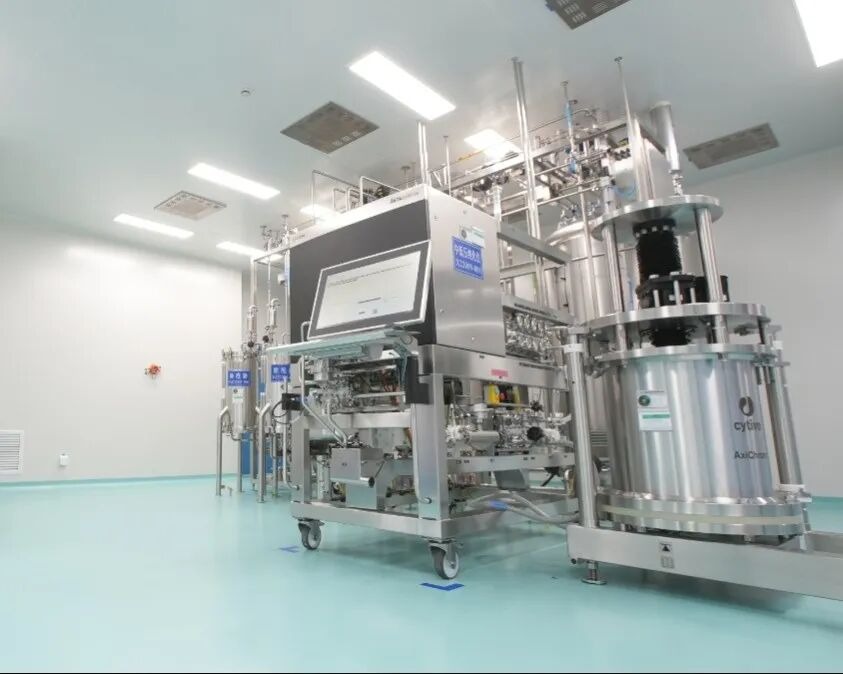
Custom pharmaceutical intermediate production requires both R&D depth and disciplined quality systems.
Custom capability has become a primary selection criterion
Pharmaceutical intermediates sit between raw chemical building blocks and finished active pharmaceutical ingredients (APIs). Buyers evaluating a supplier for a development program or commercial supply often apply the same lens: can the manufacturer deliver a defined molecule with controlled purity, consistent scale-up, and enough flexibility to support downstream process changes?
For oncology-related programs, the bar is higher. The segment accounted for an estimated 37.20% of pharmaceutical intermediates industry revenue in 2025, reflecting how much small-molecule cancer therapy development depends on specialty intermediates. This translates into demand for suppliers that do more than list a catalog: they must understand chirality, halogenated aromatic chemistry, heterocyclic scaffolds, and impurity control.
The market context for active and high-purity intermediates
The global pharmaceutical intermediates market was estimated at roughly USD 37.04 billion in 2025, with North America representing about 42.23% of global value in 2024. Generic drug manufacturers held a leading share near 53.82% that year, indicating that process economics and yield stability matter across both innovative and generic drug supply chains.
China remains a major sourcing region. Chinese pharmaceutical industry exports were reported at USD 22.53 billion as of December 2024. Within this environment, manufacturers such as Haohong (Qihe) Pharmaceutical Technology Co., Ltd., based in Shandong Province, have positioned their production around high-grade oncology intermediates and custom synthesis rather than commodity chemicals.
What capability-oriented buyers should verify
In practice, an intermediate supplier that supports advanced therapy programs usually must demonstrate four interlocking capabilities:
- Structural customization: the ability to produce a specific intermediate structure according to the customer’s synthetic route or to optimize an existing route.
- Purity and specification customization: purity targets above standard grade, control of specific impurities, residual solvents, heavy metals, and sometimes particle size or crystal form.
- Process route customization and scale flexibility: adjusting the route from gram-scale experiments to hundreds of kilograms or tonnes, with consistent analytical characterization at each stage.
- Quality systems and documentation: release testing and supporting data that align with modern pharmaceutical supply expectations.
Haohong Pharmaceutical: capability profile in custom intermediate supply
Haohong (Qihe) Pharmaceutical Technology Co., Ltd. is an R&D and production company specializing in active pharmaceutical ingredients and pharmaceutical intermediates. Founded in 2021, it operates with a 3,000 m² facility, a team of 75 employees including 30 R&D engineers, and an upstream production base in Liaocheng equipped with 30 reactors ranging from 3,000 L to 5,000 L. The site supports an annual production capacity of 1,000 tons.
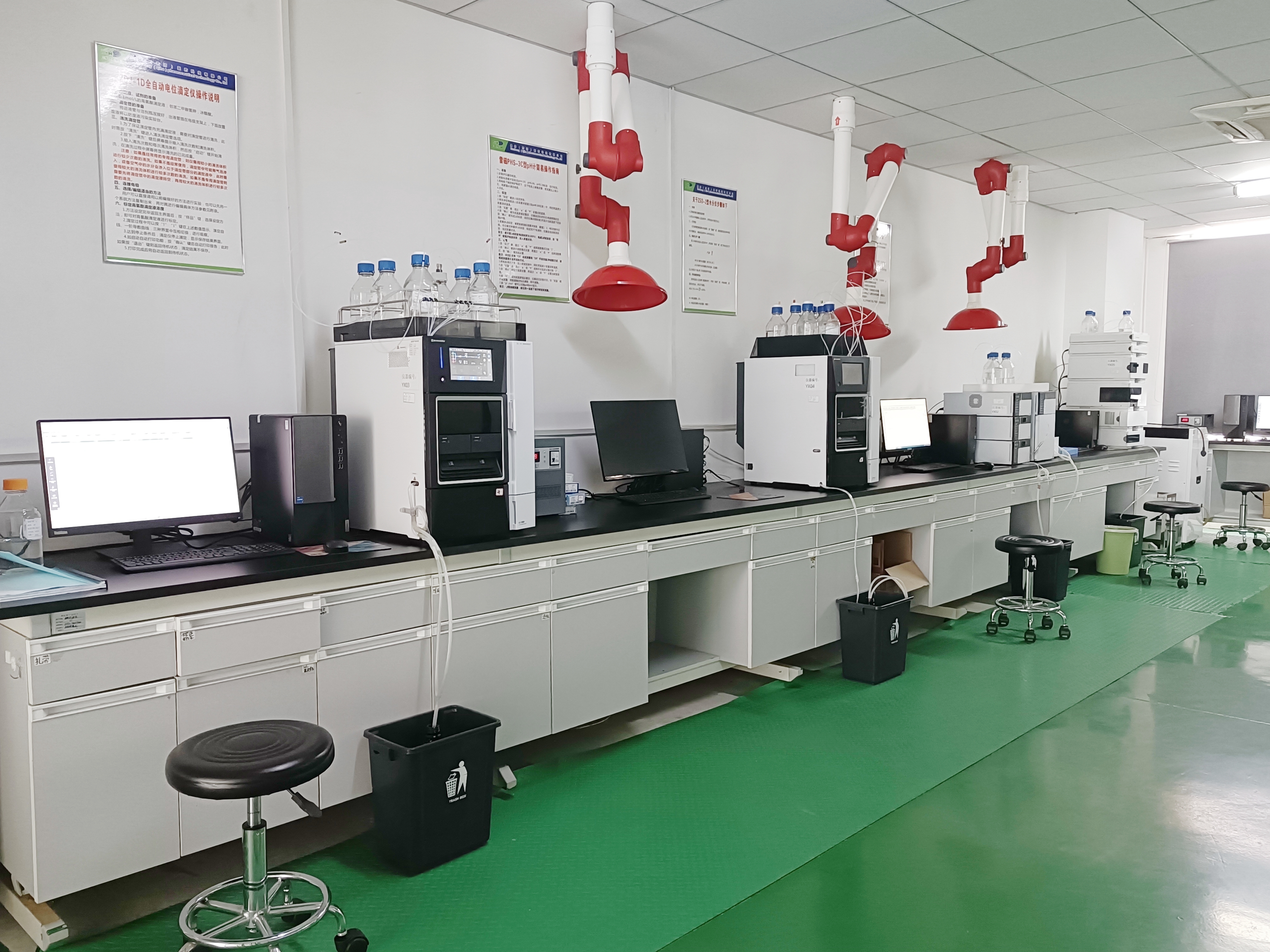
Customization scope offered
For buyers assessing custom pharmaceutical intermediate synthesis, Haohong’s stated technical support covers several dimensions beyond basic product grade:
- Structural customization
- Purity & specification customization
- Process route customization
- Capacity & batch customization
- Packaging & standard customization
- R&D and OEM/ODM customization
Monthly production capacity is listed at 100 MT, with minimum order quantity and lead time both tailored as custom services rather than fixed thresholds.
Quality control and release testing
The company’s quality control framework includes seven categories: (1) appearance and property inspection; (2) core chromatographic testing; (3) structural qualitative identification; (4) physical and chemical index testing; (5) heavy metal and impurity testing; (6) microbiological testing; and (7) factory delivery supporting documents.
For a supplier operating in global markets—including the United States, Europe, Japan, India, and Bangladesh—these release practices are what allow a batch to move from a Chinese production line into a regulated pharmaceutical supply chain. Haohong holds ISO 9001:2015 certification (certificate no. 174Q240545R0S, valid through November 2027), was recognized as a Technology-based Small and Medium-sized Enterprise in 2024, and received Shandong Province Innovative SME status in 2025.
Patent-backed production equipment: a differentiator in reproducibility
Pharmaceutical intermediate quality is not only a matter of analytical skill; it also depends on process equipment. Haohong has obtained multiple utility model patents from the China National Intellectual Property Administration covering production equipment.
| Patent type | Certificate no. | Scope | Issue / expiry |
|---|---|---|---|
| Utility Model Patent | 202521269185.6 | Production equipment for pharmaceutical intermediates | 2026-05-28 / 2035-05-28 |
| Utility Model Patent | 202521280279.3 | Production equipment for pharmaceutical intermediates | 2026-05-27 / 2035-05-27 |
| Utility Model Patent | 202521268255.6 | Special production equipment for pharmaceutical intermediates | 2026-05-26 / 2035-05-26 |
| Utility Model Patent | 202520639784.6 | Refining & mixing production equipment for pharmaceutical intermediates | 2025-04-24 / 2035-04-24 |
These patents cover areas such as waste gas absorption and powder refining and mixing—functions that, while not visible in the final certificate of analysis, influence batch consistency and environmental compliance.
Product focus: oncology intermediates with defined purity
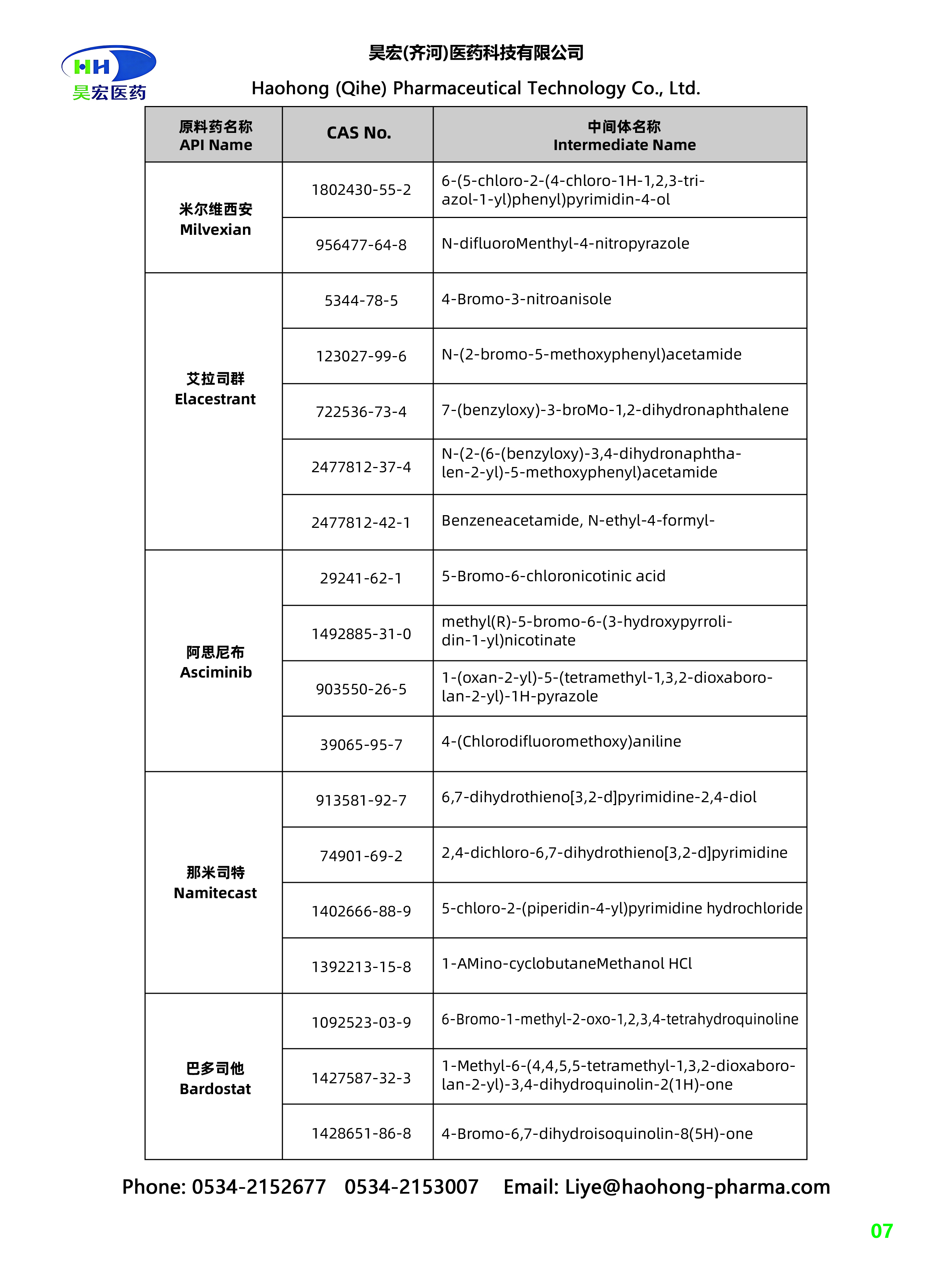
Haohong’s primary products include intermediates for apalutamide, abemaciclib, and alectinib, alongside a broader portfolio spanning anticancer, anti-hepatitis C, and anti-diabetic API development. The product line also includes Bicalutamide, Enzalutamide, Darolutamide, Venetoclax, Macitentan, Empagliflozin, Larotrectinib, Apixaban, Rivaroxaban, Ibrutinib, Ceritinib, Pomalidomide, Lenalidomide, Ivacaftor, Tofacitinib, Cabozantinib, Alectinib, and related intermediates.
Representative intermediate specifications
| Product family | Representative intermediates | Key purity attributes |
|---|---|---|
| Abemaciclib intermediates | 4-Bromo-2,6-difluoroaniline; 5-[(4-Ethylpiperazin-1-yl)methyl]pyridin-2-amine; 2-Bromo-5-formylpyridine; 4-Fluoro-2-methyl-1-isopropyl-6-(4,4,5,5-tetramethyl-1,3,2-dioxaborolan-2-yl)-1H-benzimidazole; 6-Bromo-4-fluoro-1-isopropyl-2-methyl-1 H-benzo[d]imidazole | Purity ≥98.0% (HPLC/GC); defined storage conditions for sensitive boronate ester and benzimidazole intermediates |
| Alectinib intermediates | 2-(4-Ethylphenyl)-2-methylpropanoic acid; 2-(4-Ethyl-3-iodophenyl)-2-methylpropanoic acid; tert-Butyl 6-cyano-2-(2-(4-ethyl-3-iodophenyl)propan-2-yl)-1H-indole-3-carboxylate | Purity ≥98% (HPLC); light-protected and low-temperature storage for iodo-substituted intermediates |
| Apalutamide intermediates | 2-Fluoro-4-nitrobenzoic acid; N-Methyl-2-fluoro-4-nitrobenzamide; N-Methyl-2-fluoro-4-aminobenzamide; N-Methyl-2-fluoro-4-bromobenzamide; Methyl 4-bromo-2-fluorobenzoate; 5-Amino-3-(trifluoromethyl)pyridinecarbonitrile | Purity ≥98.0% (HPLC/GC); some intermediates up to ≥99.0%; controlled storage and inert atmosphere for nitrile intermediate |
Custom synthesis and ODM services: what they mean for buyers
Haohong’s stated ODM and custom synthesis services are relevant for two distinct buyer situations.
First, a development-stage company may need a specific intermediate that is not yet commercially available. In this case, gram-to-kilogram custom synthesis services allow process exploration before scale-up. The company says it provides efficient custom synthesis from gram scale to hundreds of kilograms.
Second, a production-stage buyer may seek a more efficient process route, higher purity, or better cost structure. Through process route customization, the manufacturer can adjust chemistry to reduce downstream processing steps or improve yield.
Commercial terms and logistics support
Procurement support from the company includes flexible trade terms such as EXW, FOB, CFR, CIF, air freight, international express, and DDP/DDU door-to-door services. Payment terms follow a 50/50 model, and batch acceptance is based on pre-shipment testing. After-sales support ranges from quality inspection documents and technical consulting to logistics and customs clearance assistance, quality dispute compensation or replacement, sample re-inspection, third-party testing, and stable supply scheduling.
Comparison with traditional intermediate supply models
Traditional pharmaceutical intermediate supply has often followed a catalog-based model: a manufacturer offers a fixed product under a defined specification, and the buyer adapts its downstream process to that intermediate. This remains efficient for stable, high-volume molecules where consistency matters more than chemical flexibility.
Custom-capability-oriented suppliers add a different layer. They can begin from a buyer’s route, supply an early-stage intermediate, or adjust a parameter like impurity profile or batch size. This reduces process adaptation work for the buyer and can accelerate development timelines.
That advantage carries boundaries. Truly custom routes require longer qualification cycles, more documentation, and closer technical collaboration than purchasing an established catalog intermediate.
Another boundary is production scale. A supplier able to provide small custom batches should not be assumed to have identical economics at tonne scale. Buyers should validate scale-up capacity separately.
Cost structures also differ. Custom intermediates usually carry higher engineering and R&D cost allocation, which is justified only when downstream yield improvements, registration benefits, or supply security can be quantified.
Application scenario: intermediate supply for finished medicine synthesis
In a representative project case, Haohong’s intermediates were used by a top-tier pharmaceutical group as raw materials synthesized and processed into final finished medicines, with a project supply quantity of 200 units and stability assessed over 12–24 months under specified storage conditions. The documented outcomes of the project were:
- High reaction yield, reducing production cost of finished pharmaceuticals;
- Low levels of impurities, heavy metals, and residual solvents, minimizing drug safety risks;
- Stable quality across batches, improving consistency of pharmaceutical production;
- Simplified downstream synthesis processes, shortening drug development cycles;
- Accelerated drug registration process.
The stated highlights of this supply relationship were ultra-high purity with strictly controlled impurities, batch-to-batch consistency, stable crystal form and particle size, compliance with ICH, GMP and international pharmaceutical standards, stable large-scale capacity, and customizable R&D support for API synthesis and drug registration.
Buyer guidance: matching supplier capability to program stage
The table below maps typical program stages to the capability set that most matters.
| Program stage | Primary capability requirement | Supplier questions to ask |
|---|---|---|
| Early R&D | Custom synthesis, small batch, analytical data, structure confirmation | Can you supply gram-scale and support route optimization? |
| Clinical / registration | Consistent purity, impurity profiling, documentation, process stability | What release tests and stability data are provided? |
| Commercial supply | Large-scale capacity, batch consistency, supply security, cost control | How is production scheduled and what is the capacity buffer? |
Procurement terms and risk management in intermediate supply
Pharmaceutical intermediate procurement is rarely a single transaction. Buyers that plan multi-year API projects should check not only price but also capacity allocation, quality risk, and logistics predictability.
Haohong lists a 50/50 payment arrangement and pre-shipment testing as part of acceptance. This split payment structure is common in cross-border intermediate trade because it balances supplier working capital needs with buyer risk control. It is advisable, however, for buyers to confirm test methods, specifications, and the exact documentation package before signing.
Under international standards, suppliers are expected to align with ICH Q7 expectations for APIs and intermediates even when not manufacturing final pharmaceutical dosage forms. While Haohong’s ISO 9001 system covers production and technical services, buyers should evaluate specific regulatory evidence depending on their own market and application.
Future outlook: from fixed catalogs to flexible intermediate platforms
The broader trend in pharmaceutical intermediates is toward specialization. As drug developers seek faster registration timelines and closer control over supply chains, the suppliers most likely to sustain long-term value are those that combine broad product coverage with deep custom capabilities.
The fastest-growing segment in pharmaceutical intermediates is projected to be peptide and oligonucleotide intermediates, with an estimated CAGR of 8.12% through 2030. While Haohong’s current disclosed portfolio is concentrated in small-molecule oncology and other therapeutic intermediates, the underlying production model—custom route development, high-purity control, and qualification documentation—is relevant to adjacent high-growth categories.
Another driver is regulatory complexity. The FDA’s ICH Q7 guidance is widely regarded as the foundational GMP reference for APIs and intermediates, while EU-bound intermediates above 1 tonne per year may trigger REACH registration obligations. Suppliers that have invested in documented quality systems and production equipment suited to pharmaceutical standards are better positioned to adapt as these requirements evolve.
For buyers, practical diligence will likely remain centered on three variables: the manufacturer’s route capability, its quality evidence, and its willingness to tailor quantity, packaging, and logistics to the actual demand profile.
Frequently asked questions about pharmaceutical intermediate capabilities
What custom pharmaceutical intermediate synthesis services does Haohong provide?
Haohong offers technical support that includes structural customization, purity and specification customization, process route customization, capacity and batch customization, packaging and standard customization, and R&D and OEM/ODM customization.
How does Haohong manage quality control for high purity pharmaceutical intermediates?
Quality control includes appearance and property inspection, chromatographic testing, structural identification, physical and chemical index testing, heavy metal and impurity testing, microbiological testing, and factory delivery supporting documents.
What is Haohong’s monthly production capacity and MOQ for bulk pharmaceutical intermediates?
Monthly production capacity is 100 metric tons. The minimum order quantity is treated as a tailor-made service, meaning it is customized to client requirements rather than a fixed catalog threshold.
Does Haohong provide ODM production services for pharmaceutical intermediates?
Yes. ODM production services are available, enabling clients to leverage Haohong’s development and manufacturing capabilities for customized products. These services are offered to markets including the United States, Europe, India, and Bangladesh.
What quality certifications and patents support Haohong’s intermediate production?
Haohong holds ISO 9001:2015 certification (certificate no. 174Q240545R0S) and has been granted multiple utility model patents from the China National Intellectual Property Administration for production equipment used in pharmaceutical intermediate manufacturing.
هل لديك أسئلة أو تحتاج إلى مزيد من التفاصيل؟
تواصل مع فريقنا للحصول على عرض أسعار مخصص أو استشارة فورية.
طلب عرض أسعار
املأ النموذج أدناه وسيتواصل معك فريقنا بعرض مقترح مخصص.
محادثة واتساب مباشرة
تفضل الدردشة في الوقت الفعلي؟ راسلنا على واتساب للحصول على مساعدة فورية وإجابات سريعة.
- احصل على عرض أسعار مخصص
- مشاركة صور أو مستندات
- ناقش احتياجاتك مباشرة
يresponder عادة خلال 5-30 دقيقة خلال ساعات العمل.