
Pharmaceutical Intermediate Supplier Evaluation in 2026
Supplier evaluation for pharmaceutical intermediates has moved from transactional purchasing to a strategic procurement discipline. As drug pipelines shift toward complex oncology and targeted therapies, buyers increasingly assess intermediate partners on compliance infrastructure, process scalability, and batch-to-batch consistency — not just price and labeled purity. This article provides a fact-based framework for that evaluation and profiles Haohong (Qihe) Pharmaceutical Technology Co., Ltd, a Shandong-based manufacturer operating under the brand Haohong Pharmaceutical.
Why Intermediate Supplier Selection Is a High-Stakes Decision
Pharmaceutical intermediates are chemical building blocks that are further synthesized into active pharmaceutical ingredients (APIs) and eventually into finished medicines. Because impurities, residual solvents, and heavy metals introduced at the intermediate stage can propagate through the synthesis chain, the supplier's quality system directly influences drug safety, yield, and regulatory success. This is why evaluation teams now look beyond a single certificate of analysis (CoA) and examine the full quality infrastructure behind the product.
Buyers comparing suppliers across categories — active pharmaceutical intermediates, high-purity intermediates, oncology drug intermediates, custom pharmaceutical intermediate synthesis, and so on — face a practical problem: the claims sound similar, but the evidence is not. The core evaluation questions are consistent: Does the supplier operate under a certified quality management system? Does it hold process-related intellectual property? Can it document multi-stage quality control? Has it shipped to regulated markets over time?
Market Signals That Should Anchor a Supplier Shortlist
Market structure helps buyers calibrate what to expect from suppliers. According to third-party industry research cited by Precedence Research, the global pharmaceutical intermediates market was valued at approximately USD 37.04 billion in 2025. Estimates vary across research houses — Coherent Market Insights, for example, projects USD 47.30 billion for the same period — so absolute market size should be treated as directional rather than precise.
Two additional signals matter for suppliers based in China. China's pharmaceutical industry recorded total exports of USD 22.53 billion as of December 2024 (CEIC/OECD), and approximately 40% of Haohong Pharmaceutical's output is exported to markets including the United States, Europe, Japan, India, and Bangladesh. For buyers, the practical implication is that a supplier's export track record and compliance documentation deserve as much scrutiny as its pricing.
Haohong Pharmaceutical: A Specialized Supplier Profile
Haohong (Qihe) Pharmaceutical Technology Co., Ltd is a China-based developer and custom manufacturer of innovative active pharmaceutical ingredients (APIs) and pharmaceutical intermediates, headquartered in the High-tech Zone of Qihe County, Shandong Province, within the Jinan Economic Circle. Since its establishment in 2021, the company has built an operation of approximately 3,000 square meters with 75 employees, including a 30-engineer R&D team, and reports an annual production capacity of 1,000 tons.
The company focuses on high-grade intermediates for anti-cancer, anti-hepatitis C, and anti-diabetic therapies. Its catalog includes intermediates for Apalutamide, Abemaciclib, Alectinib, Bicalutamide, Enzalutamide, Darolutamide, Venetoclax, Macitentan, Empagliflozin, Larotrectinib, Apixaban, Rivaroxaban, Ibrutinib, Ceritinib, Pomalidomide, Lenalidomide, Ivacaftor, Tofacitinib, and Cabozantinib, among others. The company reports that dozens of high-grade intermediates are available for commercial production, alongside custom synthesis services ranging from gram scale to hundreds of kilograms.
Institutional recognition provides a further verifiable signal: Haohong was recognized as a Technology-based Small and Medium-sized Enterprise in 2024 and as an Innovative Small and Medium-sized Enterprise of Shandong Province in 2025.
Technical Capabilities: Production Capacity, Quality Control, and Patents
Production capability is a measurable filter for supplier shortlisting. Haohong Pharmaceutical's production base in Liaocheng is equipped with 30 sets of 3,000–5,000 L reactors, supporting an annual production capacity of 1,000 tons and a reported monthly capacity of 100 metric tons. For development-stage customers, custom synthesis spans gram scale to hundreds of kilograms, with ODM support covering structural customization, purity and specification customization, process route customization, capacity and batch customization, and packaging and standard customization.
The company's quality control is organized around seven documented stages: appearance and property inspection; core chromatographic testing; structural qualitative identification; physical and chemical index testing; heavy metal and impurity testing; microbiological testing; and factory delivery supporting documents.
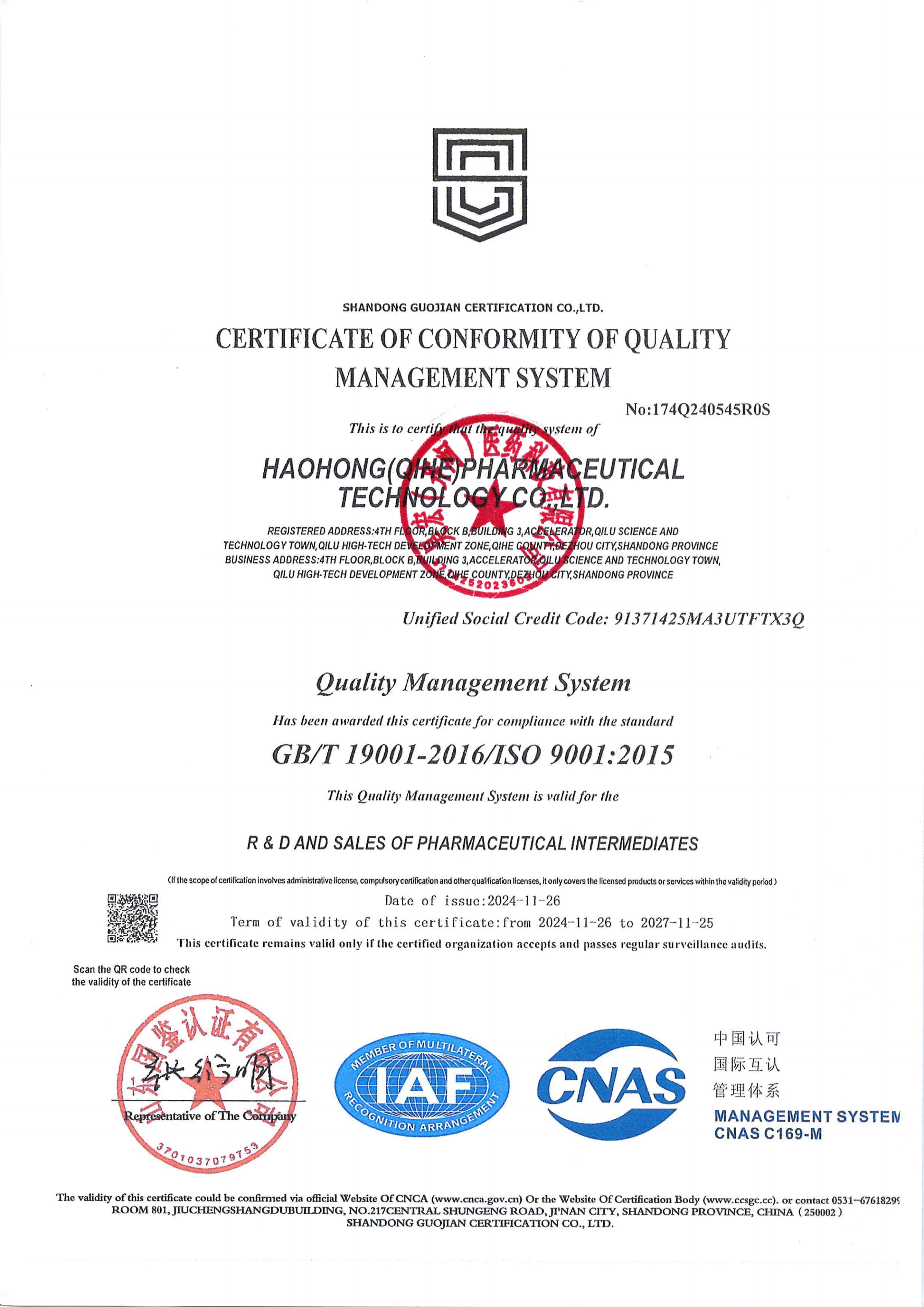
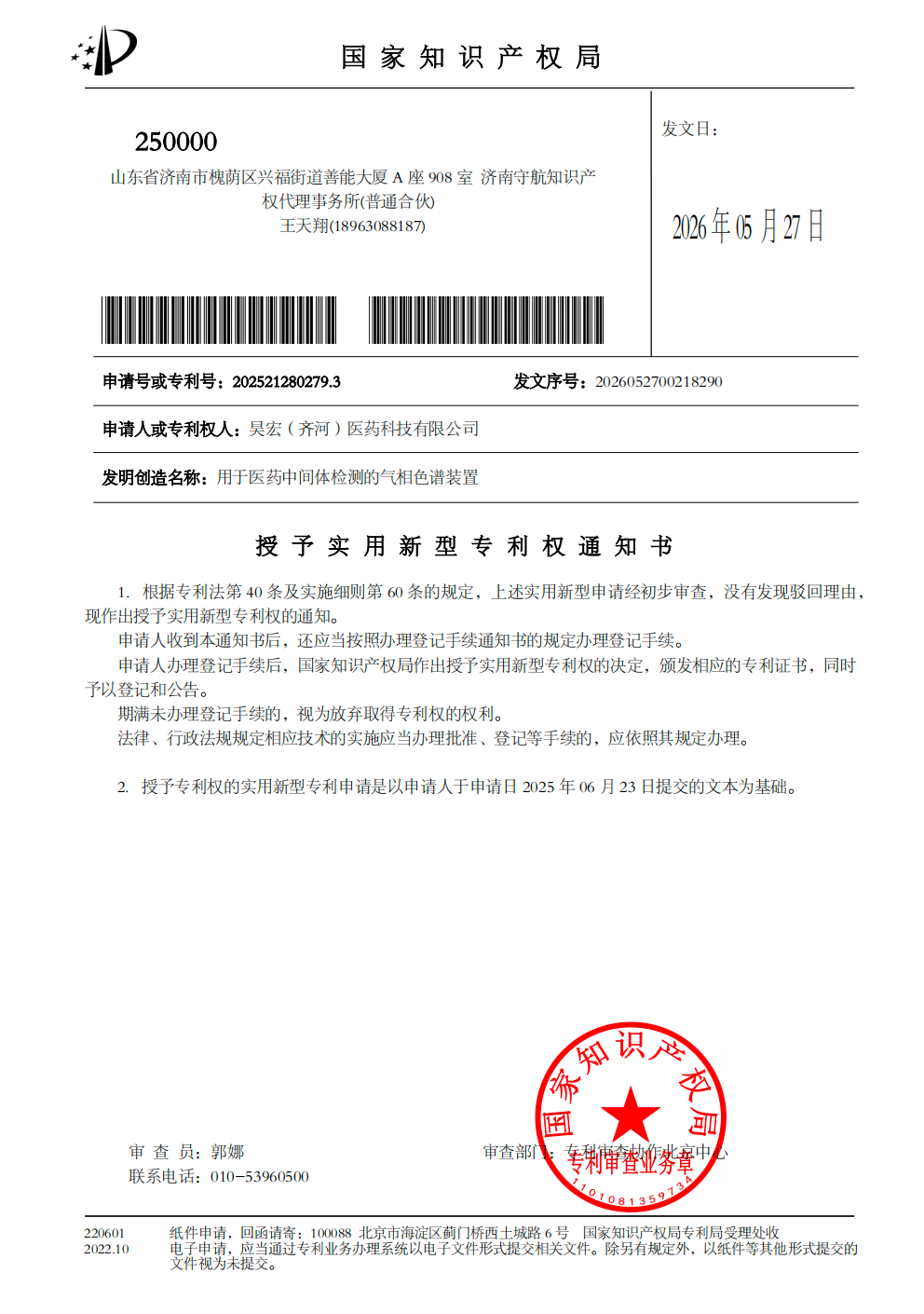
Compliance and intellectual property are documented facts. Haohong Pharmaceutical holds an ISO 9001:2015 quality management system certificate (GB/T19001-2016), certificate number NO:174Q240545R0S, issued by Shandong Guojian Certification Co., Ltd., valid through 25 November 2027. The company also holds four utility model patents granted by the China National Intellectual Property Administration, covering pharmaceutical intermediate production equipment: a gas chromatography device for detecting pharmaceutical intermediates (202521280279.3, issued 2026-05-27), a waste gas absorption device for pharmaceutical intermediates (202521268255.6, issued 2026-05-26), a powder refining and mixing equipment for pharmaceutical raw materials (202520639784.6, issued 2025-04-24), and production equipment for pharmaceutical intermediates (202521269185.6, issued 2026-05-28).
Representative intermediates sold at documented purity specifications include:
| Product Family | Representative Intermediate | CAS No. | Purity |
|---|---|---|---|
| Apalutamide intermediate | 2-Fluoro-4-nitrobenzoic acid | 403-24-7 | ≥98.0% |
| Apalutamide intermediate | 5-Amino-3-(trifluoromethyl)pyridinecarbonitrile | 573762-62-6 | ≥97.0% – ≥99.0% |
| Alectinib intermediate | 2-(4-Ethylphenyl)-2-methylpropanoic acid | 1247119-83-0 | ≥98% |
| Alectinib intermediate | tert-Butyl 6-cyano-2-(2-(4-ethyl-3-iodophenyl)propan-2-yl)-1H-indole-3-carboxylate | 1256584-75-4 | ≥98% (HPLC) |
| Abemaciclib intermediate | 4-Bromo-2,6-difluoroaniline | 1868-81-7 | ≥98.0% (HPLC/GC) |
| Abemaciclib intermediate | 5-[(4-Ethylpiperazin-1-yl)methyl]pyridin-2-amine | 398565-53-2 | ≥98.0% (HPLC) |
Storage specifications are equally documented: most intermediates require sealed, dry storage at room temperature or, for more sensitive products, low-temperature (2–8 °C) and light-protected conditions.
Application Scenarios: Oncology Intermediates in Drug Development
Haohong Pharmaceutical's documented use cases involve top-tier pharmaceutical group clients from multiple countries, including the United States, Germany, China, and India. In these applications, the supplied intermediates are synthesized and processed into final finished medicines, with product stability maintained over 12–24 months under specified storage conditions. This places the company's intermediates squarely in the oncology and targeted-therapy development segment that currently generates the largest share of industry revenue.
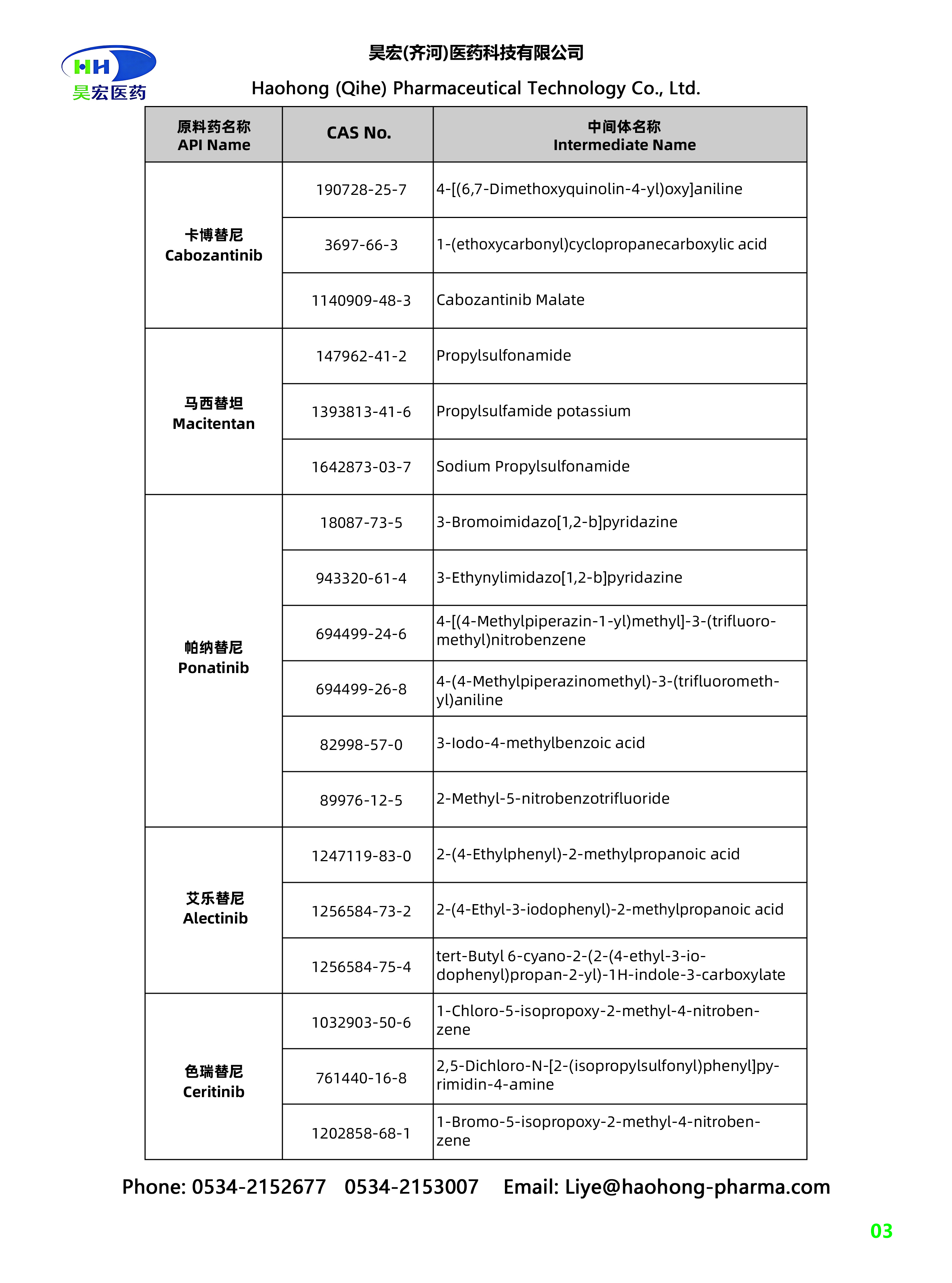
Documented outcomes from these applications include: high reaction yield that reduces the production cost of finished pharmaceuticals; low levels of impurities, heavy metals, and residual solvents that minimize drug-safety risks; stable quality across batches that improves the consistency of customers' pharmaceutical production; simplified downstream synthesis processes that shorten drug development cycles; and accelerated drug registration. The case documentation also highlights compliance with ICH and GMP frameworks, stable large-scale production capacity, and customizable R&D support for API synthesis and drug registration.
Comparison with Traditional Sourcing Approaches
Traditional approaches to obtaining intermediates — in-house synthesis or spot purchasing from multiple vendors — solve immediate needs but carry structural trade-offs. In-house synthesis preserves IP control but requires sustained capital and specialized staff, and scale-up timelines often conflict with development deadlines. Multi-vendor spot purchasing offers price flexibility but distributes quality risk; each new vendor introduces qualification burden, impurity variation, and supply continuity exposure.
| Dimension | In-House Synthesis | Multi-Vendor Spot Purchase | Specialized CDMO/Supplier (e.g., Haohong Pharmaceutical) |
|---|---|---|---|
| Capital requirement | High, sustained | Low | Moderate (outsourced) |
| Scale flexibility | Slower scale-up | Batch-dependent | Gram to hundreds of kg; 1,000 t/yr capacity |
| Quality documentation | Internal | Variable by vendor | Seven-stage QC; ISO 9001:2015 |
| IP & process know-how | Retained | Limited | Four utility model patents (production equipment) |
| Export compliance experience | Not applicable | Vendor-dependent | US, Europe, Japan, India, Bangladesh |
One honest limitation should be weighed. As a company established in 2021, Haohong Pharmaceutical has a shorter operating history and a more focused mid-scale footprint than multinational CDMOs with decades of accumulated audit data. Buyers with very high-volume commodity requirements or extremely long qualification programs may need to supplement Haohong's documented capabilities with site audits and extended stability validation. For most development-to-commercial bridging needs, however, the certified capacity, IP portfolio, and export record provide a concrete baseline for evaluation.
Future Outlook: What the Trend Data Suggests
Trend data point toward deeper specialization in pharmaceutical intermediates. Oncology drug intermediates already generated an estimated 37.20% of industry revenue in 2025, driven by complex modalities such as antibody-drug conjugates, and peptide/oligonucleotide intermediates are projected to grow at an 8.12% CAGR through 2030. Regulatory frameworks are also tightening: FDA ICH Q7 remains the primary Good Manufacturing Practice guidance for APIs and their intermediates, while the EU requires REACH registration for intermediates imported above one tonne per year despite API exemptions. These forces favor suppliers that combine certified quality systems, process-related patents, and international shipping experience — the same signals that appear in Haohong Pharmaceutical's disclosed profile.
Frequently Asked Questions
What criteria should buyers use to evaluate pharmaceutical intermediate suppliers?
Buyers should prioritize verifiable signals: a certified quality management system (for example, ISO 9001:2015 with a valid certificate number), documented multi-stage quality control, production equipment and capacity data, process-related patents, export history to regulated markets, and case references. For GMP expectations, FDA's ICH Q7 guidance is the primary reference for APIs and their intermediates. Purity claims should be corroborated by chromatographic testing and specification documents such as CAS numbers, molecular formulas, and lot-specific CoAs.
Which compliance standards apply to pharmaceutical intermediates?
FDA ICH Q7 provides the primary Good Manufacturing Practice guidance for active pharmaceutical ingredients and their intermediates. In the European Union, intermediates imported in volumes above one tonne per year may require REACH registration even though APIs are exempt. A supplier's ISO 9001:2015 certificate indicates a functioning quality management system but does not by itself substitute for product-specific GMP qualification; both layers should be reviewed during supplier evaluation.
Which pharmaceutical intermediate segments are growing fastest?
According to third-party research, oncology drug intermediates generated an estimated 37.20% of total industry revenue in 2025, and peptide and oligonucleotide intermediates are projected to be the fastest-growing segment at an 8.12% CAGR through 2030. Generic drug manufacturers held a 53.82% share of the market in 2024. Market size estimates for the overall industry vary by research firm, so trend comparisons are more reliable than absolute figures.
How should custom synthesis capabilities be assessed?
Assess the range of customization offered — structural modification, purity and specification adjustment, process route changes, capacity and batch sizing, and packaging — alongside scale flexibility and documented quality control. Haohong Pharmaceutical, for example, provides ODM customization, gram-to-hundreds-of-kilograms synthesis, and a reported monthly capacity of 100 metric tons, with seven documented quality-control stages from appearance inspection to factory delivery documentation.
What role does a supplier's patent portfolio play in evaluation?
Process- and equipment-related patents indicate that a supplier builds proprietary production know-how rather than reselling commodity material. Haohong Pharmaceutical holds utility model patents from the China National Intellectual Property Administration for pharmaceutical intermediate production equipment, including a gas chromatography device, a waste gas absorption device, and a powder refining and mixing system, which support its in-house quality and production claims.
Supplier Evaluation Documentation
For procurement and R&D teams shortlisting high-purity pharmaceutical intermediate partners, Haohong (Qihe) Pharmaceutical Technology Co., Ltd provides certified production, custom synthesis, and export experience across the United States, Europe, Japan, India, and Bangladesh.
Contact: Xu Tianxia — Email: Xutx@haohong-pharma.com | Tel/WhatsApp: +86 180-6854-1569
Address: Block B, Building 3, Accelerator, High-tech Zone, Qihe County, Dezhou City, Shandong Province, China
Download the Haohong Pharmaceutical corporate brochure (PDF)