
Pharmaceutical Packaging Lines: HOPING’s Approach to Speed, Compliance and Scalability
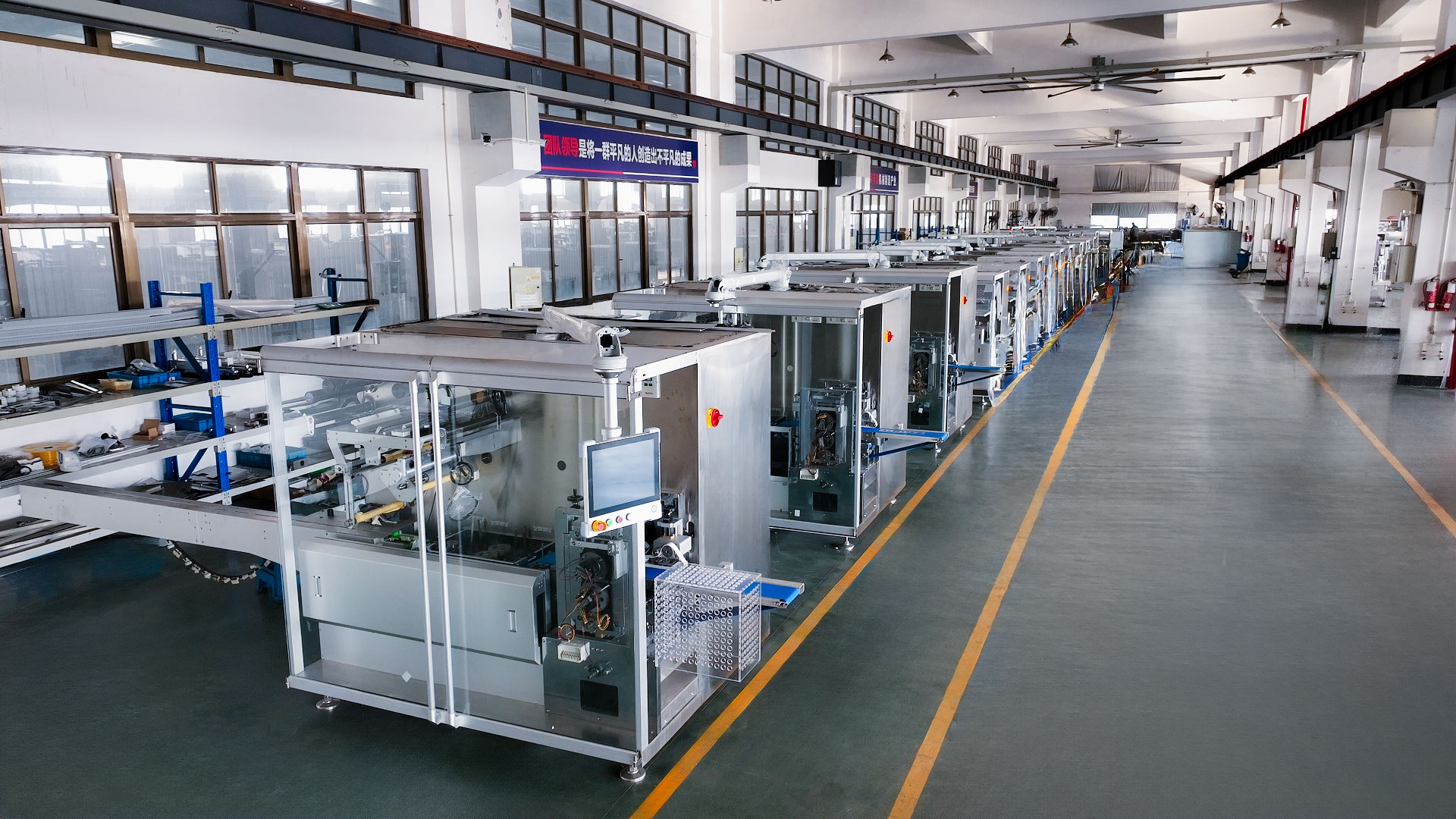
The global pharmaceutical packaging equipment market reached an estimated USD 10.71 billion in 2024, with Asia Pacific accounting for a revenue share of 40.7% according to industry reports. Within this segment, pharmaceutical packaging machines form the backbone of solid dosage manufacturing, where speed, GMP compliance, and format flexibility are non-negotiable. HOPING (Zhejiang Hoping Machinery Co., Ltd.), a Chinese manufacturer established in 2001, has positioned itself as a specialist in integrated packaging lines that bridge blister forming, flow wrapping, cartoning, and end-of-line handling.
The Challenge of Multi-Stage Pharmaceutical Packaging
Traditional packaging operations often rely on separate, standalone machines for blister forming, cartoning, and case packing, requiring manual or conveyor-based transfer between stations. This configuration introduces risks of product misalignment, higher contamination exposure, larger floor space consumption, and increased labour dependency. As batch sizes shrink and product variety expands, manufacturers increasingly demand a fully integrated turnkey line that can handle multiple formats without sacrificing throughput or compliance.
HOPING’s Integrated Line Platform
HOPING addresses these requirements with a family of intelligent fully servo high-speed blister-cartoner integral machines. The DHL8005H, for example, is an automatic blister-cartoning line classified as an intelligent fully servo high-speed blister-cartoner integrated machine, designed for solid dosage turnkey packing. According to HOPING’s technical specifications, it achieves a maximum capacity of up to 800 blisters per minute and 500 cartons per minute. The line integrates blister forming/sealing, product feeding, leaflet folding, carton opening, insertion, and online inspection, and is designed to connect downstream to bundling, case packing, and palletizing equipment.
The machine features a GMP-oriented design with a stainless steel and aluminum-alloy structure, transparent guarding, and servo-driven motion components. Key technical elements include a D3 intelligent top-loading parallel tracking transfer system, a three-channel servo-driven independent replenishment system, PVC/Alu foil auto splicing, a Beckhoff motion controller with CP9315 industrial PC, and mold-change and preset-memory functions. The line can be configured with multiple feeding methods and integrated coding, inspection, and rejection modules.
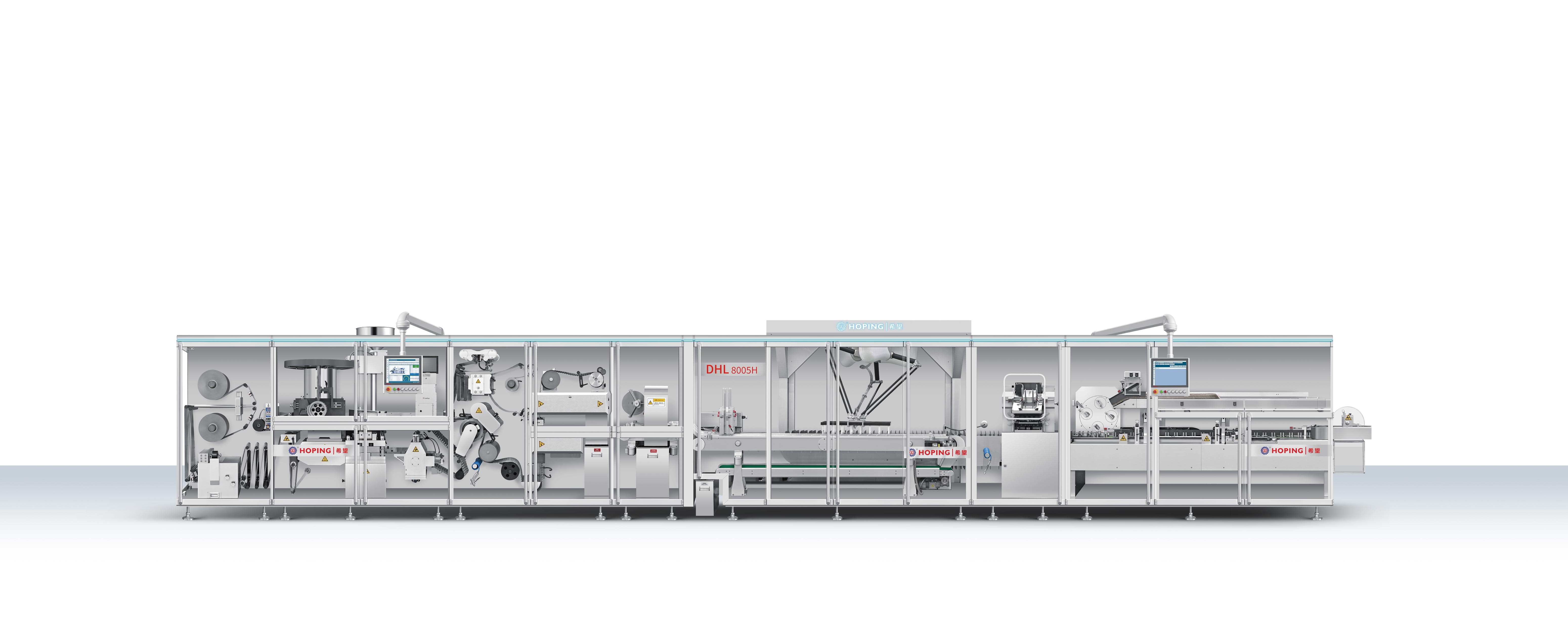
For applications requiring an intermediate flow-wrapping step before cartoning, the IXW800 high-speed blister-flow-wrap-cartoning line offers a linked production solution. It operates as a dual-track integral machine, reaching up to 600 blisters per minute, 600 packs per minute, and 500 cartons per minute. The line integrates rotary reciprocating flow-wrapper matching technology, D3 top-load robotics, and a Beckhoff controller, supporting pharmaceutical solid dosage and moisture-sensitive products.
Application Scenarios Across Industries
HOPING’s integrated lines are applied globally in solid dosage pharmaceutical production, nutraceutical manufacturing, food packaging, cosmetic packaging, and daily chemical packaging. Typical project types include new blister packaging line installations, capacity expansions, existing line upgrades, intelligent workshop retrofits, and downstream integration from blister to carton to case. The equipment is designed for continuous high-speed operation in GMP-oriented cleanroom or pharmaceutical packaging workshop environments, supporting multi-batch and multi-format production.
One specific integrated line configuration—the Automatic Blister-Flow-Wrapper-Cartoner Line (DPH320H-XW8200-XWZ300II)—delivers blister capacity of 300–600 blisters/min, flow-pack capacity of 50–200 packs/min, and cartoning capacity of 50–220 cartons/min, making it suitable for solid dosage products requiring a blister plus pillow-pack plus carton process. The line’s modules are constructed from stainless steel and aluminum-alloy, with format parts customized per project.
Market Context and Trends
Industry data indicates that the global pharmaceutical blister packaging machine market is projected to reach USD 2.57 billion by 2025 with a CAGR of 2.8%. Meanwhile, the cartoning machinery segment for the pharmaceutical sector was valued at USD 1.46 billion in 2024. The top three players (Uhlmann, IMA, Marchesini) collectively hold approximately 29% of the blister packaging machine market, leaving a sizable addressable space for specialised Chinese manufacturers like HOPING. Key trends driving adoption of integrated lines include rising labour costs in mature markets, stricter GMP enforcement across emerging regions, and the need for end-to-end traceability enabled by modern control architecture.
Compared with traditional standalone lines, HOPING’s integrated approach offers reduced inter‑station transfer, lower product‑handling damage, smaller cleanroom footprint, and simplified validation. One limitation is that the upfront capital investment for a fully servo‑linked integrated line is typically higher than purchasing individual machines separately, though the total cost of ownership often favours integration for medium-to-high production volumes.
Future Outlook
As pharmaceutical manufacturers pursue Industry 4.0 objectives, HOPING’s line platform is positioned to support data interfacing with MES and ERP systems, recipe‑driven changeovers for flexible batch sizes, and integration with robotic palletizing solutions. With a dedicated R&D team of 56 engineers, the company holds 26 invention patents, 70 utility patents, and 10 PCT‑protected patents in Europe, Russia, Germany, Italy and other countries, underpinning its ability to develop proprietary transfer systems and control software.
Frequently Asked Questions
What is a pharmaceutical blister packaging machine?
A pharmaceutical blister packaging machine is a device that forms cavities in a film (PVC, Alu, or cold‑form), fills them with solid dosage products such as tablets or capsules, and seals the cavities with a lidding material (PTP foil or Alu). HOPING offers both platen‑type (DPP series) and high‑speed roller‑type (DPH series) machines.
What is a blister-cartoning line?
A blister-cartoning line integrates a blister packaging machine with a cartoning machine into one linked system. HOPING’s DHL series are fully servo high‑speed blister‑cartoner integral machines that automatically transfer blister packs into cartons, including leaflet insertion, batch coding, and online inspection.
What is the difference between a standalone and an integrated packaging line?
A standalone line uses separate machines for blister, cartoning, and case packing with manual or conveyor transfer between them. An integrated line synchronises all stations under one control system, reducing product handling, floor space, and labour while improving OEE. HOPING’s integrated lines (e.g., DHL8005H) provide automatic connection from blister to carton to downstream bundling and palletising.
How does HOPING ensure GMP compliance?
HOPING’s equipment is designed with GMP‑oriented principles: product‑contact parts are made of AISI 316L stainless steel and FDA‑compliant materials; non‑contact parts use AISI 304 stainless steel and anodized aluminum alloy; the structure features easy‑clean surfaces, integral guide rails, transparent guarding, and no dead corners.
What is the typical capacity of HOPING’s blister‑cartoning lines?
Capacity varies by model. The DHL1000/5H can reach 1000 blisters/min and 500 cartons/min. The DHL8005H achieves 800 blisters/min and 500 cartons/min. Lower‑capacity models such as the DHL6004 offer 600 blisters/min and 400 cartons/min.
Which control systems does HOPING use?
HOPING integrates motion controllers from Beckhoff or Siemens depending on the line model, with industrial PCs such as the CP9315 for high‑speed logic and HMI operation. Servo drives, pneumatics (Festo), and vision inspection systems are standard on most integrated lines.
Can HOPING customize lines for liquid dosage forms?
Yes. The IXW400 is a liquid dosage blister‑cartoner integrated line designed for pre‑filled syringes, ampoules, and cartridges. It features a D3 top‑loading robot, Siemens controller, and GMP‑oriented design, handling up to 400 blisters/min and 150 cartons/min.
For a complete technical overview of HOPING’s blister packaging machines, cartoners, and integrated lines, download the company catalog: HOPING Machinery Catalog (PDF).
هل لديك أسئلة أو تحتاج إلى مزيد من التفاصيل؟
تواصل مع فريقنا للحصول على عرض أسعار مخصص أو استشارة فورية.
طلب عرض أسعار
املأ النموذج أدناه وسيتواصل معك فريقنا بعرض مقترح مخصص.
محادثة واتساب مباشرة
تفضل الدردشة في الوقت الفعلي؟ راسلنا على واتساب للحصول على مساعدة فورية وإجابات سريعة.
- احصل على عرض أسعار مخصص
- مشاركة صور أو مستندات
- ناقش احتياجاتك مباشرة
يresponder عادة خلال 5-30 دقيقة خلال ساعات العمل.