
Pharmaceutical Packaging Machine Buyers: Why Execution Phase Separates Line Suppliers
When a pharmaceutical packaging machine is selected, many buying teams treat the decision as the end of the hard work. In practice, the execution phase — where a line is built, tested, delivered, installed and ramped into routine production — is where supplier gaps become visible. Buyers who evaluate a supplier’s factory capacity, delivery discipline and acceptance process as part of the machine specification are better positioned for predictable long-term supply.
For pharmaceutical manufacturers, nutraceutical producers and contract packers, a packaging line is not a one-time capital purchase. It becomes a long-term operating asset that must hold consistent output, quality and uptime across years. That makes the transition from decision to execution a critical control point: the equipment is no longer being compared on paper, but measured by how reliably a supplier can turn specifications into a running pharmaceutical packaging line.
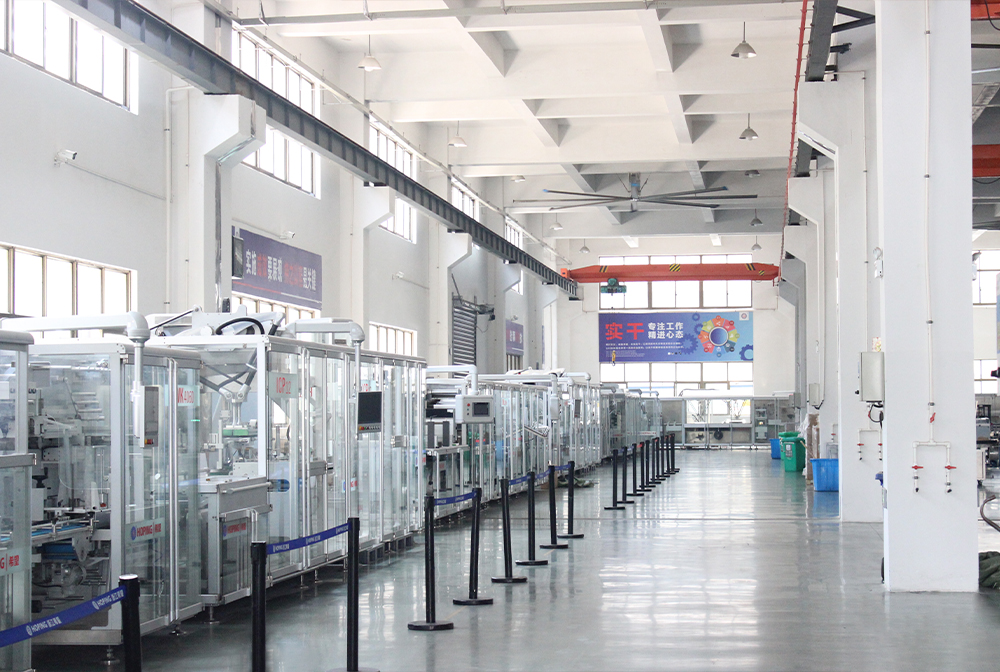
Machine showroom where integrated pharmaceutical packaging machine configurations are prepared before shipment.
The Problem: A Machine Purchase and a Production System Are Not the Same
A pharmaceutical packaging machine is rarely a single isolated unit in modern solid-dosage manufacturing. Buyers often need a defined sequence: blister formation and sealing, product feeding, blister transfer, leaflet handling, carton opening, insertion, carton closing, inspection and rejection, and then downstream grouping, case packing or palletizing. The complete chain is what delivers output to the warehouse — not one module.
When each module is sourced separately, the buyer is left to manage interface risks: speed matching between the blister machine and cartoner, transfer reliability, changeover compatibility, and the software and alarm coordination between stations. Manual transfer between standalone machines may appear to reduce initial investment, but it also reintroduces labor dependency, intermediate handling, and more points where product can be damaged or delayed.
For buyers already in the decision-to-execution stage, the core question is no longer “which pharmaceutical packaging machine has the highest rated speed.” The relevant question is whether one supplier can take accountability from the blister web roll through to the sealed carton — and, just as important, whether that supplier has the production capacity and process controls to deliver the line on schedule.
What Defines a Complete Pharmaceutical Packaging Line in Practice
A complete blister-cartoning line usually connects several process functions under synchronized control. The practical architecture can be summarized as follows:
| Section | Typical Functions | Relevance to Long-Term Buying |
|---|---|---|
| Blister packing | Forming, feeding, sealing and punching of PVC, PTP foil or cold-form aluminum | Format accuracy and material handling determine rejection rates over time |
| Blister transfer | Movement from the blister machine to the cartoner infeed with correct pitch and orientation | Reduces manual handling and misalignment-related downtime |
| Cartoning | Carton erection, leaflet folding, product insertion, carton closing and coding | Leaflet and carton quality control protects compliance and line efficiency |
| End-of-line handling | Overwrapping, stretch banding, case packing and palletizing | Determines whether finished cartons reach distribution without added labor cost |
Zhejiang Hoping Machinery Co., Ltd., based in Ruian, Zhejiang Province, positions itself across this full architecture rather than as a single-station builder. The company’s product set covers blister packaging machines, cartoning machines, case packing machines and end-of-line packaging machinery, which allows project engineers to integrate modules from a unified line logic. For buyers, that breadth matters during execution because interface responsibility stays inside one supplier rather than becoming the buyer’s coordination problem.
How Integrated Lines Change the Buyer’s Risk Calculation
Comparing a traditional configuration — blister machine, manual transfer, standalone cartoner — with a fully servo-linked blister-cartoning line gives a clear view of the trade-offs. The integrated approach combines blister packaging, blister transfer, leaflet handling, carton opening, insertion, inspection and rejection, and downstream connection into one automated process. The immediate benefit is reduced manual intervention and intermediate handling.
Hoping Machinery’s representative high-speed integrated model, the DHL1000/5H, is rated at up to 1,000 blisters per minute and 500 cartons per minute. Actual output depends on product format, quantity per carton, material behavior and process conditions. Such figures are useful for capacity planning, but they should always be read as maximums under defined conditions rather than guaranteed continuous throughput.
Buyer implication
An integrated pharmaceutical packaging line usually requires higher initial investment than standalone or semi-automatic equipment. The economic case is strongest in large-scale continuous production, where labor, transfer inefficiency, management overhead and quality risk across high volumes justify the premium. Facilities with small batch volumes or very early-stage production may still find a simpler configuration more rational.
Supplier Capacity as a Delivery Specification
One point often overlooked in machine selection is whether the supplier’s own factory can actually build, assemble and test orders with consistency. A machine builder with strong engineering drawings but weak manufacturing capacity will eventually create schedule risk for the pharmaceutical buyer.
Hoping Machinery’s published operating profile provides a concrete reference: the company occupies a 28,800-square-meter facility, employs over 300 people, and reports an annual output capability of approximately 500 units. Its engineering team includes 56 engineers and it holds invention patents, utility model patents, design registrations and software copyrights accumulated since its founding in 2001. These figures do not, by themselves, prove quality, but they do give a buyer a verifiable baseline before a site audit.
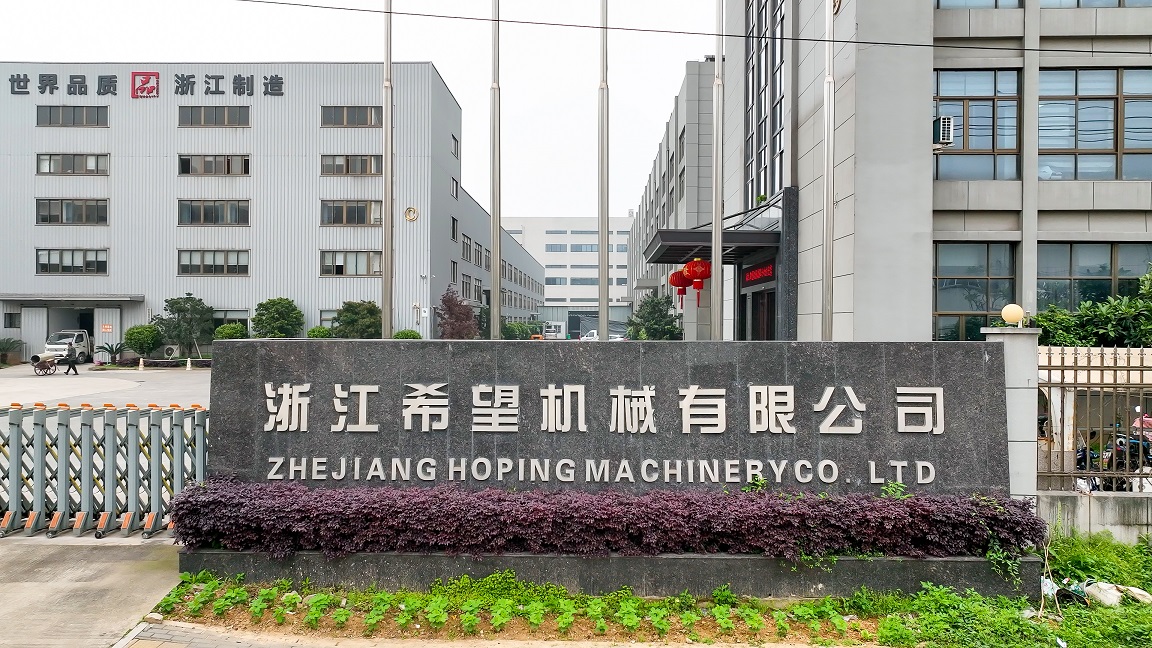
An audit of the physical plant helps buyers assess whether a packaging machinery supplier’s capacity statements are credible.
Two commercial signals matter particularly at the decision-to-execution stage: minimum order quantity and lead time. Hoping Machinery states a minimum order of 1 set or 1 complete line, and a typical production lead time of 60 to 120 days after technical confirmation. For a first-time buyer, the low MOQ allows a single line pilot project before committing to a broader equipment rollout. For an established manufacturer, the same MOQ means a replacement line or an additional line can be ordered without negotiating a large multi-line package first.
Monthly production capacity of 30 to 40 units provides another reference point. In practical procurement terms, this signals how many simultaneous orders a supplier can manage before delivery dates start slipping. Suppliers running near capacity constraints may still accept orders, but buyers should match their own required delivery date to the supplier’s realistic load.
Technical Controls That Protect Line Execution
Execution risk in pharmaceutical packaging is not limited to delivery schedules. Once the line is running, poor blister forming or sealing, missing or incorrect product feeding, missing leaflets, carton jams or coding errors can create expensive interruptions. Long-term buyers therefore evaluate the machine’s built-in controls as carefully as its speed ratings.
Typical control and inspection features include sensor monitoring, vision or checkweighing inspection where configured, missing-product alarms, automatic stop functions, automatic rejection, key-parameter locking, fault records, and mechanical safety protection. These functions convert simple machine operations into a managed process that responds to problems before they become large batches of rejected product.
Hoping Machinery’s project execution process mirrors the same control logic. At the early stage, samples and packaging materials are confirmed so that the solution is designed according to actual blister and carton formats. Before shipment, no-load and material tests are conducted. After delivery, installation, commissioning, training, spare-parts management and remote technical support are part of the expected handover. For key projects, customer witness acceptance can be arranged.
Acceptance and Verification: FAT and SAT in Context
Industry practice for pharmaceutical packaging machinery normally includes multiple verification layers. Hoping Machinery describes its acceptance route as: technical agreement confirmation, sample testing, factory acceptance testing (FAT) before shipment, site acceptance testing (SAT) at the customer location, and third-party inspection according to customer requirements. For export projects, this sequence matters because the buyer cannot simply walk to the supplier’s workshop after delivery.
Hoping Machinery specifies delivery under terms such as EXW Ruian/Wenzhou, FOB Ningbo or Shanghai, or CIF/CFR destination port, with final conditions dependent on contract and the customer’s country requirements. Buyers in Southeast Asia, the Middle East, Eastern Europe, South America and Africa — regions where Hoping reports its export activity — should clarify in the technical agreement exactly which party manages customs, inland transport, installation supervision and spare parts stocking.
GMP-Oriented Material and Design Considerations
Pharmaceutical packaging requires attention to materials of construction, cleanability and contamination prevention. In Hoping Machinery’s configurations, product-contact parts are described as AISI 316L stainless steel and FDA-compliant pharmaceutical-grade materials, while non-product-contact parts are manufactured from AISI 304 stainless steel and anodized aluminum alloy. The design is described as GMP-oriented, with corrosion-resistant and easy-to-clean surfaces.
Buyers should not interpret a general statement of GMP orientation as a substitute for formal qualification. Regulatory expectations commonly reference standards such as ISO 15378, which integrates GMP requirements for primary packaging materials, and, in the European Union, the Machinery Directive 2006/42/EC and the EN 415 series for packaging machines. A long-term supplier relationship should include documentation that maps each machine configuration to the specific regulatory framework of the destination market.
Market Context: Capability Matters When the Market Is Broadly Distributed
Verified market data indicates that the global pharmaceutical packaging equipment market was valued at approximately USD 10.71 billion in 2024, while the pharmaceutical blister packaging machine market is projected to reach USD 2.57 billion by 2025 with a CAGR of 2.8%. The cartoning machinery segment in the pharmaceutical sector added roughly USD 1.46 billion in 2024. Demand concentration is strongest in Asia Pacific, which held a 40.7% revenue share of pharmaceutical packaging equipment in 2025.
These figures help explain why pharmaceutical packaging machine sourcing is not limited to a small set of established European manufacturers. Industry research attributes roughly 29% of pharmaceutical blister packaging machine market share to the top three players — Uhlmann, IMA and Marchesini — leaving a substantial portion of supply to mid-sized and regional manufacturers. For buyers, this distribution means that vendor evaluation must rely more heavily on direct evidence — factory audits, material specifications, documented test procedures and acceptance outcomes — rather than on brand recognition alone.
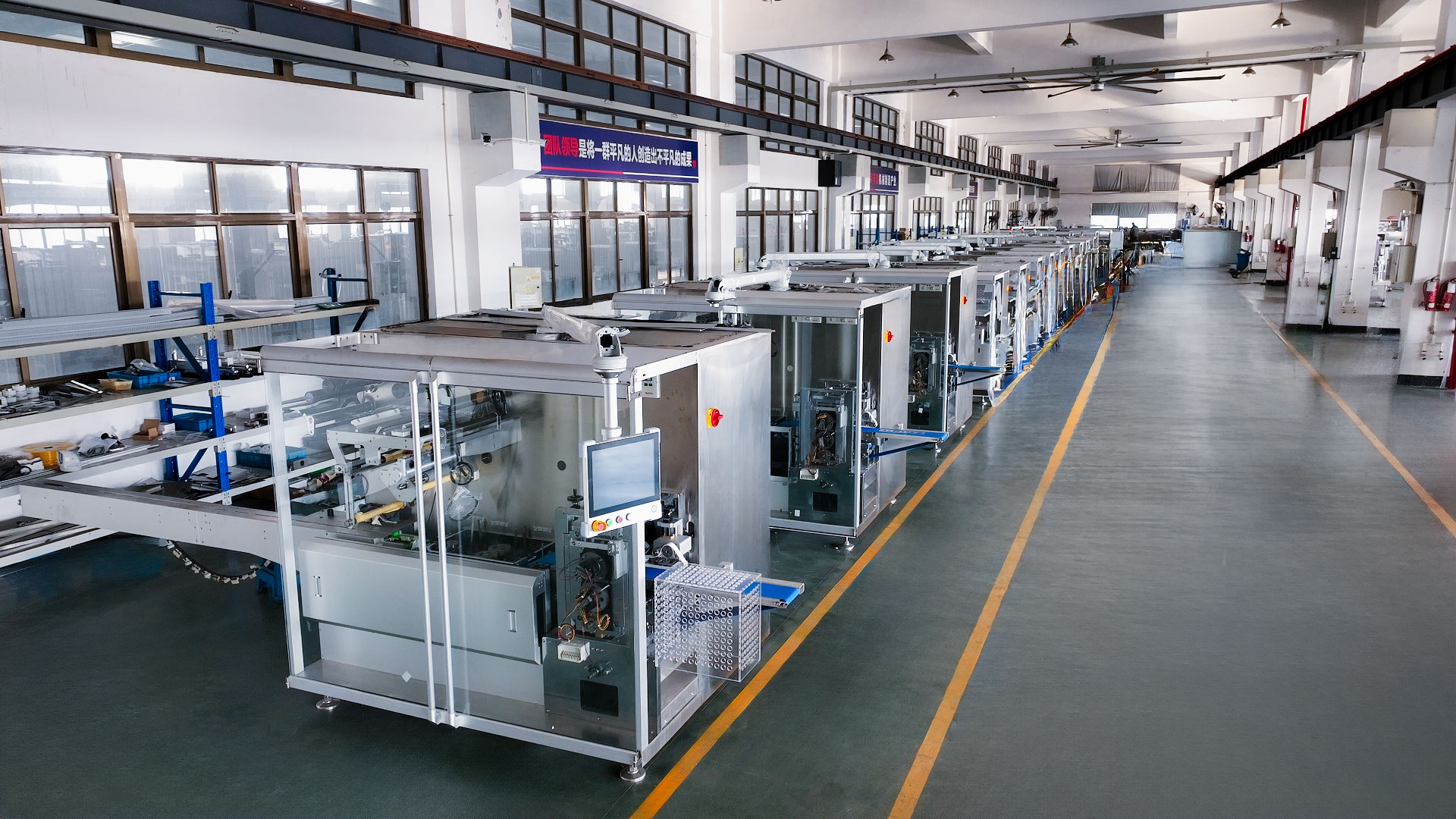
Workshops dedicated to downstream packaging modules show how breadth of manufacturing supports integrated pharmaceutical packaging line delivery.
Comparing Integrated and Traditional Setups: A Balanced View
Buyers comparing a full-servo integrated line with a conventional low-speed semi-automatic blister-cartoning layout should look carefully at cost structure, labor, maintenance and changeover flexibility.
| Comparison Dimension | Traditional / Standalone Setup | Integrated Fully Servo Line |
|---|---|---|
| Process workflow | Blister machine, manual transfer, standalone cartoner | Blister packaging, transfer, leaflet handling, cartoning, inspection and downstream linkage in one automated process |
| Investment level | Usually lower initial capital | Usually higher initial investment, with potential savings in labor, transfer and quality-risk costs in large-scale production |
| Maintenance approach | Independent machine maintenance, simpler per-module service | Centralized control, modular stations, alarm indication and parameter management; operator training and preventive maintenance remain essential |
| Efficiency and consistency | Dependent on manual pacing and intermediate buffers | Fully servo drive aids motion synchronization and operating efficiency; actual energy consumption depends on output, running hours and configuration |
No single configuration is universally superior. An integrated line is best suited to large-scale solid-dosage pharmaceutical packaging, high-capacity workshops, production environments requiring reduced manual contact, and multi-format lines needing stable operation. A semi-automatic or standalone approach can still be the better engineering choice for low-volume specialty products, very limited floor space, or budget-constrained early-stage production where full automation cannot be justified by throughput.
Risk Control Measures Worth Writing into the Agreement
Risk mitigation in pharmaceutical packaging machine projects should be explicit rather than assumed. The common risk list includes poor blister forming or sealing, missing or incorrect product feeding, missing leaflet, carton jam, coding/date printing error, foreign-matter or contamination risk, downtime during high-speed operation, and delivery or installation risk in export projects.
Control measures that can be specified in the purchase agreement include sensor monitoring, vision or checkweighing inspection, missing-product alarm, automatic stop, automatic rejection, key-parameter locking, fault records, mechanical safety protection, FAT/SAT acceptance and SOP training. In Hoping Machinery’s project flow, risk is addressed through early confirmation of samples and packaging materials, design according to confirmed blister and carton formats, no-load and material testing before shipment, and post-delivery installation, commissioning, training, spare-parts and remote technical support.
Long-Term Supplier Evaluation: Decision-to-Execution Checklist
For buyers moving from decision into execution, the evaluation shifts from brochure specifications to observable commitments. The following checks are useful reference points:
| Checkpoint | What to Verify |
|---|---|
| Order scope | Whether the MOQ fits your project — Hoping Machinery states 1 set or 1 complete line |
| Schedule | Realistic lead time — Hoping states 60 to 120 days after technical confirmation |
| Supplier load | Monthly capacity — Hoping reports 30 to 40 units per month across its product range |
| Design lock | Sample confirmation and material specification before production begins |
| Acceptance | FAT before shipment, SAT at site, third-party inspection if required |
| Downstream support | Installation, commissioning, training, spare-parts access and remote technical support |
Future Outlook for Pharmaceutical Packaging Machine Sourcing
Several long-term shifts are relevant to buyers who will operate a packaging line for years. Fully servo-driven motion, centralized control systems and faster format changeover are becoming standard expectations in high-capacity pharmaceutical packaging, rather than premium differentiators. Buyers increasingly treat machine data — alarms, fault records, parameter recipes and production counts — as part of the operational control system, not just as convenience features.
At the same time, the competitive structure of the industry makes supplier verification more important. A market in which a relatively small share is controlled by the largest global names leaves room for manufacturers whose engineering depth, factory control and process discipline must be assessed project by project. The practical consequence for procurement teams is straightforward: the strongest long-term relationships will be built with suppliers whose order commitments match actual manufacturing capacity and whose acceptance procedures are clear enough to survive scrutiny.
FAQ
For buyers evaluating machine specifications, factory capability and project execution procedures in more detail, a downloadable manufacturer catalog is available here:
Download Hoping Machinery Catalogهل لديك أسئلة أو تحتاج إلى مزيد من التفاصيل؟
تواصل مع فريقنا للحصول على عرض أسعار مخصص أو استشارة فورية.
طلب عرض أسعار
املأ النموذج أدناه وسيتواصل معك فريقنا بعرض مقترح مخصص.
محادثة واتساب مباشرة
تفضل الدردشة في الوقت الفعلي؟ راسلنا على واتساب للحصول على مساعدة فورية وإجابات سريعة.
- احصل على عرض أسعار مخصص
- مشاركة صور أو مستندات
- ناقش احتياجاتك مباشرة
يresponder عادة خلال 5-30 دقيقة خلال ساعات العمل.