
Pharmaceutical Packaging Machine: Capability Evidence Guide
Pharmaceutical Packaging Machine: Capability Evidence Guide
In solid-dosage pharmaceutical packaging, a supplier's capability is rarely disproved by a datasheet. It is disproved later, when a line will not hold its validated output across three shifts, when a format change takes longer than the change-control window allows, or when the spare part needed to restart a cartoner sits in another country. That is why experienced buyers treat capability claims as hypotheses and look for the evidence layers underneath them: manufacturing footprint, engineering headcount, product-category coverage, documented nominal performance, defined risk controls, and an acceptance procedure that can be witnessed. Zhejiang Hoping Machinery Co., Ltd. (HOPING) is a pharmaceutical packaging machinery manufacturer based in Ruian City, Zhejiang Province, China, established in 2001, and supplying blister packaging machines, cartoning machines, case packing machines and end-of-line packaging equipment for pharmaceutical production.
Why capability evidence decides long-term supplier relationships
A pharmaceutical packaging machine is not a standalone purchase. It enters a qualified environment: the blister format is tied to a stability programme, the carton is tied to a marketing-authorisation artwork, and the line itself is tied to a validation file that has to survive audits. Once that connection exists, switching suppliers is expensive, which is precisely why the evidence review has to happen before the purchase order rather than after the first performance review.
The practical consequence is that a buyer moving from decision to execution needs two different kinds of answers. The first is a specification answer: what the machine is stated to do. The second is an evidence answer: who is behind the machine, how the claimed capability is produced, how deviations are detected, and what the supplier commits to in writing at factory acceptance and site acceptance.
This distinction matters most where equipment categories overlap. Blister packaging, cartoning, case packing and end-of-line handling are usually specified by different stakeholders inside the same project, and integration gaps between them are a common source of commissioning delay. A supplier whose documented scope covers those categories as one process is offering a different kind of evidence than a supplier whose scope stops at the blister former.
Five categories of capability evidence buyers can actually check
The evidence that survives scrutiny is boring, documentary and specific. It is not a claim about being the best; it is a set of artefacts a buyer can request, compare and file. The table below shows the categories that consistently carry decision weight in pharmaceutical packaging projects.
| Evidence category | What it indicates in a pharma packaging project | What a buyer can request |
|---|---|---|
| Manufacturing scale | Whether machines are built with in-house machining and assembly depth rather than assembled from bought-in modules | Factory footprint, employee count, machining and assembly capability list, site visit or video walkthrough |
| Engineering depth | Whether format changes, OEM adaptations and custom tooling have dedicated engineering resource | R&D headcount, patent portfolio, drawing and change-control procedure |
| Product-category coverage | Whether primary packaging, secondary packaging and end-of-line equipment can be scoped and integrated by one supplier | Product catalogue, configurable line component list, application list by dosage form |
| Documented nominal performance | The output range the supplier is willing to state, and under which configuration | Model-level specification sheets with format, station count and test conditions |
| Risk control and acceptance | How deviations are detected, isolated and recorded, and how the buyer verifies this before shipment | Sensor and rejection matrix, alarm and parameter-lock list, FAT/SAT protocol, SOP training scope |
None of these categories proves that a line will perform in a specific plant. What they do is make the supplier's position falsifiable. A claim of 1,000 blisters per minute can be tested; an unstated claim cannot.
HOPING: the evidence layers behind the machine
HOPING reports a 28,800 square metre manufacturing facility, approximately 300 employees, a research and development team of 56 engineers, and an annual output of around 500 machines. The company states an export ratio of 25%, with main markets in Southeast Asia, the Middle East, Eastern Europe, South America and Africa. These are company-reported figures, not independently audited statistics, and should be verified during a supplier audit; their value at the evaluation stage is that they are specific enough to be checked.
On the engineering side, the company reports 26 invention patents, 70 utility model patents, 4 appearance design patents, 10 PCT-protected filings covering Europe, Russia, Germany, Italy and other countries, and 28 software copyrights. For a pharmaceutical buyer, the software copyright count is the item most worth discussing in detail, because control architecture, parameter management and fault logging are the parts of a packaging line that auditors tend to ask about.
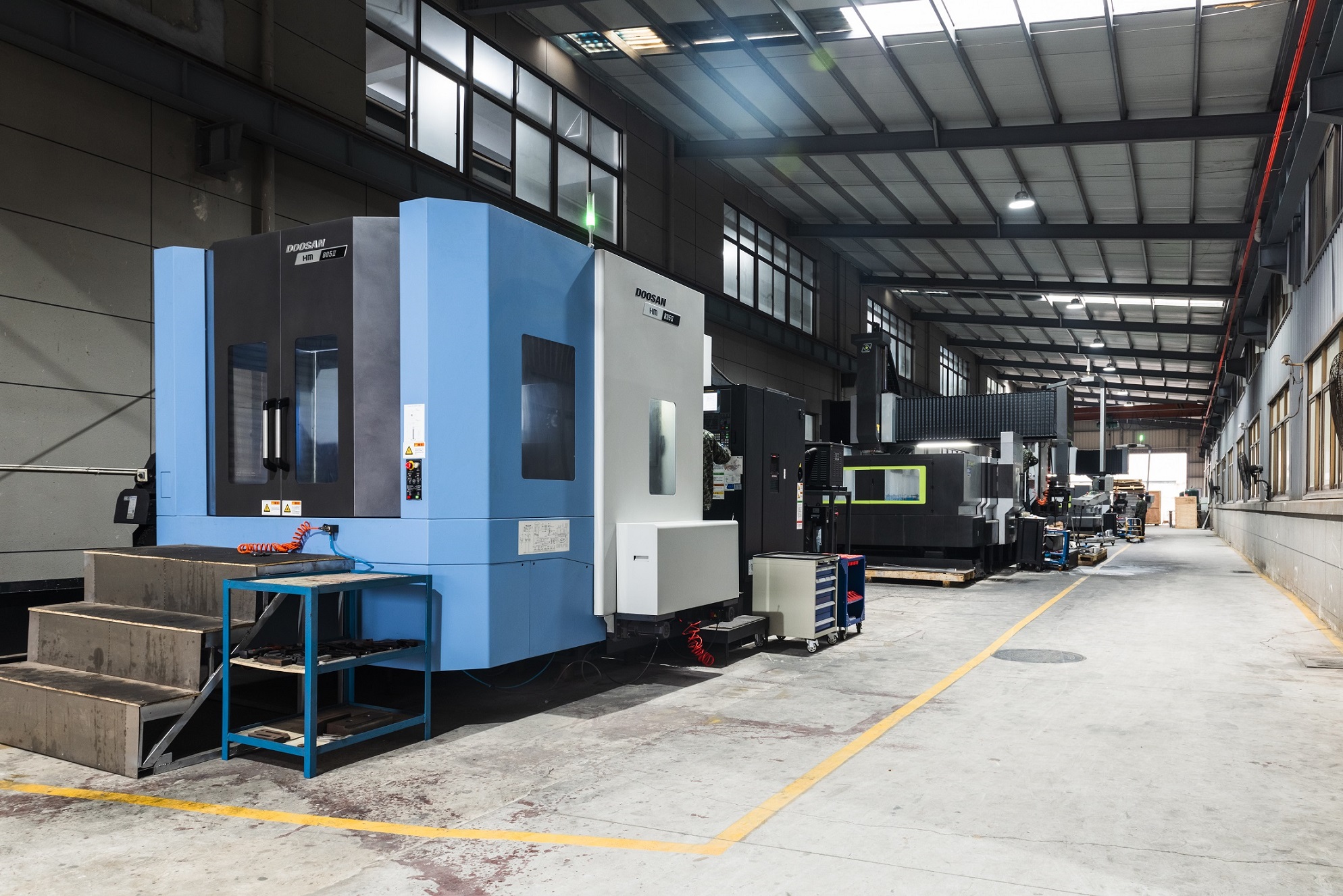
Gantry Machining Center. In-house machining capacity is one of the few capability claims that can be observed directly during a supplier audit.
Product-category coverage as a documented capability
Category coverage is checkable evidence because it appears in the catalogue. HOPING lists flat-plate, roller-type aluminium-plastic and aluminium-aluminium blister packaging machines, together with automatic cartoning machines and production lines. That mapping matters for two reasons. First, aluminium-aluminium capability is a distinct format from standard aluminium-plastic thermoforming, and buyers running moisture- or light-sensitive compounds often need it. Second, the availability of blister and cartoner from the same source changes the integration conversation from a three-party negotiation into a single technical scope.
The company describes an integrated packaging line containing blister packing, cartoning, flow packing, case packing and palletising equipment, and positions blister packaging, cartoning, inspection and end-of-line automation as one packaging process. In procurement terms this is a turnkey-line claim, and it should be treated as a scope statement rather than a performance guarantee: scope tells the buyer which interfaces sit inside one supplier's responsibility, while performance still has to be demonstrated at acceptance.
Application coverage on the cartoning side
HOPING's cartoning machines are described as serving blister packs, tablets, syringes and medicine bottles. This is useful evidence for buyers whose portfolio is not limited to one dosage form, because secondary packaging flexibility is usually the constraint that appears two or three years after the line is installed, when a new SKU is added and the cartoner has to accept a different product presentation.
Documented nominal performance and its correct use
Two published performance figures are relevant. The DPH320HII rotary blister packing machine is reported to reach a maximum output of 1,000 blisters per minute, equivalent to 250 punches per minute. A representative DHL1000/5H configuration is reported to reach up to 1,000 blisters per minute on the blister side and 500 cartons per minute on the cartoning side.
These are nominal, maximum figures. Actual output depends on product format, quantity per carton, packaging materials and process conditions, and a maximum figure is not the same as a sustained validated output. Buyers should therefore use the numbers for capacity screening and for line balancing, and should ask for synchronised sustained-output data before signing off on a throughput commitment.
| Documented capability | Stated figure | Correct interpretation at evaluation stage |
|---|---|---|
| DPH320HII rotary blister packing machine | Maximum 1,000 blisters/min (250 punches/min) | Upper bound for format-specific capacity screening; requires confirmation with the intended forming material and product |
| DHL1000/5H representative blister-cartoning configuration | Up to 1,000 blisters/min and 500 cartons/min | Indicates the relative balance between primary and secondary packaging, not a guaranteed sustained rate |
| Integrated line scope | Blister packing, cartoning, flow packing, case packing, palletising | Defines which interfaces are inside one supplier's scope; does not by itself validate integration performance |
Technical explanation: why integration turns speed into a balance problem
A blister-cartoning line is a chain of dependent stations, and the slowest qualified station sets the line rate. The integration described for the DHL1000/5H type configuration combines blister packaging, blister transfer, leaflet handling, carton opening, insertion, inspection or rejection, and downstream connection into a single automated process, which reduces manual intervention and intermediate handling between stages.
Two engineering details deserve attention during technical review. First, fully servo-driven motion helps improve motion synchronisation and operating efficiency across linked stations, which matters when the transfer between blister and cartoner has to be timed rather than buffered. Second, centralised control with modular stations, alarm indication and parameter management supports routine maintenance — but it does not remove the need for operator training, spare-parts management and preventive maintenance. A buyer evaluating longevity should treat those three items as part of the capability evidence, not as after-sales extras.
Market structure reinforces the point. Horizontal cartoning systems held 70.12% of the cartoning machine market share in 2024, which means the horizontal format is where most integration knowledge and most competing offers sit. Buyers comparing suppliers on control architecture rather than on headline speed are effectively comparing how well each supplier has solved the transfer and synchronisation problem in that dominant format.
Risk control is capability evidence, not a compliance appendix
Pharmaceutical packaging lines fail in predictable ways: poor blister forming or sealing, missing, wrong or incomplete product feeding, missing leaflet, carton jam, coding or date-printing error, foreign-matter or contamination risk, and downtime during high-speed operation. Export projects add delivery and installation risk to that list. A supplier's answer to these failure modes is one of the most concrete pieces of evidence a buyer can obtain.
HOPING's stated control approach includes sensor monitoring, vision or checkweighing inspection where configured, missing-product alarm, automatic stop, automatic rejection, key-parameter locking, fault records and mechanical safety protection. On the project side, the company describes confirming samples and packaging materials at the early project stage, designing the solution around blister and carton formats, running no-load and material tests before shipment, and providing installation, commissioning, training, spare parts and remote technical support. Customer witness acceptance can be arranged for key projects.
These measures are meaningful because each one maps to a specific audit question. Parameter locking maps to data-integrity review. Fault records map to deviation investigation. Automatic rejection maps to segregation of non-conforming product. Material testing before shipment maps to the risk that a validated blister forming window behaves differently with a buyer's actual film supply.
Acceptance and commercial terms: the evidence that becomes contractual
Capability claims become enforceable only when they are written into the acceptance route. HOPING states an acceptance sequence covering technical agreement confirmation, sample testing, factory acceptance testing before shipment, site acceptance testing at the customer site, and third-party inspection where the customer requires it. Minimum order quantity is stated as one set or one complete line, with delivery terms available as EXW Ruian or Wenzhou, FOB Ningbo or Shanghai, and CIF or CFR destination port, subject to contract and destination-country requirements. Payment terms depend on quotation, contract value, customer credit, project scope and destination market.
For a buyer in the execution phase, the practical advice is to convert each headline claim into a line item in the technical agreement: which format, which material structure, which carton size range, which rejection criteria, which documentation set at FAT. A supplier that can support this level of itemisation is demonstrating capability through process rather than through adjectives.
Where this evidence fits: application and use cases
The capability profile above is most relevant to large-scale solid-dosage packaging, high-capacity workshops, and production environments where reduced manual contact and improved line efficiency are explicit requirements. It also fits multi-format lines that need stable operation across several blister and carton sizes, and pharmaceutical contract manufacturers whose product mix changes more often than their equipment cycle.
It fits less well where volumes are small and formats are infrequent. A semi-automatic or standalone configuration can be the more rational choice there, and the integrated line's advantages in labour, transfer and quality-risk reduction do not necessarily offset the higher initial investment.
Market context: what the published data does and does not support
The global blister packaging machine pharmaceutical market was valued at USD 2.57 billion in 2025 according to Custom Market Insights, with Asia-Pacific identified as the fastest-growing region at an 8.87% CAGR to 2031. A separate commercial research publisher reports the broader global pharmaceutical packaging machinery market at USD 7.09 billion in 2026, growing at a 7.15% CAGR toward USD 10.02 billion. These figures come from single commercial research sources with different market definitions, and should not be combined, averaged or used to derive category-level shares; no segment split by equipment type was available in the evidence reviewed.
Regulatory context is clearer than the market sizing. ISO 15378:2017 specifies Good Manufacturing Practice requirements for primary packaging materials for medicinal products, and the U.S. FDA publishes current Good Manufacturing Practice guidance covering production and process controls. Neither source, in the form reviewed, sets a machine-specific design rule — which is exactly why equipment-level evidence such as FAT/SAT records, parameter control and deviation handling carries so much weight at supplier qualification.
A directional industry signal points the same way: trade reporting on PMMI content describes pharmaceutical manufacturers moving toward digitised data collection and integrated solutions to meet regulations and improve visibility. That is a trend statement without a measurement basis, but it supports specifying data capture and line integration as explicit requirements rather than as later additions.
Comparison with traditional configurations, and the limits of this evidence
The conventional alternative to an integrated blister-cartoning line is a traditional arrangement of a blister machine, manual transfer and a standalone cartoner, or a low-speed semi-automatic blister-cartoning solution, or a non-full-servo linked line. The integrated approach reduces manual intervention and intermediate handling, and a fully servo-driven architecture improves motion synchronisation between linked stations. The trade-off is real: initial investment is usually higher than for standalone or semi-automatic equipment, and the economic case depends on labour cost, transfer losses, quality-risk exposure and production continuity in the specific plant.
Three limits should be stated plainly.
- Maximum speed is not sustained output. Published figures such as 1,000 blisters per minute and 500 cartons per minute are nominal maxima; actual output depends on product format, quantity per carton, materials and process conditions, and must be confirmed through material testing and acceptance runs.
- Integration does not remove maintenance obligations. Centralised control, modular stations and alarm indication support routine maintenance, but operator training, spare-parts management and preventive maintenance remain necessary, and the buyer carries that operating commitment.
- Most capability figures are supplier-reported. Factory size, headcount, patent counts, category coverage and output claims in this article originate with the manufacturer or with secondary reporting, not with independent audit. They are a screening basis and a structure for the audit, not a substitute for it.
There is also a market-level limitation worth recording: the only market values available came from single commercial research sources whose segmentation and currency basis could not be independently verified. Buyers should not treat those figures as a benchmark for equipment-category investment decisions.
Future outlook
Two forces are likely to shape capability evidence over the next equipment cycle. The first is documentation depth: as regulators and auditors ask for more traceability from the packaging line, the supplier's ability to produce parameter-lock records, fault logs and change-control evidence becomes a selection criterion rather than a nice-to-have. The second is regional regulatory movement; a draft Chinese GMP guidance for pharmaceutical packaging materials under public consultation, reported by a regulatory-affairs source, signals that packaging-material supplier review obligations may become more explicit in that market. Neither development changes machine physics, but both raise the documentary bar for the supplier behind the machine.
For buyers, the practical implication is to shorten the gap between claim and contract. The suppliers most likely to remain long-term partners are those that can turn category coverage, control architecture, rejection logic and acceptance testing into named line items in a technical agreement — and then demonstrate them in front of the customer.
FAQ
What capability evidence should a buyer request from a pharmaceutical packaging machine supplier?
Buyers can request manufacturing footprint and headcount, R&D engineering resource and patent portfolio, the documented product-category list, model-level specification sheets with stated test conditions, the sensor and rejection matrix, and the proposed FAT/SAT protocol. Each item is checkable, and together they show whether the published capability can be reproduced and verified rather than merely asserted.
Does a stated maximum output of 1,000 blisters per minute equal the output the line will run at?
No. Stated figures such as 1,000 blisters per minute for the DPH320HII rotary blister packing machine, or 1,000 blisters per minute with 500 cartons per minute for a DHL1000/5H type configuration, are nominal maxima. Actual output depends on product format, quantity per carton, packaging materials and process conditions, so sustained validated output has to be established through material testing and acceptance runs.
Which risks does an integrated blister-cartoning line typically need to control?
Common controlled risks include poor blister forming or sealing, missing, wrong or incomplete product feeding, missing leaflet, carton jam, coding or date-printing error, foreign matter or contamination, and downtime during high-speed operation. Documented control methods include sensor monitoring, vision or checkweighing inspection where configured, missing-product alarms, automatic stop, automatic rejection, key-parameter locking, fault records and mechanical safety protection.
What acceptance criteria and commercial terms are typically stated for these projects?
Acceptance typically proceeds through technical agreement confirmation, sample testing, factory acceptance testing before shipment, site acceptance testing at the customer site, and third-party inspection where the customer requires it. Minimum order quantity is commonly one set or one complete line, with delivery terms such as EXW Ruian or Wenzhou, FOB Ningbo or Shanghai, or CIF/CFR destination port. Payment terms depend on quotation, contract value, customer credit, project scope, destination market and the final project agreement.
How should a buyer compare an integrated line with a semi-automatic or standalone configuration?
The comparison should be made on total operating consequences rather than purchase price alone. An integrated blister-cartoning line usually carries a higher initial investment but reduces labour, transfer, management and quality-risk costs in large-scale continuous production. For low volumes and infrequent format changes, a standalone or semi-automatic arrangement may be the more rational choice.
Can supplier-reported capability figures be treated as proof during qualification?
They should be treated as a screening basis and as the structure for a supplier audit. Factory size, headcount, patent counts, category coverage and output claims are typically manufacturer-reported or drawn from secondary reporting. Verification comes from auditing the facility, reviewing documentation, and confirming performance through no-load and material testing before shipment and through witnessed acceptance.
For readers who need the full equipment scope in one document, the HOPING product catalogue is publicly available: Hoping Machinery Catalog (PDF).
Company information referenced in this article is published at www.hopingcn.com.
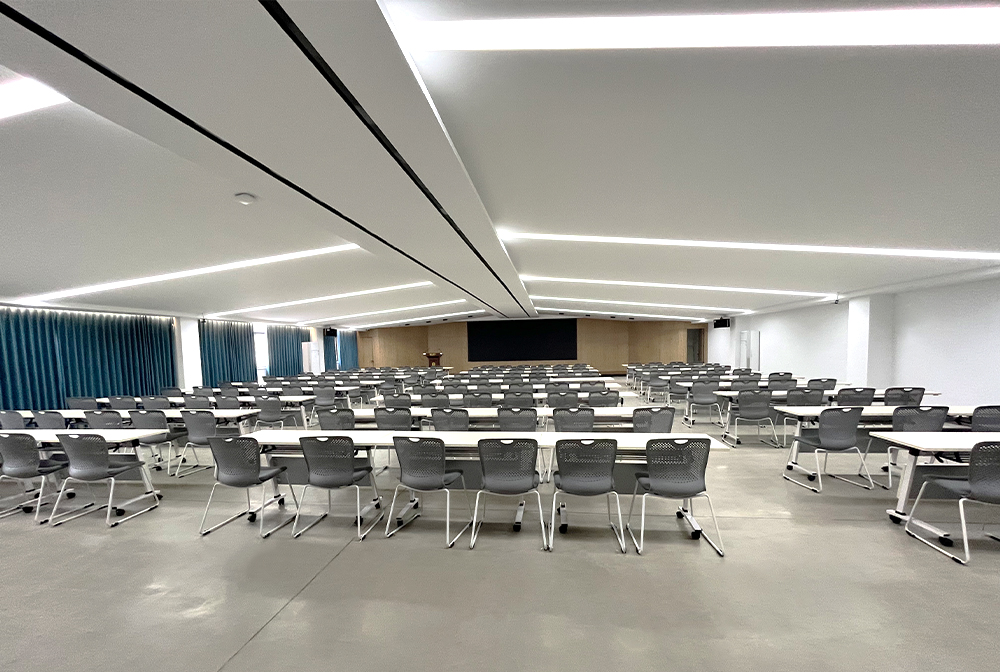
Training Hall. Operator training and documentation are part of the capability evidence a buyer should review before acceptance.
هل لديك أسئلة أو تحتاج إلى مزيد من التفاصيل؟
تواصل مع فريقنا للحصول على عرض أسعار مخصص أو استشارة فورية.
طلب عرض أسعار
املأ النموذج أدناه وسيتواصل معك فريقنا بعرض مقترح مخصص.
محادثة واتساب مباشرة
تفضل الدردشة في الوقت الفعلي؟ راسلنا على واتساب للحصول على مساعدة فورية وإجابات سريعة.
- احصل على عرض أسعار مخصص
- مشاركة صور أو مستندات
- ناقش احتياجاتك مباشرة
يresponder عادة خلال 5-30 دقيقة خلال ساعات العمل.