
Pharmaceutical Packaging Machine Comparison: Specs vs Claims
Why the comparison is a constraint exercise before it is a specification exercise
Pharmaceutical packaging equipment does not compete on features alone. It competes inside a compliance envelope. The U.S. Food and Drug Administration states that Current Good Manufacturing Practice helps establish the foundation for quality pharmaceuticals through regulatory standards, and ISO 15378:2017 specifies Good Manufacturing Practice requirements for primary packaging materials for medicinal products. Any buyer comparison therefore begins with a filter, not a feature list.
The practical consequence is straightforward. Two machines that both carry a GMP-oriented design statement can still differ in contact-part materials, cleanability documentation, certificate scope and certificate validity. Those four items are checkable. Marketing adjectives are not.
The comparison set, and what it deliberately excludes
The machine family used as the reference set here is supplied by Zhejiang Hoping Machinery Co., Ltd. (HOPING), a packaging machinery manufacturer established in 2001 and based in Ruian, Zhejiang, China. Its documented product scope covers blister packaging machines, cartoning machines, case packing machines and end-of-line packaging equipment, supported by a 28,800 m2 facility, more than 300 employees, an annual output of approximately 500 units, a 56-engineer R&D team, and an export share of about 25% across Southeast Asia, the Middle East, Eastern Europe, South America and Africa.
What follows is a configuration comparison: platform against platform, capacity band against capacity band, certificate against certificate. It is not a supplier ranking. No verified cross-supplier price data, total-cost-of-ownership data or independently tested performance data was available for this review, and the article says so where it matters rather than filling the gap with estimates.
Blister platforms: flat-plate and roller, compared by documented parameters
Blister forming is the first branch point in any comparison. Flat-plate platforms form the cavity in a platen cycle and are typically documented at lower cycle counts with lower connected power. Roller platforms use a rotary forming principle and are documented at materially higher output with correspondingly higher power demand.
| Model / platform | Documented capacity | Power and footprint | Documented position in a line |
|---|---|---|---|
| DPP260TI (flat-plate, Alu-PVC / Alu-Alu) | 20-60 cycles/min | 380V 50Hz 9.5 kW; approx. 4,420 x 710 x 1,700 mm; approx. 2,200 kg | Compact solid-dosage packaging at medium speed |
| DPP260K (flat-plate, Alu-PVC / Alu-Alu) | 20-70 cycles/min | 380V 50Hz 9.5 kW; approx. 4,700 x 735 x 1,820 mm; approx. 3,900 kg | Tablet and capsule blister packing for pharmaceutical and healthcare products |
| DPP Series (DPP350F, DPP250S, DPP250FI, DPP160F, DPP250FII) | 20-50 cycles/min depending on model | Approx. 5.6-12 kW depending on model; 380V 50Hz | Small- and medium-batch pharmaceutical and healthcare blister packaging |
| DPP260T1 (platen) | Max 300 blisters/min; 60 punches/min | 8.5 kW; format area 260 x 115 mm; feed stroke 30-120 mm | Platen blister machine for pharmaceutical, cosmetic and food packaging |
| DPH Series (roller, Alu-PVC / Alu-Alu: DPH320H, DPH260H, DPH260) | 60-200 cycles/min depending on model | Approx. 15.5-18.9 kW; 380V 50Hz | High-speed roller blister packaging for solid dosage |
| DPH320H (fully servo roller) | Forming area 320 x 280 mm; forming depth 12 mm; stroke 100-280 mm | 380V 50Hz 29.5 kW; air flow >0.6 m3/min; approx. 5,000 x 1,500 x 2,100 mm | High-speed roller blister packing for tablets and capsules |
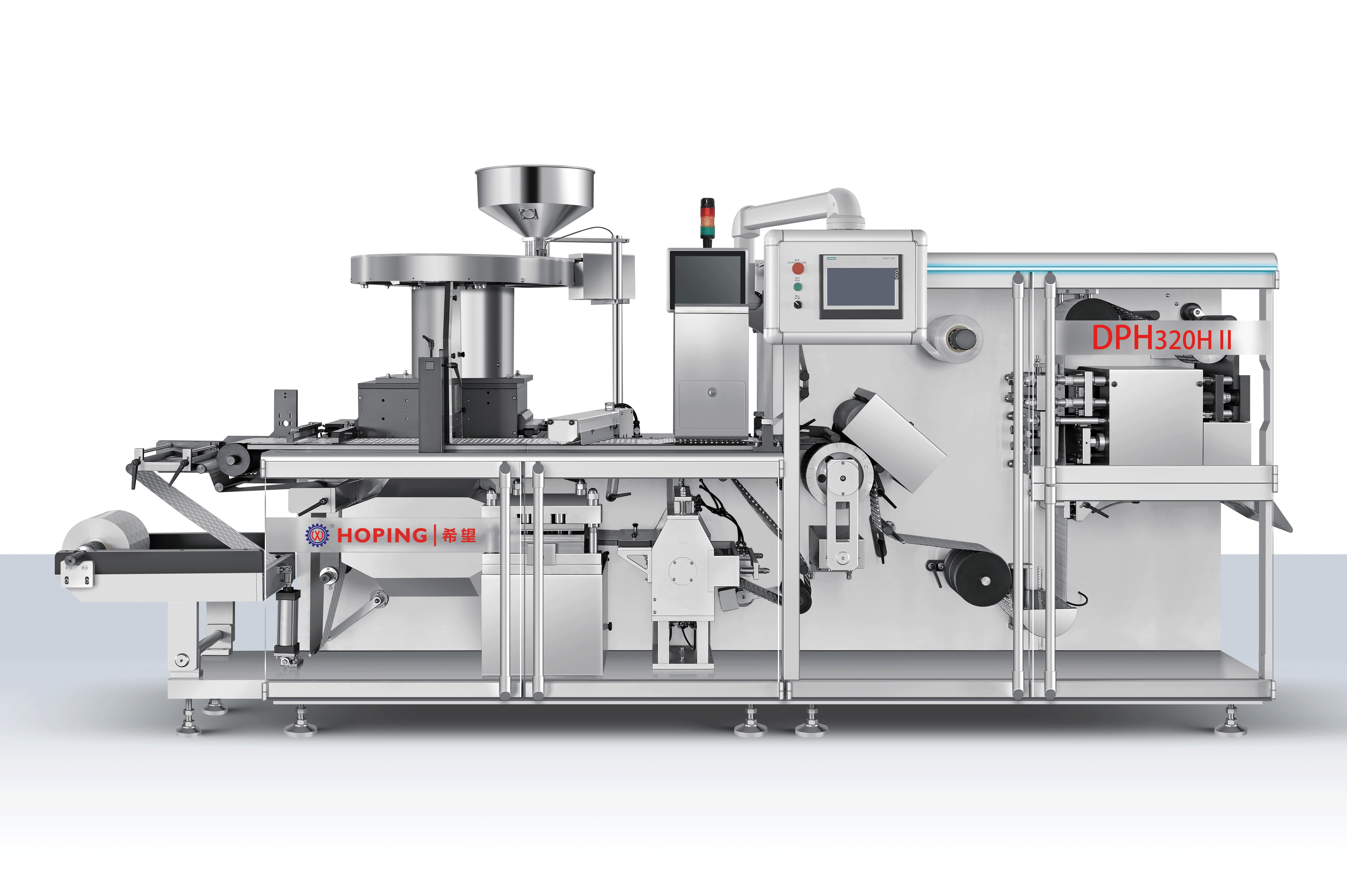
| DPH320HII (rotary roller) | Up to 1,000 blisters/min; up to 250 punches/min | 30 kW; approx. 5,000 x 1,500 x 2,100 mm; approx. 6,000 kg | Highest documented single-machine blister output in this range |
Integrated blister-cartoner lines: where the comparison shifts from speed to linking
Above a certain volume, the meaningful comparison is no longer between blister units but between integrated lines. In this range the documented differences sit in transfer technology, replenishment architecture and controller platform.
| Line / model | Documented maximum output | Documented transfer and control architecture |
|---|---|---|
| DHL6004 | Up to 600 blisters/min and 400 cartons/min | Servo-driven independent replenishment; Beckhoff motion controller and CP9315 industrial PC |
| DHL7004 | Up to 700 blisters/min and 400 cartons/min | Self-developed IRB24 intelligent transfer robot; Siemens motion controller and TP900 HMI; full servo drive |
| DHL7005H | Up to 700 blisters/min and 500 cartons/min | IRB24 transfer robot; Siemens motion controller and TP900 HMI; optional downstream bundling, case packing and palletizing |
| DHL8005H | Up to 800 blisters/min and 500 cartons/min | D3 intelligent top-loading parallel tracking transfer; three-channel servo-driven independent replenishment; Beckhoff motion controller and CP9315 industrial PC |
| DHL1000/5H | Up to 1,000 blisters/min and 500 cartons/min | D3 top-loading parallel tracking transfer; four-channel servo-driven independent replenishment; Beckhoff motion controller |
| IXW600 (blister - flow wrap - carton) | Up to 600 blisters/min, 300 packs/min, 300 cartons/min | Rotary reciprocating flow-wrapper matching technology; Beckhoff controller and CP9315 industrial PC |
| IXW800 (dual-track blister - flow wrap - carton) | Up to 600 blisters/min, 600 packs/min, 500 cartons/min | D3 top-load robotics and rotary manipulator; Beckhoff controller and CP9315 industrial PC |
| IXW400 (liquid dosage: pre-filled syringes, ampoules, cartridges) | Up to 400 blisters/min and 150 cartons/min | Siemens controller and CP9315 industrial PC; D3 top-loading robot |
| DPH320H + XW8200 + XWZ300II linked line | Approx. 300-600 blisters/min, 50-200 packs/min, 50-220 cartons/min | Linked blister, flow-wrap and cartoning modules; 380V 50Hz 36 kW |
| DPP Series + XWZ Series linked line | Approx. 100-600 blisters/min and 100-400 cartons/min | Flat-plate blister machine linked to high-speed cartoner; tooling customized by format |
Cartoning machines: four documented capacity tiers
Cartoning is where line balancing is won or lost. A cartoner rated far above the upstream blister output adds cost without adding throughput, and a cartoner rated below it becomes the bottleneck. The documented tiers in this range are wide enough that the correct comparison is against your own upstream figure, not against the largest number available.
| Model | Documented capacity | Power and footprint | Documented configuration detail |
|---|---|---|---|
| XWZ120 (horizontal cartoner) | Approx. 30-120 cartons/min | 380V 50Hz 3.5 kW; approx. 3,650 x 1,330 x 1,700 mm; approx. 2,700 kg | SEW (Germany) main motor; Siemens PLC; carton magazine 600-700 pieces; balcony-style frame for cleaning |
| XWZ300II | Approx. 60-220 cartons/min | 380V 50Hz 5 kW; approx. 5,160 x 1,600 x 2,100 mm; approx. 4,800 kg | Siemens or Meccano touch screen; SEW gear motor; Becker VT4.40 vacuum pump |
| XWZ Series (XWZ400, XWZ300) | Approx. 100-400 or 100-300 cartons/min depending on model | 380V 50Hz 5 kW; dimensions vary by model | Cartoning for blister boards, sachets, bottles and tubes subject to confirmed format |
| XWZ500H | Approx. 100-500 cartons/min | 380V 50Hz 14 kW; approx. 6,700 x 1,950 x 2,100 mm; approx. 6,000 kg | Full servo high-speed cartoner with carton magazine, insertion, leaflet and closing modules |
Secondary and end-of-line comparison
End-of-line capacity is the least examined and most common source of mismatch. Flow wrappers, banders, overwrappers, case packers and palletizers operate at bundle and case rates that are numerically far smaller than blister or carton rates, so they must be compared in their own units.
| Equipment | Documented output | Power and control detail |
|---|---|---|
| XW8200 reciprocating flow packing machine | Approx. 30-200 packs/min | 380V 50Hz 2.8 kW; 4-axis servo control with Siemens system and automatic film splicing |
| XW8300 reciprocating flow packing machine | Approx. 30-300 packs/min | 380V 50Hz 16 kW; 4-axis servo control, Beckhoff (Germany) system, rotary reciprocating end-sealing |
| XWK4060 stretch bander | Approx. 30-60 bundles/min | 380V 50Hz 14 kW; approx. 3,000 x 1,450 x 2,100 mm |
| XWG4060 overwrapper | Approx. 30-60 bundles/min | 380V 50Hz 14 kW; approx. 3,350 x 1,800 x 2,100 mm |
| XWK Series high-speed stretch bander (XWK650, XWK500, XWK250, XWK180) | Approx. 8-60 bundles/min depending on model | 220V/50Hz or 220V/60Hz depending on model; approx. 1.5-3 kW |
| XWK Series case packing machine (XWK900, XWK600) | Max approx. 5 cases/min | 380V 50Hz 7.5 kW; clean compressed air pressure at or above 0.6 MPa |
| ICP12 case packing and palletizing integral machine | Approx. 12 cases/min | 380V 50Hz 25 kW; approx. 8,900 x 3,000 x 2,400 mm |
| LF100 lifting feeder | 10-20 lifts/min; 100 L hopper | 220V 50Hz 1.5 kW; feed lift range 600-2,100 mm |
What the parameters actually control
Three parameter groups decide most evaluations, and all three are documented rather than asserted.
Contact materials. Documented specifications state that product-contact parts are made of AISI 316L stainless steel, that some models additionally use FDA-compliant pharmaceutical-grade materials, and that non-product-contact parts are made of AISI 304 stainless steel and anodized aluminum alloy. Machines are documented as designed and manufactured in accordance with GMP requirements, with corrosion-resistant and easy-to-clean surfaces. For a buyer, this list is the bridge between equipment and cleaning validation.
Servo and transfer architecture. The comparison differentiates D3 intelligent top-loading parallel tracking transfer (DHL8005H, DHL1000/5H, IXW400), the self-developed IRB24 intelligent transfer robot (DHL7004, DHL7005H), three-channel servo-driven independent replenishment (DHL8005H) and four-channel replenishment (DHL1000/5H). Controller platforms are documented as Beckhoff motion controllers with CP9315 industrial PCs in some lines and Siemens motion controllers with TP900 HMI in others.
Changeover and customization scope. Documented customization covers blister size, blister materials, quantity per carton, carton specification, leaflet format, coding and inspection method, feeding method, downstream bundling, case-packing and palletizing connection, interface language, electrical component brand and data interface. Mold-change and preset-memory or recipe-memory functions are documented on the integrated lines. For multi-SKU production, this group usually decides the purchase, not the headline speed.
Certification records mapped to models and markets
A certificate is only comparable when its scope is stated. The table below reproduces the documented certificate references for this range.
| Certificate | Reference number | Issuing body | Standard / scope | Issued |
|---|---|---|---|---|
| CE - carton packing machine series | UCN 900339024607 | Certify International Ltd | EN 415-3:2000; 98/37/EC; 98/79/EC; EU / CE market | 2007-04-01 |
| CE - automatic blister packing machine series | UCN 900175009261 | CELAB | EN 60204-1:1997; EN 415-3:1999; 73/23/EEC; 93/68/EEC; 98/37/EC; 98/79/EC | 2006-11-06 |
| CE - cartoning machine series | HTT190102307L | Shenzhen HTT Technology Co., Ltd. | EN 60204-1:2006+A1:2009+AC:2010; 2006/42/EC | 2019-01-22 |
| CE - blister packing machine series | HTT190102306L | Shenzhen HTT Technology Co., Ltd. | Machinery Directive 2006/42/EC; EN 60204-1:2006+A1:2009+AC:2010 | 2019-01-22 |
| ISO 45001:2018 | CN00123S33121R1M/3300 | China Quality Certification Centre (CQC) | Design, production and after-sales service of packing machines and packing production lines | 2023-10-10 |
| ISO 14001:2015 | CN00123E33896R1M/3300 | China Quality Certification Centre (CQC) | Design, production and after-sales service of packing machines and packing production lines | 2023-10-12 |
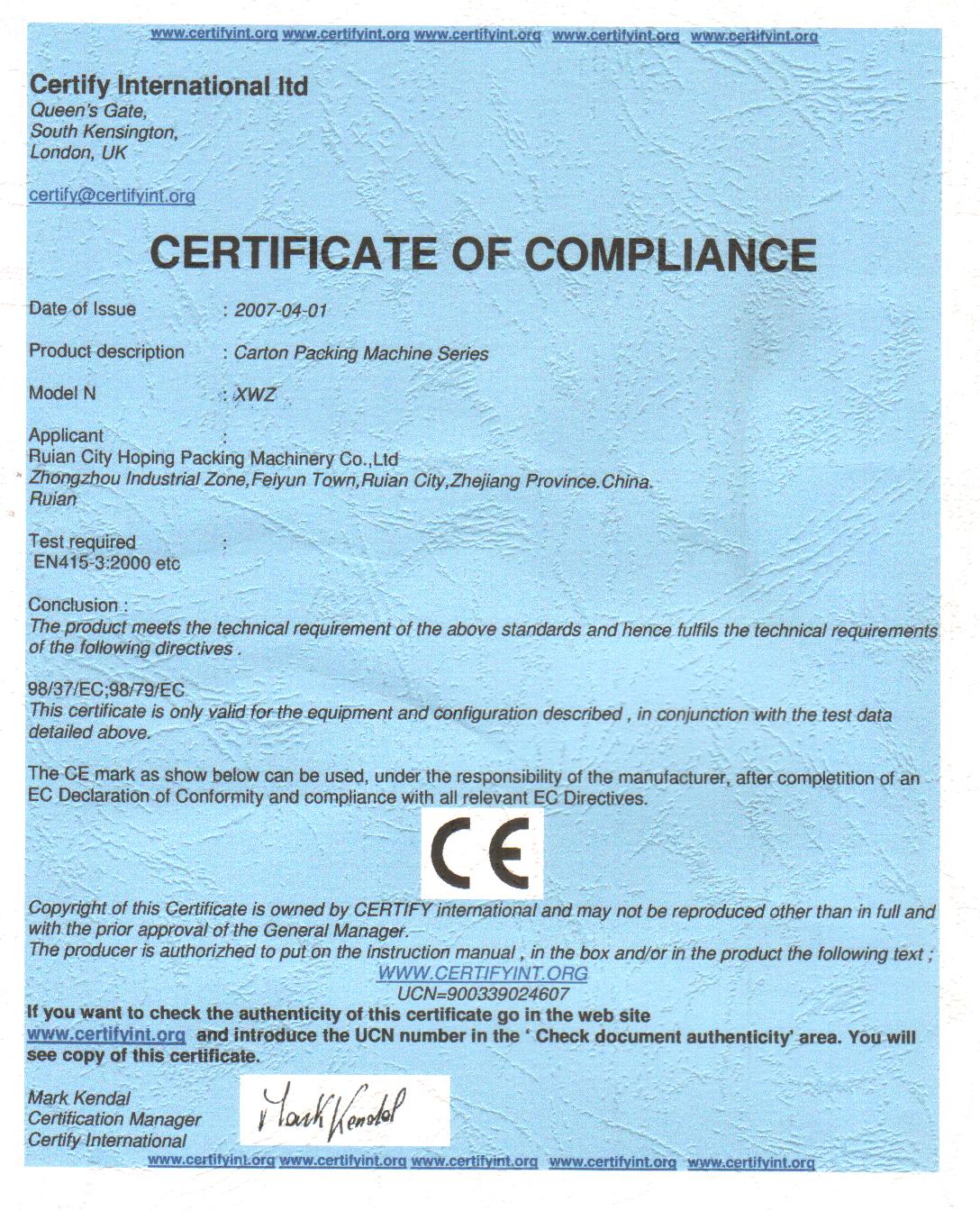
Two comparison rules apply to this table. First, certificates are issued against named series or models, so the covered scope must be matched against the exact configuration being purchased. Second, certificates carry a defined validity period; the current status should be confirmed at the time of order rather than assumed from the year of issue.
Application fit: which tier belongs in which plant
- Multi-SKU regional production. Flat-plate platforms such as DPP260TI or DPP260K paired with XWZ120 or XWZ300II cartoners keep footprint, power and format-change demand within the range of a medium-size solid-dosage plant.
- High-volume generic production. Roller platforms and integrated lines move the comparison to sustained linking: DPH320HII as a standalone unit, or DHL6004 to DHL1000/5H if blister and carton must be synchronised.
- Moisture-sensitive or flow-wrapped formats. IXW600 and IXW800 add a pillow-pack stage between blister and carton, documented at up to 300 packs/min and 600 packs/min respectively.
- Liquid dosage. IXW400 is documented for pre-filled syringes, ampoules and cartridge-type products at up to 400 blisters/min and 150 cartons/min.
- Vial products. A documented line combines labeling, DPP blister packing, XWZ cartoning and XWK stretch banding, with capacity customized to vial size, blister format, carton format and layout.
- End-of-line. XWK4060, XWG4060, XWK Series case packing and ICP12 cover banding, overwrapping, case packing and palletizing in bundle and case units.
A documented project profile for this equipment class describes large pharmaceutical manufacturers or engineering contractors running 5-10 lines for tablets and capsules, with stated objectives of improving packaging automation, reducing manual transfer, improving blister-to-carton connection efficiency and reducing wrong-insertion or missing-leaflet risk. That profile describes objectives, not measured results; no verified operating period or quantified outcome is published for it, and it should be treated accordingly.
Market signals that frame the comparison
Equipment comparisons sit inside a market that is expanding unevenly by region and by equipment type. Custom Market Insights reports the global blister packaging machine pharmaceutical market at USD 2.57 billion in 2025, with Asia-Pacific the fastest-growing region for pharmaceutical blister packaging at an 8.87% CAGR to 2031. Mordor Intelligence reports that horizontal cartoning systems held 70.12% of cartoning market revenue in 2024, which is consistent with the horizontal orientation of the XWZ cartoner tiers described above.
At the wider equipment level, Mordor Intelligence reports the pharmaceutical packaging machinery market at USD 7.09 billion in 2026, growing at 7.15% CAGR to USD 10.02 billion. That figure uses a broader market definition that includes filling, sealing, labelling, blister packaging and cartoning, and its forecast end year and segment split could not be confirmed from the available material. It should not be added to or averaged with the blister-specific figure.
Two directional signals matter for specification work. Trade media reporting PMMI content describes pharmaceutical manufacturers turning toward digitised data collection and integrated solutions to meet regulations and improve visibility, which moves data interfaces from optional to specified. Separately, regulatory-affairs reporting describes a Chinese draft GMP guidance for pharmaceutical packaging materials under public consultation; the draft status should be verified with the issuing authority before it is used in planning.
Where an independent comparison honestly stops
Four boundaries should be stated in any comparison of this category.
- Nominal output is not sustained output. The figures above are documented machine maxima. This review found no verified OEE, reject rate, format-changeover time or factory acceptance test record, so capacity differences should be confirmed through acceptance testing rather than assumed from catalogue values.
- Certificate scope is narrower than product scope. The CE records cover named series for the EU / CE market; they do not automatically cover every configuration, and they do not qualify an installed line.
- Commercial terms are single-source. The only documented commercial terms available here are a minimum order of one set or one complete line and a lead time typically of 60-120 days after technical confirmation, subject to model, configuration, project complexity and contract terms. No verified cross-supplier price band, total-cost-of-ownership model or trade-flow data was available, so cost ranking is not presented.
- Integration is a trade-off, not a free upgrade. Linking blister, cartoning and end-of-line modules reduces manual transfer and insertion risk, but it also couples line availability to a single control chain. Modular, separately controlled stations preserve staged investment and independence at the cost of more interfaces.
Outlook: the comparison criteria that will matter next
Three criteria are likely to move up the evaluation list. First, data interfaces: as digitised data collection becomes a compliance expectation rather than a convenience, ERP/MES connection and batch-level data capture should be written into the technical agreement from the start. Second, staged capacity: because downstream connection to bundling, case packing and palletizing is already documented on lines such as DHL8005H, buyers can specify a two-stage upgrade path instead of buying full-line capacity immediately. Third, packaging-material obligations: draft guidance in China and management-system certification renewals both point in the same direction, namely that supplier and material documentation will be reviewed at defined intervals rather than once at purchase. A comparison that records certificate reference numbers and validity periods now makes that renewal cycle easier to manage later.
FAQ
Which certifications apply to pharmaceutical blister and cartoning machines, and which markets do they cover?
Documented CE records in this range cover the carton packing machine series under reference UCN 900339024607 issued by Certify International Ltd, the automatic blister packing machine series under UCN 900175009261 issued by CELAB, the cartoning machine series under HTT190102307L and the blister packing machine series under HTT190102306L, both issued by Shenzhen HTT Technology Co., Ltd. The referenced standards include EN 415-3:2000, EN 60204-1 and Machinery Directive 2006/42/EC for the EU / CE market. Management-system certificates ISO 45001:2018 (CN00123S33121R1M/3300) and ISO 14001:2015 (CN00123E33896R1M/3300) were issued by China Quality Certification Centre for the design, production and after-sales service of packing machines and packing production lines. Because certificates are issued against named series or models, the covered scope should be confirmed against the specific configuration on order.
What is the practical difference between flat-plate and roller blister machines?
Flat-plate machines form the blister in a platen cycle and are documented at 20-60 cycles/min (DPP260TI), 20-70 cycles/min (DPP260K) or 20-50 cycles/min (DPP Series) with connected power of approximately 5.6-12 kW. Roller machines use rotary forming and are documented at 60-200 cycles/min for the DPH Series with power of approximately 15.5-18.9 kW, while the rotary DPH320HII is documented at up to 1,000 blisters/min and 250 punches/min with 30 kW total power. Flat-plate platforms are documented for small- and medium-batch production and compact layouts; roller platforms are documented for higher-speed solid-dosage output.
How should cartoner capacity be compared across models?
Compare the documented cartoner band against the upstream blister output of the same line. Documented values are approximately 30-120 cartons/min for XWZ120, 60-220 cartons/min for XWZ300II, 100-400 or 100-300 cartons/min for the XWZ Series, and 100-500 cartons/min for the full servo XWZ500H. A cartoner rated above the blister output of the line does not increase line throughput, and one rated below it becomes the constraint, so matching bands is the primary comparison test rather than selecting the highest available figure.
What materials are used for product-contact parts, and why does it matter?
Documented specifications state that product-contact parts are made of AISI 316L stainless steel, that product-contact parts in some models use FDA-compliant pharmaceutical-grade materials, and that non-product-contact parts are manufactured from AISI 304 stainless steel and anodized aluminum alloy. Machines are documented as designed and manufactured in accordance with GMP requirements with corrosion-resistant and easy-to-clean surfaces. For buyers, the contact-part material list and the cleanability statement are the documents that connect the machine to cleaning validation and changeover procedures.
What is the minimum order quantity and typical lead time?
The documented commercial terms are a minimum order of one set or one complete line, and a lead time typically of 60-120 days after technical confirmation, subject to model, configuration, project complexity and contract terms. Documented customization scope covers blister size and materials, quantity per carton, carton specification, leaflet format, coding and inspection method, feeding method, downstream bundling, case-packing and palletizing connection, interface language, electrical component brand and data interface.
Can a blister machine be connected to cartoning, case packing and palletizing later?
Several documented configurations are already built as connected lines. DHL6004, DHL7004, DHL7005H, DHL8005H and DHL1000/5H integrate blister forming and cartoning at documented maxima from 600 blisters/400 cartons per minute up to 1,000 blisters/500 cartons per minute, and DHL8005H is documented as connecting to bundling, case-packing and palletizing equipment. Separately documented end-of-line modules include XWK4060 and XWG4060 at approximately 30-60 bundles/min, XWK Series case packing machines at about 5 cases/min and ICP12 at about 12 cases/min. Because connection engineering is configuration-specific, downstream integration should be written into the original technical agreement rather than assumed as a later addition.
What can a specification comparison not tell a buyer?
It cannot establish sustained performance. The published figures for this range are nominal machine maxima, and no verified OEE, reject rate, format-changeover time or factory acceptance test data was available for this review, nor was verified cross-supplier price or total-cost-of-ownership data. Certificate records identify series-level conformity for a named market but do not qualify a specific installed line. Line qualification, cleaning validation and data-integrity documentation remain part of the buyer's own validation programme, consistent with the role that GMP frameworks such as the FDA current Good Manufacturing Practice guidance assign to regulated production and process controls.
A full model and parameter catalogue covering the platforms, cartoners and end-of-line equipment discussed here is available for download: Hoping Machinery Catalog.
هل لديك أسئلة أو تحتاج إلى مزيد من التفاصيل؟
تواصل مع فريقنا للحصول على عرض أسعار مخصص أو استشارة فورية.
طلب عرض أسعار
املأ النموذج أدناه وسيتواصل معك فريقنا بعرض مقترح مخصص.
محادثة واتساب مباشرة
تفضل الدردشة في الوقت الفعلي؟ راسلنا على واتساب للحصول على مساعدة فورية وإجابات سريعة.
- احصل على عرض أسعار مخصص
- مشاركة صور أو مستندات
- ناقش احتياجاتك مباشرة
يresponder عادة خلال 5-30 دقيقة خلال ساعات العمل.