
Pharmaceutical Packaging Machine: Scenario Fit Before Specification
A pharmaceutical packaging machine is normally approved against a specification sheet — speed, format range, servo count, footprint. In solid-dosage plants, none of those numbers on its own decides whether the line works. The deciding variable is scenario fit: whether a defined product portfolio, batch profile, labour model and downstream flow actually justify an integrated blister-cartoning line, and whether they justify it at this investment step rather than the next one.
The answer is narrower than most equipment enquiries assume. An integrated blister-cartoning line fits production scenarios built around large-scale solid-dosage output and high-capacity workshops that require reduced manual contact. It fits less comfortably where formats change constantly, where annual volumes are modest, or where capital budget is the binding constraint. That boundary is commercial as much as technical, and it is the first thing worth testing before any machine is compared with another.
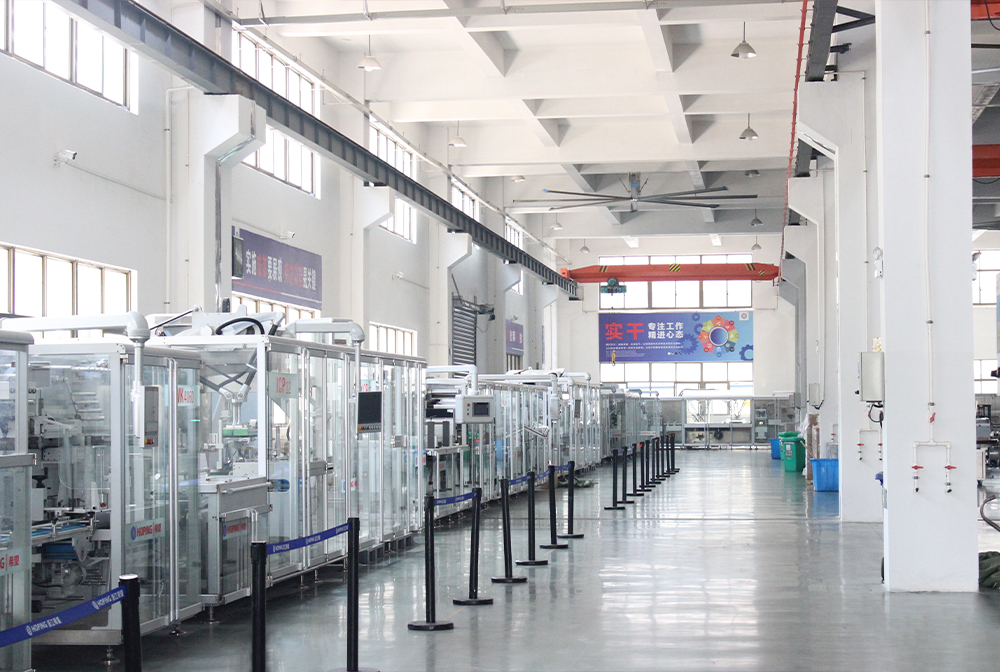
A blister-cartoning line is a configuration, not a single machine — the scenario, not the showroom, determines how it should be built.
Scenario Fit Is a Production Question Before It Is a Machine Question
Two plants can order comparable equipment and end up with very different results, because the equipment does not define the outcome — the production scenario does. Three variables usually separate a good fit from a poor one.
- Format stability. How much of annual output runs on a small number of blister formats and carton counts. A portfolio concentrated on a few repeat formats keeps an integrated line in continuous motion; a portfolio spread across many short runs spends more of its time in changeover and setup.
- Volume continuity. Whether the plant runs long, predictable campaigns or frequent short batches. Integrated automation earns its place through continuous operation, so a plant that cannot feed it consistently is paying for capacity it cannot use.
- Labour and transfer model. Where blister cards currently go after forming and sealing, who moves them, and how leaflet insertion and carton loading are staffed. The manual transfer step is the single most common reason a plant starts looking at integrated lines in the first place.
A project that scores badly on all three is not a machine-selection problem. It is a signal that a standalone blister machine and a standalone cartoner, or a semi-automatic link, remain the correct equipment class for that plant at that moment.
What "Integrated" Actually Covers on a Blister-Cartoning Line
On a HOPING integrated line, blister packaging, blister transfer, leaflet handling, carton opening, insertion, inspection/rejection, and downstream connection are combined into one automated process. The word "integrated" therefore refers to the elimination of discrete handover points rather than to a single machine with more functions bolted on.
The comparison target is not a competing brand. It is a different production model: a blister machine, manual transfer of blister cards to a separate area, and a standalone cartoner. In that model, every transfer is a handling event, and every handling event is a point where product can be delayed, mixed or damaged. Consolidating the transfer into the line removes that class of event rather than merely making it faster.
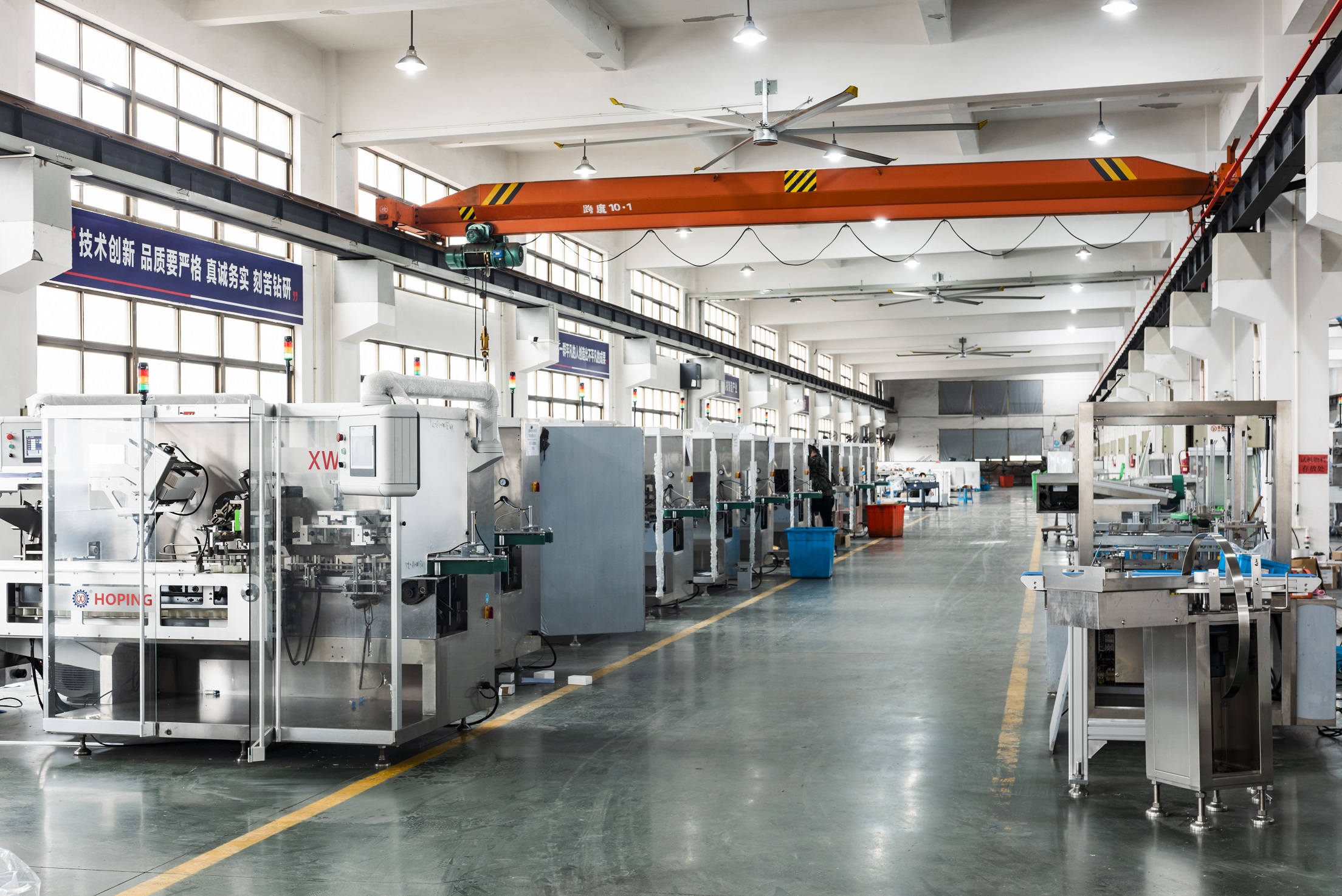
Cartoning stations are where blister output becomes a marketable pack — and where line balancing between primary and secondary packaging is decided.
HOPING's Position in the Pharmaceutical Packaging Machine Category
HOPING — Zhejiang Hoping Machinery Co., Ltd. — is a pharmaceutical packaging machinery manufacturer based in Ruian City, Zhejiang Province, China. Established in 2001, the company operates a 28,800 ㎡ manufacturing facility with more than 300 employees, including a 56-engineer R&D team, and reports an annual output of 500 units. Exports account for approximately 25% of its business, with main markets in Southeast Asia, the Middle East, Eastern Europe, South America and Africa.
Its product scope covers blister packaging machines, cartoning machines, case packing machines and end-of-line packaging machines, supported by flow wrappers, bundlers and palletizers for the downstream range. The company holds 26 invention patents, 70 utility patents, 4 appearance patents and 28 software copyrights, alongside 10 PCT-protected filings in Europe, Russia, Germany and Italy.
For scenario planning, the relevant reference point is the representative DHL1000/5H configuration, which is stated to reach up to 1,000 blisters per minute and 500 cartons per minute. Those are maximum figures for a defined configuration. Actual output depends on product format, quantity per carton, materials and process conditions — which is precisely why a scenario assessment should precede a throughput comparison.
Four Production Scenarios and How They Map to Equipment
Scenario 1: High-capacity solid-dosage workshops with reduced manual contact
This is the primary fit. The integrated line is designed for large-scale solid-dosage pharmaceutical packaging and high-capacity workshops that require reduced manual contact. Typical markers are a narrow family of high-volume products, multi-shift operation, and a downstream flow that already runs continuously into case packing. Here the value of integration is not a single speed number but the removal of the transfer and staging steps that sit between blister output and carton output.
Scenario 2: Barrier-critical formats and alu-alu structures
Forming-material strategy changes the equipment question. HOPING lists flat-plate, roller-type aluminium-plastic, and aluminium-aluminium blister packaging machines, together with automatic cartoning machines and production lines. An alu-alu format is a barrier and product-protection decision; the scenario test is whether the plant's moisture- and oxygen-sensitive products justify that structure across enough volume to keep a dedicated format running, rather than whether the machine can form the material at all.
Scenario 3: Mixed secondary-packaging portfolios
Secondary packaging often covers more than one primary format. HOPING lists automatic cartoning machines for blister packs, tablets, syringes, and medicine bottles. A plant producing both blister-packed tablets and bottle-packed or syringe-based products therefore has a genuine cartoner-scenario question: whether one cartoning platform with format changeover serves the portfolio better than separate dedicated machines. Answering it requires format and changeover data, not application lists alone.
Scenario 4: Low-volume, high-variability production
Not every plant should buy a line. Where batches are short, formats rotate frequently, labour is available and capital is constrained, a standalone blister machine plus a standalone cartoner remains a coherent configuration. The integrated line's advantage in reducing manual intervention does not translate into an advantage in a plant whose binding constraint is changeover frequency rather than handling volume.
Comparison: Integrated Line, Traditional Chain and Semi-Automatic Setup
| Evaluation dimension | Integrated blister-cartoning line | Blister machine + manual transfer + standalone cartoner | Low-speed semi-automatic blister-cartoning |
|---|---|---|---|
| Manual intervention | Reduced — blister, transfer, leaflet, carton and rejection stages are combined into one automated process | Highest — each handover is a separate manual step | Partial — automation exists but operator involvement remains central |
| Transfer between stages | Internal to the line | Manual transfer of blister cards between areas | Usually manual or semi-manual loading |
| Leaflet handling and insertion | Handled within the line process | Separate operation, often manual | Depending on configuration, partly manual |
| Inspection / rejection | Integrated inspection and rejection stage, where configured | Dependent on standalone equipment or operator checks | Limited, typically operator-led |
| Downstream connection | Designed for connection to case packing and end-of-line stages | Requires manual buffering between areas | Usually disconnected from end-of-line |
| Initial investment | Usually higher | Lower entry cost, spread across separate purchases | Lowest entry cost |
| Best-fit scenario | Large-scale solid-dosage output; high-capacity workshops; reduced manual contact | Low-to-moderate volume; flexible, labour-supported operation | Small volume; pilot or laboratory-scale output |
| Maintenance model | Centralised control, modular stations and parameter management support routine maintenance | Separate maintenance routines per machine | Simple, operator-level maintenance |
Comparison basis: publicly described line architecture and stated configuration data. Speed figures are configuration-specific maximums and are not directly comparable across suppliers without matching product format, carton count, rejection rate and operating conditions.
Where the Integrated Line Does Not Fit
The boundaries matter as much as the advantages, and they are worth stating explicitly.
- Capital intensity. Initial investment in an integrated line is usually higher than for standalone or semi-automatic equipment. That higher outlay is offset in large-scale continuous production through reduced labour, transfer, management and quality-risk costs — but only where those volumes actually exist.
- Output is conditional. Stated maximums such as 1,000 blisters per minute and 500 cartons per minute depend on product format, quantity per carton, materials and process conditions. A plant that cannot hold those conditions will not see those figures.
- Maintenance does not disappear. Centralised control, modular stations, alarm indication and parameter management make routine maintenance more manageable; operator training, spare-parts management and preventive maintenance remain necessary commitments.
- Project execution risk. For export projects, delivery and installation are genuine schedule risks. Confirm samples and packaging materials early, design around actual blister and carton formats, and run no-load and material tests before shipment.
Risks That Decide Whether a Scenario Holds
Scenario fit is only credible if the failure modes are mapped to controls. The recurring risks on a blister-cartoning line are poor blister forming or sealing, missing, wrong or incomplete product feeding, missing leaflets, carton jams, coding or date-printing errors, foreign matter or contamination risk, downtime during high-speed operation, and delivery or installation risk on export projects.
| Risk area | Control approach | Supplier-side measure |
|---|---|---|
| Forming, sealing and feeding faults | Sensor monitoring, missing-product alarm, automatic stop, automatic rejection | Sample and packaging-material confirmation at early project stage |
| Missing leaflet, carton jam, coding errors | Vision or checkweighing inspection where configured, key-parameter locking, fault records | Solution designed against the actual blister and carton formats |
| Contamination and operator safety | Mechanical safety protection, defined intervention points | Installation, commissioning and SOP training |
| High-speed downtime and acceptance disputes | FAT/SAT acceptance criteria agreed before order | No-load and material tests before shipment; customer witness acceptance for key projects |
| Export delivery and installation | Documented schedule and commissioning plan | Spare parts and remote technical support after handover |
Regulatory and Market Context Around Scenario Choice
Regulatory frameworks shape what a packaging scenario must be able to evidence, even where they do not prescribe machine design. ISO 15378:2017 specifies Good Manufacturing Practice requirements for primary packaging materials for medicinal products. In the United States, the FDA describes current Good Manufacturing Practice as the foundation for quality pharmaceuticals through regulatory standards. In China, a draft GMP guidance for pharmaceutical packaging materials has been reported at public-consultation stage, addressing how marketing licence holders review packaging material suppliers — a draft status that should be tracked rather than treated as settled rule.
Market data adds context to why integrated configurations are being examined more closely. Custom Market Insights valued the global blister packaging machine pharmaceutical market at USD 2.57 billion in 2025 and identified Asia-Pacific as the fastest-growing region at an 8.87% CAGR to 2031. Mordor Intelligence reported that horizontal cartoning systems held 70.12% of cartoning market share in 2024, which is consistent with the horizontal format dominating secondary packaging for solid dosage. Separately, trade coverage of PMMI content notes a shift toward digitised data collection and integrated solutions as manufacturers respond to regulation and visibility requirements — a directional signal rather than a measured adoption rate.
A Six-Question Scenario-Fit Checklist
Before comparing suppliers, a buyer can test the scenario itself.
- What share of annual output runs on a single blister format and carton count, and how stable is that share across the next planning cycle?
- How many format changes occur per week, and how much of that time is currently spent on transfer and staging rather than on the machines?
- Where do blister cards leave the blister machine today, who moves them, and what handling risk does that step introduce?
- Is leaflet insertion manual, semi-automatic or already in-line, and does the carton design depend on it?
- Which downstream stages — case packing, palletizing — must the line connect to, and are they already automated?
- What capital is committed, what floor space is available, and what volume is needed before the higher initial investment is recovered through reduced labour, transfer and quality-risk costs?
If the first three answers describe concentrated volume and a manual transfer bottleneck, the scenario supports an integrated line. If they describe fragmented volume and stable handling, the scenario does not — regardless of what the specification sheet says.
Future Outlook
Two pressures are likely to keep pushing solid-dosage plants toward integrated configurations. The first is volume: with Asia-Pacific identified as the fastest-growing blister packaging region to 2031, capacity expansion in that region will be specified against continuous operation rather than batch flexibility. The second is documentation: as regulatory expectations around packaging materials and process control tighten, the line's ability to record parameters, reject faults and support acceptance testing becomes part of the procurement case, not an afterthought. Neither pressure removes the boundary described earlier — a plant without the volume to run an integrated line continuously will still be better served by separate machines.
FAQ
What production scenario is an integrated blister-cartoning line designed for?
It is designed for large-scale solid-dosage pharmaceutical packaging and high-capacity workshops that require reduced manual contact. The defining characteristics are concentrated high-volume output, multi-shift operation, and a downstream flow that benefits from continuous connection between blister and carton stages.
How does an integrated line differ from a blister machine plus manual transfer and a standalone cartoner?
The integrated line combines blister packaging, blister transfer, leaflet handling, carton opening, insertion, inspection/rejection, and downstream connection into one automated process. In the traditional arrangement, blister cards are transferred manually between separate areas and each handover is a discrete handling event with its own delay and mix-up risk.
What output can a representative integrated line reach, and what limits actual output?
The representative DHL1000/5H configuration is stated to reach up to 1,000 blisters per minute and 500 cartons per minute. Actual output depends on product format, quantity per carton, materials and process conditions, so sustained output should be verified against the buyer's own formats rather than assumed from a maximum figure.
Which primary formats can a pharmaceutical cartoning machine handle?
HOPING lists automatic cartoning machines for blister packs, tablets, syringes, and medicine bottles, and separately lists flat-plate, roller-type aluminium-plastic, and aluminium-aluminium blister packaging machines. A portfolio spanning several of these formats makes changeover and format-range data the critical comparison point.
What risks should be controlled when moving from manual transfer to an integrated line?
The main risks are poor blister forming or sealing, missing, wrong or incomplete product feeding, missing leaflets, carton jams, coding or date-printing errors, foreign matter or contamination risk, and downtime during high-speed operation. Typical controls include sensor monitoring, missing-product alarms, automatic stop and rejection, key-parameter locking, fault records, mechanical safety protection, and FAT/SAT acceptance with SOP training.
HOPING publishes its full blister, cartoning, case packing and end-of-line equipment range in a downloadable catalogue: Hoping Machinery Catalog (PDF).
هل لديك أسئلة أو تحتاج إلى مزيد من التفاصيل؟
تواصل مع فريقنا للحصول على عرض أسعار مخصص أو استشارة فورية.
طلب عرض أسعار
املأ النموذج أدناه وسيتواصل معك فريقنا بعرض مقترح مخصص.
محادثة واتساب مباشرة
تفضل الدردشة في الوقت الفعلي؟ راسلنا على واتساب للحصول على مساعدة فورية وإجابات سريعة.
- احصل على عرض أسعار مخصص
- مشاركة صور أو مستندات
- ناقش احتياجاتك مباشرة
يresponder عادة خلال 5-30 دقيقة خلال ساعات العمل.