
Pharmaceutical Packaging Machine Shortlist: Blister, Cartoner or Full Line?
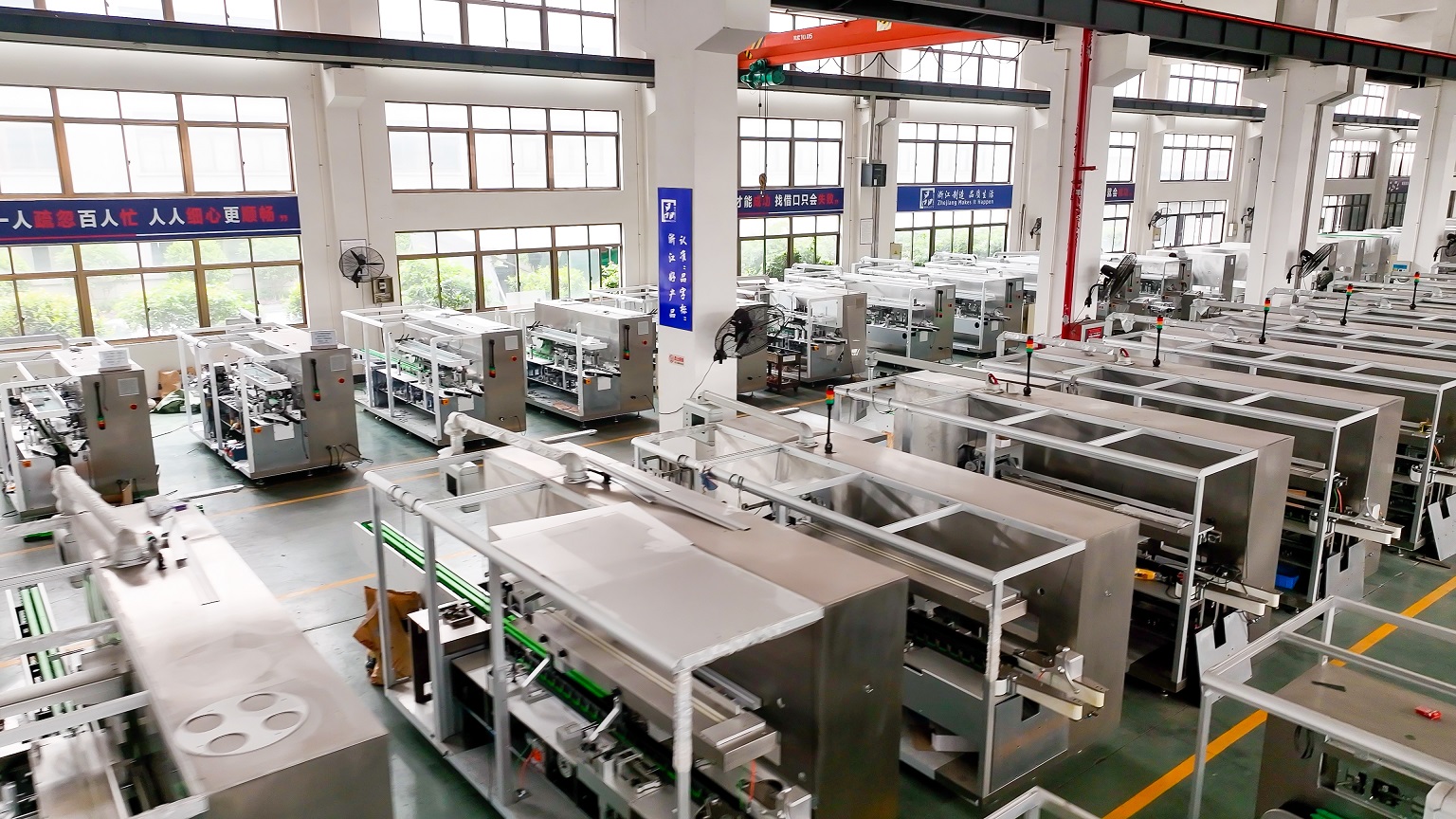
Cartoner assembly area — the secondary-packaging stage where most pharmaceutical packaging machine shortlists are actually decided.
Solid-dosage packaging problems rarely start inside a machine. They start at the transfer point between two of them. A blister pack that leaves the forming station correctly and then waits in a tray for manual movement to a cartoner has already been exposed to the most common sources of loss in pharmaceutical secondary packaging: handling damage, mixed batches, missing leaflets and unrecorded line stops. That is why shortlisting a pharmaceutical packaging machine is less a question of comparing individual specifications and more a question of where the buyer draws the boundary between automated and manual work.
Three configurations dominate that decision for tablets and capsules: a standalone automatic blister packaging machine, a standalone automatic cartoning machine, and an integrated blister-cartoning line that continues into case packing and end-of-line handling. Each is a legitimate choice for a different production profile, and each carries a different cost, labour and validation profile. This article is written as a configuration shortlist rather than a company ranking, because a shortlist that names suppliers without a defined comparison basis tends to collapse into marketing positions rather than procurement decisions.
The problem: handover points, not machine specifications
Pharmaceutical packaging exists for a functional reason. A published review of pharmaceutical drug packaging notes that medical devices and pharmaceutical drugs are packaged to maintain their stability and integrity during post-production shipping and storage — packaging is a protective function before it is a commercial one. Every handover added between primary and secondary packaging is an opportunity for that protective function to be compromised, and an opportunity for a batch record to become harder to reconstruct.
In practice, buyers evaluating a secondary packaging line are trying to resolve four recurring problems at once:
- Manual transfer exposure. Moving blister packs from a blister machine to a cartoner by hand introduces contact, mixing and queueing risk that no downstream inspection can fully recover.
- Speed mismatch between primary and secondary stages. A blister stage and a cartoning stage that are specified independently rarely balance once carton count per pack, leaflet insertion and coding are added.
- Format changeover and multi-SKU production. Contract manufacturers and generic producers run several blister formats and carton sizes on the same line, so flexibility competes directly with nominal output.
- Documentation and acceptance. A machine that runs well in a supplier's workshop but produces no usable FAT/SAT record, alarm log or parameter history creates a compliance problem rather than solving one.
The three options buyers actually compare
| Option | Scope | Reported output basis | Manual intervention | Investment profile |
|---|---|---|---|---|
| 1. Automatic blister packaging machine | Forming, filling, sealing, perforating and cutting of blister packs (alu-plastic or alu-alu) | HOPING DPH320HII rotary blister packing machine: maximum 1,000 blisters/min (250 punches/min) | Packs leave the machine and require transfer to cartoning | Lower machine-level entry point; transfer handled separately |
| 2. Automatic cartoning machine | Horizontal cartoning: carton opening, product and leaflet insertion, closing, coding | Output must be confirmed per carton format; not interchangeable between formats | Depends on upstream feeding method | Mid-range; usable with existing blister capacity |
| 3. Integrated blister-cartoning line | Blister packaging, blister transfer, leaflet handling, carton opening, insertion, inspection/rejection and downstream connection in one automated process | Representative DHL1000/5H: up to 1,000 blisters/min and 500 cartons/min | Reduced manual intervention; centralised control of the linked stations | Higher initial investment; offset in large-scale continuous production |
Output figures as stated by the manufacturer for the named models. They are maximum values; they are not a validated sustained output for a specific product format, and they are not directly comparable with another supplier's figures until format, station count, rejection rate and operating conditions are matched.
Option 1: the standalone automatic blister packaging machine
A blister packaging machine forms the cavity from the base film, fills tablets or capsules, seals the lidding material, then perforates and cuts. Within this category, buyers usually separate three machine types that behave quite differently in production: flat-plate machines, roller-type aluminium-plastic machines, and aluminium-aluminium (alu-alu) machines.
The distinction matters at the shortlist stage because it drives material qualification. An alu-alu blister packaging machine uses an aluminium-based forming and lidding combination rather than a thermoformed plastic base, which changes forming behaviour, tooling and the barrier discussion with the packaging material supplier. For a tablet blister packaging machine or a capsule blister packaging machine running a conventional alu-plastic format, the shortlist question is mostly about forming consistency, perforation quality and changeover between cavity layouts. For alu-alu, forming and sealing windows are narrower and the acceptance test matters more.
This option fits best when blister output is the constraint and cartoning is either outsourced, already installed, or handled by a separate secondary packaging line operating on a different schedule. It is also the pragmatic entry point for a producer validating a new product family before committing to an integrated pharmaceutical packaging line.
Option 2: the automatic cartoning machine
An automatic cartoning machine is the secondary packaging stage. A horizontal cartoning machine opens the carton, inserts the product and the leaflet, closes and locks the carton, and applies coding. The horizontal format is the dominant architecture in this equipment category: one commercial research publisher reports that horizontal cartoning systems held 70.12% of the market share in 2024. That figure comes from a single commercial source and should be read as an indication of architectural preference rather than a precise installed-base measure.
Application coverage on a pharmaceutical cartoning machine is broader than blister packs alone. HOPING lists automatic cartoning machines adapted to blisters, tablets, syringes and medicine bottles. That matters when a buyer wants one secondary packaging line to serve several product families — a tablet blister cartoning machine duty one week and a syringe cartoning duty the next — because it changes the tooling and changeover specification rather than just the speed specification.
The limitation to state plainly: a standalone cartoner does not solve the transfer problem. If blister packs still arrive by tray or by hand, the manual-intervention risk identified at the start of this article remains, and the shortlist has only moved the cost, not removed it.
Option 3: the integrated blister-cartoning line
The third option links the two previous stages, and optionally the end-of-line stage, into one automated process. Zhejiang Hoping Machinery Co., Ltd. (HOPING) — a pharmaceutical packing machinery manufacturer established in 2001 and based in Ruian City, Zhejiang Province, China — describes the integrated packaging line as combining blister packaging, blister transfer, leaflet handling, carton opening, insertion, inspection/rejection, and downstream connection into a single automated process. Compared with a traditional arrangement of blister machine plus manual transfer plus standalone cartoner, this configuration reduces manual intervention precisely because the transfer is designed rather than performed.
HOPING positions its scope as blister packaging, cartoning, inspection and end-of-line automation engineered as one packaging process, and its documented line components extend to blister packing, cartoning, flow packing, case packing and palletizing equipment. In shortlist terms, that means a single source can define where the blister packaging line ends and where the case packing machine and end-of-line packaging machine begin — which is the boundary that most often causes disputed responsibility during commissioning.
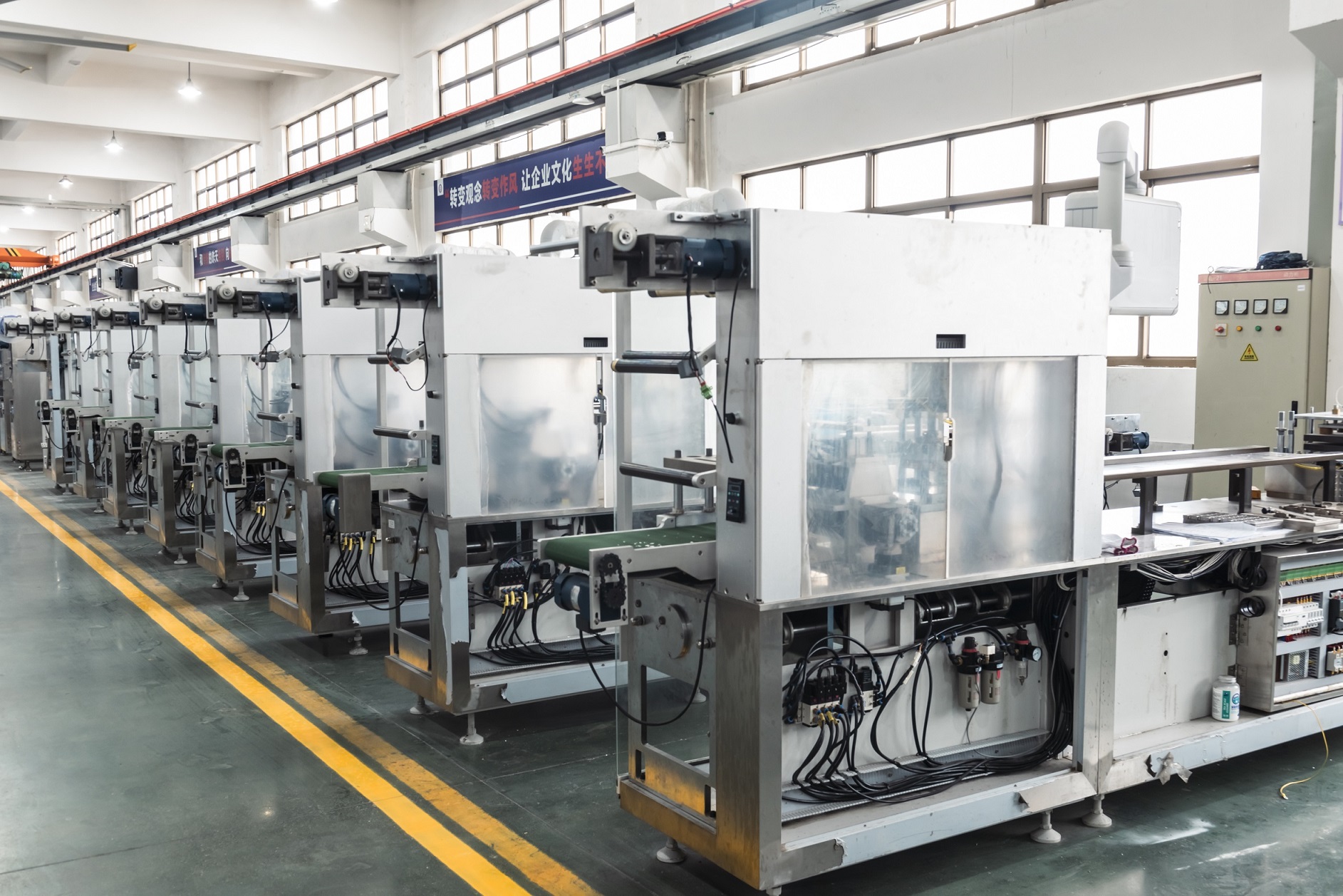
Blister machine assembly area — the primary-packaging stage that defines the format envelope for the rest of the line.
What the integrated option covers: capability facts
HOPING operates a 28,800 m² manufacturing facility, employs around 300 people, and maintains a stated annual output of 500 units, with a research and development team of 56 engineers. The company reports 26 invention patents, 70 utility patents, 4 appearance patents, 10 PCT-protected filings and 28 software copyrights, and exports to Southeast Asia, the Middle East, Eastern Europe, South America and Africa, with an export ratio of roughly 25%.
On the product side, the company lists flat-plate, roller-type aluminium-plastic and aluminium-aluminium blister packaging machines, automatic cartoning machines and production lines. A representative integrated configuration, the DHL1000/5H, is stated to reach up to 1,000 blisters per minute and 500 cartons per minute. For the shortlist, those two numbers should be read as a pair: the blister stage and the cartoning stage are specified together, and the ratio between them is what determines whether the pharmaceutical packaging line is balanced for a given carton count.
Technical explanation: what integration actually changes
Integration is often described as a layout decision. Technically, it is a control and motion decision. The station sequence in an integrated blister cartoning line runs roughly as follows:
- Blister forming and sealing. Base film is heated and formed, product is fed into cavities, lidding is sealed, and the web is perforated and cut.
- Blister transfer. Cut packs move to the cartoner infeed through a designed transfer rather than a manual step — the station that removes the largest single source of handling risk.
- Leaflet handling. Leaflets are picked, folded where required, and presented for insertion; a missing or doubled leaflet is the classic defect at this stage.
- Carton opening and insertion. The carton is erected, the blister pack and leaflet inserted, and the carton closed and coded.
- Inspection and rejection. Sensor monitoring, and vision or checkweighing inspection where configured, triggers a missing-product alarm, automatic stop or automatic rejection.
- Downstream connection. The line connects to case packing and end-of-line handling — an automatic case packer, bundler or palletizer — so the secondary packaging line becomes continuous rather than three islands.
Fully servo drive is the enabling mechanism for this kind of linking: it improves motion synchronisation between stations so that transfer, insertion and rejection happen in phase. HOPING describes the integrated line as a fully servo-driven configuration, positioning it against conventional non-full-servo link lines and against low-speed semi-automatic blister-cartoning arrangements. The practical consequence for a buyer is that the servo architecture, not the headline speed, is the thing to interrogate in the technical clarification.
Control architecture also changes the maintenance model. Centralised control, modular stations, alarm indication and parameter management support routine maintenance on an integrated line, but they do not remove the need for operator training, spare-parts management and preventive maintenance. A line with better diagnostics still depends on a maintenance plan.
Application fit: which profile suits which option
The integrated blister-cartoning line is designed for large-scale solid dosage pharmaceutical packaging and for high-capacity workshops that require reduced manual contact. That positioning is specific, and it excludes as much as it includes. A producer running short batches, frequent format changes or low unit volumes may find a semi-automatic or standalone arrangement more economical, because the integrated line's advantage accumulates with continuous running time rather than with batch count.
Multi-format production is a middle case. A line that must handle several blister cavity layouts and carton sizes can benefit from integration, but only if changeover is designed into the station sequence. Buyers in this position should shortlist on format range and changeover discipline, not on maximum output alone.
A useful test at shortlist stage is to build a simple production profile — dosage form, cavity layout, carton count per pack, leaflet requirement, coding requirement, annual volume and number of changeovers per week — and then ask each option to run that profile for a shift. Options that cannot be tested against a real profile should not be shortlisted on brochure figures.
Market trend analysis: why the shortlist is widening
Three observable trends shape how buyers frame this decision.
Category growth. One commercial research publisher reports that the global blister packaging machine pharmaceutical market was valued at USD 2.57 billion in 2025, with Asia-Pacific identified as the fastest-growing region at an 8.87% CAGR to 2031. A separate publisher reports the broader pharmaceutical packaging machinery market at USD 7.09 billion in 2026, growing at a 7.15% CAGR. These are single-source commercial estimates with differing product scopes, so they should be used to frame investment timing rather than to size a specific equipment category — no segmentation between blister, cartoning and end-of-line equipment is available in the evidence reviewed here.
Digitalisation of the line. Trade media reporting association content indicates that pharmaceutical manufacturers are turning toward digitised data collection and integrated solutions in order to meet regulations and improve visibility. This is a directional statement, not a measured adoption rate, but it aligns with what integration buyers are already asking for: alarm logs, parameter history and batch-level traceability captured at the machine rather than reconstructed afterwards.
Regulatory documentation pressure. The ISO 15378:2017 standard specifies Good Manufacturing Practice requirements for primary packaging materials for medicinal products, and the U.S. FDA's cGMP framework establishes the foundation for quality pharmaceuticals through regulatory standards. Neither source sets a machine-specific design rule for packaging equipment, and that is exactly the point: the equipment contributes to a GMP environment through documentation, cleaning, change control and validation evidence rather than through a single certificate. In China, a draft GMP guidance for pharmaceutical packaging materials has been reported as under public consultation, which would extend supplier review expectations further along the chain.
Comparison with traditional solutions — including where integration is the wrong answer
The traditional arrangement — a blister machine, manual transfer, and a standalone cartoner — has three structural weaknesses. Manual transfer introduces handling and mixing risk; the two stages can drift out of balance without anyone noticing until the buffer fills; and inspection or rejection logic applied at the cartoner cannot see what happened upstream. An integrated blister cartoning line addresses all three by design, which is why it is the configuration that most large-scale solid dosage projects eventually evaluate.
But the integrated option carries a limitation that should be stated as plainly as its advantages. Its initial investment is usually higher than standalone or semi-automatic equipment. That premium is recovered through reduced labour, transfer, management and quality-risk cost only in large-scale continuous production — a plant running short, infrequent batches will carry the capital cost without earning it back. Buyers who shortlist integration purely because it is the more automated option are making a volume assumption without checking it.
A second limitation concerns the numbers themselves. The stated maximum of 1,000 blisters per minute and 500 cartons per minute is a nominal capacity for a representative model. Actual output depends on product format, quantity per carton, packaging materials and process conditions, and the available evidence does not include independent FAT/SAT records, OEE or validated sustained-output data. A shortlist that ranks options on brochure speed, without matching format and operating conditions, is not comparing like with like. Energy consumption on a servo-driven line should likewise be measured against actual on-site output and running hours rather than accepted as a specification claim.
A third boundary is organisational. An integrated turnkey pharmaceutical packaging line concentrates dependency on one supplier's integration competence. That is an advantage during commissioning and a risk during a supply interruption, which is why spare-parts strategy and service coverage belong in the same evaluation as the machine specification.
Risk control and acceptance: what to put in the RFQ
The failure modes on a blister cartoning line are well known and mostly preventable at the specification stage: poor blister forming or sealing; missing, wrong or incomplete product feeding; missing leaflet; carton jam; coding or date-printing error; foreign matter or contamination risk; downtime during high-speed operation; and delivery or installation risk on export projects.
Controls that correspond to those risks include sensor monitoring, vision or checkweighing inspection where configured, missing-product alarm, automatic stop, automatic rejection, key-parameter locking, fault records and mechanical safety protection — supported by FAT/SAT acceptance and SOP training. On the supplier side, the measures that matter are confirming samples and packaging materials at the early project stage, designing the solution around the actual blister and carton formats, running no-load and material tests before shipment, and providing installation, commissioning, training, spare parts and remote technical support, with customer witness acceptance available for key projects.
A buyer can convert this into a short RFQ structure: one acceptance protocol per format, a defect-injection test for missing leaflet and missing product, a coding verification step, a documented changeover time to be demonstrated on site, and a named spare-parts list with lead times.
Future outlook
The direction of travel is toward lines that are specified as one system: blister forming, transfer, cartoning, inspection, case packing and palletizing defined together, with data capture treated as a line requirement rather than an add-on. That has three consequences for buyers shortlisting now. First, the interface between the blister packaging line and the case packing machine will increasingly be specified in the same contract as the blister machine itself. Second, acceptance testing will carry more weight than nominal speed, because output claims cannot be compared across formats. Third, documentation quality — alarm logs, parameter control, change-control records — will become a selection criterion rather than a post-award formality.
For producers in faster-growing regions, the practical implication is sequencing. Buying the blister stage first and integrating later is viable only if the cartoner and case packer are chosen with that path in mind; retrofitting an integrated blister cartoning line onto equipment selected as standalone units often costs more than specifying the line once.
Frequently asked questions
Is an integrated blister-cartoning line always better than a standalone blister machine plus a separate cartoner?
No. The integrated line reduces manual intervention because blister packaging, blister transfer, leaflet handling, carton opening, insertion, inspection/rejection and downstream connection are combined into one automated process. That advantage is realised in large-scale continuous production. Initial investment is usually higher than standalone or semi-automatic equipment, and for low-volume or infrequent-batch production the additional automation may not recover its cost.
What output figure should a buyer verify before shortlisting a blister-cartoning line?
Verify the combined blister and carton figure, not the blister figure alone. A representative HOPING configuration, the DHL1000/5H, is stated to reach up to 1,000 blisters per minute and 500 cartons per minute, while the DPH320HII rotary blister packing machine is stated at a maximum of 1,000 blisters per minute (250 punches per minute). Because actual output depends on product format, quantity per carton, materials and process conditions, the figure to request is a sustained output demonstrated on the buyer's own format.
Which product formats can an automatic cartoning machine handle?
HOPING lists automatic cartoning machines adapted to blisters, tablets, syringes and medicine bottles. Because a horizontal cartoning machine is set up around a specific carton format, leaflet format and product presentation, additional formats require additional tooling and changeover time, which should be specified and demonstrated rather than assumed.
Which inspection and rejection functions should be included in the specification?
At minimum, sensor monitoring with a missing-product alarm and automatic stop, plus automatic rejection of non-conforming packs. Vision or checkweighing inspection is included where the configuration provides for it. Coding and date-printing verification also belongs in the specification, because coding errors are a recognised failure mode on cartoning lines, alongside missing leaflet and carton jam.
What maintenance commitment does an integrated line require?
Centralised control, modular stations, alarm indication and parameter management support routine maintenance, but operator training, spare-parts management and preventive maintenance remain necessary. The line does not maintain itself because it has diagnostics; the diagnostics shorten fault finding and make the maintenance plan enforceable.
How does regulatory documentation affect the shortlist decision?
The U.S. FDA's cGMP framework establishes the foundation for quality pharmaceuticals through regulatory standards, and ISO 15378:2017 specifies GMP requirements for primary packaging materials for medicinal products. Neither substitutes for machine-level qualification evidence, so buyers should shortlist suppliers who can supply FAT/SAT acceptance records, alarm and parameter logs, and change-control documentation for the configuration being purchased.
A shortlist built on production profile, demonstrated output and acceptance evidence will usually separate the three options faster than a comparison of brochure specifications. HOPING publishes its current machine range, including blister packaging machines, cartoning machines, case packing machines and end-of-line equipment, in a downloadable catalog: Hoping Machinery Catalog (PDF).
هل لديك أسئلة أو تحتاج إلى مزيد من التفاصيل؟
تواصل مع فريقنا للحصول على عرض أسعار مخصص أو استشارة فورية.
طلب عرض أسعار
املأ النموذج أدناه وسيتواصل معك فريقنا بعرض مقترح مخصص.
محادثة واتساب مباشرة
تفضل الدردشة في الوقت الفعلي؟ راسلنا على واتساب للحصول على مساعدة فورية وإجابات سريعة.
- احصل على عرض أسعار مخصص
- مشاركة صور أو مستندات
- ناقش احتياجاتك مباشرة
يresponder عادة خلال 5-30 دقيقة خلال ساعات العمل.