
Pharmaceutical Packaging Machine Sourcing: A Long-Term View
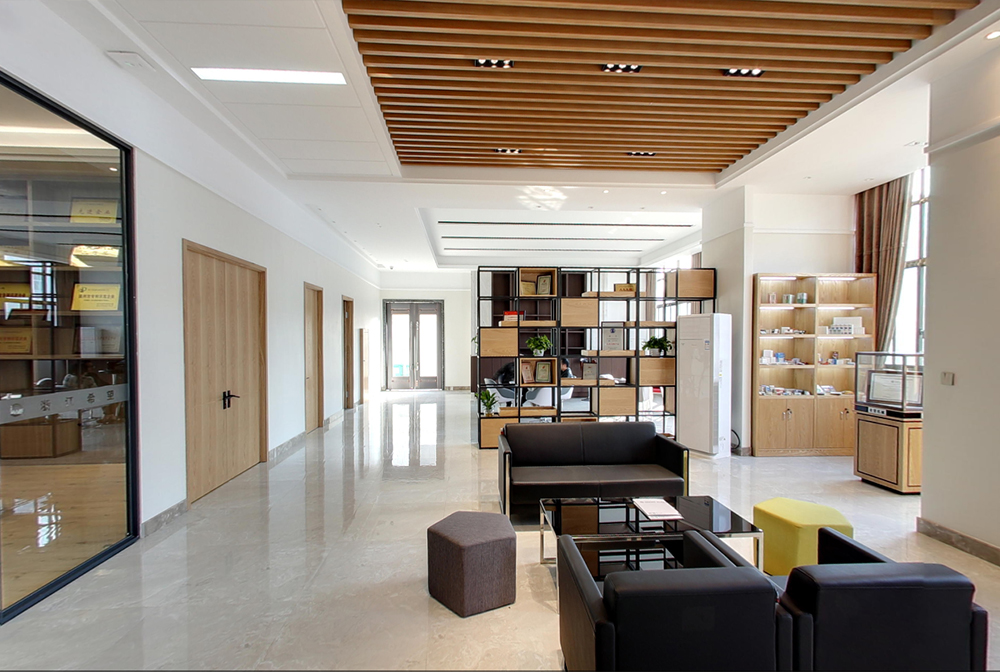
When a pharmaceutical packaging machine purchase moves into the decision and execution phase, the buyer is no longer comparing only output speeds and format ranges. The more relevant question is whether the supplier can support that equipment across years of production, multiple batches and changing regulatory expectations. This article looks at the supplier-level criteria that matter in that phase, using HOPING’s line of pharmaceutical blister-cartoning machines as a concrete reference.
Why Supplier Evaluation Becomes a Long-Term Question
Pharmaceutical packaging equipment is capital equipment with a long operating life. A buyer who selects an integrated blister packaging line is also selecting a maintenance channel, a spare-parts source, a validation partner and a future upgrade path. Those factors are difficult to see in a machine brochure, but they strongly affect total cost of ownership.
The size of the market explains why supplier choices matter. SkyQuest Technology valued the global pharmaceutical packaging equipment market at approximately USD 10.71 billion in 2024. Grand View Research reported that Asia Pacific held the largest revenue share in this market in 2025, at 40.7%. Custom Market Insights projected the pharmaceutical blister packaging machine segment at USD 2.57 billion by 2025, with a CAGR of 2.8%. Fortune Business Insights valued the pharmaceutical automatic cartoning machinery market at USD 1.46 billion in 2024. These are reference points for a capital purchase that affects a plant’s reliability for years.
At the decision stage, the evaluation tends to center on three supplier-level risks.
- Delivery risk — can the supplier produce, test and ship the line within the project timeline?
- Sustainment risk — can the supplier supply spares, tooling and technical support for years after handover?
- Expansion risk — can the supplier support larger or more complex lines if production grows?
These risks are not theoretical. In export projects, the distance between buyer and manufacturer makes pre-shipment testing, installation support and remote diagnostics more important.
HOPING at a Glance: What the Company Profile Shows
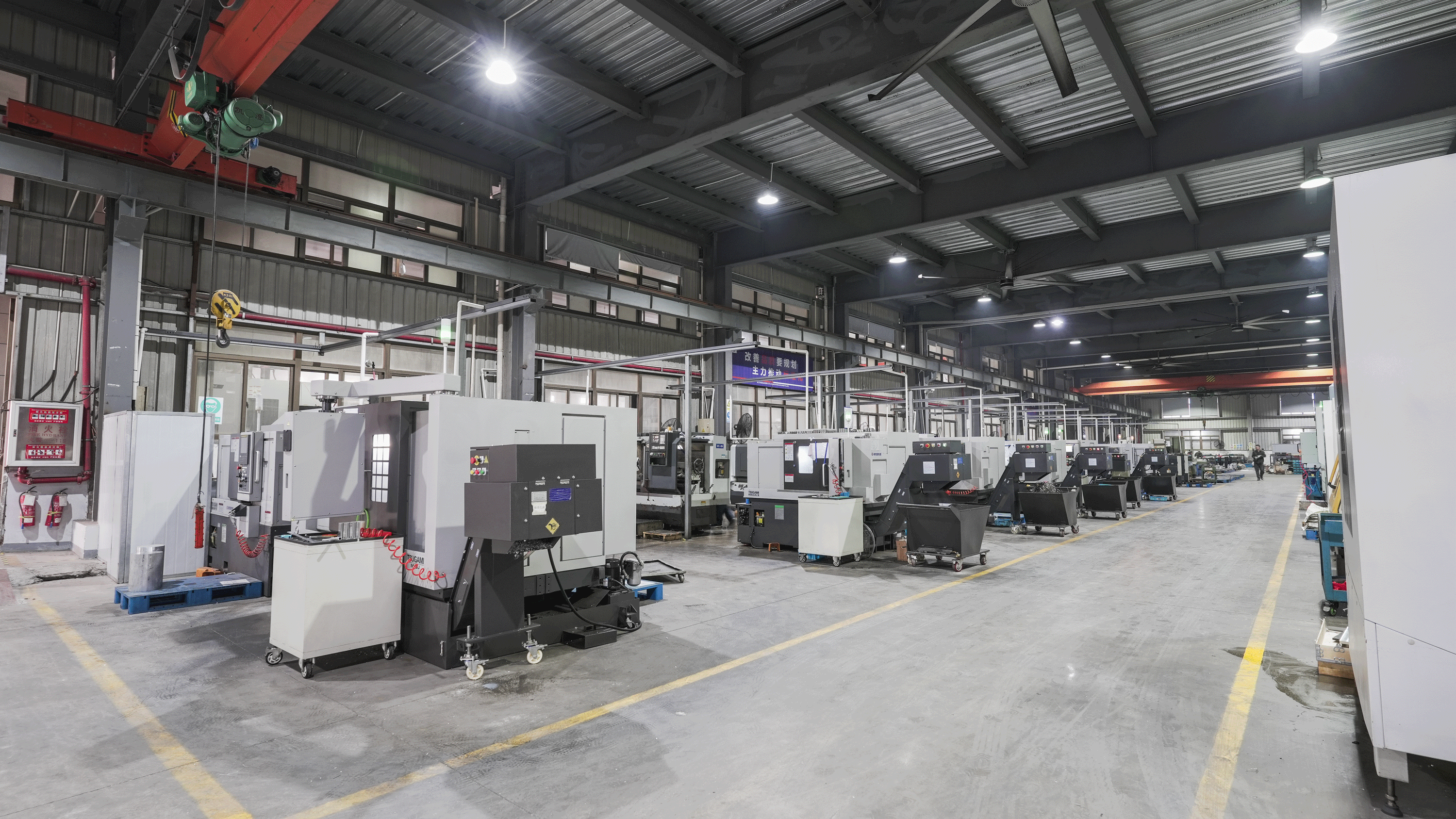
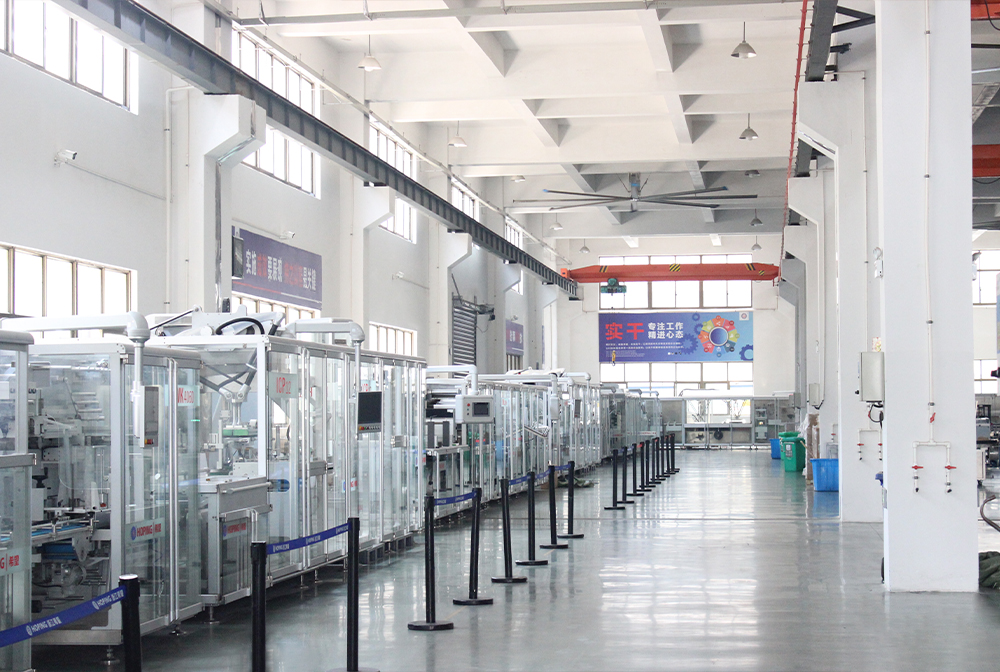
One manufacturer whose profile is useful for this discussion is Zhejiang Hoping Machinery Co., Ltd. (HOPING), located in Ruian, Zhejiang Province, China. Established in 2001, the company develops and produces blister packaging machines, cartoning machines, case packing machines and end-of-line packaging equipment. It employs more than 300 people and reports an annual output of about 500 units. Its production facility covers 28,800 square meters.
For a buyer at the decision stage, these numbers are not promotional claims. They indicate that the company operates at a scale large enough to handle repeat orders, keep format parts and spares in production and allocate engineering time to customer-specific adaptation.
HOPING’s engineering structure adds another layer of evidence. The company states that it has 56 R&D engineers. Its intellectual property portfolio includes 26 invention patents, 70 utility model patents, 4 design patents, 10 PCT-protected patents in markets that include Europe, Russia, Germany and Italy, and 28 software copyrights. According to the company’s official profile, HOPING also holds CE and ISO 9001/14001 certifications.
Integrated Blister-Cartoning: A Technical Look at the DHL Series
The products most relevant to buyers of pharmaceutical packaging machines are HOPING’s automatic blister-cartoning lines. These systems integrate blister forming and sealing, product feeding, blister transfer, leaflet folding, carton opening, product insertion, inspection/rejection and downstream connection into one automated process. Compared with a traditional blister machine feeding a standalone cartoner through manual transfer, the integrated approach reduces manual intervention and intermediate handling.
HOPING offers several DHL-series models at different capacity levels.
| Model | Maximum capacity | Transfer system | Control platform |
|---|---|---|---|
| DHL1000/5H | 1000 blisters/min, 500 cartons/min | D3 top-loading parallel tracking transfer system | Beckhoff motion controller |
| DHL8005H | 800 blisters/min, 500 cartons/min | D3 top-loading transfer system | Beckhoff controller with CP9315 industrial PC |
| DHL7005H | 700 blisters/min, 500 cartons/min | IRB24 intelligent transfer robot | Siemens motion controller with TP900 HMI |
| DHL7004 | 700 blisters/min, 400 cartons/min | IRB24 intelligent transfer robot | Siemens motion controller with TP900 HMI |
| DHL6004 | 600 blisters/min, 400 cartons/min | High-speed transfer and cartoning linkage | Beckhoff controller with CP9315 industrial PC |
These models share design features that matter for long-term operation. Full-servo drives help synchronize motion, PVC/Alu foil auto-splicing reduces the need for manual film changes, and servo-driven independent replenishment systems support continuous feeding. Tooling change and recipe memory functions allow operators to store parameters for different formats. From a maintenance perspective, centralized control, modular stations, alarm indication and parameter management simplify routine work.
Maximum capacity figures should be read as design limits. Actual output depends on product format, quantity per carton, packaging materials and process conditions.
Application Profile: Where an Integrated Line Is the Right Fit
HOPING’s line documentation describes the DHL-series systems as suitable for pharmaceutical solid-dosage production, nutraceuticals, healthcare products, food packaging and cosmetic packaging where blister-cartoning is required. The most typical use is large-scale production of tablets and capsules, where the volume justifies a fully integrated line and where reducing manual contact is a priority.
For buyers that need additional wrapping before cartoning, HOPING also builds linked configurations such as the IXW600 and IXW800 blister-flow-wrap-cartoning lines. For liquid dosage products, the IXW400 line integrates blister packaging and cartoning for filled syringes, ampoules and cartridges. At the end-of-line stage, configurations such as the XWZ300II cartoner combined with XWK4060 stretch bander and ICP12 case packing and palletizing machine provide a full secondary packaging path.
This range matters for the sourcing decision because it allows a buyer to start with a defined scope and expand later without changing supplier. The existence of a broader product family also suggests that the supplier can provide consistent control systems, documentation and service procedures across different lines.
Market Trends: Capacity, Compliance and Concentration
Three verified data points are useful for buyers interpreting the market context.
First, the market is large but not dominated by a single technology choice. As noted above, the pharmaceutical packaging equipment market reached roughly USD 10.71 billion in 2024, and the global pharmaceutical automatic cartoning machinery market was valued at USD 1.46 billion in the same year. Blister packaging machine demand is also substantial, with Custom Market Insights projecting USD 2.57 billion for 2025.
Second, regulatory pressure is rising. Pharmaceutical packaging machines must comply with ISO 15378, which applies GMP requirements to primary packaging materials, and EU equipment safety is governed by the Machinery Directive 2006/42/EC and the EN 415 series. For a buyer, working with a manufacturer that already builds these expectations into machine design reduces the compliance burden during validation and audits.
Third, the supplier landscape is fragmented. According to a MarketsandMarkets intelligence report, the top three players — Uhlmann, IMA and Marchesini — held approximately 29% of the pharmaceutical blister packaging machine market in 2025. That concentration is significant, but it also means that most projects are handled by specialized manufacturers outside the top tier. The practical consequence is that buyers need to verify each candidate’s manufacturing depth, export experience and after-sales structure instead of relying only on brand recognition.
Integrated Line vs. Traditional Setup: What the Comparison Actually Shows
A common comparison at the decision stage is between an integrated blister-cartoning line and a traditional setup composed of a blister machine, manual transfer and a standalone cartoner. HOPING’s comparison unit provides a practical framework for that comparison.
| Dimension | Traditional standalone setup | Integrated servo line |
|---|---|---|
| Process | Blister machine plus manual or semi-automatic transfer plus standalone cartoner; several intermediate handling points | Blister packaging, transfer, leaflet handling, carton opening, insertion, inspection/rejection and downstream connection in one automated process |
| Capacity example | Limited by manual transfer and separate machine synchronization | DHL1000/5H up to 1000 blisters/min and 500 cartons/min, depending on format and conditions |
| Labor requirement | More operators for transfer and monitoring | Reduced manual intervention and intermediate handling |
| Initial investment | Usually lower | Usually higher than standalone or semi-automatic equipment |
| Operating cost logic | Lower capital, but more labor and transfer-related quality risk | Helps reduce labor, transfer, management and quality-risk costs in large-scale continuous production |
| Maintenance | Standard machine maintenance plus more coordination between separate machines | Centralized control, modular stations, alarm indication and parameter management; operator training, spare-parts management and preventive maintenance remain important |
The honest limitation of the integrated approach is cost. Initial investment is usually higher than standalone or semi-automatic equipment. The economic case depends on production volume, labor cost and quality-risk exposure. In lower-volume workshops, the premium for a full-servo integrated line may be harder to justify. Actual capacity is also not a fixed number; it depends on blister dimensions, quantity per carton, film materials and process stability.
For large-scale solid-dose production, the integrated design addresses the main sources of inefficiency: manual transfer between machines, missing-product events, carton jams and insufficient line synchronization. That is why HOPING positions the DHL series for high-capacity workshops and multi-format production.
Execution Realities: From Order to Site Acceptance
For buyers in the execution phase, the supplier’s project behavior matters as much as the machine design. HOPING’s stated execution framework includes early sample and material confirmation, solution design according to blister and carton formats, no-load and material tests before shipment, and installation, commissioning, training, spare parts and remote technical support after delivery. Customer witness acceptance can be arranged for key projects.
The company’s procurement terms are also documented. The minimum order quantity is 1 set or 1 complete line. Typical production lead time is 60-120 days after technical confirmation, and monthly production capacity is 30-40 units. Delivery terms include EXW Ruian/Wenzhou, FOB Ningbo or Shanghai, or CIF/CFR destination port, with final terms subject to contract and importing-country requirements. Acceptance can include technical agreement confirmation, sample testing, pre-shipment FAT and SAT at the customer site, with third-party inspection arranged on request.
For a buyer, these details answer a practical question: can this supplier take responsibility for the whole project, or does the buyer need to coordinate multiple third parties? A turnkey line supplier with documented lead times, acceptance steps and support procedures simplifies project execution.
Future Outlook: Suppliers as Lifecycle Partners
The direction in pharmaceutical packaging is toward higher integration, better data capture and more flexible format changeover. As products become more diverse and batch sizes shrink, buyers will need machines that can be reconfigured quickly and suppliers that can adapt them over time.
Supplier evaluation at the decision stage will therefore continue to shift from “which machine” to “which supplier can carry this machine through its full lifecycle.” Evidence such as manufacturing capacity, engineering headcount, patent activity, certification status, delivery terms and service scope is more useful than promotional language.
HOPING’s broader product range, from standalone blister machines and cartoners to integrated blister-cartoning lines and end-of-line systems, illustrates the kind of portfolio that supports this long-term view. The catalog published by the company is one way for buyers to compare available configurations before starting technical discussions.
For reference, the HOPING machinery catalog is available here: https://cdn.socialarks.com/sbsp/24974/common/2026/0613/Hoping%20Machinery%20Catalog.pdf
FAQ
What is the minimum order quantity for a pharmaceutical packaging machine from HOPING?
The minimum order quantity is 1 set or 1 complete line.
What is the typical production lead time for a blister-cartoning line?
Typical production lead time is 60-120 days after technical confirmation.
How many machines can the manufacturer produce in a month?
Monthly production capacity is 30-40 units.
Which machine configurations are available for pharmaceutical packaging?
HOPING offers blister packaging machines, automatic blister-cartoning lines, flow wrappers, cartoning machines, stretch banders, case packing machines and end-of-line systems. Models include the DPP and DPH blister machine series, DHL integrated blister-cartoning lines, IXW blister-flow-wrap-cartoning lines and XWZ cartoners.
What are the available delivery and acceptance terms for export projects?
Delivery terms include EXW Ruian/Wenzhou, FOB Ningbo or Shanghai, and CIF/CFR destination port; final terms depend on contract and customer country requirements. Acceptance can include technical agreement confirmation, sample testing, pre-shipment FAT, SAT at the customer site and third-party inspection where required.
How does the manufacturer control risks during high-speed pharmaceutical packaging?
Risk control measures include sensor monitoring, vision or checkweighing inspection where configured, missing-product alarms, automatic stop, automatic rejection, key-parameter locking, fault records and mechanical safety protection. The manufacturer also confirms samples and packaging materials at an early stage, tests before shipment and provides installation, commissioning, training, spare parts and remote technical support.