
Pharmaceutical Packaging Machine: Technical Procurement FAQ
Pharmaceutical Packaging Machine: Technical Procurement FAQ
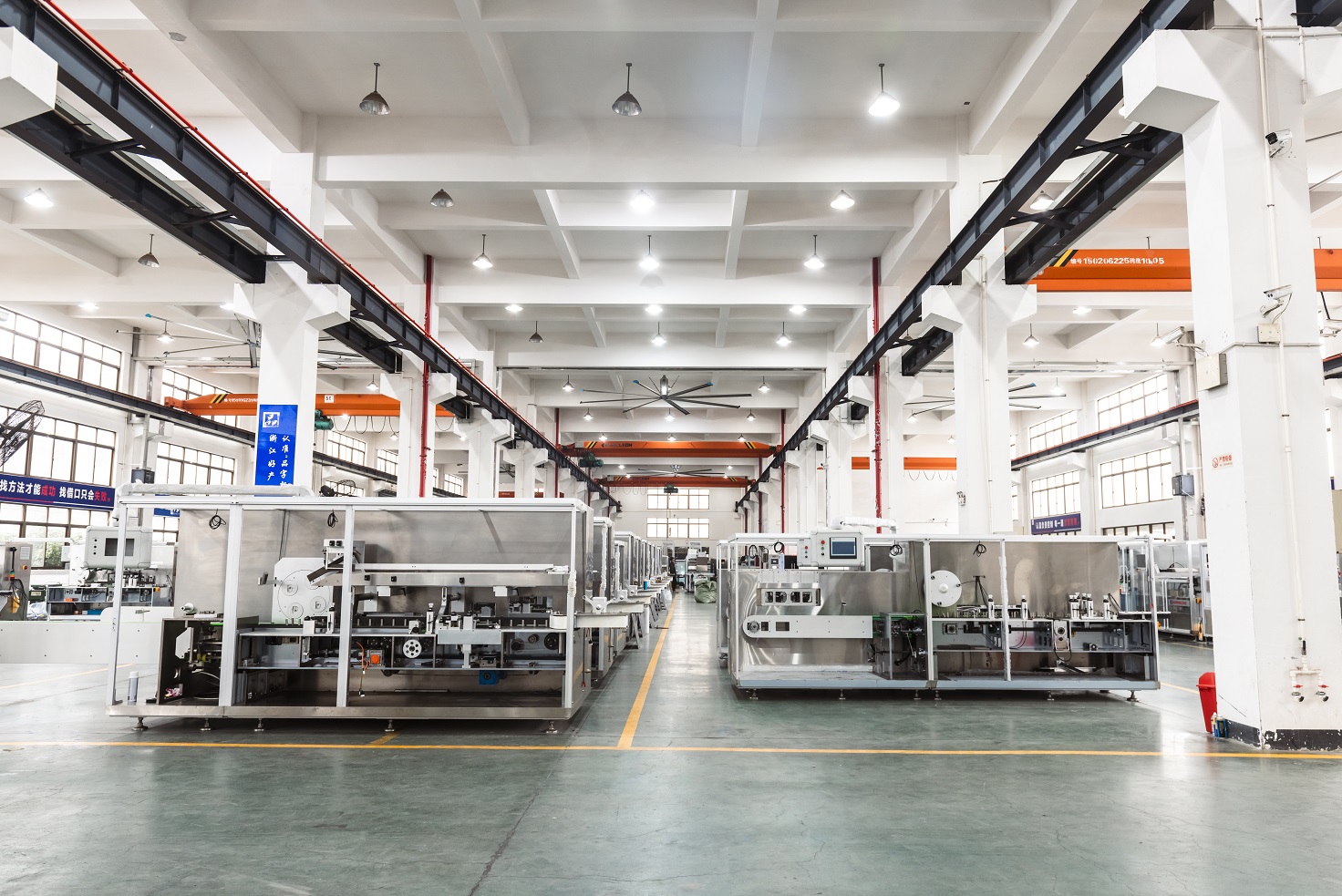
A cartoner workshop provides the production context for the procurement questions discussed in this article.
A pharmaceutical packaging machine procurement FAQ is useful only when it separates four different questions: what the machine can do, what can be customized, how it connects to the rest of the line, and what evidence proves the claim. Buyers in the evaluation-to-execution stage rarely suffer from a lack of brochure specifications. The larger risk is mixing maximum output, optional configuration and project-specific acceptance criteria into one comparison.
Zhejiang Hoping Machinery Co., Ltd. (HOPING) is a pharmaceutical packing machinery manufacturer established in 2001, with a 28,800 m² facility, 300 employees, 56 engineers and an annual output of 500 units. Its listed products include blister packaging machines, cartoning machines, case packing machines and end-of-line packaging machines. The company states a 25% export ratio and main markets in Southeast Asia, the Middle East, Eastern Europe, South America and Africa.
This article uses HOPING's documented capability as a reference case for a technical and procurement FAQ. It is not a claim that every configuration is interchangeable, and the same questions apply to any supplier.
What capability should a pharmaceutical packaging machine demonstrate?
Capability should be demonstrated at the level of the dosage format, packaging format, line interface and acceptance evidence, not at the level of a single machine name. A tablet blister packaging machine, a capsule blister packaging machine and an alu-alu blister packaging machine may share a category label but differ in forming material, heating, sealing, tooling and validation requirements.
HOPING's public product scope lists flat-plate, roller-type aluminum-plastic, aluminum-aluminum blister packaging machines, automatic cartoning machines and production lines. That scope is a starting point for screening. It does not establish that one model covers every format, and it does not replace a format trial. The buyer should ask which model and which configuration are being quoted for the actual product, carton, leaflet and downstream case packing arrangement.
| Capability question | What to ask | Why it matters |
|---|---|---|
| Dosage and package format | Tablet, capsule or other solid dosage; blister material; blister size; carton size; leaflet format. | Format defines tooling, forming, sealing and feeding requirements. |
| Line scope | Standalone blister machine, blister cartoning line, or blister-cartoning with case packing and palletizing. | The interface scope changes the engineering, acceptance and project risk. |
| Customization | Quantity per carton, coding or inspection method, feeding method, interface language, electrical component brand and data interface. | These are the points where a standard quotation can diverge from the actual project. |
| Acceptance evidence | Sample trial, FAT, SAT, third-party inspection and the documents attached to the technical agreement. | A capability claim becomes a procurement fact only when it is tied to an acceptance method. |
The first answer is therefore conditional: a machine is capable for a project when the quoted model, tooling, material, carton format, line interface and acceptance method match that project. A generic statement that a supplier makes blister packaging machines, cartoning machines or case packing machines is not enough for an evaluation-to-execution decision.
OEM and customization: what is actually customizable?
HOPING's documented production mode is ODM, OEM and customizable, but the customization list is specific and should be converted into a technical agreement before quotation. The documented customization fields are blister size, blister materials, quantity per carton, carton specification, leaflet format, coding or inspection method, feeding method, downstream bundling, case-packing or palletizing connection, interface language, electrical component brand and data interface.
That list is useful because it shows where a buyer should stop treating the machine as a catalogue item. Blister size and material affect forming and sealing. Quantity per carton and carton specification affect the cartoner and the line balance. Leaflet format affects the cartoning sequence and the risk of a missing leaflet. Coding or inspection method affects the data and rejection path. Feeding method affects upstream integration. Downstream connection affects the case packing and end-of-line scope. Interface language, electrical component brand and data interface affect documentation, spare parts and plant integration.
The documented capability also states a monthly capacity of 30 to 40 units, a minimum order quantity of 1 set or 1 complete line, and a typical lead time of 60 to 120 days after technical confirmation. The final lead time is subject to model, configuration, project complexity and contract terms. Those are planning inputs, not a promise that every customized line will meet the same schedule.
Quality control is also part of the customization answer. The documented sequence includes incoming material inspection, key component inspection, assembly inspection, electrical safety check, no-load trial run, material trial, FAT, customer witness acceptance and pre-shipment inspection. A buyer should ask which of these steps apply to the quoted configuration and which records will be delivered. A customization claim without a corresponding inspection point is difficult to verify.
The limitation is equally important. The available facts do not state unlimited customization, guaranteed material compatibility for every product, or a fixed lead time for every project. The practical test is whether the supplier can repeat the customization in drawings, material specifications, acceptance criteria and change-control documents. If the answer stays at the level of a sales description, the project is not yet ready for execution.
Blister-to-cartoner integration: which interfaces decide the project?
In an integrated blister cartoning line, the decisive capability is not the blister machine alone or the cartoner alone. It is the transfer, buffering, rejection and data interface between them. HOPING describes an integrated packaging line containing blister packing, cartoning, flow packing, case packing and palletizing equipment. For a pharmaceutical packaging line, that description should be read as a scope statement, not as proof that every interface is already engineered for a specific product.
Many pharmaceutical cartoning lines use a horizontal cartoning machine; a commercial research source cited in the available data reports that horizontal cartoning systems held 70.12% of market share in 2024. That share is a market-level observation, not evidence that a particular horizontal cartoning machine fits a specific carton or leaflet format.
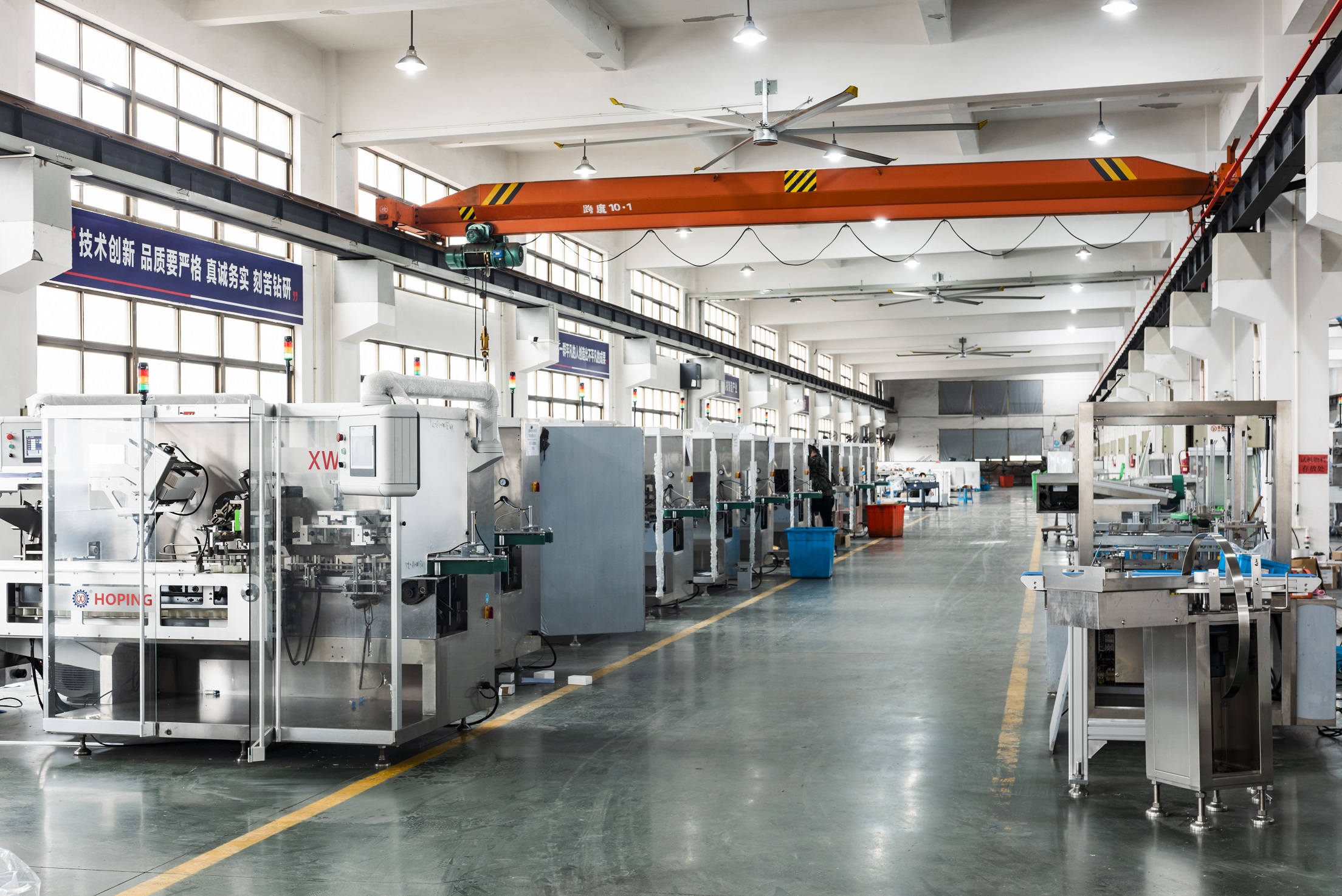
Cartoner workshop. The cartoner is only one part of a blister cartoning line; the transfer and data interfaces also require definition.
The interface questions follow directly from the documented customization fields. What is the blister size and material? How many blisters go into each carton? What is the carton specification and leaflet format? Which coding or inspection method is used? How is the product fed? Does the line connect to bundling, case packing or palletizing? Which interface language and data interface are required? These are not secondary details. They determine whether a blister packaging line and a cartoning machine become a working blister cartoning line or remain two separately accepted machines.
HOPING's representative project profile for a large pharmaceutical manufacturer covers 5 to 10 lines for tablets, capsules and other solid dosage forms. The stated objectives include improving packaging automation, reducing manual transfer, improving blister-to-carton connection efficiency, reducing wrong insertion or missing leaflet risks and supporting downstream automation integration. These are project objectives, not audited outcomes. A buyer should ask how each objective will be measured during FAT and SAT, and which result would cause acceptance to be withheld.
A standalone blister machine with manual transfer to a cartoner is not inferior by definition. It may fit lower volume, multi-product operations or a phased investment. The integrated blister-cartoning model changes the procurement question: the buyer is no longer buying two machines in isolation but an interface, a buffer, a rejection strategy and a data handshake. That can reduce manual transfer and leaflet risk when the line is properly specified, but integration by itself does not guarantee those outcomes. The case profile lists them as objectives, not as verified results across all projects.
How should buyers interpret speed and capacity claims?
Maximum output is a screening number, not a validated capacity. HOPING's packaging-line page reports a maximum of 1,000 blisters per minute and 500 boxes per minute for a line configuration. The same source does not establish the exact model, product format, station count, rejection rate or sustained output. It is therefore not a like-for-like benchmark against another supplier until the basis is matched.
The two figures also illustrate why line balancing needs its own question. A blister output and a cartoning output cannot be compared directly without knowing how many blisters are placed in each carton, how rejects are removed and how the transfer buffer works. If a buyer compares only the headline blister speed, the cartoner, the leaflet feeder or the automatic case packer may become the constraint. If a buyer compares only the cartoner speed, the blister machine may not support it in the actual format.
The procurement answer is to ask for the basis of the number. Which model? Which blister material and forming method? Which product and blister layout? How many blisters per carton? What rejection rate is assumed? Is the figure a maximum or a sustained output over a defined shift? Was it observed in a material trial, a FAT or a reference installation? The available evidence supports a maximum output claim for a line configuration, but it does not support a general statement that every configuration will reach that output.
A buyer should also separate machine capacity from line capacity. A blister packaging machine may have a high nominal cycle rate, while the cartoning machine, leaflet feeder, automatic case packer or end-of-line packaging machine sets the practical line rate. The useful comparison is the sustained rate of the complete pharmaceutical packaging line under the buyer's product mix, not the highest number in a brochure.
What acceptance and certification evidence should be requested?
Acceptance evidence should be tied to the technical agreement, not to a certificate alone. The documented purchasing terms are a minimum order quantity of 1 set or 1 complete line; delivery terms of EXW Ruian or Wenzhou, FOB Ningbo or Shanghai, or CIF or CFR destination port, with final terms subject to contract and customer country requirements; and payment terms subject to quotation, contract value, customer credit, project scope, destination market and final project agreement.
The documented acceptance path is more useful than a general quality statement. It includes technical agreement confirmation, sample testing, FAT before shipment, SAT at the customer site, and third-party inspection when arranged according to customer requirements. These steps should be written into the project schedule with hold points. A buyer in the execution stage should know which sample, which format, which carton and which acceptance record will be used at each stage.
The manufacturing quality sequence adds another layer: incoming material inspection, key component inspection, assembly inspection, electrical safety check, no-load trial run, material trial, FAT, customer witness acceptance and pre-shipment inspection. The buyer should ask which records are routine and which are project-specific. The answer affects the evidence pack that supports the factory acceptance and the final release.
Certification requires the same scope discipline. The certificate records reviewed for this article include four CE certificates: carton packing machine series UCN 900339024607, issued 2007-04-01; a sample automatic blister packing machine UCN 900175009261, issued 2006-11-06; cartoning machine series HTT190102307L, issued 2019-01-22; and blister packing machine series HTT190102306L, issued 2019-01-22. These are historical certificate records with defined scopes. A series certificate or a sample certificate does not automatically cover every model, option or integrated line configuration.
The available management-system records also need date checks. The ISO 45001 certificate CN00123S33121R1M/3300 shows an expiry date of 2026-10-09, and the ISO 14001 certificate CN00123E33896R1M/3300 shows an expiry date of 2026-10-11. At the date of this article, those dates have passed. They are historical records unless current renewal evidence is supplied. ISO 45001 and ISO 14001 are management-system certificates, not machine-safety certification, and they should not be presented as proof of machine conformity.
Two external standards help clarify the boundary. ISO 15378:2017 specifies Good Manufacturing Practice requirements for primary packaging materials for medicinal products; it is not a machine-certification standard and should not be used to claim that a packaging machine itself is GMP-certified. The U.S. FDA provides official guidance on current good manufacturing practice production and process controls, but the available source does not establish machine-specific design clauses. The buyer should ask the supplier to map documents to the buyer's own qualification plan rather than treating a certificate as a complete answer.
What does the market direction mean for procurement?
The useful market signal is not a single growth figure. It is the reported shift toward integrated lines and digitised data collection. Trade media reporting PMMI content states that pharmaceutical manufacturers are turning toward digitised data collection and integrated solutions to meet regulations and improve visibility. That is a directional statement, not a measured adoption rate, and it should not be converted into a forecast for a specific equipment category.
A published review also states that medical devices and pharmaceutical drugs are packaged to maintain their stability and integrity during post-production shipping and storage. For a buyer, this connects packaging format, material and line validation to the product's protective function. A blister packaging machine that runs at high speed but cannot support the required forming, sealing or handling conditions is not a capability match. The procurement question should include packaging integrity and data visibility, not only output.
The practical outlook is that line integration and documentation will be assessed together. That does not mean every project needs a fully integrated turnkey pharmaceutical packaging line. It means the buyer should decide early whether the project is a standalone blister packaging machine, a blister cartoning line, or a broader secondary packaging line with case packing and end-of-line equipment. The scope decision determines the evidence, interfaces and acceptance tests that follow.
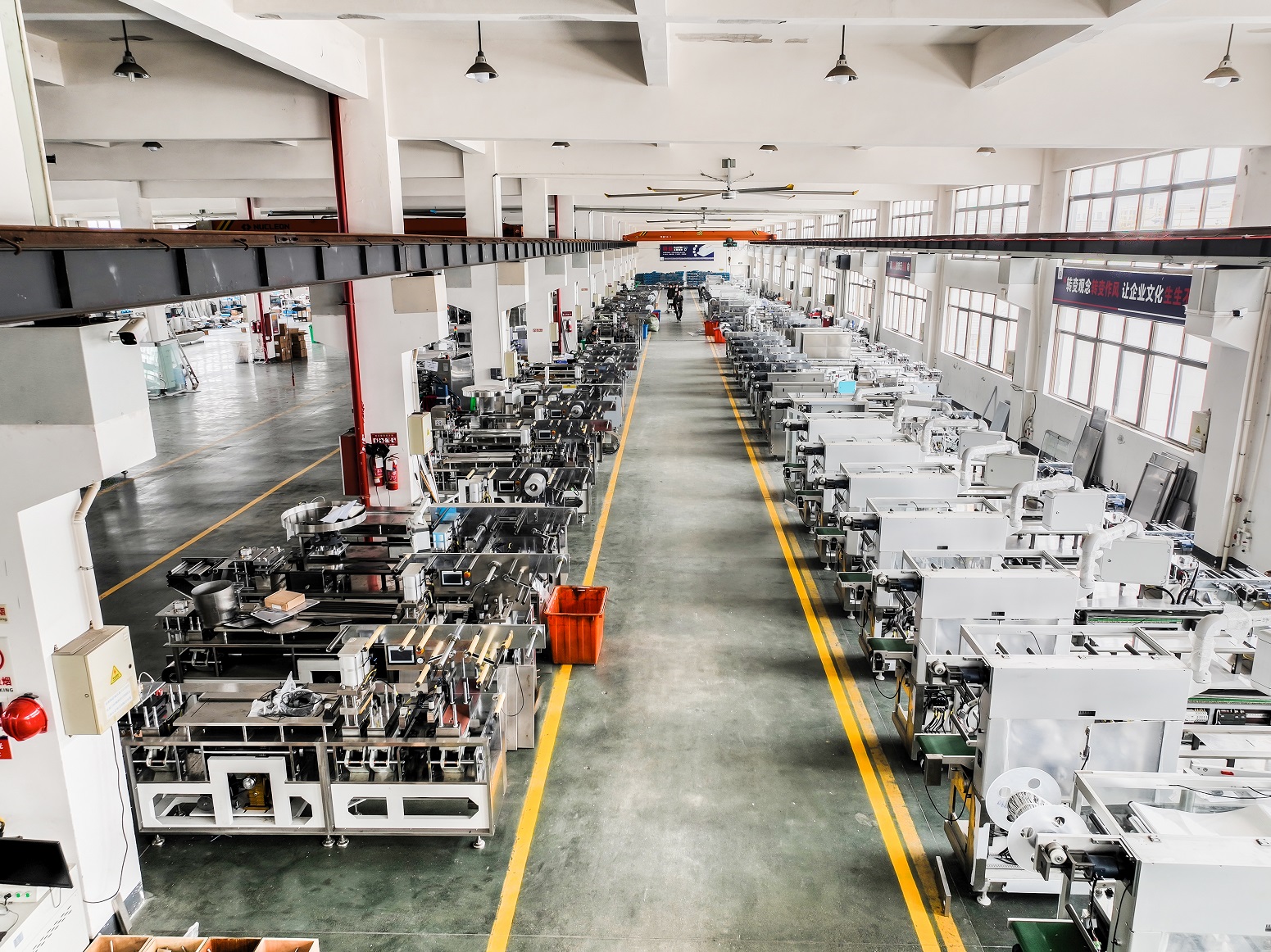
Blister machine workshop. Format, material and line interface questions should be resolved before a machine is treated as a standard catalogue item.
FAQ
What can be customized on a pharmaceutical packaging machine?
HOPING's documented customization fields include blister size, blister materials, quantity per carton, carton specification, leaflet format, coding or inspection method, feeding method, downstream bundling, case-packing or palletizing connection, interface language, electrical component brand and data interface. The same record states ODM, OEM and customizable production, a minimum order of 1 set or 1 complete line, and a typical lead time of 60 to 120 days after technical confirmation, subject to model, configuration, project complexity and contract terms. These fields should be converted into a technical agreement with drawings, material specifications and acceptance criteria.
How is a blister cartoning line integrated?
A blister cartoning line is integrated through defined mechanical, product-flow and data interfaces. The buyer should define blister size and material, quantity per carton, carton specification, leaflet format, coding or inspection method, feeding method, downstream bundling, case packing or palletizing connection, interface language and data interface. HOPING describes an integrated line containing blister packing, cartoning, flow packing, case packing and palletizing equipment. Its representative project profile for a large pharmaceutical manufacturer lists objectives such as reducing manual transfer, improving blister-to-carton connection efficiency and reducing wrong insertion or missing leaflet risks. Those are project objectives and require FAT and SAT evidence.
What acceptance tests should a buyer require?
The documented acceptance path includes technical agreement confirmation, sample testing, FAT before shipment, SAT at the customer site and third-party inspection when arranged according to customer requirements. The manufacturing quality sequence includes incoming material inspection, key component inspection, assembly inspection, electrical safety check, no-load trial run, material trial, FAT, customer witness acceptance and pre-shipment inspection. The buyer should specify which product, blister format, carton, leaflet and data record are used at each stage, and which result would prevent release.
How should buyers interpret maximum output speeds?
HOPING's packaging-line page reports a maximum of 1,000 blisters per minute and 500 boxes per minute for a line configuration. The available source does not establish the exact model, product format, station count, rejection rate or sustained output. A buyer should ask for the basis of the number, including the blister material, blister layout, blisters per carton, rejection assumptions and whether the figure is a maximum or a sustained output. Without that basis, maximum speed is a screening figure, not a validated capacity for the buyer's product.
What do CE and ISO certificates prove for a pharmaceutical packaging machine?
CE and ISO certificates prove the scope, standard and date stated on the document; they do not automatically prove conformity for every model, option or integrated line. The available records include CE certificates for carton packing machine series UCN 900339024607, a sample automatic blister packing machine UCN 900175009261, cartoning machine series HTT190102307L and blister packing machine series HTT190102306L. The available ISO 45001 and ISO 14001 records show expiry dates in October 2026 that have passed at the date of this article, so they are historical unless renewal evidence is provided. ISO 15378:2017 applies to GMP requirements for primary packaging materials, not as a machine-certification standard.
Conclusion
A procurement FAQ is not a list of questions to ask. It is a method for converting answers into evidence. For an evaluation-to-execution buyer, the practical next step is to turn the customization list, interface definitions, output basis, acceptance criteria and certificate scopes into the technical agreement. That step does not guarantee performance, but it makes the basis of the claim visible and gives the project a clear acceptance path.
For readers who need the manufacturer's published product scope, the HOPING catalog is available here: Hoping Machinery Catalog.
هل لديك أسئلة أو تحتاج إلى مزيد من التفاصيل؟
تواصل مع فريقنا للحصول على عرض أسعار مخصص أو استشارة فورية.
طلب عرض أسعار
املأ النموذج أدناه وسيتواصل معك فريقنا بعرض مقترح مخصص.
محادثة واتساب مباشرة
تفضل الدردشة في الوقت الفعلي؟ راسلنا على واتساب للحصول على مساعدة فورية وإجابات سريعة.
- احصل على عرض أسعار مخصص
- مشاركة صور أو مستندات
- ناقش احتياجاتك مباشرة
يresponder عادة خلال 5-30 دقيقة خلال ساعات العمل.