
Pharmaceutical Packaging Machine: A Certification and Specification Field Guide
Certificates and specification sheets are where most pharmaceutical packaging machine evaluations start — and where many evaluations go wrong. A CE certificate proves that a machine meets EU safety requirements; it does not tell the buyer whether the machine can protect tablets from moisture, clean quickly between batches, or connect to a cartoning machine without creating a bottleneck. This guide explains the certification and specification data that matter in a pharmaceutical packaging machine purchase, using integrated blister-cartoning lines as the working example.
Zhejiang Hoping Machinery Co., Ltd. (HOPING), established in 2001, is a China-based manufacturer of blister packaging machines, cartoning machines, case packing machines and end-of-line packaging equipment. Its factory covers 28,800 square meters and employs more than 300 people, including a 56-engineer research and development team; export markets include Southeast Asia, the Middle East, Eastern Europe, South America and Africa. For evaluation purposes, HOPING is an example of a supplier that publishes machine-level specification data across both standalone equipment and integrated lines.
Why specification and certification data drive pharma packaging purchases
Pharmaceutical packaging is not a single step. The primary pack protects the dosage form, the carton carries mandatory label information, and the outer pack must survive distribution. Each layer creates a different equipment decision. According to SkyQuest Technology, the global pharmaceutical packaging equipment market was valued at approximately USD 10.71 billion in 2024. Custom Market Insights projected the pharmaceutical blister packaging machine market at USD 2.57 billion by 2025, with a CAGR of 2.8%. Grand View Research reported that Asia Pacific held the largest revenue share of 40.7% in the wider pharmaceutical packaging equipment market in 2025.
The practical consequence is that more projects now compare suppliers across borders. In this context, specification and compliance clarity becomes part of the purchase decision. Buyers need to separate marketing-level claims from verifiable constraints: certification documents, contact materials, speed ranges, format limits and integration capability.
Certification stack: what each document actually tells you
CE marking in the European Union is a legal requirement for machinery placed on the EU market. For packaging machines, the relevant framework includes Machinery Directive 2006/42/EC and the EN 415 series. ISO 15378 is a separate GMP-related standard for primary packaging materials; it cannot be treated as a machine-level safety certificate.
HOPING’s CE documentation covers multiple series. The carton packing machine series is certified under EN 415-3:2000; the automatic blister packing machine series is covered under EN 60204-1; the cartoning machine series is certified under Machinery Directive 2006/42/EC. HOPING also holds ISO 14001:2015 environmental management and ISO 45001:2018 occupational health and safety certificates for the design, production and after-sales service of packing machines and packing production lines.
| Document | What it indicates | Example evidence |
|---|---|---|
| CE certification | EU machinery safety compliance | EN 415-3:2000; 2006/42/EC; EN 60204-1 |
| ISO 14001:2015 | Environmental management system | CQC certificate CN00123E33896R1M/3300 |
| ISO 45001:2018 | Occupational health and safety management | CQC certificate CN00123S33121R1M/3300 |
| ISO 15378 | GMP-oriented standard for primary packaging materials | Check with the material supplier, not only the machine builder |
Materials and construction: GMP-oriented design in practice
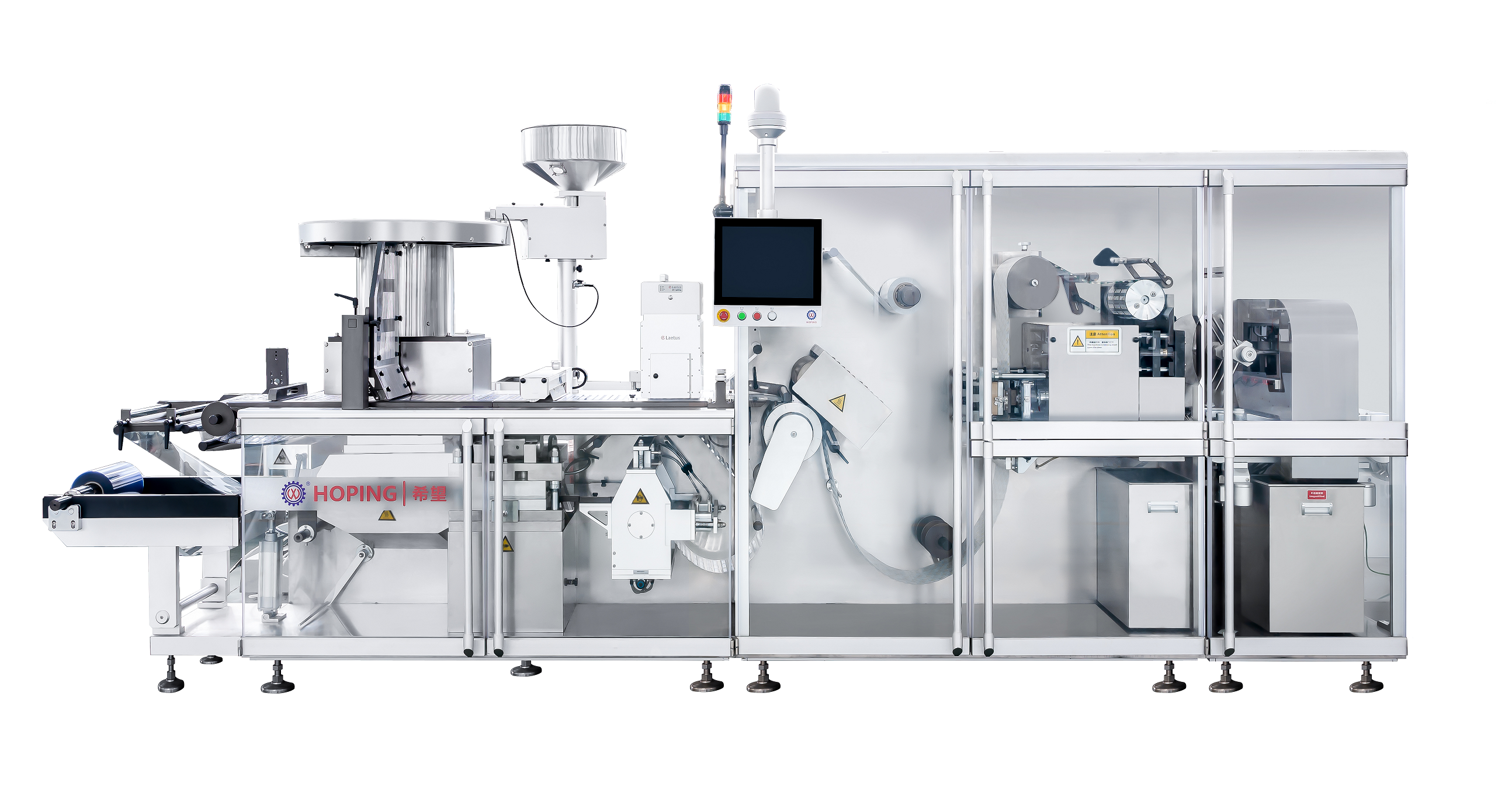
The term GMP-oriented design is common in pharmaceutical machine data sheets. In practice, it is most visible in material specifications. HOPING states that product-contact parts on the rotary blister packing machine DPH320HII and the platen blister machine DPP260T1 are made of AISI 316L stainless steel and FDA-compliant pharmaceutical-grade materials. Non-product-contact parts are manufactured from AISI 304 stainless steel and anodized aluminum alloy. Both models are designed and manufactured in accordance with GMP requirements and are described as having corrosion-resistant and easy-to-clean surfaces.
| Machine area | Specification in HOPING equipment |
|---|---|
| Product-contact parts | AISI 316L stainless steel; FDA-compliant pharmaceutical-grade materials |
| Non-product-contact parts | AISI 304 stainless steel; anodized aluminum alloy |
| Design basis | GMP-oriented design, corrosion-resistant and easy-to-clean surfaces |
Comparison of standalone blister machines: reading the parameters
Blister machine specification sheets usually include capacity, punch frequency, format area and feed stroke. A buyer should compare all four. A high output figure means little if the required blister format exceeds the forming area or the feed stroke cannot support the pitch.
| Model | Type | Maximum capacity | Maximum punch frequency | Maximum format area | Feed stroke | Total power |
|---|---|---|---|---|---|---|
| DPH320HII | Rotary blister packing machine | 1000 blisters/min | 250 punches/min | 320 x 280 mm | 100-280 mm | 30 kW |
| DPP260T1 | Platen blister machine | 300 blisters/min | 60 punches/min | 260 x 115 mm | 30-120 mm | 8.5 kW |
The same principle applies across the wider DPH and DPP series. These machines are available in configurations for Alu-PVC and Alu-Alu packaging, with tooling customized to the blister format.
Automatic cartoning machines: matching line output
Cartoning speed determines whether the blister line can run at its rated capacity. HOPING’s horizontal cartoning range spans 30 to 500 cartons per minute across three main models.
| Model | Capacity | Overall dimensions | Net weight | Power | Main features |
|---|---|---|---|---|---|
| XWZ120 | 30-120 cartons/min | 3650 x 1330 x 1700 mm | 2700 kg | 3.5 kW | Horizontal cartoner; SEW main motor; Siemens PLC |
| XWZ300II | 60-220 cartons/min | 5160 x 1600 x 2100 mm | 4800 kg | 5 kW | Intelligent high-speed cartoner; Siemens/Meccano HMI; SEW gear motor; Becker vacuum pump VT4.40 |
| XWZ500H | 100-500 cartons/min | 6700 x 1950 x 2100 mm | 6000 kg | 14 kW | Full servo high-speed cartoner; leaflet insertion and closing modules |
Integrated blister-cartoning lines: linking primary and secondary packaging
For buyers evaluating a complete pharmaceutical packaging line, the main question is whether the blister machine and cartoner can operate as one synchronised production system. HOPING’s DHL line series illustrates this approach.
| Model | Maximum capacity | Automation and control |
|---|---|---|
| DHL6004 | Up to 600 blisters/min and 400 cartons/min | Servo-driven independent replenishment; Beckhoff motion controller and CP9315 industrial PC; GMP-oriented design |
| DHL7004 | Up to 700 blisters/min and 400 cartons/min | Self-developed IRB24 intelligent transfer robot; Siemens motion controller and TP900 HMI; full servo drive |
| DHL7005H | Up to 700 blisters/min and 500 cartons/min | IRB24 transfer robot; Siemens motion controller and TP900 HMI; optional downstream bundling, case packing and palletizing |
| DHL8005H | Up to 800 blisters/min and 500 cartons/min | D3 top-loading parallel tracking transfer; three-channel independent replenishment; Beckhoff controller and CP9315 |
| DHL1000/5H | Up to 1000 blisters/min and 500 cartons/min | D3 top-loading parallel tracking transfer; four-channel independent replenishment; PVC/Alu auto splicing; Beckhoff controller; recipe memory |
What a turnkey pharmaceutical packaging line includes
In HOPING’s application documentation, the function of a modern pharmaceutical packaging line is described as completing blister packaging, leaflet folding, carton opening, blister insertion, batch/date coding, inspection and rejection, and downstream connection. Working conditions include GMP-oriented cleanroom or pharmaceutical workshops, continuous high-speed operation, multi-batch and multi-format production.
Representative project records from HOPING’s corpus describe pharmaceutical manufacturers, solid dosage producers and pharmaceutical engineering contractors using five to ten integrated lines for tablets, capsules and similar solid dosage products. The stated project objectives include improving packaging automation, reducing manual transfer, improving blister-to-carton connection efficiency, reducing wrong insertion or missing leaflet risks, and supporting downstream automation integration.
Beyond solid dosage, the equipment range covers vial labeling plus blister-cartoning-banding lines, liquid dosage blister lines for pre-filled syringes, ampoules and cartridges, freeze-dried powder blister machines, and high-speed blister-flow-wrap-cartoning lines for moisture-sensitive products.
Procurement constraints: lead time, MOQ and quality control
Specification data should be checked against delivery and acceptance constraints. HOPING’s ODM/OEM capability unit states a typical lead time of 60 to 120 days after technical confirmation, a minimum order of one set or one complete line, and a monthly production capacity of 30 to 40 units. The stated quality control process includes incoming material inspection, key component inspection, assembly inspection, electrical safety check, no-load trial run, material trial, factory acceptance test, customer witness acceptance, and pre-shipment inspection.
Market signals: why integrated and GMP-oriented lines are moving into the mainstream
Market data supports the shift toward integrated pharmaceutical packaging equipment. Beyond the overall market size, concentration data cited by MarketsandMarkets indicates that the top three global players in the pharmaceutical blister packaging machine market hold approximately 29% of the market. This leaves a substantial group of manufacturers competing on customization, line integration, regional service and compliance documentation. For buyers, the implication is that specification transparency and project references matter as much as brand recognition.
Current product data from HOPING also points in this direction: servo-driven independent replenishment, robotic transfer, automatic film splicing, recipe memory and optional data interfaces are increasingly treated as standard building blocks rather than exotic add-ons.
Integrated versus standalone lines: where the boundary is
An integrated blister-cartoning line reduces manual transfer and synchronises production. That is valuable in medium-to-high volume continuous production. But integrated lines are not always the right answer. For low-volume, high-mix production with frequent format changes, standalone machines can be easier to manage. An operator can change tooling on one station without stopping the entire linked system, and the layout can be adapted around an existing room. Integrated lines require more engineering coordination at the technical confirmation stage and more careful changeover planning.
| Consideration | Integrated blister-cartoning line | Standalone machines |
|---|---|---|
| Material flow | Linked transfer from blister to cartoner | Manual or conveyor transfer |
| Automation | Synchronised line control with inspection and rejection | Each machine controlled independently |
| Format changeover | Coordinated change across the line | Can be changed station by station |
| Engineering | Project layout and line integration required | Simpler installation |
| Best fit | Medium-to-high volume continuous production | Low-to-medium volume, frequent format changes |
Future outlook: compliance transparency and flexible integration
The next stage of pharmaceutical packaging machine evaluation will likely place even more weight on how equipment supports validation, data integrity and format flexibility. The product data already visible in the market includes fully servo motion systems, GMP-oriented material selection, automatic splicing, recipe memory and downstream connection modules. Buyers can expect manufacturers to provide clearer acceptance criteria, more detailed material declarations, and more realistic speed claims tied to specific product formats.
Frequently asked questions
What certifications should a pharmaceutical packaging machine have?
For EU-bound machines, CE marking under Machinery Directive 2006/42/EC is the central safety requirement. Packaging machine safety is commonly evaluated with the EN 415 series. ISO 14001:2015 and ISO 45001:2018 are relevant management-system certificates for the manufacturer. ISO 15378 is a GMP-related standard for primary packaging materials. GMP compliance also depends on machine design, user procedures and validation.
What does GMP-oriented design mean in HOPING machines?
It means product-contact parts are specified in AISI 316L stainless steel and FDA-compliant pharmaceutical-grade materials; non-product-contact parts are made of AISI 304 stainless steel and anodized aluminum alloy. The design is described as corrosion-resistant and easy to clean, which supports pharmaceutical cleaning and changeover workflows.
What is the maximum output of an automatic blister packaging machine?
HOPING lists a maximum capacity of 1000 blisters per minute for the rotary DPH320HII and 300 blisters per minute for the platen DPP260T1. These are maximum manufacturer figures; actual output depends on blister format, material, product feeding and line integration.
Which cartoning machine speed is right for a blister line?
Match the cartoner to the blister output. HOPING’s XWZ120 is rated at 30 to 120 cartons per minute, the XWZ300II at 60 to 220 cartons per minute, and the XWZ500H at 100 to 500 cartons per minute. The correct model depends on the number of blisters per carton and the required carton size.
What is the difference between the DPP series and the DPH series?
The DPP series is a flat or platen blister packing machine family, generally suited to small and medium batch formats. The DPH series is a high-speed roller blister packing machine family; the DPH320HII is a rotary machine designed for higher output. Both are available in configurations for Alu-PVC and Alu-Alu packaging.
What should a turnkey pharmaceutical packaging line include?
A turnkey line should cover the full process from blister to outer pack: blister forming and sealing, product feeding, blister transfer, leaflet folding, carton opening, insertion, batch/date coding, inspection and rejection. It may also include downstream bundling, case packing and palletizing, and optional modules such as flow wrapping or vial labeling.