
Pharmaceutical Packaging Machines: 2026 Evaluation Guide
Zhejiang Hoping Machinery Co., Ltd. (HOPING) is a pharmaceutical packaging machine manufacturer based in Ruian, Zhejiang Province, China, that builds blister packaging machines, cartoning machines, case packing machines, and end-of-line packaging equipment. Established in 2001, the company employs more than 300 people and operates a 28,800-square-meter facility with an annual output of 500 units. For procurement teams in the evaluation stage, HOPING represents a supplier type that is increasingly relevant in the pharmaceutical packaging equipment market: a single-source manufacturer of integrated blister-cartoning lines rather than a vendor of isolated machines.
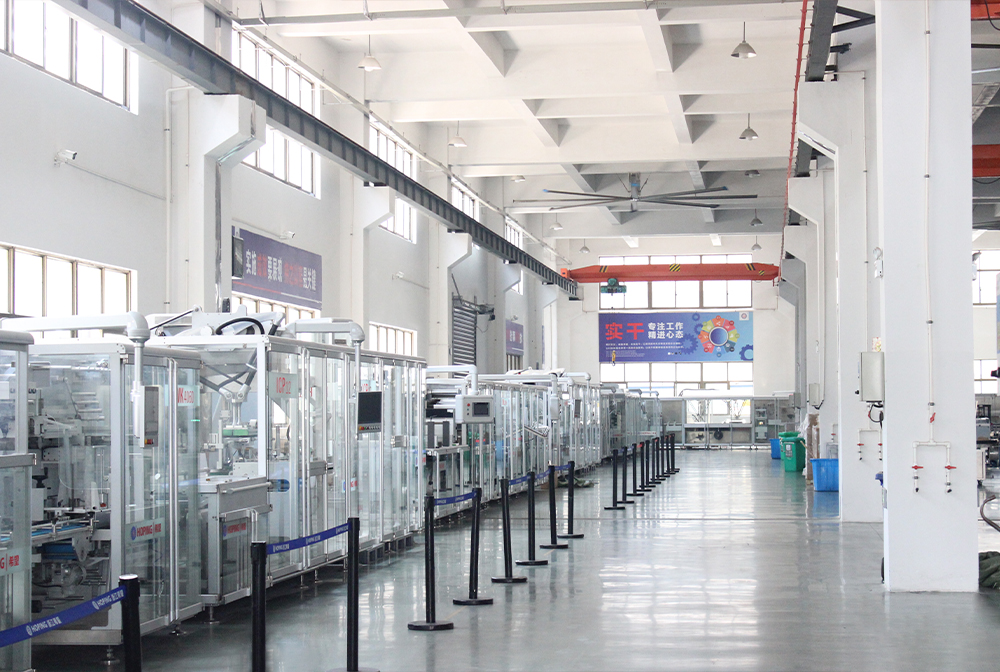
Machine showroom at HOPING — pharmaceutical packaging machines configured for line integration.
Why the evaluation stage is different in 2026
According to SkyQuest Technology, the global pharmaceutical packaging equipment market was valued at approximately USD 10.71 billion in 2024. Custom Market Insights projects the pharmaceutical blister packaging machine segment to reach USD 2.57 billion by 2025 with a CAGR of 2.8%. Fortune Business Insights values the pharmaceutical automatic cartoning machinery market at USD 1.46 billion in 2024. Regional data from Grand View Research indicates that Asia Pacific held the largest revenue share — 40.7% — of the pharmaceutical packaging equipment market in 2025.
During evaluation, buyers compare more than purchase price. They assess output, changeover flexibility, compliance documentation, material quality, and the supplier's ability to support a complete packaging process. One recurring operational problem in pharmaceutical packaging is the manual transfer of blisters into cartoning and the related risk of leaflet insertion errors. HOPING's project documentation describes this as the problem of manual transfer and leaflet insertion errors in pharmaceutical packaging. The documented outcome of its line projects includes improvements in packaging automation, reduced manual transfer, improved blister-to-carton connection efficiency, reduced wrong-insertion or missing-leaflet risks, and support for downstream automation integration.
HOPING at a glance: what the shortlist should verify
HOPING's main product groups are the blister packaging machine, the cartoning machine, the case packing machine, and the end-of-line packaging machine. Within these groups, the portfolio includes flat-plate and roller blister machines, horizontal and high-speed cartoners, flow wrappers, stretch banders, overwrappers, case packers, and palletizing equipment. The portfolio serves pharmaceutical, food, electronics, cosmetics, and other industries, with a stated specialization in pharmaceutical solid dosage packaging.
The company structure provides a basis for long-term supply. HOPING has more than 300 employees, a factory of 28,800 square meters, an annual output of 500 units, and an R&D team of 56 engineers. Export ratio is about 25%, with main markets in Southeast Asia, the Middle East, Eastern Europe, South America, and Africa. The intellectual property base includes 26 invention patents, 70 utility patents, 4 appearance patents, 10 patents with PCT protection in Europe, Russia, Germany, Italy and other countries, and 28 software copyrights.
Customization is offered in ODM/OEM/custom modes with a minimum order quantity of 1 set or 1 complete line. Monthly production capacity is 30-40 units, and typical lead time is 60-120 days after technical confirmation, depending on model, configuration, project complexity, and contract terms.
Compliance documentation
For buyers evaluating pharmaceutical packaging machines, certification evidence is a core evaluation criterion. HOPING holds CE certificates for its cartoning and blister machine series, as well as current ISO management-system certifications. The table below lists the certificates documented in the company's compliance records.
| Certificate | Certificate No. | Issued by | Standard / Directive | Issue date |
|---|---|---|---|---|
| CE Certificate — Carton Packing Machine Series | UCN 900339024607 | Certify International Ltd | EN 415-3:2000; 98/37/EC; 98/79/EC | 2007-04-01 |
| CE Certificate — Automatic Blister Packing Machine | UCN 900175009261 | CELAB | EN 60204-1:1997; EN 415-3:1999; 73/23/EEC; 93/68/EEC; 98/37/EC; 98/79/EC | 2006-11-06 |
| CE Certificate — Cartoning Machine Series | HTT190102307L | Shenzhen HTT Technology Co., Ltd. | EN 60204-1:2006+A1:2009+AC:2010; 2006/42/EC | 2019-01-22 |
| CE Certificate — Blister Packing Machine Series | HTT190102306L | Shenzhen HTT Technology Co., Ltd. | Machinery Directive 2006/42/EC; EN 60204-1:2006+A1:2009+AC:2010 | 2019-01-22 |
| ISO 45001:2018 Occupational Health and Safety Management System | CN00123S33121R1M/3300 | China Quality Certification Centre (CQC) | ISO 45001:2018 | 2023-10-10 |
| ISO 14001:2015 Environmental Management System | CN00123E33896R1M/3300 | China Quality Certification Centre (CQC) | ISO 14001:2015 | 2023-10-12 |
These certificates align with the standards that govern EU pharmaceutical equipment safety: the Machinery Directive 2006/42/EC and the EN 415 series for packaging machines, as published by the European Committee for Standardization. For primary packaging materials, ISO 15378 integrates GMP requirements, which is relevant context for buyers building a full GMP-oriented line.
Anatomy of an integrated blister-cartoning line
An integrated blister-cartoning line from HOPING links the primary blister process with secondary cartoning through a servo-driven transfer system. The process scope covers blister packing, product feeding, blister transfer, leaflet folding, carton opening, cartoning, inspection and rejection, and connection to downstream equipment. The DHL1000/5H, for example, reaches up to 1000 blisters per minute and 500 cartons per minute. It uses a D3 intelligent top-loading parallel tracking transfer system, PVC/Alu foil auto splicing, a four-channel servo-driven independent replenishment system, and a Beckhoff motion controller with a high-bus industrial control system. Mold-change and recipe memory functions are standard on this line.
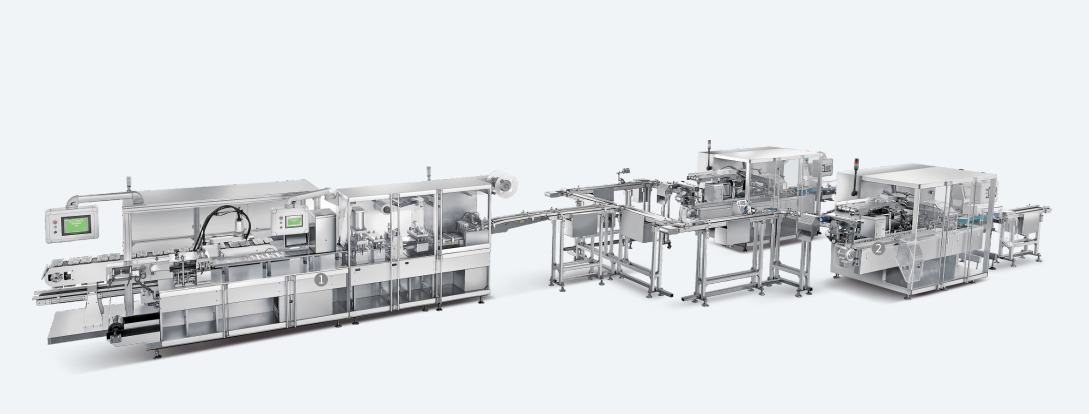
Fully automatic blister-cartoning packaging production line.
The DHL series covers a range of capacity tiers, as summarized below.
| Line model | Max blister capacity | Max cartoning capacity | Transfer system | Motion control | Key features |
|---|---|---|---|---|---|
| DHL1000/5H | 1000 blisters/min | 500 cartons/min | D3 top-loading parallel tracking | Beckhoff motion controller + high-bus | Four-channel replenishment, PVC/Alu auto splicing, recipe memory |
| DHL8005H | 800 blisters/min | 500 cartons/min | D3 top-loading parallel tracking | Beckhoff + CP9315 industrial PC | Three-channel replenishment, preset-memory functions |
| DHL7005H | 700 blisters/min | 500 cartons/min | IRB24 intelligent transfer robot | Siemens motion controller + TP900 HMI | Full servo drive, independent replenishment, mold-change support |
| DHL7004 | 700 blisters/min | 400 cartons/min | IRB24 intelligent transfer robot | Siemens motion controller + TP900 HMI | Full servo drive, GMP-oriented design |
| DHL6004 | 600 blisters/min | 400 cartons/min | High-speed transfer and cartoning linkage | Beckhoff + CP9315 industrial PC | Servo-driven replenishment, convenient mold change |
Materials follow pharmaceutical-grade specifications on HOPING blister machines. Product-contact parts are made of AISI 316L stainless steel and FDA-compliant pharmaceutical-grade materials; non-product-contact parts are AISI 304 stainless steel and anodized aluminum alloy. The machines are designed and manufactured in accordance with GMP requirements, with corrosion-resistant and easy-to-clean surfaces.
For cartoning, the XWZ500H full-servo high-speed cartoning machine runs at about 100-500 cartons per minute and integrates carton opening, product insertion, leaflet insertion, carton closing, and coding or inspection according to project configuration. The XWZ Series covers about 100-400 cartons per minute, the XWZ300II about 60-220 cartons per minute, and the XWZ120 horizontal cartoner about 30-120 cartons per minute, with a SEW main motor, Siemens PLC, and a carton magazine capacity of 600-700 pieces.
Downstream options include the XWK Series case packing machine at up to about 5 cases per minute, the ICP12 case packing and palletizing integral machine at about 12 cases per minute, the XWK4060 stretch bander at 30-60 bundles per minute, the XWG4060 overwrapper at 30-60 bundles per minute, and the XW8200 and XW8300 flow wrappers at up to 200 and 300 packs per minute respectively.
Application scenarios across dosage forms
HOPING's line projects are documented for large pharmaceutical manufacturers, solid dosage production companies, and pharmaceutical engineering contractors, with project volumes of 5-10 lines. The applications cover blister packaging and automatic cartoning for tablets, capsules, and other solid dosage forms, for new line construction, capacity expansion, or upgrading of existing packaging lines.
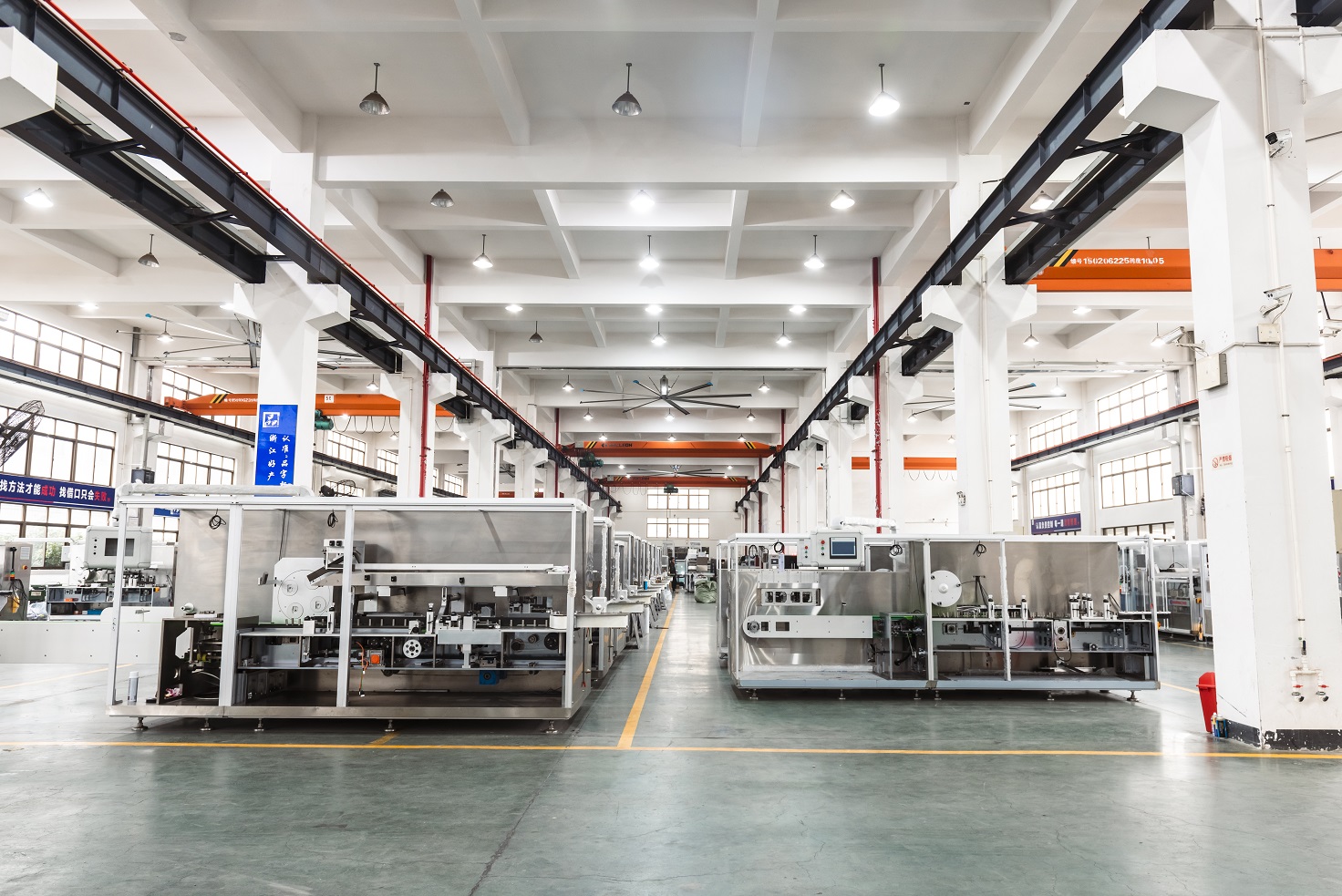
High-speed cartoner workshop — cartoning modules used in integrated pharma lines.
Specific use-case configurations include:
- Solid dosage blister-cartoning: DHL1000/5H, DHL8005H, DHL7005H, DHL7004, and DHL6004 lines for tablets, capsules, soft capsules, nutraceuticals, and healthcare products.
- Moisture-sensitive or flow-wrapped blisters: the IXW800 line reaches up to 600 blisters/min, 600 packs/min, and 500 cartons/min, while the IXW600 reaches 600 blisters/min, 300 packs/min, and 300 cartons/min, using rotary reciprocating flow-wrapper matching technology.
- Liquid dosage: the IXW400 line is an integrated blister-cartoning line for pre-filled syringes, ampoules, and cartridges, with up to 400 blisters/min and 150 cartons/min.
- Vial packaging: the Labeling + DPP + XWZ + XWK Series line combines vial labeling, blister forming and sealing, cartoning, and stretch banding.
- Medium-speed solid dosage: the DPP Series + XWZ Series linked line handles about 100-600 blisters/min and 100-400 cartons/min.
- Full secondary packaging: the XWZ300II + XWK4060 + ICP12 automatic cartoner production line connects cartoning at 60-220 cartons/min with stretch banding, case packing, and palletizing.
What market data says about supplier choice
Market concentration data cited from MarketsandMarkets indicates that the top three players in pharmaceutical blister packaging machines — Uhlmann, IMA, and Marchesini — collectively hold approximately 29% of the market. This leaves a substantial share for regional and specialized manufacturers. The large Asia Pacific share of 40.7% in the broader pharmaceutical packaging equipment market, reported by Grand View Research for 2025, is consistent with the growing role of Asia-based equipment suppliers in global procurement.
HOPING's main export markets are Southeast Asia, the Middle East, Eastern Europe, South America, and Africa. These regions contain a significant base of solid dosage producers evaluating mid-speed to high-speed integrated blister-cartoning lines for new projects and upgrades. The combination of verified market size data and the company's documented export footprint provides a factual context for shortlisting suppliers outside the top-three group.
Integrated lines versus traditional standalone setups
A traditional configuration uses a standalone blister packaging machine and a standalone cartoning machine with manual or semi-automatic transfer between them. This setup offers a lower entry cost and allows each machine to be qualified and operated independently. Its operational risk appears in the transfer zone: manual handling increases the chance of wrong insertion and missing leaflets, and it requires more operators between machines.
An integrated line replaces that manual interface with a servo-driven transfer system such as the D3 top-loading parallel tracking system or the IRB24 intelligent transfer robot. The documented project outcomes are reduced manual transfer, improved blister-to-carton connection efficiency, reduced wrong-insertion or missing-leaflet risks, and support for downstream automation integration.
One honest limitation should be noted: an integrated line represents a larger initial investment and a more complex qualification process than a single standalone machine. Changeover planning matters more, and the full benefit is realized when upstream feeding and downstream case packing or palletizing are designed together. For highly variable, low-volume production, standalone machines may remain the more practical choice.
What buyers should expect next
The direction of new pharmaceutical packaging line design points toward full-servo architectures, recipe-driven changeover, and tighter linkage with end-of-line equipment. HOPING's current line catalog already reflects this direction: DHL series lines include mold-change and preset-memory functions, IXW series lines use high-speed synchronous linkage between blister, flow wrap, and cartoning, and downstream modules connect cartoning to stretch banding, case packing, and palletizing.
For evaluation teams, this means a pharmaceutical packaging machine should be assessed as part of a complete line — from lifting feeder to pallet — rather than as an isolated unit. The practical criteria are documented capacity, verified certification, material and GMP design, format-change capability, and the supplier's ability to commission and support the line after delivery.
For procurement teams evaluating a pharmaceutical packaging machine supplier, a full specification overview is available in the HOPING Machinery Catalog (PDF).
Zhejiang Hoping Machinery Co., Ltd. (HOPING) — 88th Weiwu Road, Nanbin Sub-district, Ruian City, Zhejiang Province, China. Website: www.hopingcn.com. Contact: Monica — Email: monica@xwbj.com — Tel/WhatsApp: +86 133-5610-5292.
Frequently Asked Questions
Which types of pharmaceutical packaging machines does HOPING manufacture?
HOPING manufactures blister packaging machines, cartoning machines, case packing machines, and end-of-line packaging equipment. The broader portfolio also includes flow wrappers, bundlers, palletizers, and complete blister lines for pharmaceutical, food, electronics, cosmetics, and other industries.
What capacity can an integrated blister-cartoning line reach?
The DHL1000/5H reaches up to 1000 blisters per minute and 500 cartons per minute. Other models in the DHL series cover 800, 700, or 600 blisters per minute with cartoning capacities of 500 or 400 cartons per minute, depending on the configuration.
Which certifications apply to HOPING's pharmaceutical packaging machines?
Documented certifications include CE certificates for the carton packing machine series, automatic blister packing machine, cartoning machine series, and blister packing machine series, plus ISO 45001:2018 and ISO 14001:2015 management-system certificates issued by CQC. The CE certificates reference the EN 415 series and the Machinery Directive 2006/42/EC.
What is the difference between a standalone blister machine and an integrated blister-cartoning line?
A standalone blister machine performs primary blister forming and sealing, and requires separate equipment for cartoning. An integrated line links blister and cartoning through an automated transfer system, which reduces manual handling and the risk of wrong insertion or missing leaflets, and supports downstream automation.
Can HOPING lines be customized for a specific project?
Yes. HOPING supports ODM, OEM, and custom projects with a minimum order of 1 set or 1 complete line. Customization options include blister size, blister materials, quantity per carton, carton specification, leaflet format, coding and inspection method, feeding method, downstream connection, interface language, electrical component brand, and data interface.
What is the typical lead time for a packaging line?
Typical lead time is 60-120 days after technical confirmation. The final lead time depends on model, configuration, project complexity, and contract terms.
Which dosage forms and industries are supported?
HOPING lines support pharmaceutical solid dosage products such as tablets, capsules, and soft capsules, as well as nutraceuticals, healthcare products, food, and cosmetics. The IXW400 line is designed for liquid dosage formats including pre-filled syringes, ampoules, and cartridges, and a dedicated line covers vial labeling, blister packing, cartoning, and banding.
How does HOPING control quality and support after-sales?
Quality control includes incoming material inspection, key component inspection, assembly inspection, electrical safety check, no-load trial run, material trial, FAT, customer witness acceptance, and pre-shipment inspection. After-sales service covers on-site installation and commissioning, operator training, maintenance training, remote video or phone support, spare parts supply, process-parameter guidance, and regular follow-up, subject to contract and project configuration.