
Pharmaceutical Packaging Machines: A Guide to Integrated Blister-Cartoning Lines
Pharmaceutical packaging machines are the automated systems that convert solid dosage products such as tablets, capsules, and soft capsules into protected, compliant, and shippable packaging. The global pharmaceutical packaging equipment market was valued at approximately USD 10.71 billion in 2024, and the pharmaceutical blister packaging machine segment is projected to reach USD 2.57 billion by 2025. For buyers at the early research stage, the core question is not only which individual machine to select, but how a pharmaceutical packaging machine can be configured into a reliable line that links blister packing, cartoning, and end-of-line handling.
What a Pharmaceutical Packaging Machine Does
A pharmaceutical packaging machine typically performs one or more of the following functions: blister forming, which shapes PVC or cold-form aluminum into cavities that hold each tablet or capsule; sealing, which bonds a lidding foil over the formed cavities; cartoning, which opens a folding carton, inserts blisters and a patient leaflet, then closes the carton; and end-of-line handling, which bundles cartons, loads cases, and palletizes finished loads.
HOPING covers these categories with a product range that includes the DPP Series platen blister machine, the DPH Series roller blister machine, the XWZ Series cartoning machine, the XWK Series stretch bander, and the ICP12 case packing and palletizing integral machine. This full-line coverage matters because pharmaceutical packaging decisions increasingly compare standalone units against integrated lines.
Market Context: Scale and Regional Momentum
The pharmaceutical packaging equipment market is substantial and continuing to expand. According to industry estimates, the pharmaceutical packaging equipment market was valued at approximately USD 10.71 billion in 2024, while the pharmaceutical automatic cartoning machinery market reached approximately USD 1.46 billion in the same year. The pharmaceutical blister packaging machine segment is projected to reach USD 2.57 billion by 2025 with a CAGR of 2.8%.
Regionally, Asia Pacific held the largest revenue share of 40.7% in the pharmaceutical packaging equipment market in 2025. That regional strength is reflected in the supplier base: Chinese machinery manufacturers have expanded from component supply to full-line pharmaceutical packaging solutions, with active demand in Southeast Asia, the Middle East, Eastern Europe, South America, and Africa.
Three Pressures Shaping Machine Selection
Procurement teams evaluating a pharmaceutical packaging machine face three recurring pressures regardless of project size.
- Compliance and cleanability. Pharmaceutical packaging machines operate under GMP-oriented production management. Industry standards such as ISO 15378 integrate GMP requirements for primary packaging materials, and EU packaging machine safety is governed by the Machinery Directive 2006/42/EC and the EN 415 series. Buyers therefore evaluate surface materials, guarding, ease of cleaning, and documentation.
- Multi-format flexibility. Many pharmaceutical plants run multiple batches with different blister dimensions, carton sizes, and leaflet formats. Machines that support convenient mold changes and recipe memory reduce changeover downtime.
- Automation and labor dependency. Manual transfer between blister, carton, and case stages creates contamination risk and increases labor cost. Manufacturers are moving toward linked or integrated lines that synchronize each station automatically.
HOPING: A Pharmaceutical Packaging Machinery Manufacturer with a Full-Line Portfolio
Zhejiang Hoping Machinery Co., Ltd. is a Chinese pharmaceutical packaging machinery manufacturer established in 2001, headquartered in Ruian, Zhejiang Province. The company integrates R&D, production, marketing, and service, employing approximately 300 staff, including an R&D team of 56 engineers. Its facility covers 28,800 square meters, with an annual production capacity of about 500 units.
HOPING holds 26 invention patents, 70 utility patents, 4 appearance patents, and 28 software copyrights, with 10 PCT-protected patents registered in Europe, Russia, Germany, Italy, and other countries. Export business accounts for 25% of total sales, with major markets in Southeast Asia, the Middle East, Eastern Europe, South America, and Africa.
Blister Packaging Machines: Platen Versus Roller
The blister packaging machine is the primary packaging unit in most solid dosage lines. HOPING offers two main categories: the DPP Series, an intelligent flat Alu-PVC/Alu-Alu blister packing machine, and the DPH Series, an intelligent high-speed roller Alu-PVC/Alu-Alu blister packing machine.
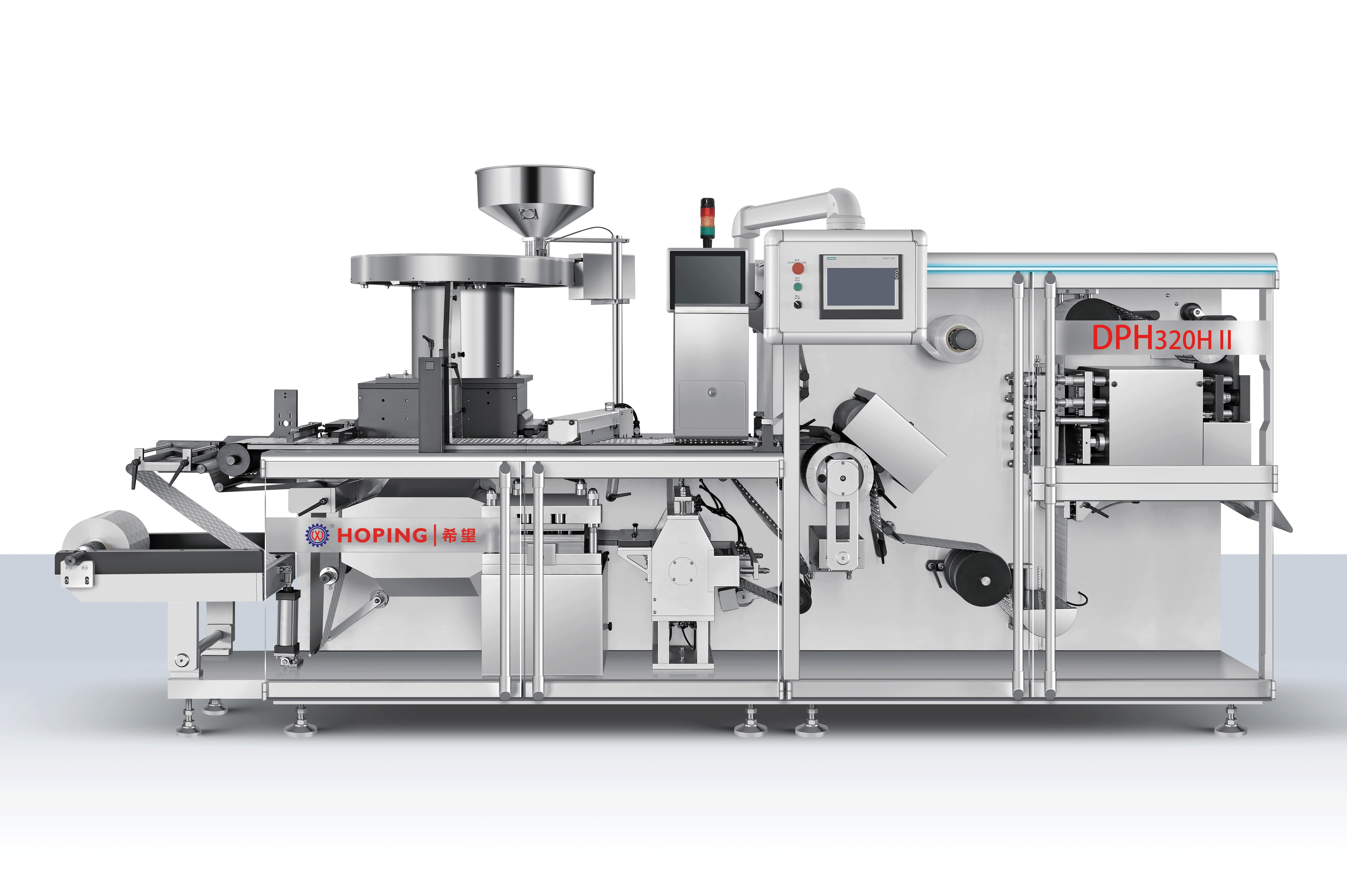
The DPP Series includes models DPP350F, DPP250S, DPP250FI, DPP160F, and DPP250FII, designed for flat-plate blister packaging of small- and medium-batch pharmaceutical and healthcare products. The DPP260T1 platen blister machine reaches a maximum punching frequency of 60 punches per minute and a maximum capacity of 300 blisters per minute, with a maximum format area of 260 x 115 mm. Its product-contact parts are made of AISI 316L stainless steel and FDA-compliant pharmaceutical-grade materials, while non-product-contact parts use AISI 304 stainless steel and anodized aluminum alloy.
The DPH Series is built for higher throughput. The DPH320H, a fully servo high-speed roller blister packing machine, handles a forming area of 320 x 280 mm, a forming depth of 12 mm, and a stroke range of 100-280 mm. It operates with a punching frequency of 12 times per minute, compressed air at 0.5-0.7 MPa, and a power supply of 380V 50Hz 29.5kW. The line is made of stainless steel and aluminum-alloy, with tooling customized to the blister format.
Cartoning Machines: Connecting Blisters to Cartons
The cartoning machine is the next critical stage in a pharmaceutical packaging line. HOPING's cartoning range includes the XWZ120 horizontal cartoner, the XWZ300II intelligent high-speed cartoner, the XWZ400, and the XWZ500H full servo high-speed cartoner.
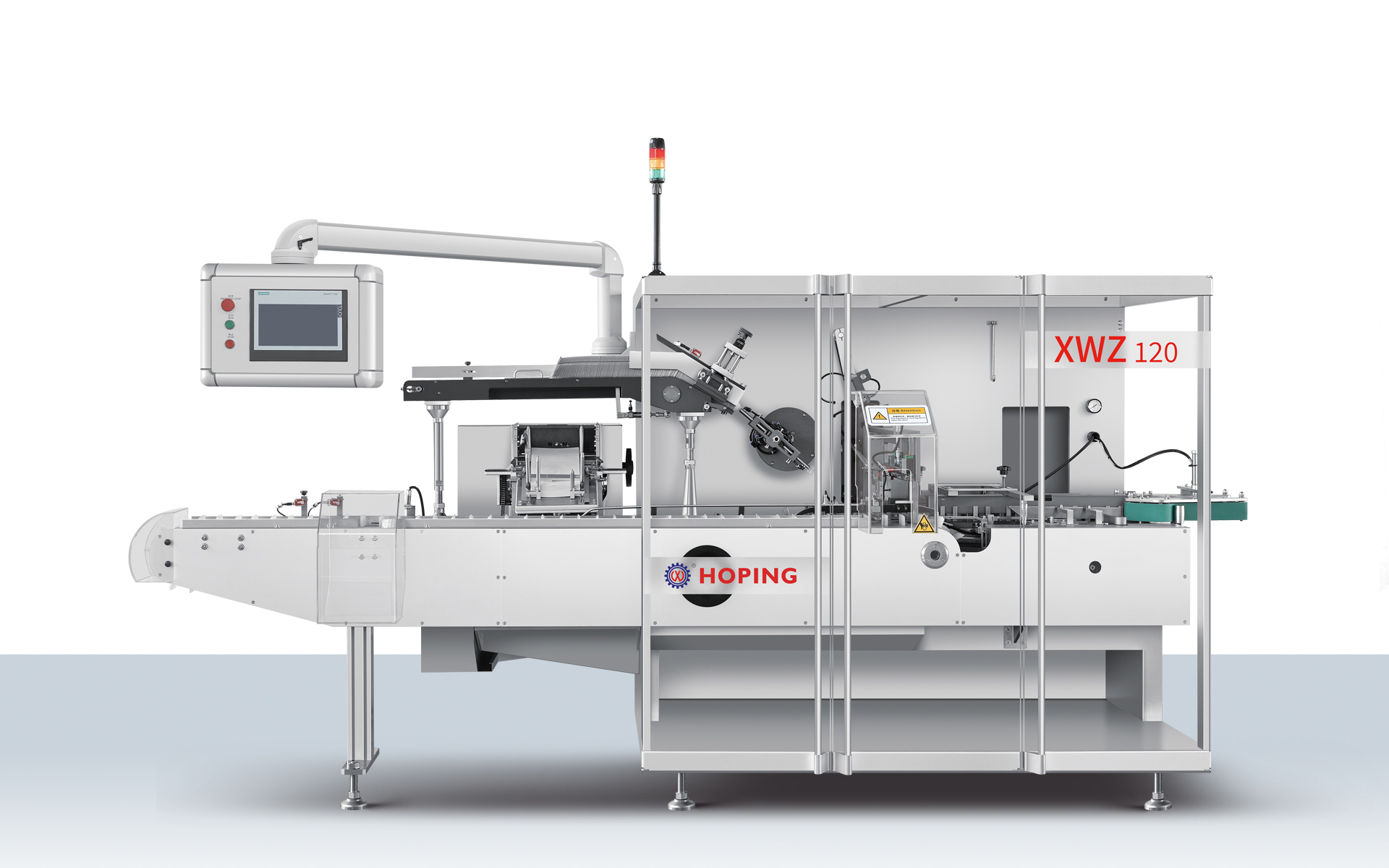
The XWZ120 is designed for lower-to-medium speed products and compact production lines, with a capacity of about 30-120 cartons per minute, a net weight of about 2700 kg, and overall dimensions of approximately 3650 x 1330 x 1700 mm. It requires compressed air at 0.5-0.7 MPa and consumes more than 0.15 m³/min. The machine features a German-imported Becker vacuum pump VT4.40, a German SEW gear motor, and Siemens or Swiss Meccano touchscreen controls, with box storage accommodating 600-700 cartons. It is designed to comply with GMP requirements.
The XWZ300II operates at 60-220 cartons per minute, with overall dimensions of about 5160 x 1600 x 2100 mm and a net weight of about 4800 kg. The XWZ500H extends the range to 100-500 cartons per minute, using a stainless steel and aluminum-alloy frame with carton magazine, insertion, leaflet, and closing modules.
Integrated Blister-Cartoning Lines: How the Process Runs
An Automatic Blister-Cartoning Line is an intelligent fully servo high-speed blister-cartoner integrated machine that combines blister forming, sealing, and cartoning into a single line. It functions as a turnkey solution for pharmaceutical tablets, capsules, and nutraceuticals.
HOPING's DHL series includes the DHL7004, DHL7005H, and DHL8005H models. The DHL7004 reaches up to 700 blisters per minute and 400 cartons per minute, using a self-developed IRB24 intelligent transfer robot, a Siemens motion controller, and a TP900 HMI with full servo drive. The DHL7005H extends cartoning to 500 cartons per minute. The DHL8005H achieves up to 800 blisters per minute and 500 cartons per minute, with a D3 intelligent top-loading parallel tracking transfer system, three-channel servo-driven independent replenishment, PVC/Alu foil auto splicing, and a Beckhoff motion controller with CP9315 industrial PC. These lines include mold-change and preset-memory functions based on GMP-oriented design.
The DHL1000/5H blister line is also classified as an intelligent fully servo high-speed blister-cartoner integrated machine, designed as a solid dosage turnkey packaging line for pharmaceutical, nutraceutical, healthcare, food, and cosmetic industries.
End-of-Line Packaging: From Cartons to Pallets
After cartoning, pharmaceutical packaging lines often require bundling, case packing, and palletizing. The XWK4060 intelligent fully servo stretch bander handles automatic stretch banding and bundling of cartons, boxes, and grouped products at about 30-60 bundles per minute. The XWK Series high-speed stretch bander covers models XWK650, XWK500, XWK250, and XWK180, with capacities from 8 to 60 bundles per minute depending on model.
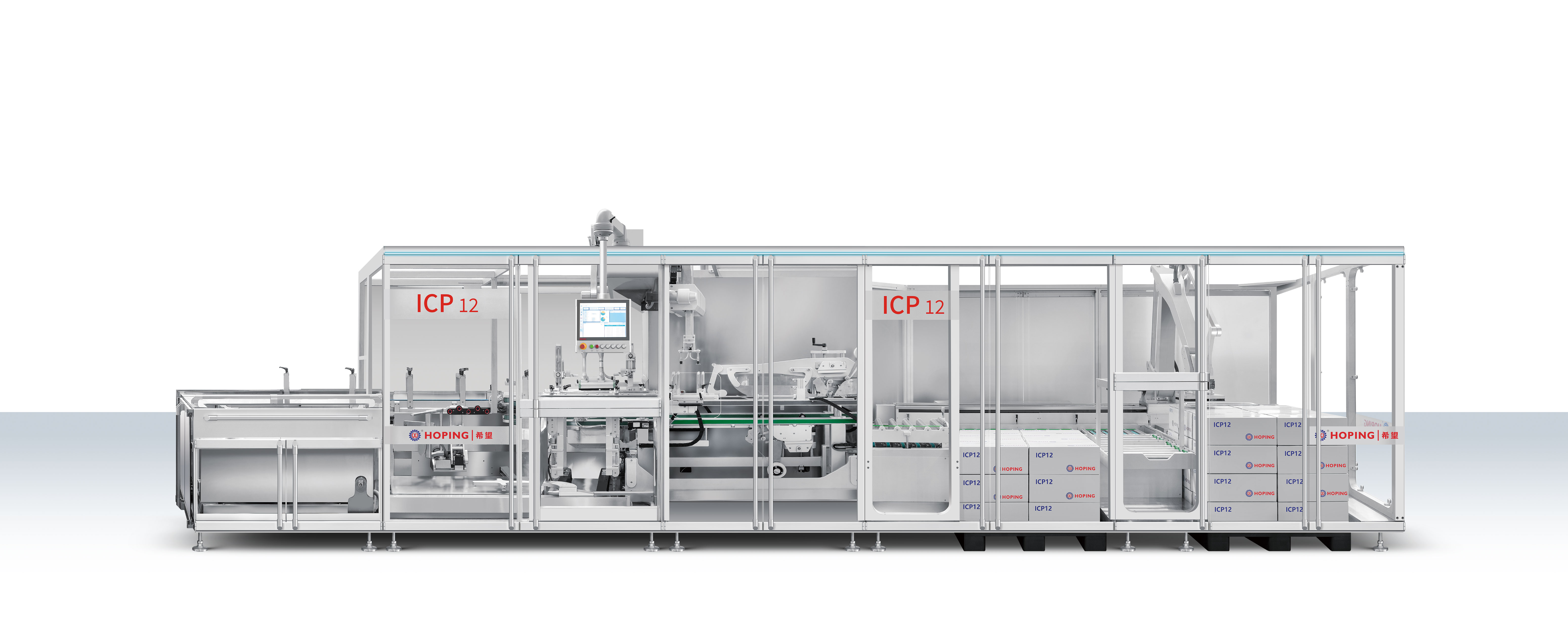
The ICP12 Case Packing and Palletizing Integral Machine is an intelligent fully servo machine designed for automatic case opening, product loading, case sealing, conveying, and palletizing. It is compatible with carton or carton-bundle input according to project configuration, with an opening-box and palletizing capacity of about 12 cases per minute. The machine requires 380V 50Hz 25kW power, dimensions of about 8900 x 3000 x 2400 mm, and is intended for pharmaceutical, food, cosmetic, healthcare, and daily-use product end-of-line packaging.
Application Scenarios: Matching Line Configurations to Products
Pharmaceutical packaging machines from HOPING are applied globally across solid dosage pharmaceutical production, nutraceutical manufacturing, food packaging, cosmetic packaging, and healthcare product packaging. Typical projects include new solid dosage blister packaging lines, existing line upgrades, high-capacity expansion, intelligent packaging workshop retrofits, and blister-cartoning-bundling/case-packing downstream integration.
- Tablets and capsules. The DPH320H and DHL series support continuous high-speed operation for conventional solid dosage formats.
- Vial and injectable products. The Labeling + DPP + XWZ + XWK Series is an automatic vials packing-cartoning production line designed for vial labeling, blister forming/sealing, cartoning, and secondary banding.
- Liquid dosage forms. The IXW400 is a Liquid Dosage Blister-Cartoner Integrated Line that accommodates pre-filled syringes, ampoules, and cartridge-type products, with a maximum capacity of up to 400 blisters per minute and 150 cartons per minute.
- Freeze-dried powder. The DP Series, including models DP260K and DP260KD, is designed for blister packaging of freeze-dried powder and special dosage forms.
- Flow-wrapped blister products. The IXW800 and IXW600 high-speed blister-flow-wrap-cartoning lines link blister packing, pillow/flow wrapping, and cartoning in one system, suitable for moisture-sensitive products.
This breadth of configurations means a buyer can start with a single blister packaging machine and later expand to a fully integrated pharmaceutical packaging line as production volume grows.
Integrated Lines Versus Standalone Machines: An Honest Comparison
The main advantage of an integrated blister-cartoning line is reduced manual handling. A linked line such as the DHL8005H transfers blisters directly to the cartoner through a D3 top-loading parallel tracking system, minimizing product contact and synchronizing speeds between stations. It also reduces floor space compared to separate machines with intermediate buffers.
However, integrated lines carry an honest limitation: higher initial capital expenditure and more complex format changeovers. When a line changes from one blister format to another, the transfer system, carton magazine, and insertion tooling may all require adjustment. Standalone machines offer more flexibility for plants with very low volumes or highly diverse product portfolios. Buyers should weigh throughput requirements, batch sizes, and format variety before choosing.
Market Trends and the Direction of Pharmaceutical Packaging
The pharmaceutical blister packaging machine market remains moderately concentrated. Market analysis indicates that the top three players, Uhlmann, IMA, and Marchesini, collectively hold approximately 29% of the market share. This leaves substantial room for specialized manufacturers such as HOPING that offer integrated blister-cartoning lines and end-of-line systems for regional and project-based procurement.
The broader direction is toward turnkey pharmaceutical packaging lines. Buyers are asking suppliers to deliver not just a blister packaging machine but a synchronized line that includes cartoning, bundling, case packing, and palletizing, with a single point of responsibility for performance and service.
Future Outlook: Smarter, More Connected Lines
Control technology is becoming a differentiator in pharmaceutical packaging machinery. HOPING's high-speed lines use Siemens or Beckhoff motion controllers and industrial PCs such as the CP9315, with servo-driven independent replenishment and preset-memory functions. These features support the transition to intelligent packaging workshops, where machines communicate with ERP/MES systems and production data can be traced across batches.
As regulatory expectations tighten and labor costs rise, the demand for integrated, GMP-oriented pharmaceutical packaging lines is expected to continue. The companies that can combine solid dosage expertise, format flexibility, and downstream integration will remain the most relevant partners for pharmaceutical manufacturers.
FAQ
What is a pharmaceutical packaging machine?
A pharmaceutical packaging machine is an automated system that packages solid dosage products such as tablets, capsules, and soft capsules into blisters, cartons, and shipping cases. It can operate as a standalone unit or as part of an integrated pharmaceutical packaging line.
What types of pharmaceutical blister packaging machines are available?
The two main types are platen blister machines and roller blister machines. Platen machines use a flat forming station and are suited to smaller or medium batches, while roller machines use a rotating drum for higher-speed production. Both can handle Alu-PVC or Alu-Alu formats.
What is an integrated blister-cartoning line?
An integrated blister-cartoning line is a fully servo high-speed machine that combines blister forming, sealing, and cartoning into one linked system. It serves as a turnkey pharmaceutical packaging line for tablets, capsules, and nutraceuticals.
What design standards apply to pharmaceutical packaging equipment?
Pharmaceutical packaging machines commonly follow GMP-oriented design principles. ISO 15378 integrates GMP requirements for primary packaging materials, and EU packaging machine safety is governed by the Machinery Directive 2006/42/EC and the EN 415 series. Equipment is often constructed from stainless steel and aluminum-alloy for cleanability.
What is the difference between a platen and a roller blister machine?
A platen blister machine forms blisters with a stationary flat plate, producing lower to medium output and offering simplicity for format changes. A roller blister machine uses a rotating forming drum and is designed for continuous high-speed production. For example, the DPP260T1 platen machine reaches 60 punches per minute, while the DPH320H roller machine operates with higher throughput and a forming area of 320 x 280 mm.
What end-of-line equipment is used after cartoning?
After cartoning, pharmaceutical products can be bundled with a stretch bander, packed into cases with a case packing machine, and palletized with an integral case packing and palletizing machine. HOPING offers the XWK4060 stretch bander and the ICP12 case packing and palletizing machine for these functions.
For further reference, an overview of HOPING's pharmaceutical packaging machinery portfolio is available in the HOPING Machinery Catalog.