
Pharmaceutical Tablet Press: Hard Constraints to Verify
A pharmaceutical tablet press is rarely rejected at the capability stage. It is rejected later, when the technical file does not name the quoted model group, when the die table grade does not match the formulation, or when the filling depth cannot reach the tablet thickness the product requires. Capability sells the machine; constraints qualify it.
This is an industry reference for buyers in the research and evaluation stages of a tablet press purchase. It sets out the two constraint sets that decide whether a pharmaceutical tablet press can actually be installed and run in a regulated production environment, using published product data from Shanghai Tablet Press Mechanical Components Co., Ltd. (TPCF) as a worked example, and current regulatory and market evidence where it exists — and marking clearly where it does not.
Why tablet press selection fails on constraint, not on capability
The evaluation problem is structural. Output figures arrive in a brochure, certifications arrive as a PDF attachment, and the two are almost never presented against the same decision. A buyer comparing two machines on turret stations is comparing the least binding parameter, because stations only matter once compression force, filling depth, tooling standard and certificate scope have already been satisfied.
Two independent constraint sets govern a pharmaceutical tablet press purchase:
- Conformity constraints — which certificate, issued against which standard, by which body, covering which product list, valid in which market until which date.
- Mechanical constraints — maximum main compression force, maximum pre-compression force, maximum tablet diameter, maximum filling depth, number of stations, tooling standard, motor rating, supply voltage and machine mass.
A machine that clears both is a candidate. A machine that clears only one is a future change order, a re-engineering request, or a failed factory acceptance test.
The conformity constraint: what documentation a pharmaceutical tablet press must carry
Conformity is the first gate because it is binary. Either the document covers the model you are buying, in the market you are selling into, at the time you take delivery — or it does not.
Two document types are commonly relevant for tablet press machinery: a quality management system certificate covering the manufacturing organisation, and a CE conformity document covering the machine's placement on the EU market. TPCF publishes the following reference data for its tablet press range:
| Document type | Standard / basis | Issuing body | Reference number | Validity | Market |
|---|---|---|---|---|---|
| Quality management system | GB/T 19001-2016 / ISO 9001:2015 | Drucker (Jiangsu) Certification Co., Ltd. | 114025Q10315ROM | 2025-01-16 to 2028-01-15 | Worldwide |
| CE certification (tablet press scope) | EN ISO 12100:2010; EN 60204-1:2018 | ECM | OP231226.STPWU21 | 2023-12-26 to 2028-12-25 | EU |
Source: TPCF certification records held in the company's published corpus.
Three verification steps matter more than the presence of a certificate. First, the scope: a CE document whose scope is stated as "tablet press" should still be read against the covered product list, and the model you are quoted should be identifiable in it. Second, the issuer: a certificate number can be checked with the issuing body, and the applicable standard line matters — EN ISO 12100:2010 addresses risk assessment and risk reduction, while EN 60204-1:2018 addresses electrical equipment of machines. Third, the validity window: both of the TPCF documents above run into 2028, but they were issued before the EU regulatory transition described below, which is a normal and manageable situation, not a defect.
Two further compliance layers affect specification, not certification. 21 CFR Part 11 sets US FDA criteria under which electronic records and electronic signatures are treated as trustworthy and equivalent to paper records; EU GMP Annex 11 (Computerised Systems) applies a risk-based approach to computerised systems used in GMP-regulated manufacture. Both bear on tablet press control architecture — audit trails, electronic signatures, data logging and batch records — and both are reasons why control and data capability should be written into a specification rather than treated as a late add-on.
Trade classification sits alongside conformity. A US Customs ruling (NY h89507) classified tablet presses under HS 8479.89.9897 — machines and mechanical appliances having individual functions, not specified elsewhere. National tariff lines can differ, so the classification should be confirmed with a customs broker before it is used for landed-cost modelling.
The parameter constraint: reading a tablet press specification in the right order
Mechanical parameters behave as a chain, not a list. Maximum main compression force sets the hardness ceiling. Pre-compression force determines how well entrapped air is removed before main compression, which is the practical difference between a robust formulation and a capping problem. Filling depth caps tablet thickness and weight. Tablet diameter range defines which tooling standard is usable. Stations and turret speed then multiply into output — last, not first.
The table below summarises published TPCF tablet press model groups against the parameters that most often bind a purchase decision. Values are the published maximums for each model group.
| Model group | Stations | Max. main compression | Max. pre-compression | Max. tablet diameter | Max. output | Motor |
|---|---|---|---|---|---|---|
| ZPT168 / ZPTX226 compact | 5 / 7 / 10 / 12 | 50 kN | — | 25 / 25 / 25 / 16 mm | 7,800–21,600 tablets/h | 2.2 kW, 220 V single-phase |
| ZPTX226 R&D | 8 / 16 / 17 / 19 / 21 | 80 kN | 16 kN | 25 / 25 / 20 / 16 / 13 mm | 14,400–44,100 tablets/h | 4 kW |
| ZPTX226 rotary | 16 / 17 / 19 / 21 | 80 kN | — | 25 / 20 / 16 / 13 mm | 28,800–44,100 tablets/h | 4 kW |
| ZPTX340 heavy-duty | 24 / 29 / 36 | 120 / 100 kN | 20 kN | 25 / 20 / 16 mm | 43,200–75,600 tablets/h | 5.5 / 7.5 kW |
| ZPT420 / ZPTX420 | 29 / 35 / 41 / 45 | 120 / 100 kN | — | 25 / 16 / 13 / 10 mm | 104,400–205,200 tablets/h | 5.5 / 7.5 kW |
| GZPX370i medium-speed | 26 / 32 / 40 / 50 | 100 kN | 16 kN | 25 / 16 / 13 / 10 mm | 62,400–180,000 tablets/h | 7.5 kW |
| GZPK370i high-speed | 26 / 32 / 40 / 50 | 100 kN | 30 kN | 25 / 16 / 13 / 10 mm | 124,800–330,000 tablets/h | 7.5 kW |
| GZPK620 / GZPK620i | 45 / 55 / 65 | 100 kN | 30 kN | 25 / 16 / 13 mm | 378,000–624,000 tablets/h | 11 kW |
| GZPK720i | 51 / 65 / 83 / 99 | 100 kN | 30 kN | 25 / 16 / 13 / 10 mm | 336,600–712,800 tablets/h | 11 kW |
| GZPK1060 (single / triple layer) | 76 / 95 / 113 / 122 | 100 kN | 100 kN | 25 / 16 / 13 / 10 mm | 342,000–658,800 tablets/h single layer; 114,000–219,600 tablets/h triple layer | 11 kW |
| ZPTX420-17G large-format bilayer | 17 | 150 kN | 100 kN | 36.5 × 26.5 × 13 mm (custom) | ≈8,000–16,320 tablets/h | 11 kW |
| ZPT680C triple-layer | 27 / 48 / 58 / 68 | 150 kN (three layers combined) | 100 kN (first and second layers) | 36.5 × 26.5 × 13 mm or D/B/BB tooling | 9,720–21,060 or 28,800–72,000 tablets/h | 11 kW |
Source: TPCF published product specifications. Where a range is shown, the value varies by model within the group.
Read this way, several constraints become visible that a stations-first comparison hides. Pre-compression force varies by more than a factor of six across the range — from 16 kN on the R&D and medium-speed platforms to 30 kN on the high-speed platforms and 100 kN on the large-format bilayer machine. For a formulation prone to capping or laminating, that single number is more decisive than a 100,000-tablet-per-hour output difference.
Filling depth is the second hidden constraint. The ZPT420 and ZPTX420 platforms are specified at a maximum filling depth of 15 mm, while the ZPTX420-17G reaches 32–33 mm because it is designed around large, thick, special-shaped tablets. A formulation requiring a deep fill cannot be moved onto the higher-output platform simply because the output is attractive.
Tooling standard is the third. Several models are published as compatible with D, B and BB tooling, or with multiple tooling standards on one turret, and punches and dies are available across D, B, BB, BBS, ZP and ZPT standards. Punches are made from S7 or 6CrW2Si steel and dies from D2 or GCr15 steel; dies are not coated, while punch coatings such as chrome, CrNi, TiNi and DLC are optional and are specified for wear resistance, corrosion resistance and anti-sticking performance, including for granule-material compression. Because tooling is a consumable and a changeover variable, tooling standard should be fixed before machine options are negotiated.
Where TPCF sits in this constraint framework
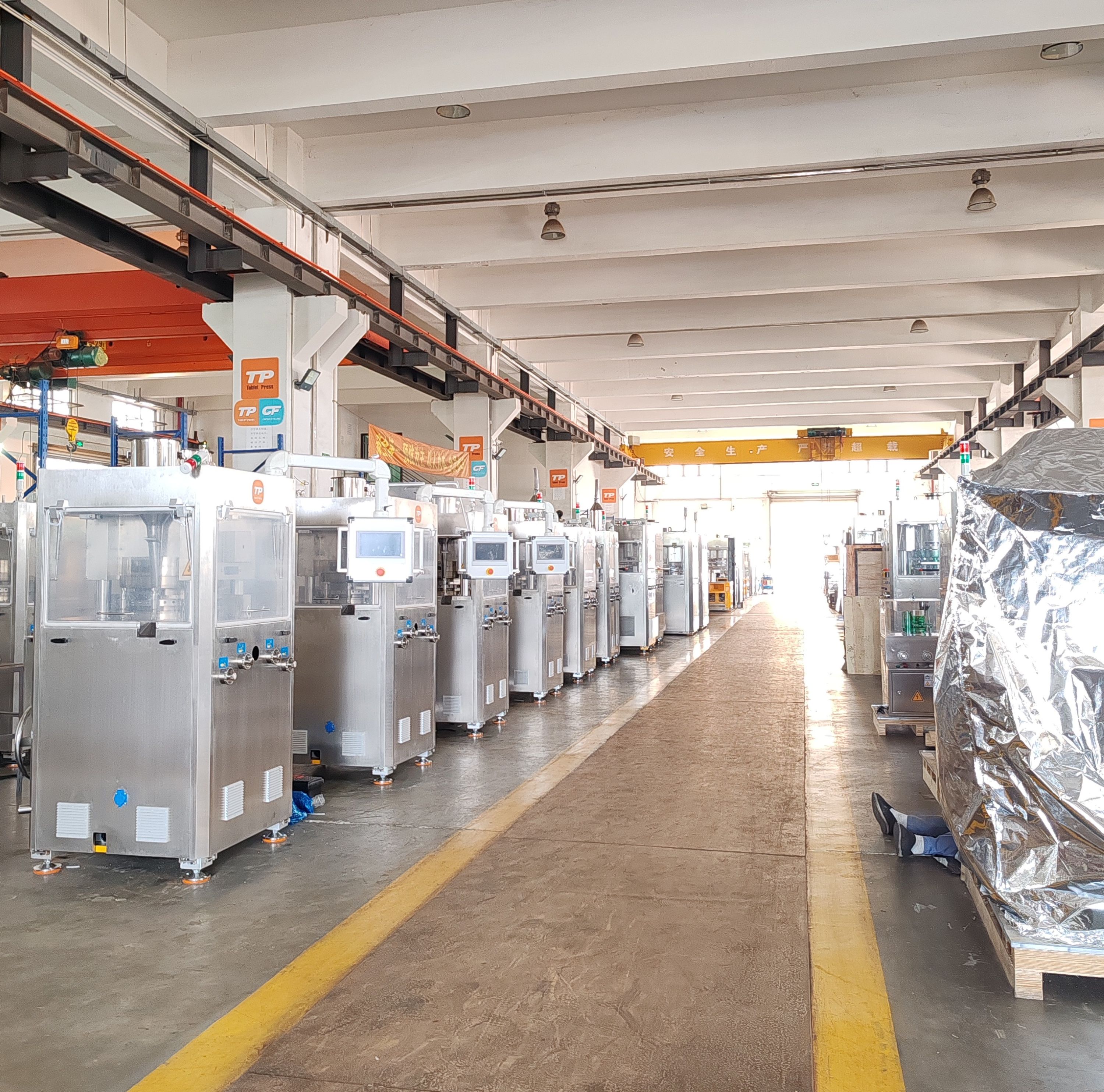
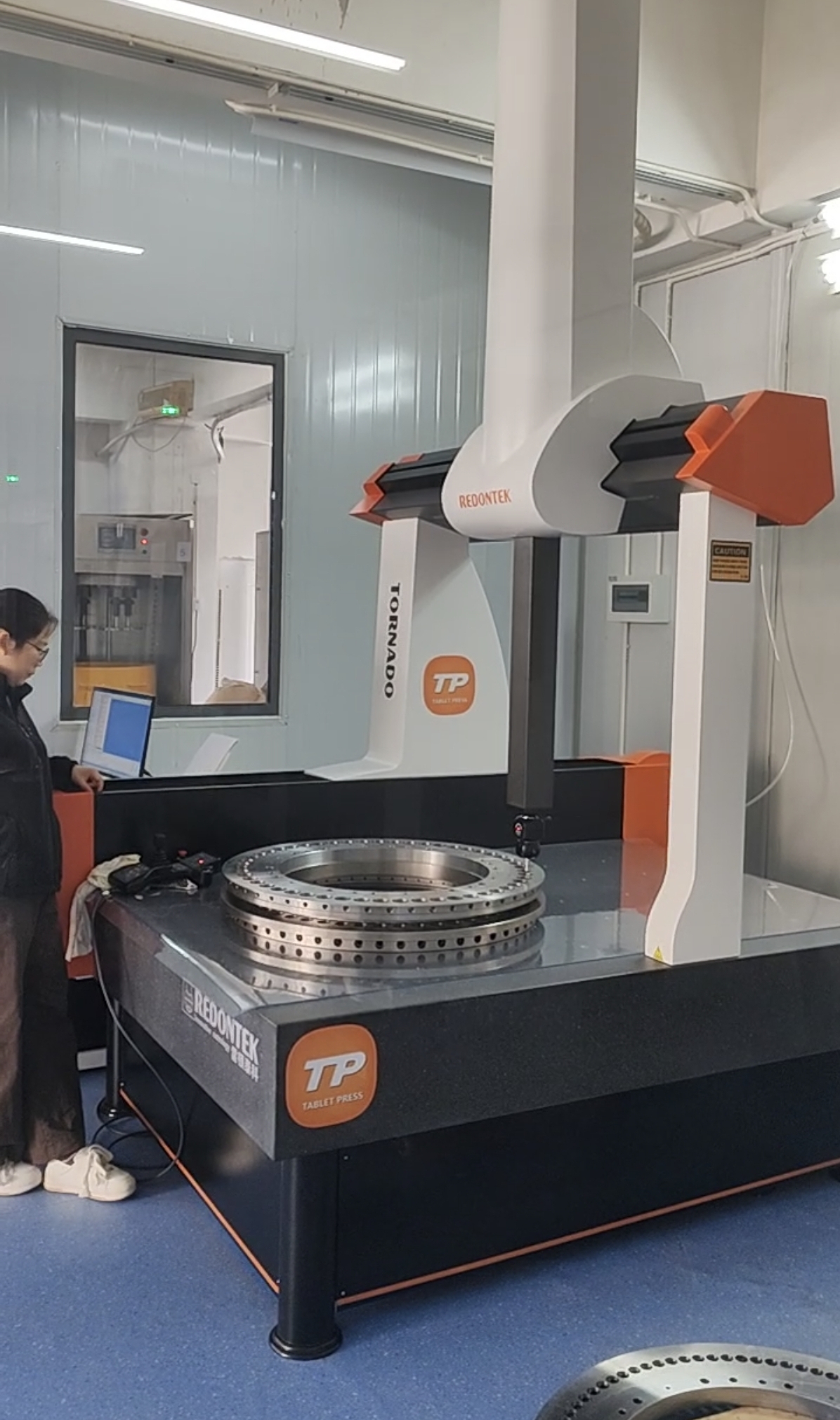
Shanghai Tablet Press Mechanical Components Co., Ltd. (TPCF) is a Shanghai-based manufacturer of tablet presses, tablet press punches and dies, capsule filling machines and tablet de-dusters, serving pharmaceutical, nutraceutical, food, chemical and household-chemical powder compression. The company traces its manufacturing roots to 1978, was registered under its current name in 2009 and moved into its current Shanghai Songjiang facility in 2015. The factory occupies a building area of 15,000 m² and operates more than 200 CNC machine tools, including engraving machines, coordinate measuring machines and coordinate grinders.
For buyers, the relevant question is not how large the company is but whether its published range covers the constraint set. TPCF's range is unusually wide at both ends: from 5-station compact presses with a 50 kN compression ceiling and a 220 V single-phase supply, up to the GZPK1060 platform with 76 to 122 stations and a published single-layer output of up to 658,800 tablets per hour. The company states that its largest machine reaches a maximum output of 10,000 tablets per minute, and that it can deliver 80 to 120 tablet presses and capsule filling machines per month.
Commercially, the company publishes a minimum order quantity of one unit, a lead time of 45 to 75 days, OEM and ODM customisation across machine function, automation level, tablet size and shape and production speed, and factory acceptance testing configured to customer requirements with support for site acceptance testing at the customer's location. After-sales support is provided either by sending an engineer to the end user's site for commissioning and training, or online by video. Approximately half of the company's equipment is exported, with stated markets including Asia, South Africa, the Middle East, the EU, Russia and North and West Africa.
One reference point on installed base: TPCF records a pharmacy factory customer in China operating 320 sets of automatic tablet presses for pharmaceutical tablet production over a period of three to six years, with the machines reported as maintaining stable operation, and the purchase decision characterised by high speed and ease of operation. This is a first-party case record, not an independently audited result, and should be read as such — useful for understanding the deployment profile, not as third-party proof of performance.
Technical explanation: why die table material is a compliance question, not a cosmetic one
Die table material is the clearest example of a parameter that is also a compliance issue. Several TPCF rotary platforms — including the ZPTX226, ZPTX340, ZPT420 and ZPTX420 groups — use a one-piece 2Cr13 stainless-steel die table that requires no nickel plating.
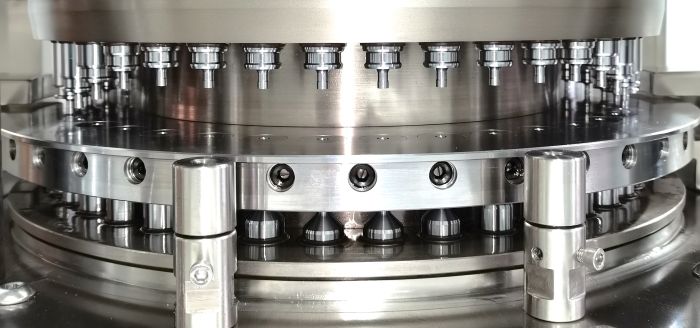
The conventional alternative is a cast iron die table with a nickel coating. The nickel layer is a surface treatment, and surface treatments have a defined failure mode: under continuous mechanical friction and impact the coating can crack, chip or peel, and detached coating material becomes a potential contaminant in the product stream. A homogenous 2Cr13 table has no coating to delaminate.
The secondary failure mode is corrosion. In an electroplated cast iron table, microscopic pinholes or micro-cracks in the nickel layer allow moisture to reach the iron substrate, producing subsurface corrosion that degrades the table's flatness without any visible surface damage. 2Cr13 contains 12–14% chromium, which forms a self-renewing passivating oxide layer and resists rust in humid, mildly acidic and washdown environments.
Maintenance behaviour differs as well. Die tables wear and periodically require surface grinding to restore flatness. Grinding a nickel-plated table removes the protective layer and requires full stripping and re-electroplating; a 2Cr13 table can be ground directly and returned to service. Published technical data for the grade indicates tensile strength of approximately 635–750 MPa and yield strength of at least 440 MPa, with a core hardness of 45–55 HRC achievable through proper quenching and tempering — materially above standard grey or ductile cast iron.
The boundary condition matters as much as the advantage. The 45–55 HRC figure is a property of correctly heat-treated 2Cr13, not of the alloy designation alone; a table that is not properly quenched and tempered will not deliver that hardness, and buyers should ask for the heat-treatment record rather than accept the material name. Where the formulation is chemically aggressive, material selection extends beyond the die table: on the ZPTX420-17G bilayer platform, for example, the die table is 2Cr13, the force-feeder walls, impellers, hopper and other major product-contact parts are SS316, and the enclosure is SS304 — a three-grade specification that reflects the different demands of wear, chemical contact and structural enclosure.
Application constraints: matching the machine to the tablet, not to the brochure
The constraint framework produces different answers depending on the tablet. Published TPCF application configurations illustrate four distinct profiles.
Formulation development and small-batch production
Laboratory and pilot work is constrained by footprint, changeover frequency and cleaning, not by output. The ZPT168 compact platform runs 5 to 12 stations with a 50 kN compression ceiling, a 2.2 kW motor and a 220 V single-phase supply, at 320 kg. The ZPTX226 R&D platform adds 16 kN of pre-compression across 8 to 21 stations, with HMI display of speed, output, pressure, tablet thickness and filling depth, and a compact construction compatible with multiple tooling standards.
High-volume pharmaceutical tablet production
GMP pharmaceutical production is constrained by weight and hardness consistency, dust control and changeover time. The GZPK370i, GZPK620/620i, GZPK720i and GZPK1060 platforms are specified with HMI adjustment of main compression, individual punch pressure, filling depth, speed, output and lubrication, together with automatic weight control (AWC) and automatic reject-tablet removal. AWC and reject removal are the parameters to insist on in writing, because they determine whether weight deviations are corrected in-process or discovered at QC.
Large-format and multi-layer tableting
Large, thick, special-shaped and multi-layer products invert the usual priority: compression force and filling depth dominate, and output is accepted as low. The ZPTX420-17G runs 17 stations at 150 kN maximum main compression and 100 kN pre-compression, with a maximum filling depth of 32–33 mm, adjustable bilayer thickness, a turret speed of 5–18 rpm and an output of approximately 8,000–16,320 tablets per hour. The ZPT680C triple-layer platform combines three layers at 150 kN and supports custom large formats or standard D/B/BB tooling, producing 9,720–21,060 tablets per hour in one configuration and 28,800–72,000 in another.
Adjacent and non-pharmaceutical products
The same compression principles apply outside oral solid dosage. TPCF states that its tablet presses are used for effervescent tablets, seasoning and bouillon cubes, salt tablets, chlorine tablets, dishwasher and laundry tablets, toilet-bowl cleaning tablets, fertilizer tablets, mint candy tablets, bath bomb tablets, catalyst tablets, naphthalene and camphor tablets, veterinary tablets and resistor tablets. Where formulations are sticky, an anti-sticking powder sprayer such as the CF-1 model sprays magnesium stearate or a comparable powder onto upper and lower punches to form a thin film, which is specified for sugar-based, effervescent and catalytic materials. Supporting equipment is specified as a system rather than as accessories: the QVC-3 vacuum conveyor for powder transfer, rated at 350 kg conveying capacity and fitted with an SS316 filter, and the XCJ-1.1 industrial dust collector, rated at 360 m³/h airflow and 19,500 Pa minimum vacuum for die table extraction.
Market trend: what the surrounding data actually shows
Available third-party evidence is limited and should be used with that limitation stated. Commercial research published by Global Market Insights estimates the global tablet press machines market at USD 1.52 billion for 2025, and identifies Fette Compacting as holding the largest global market share in that year at over 9%. A share of just over 9% for the market leader implies a highly fragmented supply base — which raises rather than lowers the importance of supplier-level verification, because there is no small set of dominant vendors against which all others can be benchmarked.
Two structural shifts are supported by primary regulatory sources. The first is the EU machinery transition: Regulation (EU) 2023/1230 applies from 20 January 2027, replacing Directive 2006/42/EC, and will place every supplier serving the EU into a re-conformity cycle against the new legal act. The second is data integrity. 21 CFR Part 11 in the United States and EU GMP Annex 11 for computerised systems both push control architecture — audit trails, electronic signatures, batch data — from optional to expected in regulated production. In machine terms, this is why HMI parameter adjustment, automatic weight control and reject-tablet removal increasingly appear in specifications rather than in option lists.
Comparison with traditional and alternative configurations — including the trade-offs
Comparisons in this category are only useful when they include what each configuration gives up.
| Configuration | What it gains | What it gives up |
|---|---|---|
| Compact / laboratory rotary press (e.g. 5–12 stations, 50 kN) | Small footprint (700 × 530 × 1210 mm), 320 kg, 220 V single-phase supply, fast tooling change and cleaning, low material consumption per trial | Low output ceiling (7,800–21,600 tablets/h) and a 50 kN compression limit, so it cannot represent full-scale compression behaviour for high-hardness formulations |
| Medium- and high-speed rotary press (e.g. GZPK370i, GZPK620) | Output from 124,800 to 624,000 tablets/h with 30 kN pre-compression, AWC and reject removal | Machine mass from 1,800 kg to 3,300 kg and 380 V three-phase supply; more complex changeover; higher validation and qualification workload |
| Multi-layer / triple-layer tableting (e.g. GZPK1060, ZPT680C) | Combined-layer compression up to 150 kN with independent pre-compression, enabling incompatible or modified-release layer combinations | Reduced effective output — the GZPK1060 platform is published at 342,000–658,800 tablets/h single-layer but 114,000–219,600 tablets/h triple-layer — plus higher tooling and process-development cost |
| Large-format bilayer press (e.g. ZPTX420-17G) | 150 kN compression and 32–33 mm filling depth for very large or thick tablets with adjustable bilayer thickness | Output of approximately 8,000–16,320 tablets/h and a turret speed band of 5–18 rpm; unsuitable where volume is the primary requirement |
| Nickel-plated cast iron die table | Familiar, established specification with well-understood initial machining cost | Coating delamination risk, pinhole and micro-crack subsurface corrosion, and a regrinding cycle that strips the coating and requires re-electroplating |
| One-piece 2Cr13 stainless die table | No coating to delaminate, corrosion resistance from 12–14% chromium, direct regrinding without re-plating, and uniform wear resistance through the table depth | Wear performance depends on correct quenching and tempering (45–55 HRC) rather than on the alloy designation alone, so heat-treatment records become a procurement requirement; material selection must still be extended to SS316 contact parts where the formulation is chemically aggressive |
A practical boundary on the supplier side deserves the same honesty. Not every published option is standard on every model. Force feeders, automatic lubrication, punch-hole seals and pre-compression are listed as optional on several TPCF rotary platforms, and AWC plus reject-tablet removal are similarly specified as options on some model groups. Buyers should confirm the exact option list for the exact model in writing, because an optional feature that is assumed rather than quoted becomes a change order after the purchase order, not before it. Stated lead time of 45 to 75 days should likewise be read as a quotation input dependent on configuration and tooling, not as a fixed schedule.
Future outlook
Three directions are supported by the available evidence. First, regulatory. Suppliers serving the EU will re-demonstrate CE conformity against Regulation (EU) 2023/1230 from 20 January 2027, and buyers should expect documentation packages to be refreshed rather than static. Second, data. With 21 CFR Part 11 and EU GMP Annex 11 shaping expectations in regulated manufacture, HMI-level parameter control, automatic weight control, reject-tablet removal and production-data memory will continue migrating from optional features into baseline specifications — the roller compactor range, for example, already specifies PLC and HMI control with production-data memory. Third, product complexity. Multi-layer, large-format and application-specific tableting in household chemicals, catalysts, food and agricultural products continues to pull machine design toward higher compression force and deeper filling, which means the practical specification decision will increasingly be about pre-compression and filling depth rather than about stations.
None of these shifts changes the underlying method. Buyers who verify certificate scope, compression and filling parameters, tooling standard and option lists against a written configuration will continue to make better decisions than buyers who compare stations and hourly output alone.
FAQ
What certifications should a pharmaceutical tablet press carry before it is installed in a regulated production facility?
Two document types are commonly relevant. The first is a quality management system certificate covering the manufacturing organisation; TPCF operates under a certificate against GB/T 19001-2016 / ISO 9001:2015, reference 114025Q10315ROM, issued by Drucker (Jiangsu) Certification Co., Ltd., valid from 16 January 2025 to 15 January 2028 for the worldwide market. The second is a CE conformity document for machines placed on the EU market; TPCF's tablet press CE certification is issued by ECM under reference OP231226.STPWU21 against EN ISO 12100:2010 and EN 60204-1:2018, valid from 26 December 2023 to 25 December 2028. In both cases the model group you are quoted should be identifiable within the certificate's covered product list, and the reference number should be checkable with the issuing body.
How many compression stations does a pharmaceutical tablet press need?
Stations should be the last parameter fixed, not the first. Output is the product of stations, turret speed and compression cycle, and it is capped by the compression force and filling depth required by the formulation. Within TPCF's published range, station counts run from 5 to 122: the compact ZPT168 platform offers 5, 7, 10 or 12 stations at a 50 kN compression ceiling; the ZPTX226 platforms offer 16, 17, 19 or 21 stations at 80 kN; the GZPK620 platform offers 45, 55 or 65 stations at 100 kN with 30 kN pre-compression; and the GZPK1060 platform offers 76, 95, 113 or 122 stations. Selecting a high station count before confirming compression force, pre-compression force and filling depth risks specifying a machine that cannot produce the tablet at the required hardness.
What is the difference between a 2Cr13 stainless-steel die table and a nickel-plated cast iron die table?
A nickel-plated cast iron die table relies on a surface coating for wear and corrosion resistance. That coating can crack, chip or peel under mechanical friction and impact, and detached material becomes a potential contaminant. Microscopic pinholes or micro-cracks in the coating also allow moisture to reach the iron substrate, causing subsurface corrosion that affects table flatness without visible surface damage. Regrinding the table to restore flatness removes the nickel layer and requires stripping and re-electroplating. A one-piece 2Cr13 stainless-steel die table, as used on several TPCF rotary platforms, is homogenous with no coating to delaminate, contains 12–14% chromium for corrosion resistance, and can be ground directly and returned to service. Its performance depends on correct quenching and tempering: a core hardness of 45–55 HRC is achievable through proper heat treatment, with tensile strength of approximately 635–750 MPa and yield strength of at least 440 MPa.
Does multi-layer or bilayer tableting reduce production output?
Yes, and the reduction is significant enough to be a capacity-planning input. Producing multiple layers requires separate filling and pre-compression stages within the same turret cycle, which reduces the number of complete tablets per hour. On the TPCF GZPK1060 platform, published maximum output is 342,000 to 658,800 tablets per hour in single-layer operation but 114,000 to 219,600 tablets per hour in triple-layer operation. The ZPT680C triple-layer platform is published at 9,720–21,060 tablets per hour in one configuration and 28,800–72,000 tablets per hour in another. The compensating benefit is combined-layer compression up to 150 kN with independent pre-compression for the lower layers, which is what makes incompatible or modified-release layer combinations possible at all.
Why is there no published price list for pharmaceutical tablet presses, and how should cost be compared?
No verified public dataset for tablet press unit price, price band, MOQ or lead-time benchmarks by model class was located for this analysis, so unit price is not a reliable comparison basis. Configuration is. The parameters that move cost are the same ones that constrain capability: number of stations, maximum main and pre-compression force, maximum tablet diameter and filling depth, tooling standard and any punch coating such as chrome, CrNi, TiNi or DLC, automation options including automatic weight control and reject-tablet removal, dust extraction and powder transfer equipment, and the certification scope required for the destination market. Comparing two quotations is only meaningful when both are itemised against the same configuration list. For reference, TPCF publishes a minimum order quantity of one unit and a lead time of 45 to 75 days.
How is a tablet press qualified before shipment and at the customer's site?
TPCF states that factory acceptance testing is carried out according to customer requirements, and that the company supports site acceptance testing at the customer's own location. Commissioning support is provided either by sending an engineer to the end user's site for machine commissioning and operator training, or remotely online by video. From a buyer's perspective, the useful content of a factory acceptance test is parameter-based rather than visual: verification of main and pre-compression force, filling depth against the specified maximum, tablet diameter and thickness against the tooling drawing, output at the specified turret speed, and the function of any specified automation such as automatic weight control and reject-tablet removal.
For readers who want the underlying product data behind this analysis, TPCF publishes a downloadable company and product brochure: TPCF brochure (PDF).