
Pharmacy Automation Compliance: What Paperwork Doesn't Tell You
A certificate confirms that a device met a standard on the day it was tested. It says nothing about the room, the wall socket, or the audit trail it will be judged by later.
Compliance officers reviewing pharmacy automation projects routinely receive a document pack: quality management certificates, electrical safety reports, declarations of conformity. Those documents answer a narrow question. They do not answer whether the room the equipment will occupy meets the cleanliness class the equipment assumes, whether the electrical supply falls inside the nameplate tolerance, whether the floor can carry the load, or whether the records the system generates will satisfy an electronic-records auditor. In hospital pharmacy automation, the gap between a supplier's paperwork and an installation that passes regulatory review is where most project risk sits.
This article examines that gap through three specific Haier Biomedical pharmacy automation products: the HOH-Robot-Plus fully automated cytotoxic drug compounding robot, the HOH-MJ-01 anesthetic medication dispensing cabinet, and the HOH-BQ-A intelligent integrated medication management cabinet. The purpose is not to restate their specifications, but to show which parts of those specifications become compliance obligations for the hospital, and which parts remain the supplier's responsibility.
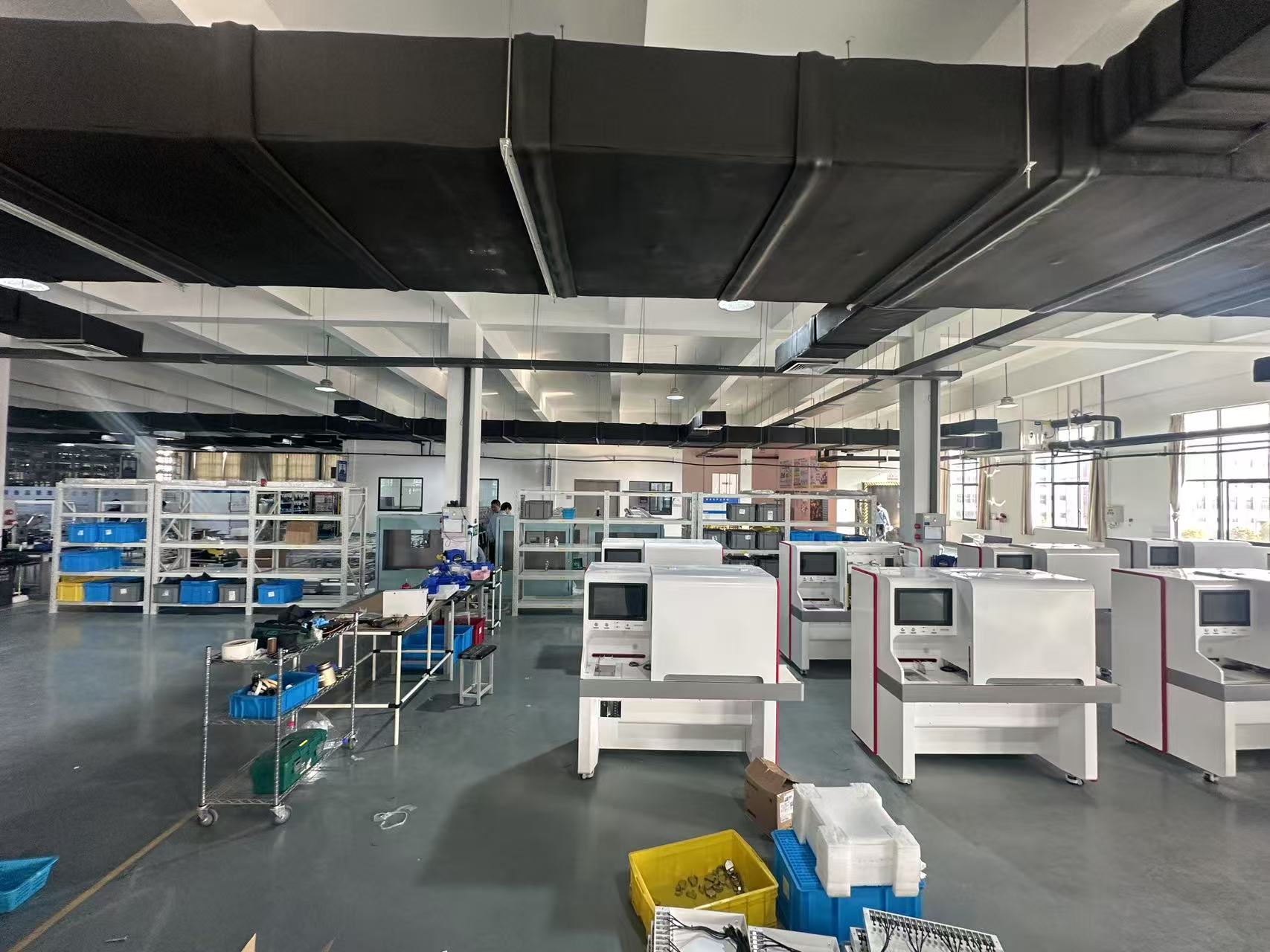
Equipment qualification begins in the manufacturing and assembly environment, shown here at Haier Biomedical Technology (Suzhou) Co., Ltd. Image: Haier Biomedical.
Why certification documents are a starting point, not a compliance position
Regulatory expectations in this category are built in layers, and each layer is owned by a different party. CSA Group notes that pharmacy automation systems must comply with IEC 60601-1 for medical electrical equipment safety and with ISO 13485 for quality management. The U.S. Food and Drug Administration's 21 CFR Part 11 regulates electronic records and electronic signatures, which becomes relevant wherever an automated pharmacy workflow generates, stores, or transmits medication records electronically.
None of those obligations is satisfied by possession of a document. IEC 60601-1 addresses the safety of the medical electrical equipment itself. ISO 13485 addresses how the manufacturer designs, produces, and controls that equipment. Part 11 addresses how records and signatures are created and protected inside a regulated workflow. A hospital that holds all three documents can still fail an inspection if the installation environment, the utility supply, or the system configuration does not match what those documents presuppose.
Haier Biomedical Technology (Suzhou) Co., Ltd is a healthcare technology company under Haier Group, founded in 2015, operating a 13,000 m² facility with approximately 500 employees, including a 100-engineer research and development team. Its pharmacy automation business unit develops intelligent pharmacy automation solutions for hospitals and clinics, with a product portfolio covering intelligent pharmacy automation solutions, outpatient automated dispensing systems, inpatient pharmacy automation systems, and automated PIVAS systems. The company operates an ISO 13485 medical device quality management system, designs its solutions for integration with hospital information systems including HIS and EMR platforms, and serves markets including Southeast Asia, Latin America, and the Middle East.
That entity profile explains what the supplier controls. What follows explains what the hospital controls, and why those two sets of responsibilities need to be separated before a purchase order is signed.
Three prerequisites that never appear in a certificate
A device certificate travels with the device. Site prerequisites do not travel with anything. They are determined by the building, the department, and the local utility environment, and they are usually discovered late in a project unless someone checks them early.
1. Compounding environment: Class 100 (ISO 5)
The HOH-Robot-Plus is specified for compounding under Class 100 (ISO 5) cleanroom conditions. That is an environmental requirement attached to the equipment, and it logically precedes the equipment. The unit itself measures 2,200 × 1,520 × 2,370 mm and weighs 1,300 kg. Its product data specifies compatibility with more than 95% of vial types, a compounding efficiency of 25 preparations per hour, and solvent compatibility with 50–1000 mL soft bags, plastic bottles, and stand-up pouches, using luer-lock general-purpose syringes and dedicated needles as consumables. Compounding accuracy is specified at 100% in the product data, and the unit is positioned for PIVAS applications.
For a compliance officer, the operational consequence is straightforward: the cleanroom is not a feature of the device, and the device cannot compensate for a room that does not meet the class. The validation work that supports a cleanroom claim — environmental monitoring, pressure and airflow control, gowning and entry discipline, cleaning procedures — belongs to the hospital and its facilities or infection-control function. If a project plan lists the compounding robot as the compliance deliverable, the plan is incomplete.
2. Ambient environment: temperature and humidity
The HOH-FB-D400-HD automatic sub-packaging and verification machine carries an explicitly stated operating environment: temperature 0–40°C and humidity 10–80%. The same product data lists overall dimensions of 1200 × 880 × 2025 mm, a rated power of 2,000 W, a net weight of 700 kg, capacity for 400 medication boxes, a packaging speed of 40–60 packs per minute, a packaging bag size of 75 × 70 mm, a 72-slot external output tray, and a power supply of AC 220 V +10%, 50/60 Hz.
An environmental range is not a design target. It is a boundary condition. If the room where sub-packaging and verification will operate regularly exceeds 40°C, or if humidity in a monsoonal or coastal facility falls outside 10–80%, the machine is being operated outside its specified envelope regardless of how many certificates accompany it. Recording those conditions during a pre-installation survey, and again after commissioning, is a low-cost compliance control that most project schedules omit.
3. Electrical supply and physical load
Electrical specifications are where paperwork and reality diverge most often. The HOH-FB-D400-HD is specified at AC 220 V +10%, 50/60 Hz with a rated power of 2,000 W. The HOH-BQ-A intelligent integrated medication management cabinet is specified at AC 220 V, 50/60 Hz, with a 23-inch touch screen. The HOH-MJ-01 anesthetic medication dispensing cabinet is specified at 220 V / 50 Hz / 60 Hz with 400 W power consumption and a net weight of 400 kg.
The dual 50/60 Hz rating indicates that the equipment is specified for both common mains frequencies. It does not indicate that the equipment is specified for every mains voltage. In facilities operating on 110–120 V supply, the nameplate value is a site-engineering input: a compliance officer should confirm how the required supply will be provided, who is responsible for that provision, and how the arrangement will be documented before installation. The same logic applies to physical load. A 1,300 kg compounding unit, a 700 kg sub-packaging machine, and a 400 kg dispensing cabinet each impose floor-loading, access-route, and door-clearance questions that appear nowhere in a certificate of conformity.
Controlled substances: equipment can carry a control, not the accountability
Controlled-substance handling in hospital pharmacy is governed less by product standards than by procedure. In many hospital systems, including those operating under Chinese hospital pharmacy practice, narcotics and anesthetic agents are managed through a framework commonly described as 'five-specialty' management: dedicated personnel, dedicated locked storage, a dedicated ledger, a dedicated prescription, and dedicated registration. The framework is designed so that accountability can be reconstructed after the fact.
The HOH-MJ-01 anesthetic medication dispensing cabinet is configured around that logic. Its storage structure comprises nine drawers — the first seven laid out in a six-grid arrangement and the bottom two in a single-grid arrangement, all with lids — for a total of 44 compartments. Maximum single-layer volume is 28.3 L. The external dimensions are 745 × 700 × 1800 mm, with small drawers measuring 243 × 128 × 85 mm and large drawers measuring 477 × 491 × 108 mm. A 15-inch touch screen provides the operator interface.
The compliance interpretation matters here. Compartmentalisation with individual lids is a physical control: it separates agents, restricts casual access, and makes a missing item visible rather than hidden. A dedicated interface screen can support structured registration at the point of issue. What equipment cannot do is assign responsibility, maintain the ledger as a regulated record, or enforce the prescription rule. Those remain hospital obligations, and a compliance officer should treat the cabinet as an instrument that makes those obligations easier to discharge — not as a substitute for them.
Data integrity: the audit that is not a binder
Where 21 CFR Part 11 applies, the compliance question shifts from what a machine does to what the machine remembers and who can change the record. Automated dispensing equipment generates a continuous stream of transaction data — what was picked, when, for which prescription, and by whom. If that stream is incomplete, editable without trace, or not attributable, the installation weakens the hospital's data-integrity position rather than strengthening it.
Traceability capability varies by product family. The HOH-KF-Smart robotic arm medication dispensing system is specified with barcode recognition and full-chain monitoring designed for full traceability, together with FIFO/FEFO expiration management described in the specification as zero-error dispensing. Its stated capacity parameters are ≥1500 medication types, ≥20,000 boxes of storage, ≥300 prescriptions per hour dispensing speed, and ≥700 boxes per hour replenishment speed. Separately, Haier's own selection guidance describes the robotic arm dispenser as offering dispensing accuracy of up to 99%, and its integrated dispensing-and-verification configuration is associated with accuracy improvement to ≥99.9% in the comparison data on automated dispensing and verification.
Record continuity also depends on system interfaces. Haier pharmacy automation solutions can be integrated with hospital information systems to support automated prescription processing and dispensing workflows; depending on project requirements, the system can connect with HIS/EMR and other hospital systems so that prescription information is transferred to the pharmacy automation system for dispensing. The verification work this implies is project-specific: interface documentation, user-role definitions, audit-trail configuration, and signature meaning all have to be reviewed against the hospital's own electronic-records policy. A supplier can state that integration is supported. Only the hospital can confirm that its configured system meets its regulatory standard.
Comparing automated and manual processes on compliance-relevant measures
Decision-stage comparisons in pharmacy automation usually focus on throughput. The measures below come from published comparison data on manual versus automated pharmacy processes, presented here with an added column showing why each measure has a compliance dimension.
| Dimension | Manual process | Automated system | Compliance relevance |
|---|---|---|---|
| Dispensing workflow | Manual picking and checking, repeated per prescription | 3–5 times improvement in dispensing efficiency; fewer manual operation steps | Shorter queues and fewer handover points reduce the number of undocumented steps |
| Dispensing and verification accuracy | Accuracy depends on individual verification discipline | Integrated dispensing and verification improves accuracy to ≥99.9% | Lower error rates mean fewer incident investigations and a shorter adverse-event record |
| Storage density | Shelving and manual location management | 2–4 times higher storage capacity; improved use of pharmacy space | Denser storage with defined locations simplifies stock reconciliation |
| Replenishment and expiry control | Manual counting and reordering | Data-driven inventory prediction with accuracy up to 85% or higher and automatic replenishment support | Systematic expiry handling reduces wastage that auditors otherwise query |
| Environment and infrastructure | Room, shelving, and staff-dependent process; no automation prerequisites | Requires defined cleanliness, temperature, humidity, supply, and floor-loading conditions | Boundary condition: automation shifts compliance work from the operator to the facility |
The last row is the one that procurement documents tend to understate. Automation does not reduce the total compliance workload. It relocates a portion of it from daily human behaviour to one-time facility qualification, and then holds it there.
Boundaries and limitations worth stating plainly
A vendor document pack that lists no limitations is not more reassuring than one that does. The following boundaries apply to the products discussed here and to automated pharmacy installations generally.
- Certification does not transfer site qualification. ISO 13485 describes the manufacturer's quality management system. It does not certify the room, the mains supply, or the building services that the equipment depends on.
- The Class 100 (ISO 5) requirement is a capital and validation scope item. For the HOH-Robot-Plus, the compounding environment must exist and be maintained before the robot can perform to specification. Hospitals that cannot fund or maintain such an environment cannot treat the robot as a standalone compliance solution.
- Automation suits certain volume profiles better than others. The comparison data positions automated dispensing as more suitable than manual dispensing for large hospitals, outpatient pharmacies, and high-volume dispensing centers. Selection guidance tied to Haier's product range similarly frames the robotic arm dispenser for facilities handling a relatively large volume of boxed medications. A low-volume site may find that the prerequisites outweigh the benefit.
- Nameplate voltage is not a universal fit. The HOH-FB-D400-HD is specified at AC 220 V +10%, 50/60 Hz and the HOH-BQ-A at AC 220 V, 50/60 Hz. Sites on other supply voltages require a documented site-side engineering solution.
- Weight and footprint constrain layout. At 1,300 kg (HOH-Robot-Plus), 700 kg (HOH-FB-D400-HD), and 400 kg (HOH-MJ-01), transportation routes, floor loading, and cabinet positioning are installation prerequisites rather than afterthoughts.
- Procedural controls remain human. Dedicated personnel, ledger maintenance, prescription control, and registration under a five-specialty framework are not delegated to hardware.
- Integration support is not integration verification. HIS/EMR connectivity is supplied as a capability; its configuration against a specific hospital's electronic-records policy must be validated locally.
Matching compliance intensity to the department
Different pharmacy departments carry different compliance intensities, and the equipment portfolio reflects that. The table below maps typical departments to the units discussed in this article, using published specifications only.
| Setting | Typical unit | Key specified parameters | Primary compliance question |
|---|---|---|---|
| Central or inpatient pharmacy, boxed medications | HOH-KF-Smart robotic arm dispenser | ≥1500 medication types; ≥20,000 boxes; ≥300 prescriptions/hour; FIFO/FEFO; barcode traceability | Is transaction data complete, attributable, and retained? |
| High-volume outpatient pharmacy with limited floor space | HOH-KF-1200 chute type dispenser | >1100 medication types; >15,000 boxes; space requirement <12.85 m²; 350–500 prescriptions/hour; ≥2 buffer channels | Does the layout still allow safe dispensing and replenishment separation? |
| Fast boxed-medication throughput | HOH-GF high speed dispenser (2 modules) | ≥100 storage slots; ≥5000 boxes; ≥2 boxes/sec single channel; photoelectric dispensing detection; indicator-light error guidance | Are dispensing discrepancies detected and logged rather than corrected silently? |
| PIVAS cytotoxic compounding | HOH-Robot-Plus | Class 100 (ISO 5) cleanroom; 25 preparations/hour; >95% vial compatibility; 100% specified compounding accuracy; 1,300 kg | Is the cleanroom qualified and maintained independently of the robot? |
| Operating theatre and anesthetic storage | HOH-MJ-01 anesthetic medication dispensing cabinet | 9 drawers; 44 compartments; all drawers lidded; 28.3 L maximum single-layer volume; 15-inch touch screen; 400 W | Does physical control align with the five-specialty procedural framework? |
| Sub-packaging and unit-dose verification | HOH-FB-D400-HD | 400 medication boxes; 40–60 packs/min; 72-slot output tray; AC 220 V +10% 50/60 Hz; 0–40°C; 10–80% RH | Has the operating environment been measured, not assumed? |
| Ward-level or satellite stock | HOH-BQ-A intelligent integrated management cabinet | 620 × 700 × 1240 mm; 32 small pillboxes (150 pcs each, by 1 mL ampoule); 8 large pillboxes (20 pcs each); 23-inch touch screen; AC 220 V 50/60 Hz | Is cabinet stock reconciled into the main pharmacy record? |

Haier Biomedical Technology (Suzhou) Co., Ltd operates a 13,000 m² facility with approximately 500 employees. Image: Haier Biomedical.
Market context: why compliance scope is widening
The commercial trajectory of pharmacy automation explains why compliance scope is expanding rather than stabilising. Insightace Analytic estimated the global pharmacy automation devices market at USD 6.7 billion in 2024. Grand View Research projects the global pharmacy automation market to reach USD 11.6 billion by 2030, growing at a compound annual growth rate of 9.9%. Dataintelo and MarketsandMarkets data indicate that North America held the largest revenue share in 2024, in a range of approximately 38.2% to 47.8%, and that medication dispensing systems accounted for the largest product segment share at 32.5% in 2025.
The growth is not evenly distributed across product types, and the fastest-growing segments are the ones with the heaviest qualification burden. Grand View Research projects automated medication compounding systems as the fastest-growing product segment, with a CAGR exceeding 10% — the same category that carries cleanroom prerequisites such as the Class 100 (ISO 5) condition specified for the HOH-Robot-Plus. MarketsandMarkets identifies pharmacy automation software as the fastest-growing component through 2030, which shifts audit attention toward records, interfaces, and data retention. Fortune Business Insights reports that the hospital pharmacy segment held the largest market share in 2024 on the strength of patient volumes and complex medication regimens, and projects that decentralized distribution models will account for 79.8% of the market in 2026 as automated dispensing cabinets spread into wards and satellite locations.
Regional figures reinforce the point. Grand View Research estimates the China pharmacy automation market growing at a CAGR of 5.6% between 2025 and 2030, while Fortune Business Insights projects the U.S. pharmacy automation market reaching USD 1.9 billion by 2026. In both markets, the growth is concentrated in settings where controlled substances, cytotoxic agents, and electronic records converge — which is precisely where certification documents stop being sufficient.
A pre-purchase compliance checklist
The following sequence reflects the order in which gaps typically surface. It is written for compliance officers and procurement leads who must sign off before installation rather than after.
- Separate device obligations from site obligations in writing. Request a document that states which conditions the equipment assumes and which party is responsible for creating them.
- Confirm the applicable standards framework for the destination market. IEC 60601-1 for medical electrical equipment safety and ISO 13485 for quality management are identified by CSA Group as applicable to this category; 21 CFR Part 11 governs electronic records for U.S.-regulated workflows.
- Measure the room, not the plan. Verify temperature and humidity against stated ranges — 0–40°C and 10–80% relative humidity for the sub-packaging and verification unit, for example.
- Verify cleanliness class where compounding is involved. A Class 100 (ISO 5) requirement must be met and maintained by the facility.
- Audit the electrical plan against the nameplate. AC 220 V +10%, 50/60 Hz for the sub-packaging unit; AC 220 V 50/60 Hz for the management cabinet; 220 V 50/60 Hz, 400 W for the anesthetic cabinet.
- Check floor loading and transport routes against unit weights of 1,300 kg, 700 kg, and 400 kg respectively.
- Define the electronic-record requirement before ordering the interface. Identify which transactions must be attributable, what an audit trail must contain, and how long records are retained.
- Map physical controls to procedural controls. For controlled substances, confirm how compartmentalisation and lidded drawers align with dedicated storage, ledger, prescription, and registration rules.
- Confirm the volume case. Automated dispensing is more suitable for large hospitals, outpatient pharmacies, and high-volume dispensing centers than for low-volume sites.
- Document who signs off on commissioning. Assign acceptance responsibility for environmental, electrical, data, and workflow criteria separately, rather than as one handover event.
Future outlook
The direction of travel is toward records and environments, not toward more certificates. Haier Biomedical reported in its 2025 annual report that its AI-powered automated pharmacy solutions increased direct dispensing rates to 80%, that AI-powered applications contributed 15% of total revenue, and that overseas revenue grew 17.9% year on year to 840 million yuan, within total revenue of RMB 2.33 billion (approximately USD 340.77 million). Whatever the commercial reading of those numbers, the operational reading is consistent with the wider market: more transactions are being generated automatically, and more of the compliance record is being written by software.
Two consequences follow for hospitals planning 2026 and 2027 installations. First, environmental qualification will increasingly be treated as part of the automation project rather than as a facilities side task, particularly where compounding or controlled substances are involved. Second, electronic-records review will move earlier in the procurement cycle, because an interface decision made late is expensive to reverse. Compliance officers who ask about the room, the supply, the load, and the audit trail before the purchase order is issued will spend less time explaining afterwards why the certificate did not cover it.
Frequently asked questions
Which certification documents should a hospital verify before purchasing pharmacy automation?
At minimum, verify the manufacturer's quality management certification and the electrical safety documentation applicable to medical electrical equipment. CSA Group identifies IEC 60601-1 for medical electrical equipment safety and ISO 13485 for quality management as applicable to pharmacy automation systems, and the U.S. FDA's 21 CFR Part 11 governs electronic records and electronic signatures in automated pharmacy workflows. Haier Biomedical states that it operates an ISO 13485 medical device quality management system. Documentation should also identify which conditions the equipment assumes, since certificates do not confirm site readiness.
What site conditions must be confirmed for a cytotoxic compounding robot?
The HOH-Robot-Plus is specified for Class 100 (ISO 5) cleanroom conditions, so the compounding environment is a prerequisite rather than an accessory. The unit measures 2,200 × 1,520 × 2,370 mm and weighs 1,300 kg, which raises floor-loading and access-route questions. It is specified for compatibility with more than 95% of vial types, a compounding efficiency of 25 preparations per hour, and solvent compatibility with 50–1000 mL soft bags, plastic bottles, and stand-up pouches, using luer-lock general-purpose syringes and dedicated needles as consumables. It is positioned for PIVAS applications.
Which electrical specifications affect hospital installation?
Three units illustrate the range. The HOH-FB-D400-HD automatic sub-packaging and verification machine is specified at AC 220 V +10%, 50/60 Hz with a rated power of 2,000 W. The HOH-BQ-A intelligent integrated medication management cabinet is specified at AC 220 V, 50/60 Hz. The HOH-MJ-01 anesthetic medication dispensing cabinet is specified at 220 V / 50 Hz / 60 Hz with 400 W power consumption. Sites operating on different supply voltages need a documented site-side engineering solution, since nameplate values describe the equipment, not the building.
Can pharmacy automation integrate with a hospital information system?
Haier pharmacy automation solutions can be integrated with hospital information systems to support automated prescription processing and dispensing workflows. Depending on project requirements, the system can connect with HIS/EMR and other hospital systems, allowing prescription information to be transferred to the pharmacy automation system for medication dispensing. The interface reduces repetitive manual data entry and improves process continuity. Configuration, audit-trail settings, and validation against the hospital's own electronic-records policy remain hospital responsibilities.
Is pharmacy automation suitable for every hospital?
No. Selection depends on prescription volume, medication types, SKU requirements, dispensing workflow, storage capacity, available space, system integration requirements, scalability, and investment budget. Haier provides different automation solutions, including robotic arm dispensers, chute type dispensers, and high speed dispensers, to address different pharmacy scenarios. Published comparison data positions automated dispensing as more suitable than manual dispensing for large hospitals, outpatient pharmacies, and high-volume dispensing centers, which implies that low-volume sites need a more careful assessment.
How does a dispensing cabinet support controlled-substance handling?
The HOH-MJ-01 anesthetic medication dispensing cabinet uses nine drawers — seven with a six-grid layout and two with a single-grid layout, all fitted with lids — creating 44 compartments in total. Maximum single-layer volume is 28.3 L, external dimensions are 745 × 700 × 1800 mm, and a 15-inch touch screen provides the operator interface. This structure supports physical separation and restricted access, which align with the dedicated-storage element of a five-specialty management framework. Dedicated personnel, ledger, prescription, and registration requirements remain procedural obligations of the hospital.
A full-scenario overview of Haier Biomedical's intelligent pharmacy portfolio, including outpatient, inpatient, and PIVAS automation, is available in the Full-scenario Intelligent Pharmacy brochure. Haier Biomedical Technology (Suzhou) Co., Ltd can be reached at smartpharmacy@haierbiomedical.com; product and project information is published at www.haierautomation.com.