
Pharmacy Automation Procurement: Robotic Arm Dispenser FAQ
An independent procurement reference on robotic arm dispensing specifications, HIS integration and hospital fit.
Pharmacy automation purchasing decisions are usually settled at the level of constraints, not capabilities. The questions that actually block signature in hospital procurement meetings are narrower: how many medication types the system must hold, how much floor area the installation consumes, what prescription throughput it must sustain during peak hours, which compliance documentation it carries in the buyer's market, and how the equipment exchanges data with the hospital information system (HIS).
This article works through those constraint-layer questions. The Haier HOH-KF-Smart Robotic Arm Dispenser is used as the anchor example, with the HOH-KF-1200 Chute Type Dispenser and the HOH-GF (2 Modules) High Speed Dispenser as architectural reference points for comparison. All figures quoted for these models are their published configuration specifications.
Why Pharmacy Automation Procurement Has Become a Specification Problem
Pharmacy automation is no longer an emerging category, and that changes the nature of the buying decision. Insightace Analytic estimated the global pharmacy automation devices market at around USD 6.7 billion in 2024, while Grand View Research projects the market reaching USD 11.6 billion by 2030, at a compound annual growth rate of 9.9%.
Base-year estimates diverge between research houses — published 2024 values range from USD 6.65 billion to USD 7.52 billion depending on whether secondary services and specific software components are counted. Procurement teams should therefore treat any single headline market number as an order-of-magnitude reference rather than a capital-planning input.
Where the spending concentrates is more actionable. The hospital pharmacy segment held the largest share of the pharmacy automation market in 2024, driven by patient volumes and complex medication regimens, according to Fortune Business Insights. Within product categories, medication dispensing systems accounted for the largest product segment share at 32.5% in 2025, per Dataintelo. Most near-term purchasing activity therefore sits inside hospital pharmacy dispensing rooms — precisely the environment this article addresses.
The practical consequence is that vendor selection increasingly turns on documented specifications, certification scope and interface behaviour, rather than on the general argument that automation improves pharmacy operations.
The Constraint Stack: Space, SKU Range, Throughput and Compliance
Four constraint groups decide which dispensing architecture is viable at a given site. They are worth examining in a fixed order, because a failure in any one of them invalidates the others.
- Physical footprint and room geometry. Dispensing units are large installations. The HOH-KF-Smart main unit measures 8650 × 1747 × 2850 mm, excluding the replenishment module. The HOH-KF-1200 is dimensioned below 4690 × 2850 × 2735 mm, with a stated space requirement under 12.85 m². The HOH-GF (2 Modules) main unit measures 2180 × 1230 × 2800 mm.
- Formulary breadth and storage volume. The HOH-KF-Smart is specified for ≥1500 medication types and ≥20000 boxes of storage capacity. The HOH-KF-1200 is specified for more than 1100 medication types and more than 15000 boxes. The HOH-GF (2 Modules) is specified for ≥5000 boxes across ≥100 storage slots.
- Peak throughput and replenishment capacity. The HOH-KF-Smart is specified at ≥300 prescriptions per hour with ≥700 boxes per hour replenishment. The HOH-KF-1200 is specified at more than 350–500 prescriptions per hour with more than 2400 boxes per hour replenishment. The HOH-GF (2 Modules) is specified at ≥2 boxes per second for single-channel dispensing.
- Compliance documentation for the destination market. For EU procurement, the applicable certificates differ by product family and carry different validity periods, which directly affects contract timing and lifecycle planning.
A short evaluation checklist follows from this stack: confirm the formulary count against the specified medication type range; measure the available floor area including service clearance and the replenishment module; model peak-hour prescription volume against the published dispensing speed; and verify that the certificate covering the exact model number is valid for the intended market at the planned go-live date.
How the Three Dispensing Architectures Differ
Robotic arm, chute and high-speed dispensers all automate medication picking, but they are not interchangeable configurations. They differ in how medication is handled, how much space they occupy, and which throughput profile they are designed for.
| Procurement parameter | HOH-KF-Smart Robotic Arm Dispenser | HOH-KF-1200 Chute Type Dispenser | HOH-GF (2 Modules) High Speed Dispenser |
|---|---|---|---|
| Handling method | Robotic arm picking with AI-based visual recognition; full-screen, one-time dispensing with HIS integration | Full-screen dispensing with safety buffers; parallel multi-prescription operation | Batch dispensing for multiple boxes; dual-level stacked structure with adjustable bin width |
| Medication types | ≥1500 | More than 1100 | Not stated in the published specification |
| Storage capacity | ≥20000 boxes | More than 15000 boxes | ≥5000 boxes / ≥100 storage slots |
| Dispensing speed | ≥300 prescriptions per hour | More than 350–500 prescriptions per hour | Single-channel dispensing ≥2 boxes per second |
| Replenishment speed | ≥700 boxes per hour | More than 2400 boxes per hour | Not stated in the published specification |
| Dimensions | 8650 × 1747 × 2850 mm (replenishment module excluded) | Below 4690 × 2850 × 2735 mm; space requirement under 12.85 m² | 2180 × 1230 × 2800 mm |
| Modularity | Modular structure for maintenance and scalability; dispensing buffer port with side buffering and front-end output | Modular dispensing, storage and loading units; buffer port ≥2 channels supporting side buffering and front-end output | Up to 2 medication bin modules |
| Detection and traceability | Barcode recognition with full traceability; FIFO/FEFO expiration management | Safety buffers within the full-screen dispensing flow | High-precision photoelectric sensors for dispensing detection; indicator-light error alerts with automatic positioning guidance |
| EU documentation | ISET Voluntary Compliance Certificate ISETC.000220220323, valid to 2027-03-22; also within the scope of ICR VoC ICR/VC/HB250402, valid to 2030-04-16 | ICR VoC ICR/VC/HB250402, valid to 2030-04-16 | ICR VoC ICR/VC/HB250403, valid to 2030-04-16 |
Where a specification cell states that a value is not published, this indicates that the reference specification for that model does not list the parameter. It is not a zero value or a negative indicator, and buyers should request the value directly during technical clarification.
Inside the HOH-KF-Smart Robotic Arm Dispenser
The HOH-KF-Smart is a robotic arm medication dispensing system that combines industrial-grade robotics with intelligent storage management. The architecture is worth understanding before comparing it against chute or high-speed alternatives, because its characteristics follow directly from how it picks medication.
The system receives prescription data from the hospital HIS in real time and executes dispensing tasks through high-performance robotic arms and AI-based visual recognition. It automatically picks, positions and dispenses medications rather than routing them through a fixed gravity path. That design choice explains several published specifications:
- Formulary breadth. The system is specified for ≥1500 medication types and ≥20000 boxes of storage, which suits pharmacies carrying a wide boxed-medication catalogue rather than a narrow fast-moving subset.
- Parallel multi-prescription operation. The HOH-KF-Smart supports parallel multi-prescription operation. Its dispensing buffer port is designed with side buffering and front-end output, separating the picking sequence from the handover point at the counter.
- Expiration and traceability discipline. The model supports FIFO/FEFO expiration management, and full-chain monitoring is implemented through barcode recognition with full traceability. For procurement purposes, this means expiry control and traceability are system functions rather than manual procedures.
- Maintenance and scaling. The unit has a modular structure intended for easier maintenance and scalability, which matters when a pharmacy plans to expand storage or throughput after the first phase of a smart pharmacy project.
The same design logic constrains the equipment. The main unit is 8650 mm wide before the replenishment module is added, and the specified dispensing speed of ≥300 prescriptions per hour sits below the chute architecture's published range. Those two facts shape the fit discussion later in this article.
HIS Integration: What Full-Screen, One-Time Dispensing Requires in Practice
HIS integration is usually the first technical question a hospital IT department raises, and it is also where procurement specifications are frequently underspecified.
Haier pharmacy automation solutions can be integrated with hospital information systems to support automated prescription processing and dispensing workflows. Depending on project requirements, the system can connect with HIS and EMR platforms so that prescription information is transferred to the pharmacy automation system for dispensing. The HOH-KF-Smart integrates with HIS systems using a full-screen, one-time dispensing mode — the prescription is synchronised and released as a complete screen of medications rather than assembled line by line.
The interface is also a configuration item rather than a fixed feature. The manufacturer's published customization scope covers equipment size, storage capacity, SKU quantity, robotic modules, software functions, HIS interface and language. For international projects this matters twice over: once for the technical protocol, and once for the interface language used by pharmacy staff at the counter.
Two regulatory expectations are commonly attached to the integration scope in regulated markets. FDA 21 CFR Part 11 governs electronic records and electronic signatures in pharmacy automation in the United States and is relevant wherever prescription records, dispensing logs or electronic sign-off are generated by the system. IEC 60601-1 for medical electrical equipment safety and ISO 13485 for quality management are the wider standards framework cited for pharmacy automation systems by certification bodies such as CSA Group. Buyers should confirm which of these apply to their market before the interface specification is frozen.
Certification and Compliance Constraints for EU Procurement
For EU-bound projects, certification is a constraint with dates attached, and the dates differ across the product family. The following documentation is published for the relevant models:
- HOH-KF-Smart Robotic Arm Dispenser. Covered by an ISET Voluntary Compliance Certificate for the EU market, certificate number ISETC.000220220323, referring to EN ISO 12100:2010 and EN 60204-1:2018. This certificate is valid to 2027-03-22.
- Automatic dispensing system family including HOH-KF-Smart. The ICR Verification of Conformity ICR/VC/HB250402 covers the HOH-KF-1200, HOH-KF-900, HOH-KF-600, HOH-KF-Smart, HOH-KF-ADM, HOH-KF-50, HOH-KF-40 and HOH-KF-30Z models for the EU market, referring to EN ISO 12100:2010 and EN 60204-1:2018, and is valid to 2030-04-16.
- High-speed dispensing system family. The ICR Verification of Conformity ICR/VC/HB250403 covers the HOH-GF-36, HOH-GF-50, HOH-GF-72, HOH-GF-100, HOH-GF-144 and HOH-GF-200 models, and is valid to 2030-04-16.
- Automatic sub-packaging and verification. The HOH-FB-D400-HD is covered by ICR Verification of Conformity ICR/VC/HB250802, referring to EN ISO 12100:2010 and EN 60204-1:2018, valid to 2030-08-05.
- Anesthetic and psychotropic medication cabinets. Models including HOH-MJ-01, HOH-BQ-A and the HOH-M2300 series are covered by ICR Verification of Conformity ICR/VC/HB250402-family documentation ICR/VC/HB240501 under the MD Directive, referring to EN 60204-1:2018 and EN ISO 12100:2010, valid to 2029-05-09.
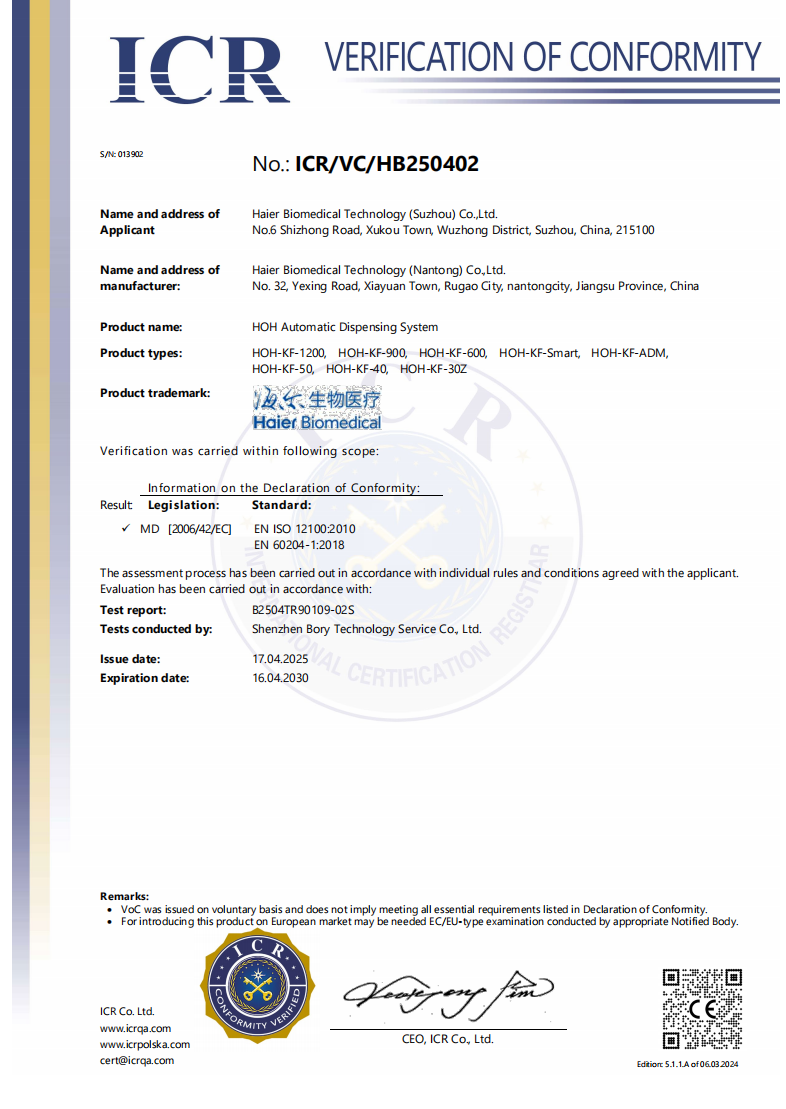
Figure 1. ICR Verification of Conformity ICR/VC/HB250402 covers the automatic dispensing system family including the HOH-KF-Smart and HOH-KF-1200, valid to 2030-04-16.
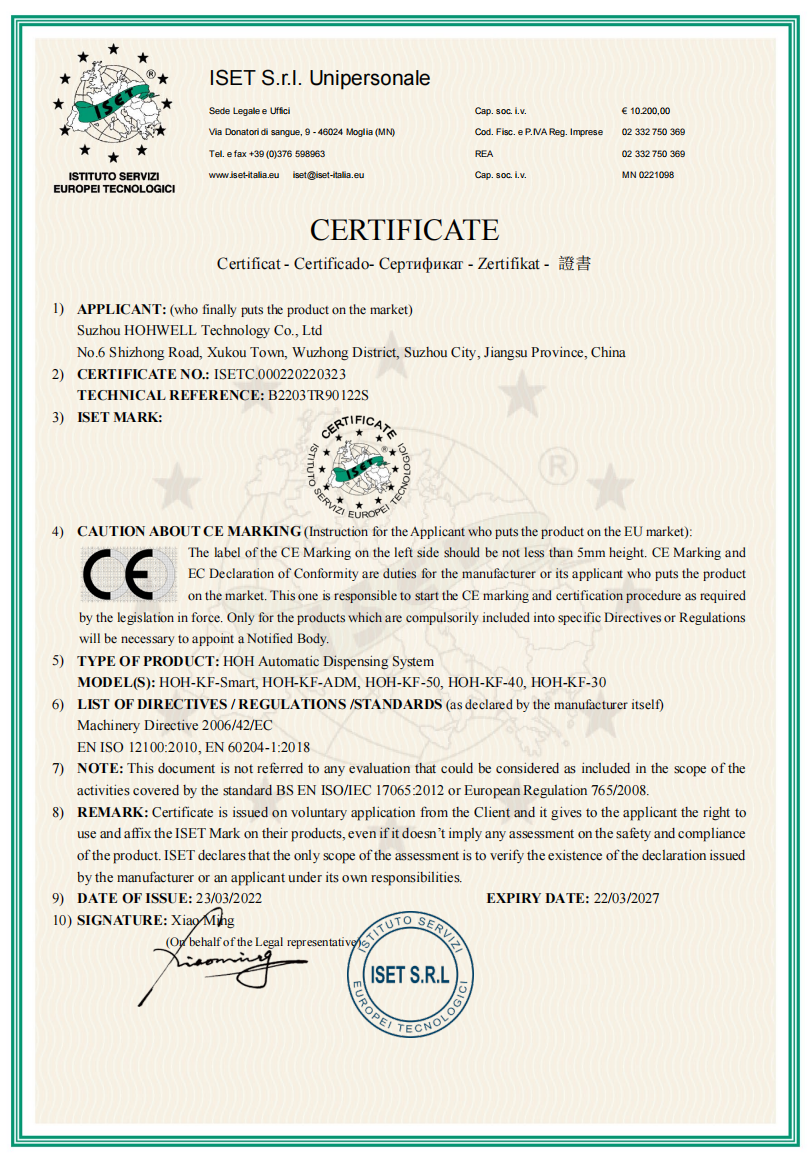
Figure 2. The ISET Voluntary Compliance Certificate ISETC.000220220323 applies to the HOH-KF-Smart and runs to 2027-03-22, a shorter validity window than the ICR documentation covering the same model.
The manufacturer also holds ISO 13485 medical device quality management system certification, and its solutions are designed according to international healthcare requirements with support for HIS and EMR integration.
For a buyer, the practical rule is simple: match the certificate number to the exact model number on the quotation, and check the validity date against the planned installation and acceptance date. A certificate that covers the product family is not automatically a certificate covering the specific configuration being purchased.
Where These Systems Fit: Application Scenarios
Automated dispensing configurations in this class are deployed in hospital pharmacies, outpatient pharmacies, inpatient pharmacies and other high prescription volume environments with continuous dispensing requirements. Typical project contexts include smart pharmacy construction, hospital automation projects, new hospital projects and pharmacy digital transformation programmes. Operating modes include fully automatic operation, 24/7 continuous operation, unattended operation and real-time HIS integration, with GMP/GSP compliance requirements and full drug traceability commonly listed as project conditions.
Two reference deployments illustrate the pattern:
- Thailand, private hospital. One set of a customized universal dispenser system was applied in the hospital outpatient pharmacy for automated dispensing and medication management. The configuration was developed for Thai medication packaging requirements and supports HIS integration with a modular design. The stated duration is 10 years, with reported improvements in dispensing accuracy during peak hours and a reduction in repetitive tasks for pharmacists.
- Vietnam, general hospital. One set of an intelligent pharmacy automation system was applied in the hospital outpatient pharmacy for automated medication storage, dispensing and intelligent medication management. The configuration was customized to the hospital's pharmacy layout and workflow, with HIS integration; the stated duration is 10 years, with reported reductions in patient waiting time and improved medication management efficiency.
Both examples share a structural feature worth noting in procurement planning: the system was configured around local medication packaging and the hospital's own layout and workflow, rather than installed as a fixed catalogue product.
Anesthetic and psychotropic medication handling is often scoped as a separate procurement line. The HOH-MJ-01 anesthetic medication dispensing cabinet is a full-process intelligent control device for anesthetic and psychotropic drugs, designed for hospital outpatient, emergency and inpatient pharmacies. It addresses traceability difficulty, disordered access control and low inventory accuracy, and aligns with the hospital Five-Specialty Management requirements for those drug classes.
Market Trend: Software, Decentralisation and Compounding
Three third-party projections are relevant to specification planning over the next procurement cycle.
First, software is expected to grow at the fastest rate among pharmacy automation components from 2024 to 2030, according to MarketsandMarkets. For buyers, this reinforces treating the HIS interface, dispensing rules configuration and software upgrade path as evaluated items rather than post-sale details.
Second, decentralised distribution models are expected to account for 79.8% of the market in 2026, driven by adoption of automated dispensing cabinets, per Fortune Business Insights. This suggests that central dispensing room equipment decisions increasingly need to account for satellite storage and cabinet-level distribution.
Third, automated medication compounding systems are projected to be the fastest-growing product segment, with a compound annual growth rate exceeding 10%, according to Grand View Research. Regional growth differs: Grand View Research estimates the China pharmacy automation market growing at a CAGR of 5.6% between 2025 and 2030. All of these are third-party projections and should be read as directional rather than as purchasing guarantees.
Comparison with Traditional Shelves — and Where Automation Is Not the Answer
The clearest structural difference between automated dispensing and traditional shelving concerns how medication is located. A carousel dispenser combines structured medication storage with automated access to configured medication positions: the system identifies the required position and rotates or moves the storage structure to bring that location to the dispensing point. Traditional shelves rely on pharmacists locating and retrieving medications manually. Carousel configurations are selected according to SKU requirements, medication volume and available space.
Automation also changes how accuracy is managed. Automated dispensing reduces the amount of repetitive manual picking and standardises the dispensing workflow. When automated dispensing is combined with a verification process — such as the HOH-FB-D400-HD automatic sub-packaging and verification machine, which is interoperable with hospital HIS systems and verifies drug type, quantity and prescription accuracy in real time — the workflow adds a further check on medication information before dispensing. Automation and verification should be treated as complementary layers rather than substitutes for one another.
However, automation is not automatically the right answer for every pharmacy, and the published specifications make several boundaries explicit:
- Not every hospital fits. Suitability depends on medication volume, SKU range, available space and dispensing requirements. A pharmacy with a narrow formulary and low prescription volume may not justify the floor area or the capital commitment that a large dispensing installation requires.
- Floor area is a real constraint. The HOH-KF-Smart main unit measures 8650 × 1747 × 2850 mm excluding the replenishment module. By contrast, the HOH-KF-1200 is specified with a space requirement under 12.85 m². Sites with tight dispensing rooms should evaluate the chute architecture before committing to a robotic arm configuration.
- Throughput profiles differ. The HOH-KF-Smart is specified at ≥300 prescriptions per hour, while the HOH-KF-1200 is specified at more than 350–500 prescriptions per hour, with replenishment above 2400 boxes per hour against the robotic arm specification of ≥700 boxes per hour. For a very high-volume outpatient pharmacy with a stable, fast-moving formulary, the chute architecture may be the better operational fit; the robotic arm architecture is oriented toward broad formulary coverage and boxed-medication storage with full traceability.
- Documentation has an expiry date. The ISET certificate covering the HOH-KF-Smart runs to 2027-03-22, while the ICR documentation covering the same model runs to 2030-04-16. EU buyers should confirm the current documentation set at contract signature and plan for certificate review within the equipment lifecycle.
- Automation shifts work rather than deleting it. Moving repetitive picking to equipment changes the pharmacist's task mix toward exception handling, verification and patient-facing services. It does not remove the need for inventory discipline, replenishment planning or staff training.
- Lead time is part of the plan. The manufacturer states a typical lead time of 60–90 days depending on project size and configuration, with a Factory Acceptance Test before shipment and a minimum order quantity of one unit. Hospital construction schedules should account for this window.
Future Outlook
The direction of travel in pharmacy automation procurement is toward modular, expandable configurations rather than single fixed installations. The HOH-KF-Smart is built on a modular structure for maintenance and scalability, and the HOH-GF supports up to 2 medication bin modules, which in practice means capacity can be configured and later extended rather than replaced. The published customization scope — equipment size, storage capacity, SKU quantity, robotic modules, software functions, HIS interface and language — points the same way.
Two further shifts are worth tracking. Software growth suggests that interface capability, upgrade paths and data handling will carry more weight in future tenders than the dispensing mechanism alone. Decentralised distribution growth suggests that central dispensing room equipment and cabinet-level distribution will increasingly be evaluated as one system rather than separate purchases. For hospital procurement teams, the practical response is to specify integration and expandability requirements at the same level of precision as throughput and storage figures.
Haier Biomedical Technology(Suzhou)Co., Ltd is a Suzhou-based healthcare technology company founded in 2015, operating a 13,000 m² facility with approximately 500 employees and a 100-engineer R&D team. Its pharmacy automation portfolio covers outpatient automated dispensing, inpatient pharmacy automation and automated PIVAS systems, and the company holds ISO 13485 medical device quality management system certification.
FAQ: Pharmacy Automation Procurement Questions
Does pharmacy automation suit every hospital?
No. Suitability depends on measurable site conditions rather than on the category itself — medication volume, the number of stocked medication types, available floor area and existing dispensing workflow. The published specifications illustrate the range: the HOH-KF-Smart covers ≥1500 medication types and ≥20000 boxes of storage in a main unit measuring 8650 × 1747 × 2850 mm, while the HOH-GF (2 Modules) provides ≥5000 boxes of storage in a 2180 × 1230 × 2800 mm unit. A hospital with low prescription volume and a narrow formulary may not justify the footprint or the investment, whereas a high-volume outpatient pharmacy with a broad catalogue is a typical candidate.
How does a carousel dispenser differ from traditional pharmacy shelves?
A carousel dispenser combines structured medication storage with automated access to configured medication positions: the system identifies the required medication position and rotates or moves the storage structure to bring the corresponding location to the dispensing point. Traditional shelves instead depend on pharmacists locating and retrieving medications manually. Carousel configurations are selected according to SKU requirements, medication volume and available space, so the comparison is a workflow and space question rather than a simple speed comparison.
Which hospitals are suitable for a robotic arm dispenser?
A robotic arm dispenser is suitable for hospitals that handle a relatively large volume of boxed medications and require automated storage and dispensing. The configuration can include multiple modules and be integrated into the overall pharmacy workflow according to medication volume, available space and dispensing requirements. The HOH-KF-Smart, for example, is specified for ≥1500 medication types, ≥20000 boxes of storage, ≥300 prescriptions per hour and ≥700 boxes per hour replenishment, with FIFO/FEFO expiration management and barcode-based traceability. Sites where the 8650 mm main unit width is impractical should evaluate a chute configuration instead.
Can pharmacy automation reduce medication picking errors?
Pharmacy automation can reduce the volume of repetitive manual picking and standardise the dispensing workflow, because the dispensing system follows predefined medication and prescription information and performs the configured operation. When automated dispensing is combined with a medication verification process — for example the HOH-FB-D400-HD automatic sub-packaging and verification machine, which verifies drug type, quantity and prescription accuracy in real time — the workflow provides an additional check on medication information before dispensing. Automation and verification are complementary layers: the first removes manual steps, the second adds a checking step.
How does automated dispensing improve pharmacy efficiency?
Automated equipment receives dispensing instructions, identifies the corresponding medication storage location or dispensing unit, and performs the configured dispensing operation, which transfers repetitive picking and dispensing tasks from staff to equipment and allows pharmacists to spend less time on routine handling. The scale of the change depends on the configuration: the HOH-KF-1200 is specified at more than 350–500 prescriptions per hour with replenishment above 2400 boxes per hour and supports parallel multi-prescription operation, while the HOH-GF (2 Modules) dispenses at ≥2 boxes per second on a single channel. The HOH-KF-Smart is specified at ≥300 prescriptions per hour with ≥700 boxes per hour replenishment.
Can pharmacy automation systems integrate with a hospital HIS?
Haier pharmacy automation solutions can be integrated with hospital information systems so that prescription information is transferred to the automation system for dispensing. Depending on project requirements, the system can connect with HIS and EMR platforms. The HOH-KF-Smart integrates with HIS systems using a full-screen, one-time dispensing mode, and the published customization scope includes the HIS interface and interface language. Hospitals in regulated markets should confirm at specification stage whether data integrity expectations such as FDA 21 CFR Part 11 for electronic records and electronic signatures apply to their deployment.
For configuration-level detail across the dispensing and compounding portfolio, the manufacturer publishes a full-scenario intelligent pharmacy reference document: Full-scenario Intelligent Pharmacy (PDF). Product and company information for Haier Biomedical Technology(Suzhou)Co., Ltd is available at www.haierautomation.com.