
Pharmacy Automation Recommended Options: A Task-Based Shortlist of Haier Biomedical Systems
Pharmacy automation is not a single purchase. It is a group of dispensing, verification, compounding and control tasks that happen to sit inside one hospital department. This shortlist is organised by task rather than by vendor ranking: for each hospital pharmacy job it names the Haier Biomedical system whose published specifications match that job, states what the equipment does, and records where the fit stops.
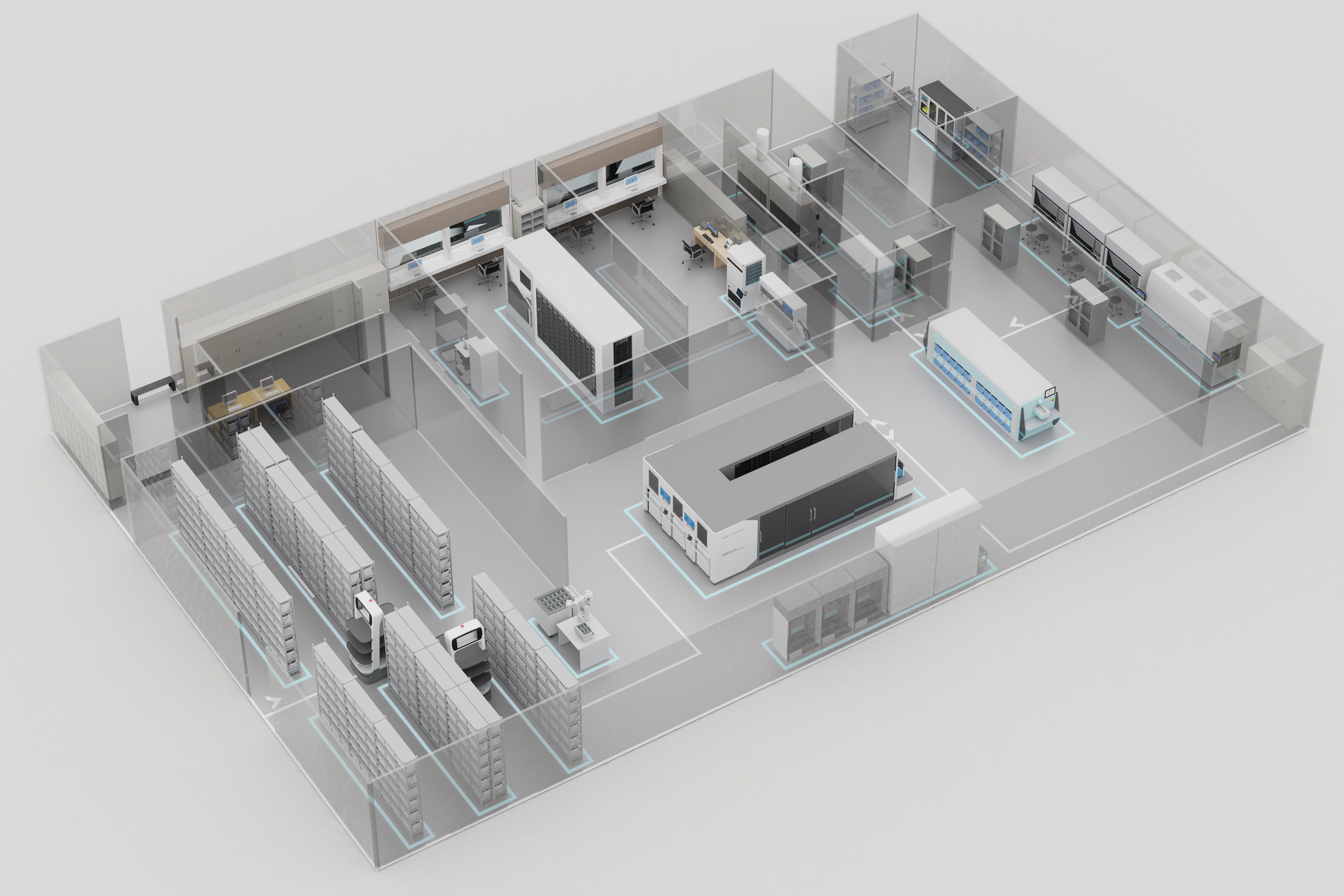
A PIVAS preparation area is one of several pharmacy tasks that each require a different automation profile.
Why hospital pharmacies are shortlisting by task
Pharmacy automation covers automated dispensing, intelligent storage, medication verification, inventory management, IV compounding automation and digital workflow software. The global pharmacy automation devices market was estimated at USD 6.7 billion in 2024 (Insightace Analytic) and is projected to reach USD 11.6 billion by 2030 at a CAGR of 9.9% (Grand View Research). Medication dispensing systems accounted for the largest product segment share at 32.5% in 2025 (Dataintelo), and hospital pharmacies remained the largest end-user segment in 2024 on the strength of patient volume and complex medication regimens (Fortune Business Insights).
The practical consequence is that a hospital rarely buys one machine. It buys a set, and that set is defined by tasks: clearing outpatient prescriptions at peak hours, packaging unit doses for inpatient rounds, preparing cytotoxic infusions, and controlling narcotic and psychotropic stock. Each task carries its own throughput, footprint, precision and traceability requirements. A shortlist that ranks suppliers on a single composite score hides those differences; a list organised by task exposes them, which is what a pharmacy team needs before it defines a specification.
The problem: one pharmacy, several incompatible jobs
Medication dispensing is high-frequency, repetitive and unforgiving. Pharmacist time is a shared constraint across the whole department; labour analysis published by Omnicell has indicated that 75% of pharmacist time has traditionally been spent on non-clinical tasks. Automation does not remove clinical responsibility, but it does move repetitive picking and transport onto equipment that follows configured rules.
Error reduction works the same way. Automated dispensing follows predefined medication and prescription information, while a verification step checks the dispensed item against the relevant information according to the configured workflow. The two functions are complementary rather than interchangeable, which is why task-based shortlists separate dispensing from verification instead of treating both as one purchase.
Three further constraints shape every hospital pharmacy, particularly in inpatient and high-volume outpatient settings: controlled substances require traceability and access control rather than speed; PIVAS cytotoxic preparation requires operator separation from the hazard; and space is finite, so the physical envelope of a system can disqualify it before its specifications are even discussed.
How this shortlist was built
Five filters were applied to each candidate system: the task it is designed to perform; the throughput and capacity the published specifications state; the installation envelope and site requirements; the integration path into hospital information systems including HIS and EMR platforms; and the traceability or control mechanism it provides. No vendor was scored, and no system was ranked against another. The output is a matching table, not a leaderboard.
| Pharmacy task | System | Core specifications | Planning constraint |
|---|---|---|---|
| Parallel prescription flow | HOH-KF-Smart Robotic Arm Dispenser | >=1500 medication types; >=20000 boxes; >=300 prescriptions/hour; FIFO/FEFO | Main unit 8650 x 1747 x 2850 mm, replenishment module excluded |
| High-volume full-screen dispensing | HOH-KF-1200 Chute Type Dispenser | >1100 medication types; >15000 boxes; >350-500 prescriptions/hour | Space under 12.85 m2; height under 2850 mm |
| High-speed boxed dispensing and verification | HOH-GF (2 Modules) High Speed Dispenser | >=100 slots; >=5000 boxes; single channel >=2 boxes/second | Capacity aligned to fast movers; up to 2 bin modules |
| PIVAS cytotoxic compounding | HOH-Robot-Plus | Class 100 (ISO 5); 25 cycles/hour; >95% vial compatibility | 1300 kg device weight; dedicated consumables |
| Controlled and anesthetic medication control | HOH-BQ-A; HOH-MJ-01 | 32 small and 8 large pillboxes; 44 compartments in 9 drawers | Cabinet-level capacity per unit; fixed footprints |
Task 1 - Parallel prescription flow at the outpatient window
Two systems in the Haier Biomedical pharmacy portfolio address the same job from different mechanical directions: keeping several prescriptions moving at once without queueing behind a single dispensing cycle.
HOH-KF-Smart Robotic Arm Dispenser. The robotic arm system is designed for pharmacies handling a wide medication range and a large boxed inventory. Published specifications list >=1500 medication types, >=20000 boxes of storage, dispensing speed of >=300 prescriptions per hour and replenishment speed of >=700 boxes per hour. Expiration management supports FIFO and FEFO, and barcode recognition provides full-chain monitoring and traceability. The dispensing buffer port uses side buffering and front-end output with at least two channels, which is what allows parallel multi-prescription operation rather than one prescription at a time. Integration with the hospital HIS is real-time, and the modular structure is intended for maintenance and scalability.
HOH-KF-1200 Chute Type Dispenser. The chute system is built for outpatient volume. Published specifications list more than 1100 medication types, more than 15000 boxes of storage, a dispensing speed above 350-500 prescriptions per hour, and a replenishment speed above 2400 boxes per hour. Dispensing is full-screen and one-time with safety buffers, and the buffer port provides at least two channels supporting side buffering and front-end output. The modular structure separates dispensing, storage and loading units, and error alerts use automatic positioning guidance with indicator lights.
Task fit is decided by the shape of the queue, not by which system is newer. Where the outpatient window must release many prescriptions simultaneously and the medication range is very wide, the robotic arm profile is the closer match. Where the throughput target is expressed in hundreds of prescriptions per hour and replenishment speed matters more than medication range, the chute configuration is the closer match. In both cases the HIS interface carries prescription information into the automation workflow, which reduces repetitive manual data entry and keeps the process continuous.
Task 2 - High-speed single-channel dispensing and verification
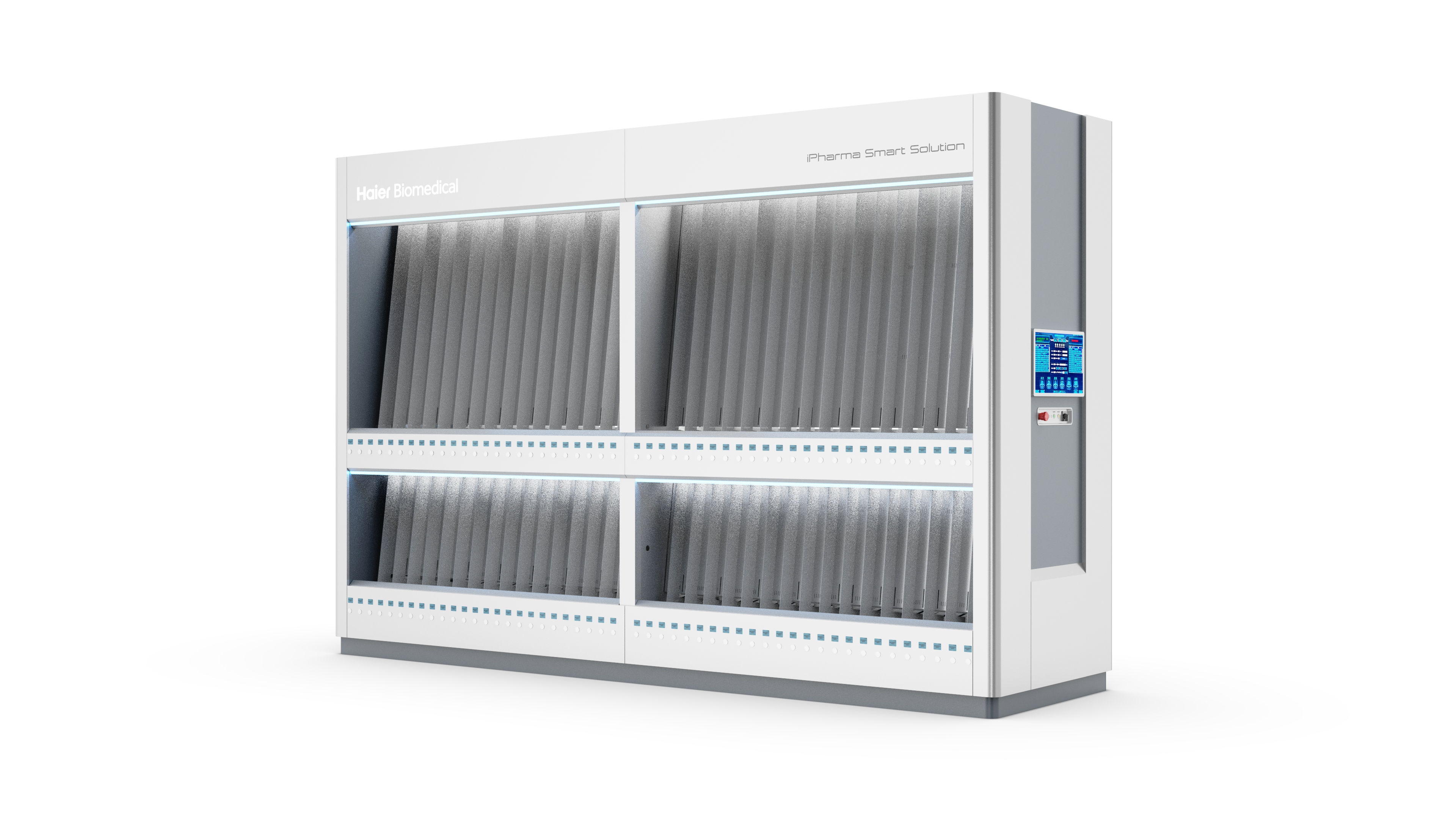
The HOH-GF (2 Modules) high speed dispenser uses a dual-level stacked structure for dense boxed storage.
HOH-GF (2 Modules) High Speed Dispenser. This unit is designed for high-frequency, high-volume boxed medications rather than for a full formulary. Specifications state at least 100 storage slots, at least 5000 boxes of capacity, up to two medication bin modules, and a single-channel dispensing speed of at least 2 boxes per second, with batch dispensing for multiple boxes. The structural design is dual-level stacked with adjustable bin width. Dispensing detection uses high-precision photoelectric sensors, and error alerts rely on automatic positioning guidance with indicator lights. The system is interoperable with hospital HIS systems and integrates AI-powered visual verification, and it is specified for an operating environment of 0-40 degrees Celsius and 10-80% relative humidity.
HOH-FB-D400-HD Automatic Sub-packaging and Verification Machine. Where the task is unit-dose packaging rather than box dispensing, this machine covers 400 medication boxes, a packaging speed of 40-60 packs per minute, 75 x 70 mm bags and a 72-slot external output tray. It is interoperable with hospital HIS systems and applies AI-powered visual verification, alongside real-time checking of drug type, quantity and prescription accuracy. Packaging and verification therefore form one closed workflow rather than two disconnected steps.
In task terms, the dispenser answers the question of how fast a box can leave storage; the verification machine answers the question of whether the right item left at all. Procurement teams that specify one without the other tend to discover the gap during the first peak-volume month.
Task 3 - PIVAS cytotoxic compounding
HOH-Robot-Plus Fully Automated Cytotoxic Drug Compounding Robot. This system is intended for the PIVAS environment and performs drug injection, dissolution, aspiration and mixing automatically inside a closed, clean environment. It works under Class 100 (ISO 5) cleanroom conditions, with a stated compounding accuracy of 100%, compounding efficiency of 25 cycles per hour, and compatibility with more than 95% of vials. Solvent compatibility covers 50-1000 mL soft bags, plastic bottles and stand-up pouches, and consumables are Luer-lock general-purpose syringes with dedicated needles. AI vision recognition and high-precision weighing are used to control the process. The device weighs 1300 kg and measures 2200 x 1520 x 2370 mm.
The task here is not throughput alone. It is human-machine separation: removing staff from direct handling of cytotoxic drugs eliminates occupational exposure risk, while continuous drug supply and automatic medical waste classification and storage keep the workflow enclosed. The same design supports digitalised management across the medication process, which is what makes a PIVAS configuration auditable rather than simply faster.
Task 4 - Controlled and anesthetic medication control
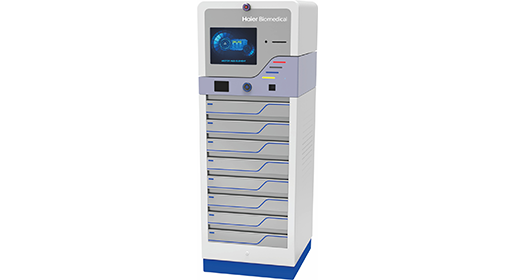
The HOH-MJ-01 anesthetic medication dispensing cabinet provides 44 compartments across nine drawers.
HOH-BQ-A Intelligent Integrated Medication Management Cabinet. This cabinet is designed for the storage, management and monitoring of narcotic and psychotropic drugs in operating rooms or pharmacy preparation areas. It complies with national regulations for the management of controlled substances and is intended to deliver full traceability, precise control and compliant operation across the whole process. Configuration is 32 standard small pillboxes, each holding 150 pieces measured on a 1 mL ampoule basis, plus 8 standard large pillboxes holding 20 pieces each. The unit measures 620 x 700 x 1240 mm, runs on AC 220V 50/60Hz and uses a 23-inch touch screen.
HOH-MJ-01 Anesthetic Medication Dispensing Cabinet. Designed for outpatient, emergency and inpatient pharmacies, this cabinet targets three specific weaknesses of manual handling: difficult traceability, disordered access control and low inventory accuracy. It aligns with the hospital Five-Specialty Management requirements for anesthetic and psychotropic drugs. The unit has nine drawers - the first seven in a six-grid layout and the bottom two in a single-grid layout, all with lids - giving 44 compartments in total, with a maximum single-layer volume of 28.3 L. External dimensions are 745 x 700 x 1800 mm, net weight is 400 kg, power consumption is 400 W at 220V/50Hz/60Hz, and the interface is a 15-inch touch screen.
These two cabinets are not interchangeable with a dispenser. Their task is access governance: who opened which drawer, under what authorisation, and what remains in stock afterwards. Hospitals that treat controlled substances as a storage problem rather than an access problem usually end up with accurate shelves and inaccurate records.
Technical explanation: what makes task matching work
Across the portfolio, four mechanisms decide whether a system actually fits the task it was bought for.
Integration. Haier Biomedical Technology (Suzhou) Co., Ltd., a healthcare technology company under Haier Group based in Suzhou, China, designs its pharmacy solutions to support integration with hospital information systems including HIS and EMR platforms. When the hospital system sends prescription information through the defined interface, the automation system processes it according to configured dispensing rules. Without that path, staff re-key data, and the automation becomes a faster version of a manual process.
Identification and traceability. Barcode recognition for full-chain monitoring, photoelectric sensors for dispensing detection and AI-based visual recognition are different checks applied at different points. The robotic arm dispenser, for example, provides pharmacy inventory management, a prescription verification system and medication identification capable of recognising various medications. These are the mechanisms that make a record defensible after an incident rather than only during normal operation.
Stock discipline. FIFO and FEFO support, intelligent replenishment at rates such as >=700 boxes per hour on the robotic arm system and >2400 boxes per hour on the chute system, and expiration management together determine how much of the inventory is genuinely usable at any moment.
Standards and quality management. Pharmacy automation systems generally have to comply with IEC 60601-1 for medical electrical equipment safety and ISO 13485 for quality management (CSA Group), and where electronic records are used for regulated decisions, FDA 21 CFR Part 11 sets expectations for electronic records and electronic signatures. Haier Biomedical holds ISO 13485 certification for its medical device quality management system. A quality management certification describes the manufacturing system; it does not certify that a specific configuration will meet a specific site throughput target, and buyers should treat it accordingly.
Market signals behind task-level buying
Several published forecasts point in the same direction. Software is expected to grow at the fastest rate among components from 2024 to 2030 (MarketsandMarkets), which supports the view that the value of automation increasingly sits in workflow logic rather than in steel. Automated medication compounding is projected to be the fastest-growing product segment, with a CAGR above 10% (Grand View Research), consistent with the attention PIVAS configurations are receiving. Decentralised distribution models are expected to account for 79.8% of the market in 2026 on the strength of automated dispensing cabinet adoption (Fortune Business Insights). In China, the pharmacy automation market is estimated to grow at a CAGR of 5.6% between 2025 and 2030 (Grand View Research).
Supplier-side signals matter for a different reason: they indicate whether a vendor can support a multi-task installation over time. Haier Biomedical reported total revenue of RMB 2.33 billion in 2025, with overseas revenue growing 17.9% year on year to RMB 840 million, and stated that AI-powered applications contributed 15% of total revenue and that its AI-powered automated pharmacy solutions raised direct dispensing rates to 80% in that year. The company was founded in 2015, employs approximately 500 staff including 100 engineers in R&D, and operates a 13000 square metre manufacturing facility in Suzhou. Its stated markets include Southeast Asia, Latin America and the Middle East.
Where automation stops short - and how it compares with manual practice
Compared with manual shelving and paper-based picking, automated dispensing transfers repetitive retrieval to equipment that follows configured rules, standardises the sequence of operations, and produces a machine-readable record of what moved. Manual shelves rely on pharmacists locating and retrieving medications by hand, which is flexible but leaves accuracy dependent on individual attention at the end of a long shift. The trade is real, but it is a trade: automation buys consistency with capital, space and workflow change.
Four limits are worth stating plainly before a shortlist becomes a purchase order.
Physical envelope. The HOH-KF-Smart main unit measures 8650 x 1747 x 2850 mm excluding the replenishment module, and the HOH-KF-1200 requires under 12.85 m2 of floor space with a height under 2850 mm. Ceiling height, corridor access and floor loading - 1300 kg for the HOH-Robot-Plus, 400 kg for the HOH-MJ-01 - are site conditions that no specification sheet can waive.
Capacity ceilings. The HOH-GF (2 Modules) stores at least 5000 boxes across up to two bin modules, which suits high-frequency fast movers rather than a complete formulary. The HOH-BQ-A holds 32 small and 8 large pillboxes; the HOH-MJ-01 holds 44 compartments. Departments that grow faster than their cabinet count will need additional units, not a software upgrade.
Throughput is a fixed number, not a promise. The HOH-Robot-Plus compounds at 25 cycles per hour and uses dedicated consumables - Luer-lock general-purpose syringes and dedicated needles - so PIVAS planning has to cover both cycle time and consumable supply. Dispensing speeds quoted per hour assume the medication mix and configuration the vendor specified.
Automation is not verification. Dispensing systems reduce manual picking steps; verification processes provide the additional check. Neither replaces the interface work, staff training and governance that make a multi-system pharmacy coherent. A hospital that buys the machines and skips the workflow design ends up with expensive equipment running an unchanged process.
Future outlook
Three developments are likely to reshape task-based shortlists over the next few years. First, software growth outpacing hardware growth suggests that differentiation will shift toward prescription analysis, demand forecasting and workflow orchestration layered on top of the same mechanical platforms. Second, the projected growth of automated compounding above 10% CAGR implies that PIVAS will move from a specialist configuration to a standard element of hospital pharmacy planning. Third, decentralised dispensing models reaching 79.8% of the market in 2026 indicate that automation is spreading to the point of care rather than concentrating in a central store - which changes the task definition again, from bulk dispensing to access control at the ward level.
For procurement teams, the practical implication is that a shortlist should be re-validated against the task mix rather than against the vendor list. Tasks change as wards are added, outpatient volume shifts and compounding scope expands. A system that matched the task in year one may match a different task in year four.
FAQ
What is pharmacy automation, and why organise a shortlist by task?
Pharmacy automation refers to the use of equipment and software for medication storage, automated dispensing, medication verification, inventory management and IV compounding, together with digital workflow support. Organising a shortlist by task reflects the fact that these functions have different throughput, space, precision and traceability requirements, so the same system is rarely the best match for all of them.
Can pharmacy automation reduce medication picking errors?
Automation reduces the amount of repetitive manual picking and standardises the dispensing workflow. When automated dispensing is combined with a medication verification process, such as an automated verification machine, the workflow provides additional checks on medication information before dispensing. The two layers serve different functions and are usually specified together.
Can pharmacy automation systems integrate with a hospital HIS?
Haier pharmacy automation solutions can be integrated with hospital information systems to support automated prescription processing and dispensing. Depending on project requirements, the system connects with HIS and EMR platforms, allowing prescription information to be transferred to the pharmacy automation system. The hospital system sends prescription information through the defined interface, and the automation system processes it according to configured dispensing rules and equipment workflows.
Which hospital pharmacies suit a robotic arm dispenser?
A robotic arm dispenser suits hospitals that handle a relatively large number of boxed medications and require automated storage and dispensing. Haier robotic arm systems can be configured with multiple modules and integrated into the overall pharmacy workflow according to medication volume, available space and dispensing requirements. The robotic arm performs automated picking and placement based on system instructions, moving medications between configured storage locations and dispensing points.
How does a chute type dispenser differ from a robotic arm dispenser in practice?
The published specifications differ mainly in scale and speed. The HOH-KF-1200 chute type dispenser supports more than 1100 medication types, more than 15000 boxes and a dispensing speed above 350-500 prescriptions per hour, using full-screen one-time dispensing with safety buffers. The HOH-KF-Smart robotic arm dispenser supports at least 1500 medication types, at least 20000 boxes and a dispensing speed of at least 300 prescriptions per hour, with barcode-based full-chain traceability and FIFO/FEFO expiration management. The chute system prioritises prescription throughput; the robotic arm system prioritises medication range and traceability depth.
Where do controlled-substance cabinets fit in a pharmacy automation plan?
The HOH-BQ-A and HOH-MJ-01 address access governance rather than dispensing speed. The HOH-BQ-A is designed for narcotic and psychotropic drug storage, management and monitoring in operating rooms or pharmacy preparation areas, complying with national regulations for controlled substances. The HOH-MJ-01 targets traceability, access control and inventory accuracy in outpatient, emergency and inpatient pharmacies, and aligns with hospital Five-Specialty Management requirements. Both are typically specified as a separate task line alongside dispensing equipment.
A full-scenario overview of the portfolio, including configuration detail across outpatient, inpatient and PIVAS tasks, is available in the Full-scenario Intelligent Pharmacy brochure.
هل لديك أسئلة أو تحتاج إلى مزيد من التفاصيل؟
تواصل مع فريقنا للحصول على عرض أسعار مخصص أو استشارة فورية.
طلب عرض أسعار
املأ النموذج أدناه وسيتواصل معك فريقنا بعرض مقترح مخصص.
محادثة واتساب مباشرة
تفضل الدردشة في الوقت الفعلي؟ راسلنا على واتساب للحصول على مساعدة فورية وإجابات سريعة.
- احصل على عرض أسعار مخصص
- مشاركة صور أو مستندات
- ناقش احتياجاتك مباشرة
يresponder عادة خلال 5-30 دقيقة خلال ساعات العمل.