
Physical Evidence Audit: DSP Personal Care OEM Star Table
Physical Evidence Audit: DSP Personal Care OEM Star Table
Personal care appliance sourcing rarely fails at the negotiation table. It fails earlier, when a buyer has to decide which supplier claims deserve a factory visit and which ones belong to the category of marketing. The size of the decision makes that sorting worth doing properly: Mordor Intelligence values the global personal care appliances market at USD 52.13 billion in 2026 and projects a 5.87% compound annual growth rate through 2031, while Future Market Insights attributes 29.4% of 2025 category revenue to shaving and hair removal alone.
This audit takes one supplier — Yiwu DSP Electric Appliance Co., Ltd., which sells under the DSP brand — and places its public evidence beside four other personal care appliance OEM profiles on a single five-dimension star table. The stars measure how much specific, checkable evidence each profile exposes. They do not measure factory performance, product quality or commercial fit, and no supplier named here has been independently audited for this article.

Cover: a supplier's physical evidence starts with the site a buyer can actually visit, not with the capability adjectives on its homepage.
Why capability claims are hard to check at the evaluation stage
Almost every manufacturer page in this category says the same three things: OEM and ODM services are available, certification is held, and capacity is sufficient. Those statements are not false so much as unrankable. A buyer comparing six candidates reads six near-identical paragraphs and ends up shortlisting on price and response speed, which are the two variables least related to whether the factory can hold a specification across a repeat order.
The gap has a specific shape. The evidence buyers need is document-level and site-level — which standard a conformity file was issued against, which model the file covers, when it expires, how large the plant is, who does the end-of-line test. The evidence suppliers publish is usually category-level: a product grid, a service menu, a quality slogan. Between those two levels sits the real evaluation work, and it is the part most sourcing teams skip because the material to do it with was never supplied.
An audit does not fix that gap by declaring a winner. It fixes it by making the difference in evidence quality visible, so a buyer can see which claims are worth a follow-up email and which are worth a plant visit.
How this audit scores five dimensions
Four evidence tiers are used throughout. Tier A is document-level proof: a certificate number, an issuing body, a named standard and a validity window. Tier B is registry-level company fact: plant area, headcount, annual output, engineering headcount. Tier C is site-level claim: product categories, service modes, stated lead times. Tier D is assertion without specificity, such as advanced equipment or strict quality control with no name, number or date attached.
Each of the five dimensions below is scored from zero to five stars. A high score means the profile exposes several Tier A or Tier B items on that dimension. A low score means the profile is silent, not that the factory is weak. This distinction matters more than any single score in the table, because the absence of a published number is a documentation gap a buyer can close with one request, whereas a published number that fails verification is a different kind of problem entirely.
Dimension 1 — Factory evidence
Factory evidence is the physical envelope of the operation: floor area, headcount, production engineering staff and stated output. DSP publishes a 20,000 m² facility, 130 employees, a 30-engineer R&D team and 100% export orientation across more than 100 markets. Those are Tier B facts — specific enough to check against a business licence and a site visit. The four peer profiles reviewed here publish product scope and service modes but no comparable plant figures, which is why they score lower on this dimension without any implication about their actual facilities.
Dimension 2 — Component depth
Component depth asks whether a supplier demonstrates control over the parts that decide reliability: motors, gear trains, shafts, housings and tooling. Motor specification is the clearest public proxy. DSP's case records reference a pure copper motor and full copper motor on hand mixer programmes, a 1500 W motor with variable speed control on a stand mixer and food blender platform, and a 1000 W pure copper motor on a five-in-one food blender. These are product-level highlights rather than full bills of materials, so the dimension scores well but not at ceiling.
Dimension 3 — Assembly scope
Assembly scope is the range of operations a supplier performs in-house versus buys in finished. DSP states OEM and ODM production with customization across design, size, logo and material, supported by a stated 100% test regime and a one-year after-sales term. Peer profiles in this set describe OEM, ODM, private label, sampling and graphic processing without stating which operations sit inside the plant. Both levels of disclosure support a first conversation; only one supports a capacity calculation.
Dimension 4 — Product-family breadth
Breadth is where a buyer should expect the honest answer to be uncomfortable. DSP's published personal care lines are narrower than its appliance catalogue: company material lists hair clippers, electric shavers, beard trimmers, hair dryers and hair styling tools, while its kitchen and food-preparation range is far deeper. Zhejiang Haohan, by contrast, lists electric epilators, hair trimmers, nose hair trimmers, shavers, foot files and callus removers, facial cleansing brushes, eyebrow trimmers and aroma diffusers. On this dimension DSP scores mid-table, and the audit says so.
Dimension 5 — Production scale-up checks
Scale-up evidence is what turns a sample approval into a delivery plan: stated capacity, stated lead time and stated inspection regime. DSP publishes a monthly capacity band of 50,000 to 100,000 pieces, a 30 to 40 day lead time and 100% testing. YEEPUL publishes a 30 to 45 day production cycle after approval. The other profiles reviewed do not state a capacity or cycle figure, leaving the buyer to establish it by questionnaire.
The five-profile star table
The table below places the DSP profile against four representative personal care appliance OEM profiles. It is a documentation comparison of five selected companies, not a market ranking, and the ordering carries no commercial meaning. Every cell reflects what the named source published at the time of review.
| Profile | Factory evidence | Component depth | Assembly scope | Family breadth | Scale-up checks | Total /25 |
|---|---|---|---|---|---|---|
| DSP Yiwu DSP Electric Appliance Co., Ltd. | ★★★★★ | ★★★★ | ★★★★★ | ★★★ | ★★★★ | 21 |
| Zhejiang Haohan Haohan Electric Appliance | ★★ | ★★ | ★★★ | ★★★★ | ★★ | 13 |
| Huux | ★★ | ★★ | ★★★ | ★★★★ | ★★ | 13 |
| YEEPUL | ★★ | ★★ | ★★★ | ★★ | ★★★ | 12 |
| AIMEI | ★ | ★ | ★★ | ★★ | ★ | 7 |
Scores reflect published disclosure specificity only. A low score indicates silence in the reviewed material, not a capability judgment.
Reading DSP's certificate file the way an auditor would
Four conformity documents in the DSP record carry a number, an issuing body, a standard set and an expiry date — the strongest evidence tier available at desk stage. All four sit inside the kitchen appliance programme, and three are tied in the file to specific hand mixer or blender models.
| Certificate | Issued by | Scope in file | Standard family | Valid to |
|---|---|---|---|---|
| WTA24F08188711E | Waltek | Hand mixer (KM2141) | EN IEC 55014-1/-2, EN IEC 61000-3-2, EN 61000-3-3 | 26 Sep 2029 |
| EFSH202212-L032 | Eurofins | Hand blender scope; linked to hand mixer KM1153 | EN 60335-2-14, EN 60335-1, EN 62233 | 12 Dec 2027 |
| N°1966AB11JKN33277-N7 | Bureau Veritas | Hand blender (KM1172) | EN IEC 55014-1/-2, EN IEC 61000-3-2, EN 61000-3-3 | 19 Oct 2028 |
| EFSH202312-L037 | Eurofins | Blender (KM1138) | EN 60335-1, EN 60335-2-14, EN 62233 | 19 Dec 2028 |
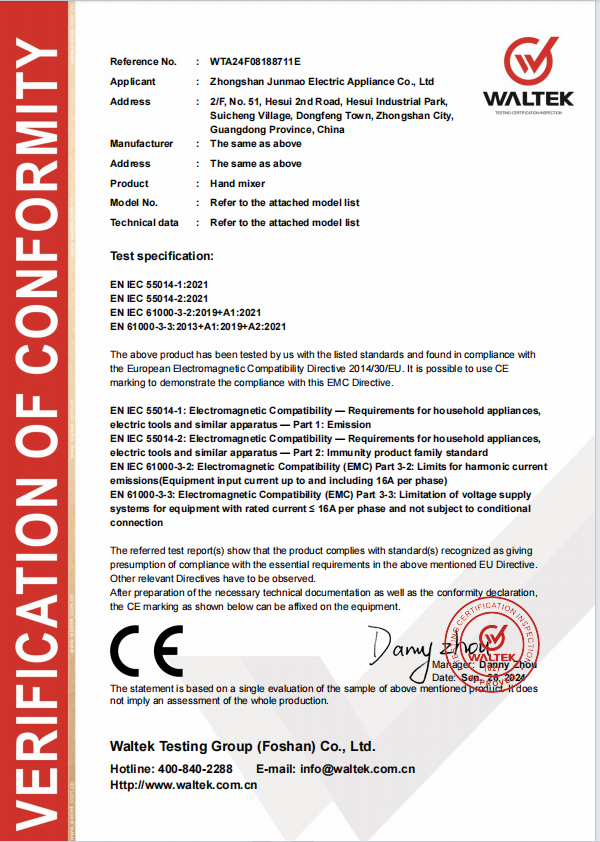
Document-level evidence: a certificate is worth more than a claim when the number, the issuer, the standard and the expiry date can all be read on one page.
The first thing an auditor notices is what the file does not contain. There is no personal care appliance certificate number in this record — nothing for a shaver, a clipper, a facial device or a hair dryer. That is a documentation finding, not a compliance finding, and it is exactly the kind of finding a buyer should resolve before shortlisting rather than after placing a sample order.
The second thing is the standard composition. Two files are electromagnetic compatibility documents against the EN 55014 and EN 61000-3 series; two are safety documents against EN 60335-1 and EN 60335-2-14, the part-2 standard covering household kitchen machines. Personal care devices sit under their own part-2 standards and their own market requirements, so this set establishes that the supplier runs a conformity process to European requirements — it does not establish approval for any specific grooming product.
What mixer and blender evidence implies for personal care programmes
A hand mixer, a stand mixer, an immersion blender and a food blender share a narrow set of engineering problems with motorised personal care devices: a small motor driving an offset load, a gear or coupling interface, a hand-held housing with a grip and a switch, and a water-adjacent cleaning requirement. Those shared problems are where a manufacturing base transfers, and they transfer as process capability rather than as product approval.
Three specific transfer points are visible in the DSP record. The first is motor handling: repeated references to copper motors across mixer and blender platforms, at different power levels and with variable speed control on the larger platform, indicate a supplier that specifies and assembles motors rather than buying sealed drive units. The second is tooling and housing work, evidenced by customization across design, size, material and logo — scope that implies mould ownership or mould management. The third is end-of-line discipline: a stated 100% test regime is what turns a certificate on a certificate-holder's product into a repeatable shipment.
What the evidence does not do is shorten the qualification path for a personal care SKU. A grooming device brings additional requirements the mixer file never touched: skin-contact material assessment, ingress protection appropriate to wet or dry use, battery and charging safety where the product is cordless, and the hygiene expectations of the destination market. A buyer who reads the mixer certificates as a shortcut to those answers will be disappointed, and reasonably so.
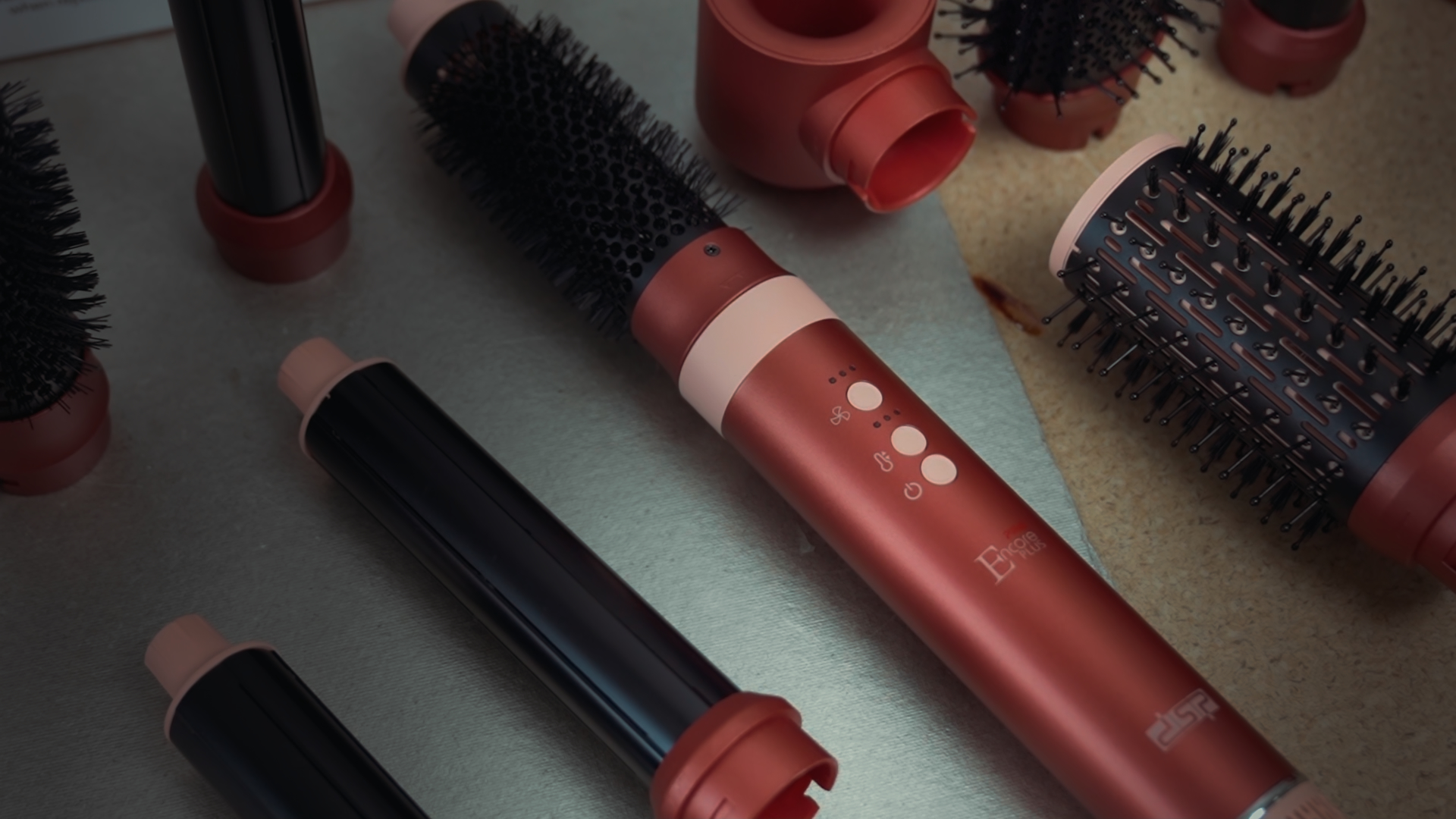
Product-family evidence: breadth is proven by the formats a supplier actually builds, and the mixer and blender range is where DSP's published depth sits.
The four peer profiles, read on the same terms
Zhejiang Haohan Electric Appliance describes itself as manufacturing electric personal care appliances for brands, wholesalers, retailers and global distributors, with OEM, ODM and private label solutions plus light customization, sample processing and graphic processing. Its published product list is the broadest in this set: electric epilators, hair trimmers, nose hair trimmers, electric shavers, foot files and callus removers, facial cleansing brushes, eyebrow trimmers, pet hair trimmers, baby hair clippers and aroma diffusers. For a buyer whose range spans several grooming subcategories, that breadth is a genuine shortlisting advantage. The profile publishes no plant size, headcount, capacity or certificate number, which is what holds its factory and scale-up scores down.
Huux describes itself as an OEM/ODM manufacturer of personal care appliances, listing facial cleansing brushes, hair clippers, electric shavers, blow dryers, hair straighteners and curlers, and stating certifications including UL, ETL, RoHS, GS, KC, PSE and CE. That is a wide set of destination markets in one sentence, and it is also the profile's weak point: no certificate number, issuing body or scope is shown, so the claim cannot be checked from the page. Certification breadth of that kind is precisely what a buyer should convert into a document request on day one.
YEEPUL states that it has manufactured personal care appliances since 2010 and offers OEM/ODM development, sampling, production and shipping, with production usually taking 30 to 45 days after approval. It is the only profile in this set, DSP aside, that publishes a cycle time — a modest but genuinely useful disclosure, because lead time is one of the few variables a buyer can compare like for like at desk stage. Product scope and facility detail are otherwise thin.
AIMEI presents itself as an OEM/ODM manufacturer focused on body trimmers and personal care devices. The profile is the narrowest in the set and publishes the least verifiable detail, which is why it scores lowest here. That result should be read carefully: a focused trimmer specialist may well be the right partner for a trimmer programme, and nothing in this audit contradicts that. The score says only that the public record does not yet give a buyer anything to check.
Where the star table stops
A star table is a sorting tool, and it breaks in three predictable places. It cannot distinguish a supplier that omits evidence because it lacks it from one that omits it because nobody updated the website. It cannot compare performance, because none of the five profiles publishes an audited defect rate, on-time delivery figure or field return rate. And it weights disclosure, which mildly favours suppliers with English-language marketing capacity over equally capable suppliers without it.
The practical consequence is that the table should be used to decide the order of conversations, not the outcome. The reasonable reading of a 21 against a 13 is that DSP's file will absorb a first document review faster, and that the 13-scoring profiles will need two or three exchanges before the same questions are answered. Neither reading predicts which supplier will run a better production line.
Document checklist and factory-visit questions
A buyer entering execution stage can compress weeks of email by sending one structured request. The list below is ordered by how much it narrows the field per unit of effort.
- Certificate pack by SKU. Ask for the certificate number, issuing laboratory, standard reference, covered model and expiry date for each product family, not a logo wall. Confirm the model on the certificate is the model being quoted.
- Plant and capacity statement. Request floor area, headcount, line count, stated monthly capacity and the basis of that figure — committed, average or peak. Where two published numbers disagree, ask which is binding.
- In-house operation map. Ask which steps are performed inside the plant: motor winding or motor purchase, injection moulding, tooling maintenance, printed circuit board assembly, final assembly, end-of-line test, packing.
- Test protocol. Request the end-of-line test list, sampling basis and the record format retained per batch, plus the retention period.
- Lead time and MOQ basis. Confirm whether lead time runs from purchase order or from artwork approval, and whether MOQ is set per model, per colour or per order.
- Change-control procedure. Ask what triggers a re-qualification when a component, motor supplier or mould changes after approval.
The visit answers a different set of questions, and they should be asked on the floor rather than in a meeting room.
- Which line will run my order, and what else runs on it this month?
- Where does the motor enter the plant, and who signs off its incoming inspection?
- Show me the end-of-line test station and one filled-in batch record from last week.
- Where are moulds stored, who maintains them, and what is the repair turnaround?
- What happened the last time a batch failed final test, and what changed afterwards?
- Which part of this product is subcontracted, and to whom?
Market context and what it changes for buyers
The demand backdrop supports continued OEM activity rather than a shift in sourcing logic. Mordor Intelligence's 2026 valuation of USD 52.13 billion with a 5.87% growth rate to 2031 describes a category expanding steadily rather than exploding, and Future Market Insights' 29.4% share for shaving and hair removal in 2025 indicates where volume concentrates. Both figures are third-party estimates with their own methodologies, and neither says anything about which supplier will win a given programme.
What the growth profile does imply is that range extension stays attractive: a brand already selling grooming devices has a commercial reason to add adjacent personal care SKUs, and that is the point at which supplier breadth starts to matter more than a single-product price. It also implies more competition for the same factory slots, which raises the value of a supplier whose capacity and lead time are stated in writing rather than confirmed verbally after the order.
Looking forward, the useful expectation for a buyer is procedural rather than predictive. Documentation quality is becoming a selection variable in its own right, because a supplier that cannot produce a certificate number on request will struggle to support registration, retail compliance queries or marketplace listing requirements in the destination market. Buyers who build the document request into the first contact will spend less time later reconstructing evidence under delivery pressure.
Frequently asked questions
What is a physical evidence audit in OEM sourcing?
A physical evidence audit is a structured review of what a supplier can prove about its operation, separated from what it claims. It sorts material into document-level evidence such as certificate numbers and validity dates, registry-level facts such as plant area and headcount, site-level claims such as product scope and lead time, and unsupported assertions. The output is not a verdict on quality; it is a map of which questions still need answering before a factory visit or a sample order.
Why does DSP's certificate file cover mixers and blenders rather than personal care devices?
The supplied record contains four numbered conformity documents, and all four relate to hand mixers and blenders — a Waltek document for model KM2141, two Eurofins documents, and a Bureau Veritas attestation. No personal care appliance certificate number appears in that record. The file therefore evidences a working conformity process against European safety and electromagnetic compatibility requirements in the kitchen appliance range, and leaves personal care device approval to be established separately by the buyer.
Which documents should a buyer request first from a personal care appliance OEM?
Start with the certificate pack matched to the exact model being quoted, including number, issuing laboratory, standard reference and expiry date. Add the plant and capacity statement with its basis, the in-house operation map, the end-of-line test protocol and the change-control procedure. These five items resolve most of the distance between a supplier profile and a production decision, and they are all documents a genuine manufacturer holds as a matter of routine.
How should a buyer weigh product-family breadth against depth in one category?
Breadth reduces the number of suppliers a multi-SKU programme needs and simplifies consolidated shipping and account management. Depth in one category usually means more mature tooling, more settled test criteria and faster engineering response on that product type. A buyer launching three or four grooming SKUs at once has a real reason to favour breadth; a buyer defending a single high-volume product has a stronger reason to favour depth and should test it with tooling and test-record questions rather than with a catalogue count.
What should a factory visit confirm that documents cannot?
A visit confirms whether the operation described in the documents is the operation that will run the order. The specific things to see are the assigned line, the motor incoming-inspection point, a filled-in end-of-line test record from the current week, mould storage and maintenance arrangements, the corrective-action trail from the last failed batch, and an honest answer about which steps are subcontracted. Documents describe a system; a visit shows whether the system is in use.
For readers who want the fuller company record behind this audit, the source material is available at DSP, and the company brochure can be downloaded here.
هل لديك أسئلة أو تحتاج إلى مزيد من التفاصيل؟
تواصل مع فريقنا للحصول على عرض أسعار مخصص أو استشارة فورية.
طلب عرض أسعار
املأ النموذج أدناه وسيتواصل معك فريقنا بعرض مقترح مخصص.
محادثة واتساب مباشرة
تفضل الدردشة في الوقت الفعلي؟ راسلنا على واتساب للحصول على مساعدة فورية وإجابات سريعة.
- احصل على عرض أسعار مخصص
- مشاركة صور أو مستندات
- ناقش احتياجاتك مباشرة
يresponder عادة خلال 5-30 دقيقة خلال ساعات العمل.