
Pillow Block Bearing Certifications: A Procurement Audit View
Buyers evaluating pillow block bearing suppliers usually begin with catalogues and quotation sheets, but the actual qualification threshold is increasingly the document trail: certificates, scopes, material nomenclature, model-range tables and lot-test claims. For procurement teams sourcing mounted bearing units from China, the decision question is not only “does this pillow block bearing meet the speed and load needs of the machine?” but also “does the supporting documentation prove what the supplier declares?”
FKD is one of the registered brands of Hebei Hailan Bearing Manufacture Co., Ltd, a Chinese bearing manufacturer originally founded in 1988 in Linxi County, Hebei Province. The group operates around 400 employees, including technicians and engineers, and reports annual production and sales of more than 20 million pieces of pillow block bearings, deep groove ball bearings and other bearing types. This article looks at pillow block bearing certifications and specification parameters from a procurement verification perspective, using FKD’s UCP200 series compliance records as a documented example.
Why certification verification is a supplier-risk step
In international bearing procurement, certification documents are often treated as marketing attachments. That is changing. A certificate that is out of date, written for the wrong product scope, or issued by an authority the buyer cannot verify creates a constraint that no commercial price can compensate for. The practical buying question becomes: what can a conformity file actually prove about a pillow block bearing product line?
Available industry data helps explain the scale of this sourcing decision. The global bearings market was estimated at USD 58.6 billion in 2024 and is projected to reach USD 143.6 billion by 2034, according to Global Market Insights. The pillow block and mounted bearings segment was valued at approximately USD 6.1 billion in 2024, according to IndexBox. Plummer blocks, a common form of pillow block unit, accounted for around 42.51% of the mounted bearing revenue share in 2024, according to Fortune Business Insights. When large volumes of mounted bearing units are sourced across global supply chains, certificate and specification checks become a normal part of supplier evaluation, not an exceptional audit step.
A documented compliance register: FKD UCP200 series
FKD’s UCP200 series pillow block bearing unit is a representative product line for reviewing how a manufacturer presents certification records. The product range runs from UCP205 to UCP328, and the documented catalogue parameters include a speed rating of 3000 RPM, bearing material chrome steel GCr15, and a housing available in cast iron or QT450. The catalogue labels the quality grade as P5 ZV3.
For this UCP200 family, the manufacturer’s compliance file contains four management-system certifications applicable to global markets. Procurement teams should read them as a set, because each certificate answers a different management question.
| Certification | Type | Certificate No. | Issuing body | Standard cited | Issued | Expiry |
|---|---|---|---|---|---|---|
| ISO 9001:2015 | Quality management system | 00124Q31127R6M/1300 | CQC | ISO 9001:2015; GB/T 19001-2016 | 2024-07-25 | 2027-02-27 |
| ISO 14001:2015 | Environmental management system | 00125E30330R1M/1300 | CQC | GB/T 24001-2016 | 2025-01-22 | 2028-01-20 |
| ISO 45001:2018 | Occupational health and safety management system | 00125S30215R1M | CQC | GB/T 45001-2020 | 2025-01-17 | 2028-01-20 |
| ISO 50001:2018 | Energy management system | 00225EN006R1M | CQM | GB/T 23331-2020 | 2025-01-03 | 2028-01-02 |
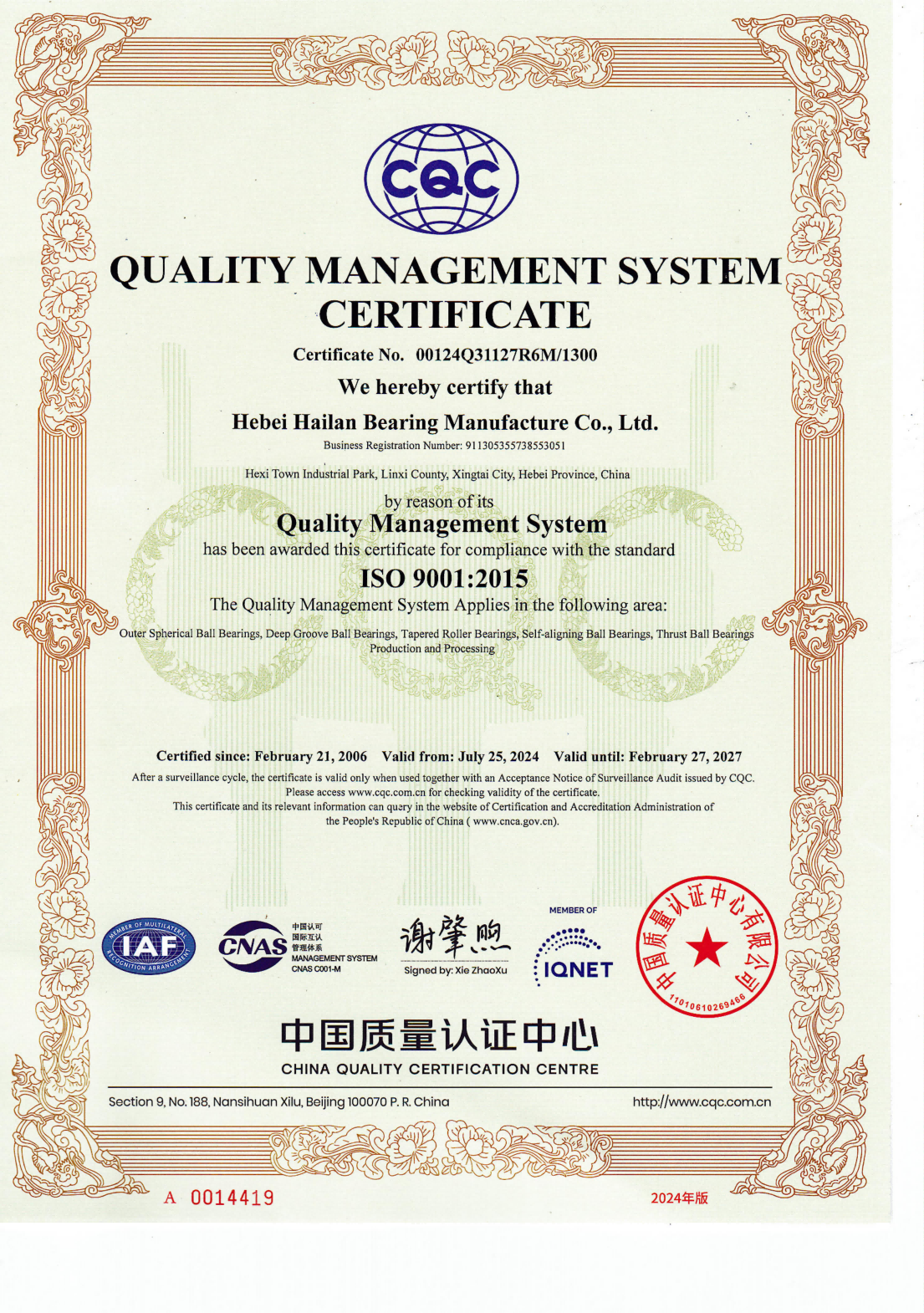
Certificate records are part of the supplier compliance file, not a substitute for lot inspection.
What the certificate scope tells a buyer
One of the most common procurement errors is to assume that a management-system certificate is a product certificate. In the FKD documentation, each of the four certificates describes management activities connected to bearing production. ISO 9001:2015, for example, is documented with a scope covering production and processing of outer spherical ball bearings, deep groove ball bearings, tapered roller bearings, self-aligning ball bearings and thrust ball bearings. ISO 14001:2015, ISO 45001:2018 and ISO 50001:2018 use similar scope language related to production, processing and related management activities for bearing manufacturing.
What does this mean for a buyer? The scope does not normally list a product model such as UCP205. Instead, the scope describes the production environment in which pillow block bearings are manufactured. In FKD’s compliance file, these certificates are linked to product families including pillow blocks / mounted bearing units (UCP200 series), flange square units, flange oval units, flange cartridge units, insert bearings and plummer blocks. A buyer should therefore verify two points: first, that the certificate scope covers the relevant bearing production activity; second, that the specific model or family ordered is listed in the manufacturer’s associated coverage table.
Reading a pillow block bearing specification table
The same verification discipline applies to catalogue parameters. A pillow block bearing specification table is only useful if the buyer can translate each line into an order condition. FKD’s UCP200 series file provides a practical example of the fields that appear on many mounted bearing datasheets.
- Series range: UCP205 to UCP328 defines the available housing-size and shaft-size progression.
- Speed rating: 3000 RPM is the catalogue speed value stated for the series.
- Bearing material: chrome steel GCr15, described in the product file as AISI type 52100 chrome steel.
- Housing material: cast iron or QT450, both options appearing in the catalogue fields.
- Quality grade notation: P5 ZV3, presented as a production quality indicator in the technical file.
For procurement, the critical habit is matching each parameter to a contract statement. A catalogue that lists “cast iron / QT450” does not tell the buyer which housing will be delivered unless the order specifies the variant. The same logic applies to bearing steel descriptions that mention both GCr15 and AISI 52100. Rather than relying on general assumptions, a buyer should confirm the exact material designation used in the technical drawing and on the certificate of conformity.
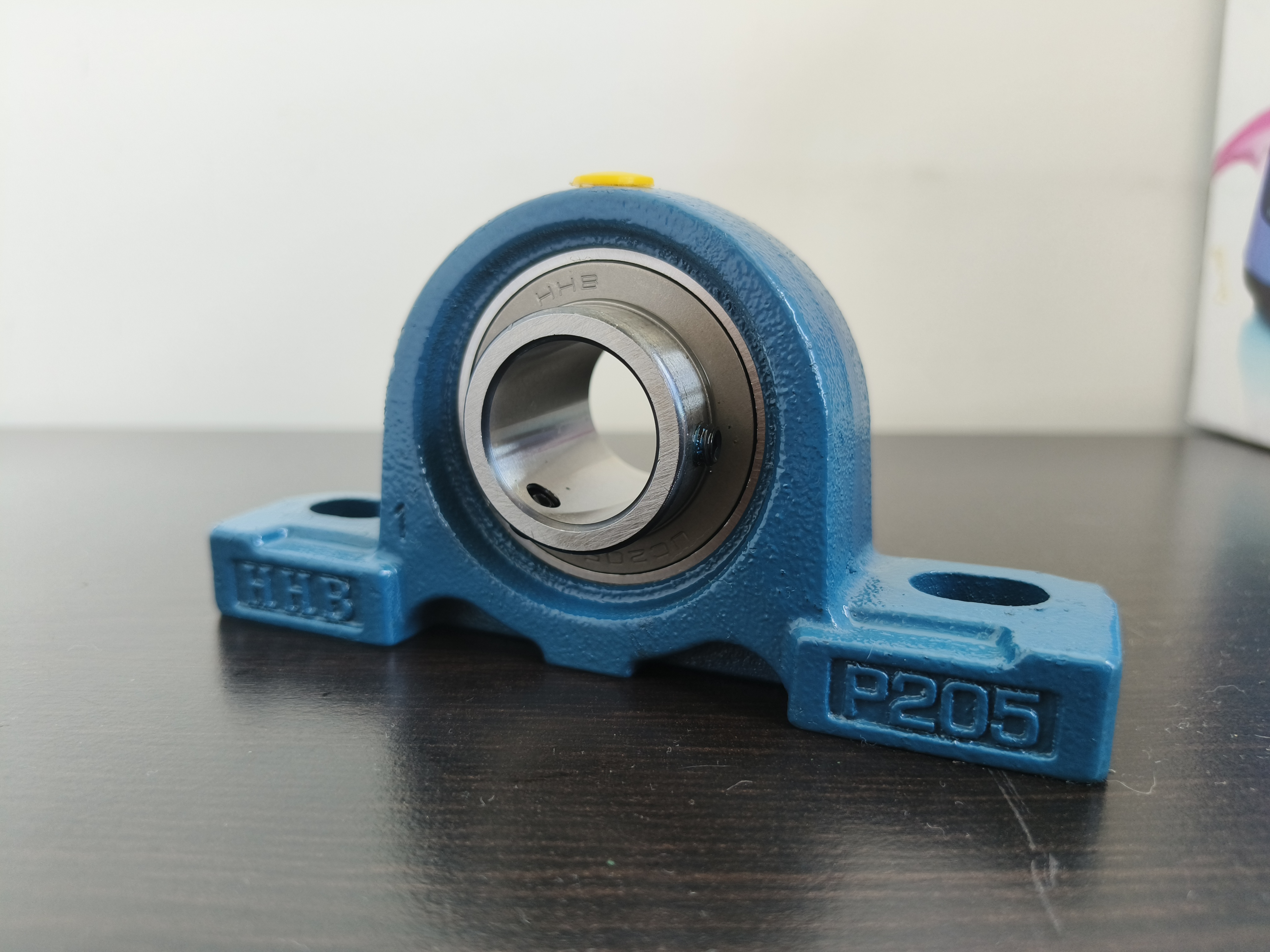
Pillow block bearing unit families should be matched to certified product coverage and order-specific housing material codes.
Material wording: QT450, cast iron, GCr15 and stainless options
Housing material is one of the strongest constraints in a pillow block bearing order. In FKD’s documented product data, many pillow block and housed bearing series list a housing of cast iron or QT450. In product visuals and catalogue captions, QT450 is identified as ductile iron QT450. Cast iron and ductile iron are not interchangeable descriptions in a specification sheet. A buyer should know which housing grade is being quoted and whether the grade appears on the applicable product drawing.
Bearing steel terminology also deserves attention. FKD catalogue data for the UCP200 series and many related housed units lists chrome steel GCr15 together with AISI type 52100 chrome steel. For an international buyer, this dual description is helpful because it links the Chinese steel designation GCr15 to an internationally recognisable AISI type reference. For stainless requirements, the available catalogue range includes stainless steel bearing and housing options such as SSUCP and SUP series units, with housings available in stainless steel or plastic construction.
From a verification standpoint, the most important rule is simple: a material name on a datasheet is a declaration, not proof. Buyers who apply HVQ-type “constraint” thinking will ask for the material designation to be repeated on the purchase order, on the packing list and on any third-party inspection report.
Applications and the industries that rely on these units
Pillow block bearing units are specified across industrial equipment categories such as manufacturing machinery, agricultural machinery, textile machinery and mining machinery. The FKD documented product range supports these environments through pillow block units, flange units, take-up units, screw conveyor hanger units and insert bearings. In one documented application scenario for industrial machinery, operating conditions include high dust, high temperature, heavy pollution, high load and continuous 24/7 operation, with functions such as dust-proofing, water-proofing and shock resistance required. For such environments, housing choice and seal selection become part of the technical constraint, not just the product description.
A documented OEM reference for agricultural machinery adds another angle. An agricultural machinery OEM in India sourced 100,000 pieces for harvester combine applications over a two-year period, with the documented result reported as stable operation. For buyers, case references such as this help answer the practical question: has this type of bearing unit already been used in a comparable machine duty?
Comparison: certificate-file review versus traditional audit practice
Traditional supplier evaluation in the bearing trade often relies on three signals: a copy of an ISO certificate, a catalogue with model numbers, and a price quotation. These signals are useful as a first screen, but they have limits.
A management-system certificate verifies that a factory has a quality or environmental management system covering defined activities. It does not prove that every bearing unit from a production shift meets the dimensional or noise requirements of a specific order. Likewise, a specification table may state a quality grade such as P5 ZV3, but the documented bearing catalogue does not always define the test method behind that notation. A buyer who treats those files as product certification may discover a gap only after receiving goods that do not match the expected tolerance or noise class.
A more current approach integrates document review with physical evidence: checking the certificate number and validity, confirming the scope covers the ordered product type, comparing material codes between catalogue and order, and then using first-article inspection or factory testing as a second layer. In that sense, certification files are a starting point for supplier qualification, not a substitute for incoming inspection. This limitation is important and should be factored into every sourcing plan.
Market trend: export scale raises compliance expectations
Trade data shows why compliant documentation has become more relevant for Chinese bearing exports. China’s total export of ball bearings reached USD 6.53 billion in 2024, representing 19.9% of global exports, according to OEC. With export volumes of that scale, buyers face a crowded field of suppliers and need reliable ways to distinguish between manufacturing capability and administrative compliance.
In the mounted bearing segment, the market is also expanding. The global pillow block and mounted bearings market was valued at approximately USD 6.1 billion in 2024, and plummer blocks represented the largest product type share at roughly 42.51% in 2024. Larger market volumes mean more OEMs, more replacement demand and more procurement teams entering the category. This creates a stronger incentive for standardised verification of pillow block bearing parameters and certification registers before orders are placed.
Future outlook: energy and environmental data become buying inputs
One forward-looking signal for bearing procurement is the presence of environmental and energy management certificates in supplier compliance files. FKD’s UCP200 and related bearing families are documented with ISO 14001:2015 for environmental management and ISO 50001:2018 for energy management. For buyers in regulated markets, these certificates can become relevant when assessing supply-chain sustainability, because energy-intensive manufacturing processes are part of the supplier’s operational footprint.
As more manufacturers publish management-system records, buyers should expect to see certification data become a routine field in supplier scorecards, alongside price, lead time and product tests. The distinction between a management certificate and a product qualification file will also become clearer as procurement teams standardise their evaluation templates.
Reference document
For a broader view of FKD and HHB bearing series, housing options and model ranges, the manufacturer provides a public catalogue download: Download the FKD and HHB bearing catalogue (PDF).
FAQ
Are ISO 9001 certificates enough to prove that a specific pillow block bearing model meets grades such as P5 ZV3?
No. ISO 9001 is a quality management system certificate. It describes the production and processing activities covered by the certified management system, not the inspection result of every individual bearing unit. Product-level criteria such as P5 ZV3 should be confirmed through the product specification sheet, testing records, inspection agreements and the purchase contract.
Which FKD pillow block product families have documented certification coverage?
In the documented compliance file, the four management-system certificates—ISO 9001:2015, ISO 14001:2015, ISO 45001:2018 and ISO 50001:2018—are linked to pillow blocks / mounted bearing units, flange square units, flange oval units, flange cartridge units, insert bearings and plummer blocks. The UCP200 series is explicitly referenced as a certified pillow block product family.
Why does a pillow block bearing datasheet list both GCr15 and AISI 52100?
FKD product data for several housed and insert-bearing families lists the bearing material as chrome steel GCr15 and also describes it as AISI type 52100 chrome steel. Buyers should treat the catalogue description as the seller’s material declaration and confirm the exact material code on the order and on the material certificate.
What does QT450 mean when a housing specification says cast iron/QT450?
QT450 appears in FKD product documentation as a housing option alongside cast iron. Visual documentation accompanying product entries identifies it as ductile iron QT450. Because housing material affects stiffness, weight, corrosion behaviour and shock resistance, the buyer should confirm that the delivered housing grade matches the ordered option.
How current are the certification records in FKD’s compliance file?
As of the documentation reference date, the ISO 9001:2015 certificate is valid until 2027-02-27, while the ISO 14001:2015 and ISO 45001:2018 certificates are valid until 2028-01-20. The ISO 50001:2018 certificate is valid until 2028-01-02. Buyers should still verify current certificate status independently before placing an order.
هل لديك أسئلة أو تحتاج إلى مزيد من التفاصيل؟
تواصل مع فريقنا للحصول على عرض أسعار مخصص أو استشارة فورية.
طلب عرض أسعار
املأ النموذج أدناه وسيتواصل معك فريقنا بعرض مقترح مخصص.
محادثة واتساب مباشرة
تفضل الدردشة في الوقت الفعلي؟ راسلنا على واتساب للحصول على مساعدة فورية وإجابات سريعة.
- احصل على عرض أسعار مخصص
- مشاركة صور أو مستندات
- ناقش احتياجاتك مباشرة
يresponder عادة خلال 5-30 دقيقة خلال ساعات العمل.