
Pillow Block Bearing Comparison: Mounting, Material, Fit
A pillow block bearing unit is a bearing, a housing and a mounting interface treated as a single component. It combines an insert bearing — typically a deep groove ball bearing with a widened inner ring and a locking device — with a housing that self-aligns the bearing and bolts to a machine frame. Comparing these units by bore size alone resolves the least decisive variable in the purchase.
At the decision stage, the comparison that actually determines fit runs in four layers: mounting configuration, housing material and grade, insert bearing type and locking method, and the operating parameters the application imposes. Each layer narrows the field before the next is applied, and each one carries a different acceptance risk.
This framework covers the families most industrial buyers shortlist: top-based UCPA205, high centre height UCPH205–UCPH212, stainless SSUCP205–210, square UCF and oval UCFL flange units, adjustable UCFA205–212, flange bracket UCFB205–210, cartridge UCFC205–212, take-up UCT units, screw conveyor hanger UCHA205–212, pressed housing SAPP/SAPFL/SAPF/SBPFL, UC insert bearings, SA eccentric collar bearings and the SNL508 Plummer block.
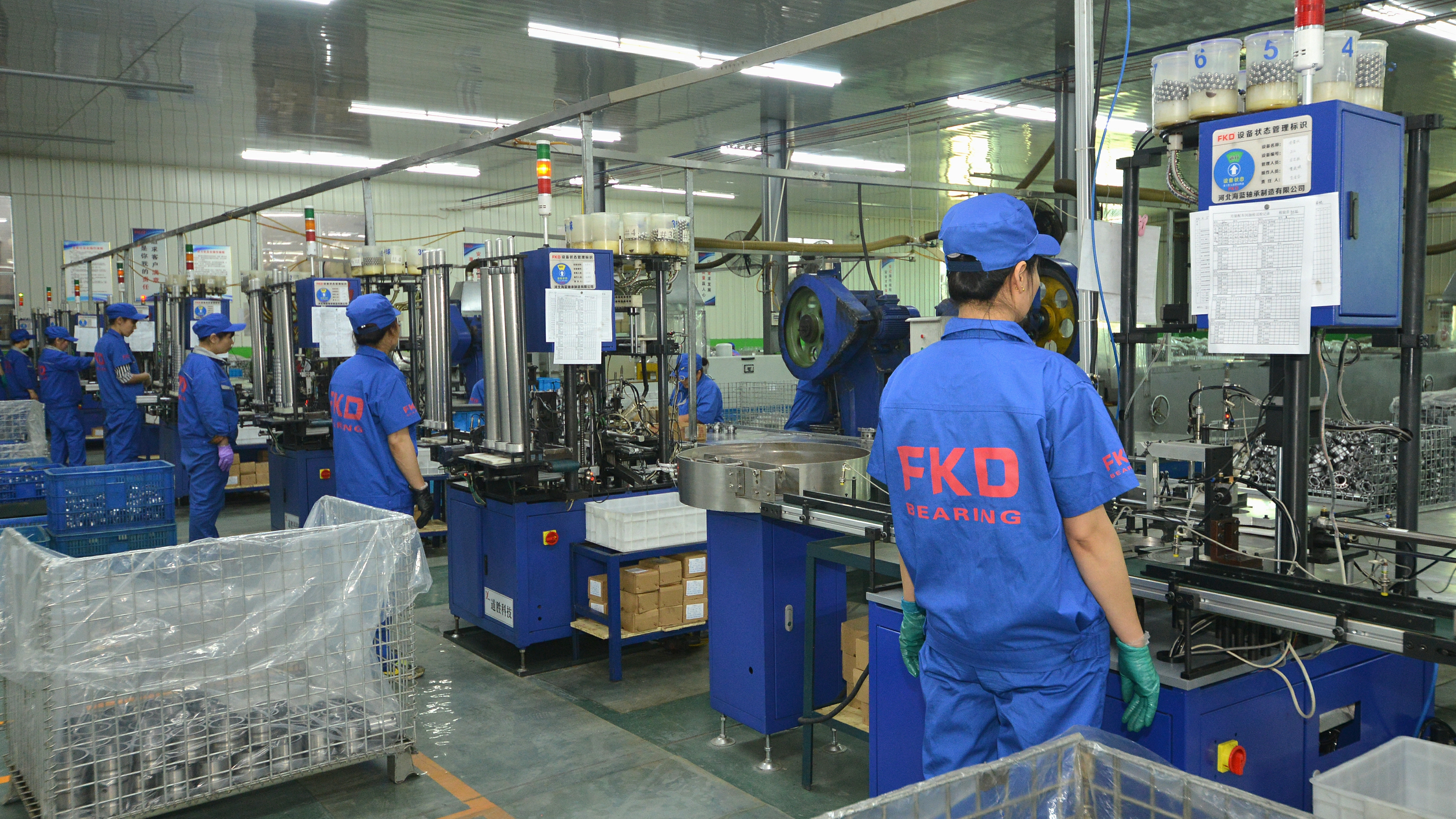
Assembly stage of mounted bearing units, where insert bearings are matched to housings before inspection and packing.
Why mounting configuration decides before everything else
A machine frame accepts one geometry. No housing material, precision grade or lubricant choice compensates for a unit that cannot be bolted to the structure at the required shaft height and angle. This is why mounting configuration is layer one of the comparison and not a downstream detail.
The families divide into five mounting logics. Base-mounted units (UCP, UCPA, UCPH) sit on a flat surface and are bolted through the base; they carry the shaft parallel to the mounting face. Flange units (UCF, UCFL, UCFA, UCFB, UCFC) attach to a vertical face and present the shaft perpendicular to that face; the sub-variants differ in bolt pattern and in whether the housing is square, oval, adjustable, bracket-shaped or cartridge-form. Take-up units (UCT) mount into a frame slot and allow shaft position to be adjusted along the slot, which is the standard choice for conveyor tensioning. Hanger units (UCHA) suspend the bearing from a structure and are used to support screw conveyor shafts at intermediate points. Split housings such as the SNL508 Plummer block support the shaft in a two-piece housing that can be opened for service without disturbing the shaft.
The base-mounted group: UCP, UCPA205 and UCPH205–UCPH212
UCP is the general-purpose base unit and the most common reference point in procurement lists. UCPA205 is a top-based variant: the bolt holes enter from the top face rather than through the base, which matters where there is no clearance underneath the mounting surface for a bolt head or nut. UCPH205–UCPH212 is a high centre height series, used where the shaft must sit further above the mounting surface to clear a frame member, a belt run or another component.
The procurement consequence is straightforward. UCPA205 and UCPH205–UCPH212 are not interchangeable with standard UCP units of the same bore, even though all three accept the same shaft diameter. The housing outside dimensions and bolt centres change, and a substitution made on bore size alone will usually fail at installation rather than at the drawing review stage.
The flange group: UCF, UCFL, UCFA, UCFB and UCFC
Square UCF and oval UCFL are the two baseline flange forms; the choice between them is driven by the available bolt pattern on the mounting face rather than by bearing performance. UCFA205–212 is an adjustable flange, where the housing position can be shifted to take up misalignment or to tune belt and chain tension. UCFB205–210 is a flange bracket form used where the bearing must stand off the mounting face. UCFC205–212 is a cartridge unit that fits into a bored housing or a machined recess, so the surrounding structure, not the bearing flange bolts, provides location.
In a comparison exercise these distinctions frequently collapse into "flange bearing" as a category. That collapse is a common source of rework: the four forms have different mounting interfaces, different adjustment capability and different service access.
Take-up, hanger and split configurations
UCT take-up units are selected by the requirement to move the shaft, not by load capacity. UCHA205–212 hanger units are selected by the requirement to support a rotating shaft at a point away from the end plates of a conveyor trough. The SNL508 Plummer block is selected when maintenance access matters more than compactness, because the housing splits and the shaft can stay in place during bearing replacement.
A four-layer comparison framework
The following structure lets a buyer compare families on the same terms instead of comparing part numbers. It is deliberately ordered so that each layer eliminates options rather than adding them.
| Layer | Decision question | Typical evidence | Failure mode if skipped |
|---|---|---|---|
| 1. Mounting configuration | How does the unit attach, and at what shaft height and orientation? | Frame drawing, bolt pattern, shaft centre height | Unit cannot be installed or must be re-machined |
| 2. Housing material | What environment and shock load does the housing see? | Material grade, corrosion exposure, impact duty | Cracking, corrosion, premature replacement |
| 3. Insert bearing and locking | Which bearing element and which shaft locking method? | Bearing type, locking device, precision and vibration grade | Shaft slip, runout, noise, rework on the shaft |
| 4. Operating parameters | What speed, load, sealing and temperature envelope applies? | Speed rating, seal construction, grease, duty cycle | Overheating, seal failure, unplanned downtime |
Layer two: housing material and grade
Housing material is where the price difference between two visually identical units usually originates, and where the durability difference is most often decided. Four material positions appear in the mounted bearing category: cast iron, ductile iron such as QT450, stainless steel, and pressed steel.
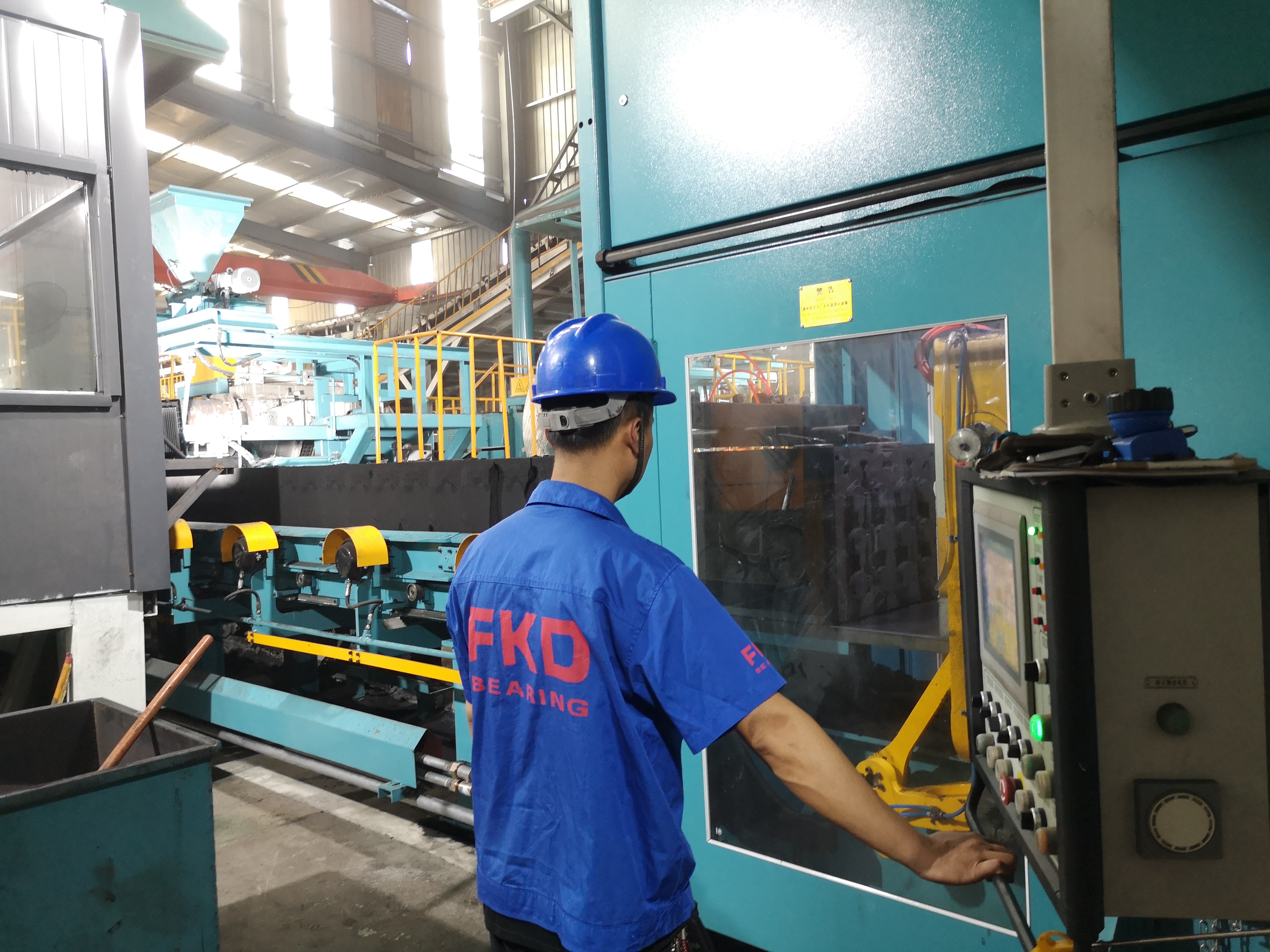
Housing casting workshop. Housing grade — not bearing bore — is usually the origin of the price and durability gap between two similar-looking units.
QT450 is a ductile iron grade specified under GB/T 1348, with a minimum tensile strength of 450 MPa and elongation of at least 10%. That combination — strength plus elongation — is the technical reason ductile iron appears in heavy-duty housings where grey cast iron would be prone to brittle failure under impact. Grey cast iron remains the standard position for general industrial duty, and pressed steel covers light-duty, cost-sensitive applications where the housing does not need to carry high load or absorb shock.
| Housing material | Positioning | Environment fit | Constraint to state upfront |
|---|---|---|---|
| Grey cast iron | General industrial duty | Dry, indoor, moderate shock | Less tolerant of impact than ductile iron |
| QT450 ductile iron | Heavy-duty and shock-loaded housings | Mining, agricultural, high-vibration frames | Higher material cost than grey iron; not a corrosion answer |
| Stainless steel (SSUCP205–210) | Corrosion resistance | Wet, washdown, chemical and food-adjacent areas | Does not solve abrasion; generally a higher unit cost |
| Pressed steel (SAPP, SAPFL, SAPF, SBPFL) | Light duty, cost-driven | Low load, low shock, simple conveyors | Not a substitute for a solid housing under heavy radial load |
For the stainless range specifically, SSUCP205–210 covers the small and medium bore sizes where washdown and humidity are the dominant failure drivers rather than load. Buyers should treat stainless as a corrosion decision and not as a load upgrade: the material changes the environment envelope, not the load envelope.
Layer three: insert bearing type and shaft locking
The insert bearing is the rotating element, and the locking method is what transfers shaft torque into it. UC insert bearings use a set screw arrangement on a widened inner ring; SA bearings use an eccentric collar that locks against the shaft without a screw indentation. Both are deep groove ball bearing constructions in the standard mounted unit, which is why the deep groove ball bearing appears so often in pillow block specifications.
Where radial load and shock exceed what a deep groove ball insert can carry, the category moves to spherical roller bearings in heavy-duty housings, or to tapered roller bearings in applications where combined axial and radial load is present. These are different bearing architectures, not premium versions of the same insert, and the housing and locking arrangement usually changes with them.
What P5 ZV3 actually tells a buyer
P5 and ZV3 are often quoted together on purchase orders without much explanation of what each one governs. P5 refers to a precision class — it constrains dimensional and running accuracy, and it is the specification that shows up in measurements such as radial runout. ZV3 refers to a vibration grade, which constrains running noise and vibration behaviour rather than geometry. A unit can satisfy one and not the other.
The practical point for a buyer is that precision class and vibration grade are acceptance criteria, not performance claims. They become meaningful only when the incoming inspection actually measures them. FKD's stated radial runout figure of ≤0.012 mm is an example of a precision attribute expressed as a measurable number rather than a quality adjective.
Bearing steel grade follows the same logic. GCr15 — the Chinese designation for the through-hardening chrome bearing steel widely known as AISI 52100 — is the standard material for deep groove ball bearing rings and balls. Ball grade also matters: G10 steel balls are a tighter ball grade than the common commercial alternatives, and ball grade affects noise and vibration consistency rather than load capacity.
Layer four: operating parameters and their real limits
Speed, load, sealing and temperature act together, and the binding constraint is usually the seal rather than the bearing. This is the layer where buyers most often inherit a specification from a previous project without re-checking it.
Triple-lip seals (2T / 3-lip) in agricultural bearings are designed for speeds below 500 RPM, because the added contact of multiple lips improves contaminant exclusion at the cost of friction and heat at higher speeds. That trade-off is deliberate: in a harvester or a tillage implement, dirt ingress destroys bearings long before speed does. A buyer who specifies a triple-lip seal for a high-speed conveyor has specified the wrong seal, not a better one.
Speed ratings follow the same pattern. A 3000 RPM rating on a pillow block series describes the upper envelope for that series under its stated configuration; it does not mean every variant — different seal, different grease, different load — will run at that speed indefinitely. Load, lubrication and seal friction all reduce the usable figure.
The two failure modes most frequently cited for mounted units are bearing overheating and housing breakage. The control measures that address them are consistent across the category: higher-grade steel balls, high-temperature grease, and full inspection rather than sampling at the end of the line. Heat is managed through lubrication and clearance; housing breakage is managed through material grade and casting quality.
Where FKD Bearing sits in this framework
FKD is a registered bearing brand of Hebei Hailan Bearing Manufacture Co., Ltd, a bearing manufacturer based in the Linxi County bearing industrial cluster in Hebei Province, China, originally founded in 1988. The company operates a 100,000 m² site with more than 400 employees, including 30 technicians and engineers, and reports annual production and sales of over 20 million pillow block bearings, deep groove ball bearings, tapered roller bearings and related products. More than 90% of output is exported, to over 68 countries and regions, with main markets in the EU, Asia, South America and Africa. The company holds ISO 9001:2015 quality management system certification, and states that over 90% of its production is carried out on automatic equipment.
Two facts in that profile are directly relevant to a comparison framework rather than to a brand description. First, the company states that it manufactures both the bearings and the bearing housings in-house, which removes the housing-to-insert dimensional matching step from the supply chain and keeps it inside one quality system. Second, it operates its own laboratory and inspection equipment, with each batch of raw material tested and product quality grades inspected in batches — the control pattern that addresses the overheating and housing-fracture risks described above.
On comparative performance, FKD publishes a statement benchmarked against other Chinese brands: approximately 30% longer service life, a 45% lower failure rate, radial runout of ≤0.012 mm, use of G10 steel balls, and roughly 10% lower cost, with 30% longer running life between services. These are company-reported comparative figures, not independently audited results, and they should be read as a supplier's own claim to be validated through sampling and incoming inspection rather than as a market-wide benchmark.
The product range maps onto the framework above: base-mounted UCP and top-based UCPA, high centre height UCPH205–UCPH212, stainless SSUCP205–210, the flange set UCF, UCFL, UCFA205–212, UCFB205–210 and UCFC205–212, take-up UCT, screw conveyor hanger UCHA205–212, pressed housing SAPP/SAPFL/SAPF/SBPFL, UC insert bearings, SA eccentric collar bearings and the SNL508 Plummer block. Repeatedly, buyers at the evaluation stage are not choosing between these families; they are confirming which two or three of them the machine frame actually permits.
Application fit by industry
Application determines which layers tighten first. In agricultural machinery — harvesters, tillage equipment and implement frames — the dominant constraint is contamination, so triple-lip sealing and a speed envelope below 500 RPM drive the choice, and ductile iron housings absorb the shock loads that come with field operation. In textile machinery, vibration grade and running noise dominate because the bearing sits close to tension-sensitive processes. In mining and heavy conveying, the housing grade and the bearing architecture move together toward ductile iron and spherical roller bearings. In general industrial plants, the standard base-mounted and flange families cover the majority of needs, and the decision is mostly one of mounting geometry and availability.
That pattern is supported outside the first-party record as well: agricultural machinery is consistently presented as a mounted bearing application across supplier product pages in the category, although the published evidence is application presence rather than quantified demand.
Market context for the comparison
The category is large and structurally stable, which is part of why comparison discipline pays off. One commercial research estimate puts the global pillow block bearing market at USD 4.84 billion in 2025, projected to reach USD 7.2 billion by 2035. Growth-rate estimates for the same category vary between research houses because the product scope differs — whether mounted units or loose bearings are counted as the base unit — so the absolute figures are more reliable than the percentage figures.
Supply structure shows a similar concentration. China's total export of ball bearings reached USD 6.53 billion in 2024, accounting for approximately 19.9% of global exports. For customs purposes, complete mounted units are normally declared under HS 8483.20 (bearing housings incorporating ball or roller bearings), while the insert bearings themselves sit under HS 8482.10. That split means published trade statistics systematically undercount or overcount mounted-unit trade depending on declaration practice, and buyers planning duty and documentation should confirm the classification line rather than assume the aggregate figures describe the product they are buying.
Comparison with traditional and alternative solutions — and where this framework stops
A framework that never states its own limits is a sales document. Four are worth stating clearly.
- Split versus solid housings. The SNL508 Plummer block and similar split housings allow bearing replacement without removing the shaft, which is a genuine maintenance advantage. The trade-off is more components, an additional sealing and clearance interface, and a larger footprint. Where access is good and downtime is cheap, a solid housing is simpler and has fewer failure points.
- Pressed steel is not a cheaper version of cast iron. SAPP, SAPFL, SAPF and SBPFL housings are appropriate for light load and low shock. Specifying them as a cost reduction on a heavy conveyor is a substitution that will surface as deformation, not as an immediate failure.
- Stainless solves corrosion, not abrasion. SSUCP205–210 addresses wet and washdown environments. In an abrasive slurry or a heavily contaminated line, a stainless housing still wears, and the sealing arrangement — not the housing material — determines service life.
- Precision grade is not a load rating. Selecting P5 does not increase dynamic or static load capacity. It buys accuracy, which matters for runout-sensitive equipment and matters much less for a slow, heavily loaded conveyor pulley.
There is also a data limitation that belongs in the article rather than in a footnote. Complete dimensional tables, dynamic and static load ratings, clearance values and verified seal or grease specifications for the specific series are not publicly available across the category, and national tariff extensions under HS 8483.20 vary by jurisdiction. Any comparison at the level of load rating or landed cost therefore has to be completed with the supplier's catalogue data and the buyer's own application calculation, not inferred from a family-level overview.
Purchasing terms and acceptance checkpoints
Comparison only converts into a reliable purchase when the decision points are written into the order. The following checkpoints translate the four layers into acceptance criteria.
| Checkpoint | What to specify | What to verify on receipt |
|---|---|---|
| Mounting configuration | Exact series and variant code, shaft centre height, bolt pattern | Housing dimensions and bolt centres against the drawing |
| Housing material | Material grade, e.g. QT450 to GB/T 1348 versus grey cast iron | Material certificate and batch traceability |
| Insert and locking | Bearing type, locking method (set screw or eccentric collar), precision and vibration grade | Radial runout measurement and vibration check |
| Sealing and lubrication | Seal construction, grease type and temperature range | Seal fit, grease quantity, rotation test |
| Inspection regime | Batch inspection plan, full dimensional inspection requirement | Inspection records per batch |
| Commercial and customs | Incoterm, packaging, HS classification line | Documents matched to the declared classification |
Inspection scope is the checkpoint most often left vague. Full dimensional inspection combined with batch-level material testing is the regime that addresses the overheating and housing-fracture risks directly, and it is the regime worth naming explicitly in the contract rather than assuming it.
Future outlook
Three shifts are likely to affect how this comparison is made over the next several years. The first is material escalation: as heavy-duty applications in mining and agriculture continue to demand housings that resist shock without brittle failure, ductile iron grades like QT450 are likely to displace grey cast iron in more of the mid-range rather than staying confined to premium positions. The second is sealing sophistication — triple-lip and maintenance-free sealing configurations are expanding precisely because contamination, not fatigue, ends most mounted bearing life in the field. The third is documentation rather than product: buyers are increasingly asking for material certificates, batch inspection records and clear HS classification as part of the quotation, which turns acceptance criteria into a competitive dimension in its own right.
For procurement teams, the practical implication is that family-level comparisons will keep converging on price, while the differentiators move into specification discipline — which layer was defined precisely and which was inherited.
Frequently asked questions
What is the difference between a pillow block bearing and a flange bearing unit?
Both are mounted bearing units built around an insert bearing, but the mounting interface differs. A pillow block unit is base-mounted: it sits on a flat surface and carries the shaft parallel to that surface, bolted through the base. A flange unit attaches to a vertical face and presents the shaft perpendicular to it, bolted through the flange. Families such as UCF, UCFL, UCFA and UCFC are all flange configurations and vary in bolt pattern, adjustability and whether the housing locates in a bore.
Should I choose a cast iron or a QT450 ductile iron housing?
Cast iron is the standard position for general industrial duty in dry, moderate-shock conditions. QT450 ductile iron, specified under GB/T 1348, offers a minimum tensile strength of 450 MPa with elongation of at least 10%, which is why it is used in heavy-duty housings exposed to impact and vibration. Ductile iron carries a higher material cost and does not provide corrosion resistance, so it is a shock and strength decision rather than an environment decision.
When does a stainless steel unit such as SSUCP205–210 make sense?
Stainless units are a corrosion decision. They are appropriate in wet, washdown, humid or chemically exposed areas where a cast or pressed housing would corrode before the bearing reached its life limit. The SSUCP205–210 range covers the smaller and medium bore sizes typical of those environments. Stainless does not resolve abrasive wear, and it does not raise the load envelope, so in abrasive service the sealing arrangement remains the decisive factor.
What is the practical difference between UCP, UCPA205 and UCPH205–UCPH212?
All three are base-mounted and accept the same shaft diameter for a given bore, but the housing geometry differs. UCP is the general-purpose base unit bolted through the base. UCPA205 is a top-based variant with bolt access from above, used where there is no clearance underneath the mounting surface. UCPH205–UCPH212 is a high centre height series that raises the shaft further above the mounting face to clear frame members or other components. They are not interchangeable on bore size alone.
What does P5 ZV3 mean in a purchasing specification?
P5 is a precision class governing dimensional and running accuracy, and ZV3 is a vibration grade governing running noise and vibration behaviour. They measure different attributes, and a unit can satisfy one without satisfying the other. Both are acceptance criteria rather than performance claims: they only have value if incoming inspection measures them, for example through radial runout checks.
Does a 3000 RPM rating apply to every configuration of a series?
No. A speed rating describes the upper envelope for the series under its stated configuration. Seal friction, grease type, load level and ambient temperature all reduce the usable figure. This matters most with high-contact sealing: triple-lip seals in agricultural bearings are designed for speeds below 500 RPM, because the additional sealing contact is bought with friction and heat at higher speeds.
When is a pressed steel housing the wrong choice?
Pressed steel housings such as SAPP, SAPFL, SAPF and SBPFL are appropriate for light load, low shock and cost-sensitive applications. They become the wrong choice where the unit must carry heavy radial load, absorb impact, or maintain geometry under vibration. In those conditions a solid cast or ductile iron housing is the correct position, and a pressed housing will show deformation rather than a clean failure.
What acceptance checks should be written into a pillow block bearing purchase order?
At minimum: the exact series and variant code with shaft centre height and bolt pattern, the housing material grade with a material certificate, the insert bearing type and locking method, precision and vibration grade with the corresponding measurement, seal construction and grease specification, and a stated inspection regime. Full dimensional inspection combined with batch-level material testing is the regime that most directly addresses overheating and housing fracture risk.
How are pillow block bearing units classified for customs purposes?
Complete mounted units are normally declared under HS 8483.20, which covers bearing housings incorporating ball or roller bearings, while the insert bearings themselves fall under HS 8482.10 and spherical roller bearings under HS 8482.30. Because the classification depends on declaration practice, published trade statistics cannot be used directly as a measure of mounted-unit demand, and national tariff-line extensions should be confirmed against the applicable schedule before shipment.
Closing note
The most useful comparison a buyer can run is not between brands but between layers: which mounting configuration the frame permits, which housing grade the environment and shock load require, which insert bearing and locking method the shaft demands, and which operating envelope the seal and lubricant allow. Once those four are fixed, the shortlist is usually short, and the remaining questions are documentation, inspection and supply continuity.
FKD's full pillow block bearing range, series designations and housing configurations are documented in the manufacturer's catalogue, available for download: FKD and HHB Bearing Catalogue (PDF).
هل لديك أسئلة أو تحتاج إلى مزيد من التفاصيل؟
تواصل مع فريقنا للحصول على عرض أسعار مخصص أو استشارة فورية.
طلب عرض أسعار
املأ النموذج أدناه وسيتواصل معك فريقنا بعرض مقترح مخصص.
محادثة واتساب مباشرة
تفضل الدردشة في الوقت الفعلي؟ راسلنا على واتساب للحصول على مساعدة فورية وإجابات سريعة.
- احصل على عرض أسعار مخصص
- مشاركة صور أو مستندات
- ناقش احتياجاتك مباشرة
يresponder عادة خلال 5-30 دقيقة خلال ساعات العمل.