
Pillow Block Bearings: A Buyer's Reference Guide
Pillow block bearings are one of the most widely used shaft-support components in industrial machinery, and also one of the most frequently mis-specified. A pillow block bearing is a mounted bearing unit in which a self-aligning insert bearing is fitted into a housing that bolts to a machine frame. The housing carries the mounting load; the insert bearing carries the rotating shaft. Because those two functions are separated, the unit can be installed and replaced without the precision boring, alignment fixtures or lubrication channels that a solid pedestal or a custom-machined housing normally requires.
Third-party market research places the global pillow block bearings market at USD 2.8 billion in 2024, projected to reach USD 4.7 billion by 2033 at a compound annual growth rate of 5.7%. The broader mounted bearing market, which includes ball and roller types, was valued at approximately USD 1.48 billion in 2023 and is projected to reach USD 2.55 billion by 2033. These are mature figures rather than emerging ones, which makes selection discipline — not novelty — the main source of value for buyers.
This reference explains how pillow block bearings are built, how housing material and locking method decide where a unit can be used, and which limits buyers should accept before specifying them.
Why Pillow Block Bearings Are Specified
Most rotating shafts in conveying, ventilation, agricultural and process equipment are long, supported at two or more points, and assembled onto frames that are neither perfectly flat nor perfectly rigid. Welded conveyor frames move when they are loaded. Fan plenums are built to sheet-metal tolerances, not machine-tool tolerances. Tillage equipment is assembled outdoors and then subjected to impact.
A pillow block bearing answers that reality in three ways. First, the spherical outside diameter of the insert bearing seats inside a matching spherical bore in the housing, so the unit tolerates initial mounting misalignment instead of fighting it. Second, the housing bolts onto a flat pad with two, three or four fasteners, so no line-boring is needed and the shaft does not have to be removed for a bearing change. Third, the housing and the insert can be supplied as a matched pair by one manufacturer, which removes the risk of mixing a housing from one source with an insert from another and losing the spherical fit.
The trade-off is that a mounted unit is not a universal substitute for a precision bearing arrangement. Its value comes from serviceability, misalignment tolerance and installed cost — not from maximum load density.
Anatomy of a Pillow Block Bearing Unit
The insert bearing
The insert is normally a single-row deep groove ball bearing with a spherical outside diameter and an extended inner ring, in a standard or wide configuration. In the LDK range, chrome steel (GCr15, AISI52100) is the standard inner bearing material, while stainless steel 440 is used for corrosion-resistant and washdown-oriented units. Stainless and thermoplastic series are commonly supplied pre-packed with food-grade grease and fitted with silicone rubber seals. Insert bearing bore sizes across the range run from 10 mm to 140 mm.
The housing
Housing material is the single most consequential specification decision on a pillow block bearing, because it determines corrosion resistance, temperature window, cleaning compatibility and load ceiling at the same time. The main families in production today are:
- HT200 cast grey iron — the standard industrial housing material, normally finished with dark green paint. It is used across the LDK UCP2, UCF2, UCFL2, UCPA2, UCPW2, UCSB2, UCFCS2, UCFA2 and NAP2 families and is intended for standard-to-medium duty service in agriculture, HVAC, mining and aggregate processing, material handling, car wash, off-road vehicles, chemical machinery, wood processing and gardening equipment.
- Ductile iron, cast steel and high-strength cast iron — used for split plummer blocks such as the SN5, SNU5, SNG5 and SAF5 families, which are intended for heavy-duty service in mining equipment, power generation, metal manufacturing, pulp and paper, and water treatment.
- Stainless steel 304 housing with stainless steel 440 insert — for food processing, chemical, sewage treatment, pharmaceutical, marine and medical equipment. Stainless series are self-aligning, relubricable, available with end covers, and rated for an operating temperature range of -35 °C to 102 °C.
- PBT or PA6 thermoplastic housings with stainless steel 440 inserts — corrosion-resistant, washdown-tolerant units for food processing, pharmaceutical, chemical, car wash, sewage treatment and food packaging equipment. Standard thermoplastic units are available in white, green or black, while the waterproof PA6 range uses a black housing with an orange cover for visual detection in washdown areas.
- Stamped zinc-plated steel housings — a light-duty family, with stainless steel also available as an alternative housing material. These units are aimed at agriculture machinery, HVAC, material handling, conveyor systems, gardening equipment and light industry equipment.
- Zinc die-cast alloy housings — the miniature Silver Series, using chrome steel inserts, for shafts from 10 mm to 30 mm in medical equipment, car wash and pharmaceutical machinery.
The locking method
How the insert grips the shaft affects concentricity, vibration behaviour and how easily the unit can be serviced in the field. Four methods dominate:
- Set screw locking on a wide inner ring — the most common configuration, used across UCP2, UCF2, UCFL2, UCPA2 and UCPW2 series, with shaft diameters from 12 mm upward.
- Eccentric locking collar on a narrow inner ring — used where reversing or vibratory loads are present, including the NAP2, NAF2, NAFL2, SA and CSA families and rubber-mounted cartridge units.
- Concentric locking on a wide inner ring — used in the UEP2, UE, UER, SSUEP2, SSUEF2 and SSUEFC series, generally where running accuracy and reduced shaft damage matter more than the lowest bill of materials.
- Adapter sleeve locking on a tapered bore — used in UKP2, UKF2, UKFL2 and UK insert families for shafts from 20 mm to 80 mm, where a larger interference fit is needed without a press.
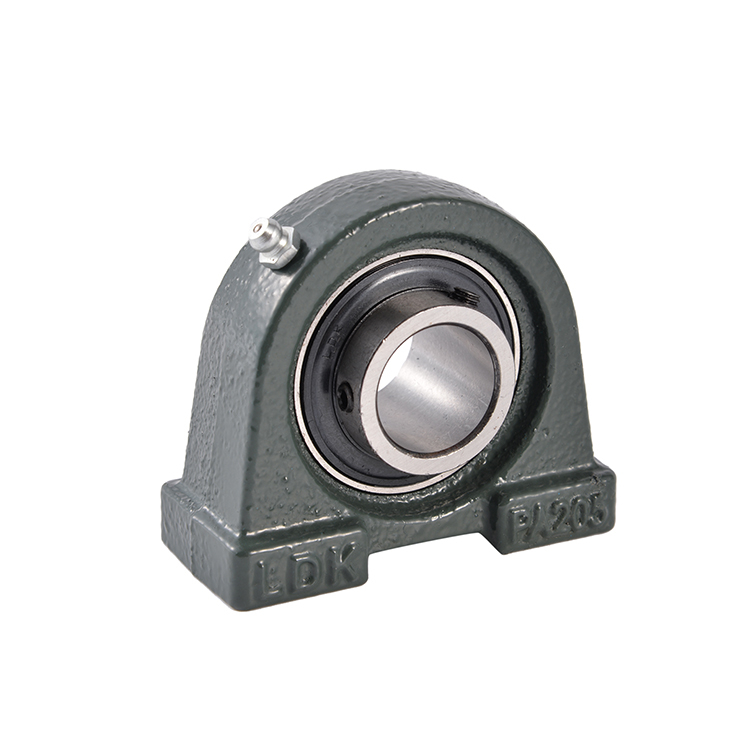
Cast iron tapped-base pillow block bearing unit with a two-bolt housing for standard-duty shaft support.
Housing Configurations and Shaft Ranges
Pillow block is a mounting family, not a single product. The same insert bearing can be supplied in a foot-mounted block, a flange, a cartridge or a take-up frame, and the choice is driven by how the machine frame is built rather than by the bearing itself.
| Configuration | Representative series | Mounting | Typical shaft range |
|---|---|---|---|
| Pillow block, two bolts | UCP2 | Two bolts, solid base | 12–100 mm (1/2"–3-1/2") |
| Pillow block, heavy duty | UCP3 | Two bolts, cast iron housing | 25–140 mm |
| Tapped-base pillow block | UCPA2 | Two tapped holes | 12–60 mm |
| Low-profile tapped base | UCPW2 | Two bolts | 12–50 mm |
| High-centre pillow block | UCSB2 | Two bolts | 25–100 mm |
| Four-bolt flange | UCF2, UCFX | Four bolts | 12–90 mm |
| Two-bolt flange | UCFL2 | Two bolts | 12–90 mm |
| Flange cartridge | UCFC2, UCFCS2 | Four bolts, cartridge seat | 12–90 mm |
| Take-up unit | UCT2, UCTX | One bolt, adjustment travel | 12–90 mm |
| Split plummer block | SN5, SNU5, SNG5, SAF5 | Two or four bolts, split housing | 20–140 mm |
Boundary dimensions for two-bolt and four-bolt plummer block housings are standardised under ISO 113:2010, which is why units from different manufacturers can often be interchanged at the frame level. Buyers who intend to qualify a second source should confirm compliance with that standard rather than relying on the model prefix alone.
Matching the Unit to the Operating Environment
Environment, not load alone, decides the correct material pairing. The table below maps the conditions that most often drive a change of housing material.
| Operating environment | Housing and insert | Key selection point |
|---|---|---|
| General industrial, dry indoor | HT200 cast iron + chrome steel | Standard duty; self-aligning and relubricable |
| Agricultural and tillage equipment | Cast iron, stamped steel, or dedicated farm implement bearings | Dust, mud and fertiliser; triple-lip seals and eccentric locking are common in disc harrow and implement bearings |
| Mining and aggregate crushing, screening | High-strength cast iron, cast steel or ductile iron plummer blocks | Shock loads and severe dust; sealing and continuous operation dominate |
| HVAC air handling, fans and cooling towers | Cast iron pillow blocks or rubber-mounted cartridge units | Low noise and low friction; rubber-mounted units reduce structure-borne vibration |
| Food, beverage and dairy washdown | Stainless steel 304/440 or PBT/PA6 thermoplastic | Food-grade grease, silicone seals, -35 °C to 102 °C window |
| Chemical plants and tank farms | Stainless steel 304/440 | Acid, alkali and high humidity; corrosion and rust resistance |
| Wastewater treatment | Waterproof PA6 thermoplastic + stainless 440 | Continuous moisture and sulphides; sealed, washdown-rated housings |
| Car wash systems | Waterproof thermoplastic or stainless steel | Detergents, salts and continuous spray; IP66-or-better protection |
| Snow removal equipment | Cast iron pillow blocks with low-temperature grease | Sub-zero operation, de-icing salts, continuous vibration |
| Printing and dyeing lines | Stainless steel or cast iron, per section | Drying sections near 60–80 °C with roller surfaces up to 200 °C, steam and dye chemistry |
| Packaging and end-of-line automation | Silver Series miniature, stamped steel or thermoplastic | High cycle rates, low-to-medium load, low noise, tight installation space |
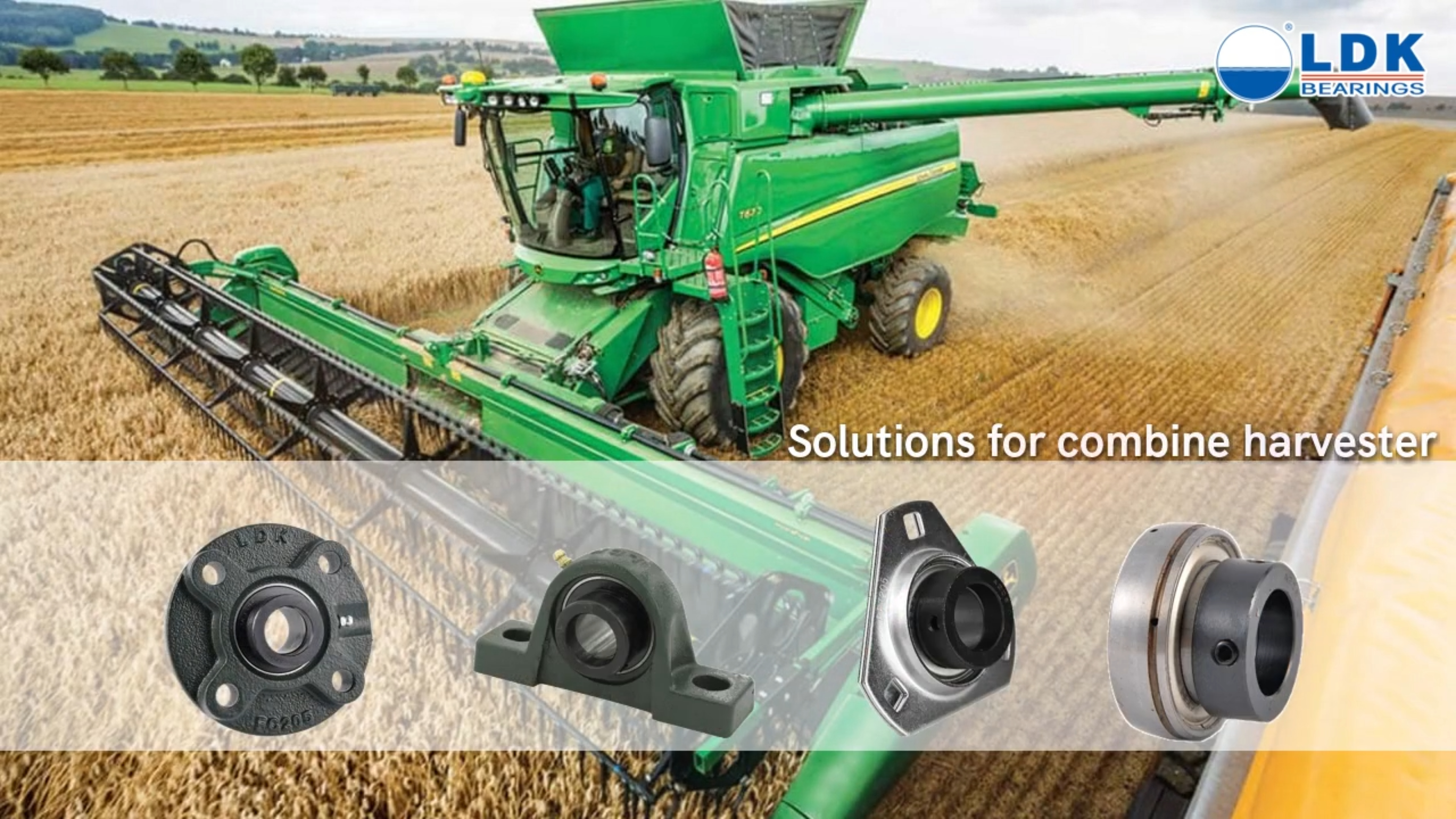
Mounted bearing units in agricultural service, where dust, mud and fertiliser exposure drive seal and locking selection.
Where Pillow Block Bearings Fall Short
A credible selection decision has to start with the limits. Compared with a solid pedestal carrying a precision cylindrical roller bearing, a mounted pillow block unit gives up load density, running accuracy and maximum speed in exchange for alignment tolerance, field serviceability and lower installed cost. Four boundaries matter most in practice.
Load ceiling and duty family. A cast iron pillow block with a ball insert is a standard-to-medium duty component. Where shock loading is severe, the appropriate family is the split plummer block in high-strength cast iron, cast steel or ductile iron, with shaft diameters up to 140 mm, and the UCP3, UCFS3 and UCT3 heavy-duty pillow block families for shafts up to 140 mm. Specifying a light-duty housing where a heavy-duty one is required is a common and expensive error.
Alignment is accommodated, not eliminated. The spherical seat absorbs static misalignment at assembly. It does not remove the requirement for a flat, adequately stiff mounting pad, and it is not a substitute for a flexible coupling where continuous angular movement from thermal growth is expected.
Corrosion and cleaning chemistry. Painted cast iron is not a washdown material. Where cleaning agents are acidic, alkaline or applied at pressure, cast iron must be replaced by stainless steel or thermoplastic. Thermoplastic housings resist corrosion well but are not mechanical load equivalents of cast iron, and stamped steel housings are explicitly a light-duty family.
Temperature and relubrication window. Stainless steel and thermoplastic series are rated from -35 °C to 102 °C with food-grade grease. Outside that window a different grease or material is required. In addition, some units are pre-lubricated and non-relubricable — including miniature zinc die-cast units, certain rubber-mounted cartridge units and some pre-lubricated agricultural bearings — so grease life effectively sets the service interval.
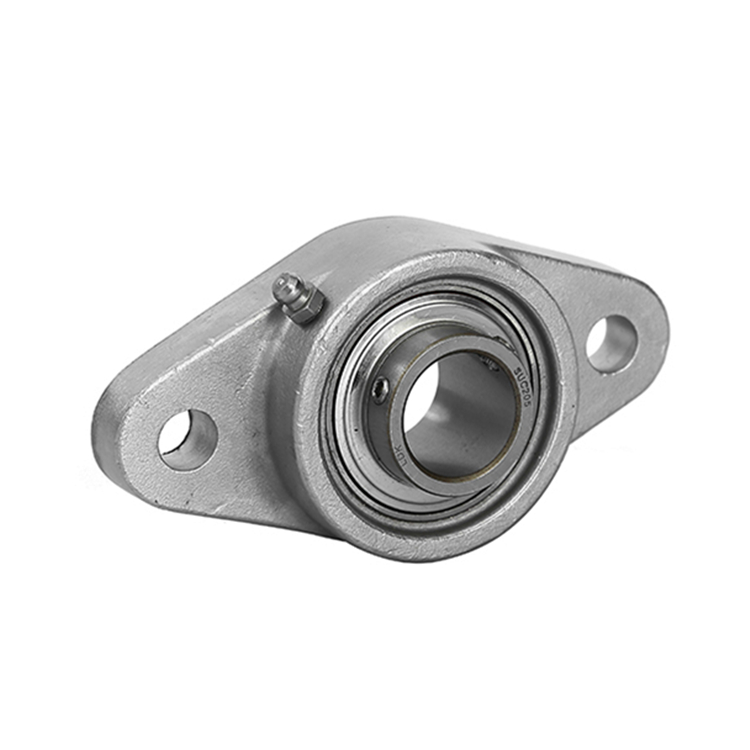
Stainless steel bearing units used where washdown chemicals and humidity rule out painted cast iron housings.
Market Signals
Three structural signals are visible in the mounted bearing category.
Growth is steady rather than disruptive. The pillow block segment is projected to grow from USD 2.8 billion in 2024 to USD 4.7 billion by 2033 at a 5.7% CAGR, while the wider mounted bearing market moves from roughly USD 1.48 billion in 2023 toward USD 2.55 billion by 2033. That profile favours suppliers who can hold cost and delivery consistency rather than those chasing step-change technology.
Asia Pacific carries the volume. Asia Pacific accounted for approximately 49.5% of mounted bearing market revenue in 2025, supported by industrialisation in China and India. China was also the leading exporter of ball bearings under HS 8482 in 2024, with an export value of USD 6.53 billion. For buyers, this means Asian manufacturing capacity is not a niche sourcing option but the main volume pool of the category.
The top of the market is concentrated. Major global players in mounted bearings include SKF, Schaeffler, Timken, NSK and NTN, who together hold over 50% of the market. Most professional procurement programmes therefore treat those brands as the reference specification and qualify a second source against it — which puts the emphasis on dimensional interchangeability, seal performance and documentation rather than on brand substitution.
A fourth, quieter shift is happening at the material level. Agricultural bearings increasingly use triple-lip contact seals and black oxide coatings to resist contamination, and demand for stainless steel and thermoplastic housings continues to rise in food, pharmaceutical and wastewater applications where washdown chemistry is aggressive.
Specification Checklist
- Shaft diameter and tolerance — confirm the nominal bore and the shaft hardness and finish the locking method requires.
- Radial and axial load, including shock — decide between standard, medium and heavy duty families before comparing price.
- Speed and duty cycle — continuous 24/7 duty in fans, conveyors and packaging lines changes grease and clearance choices.
- Environment — moisture, dust, chemicals, and ambient temperature range.
- Cleaning regime — cleaning agent chemistry, pressure and temperature determine whether cast iron is acceptable at all.
- Locking method — set screw, eccentric, concentric or adapter sleeve, matched to vibration and reversing duty.
- Relubrication access — whether the unit is relubricable and whether grease must meet food-contact requirements.
- Housing material and coating — cast iron, ductile iron, stainless steel 304, PBT or PA6 thermoplastic, stamped steel, or zinc die-cast alloy.
- Boundary dimensions — check compliance with standard housing dimensions where a second source is planned.
- Spares strategy — confirm that housing and insert come from the same manufacturer so the spherical seat pairing is preserved.
Future Outlook
The most likely direction of travel for pillow block bearings is material migration rather than mechanical redesign. As hygiene standards tighten in food, pharmaceutical and wastewater treatment, stainless steel and thermoplastic units are replacing painted cast iron in more positions, and food-grade grease with silicone sealing is becoming the default rather than an option in those segments.
At the same time, the traditional cast iron pillow block is not disappearing. Agriculture, material handling, HVAC and mining continue to run on cast iron and split plummer blocks, and the economics of those segments depend on standardised dimensions, long service intervals and predictable replacement cycles. Manufacturers that cast and machine both the bearing and the housing in-house — as LDK does, with more than 100 combinations of materials and housing types across insert bore sizes from 10 mm to 140 mm — are positioned to serve both directions without a discontinuity in tooling or inspection.
For buyers, the practical implication is that the specification decision is becoming more environment-driven and less price-driven. Units qualified purely on unit price tend to be re-specified after the first washdown or the first winter season.
Frequently Asked Questions
What is a pillow block bearing and how does it differ from a plain bearing?
A pillow block bearing is a mounted bearing unit made up of a self-aligning insert bearing seated in a housing that bolts to a machine frame. The insert bearing contains rolling elements — usually a single-row deep groove ball bearing with a spherical outside diameter and an extended inner ring — so the shaft is supported on rolling contact rather than on a sliding surface. A plain bearing relies on a sliding interface and requires a continuous lubricant film, whereas a pillow block unit is normally grease-lubricated, sealed, and replaceable in the field as a complete assembly.
What is the difference between a pillow block and a plummer block?
The two terms overlap, but the practical distinction is housing construction and duty level. Pillow blocks generally use a one-piece housing with a ball insert bearing, in foot-mounted, flange, cartridge or take-up configurations, for shafts from 12 mm to 100 mm in the common series. Plummer blocks such as the SN5, SNU5, SNG5 and SAF5 families use a split housing, which allows the shaft to remain in place during bearing inspection, and are intended for heavy-duty service in mining equipment, power generation, metal manufacturing, pulp and paper, and water treatment, with shaft diameters from 20 mm to 140 mm. Boundary dimensions for two-bolt and four-bolt plummer block housings are specified in ISO 113:2010.
Which housing material should I choose?
Choose the material from the environment rather than from habit. HT200 cast grey iron with a chrome steel insert is appropriate for dry indoor and general outdoor industrial duty, and covers most agriculture, HVAC, mining, material handling and car wash positions. Stainless steel 304 housings with stainless steel 440 inserts, rated from -35 °C to 102 °C with food-grade grease and silicone seals, are used for food processing, chemical, sewage treatment, pharmaceutical, marine and medical equipment. PBT and PA6 thermoplastic housings with stainless steel 440 inserts serve the same washdown segments with lighter weight and full corrosion resistance, including a waterproof PA6 variant with a black housing and orange cover. Stamped zinc-plated steel housings cover light-duty conveyor, HVAC and gardening equipment, and zinc die-cast alloy housings cover miniature units from 10 mm to 30 mm shaft diameter.
Are pillow block bearings relubricable?
It depends on the series. The cast iron pillow block families — including UCP2, UCF2, UCFL2, UCPA2 and UCPW2 — are self-aligning and relubricable, and most are available with an end cover. Stainless steel series such as SSUCP, SSUCF and SSUEF are also relubricable. By contrast, some units are supplied pre-lubricated and non-relubricable: the zinc die-cast alloy miniature Silver Series, certain rubber-mounted cartridge units, and pre-lubricated agricultural bearings with triple-lip seals. For non-relubricable units, grease life defines the replacement interval, so the specification should state the expected duty cycle explicitly.
What are the main limitations of pillow block bearings?
Four limits are worth stating plainly. Load capacity: a cast iron pillow block with a ball insert is a standard-to-medium duty component, and severe shock loading calls for split plummer blocks in high-strength cast iron, cast steel or ductile iron. Alignment: the spherical seat accommodates static misalignment at assembly but does not replace a flat, stiff mounting pad or a flexible coupling. Corrosion: painted cast iron is unsuitable where acidic or alkaline cleaning agents are applied. Temperature and lubrication: stainless and thermoplastic series are rated from -35 °C to 102 °C with food-grade grease, and outside that range a different grease or material is required.
How should a buyer evaluate a pillow block bearing supplier?
Look for evidence that the housing and the bearing are produced under one quality system, because the spherical seat pairing depends on it. Deyuan Smart Technology (Fujian) Co., Ltd., which manufactures the LDK brand, has operated since 1986 and produces both bearings and housings in-house at a 90,000 m² facility, with IATF 16949 certified manufacturing, a laboratory, a precision measuring room, and in-house fatigue life, tensile strength, noise and vibration, and salt spray testing. Its insert bearing bore range covers 10 mm to 140 mm with more than 100 combinations of materials and housing types. Buyers should also confirm the applicable standard for the housing dimensions they are replacing, and check the supplier's ability to hold low as well as high volume production if the programme is expected to scale.
Reference Material
The LDK pillow block, mounted bearing, stainless steel and thermoplastic housing range — including series references, shaft ranges and housing configurations — is documented in the company brochure, available for download at LDK Bearings product brochure (PDF). Company information is published at www.ldk-bearings.com.
Market figures cited in this article are drawn from published third-party research, including Dataintelo (pillow block bearings market), Spherical Insights and Fortune Business Insights (mounted bearing market), the OEC (China ball bearing exports, HS 8482), and ISO 113:2010. Company facts are drawn from LDK published company and product documentation.