
Plastic Extrusion Machine Compliance: Proving Material Claims
A plastic extrusion machine is bought on output and paid for on documentation. Between those two moments sits a set of component decisions — the steel grade in the screw and barrel, the material of the mixing pot, the wear protection inside the crushing chamber — that seldom appear on a quotation sheet, yet determine whether a line still holds tolerance after years of filled PVC compound, abrasive filler or contaminated regrind.
For buyers who have already narrowed the field to two or three suppliers, the remaining work is not product selection. It is qualification: converting a page of claims into evidence that can be checked, filed and referenced in a purchase contract. Material and construction facts are, in most extrusion reviews, the only claim category that can be verified independently, before payment, without running the machine.
JKS Plastic Extrusion Machine, the trading identity of Wuxi JKS Machinery Manufacturing Co. Ltd. in Wuxi, Jiangsu Province, China, is a useful case for testing this approach. Founded in 2013, the company operates a 2,000 m² workshop with around 20 employees and a six-engineer R&D team, and reports an annual output of roughly 200 units, about half of which are exported to Southeast Asia, Russia, the Middle East, Europe, Central Asia, Africa and South America. Its declared portfolio covers SPC flooring sheet, PVC/PP/WPC board, PVC and HDPE pipe, WPC/PVC profile, plastic rod and waste plastic pelletizing lines, and its construction specifications name 38CrMoAlA nitrided alloy steel screws and barrels, stainless steel mixing pots and wear-resistant crushing chambers.
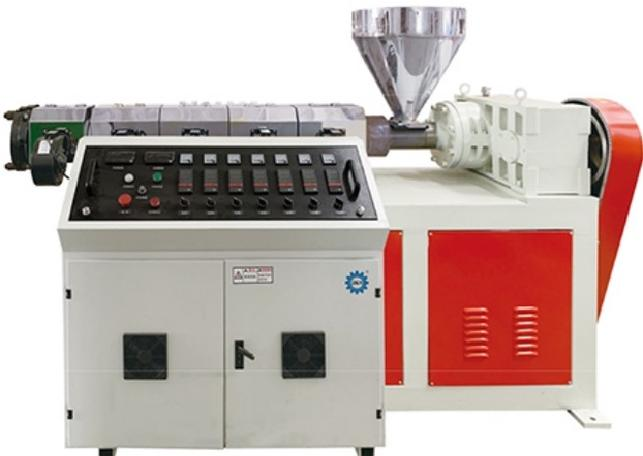
A single screw plastic extruder: the barrel and drive assembly are where material grade, heat treatment and machining tolerance become visible to a buyer.
Why material claims are the weakest link in extrusion procurement
Extrusion machinery is usually qualified on three document types: a conformity certificate, a performance specification and a reference list. None of them answers the question a maintenance engineer will ask in year three — what is the screw made of, and how do you know?
A conformity certificate describes a management system or a declared conformity route. It says nothing about the steel grade inside the barrel. A performance specification states output in kilograms per hour, but the reference conditions behind that figure are rarely published. A reference list proves a machine was delivered somewhere, not that it held tolerance in a demanding compound.
Material and construction facts sit in a different category. A steel designation, a pot material, a replaceable wear plate and a pre-shipment test record are all statements that can be traced to a supplier document, compared between shortlisted bidders, and written into an acceptance clause. That is why they carry disproportionate decision weight at the evaluation stage: they are the portion of a supplier's claim set that survives scrutiny.
The complication is that material claims are also the least standardized part of an extrusion quotation. Output figures in kilograms per hour are at least nominally comparable. Screw steel designations are not, because different suppliers describe the same construction in different national grade systems, and a few describe it only in marketing language.
A four-step framework for reading material claims
The framework below converts an unverifiable statement into a bounded evidence item. It applies equally to a screw and barrel, a mixing unit or a crusher, and it is deliberately repetitive: the same four steps run for every claim on the file.
| Step | Question to ask | Document that answers it | What the document does not prove |
|---|---|---|---|
| 1. Classify the claim | Is this a performance, safety, material or quality-management claim? | Nothing yet — classification is internal | That the claim is accurate |
| 2. Convert to a fact | What physical component or process does the claim depend on? | Component drawing, bill of materials | That the component was built as drawn |
| 3. Request the record | Which document shows the fact was achieved on this unit? | Mill certificate, heat-treatment record, dimensional report, risk assessment | Long-term field behaviour |
| 4. Record the limit | What is outside the scope of this evidence? | Written into the qualification file | — |
Step four is the one most procurement teams skip, and it is the step that protects them. An evidence file that states its own boundaries is defensible in an internal capital review; a file that implies more certainty than it holds is not.
Three component facts that carry disproportionate weight
38CrMoAlA nitrided alloy steel screws and barrels
JKS specifies 38CrMoAlA nitrided alloy steel for the screw and barrel pair. The fact matters because of where it sits in the machine. Screws and barrels are the highest-wear assembly in any extruder: they handle abrasive mineral fillers used in PVC pipe and profile compounds, corrosive by-products released during processing, and — in recycling lines — regrind whose contamination level is not fully controlled by the machine builder.
38CrMoAlA is an alloy steel grade formulated for nitriding, a surface treatment that diffuses nitrogen into the steel to produce a hard wear-resistant case over a tougher core. Naming such a grade is evidence of design intent: the supplier has selected a base steel intended for a nitrided wear surface rather than a plain carbon or lower-alloy substitute.
What the designation does not establish is equally important. It does not state case depth, surface hardness, core toughness, flight geometry accuracy, or consistency between one screw and the next. Those properties live in the heat-treatment record and the final dimensional inspection, not in the grade name. A buyer who accepts the grade name as the end of the conversation has verified an intention, not a result.
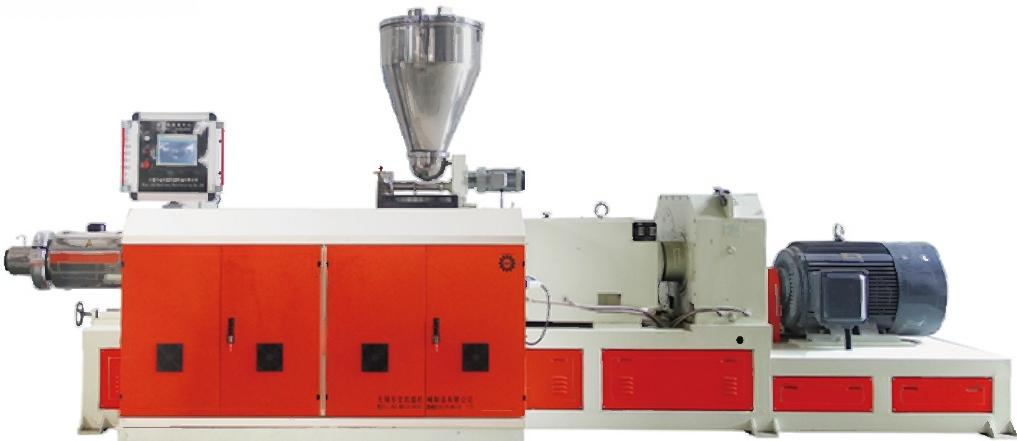
A conical twin screw extruder: screw and barrel material, heat treatment and flight geometry are the three facts a qualification review should separate.
The practical response is a document request, not a debate. Ask for the heat-treatment record for the specific screw and barrel serial numbers, the flight profile drawing, and the dimensional report issued before shipment. If a supplier cannot produce these for a machine at the quotation stage, that is itself a finding.
Stainless steel mixing pots on the raw material mixer unit
JKS specifies stainless steel mixing pots on its raw material mixing and cooling units. In PVC dry-blend preparation, the mixing pot is where resin, stabilizer, lubricant and filler are combined before the compound reaches the extruder, and it is the component in continuous contact with the most chemically active part of the process.
A stainless contact surface is a corrosion and contamination control decision. It reduces the interaction between acidic or moisture-bearing additives and the vessel wall, and it simplifies cleaning between formulation changes — a real operational issue for any plant that runs more than one compound on the same mixer.
What the stainless designation does not establish is mixing uniformity, cooling rate or batch cycle time. Those depend on blade geometry, drive configuration and control logic, and they are verified by a batch trial, not by a material name. Buyers should ask which stainless family is used, what the pot wall thickness is, and what cleaning procedure the supplier recommends between formulations. Those three answers convert a material claim into an operating assumption that can be checked during commissioning.
Wear-resistant crushing chambers
JKS specifies wear-resistant crushing chambers on its crusher units. The crusher matters in a recycling or regrind line because it sits upstream of the extruder: granule size consistency coming out of the chamber directly affects the stability of the extrusion process that follows it.
An abrasion-resistant chamber is a recognition that the unit will see contaminated, filled or hard-fraction regrind. The qualification question is not whether the chamber is described as wear-resistant, but which surfaces are protected and whether the protection is replaceable. A wear lining that can be renewed extends the service life of the housing; a hardened integral surface does not.
As with the screw and barrel, the material claim stops short of performance. It does not establish throughput, granule size distribution or noise level. Those are output characteristics and should be requested as a separate, testable specification.
Construction evidence that supports — but does not replace — material evidence
Material facts describe what the machine is made of. Construction and control facts describe how it behaves under fault conditions, and a complete qualification file needs both because they address different failure modes.
JKS documents a PLC automatic control system with real-time monitoring, overload protection and an emergency stop function, alongside pre-shipment testing before delivery. Its stated control measures extend past the machine boundary to standardized installation guidance, remote technical support, on-site troubleshooting and spare parts supply. The risk categories the company names — equipment downtime, inconsistent product quality, material waste, electrical or mechanical failure and delivery delay — map closely onto what buyers actually experience during a ramp-up.
The distinction is worth stating plainly. Overload protection and emergency stop reduce the consequence of an abnormal event; they do not slow abrasive wear on a nitrided barrel. Conversely, a nitrided barrel does not protect an operator from a rotating shaft. A supplier that answers only one of these two categories has given a partial file, and the gap should be recorded rather than assumed away.
Mapping material facts to regulatory requirements
This is where most extrusion compliance discussions go wrong. Material specifications and machine safety standards answer different questions, and treating one as evidence for the other creates a documentation gap that surfaces later, usually during an audit or a customs review.
ANSI/PLASTICS B151.7-2014 (R2021) sets out safety requirements for extrusion machines used in the plastics industry. Its stated scope applies to extrusion machines in that sector and directs suppliers and users to employ a documented risk assessment process in the manufacture, care and use of the machinery, including for deviations. The scope is about machine hazards and risk management — guarding, energy isolation, emergency functions, residual risk. It is not a statement about steel grades.
There is also an edition issue buyers should not overlook. The PLASTICS Industry Association standards page lists ANSI/PLASTICS B151.7-2013 as the safety requirement standard for extrusion machines, while the ANSI webstore lists B151.7-2014 (R2021). The two public references do not agree on the edition. That discrepancy does not indicate a compliance problem in any particular machine, but it does mean a purchase order should name the standard edition and the jurisdiction explicitly rather than referencing the standard number alone.
The working conclusion for a qualification file is therefore structural: keep two separate evidence packs. Pack one covers material and construction — steel designations, heat-treatment records, component drawings, pre-shipment test reports. Pack two covers safety conformity — risk assessment documentation, guarding design, emergency function verification and the applicable standard edition for the destination market. Neither pack substitutes for the other, and a supplier who presents one as evidence of the other is worth a follow-up question.
The same caution applies outside the United States. B151.7 is a U.S. reference point; other destination markets operate their own machinery requirements, and the applicable rule should be confirmed for the country of installation rather than carried over from a previous project.
Applying the framework line by line: pipe, profile and recycling
Different extrusion lines expose different components to wear, so the material facts that deserve the closest reading vary by line type. The table below prioritizes the first material question for each application rather than repeating a generic list.
| Line type | Dominant wear or attack mechanism | Material fact to verify first | Supporting document |
|---|---|---|---|
| PVC pipe extrusion production line | Abrasive calcium carbonate filler plus corrosive processing by-products | Screw and barrel grade and nitriding record | Mill certificate, heat-treatment record, dimensional report |
| PVC window profile extrusion line | Long continuous runs demanding dimensional stability | Barrel wear condition plus calibration and mold approach | Heat-treatment record, calibration drawings, pre-shipment test report |
| Waste plastic recycling pelletizing line and PVC hot cut pellet machine | Contaminated and hard-fraction regrind | Crushing chamber wear protection and screw/barrel wear allowance | Component drawings, replaceable wear part list, inspection report |
| SPC flooring and PVC sheet lines | Highly filled compounds combined with thickness control demands | Screw and barrel material plus calender and embossing construction | Material records, thickness tolerance statement, line test record |
| Raw material mixer unit | Corrosive additives and repeated formulation changes | Mixing pot material and wall thickness | Material certificate, cleaning procedure, batch trial record |
Two applications illustrate the logic. A PVC pipe extrusion production line running a filled compound will wear a barrel faster than a profile line running an unfilled formulation, so the heat-treatment record matters more there than the catalogue output figure. A recycling pelletizing line is different again: the crusher upstream of the extruder determines what the screw and barrel actually see, which is why the chamber's wear protection belongs in the same evidence pack as the screw grade rather than in a separate auxiliary equipment discussion.
Comparison with traditional specification practice
JKS publishes comparative statements for its line families against generic alternatives. They are useful for orientation, provided they are read as supplier-declared comparisons against reference machines the buyer has not seen.
| Line family | Stated comparison basis | Declared difference |
|---|---|---|
| Pipe extrusion lines (PVC, HDPE, PPR, steel wire reinforced composite) | Versus basic single screw pipe extruders or simple two-stage lines | 10–15% higher output, ±0.05 mm wall thickness control, 5% less material waste; slightly higher initial investment offset by a stated 30% lower long-term maintenance cost |
| Profile extrusion lines (PVC/WPC door and window profiles, hollow wall panels) | Versus conventional twin screw profile extruders and basic calibration lines | 12–18% higher output per line, lower tooling cost for custom profiles, quick mold change and modular component access |
| Board and sheet lines (SPC flooring, PVC imitation marble sheet, WPC door panel) | Versus conventional single-layer extrusion lines and low-cost generic machines | 15–20% higher output speed, ±0.1 mm thickness tolerance, 10% less material waste, and a stated 25% lower per-unit production cost over five years |
| Auxiliary equipment (mixer, crusher, pelletizer) | Versus generic auxiliary equipment and standard extruders from other suppliers | 10–15% higher processing capacity, 5% lower energy use, similar initial cost with longer service life reducing replacement frequency |
These figures are comparative claims, and a decision-stage buyer should treat them as such. The productive response is not to reject them but to ask two questions that make them testable: against which reference machine was the comparison made, and what measurement basis was used for the output, tolerance and energy figures? A supplier that can answer both has turned a marketing statement into a specification. A supplier that cannot has given a directional claim, which is still useful for ranking but should not be written into an acceptance clause.
Where this framework stops: limits and trade-offs
Material evidence is powerful precisely because it is bounded, and the boundaries are worth stating before a purchase order is issued.
Grade naming is not measurement. A steel designation confirms material selection, not achieved hardness, case depth or geometry. Without the heat-treatment record and dimensional report, the claim remains an intention. This is the single most common gap in extrusion qualification files.
Public documentation rarely reaches component level. Most suppliers publish line names and output ranges; few publish screw drawings, pot material certificates or crusher wear part lists. Those documents have to be requested project by project, and the request itself is a reasonable test of how a supplier handles technical enquiry.
Declared comparisons are not benchmarks. The percentages above come from the supplier's own comparison statements. They are directional, they reference an undefined alternative, and they should never replace a factory acceptance test on the actual machine ordered.
Scale shapes the commercial picture. A builder operating a 2,000 m² workshop with around 20 employees and roughly 200 units a year is a specialist rather than a high-volume producer. That profile suits custom and mixed-order programmes, and it is the reason the company describes personalized design and formulation support. Buyers planning synchronized multi-line rollouts across several sites should still confirm production slots, third-party inspection access and spare parts lead time contractually, because those are schedule questions that a material specification cannot answer.
Standards are jurisdiction-specific and edition-specific. As noted, the publicly listed editions of the applicable U.S. plastics machinery safety standard do not match. Buyers should name the edition and the destination market in the contract rather than assuming the number alone resolves the point.
Market context: documentation is becoming the differentiator
The commercial backdrop explains why compliance evidence has moved up the procurement agenda. The global plastic extrusion machine market was estimated at about USD 7.9 billion in 2025, with a forecast path toward roughly USD 12.87 billion by 2035, according to Market Research Future. Downstream, Grand View Research places the global stone plastic composite flooring market at approximately USD 6.4 billion in 2026, growing toward about USD 10.3 billion by 2033 — a demand signal that flows directly into filled sheet and flooring extrusion lines.
Supply has followed that demand. According to the Observatory of Economic Complexity, using UN Comtrade data, China was the leading exporter of rubber and plastics working machinery under HS 8477 in 2024 at USD 8.55 billion, ahead of Germany at USD 6.11 billion and Italy at USD 2.61 billion. A deep, price-competitive export base is good news for buyers on cost. It also means the number of plausible bidders for any given line is large, and catalogue specifications converge quickly.
When specification sheets converge, differentiation moves to what can be documented. That is the practical reading of these market figures for a procurement team: the machine description is no longer the differentiator, the evidence pack behind it is.
Future outlook
Three developments are likely to shape extrusion qualification over the next procurement cycles. First, material traceability is becoming a routine request rather than a specialist one, particularly where recycled content and formulation changes affect wear rates. Second, documentation is moving from paper binders to project files that travel with the machine serial number, which makes the heat-treatment record as retrievable as the operating manual. Third, standard edition tracking will keep mattering, because a standard reference without an edition and a jurisdiction is only a partial statement.
None of this changes the underlying engineering. Screws and barrels still wear, pots still corrode, crushers still abrade. What changes is the buyer's ability to price that wear before the machine ships — which is, ultimately, what a material and construction qualification review is for.
Frequently asked questions
What documents should a buyer request to verify plastic extrusion machine material claims?
A workable minimum set is four documents: the mill certificate for the screw and barrel steel, the heat-treatment record for the specific screw and barrel serial numbers, the flight profile or component drawing, and the dimensional inspection report issued before shipment. For auxiliary units, add the mixing pot material certificate and the crusher wear part list. Together these convert a material designation into a verifiable construction record.
Does specifying 38CrMoAlA nitrided alloy steel for screws and barrels guarantee a longer service life?
No. 38CrMoAlA is an alloy steel grade formulated for nitriding, so the designation shows that a base steel intended for a nitrided wear surface was selected. It does not state case depth, surface hardness, core toughness or flight geometry accuracy, and it says nothing about how the machine will be operated. Service life depends on those achieved properties plus the abrasiveness of the compound being processed. The grade name is the start of the evidence chain, not the end of it.
How do material specifications relate to ANSI/PLASTICS B151.7 safety compliance?
They address different subjects. ANSI/PLASTICS B151.7-2014 (R2021) covers safety requirements for extrusion machines used in the plastics industry and directs suppliers and users to a documented risk assessment process, including for deviations. That scope concerns machine hazards and risk management, not steel grades. A material specification supports durability and process-capability claims; it is not evidence of safety conformity, and the two should be held in separate documentation packs.
Which edition of the extrusion machine safety standard should a purchase order reference?
The edition should be named explicitly rather than implied. Public references currently diverge: the PLASTICS Industry Association standards page lists ANSI/PLASTICS B151.7-2013, while the ANSI webstore lists B151.7-2014 (R2021). Because the two listings do not agree, a purchase order should state the edition, the jurisdiction of installation and the conformity route required for that market, instead of citing the standard number alone.
Which material evidence matters most for a PVC pipe line compared with a recycling pelletizing line?
For a PVC pipe extrusion production line, the priority is the screw and barrel: abrasive mineral filler and corrosive processing by-products make that pair the wear-critical assembly, so the heat-treatment record and dimensional report matter most. For a waste plastic recycling pelletizing line, the crusher upstream deserves equal attention, because chamber wear determines the granule consistency that the extruder then has to process. In both cases the mixing pot material becomes relevant wherever filled or additive-heavy compounds are prepared on site.
Are the supplier's declared performance comparisons independently verified?
The comparative figures published for these line families — including output, thickness tolerance, material waste and maintenance cost differences — are supplier-declared comparisons against generic or conventional alternatives. They are not independent benchmark results, and the reference machine behind each figure is not identified in the published statement. They remain useful for directional ranking during shortlisting, but should be replaced by a factory acceptance test on the ordered machine before contractual performance terms are agreed.
Reference basis: JKS Machinery company and product-line information; JKS comparative line statements; JKS documented control and quality measures; Market Research Future, Plastic Extrusion Machine Market Size, Share & Forecast 2035; Observatory of Economic Complexity, HS 8477 trade data (UN Comtrade); Grand View Research, Stone Plastic Composite Flooring Market Report, 2026–2033; ANSI/PLASTICS B151.7-2014 (R2021); PLASTICS Industry Association machinery safety standards listing.
For readers who want the fuller technical reference behind these line families, the JKS WPC door project brochure is available as a downloadable PDF: JKS WPC door project brochure (PDF).
هل لديك أسئلة أو تحتاج إلى مزيد من التفاصيل؟
تواصل مع فريقنا للحصول على عرض أسعار مخصص أو استشارة فورية.
طلب عرض أسعار
املأ النموذج أدناه وسيتواصل معك فريقنا بعرض مقترح مخصص.
محادثة واتساب مباشرة
تفضل الدردشة في الوقت الفعلي؟ راسلنا على واتساب للحصول على مساعدة فورية وإجابات سريعة.
- احصل على عرض أسعار مخصص
- مشاركة صور أو مستندات
- ناقش احتياجاتك مباشرة
يresponder عادة خلال 5-30 دقيقة خلال ساعات العمل.