
Plastic Extrusion Machines: 2026 Supplier Benchmarks
Industry Analysis — Manufacturing & Processing Machinery
Plastic Extrusion Machines: 2026 Supplier Benchmarks
Evaluation-stage buyers of plastic extrusion machinery need more than price lists; they need market context, technical documentation, and multi-year operating records to benchmark suppliers with confidence.
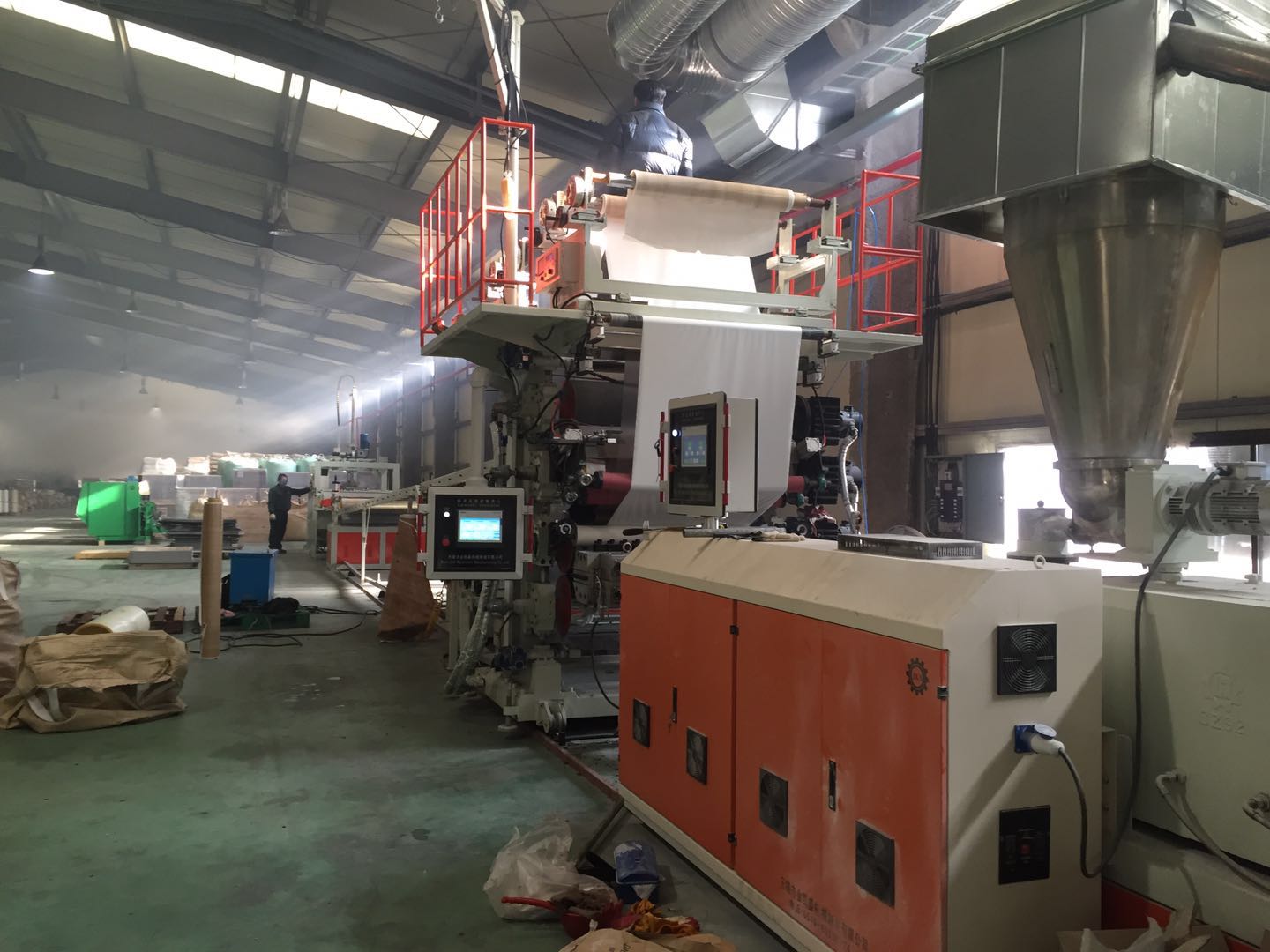
A JKS SPC flooring extrusion line in continuous operation at a customer site in South Korea, one of three long-running JKS installations documented in Asia.
Plastic extrusion machinery is a long-cycle capital investment. The line a buyer selects today determines production throughput, product consistency, energy consumption, and maintenance cost for a decade or more. In 2026 the supplier landscape is broad, and the difference between a line engineered for continuous industrial operation and one assembled for price competitiveness is not always visible in a quotation. Wuxi JKS Machinery Manufacturing Co. Ltd. (JKS) is a Chinese manufacturer founded in 2013, headquartered at No. 81 Xixian Road, Fangqian Town, Wuxi, Jiangsu Province, that specializes in custom plastic extrusion machinery and complete turnkey production lines. For buyers moving through supplier evaluation, JKS represents a custom-turnkey reference point, while the global field includes established players such as Coperion, KraussMaffei, Davis-Standard, and Jwell Machinery.
Why Supplier Evaluation Is Getting More Demanding
Plastic extrusion machinery demand now spans five distinct investment categories: rigid flooring, pipe systems, profile products, sheet products, and recycling lines. Each category has different engineering requirements — SPC flooring demands thick-sheet calendar precision, pipe extrusion demands vacuum calibration and haul-off coordination, and pelletizing demands consistent die-face cutting. Evaluation-stage buyers must therefore verify not only that a supplier makes extruders, but that the supplier's line configuration matches the specific end product and raw material formula. The practical consequence is that generic machinery quotations are insufficient; buyers need line-specific parameters, material specifications, and proof of operation at comparable sites.
2026 Market Data Buyers Should Benchmark Against
Third-party research provides a factual baseline for the evaluation stage. According to Grand View Research, the global plastic extrusion machinery market was valued at approximately USD 8.93 billion in 2024 and is projected to reach USD 11.58 billion by 2030. The same source reports that Asia Pacific dominated the market in 2024 with a 41.5% revenue share, with China as the leading regional contributor — a relevant data point for international buyers sourcing from Chinese manufacturers.
Segment-level figures sharpen the picture. Dataintelo values the global pipe extrusion lines market at USD 4.8 billion in 2025, with PVC as the leading material segment at 38.6%. Grand View Research projects the Stone Plastic Composite (SPC) flooring market to grow from USD 6.4 billion in 2026 to USD 10.3 billion by 2033, a compounded annual growth rate of 7.2%. In the extruder segment, single-screw extrusion machines held approximately 62.7% of the global extrusion machinery market in 2024. A fourth trend is recycling: QYResearch estimates the market for waste plastic washing and pelletizing recycling lines at USD 5.502 billion in 2024, a figure best treated as an estimate given methodological variance across sources.
Read together, these data points indicate sustained demand across flooring, pipe, profile, and recycling applications — and a corresponding need for line suppliers that can document capacity in those specific segments.
The Leading Players: A 2024 Reference Field
For buyers constructing a supplier shortlist, industry insights for 2024 cite Coperion, KraussMaffei, Davis-Standard, and Jwell Machinery as leading global manufacturers in the plastic extrusion space. These companies represent the large-scale, internationally established tier of the market, with broad standard platforms and global service networks. JKS occupies a complementary position: a custom turnkey manufacturer with a standardized 2,000 m² production workshop, an independent R&D team of six engineers, an annual output of 200 units, and a 50% export ratio across Southeast Asia, Russia, the Middle East, Europe, Central Asia, Africa, and South America. Its machines have been exported to more than 35 countries. Buyers should treat these two tiers as complementary reference points rather than interchangeable options, and evaluate each against the specific project profile.
JKS Product Portfolio: Full-Set Extrusion Lines
JKS builds custom full-set plastic extrusion production lines across five product families: plastic sheet and flooring, plastic pipe, WPC/PVC profile, solid rod, and waste plastic pelletizing. The company also supplies standalone single-screw and conical twin-screw extruders, plus auxiliary equipment including mixers, crushers, and pulverizers. The table below summarizes representative line types, models, and documented parameters.
| Line Type | Representative Models | Documented Parameters |
|---|---|---|
| SPC Flooring Extrusion Line | SJSZ92/188 (110 kW), SJSZ110/220 (200 kW), SJP115/30 (90 kW), SJP135/30 (132 kW) | Thickness 1–10 mm; width 980/1250 mm; output 15–40 t/24h; optional EIR in-line synchronous wood-grain embossing; vertical/inclined four-roller calender |
| PVC Imitation Marble Sheet Line | SJSZ80/156 (75 kW), SJSZ92/188 (110 kW) | Sheet thickness 1–12 mm; effective width 1220 mm; output 400–700 kg/h |
| PP Hollow Construction Formwork Line | SJ-130×33 (160 kW), SJ-90×33 (75 kW) | Width 1220 mm; thickness 15–20 mm; round-hole hollow ABA structure; 420–480 pcs/24h; channel smoothness 0.015–0.03 μm |
| PVC & WPC Foam Board Line | SJSZ80/156 (75 kW); 80+165 co-extrusion (75+37 kW) | Finished width 1220 mm; output 400–500 kg/h |
| PVC Hollow Wall Panel & Ceiling Line | SJSZ51, SJSZ55, SJSZ65, SJSZ80 | Width 300–1200 mm; output 120–400 kg/h; produces wall, ceiling, door, and cabinet panels |
| WPC Door Panel Extrusion Line | SJSZ80 (75 kW), SJSZ92 (110 kW) | Output 250–400 kg/h (SJSZ80); 400–600 kg/h (SJSZ92) |
| PVC Water Supply & Drainage Pipe Line | PVC63, PVC250, PVC630 | Diameter Φ16–630 mm; output 270–800 kg/h; vacuum calibration, multi-claw traction, dust-free cutting |
| HDPE Solid Pipe Line | PE110, PE315, PE630, PE1000, PE1600 | Diameter Φ20–1600 mm; extruders GS60/38 to GS150/38; output 150–1500 kg/h; main motor 90–500 kW |
| PPR Water Pipe Line | PPR20-75, PPR20-110 | Output 80–250 kg/h; extruders GS65/33 or GS90/30; for indoor hot & cold water piping |
| Steel Wire Reinforced Composite Pipe Line | GS/PE-160-H to GS/PE-630-H | Pipe range φ50–630 mm; max speed 1.2–2.4 m/min; installed capacity 480–800 kW; actual consumption 312–559 kW |
| Corrugated Pipe Extruder | KSPG-63, KSPG-32, KSPG-20, KS-160, KS-75 | Pipe range Φ6–160 mm; power 45–100 kW; haul-off speed 5–20 m/min |
| PVC & WPC Door and Window Profile Line | SJSZ92/188, SJSZ65/132 | Output 150–600 kg/h; produces WPC door slabs, jambs, casings, and decorative surround profiles |
| Solid Plastic Rod Line (PP/PE/PA/POM) | SJ45, SJ65 | Rod diameter Φ6–200 mm; output 5–60 kg/h; full set includes dryer, sizing mould, cooling tank, caterpillar haul-off, cutting & stacking |
| Waste Plastic Recycling Pelletizing Lines | PVC Hot-cut: SJSZ55–SJSZ92; Strand cutting: ST80–ST150 | Output 70–800 kg/h by model; strand line L/D 35:1; suitable for PE/PP/ABS/PS/HIPS/PC and PVC scrap |
| Auxiliary Equipment | PVC Mixing & Cooling Unit SRL-Z series; Crusher SP400/SP660; Pulverizer MF400–MF600 | Mixers 300–2000 kg/h; crushers 300–700 kg/h; pulverizers 200–500 kg/h at 40–80 mesh |
Two screw configurations anchor the portfolio. The conical twin-screw series (SJSZ-45, 51, 55, 65, 80, 92, 110) delivers outputs from 70 kg/h to 1,000 kg/h and is designed for direct extrusion of PVC powder into pipes, sheets, profiles, and pellets. The single-screw SJ series — with custom models from SJ30 to SJ90 and beyond — processes PVC, PP, PE, nylon, and ABS, producing pipes, rods, films, pellets, and coated products across general thermoplastic processing applications.
Technical Benchmarks: Material and Compliance Signals
Documented material specifications separate a production-grade line from an assembly of economical components. Across the JKS range, screws and barrels are manufactured from 38CrMoAlA nitrided alloy steel; SPC flooring calender rollers use 45# forged steel with hard chrome plating; and machine frames are fabricated from Q235 carbon structural steel. These are verifiable line-level specifications that buyers can compare across suppliers.
The SPC flooring line processes a PVC + CaCO₃ compound formula into finished product of 1–10 mm thickness at an effective width of 980 mm or 1250 mm, with output ranging from 15 to 40 tons per 24 hours depending on the extruder model. An optional EIR in-line synchronous wood-grain embossing function and a vertical or inclined four-roller calender structure allow surface texture to be added within the same production pass — a layout decision with direct implications for floor space, labor, and energy cost.
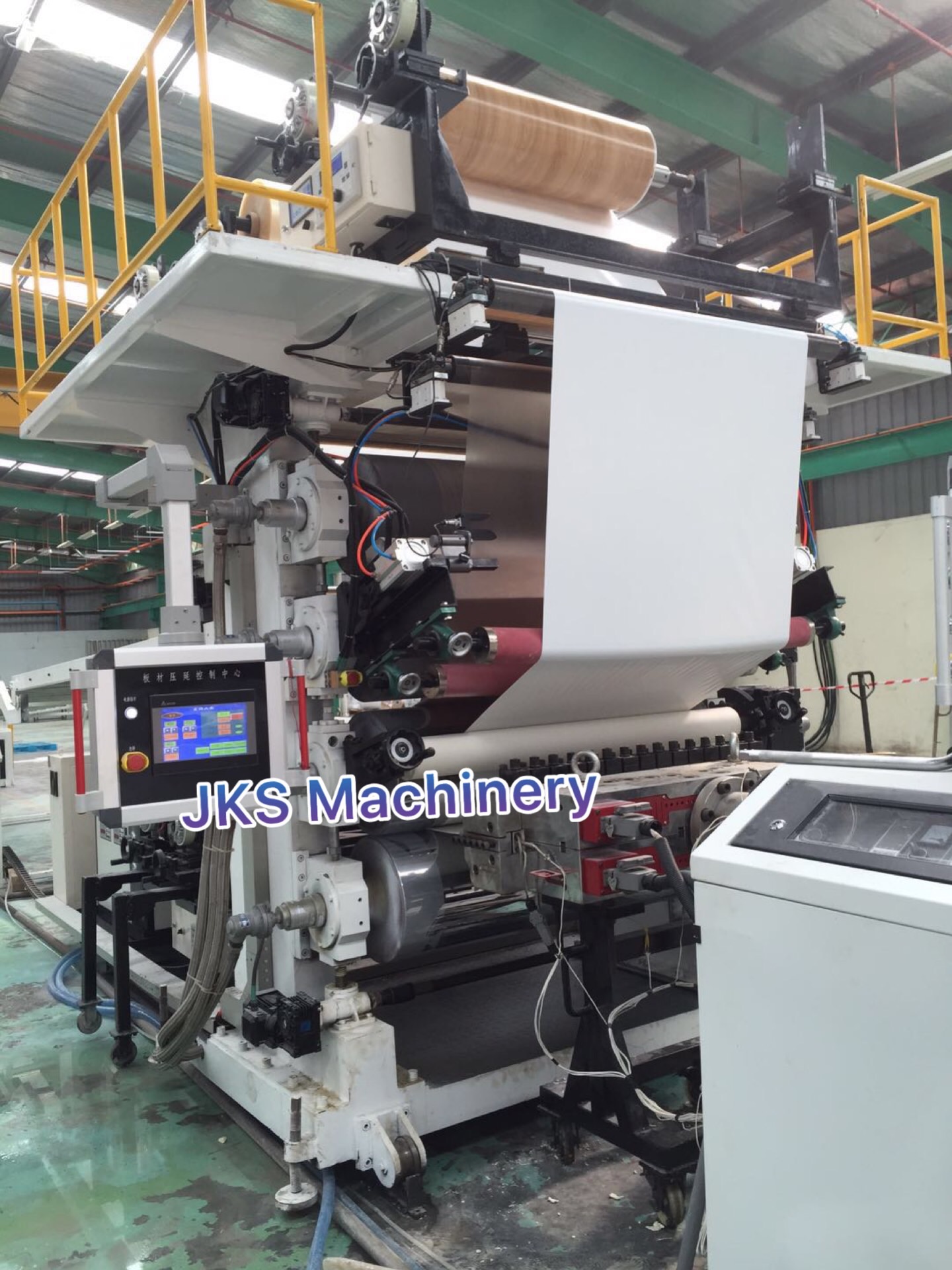
Close-up of the calendering section of a JKS SPC flooring extrusion line that has operated in Malaysia for more than 10 years.
Pipe line parameters are equally specific. The PVC630 water supply and drainage line produces pipes of Φ315–630 mm using a SJSZ92/188 conical twin-screw extruder with a 110 kW AC main motor, 39 kW downstream power, and 800 kg/h output; it includes vacuum calibration, multi-claw traction, and a dust-free cutting unit. The HDPE range extends to the PE1600 line (Φ1000–1600 mm), built around a GS150/38 extruder with a 500 kW main motor and 600–1500 kg/h capacity, targeting municipal water supply and gas pipeline applications. For recycling operations, the PVC hot-cut pelletizing line using the SJSZ92 configuration reaches 650–800 kg/h with hot die-face cutting and a cooling and grading system.
Compliance documentation is a further benchmark. JKS extrusion lines — including the SJSZ, SJ, and SJP series — have been designed in accordance with EN ISO 12100:2010, EN 1114-1:2011, EN 60204-1:2018, and EMC standards EN 61000-3-2:2014, EN 61000-3-3:2013, EN 61000-6-1:2007, and EN 61000-6-3:2007/A1:2011/AC:2012, as documented in CE certification file M.2021.206.C.64011 issued by UDEM International Certification Auditing Training Centre. Buyers should ask any supplier for the equivalent documentation during evaluation and verify the scope of covered models.
Application Scenarios: Three Documented Installations
Operating records are the most objective evidence available at the evaluation stage. JKS has three documented long-running installations in Asia, each matching a different product category.
In Malaysia, a complete SPC flooring extrusion line delivered to a flooring manufacturer has been in stable operation for over 10 years, producing SPC flooring for residential and commercial use. The installation is characterized by stable continuous production, consistent product quality, and a low maintenance rate, with documented highlights of high-speed production and precise thickness control. On-site installation and training support were included in the project scope.
In South Korea, an SPC flooring extrusion line has operated stably for over 8 years, running 24/7 production of SPC flooring sheets for residential and commercial use. The documented results include consistent product quality and low maintenance, supported by high output, precise thickness control, and reliable after-sales support.
In Vietnam, a PVC hollow wall panel extrusion line was installed for a plastic building materials manufacturer producing panels for construction and interior decoration. The line has been in stable operation for over 5 years, achieving stable continuous production and consistent product quality. The project was delivered as a complete turnkey solution with on-site installation support and full export documentation.
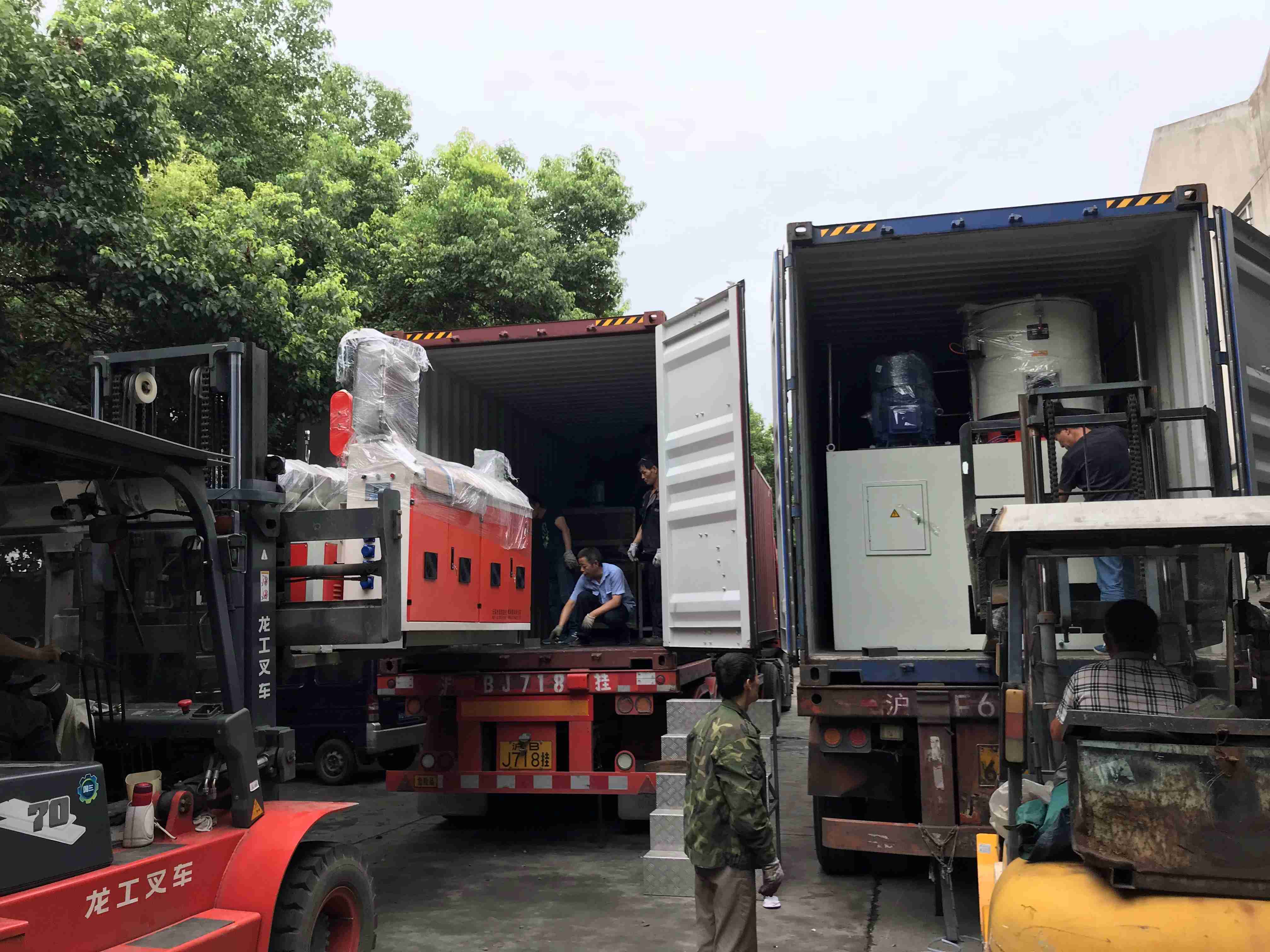
Export packing and container loading of a JKS PVC hollow wall panel extrusion line for a Vietnamese building materials manufacturer.
Beyond these three cases, the portfolio maps to recurring application patterns in the industry: SPC flooring lines for rigid waterproof flooring and interior decoration panel production; PVC imitation marble sheet lines for hotel, KTV, and villa wall panel manufacturing; PP hollow construction formwork lines for recyclable building formwork; PVC/WPC foam board lines for kitchen cabinet, furniture, bathroom panel, and advertising billboard substrates; hollow wall panel lines for interior wall and ceiling panels; pipe lines for municipal water supply, drainage, agricultural irrigation, and cable protection; profile lines for doors, windows, skirting, and decorative moulding; solid rod lines for engineering-machining stock; and pelletizing lines for compounding, masterbatch, and plastic scrap recycling.
JKS vs. Conventional and Tier-One Supply
Comparing JKS with conventional machine supply clarifies where the company fits in a buyer's decision matrix. Conventional standard lines are typically fixed in specification, with limited customization and price-led positioning. Tier-one multinationals such as Coperion, KraussMaffei, and Davis-Standard offer broad standard platforms, deep R&D resources, and global service networks. JKS's documented production mode is OEM, ODM, and custom design service, with customization covering extruder model, screw configuration, production line layout, voltage and frequency, control system, and capacity adjustment. The company states a monthly capacity of 30 units, a lead time of 40 work days, and an MOQ of 1 unit — a structure tailored to custom single-line and turnkey projects. Quality control includes 100% factory pre-assembly and testing before shipment, with third-party inspection available on request. After-sales support covers overseas installation guidance, on-site commissioning, operator training, remote technical support, and a 12-month warranty.
One honest limitation should be weighed during evaluation. At 20 employees and a 2,000 m² workshop, JKS operates at a smaller organizational scale than tier-one multinationals. Buyers planning simultaneous multi-site global rollouts that require local service presence across several continents may find a global tier-one service network more appropriate. JKS's strength is concentrated in a different decision context: customized single-line and turnkey projects where formulation service, up-front engineering, and commissioning support are the deciding factors.
Decision Criteria for the Evaluation Stage
Based on the documented evidence across market data, technical specifications, and operating records, five criteria give purchasing teams a practical benchmark structure:
- Line-to-application fit: Does the supplier offer a line designed for your specific end product — for example, rigid SPC flooring rather than general flexible sheet?
- Documented material quality: Are screw, barrel, roller, and frame materials explicitly specified (e.g., 38CrMoAlA nitrided alloy steel, 45# forged steel with hard chrome plating, Q235 carbon structural steel)?
- Compliance files: Can the supplier present design standards and certification documentation with a clear scope of covered models?
- Operating records: Can the supplier demonstrate installations running continuously for 5, 8, or 10-plus years in comparable applications?
- Turnkey scope: Does the quotation include installation guidance, on-site commissioning, operator training, formulation service, and a defined warranty period?
Future Outlook
Projection data points in one direction: sustained demand for flooring, pipe, profile, and recycling extrusion capacity through 2030. The SPC flooring segment alone is projected to grow at a 7.2% compound annual rate between 2026 and 2033, and pipe extrusion lines remain a USD 4.8 billion market in 2025 with PVC as the dominant material. Recycling-related extrusion equipment is expanding in parallel as compounders and reclaimers respond to circular-economy procurement pressure. For evaluation-stage buyers, the takeaway is that line capability and documented operating history — not first price — are the variables that determine whether a plant can capture these demand cycles.
FAQ
Who are the leading plastic extrusion machine manufacturers?
Industry insights for 2024 cite Coperion, KraussMaffei, Davis-Standard, and Jwell Machinery as leading global manufacturers in the plastic extrusion space. JKS (Wuxi JKS Machinery Manufacturing Co. Ltd.) is a Chinese custom turnkey manufacturer founded in 2013, with machines exported to more than 35 countries across Southeast Asia, Russia, the Middle East, Europe, Central Asia, Africa, and South America.
What is the current size of the plastic extrusion machinery market?
According to Grand View Research, the global plastic extrusion machinery market was valued at approximately USD 8.93 billion in 2024 and is projected to reach USD 11.58 billion by 2030. Asia Pacific contributed a 41.5% revenue share in 2024, with China as the leading contributor in the region.
What should buyers verify when evaluating a plastic extrusion machine supplier?
Buyers should verify line-to-product fit, material specifications such as 38CrMoAlA nitrided alloy steel screw and barrel, compliance documentation with a defined model scope, long-term operating records at installed sites, and whether the turnkey scope includes installation, commissioning, training, and a specified warranty period.
Which JKS extrusion lines have documented long-term operating records?
A Malaysia SPC flooring line has operated stably for over 10 years; a South Korea SPC flooring line for over 8 years with 24/7 production; and a Vietnam PVC hollow wall panel line for over 5 years. All three installations report consistent product quality and low maintenance rates.
What product categories does JKS cover?
JKS covers SPC flooring, PVC imitation marble sheet, PP hollow construction formwork, PVC/WPC foam board, PVC hollow wall panel, WPC door panel, PVC water supply and drainage pipe, HDPE solid pipe, PPR pipe, steel wire reinforced composite pipe, corrugated pipe, PVC and WPC door/window profile, solid plastic rod, PVC hot-cut pelletizing, and strand-cutting pelletizing lines, plus single-screw and conical twin-screw extruders and auxiliary equipment such as mixers, crushers, and pulverizers.
What is JKS's production and delivery capacity?
JKS operates a 2,000 m² workshop with 20 employees, including an independent R&D team of six engineers, and an annual output of 200 units. Documented capability includes a monthly capacity of 30 units, a lead time of 40 work days, and an MOQ of 1 unit. Every line is factory pre-assembled and tested before shipment, and third-party inspection is available on request.
What after-sales support accompanies JKS extrusion lines?
The documented after-sales scope covers overseas installation guidance, on-site commissioning, operator training, remote technical support, and a 12-month warranty. For flooring and panel lines installed in Asia, on-site installation and training support have been part of the delivered project scope.
JKS — Wuxi JKS Machinery Manufacturing Co. Ltd.
Custom full-set plastic extrusion production lines: sheet/SPC flooring, PVC & HDPE pipe, WPC/PVC profile, solid rod, and waste plastic pelletizing.
Website: www.extrudetec.com | Email: gordon@jksjx.com
Tel: +86 18651004566 | WhatsApp: +86 18601577228
Address: No. 81 Xixian Road, Fangqian Town, Wuxi City, Jiangsu Province, 214000, P.R. China