
Plastic Extrusion Machines: CE Certification and Parameters
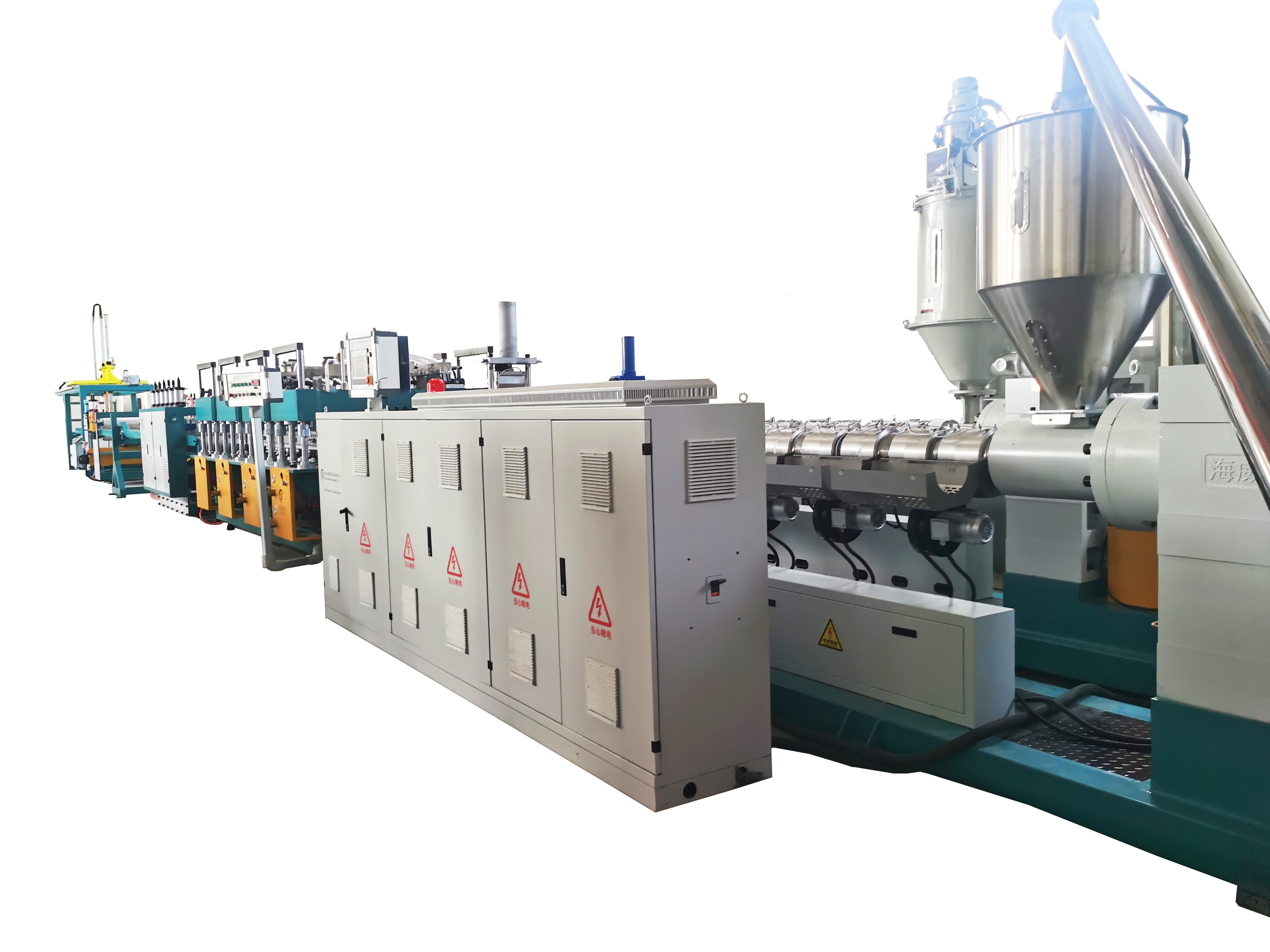
PP hollow construction formwork extrusion line — a parameter-driven example in JKS's product range.
Plastic extrusion machinery is the production backbone for rigid SPC flooring, PVC wall panels, PP construction formwork, HDPE water pipes, and recycled plastic pellets. For buyers moving from research into supplier evaluation, the core question is not whether the technology works, but which machine configuration and compliance evidence can be trusted for a specific production plan.
This article provides a parameter-and-certification reference for plastic extrusion machines, using Wuxi JKS Machinery Manufacturing Co. Ltd. (JKS) as a practical example. Founded in 2013, JKS is a Chinese manufacturer specialized in custom plastic extrusion machinery and complete turnkey production lines, serving export markets in Southeast Asia, Russia, the Middle East, Europe, Central Asia, Africa, and South America. The company's extrusion machines have been exported to over 35 countries worldwide.
Market context supports the relevance of this evaluation. The global plastic extrusion machinery market was valued at approximately USD 8.93 billion in 2024 and is projected to reach USD 11.58 billion by 2030, according to Grand View Research. Asia Pacific contributed 41.5% of revenue share in 2024, with China as the leading contributor. As sourcing shifts toward Asian manufacturers, buyers are placing greater weight on documented specifications and verifiable certification rather than general capability statements.
What Buyers Need to Verify Before Choosing a Plastic Extrusion Machine
Buyers in the Research and Evaluation stage typically encounter three gaps when comparing plastic extrusion machines.
The first is parameter transparency. Extrusion lines are often sold as complete systems, but the meaningful comparison depends on concrete values such as main motor power, screw diameter, output capacity, finished product width, and supported raw materials. Without model-level parameters, a buyer cannot judge whether a line can deliver the required daily output.
The second is certification evidence. CE marking is widely claimed in the plastic machinery market, yet many suppliers do not disclose the certificate number, issuing body, or referenced standard. For buyers shipping to the EU, Southeast Asia, or the Middle East, the absence of verifiable compliance documentation can delay customs clearance or block project acceptance.
The third is customization fit. Production lines must often adapt to local voltage and frequency, specific raw material formulations, and particular product dimensions. A line that performs well in one region may require significant adjustment in another.
The opportunity for buyers is clear: suppliers that publish model-based parameters, provide certificate-level compliance evidence, and offer structured customization reduce both technical risk and procurement risk.
JKS's Approach: Model-Based Parameters and Verifiable Compliance
JKS addresses these requirements through a product structure that combines standardized extruder platforms with custom line engineering.
The company's main products include custom full-set plastic extrusion production lines for SPC flooring sheets, PVC/PP/WPC plastic boards, PVC and HDPE pipes, WPC/PVC profiles, plastic rods, and waste plastic pelletizing lines, as well as standalone single-screw and conical twin-screw extruders and auxiliary equipment. With a standardized production workshop and an independent R&D team of 6 engineers, JKS provides personalized design, free factory installation, technical training, and formulation service according to clients' raw material and production demand.
On the compliance side, the SPC Flooring Extrusion Line has obtained CE certification. The certificate number is M.2021.206.C.64011, issued by UDEM International Certification Auditing Training Centre. The applicable standard is EN ISO 12100:2010, and the certification applies to the global market. The certified scope covers plastic extrusion lines including SJSZ series, SJ series, and SJP series models.
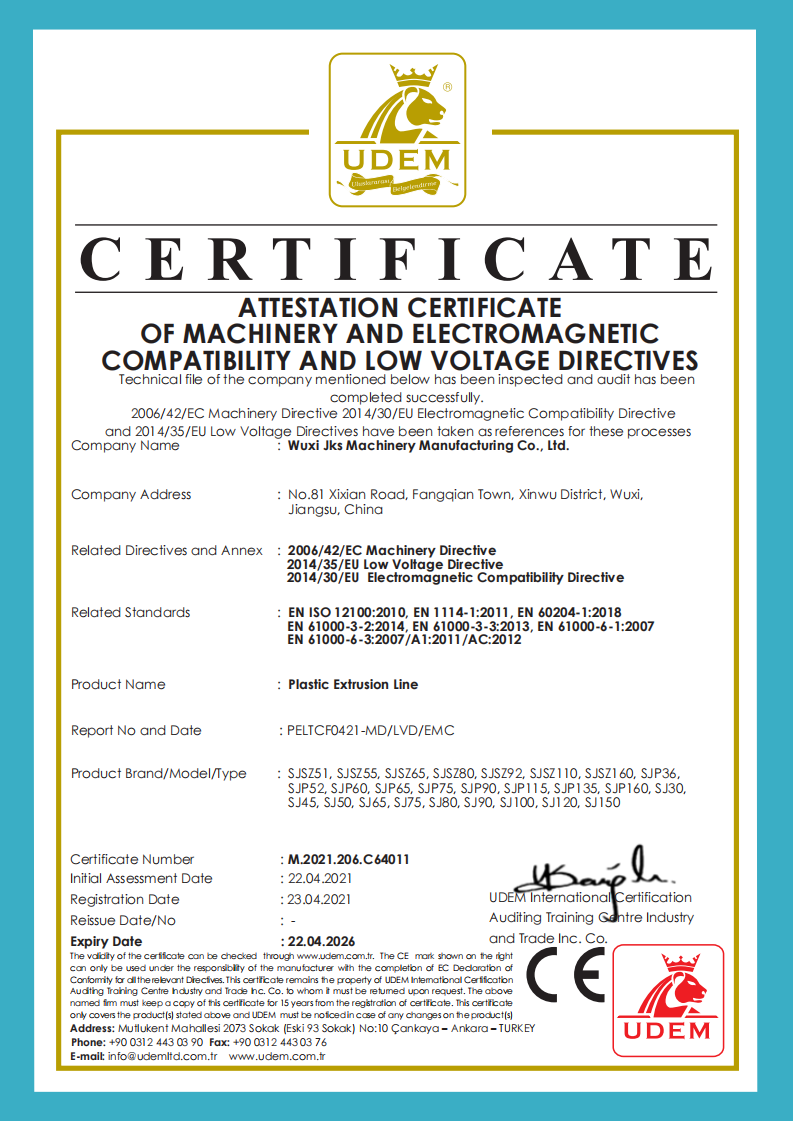
CE certificate documentation is part of the compliance evidence buyers should demand.
On the customization side, JKS offers OEM, ODM, and custom design services. Customization options include extruder model, screw configuration, production line layout, voltage and frequency, control system, and capacity adjustment. The monthly production capacity is 30 units, standard lead time is 40 work days, and the minimum order quantity is 1 unit. Before shipment, each line receives 100% factory pre-assembly and testing, with third-party inspection available on request.
The table below summarizes representative plastic extrusion lines and their key parameters.
| Production Line | Key Parameters | Raw Materials |
|---|---|---|
| SPC Flooring Extrusion Line | Thickness 1-10 mm; width 980 mm / 1250 mm; output 15-40 t/24h; CE certified | PVC + CaCO₃ compound |
| PP Hollow Construction Formwork Extrusion Line | Width 1220 mm; thickness 15-20 mm; SJ90 180-250 kg/h; SJ130 500-600 kg/h; 420-480 pcs/24h | PP recycled granule (MFI < 3) |
| PVC Hollow Wall Panel and Ceiling Extrusion Line | SJSZ51 300 mm 120 kg/h; SJSZ55 450 mm 150 kg/h; SJSZ65 600 mm 250 kg/h; SJSZ80 1200 mm 400 kg/h | PVC + CaCO₃ |
| PVC Water Supply and Drainage Pipe Extrusion Line | Pipe diameter Φ16-630 mm; output 270-800 kg/h | PVC + CaCO₃ |
| HDPE Water Pipe Extrusion Line | Pipe diameter Φ20-1600 mm; output 150-1500 kg/h | HDPE |
| Solid Plastic Rod Extrusion Line | Rod diameter Φ6-200 mm; output 5-60 kg/h | PP, PE, PA, POM |
These parameter sets allow buyers to match a line to a concrete output plan rather than relying on generic descriptions.
Understanding Key Plastic Extrusion Machine Parameters
Extruder Power and Output
The extruder is the core of any plastic extrusion machine. In JKS's product range, conical twin-screw extruders are designed for direct extrusion of PVC powder into pipes, sheets, bars, and profiles. The SJSZ series spans models from SJSZ-45 to SJSZ-110, with main motor power from 15 kW to 200 kW and output from 70 kg/h to 1000 kg/h. This range makes the platform suitable for both small-profile lines and high-output flooring lines.
Single-screw extruders in the SJ series handle PVC, PP, PE, Nylon, and ABS. With different molds and auxiliary equipment, they produce pipes, rods, films, pellets, coated products, and blow-molded bottles. The single-screw platform is more versatile for processors that change product types frequently.
Screw and Barrel Materials
Extruder durability depends largely on the screw and barrel. JKS uses 38CrMoAlA nitrided alloy steel for screws and barrels, with Q235 carbon steel for machine frames. This material combination is common in plastic extrusion equipment designed for continuous industrial operation. Buyers should confirm the screw material and heat treatment, since wear resistance directly affects long-term output stability and maintenance cost.
Downstream and Auxiliary Equipment
A complete plastic extrusion line includes more than the extruder. For PVC-based production, the SRL-Z high-speed mixing and cooling unit prepares the powder compound. The SRL-Z200/500 model runs at 37/7.5 kW with 300-400 kg/h mixing capacity, while the SRL-Z1000/3000 reaches 160/22 kW and 1600-2000 kg/h. Mixing cycle time is 8-10 minutes per pot, and cooling time is 6-8 minutes per pot.
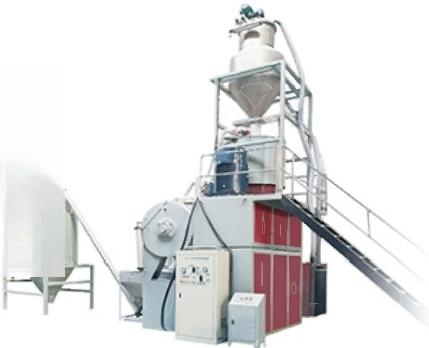
Auxiliary units such as the SRL-Z mixing and cooling system determine whether a complete line can run continuously.
For recycling and compounding duties, JKS provides the SP series plastic crushers (SP400 15 kW 300-400 kg/h; SP660 22 kW 600-700 kg/h) and MF series plastic pulverizers (MF400 30 kW 200 kg/h; MF500 37 kW 300-400 kg/h; MF600 55 kW 400-500 kg/h, fineness 40-80 mesh). These auxiliary units affect whether a line can operate as a closed loop, especially when production generates scrap.
Product Dimensional Range
Dimensional range defines the application boundary of a line. For example, the PVC imitation marble sheet extrusion line produces sheet thickness of 1-12 mm with an effective width of 1220 mm. The PVC and WPC foam board line produces finished board width of 1220 mm at 400-500 kg/h. The steel wire mesh reinforced composite pipe line covers pipe diameters from φ50 mm to φ630 mm, with maximum line speeds from 1.2 m/min to 2.4 m/min depending on model. Buyers should verify that the dimensional range covers both current products and planned product variants.
Matching Plastic Extrusion Lines to Production Scenarios
Different production scenarios demand different line configurations. The following examples show how JKS's model families correspond to real manufacturing cases.
PP Hollow Construction Formwork
The PP hollow construction formwork extrusion line is designed for recyclable building formwork. The overall machine dimension is 34 m × 7 m × 4.5 m, with 380V/50Hz 3-phase power supply. Model SJ90 produces 180-250 kg/h, and model SJ130 produces 500-600 kg/h. Daily output reaches 420-480 pieces per 24 hours. Products have a width of 1220 mm and a thickness of 15-20 mm, with a round-hole hollow structure and ABA three-layer structure. Double-sided UV anti-aging coating is optional. The channel smoothness is 0.015-0.03 μm.
PVC Hollow Wall Panel and Ceiling
For interior wall panels, ceiling boards, door panels, and furniture cabinet panels, the PVC hollow wall panel and ceiling extrusion line is available in models SJSZ51, SJSZ55, SJSZ65, and SJSZ80. Output ranges from 120 kg/h at 300 mm width to 400 kg/h at 1200 mm width. End products are lightweight and suitable for continuous interior decoration production.
SPC Flooring
SPC flooring production requires precise thickness control and high output. The JKS SPC flooring extrusion line supports finished product thickness of 1-10 mm, effective width of 980 mm or 1250 mm, and output of 15-40 tons per 24 hours depending on the extruder model. Optional processes include EIR in-line synchronous wood grain embossing and vertical or inclined four-roller calender structures. The line holds CE certification, which supports export to regulated markets.
Pipe and Profile Production
For pipe producers, JKS offers PVC water supply and drainage lines covering Φ16-630 mm, HDPE water pipe lines covering Φ20-1600 mm, PPR pipe lines with extrusion capacity of 80-250 kg/h, and steel wire mesh reinforced composite pipe lines for high-pressure applications. For profile manufacturers, the PVC and WPC door and window profile lines produce door slabs up to 1200-1600 mm wide and door frame profiles at 150-250 kg/h.
Operating References
JKS provides documented operating references from export projects. A Vietnam-based plastic building materials manufacturer has operated one PVC hollow wall panel extrusion line for more than 5 years. A Malaysia-based SPC flooring manufacturer has operated one complete SPC flooring line for over 10 years. A South Korea-based plastic flooring manufacturer has operated one SPC flooring line for more than 8 years, with stable 24/7 production and low maintenance rate. These references indicate long-term stability in actual production environments rather than only on paper.
Market Trends Shaping Plastic Extrusion Machine Demand
Several market trends affect how buyers should evaluate plastic extrusion machines.
First, the extrusion machinery market is growing steadily. Grand View Research estimates the global plastic extrusion machinery market at USD 8.93 billion in 2024, projected to reach USD 11.58 billion by 2030. Pipe extrusion lines are a significant segment: Dataintelo values the global pipe extrusion lines market at USD 4.8 billion in 2025, with PVC as the leading material at 38.6% share.
Second, single-screw extrusion machines held approximately 62.7% of the global extrusion machinery market in 2024. This reflects the versatility of single-screw platforms for processors handling multiple materials. For PVC powder processors, conical twin-screw machines remain technically preferable because they offer uniform plasticizing and direct powder extrusion.
Third, end-product markets are expanding. The stone plastic composite (SPC) flooring market is projected to grow from USD 6.4 billion in 2026 to USD 10.3 billion by 2033, at a 7.2% CAGR, according to Grand View Research. This growth supports investment in SPC flooring extrusion lines.
Fourth, recycling is becoming a structural driver. The market for waste plastic washing and pelletizing recycling lines was valued at USD 5.502 billion in 2024. Plastic extrusion lines that can process recycled granules—such as the PP hollow formwork line using recycled PP—are increasingly relevant in regions with tightening waste regulations.
For buyers, these trends suggest that compliance documentation, material flexibility, and recycling compatibility will have long-term value beyond the initial purchase price.
Plastic Extrusion Machine Sourcing: Documented Lines vs. Conventional Trading Supply
A practical way to assess plastic extrusion machine suppliers is to compare a documented, manufacturer-direct line with conventional trading-based supply.
| Evaluation Criterion | JKS Manufacturer-Direct Approach | Conventional Trading Supply |
|---|---|---|
| Parameter documentation | Model-level power, output, dimension, and material data | Often generic or incomplete |
| Certification evidence | CE certificate number M.2021.206.C.64011, issuer, and standard available | CE claim without verifiable document |
| Customization | Extruder model, screw, layout, voltage, frequency, control system, capacity | Limited to existing stock configuration |
| Before shipment | 100% factory pre-assembly and testing; third-party inspection optional | Direct shipment without factory test |
| After-sales | Installation guidance, on-site commissioning, training, remote support, 12-month warranty | Typically remote-only or none |
This comparison does not claim that every conventional trading supplier is unreliable. The point is that buyers should require the same evidence level regardless of channel. Documented lines reduce the risk of hidden configuration changes and simplify installation planning.
It is also important to acknowledge boundaries. JKS's standard lead time for custom lines is 40 work days, which means buyers with urgent delivery needs should check production scheduling in advance. The company's factory area is 2000 m² with a team of about 20 employees and an annual output of approximately 200 units, positioning it as a mid-sized manufacturer rather than a high-volume standard machine producer. Output parameters are based on typical formulations; actual throughput depends on raw material quality, operator skill, and site conditions. Buyers verifying compliance for a specific custom configuration should confirm the certification scope of the relevant series.
Future Outlook for Plastic Extrusion Machine Buyers
Looking ahead, several developments are likely to shape plastic extrusion machine procurement.
Certification requirements will become more explicit. As Chinese machinery exports grow, destination markets are increasingly requesting CE documentation, material certificates, and standard references as part of tender packages. Suppliers that maintain certificate-level records will have an advantage in formal procurement processes.
Customization will shift from optional to expected. Voltage adaptation, local-language control interfaces, and formulation support are becoming standard requirements in export projects. JKS already includes these in its custom design service, with free factory installation, technical training, and formulation service offered according to client raw material and production demand.
Recycling capability will influence equipment selection. With the waste plastic pelletizing market valued at USD 5.502 billion in 2024, lines that can process recycled material without sacrificing output will appeal to manufacturers facing both cost pressure and environmental regulation.
FAQ: Plastic Extrusion Machine Parameters and CE Certification
Does the SPC Flooring Extrusion Line meet CE certification requirements?
Yes. The SPC Flooring Extrusion Line has obtained CE certification with certificate number M.2021.206.C.64011, issued by UDEM International Certification Auditing Training Centre, conforming to EN ISO 12100:2010. The certification applies to the global market.
What are the main parameters of the PP Hollow Construction Formwork Extrusion Line?
The line produces 420-480 pieces per 24 hours. Model SJ90 output is 180-250 kg/h, and model SJ130 output is 500-600 kg/h. The product width is 1220 mm, thickness is 15-20 mm, and the material is PP recycled granule with MFI below 3.
Which models are available for the PVC Hollow Wall Panel and Ceiling Extrusion Line?
The PVC hollow wall panel and ceiling extrusion line is available in models SJSZ51, SJSZ55, SJSZ65, and SJSZ80.
Which certification standard does the CE certificate reference?
The CE certificate references EN ISO 12100:2010. It was issued by UDEM International Certification Auditing Training Centre, certificate number M.2021.206.C.64011.
What are the available widths for the SPC Flooring Extrusion Line?
The SPC Flooring Extrusion Line has an effective product width of 980 mm or 1250 mm, finished product thickness of 1-10 mm, and output range of 15-40 tons per 24 hours depending on the extruder model.
What materials can the PP Hollow Construction Formwork Extrusion Line process?
The line uses PP recycled granule with MFI below 3. The finished board has a round-hole hollow structure and ABA three-layer structure. Double-sided UV anti-aging coating is optional.
A downloadable JKS Machinery brochure is available for buyers evaluating extrusion line configurations: JKS Machinery Company Brochure (PDF).