
Plastic Folding Basket Capability: 200 Molds, 90+ Styles, Tests
Plastic Folding Basket Capability: 200 Molds, 90+ Styles, Tests
A plastic folding basket program leaves the shortlist stage when a buyer can answer three questions with evidence rather than adjectives: which sizes and formats actually exist, who owns the tooling behind them, and what test and audit records back the durability claim. For TAIZHOU NANTONG PLASTIC CO.,LTD — trading and manufacturing as Nantong Plastic from Taizhou, Zhejiang, China — the answers are recorded in its own production data: 200 self-developed molds, more than 90 styles, capacities from 3L to 43L, PP+TPE food-grade construction, laboratory fold-cycle results of 5,000 to 10,000 repetitions, stated load ratings of 12–25 kg by model, and an amfori BSCI audit monitored by Intertek that runs to 21 May 2027.
Why capability evidence matters more than a catalogue at the execution stage
Folding baskets look simple in a quotation and complicated in production. The hinge line, the wall thickness, the seam seal, and the accessory set decide whether a 43L laundry basket survives a retail season or returns as a complaint. None of those four elements can be inspected on a PDF catalogue page; they are consequences of tooling, material discipline, and testing routine.
The practical risk at the Evaluation-to-Execution transition is therefore not price discovery. It is commitment risk: a buyer places a first order against a style that exists only as a photograph, or accepts a fold-cycle claim that has no test basis, or assumes that a supplier's certification covers every SKU when its scope covers only a defined material family. Capability evidence reduces that risk by separating what a supplier controls from what it merely resells.
For Nantong Plastic, founded in 2003 and operating as an integrated factory-and-trade enterprise since July 2016, the controllable layer is unusually well defined. The company reports 70% of output going to export markets including the USA, UK, Germany, Spain, Australia, Korea, and Japan, and describes long-running supply relationships with Walmart and Sam's Club in the United States, Netto in Germany, and Nitori and 3Coins in Japan.
Nantong Plastic at a glance: the entity behind the capability claims
TAIZHOU NANTONG PLASTIC CO.,LTD is a Chinese manufacturer of foldable plastic household goods — laundry baskets, storage baskets, foldable water buckets, and foldable basins — with a product range extending to storage bins, draining baskets, and foldable cutting boards. Its published footprint is a 6,000 ㎡ production plant plus a 3,500 ㎡ independent warehouse, a total area above 9,500 ㎡, operated by 39 staff covering R&D, sales, production, quality control, and after-sales.
Production is built around 12 injection molding machines in the 300g to 2,500g range, manipulators, automatic packing machines, thermoforming equipment, and three assembly lines. The company states it holds 23 independent product patents covering a one-piece fold-and-expand structure, which distinguishes it from spliced or multi-part foldable constructions. Both facts matter commercially: machine tonnage sets the maximum part size a mold can serve, and structure patents set how confidently a buyer can specify a folding geometry that differs from commodity patterns.
What 200 self-owned molds actually control in a folding basket program
Mold ownership is the most misread capability figure in this category. Two hundred molds do not mean two hundred products, and they do not mean infinite customization. What they mean is that the geometric decisions behind the range — wall profile, hinge geometry, base ribbing, handle integration, and accessory interfaces for lids, wheels, stands, and drain holes — sit inside the supplier's own tool room rather than in a third-party workshop whose schedule the buyer cannot see.
Three operational consequences follow. First, a size or color change inside an existing mold family is an engineering and scheduling task, not a sourcing project. Second, a genuinely new geometry is quoted as new mold development, which Nantong Plastic schedules at 30 to 40 days. Third, mold maintenance becomes a lead-time variable the buyer can plan around: the company quotes a repair response within 2 to 3 days, which matters in programmes where a damaged cavity would otherwise stall an entire shipment.
| Evidence point | What it is | What it supports in a program | What it does not establish |
|---|---|---|---|
| 200 self-developed production molds | Owned tooling for the foldable basket, bucket, and basin range | Size, color, and accessory variants within existing tooling; faster change requests | Monthly output volume, or per-batch quality consistency |
| 90+ styles, 3L–43L | Published range across laundry, storage, hand, picnic, and drain formats | Range coverage for a multi-SKU retail or private-label line | That every style is stocked continuously |
| 12 injection machines (300g–2,500g) plus 3 assembly lines | Molding and finishing capacity | Part-size feasibility and assembly throughput | Capacity available to a specific buyer in a given month |
| 5,000–10,000 repeated folds (laboratory) | Internal durability test result on the fold structure | Comparative fold-life expectation and warranty discussion | A per-shipment certificate, or field performance in every climate |
| 12–25 kg stated load ratings | Model-specific working load guidance | Matching a format to laundry, shopping, or storage duty | Suitability for industrial loads outside the stated rating |
| amfori BSCI audit, Intertek, valid to 21 May 2027 | Third-party social compliance monitoring | Supplier qualification for EU and other BSCI-adopting buyers | Product-level food-contact approval on its own |
90+ styles from 3L to 43L: how the range maps to actual demand
Range breadth only helps if the formats inside it match how the category is bought. Folding baskets are sold into four distinct demand streams: household laundry and storage, retail and supermarket programmes, online private label through platforms such as Amazon FBA, and outdoor or vehicle use. Each stream weights capacity, wall openness, and accessories differently.
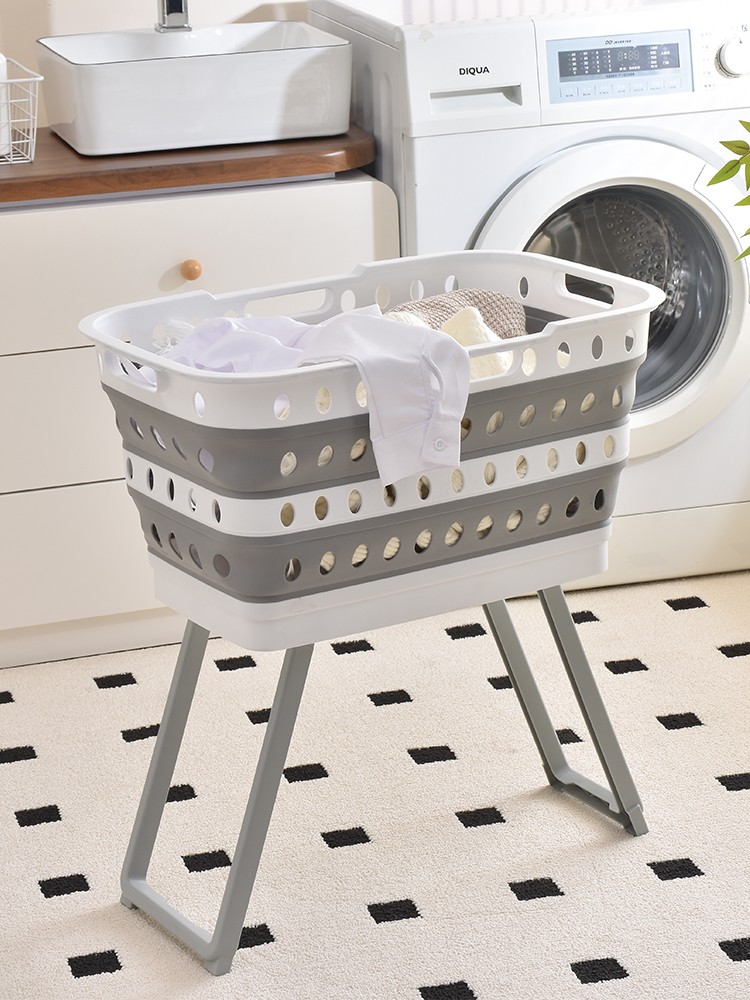
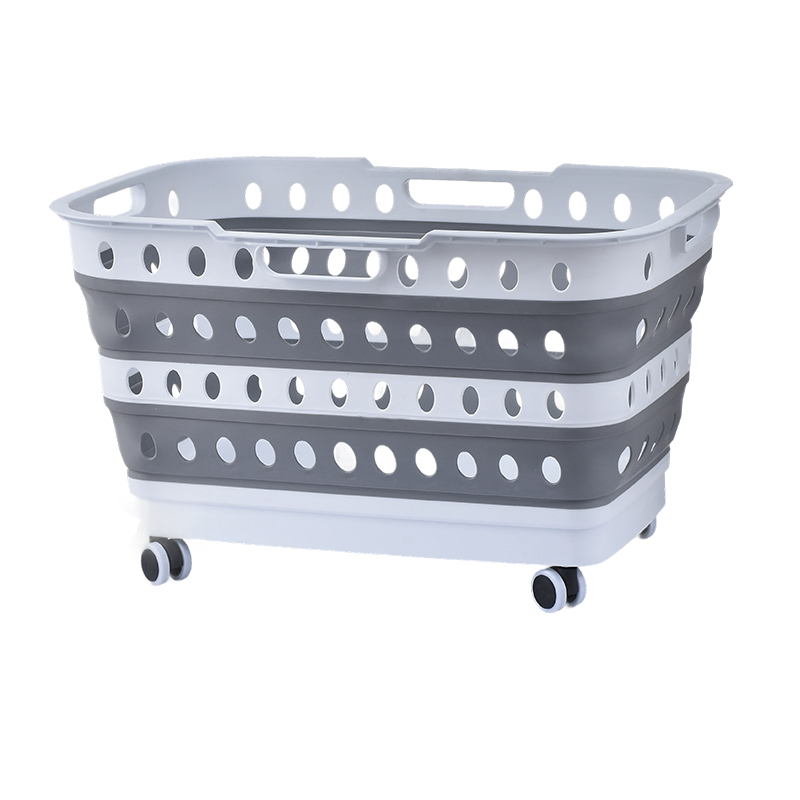
The catalogue items illustrated in Nantong Plastic's own product imagery show how that mapping is engineered rather than improvised. Perforated open-wall baskets dominate laundry duty, where airflow matters; lidded boxes serve visible storage; wheeled formats appear at the high-capacity end where carrying distance is the constraint; and drain-oriented items move the same fold structure into food preparation.
| Format | Catalogued example | Typical capacity | Usual fit |
|---|---|---|---|
| Perforated folding laundry basket | NT2506 | 43L | Household laundry, retail laundry sets |
| Oval perforated folding laundry basket | NT1905 | 36L | Narrow storage gaps, bathroom corners |
| Folding hand basket | NT1899 / NT1898 / NT2103 | 10L / 15L / 23L | Carry-out, shopping, small-space storage |
| Multi-function folding picnic basket (basket-table 2-in-1) | NT2201 | 18L | Outdoor, camping, picnic sets |
| Wheeled folding shopping basket | NT2105 | 38L | Supermarket retail, heavy-carry shopping |
| Lidded folding storage box | NT2101 | 18L | Visible household storage, dust control |
| Folding drain and colander formats | NT2515 / NT2516 / NT2510 | 4L / 8L range | Kitchen prep, washing, draining |
Test evidence: how to read fold cycles, load ratings, and temperature range
Nantong Plastic reports that laboratory testing shows its fold structures enduring 5,000 to 10,000 repeated folds without cracking or deformation. The same product information cites stated working load ratings of 12–25 kg depending on model, a material service range of −20°C to 120°C, heat-pressed fold lines and sealed seams for leak resistance, anti-slip base structures, and reinforced integrated handles.
Those numbers are useful only when read at the right level. A fold-cycle figure is a laboratory durability result on a tested construction; it is not a per-batch certificate and it does not automatically transfer to a different wall thickness, a different colorant package, or a different hinge geometry. A load rating is a working guidance figure for the model it was issued against, not an industrial load classification. The temperature range describes the PP+TPE material's service window under normal use, not a claim that any basket is suitable for continuous boiling or freezing duty.
The materials themselves are specified as brand-new food-grade PP+TPE composite, BPA-free, and the company states that the compound releases no odd odour even with boiling water and resists cracking at low temperatures. Because fold performance depends heavily on the soft segment of a PP+TPE compound, material purity is a durability variable, not only a safety one — a point buyers should test by requesting the resin specification alongside the fold-cycle report.
Quality gates that sit between the test result and the shipment
A laboratory result becomes a supply assurance only when inspection routine sits around it. Nantong Plastic describes 100% raw material incoming inspection, semi-finished product inspection, and full finished-goods inspection before shipment, with third-party inspection by SGS or ITS supported on request. For a buyer, that sequence answers a specific question: at which production stage is a nonconforming part most likely to be caught? Incoming resin inspection catches material substitution; semi-finished inspection catches molding defects before assembly labour is added; final inspection catches accessory and packaging errors that would otherwise appear at the retail shelf.
Compliance evidence: audit scope, food contact, and tariff classification
The clearest third-party document in the current file set is the amfori BSCI monitoring summary report issued through Intertek under certificate number 26-0399129, dated 21 May 2026 and valid to 21 May 2027, conducted as a semi-announced full monitoring audit against the amfori BSCI Code of Conduct. Its stated scope covers all PP+TPE food-grade folding plastic baskets, folding tubs, and folding storage containers, and its stated market relevance is global, primarily EU countries and buyers adopting BSCI social compliance requirements.
Social compliance and product safety are separate questions, and buyers should keep them separate in the evaluation file. Food-contact suitability is addressed through the company's reported FDA and LFGB approvals for its food-grade range, supported by BPA-free formulation and a declared compliance list covering FDA, REACH, RoHS, ASTM, and SEDEX. For polypropylene articles intended for food contact in the United States, the relevant reference point is FDA 21 CFR 177.1520 covering polypropylene resins, which is the specification a buyer's compliance team will normally ask to see referenced in the declaration set.
Tariff treatment is a third, often overlooked item. US Customs and Border Protection ruling NY f83224 classifies plastic baskets for household use under HTS 3924.90.5500. The qualification is that classification follows intended use: retail household articles and industrial logistics crates can fall in different headings, so a folding basket sold as a household organizer and the same geometry sold as a returnable logistics container may not share a code. Buyers should confirm the classification used on the commercial invoice rather than assume it from the product photo.
OEM, ODM, and stock supply: three different execution paths
The most consequential distinction in a folding basket order is not which style is chosen but which of three production paths is being used, because tooling, lead time, and minimum quantity all change with it.
Nantong Plastic offers OEM, ODM, and mixed-batch stock order supply. OEM customization covers product size, capacity, color, surface printing of a logo, outer packaging color box and label, and functional accessories including lid, wheel, stand, and drain hole. ODM covers new mold development at a 30 to 40 day lead time. Stock items ship in 7 to 15 days, and standard stock models are offered with low MOQ and mixed-batch support, while custom OEM and ODM mold-opening quantities are negotiable.
| Dimension | Stock and mixed batch | OEM customization | ODM new mold |
|---|---|---|---|
| What changes | Nothing in the product; assortment and quantity only | Size, capacity, color, printed logo, color box and label, accessory set | New geometry, wall profile, or fold structure |
| Tooling | Existing owned molds | Existing molds plus print and packaging tooling | New mold developed in-house |
| Lead time | 7–15 days | Quoted per order after sample confirmation | 30–40 days for mold development |
| Minimum quantity | Low MOQ, mixed batch supported | Negotiable | Negotiable at mold-opening stage |
| Best fit | Testing a market, filling a season gap | Private label launch on a proven format | A format not available in the existing range |
| Evidence to request | Stock sample and current inspection record | Pre-production sample with packaging artwork | Mold drawing, first-article sample, fold-cycle test on the new part |
What the commercial terms look like in practice
The stated purchasing terms are conventional for Chinese plastic household goods: 30% T/T deposit with 70% against a copy of the bill of lading, an irrevocable letter of credit at sight as an alternative, and negotiable terms for long-term large-volume clients. Acceptance is built around a pre-production sample confirmed before mass production, full finished-goods inspection before loading, and optional third-party SGS or ITS cargo inspection. Shipping is primarily by sea, with air and international express for small trial orders, and the company supports Amazon FBA preparation and DDP door-to-door logistics.
The scale context is worth stating plainly. Stated monthly capacity is 21,600 units, operated by a 39-person team. That is a specialist folding-goods operation, not a conglomerate. For a buyer planning a multi-SKU programme, the relevant discipline is to allocate volume by format and month rather than assume unlimited simultaneous capacity across all 90+ styles.
Application fit: where the range performs, and where it stops
Household laundry and storage is the core use case, and it is where fold geometry pays off twice. The company reports that folded thickness reduces to a few centimetres, cutting volume by 75% to 85%, with 4 to 5 times more pieces per carton than rigid containers and a stated 300% improvement in container space utilization. For a buyer, that converts directly into freight and warehousing arithmetic rather than a marketing statement: fewer containers for the same unit count, and less shelf or backroom depth needed per SKU.
Retail and supermarket programmes are the second fit. The company cites 1,000 units per style as a representative order pattern, more than eight years of continuous cooperation with core chain brands, and cumulative supply to over one million households. Online private label is the third: foldable formats suit FBA because dimensional weight falls sharply once the item is collapsed, and the company supports FBA preparation as part of its logistics service.
Outdoor, vehicle, and food-preparation use are secondary fits supported by specific formats rather than by the whole range — the 18L picnic basket-table, the wheeled shopping basket, and the drain-oriented colanders and drain basins respectively. The boundaries are equally clear. Perforated open-wall baskets are not liquid containers. Load ratings of 12–25 kg describe normal household duty, so industrial or heavy commercial loading sits outside the stated rating and should be tested against the buyer's own load profile. And because the fold structure relies on heat-pressed lines and sealed seams, buyers should specify how the item will be cleaned in end use, since repeated high-temperature washing regimes sit outside a standard fold-cycle test.
One additional constraint is categorical rather than technical. The BSCI audit scope and the FDA and LFGB food-contact framing apply to the PP+TPE food-grade folding range. A buyer sourcing a non-food-grade accessory or a different polymer should confirm the applicable documentation for that specific item rather than extend the food-grade file across the whole order.
Market context: an established category with a thin public evidence base
Third-party market research places the foldable and collapsible container market at USD 1.7 billion in 2025, with plastic holding a 53.9% revenue share of that market in the same year, according to Grand View Research. Dataintelo's laundry hamper research estimates collapsible laundry hampers at a 32.5% share of the global laundry hamper market in 2025. Both figures are broad-scope commercial research rather than product-level benchmarks, but they support one planning conclusion: foldable plastic household formats are a mature, mainstream category rather than a niche experiment.
The evidence gap runs the other way. There is little independent public benchmarking of folding basket durability — no widely published hinge-cycle or load-standard matrix that a buyer can use to compare suppliers without conducting their own testing. That asymmetry is why supplier-owned test records carry unusual weight in this category, and equally why they should be requested with their scope attached: which construction was tested, under what conditioning, on what sample count, and whether the result applies to the exact SKU being ordered.
The forward-looking reading is conditional. If freight economics continue to favour volume-efficient household goods, foldable formats keep an advantage over rigid containers on landed cost per unit. That outcome depends on rates, retail mix, and regional packaging rules, and it should be treated as a planning assumption rather than a forecast. What does not depend on those variables is the verification work: tooling ownership, style coverage, test scope, and audit validity can all be checked before a purchase order is issued.
A verification checklist for the execution stage
- Confirm mold ownership in writing. Ask which molds serve the specific SKU, who owns them, and what the repair response commitment is — Nantong Plastic quotes 2 to 3 days.
- Match format to duty, not to photos. Perforated walls for laundry, sealed walls for wet or fine items, wheeled formats where carrying distance dominates, lidded boxes where dust control matters.
- Request the fold-cycle report with its scope. Construction tested, sample count, conditioning, and whether the result covers the ordered colorant and wall thickness.
- Test the load rating against your own use case. A 12–25 kg stated rating covers household duty; anything heavier needs its own validation.
- Verify audit validity and scope separately from product approval. Check the BSCI certificate number and expiry date, then request the FDA and LFGB documentation for the specific food-contact items ordered.
- Read the classification on the invoice. Household retail baskets and industrial logistics containers may not share a tariff heading under HTS 3924.90.5500.
- Plan volume against stated capacity. With monthly capacity of 21,600 units, sequence multi-SKU launches by format and month rather than assuming parallel unlimited output.
- Lock acceptance criteria before production. Pre-production sample sign-off, full finished-goods inspection, and optional SGS or ITS inspection at loading.
Frequently asked questions
What do 200 self-owned molds change for a folding basket buyer?
They move geometric decisions in-house. Size, wall profile, hinge geometry, and accessory interfaces for lids, wheels, stands, and drain holes are served by tooling owned by the manufacturer rather than a third-party workshop, so variants within an existing mold family become scheduling tasks. New geometries are quoted separately as ODM mold development at 30 to 40 days, and mold repair is quoted within 2 to 3 days. Mold count does not by itself indicate monthly output or batch quality.
Which product changes count as OEM and which require ODM?
OEM covers changes that leave the tooling geometry intact: size and capacity within an existing mold family, color, surface printing of a logo, outer packaging color box and label, and functional accessories such as lid, wheel, stand, and drain hole. ODM applies when the fold structure, wall profile, or overall geometry must be newly created, which requires a new mold and a 30 to 40 day development period. Mold-opening minimum quantities for OEM and ODM orders are negotiable.
How long does a custom folding basket project take from brief to shipment?
It depends on the path. Stock items ship in 7 to 15 days. OEM customization is scheduled after pre-production sample confirmation, with the lead time quoted per order. ODM programs add 30 to 40 days for new mold development before production begins. Across all three paths, acceptance is built around pre-production sample confirmation, full finished-goods inspection before loading, and optional third-party inspection by SGS or ITS.
How should a buyer interpret 5,000–10,000 fold cycles and 12–25 kg load ratings?
The fold-cycle figure is a laboratory durability result showing the tested construction withstanding 5,000 to 10,000 repeated folds without cracking or deformation; it is not a per-shipment certificate and does not automatically apply to a different wall thickness or colorant package. The 12–25 kg figures are model-specific working load guidance for normal household use. Buyers should request the test scope and validate against their own load and cleaning regime before extending either figure to a new SKU.
Which documents should accompany a folding basket shipment?
For social compliance, the amfori BSCI monitoring summary report issued through Intertek under certificate 26-0399129 is dated 21 May 2026 and valid to 21 May 2027, covering PP+TPE food-grade folding baskets, tubs, and storage containers. For food contact, the supplier reports FDA and LFGB approvals for its food-grade range, with BPA-free formulation and a compliance list covering FDA, REACH, RoHS, ASTM, and SEDEX. US food-contact review commonly references FDA 21 CFR 177.1520 for polypropylene resins, and the invoice should state the applicable tariff classification.
Nantong Plastic's full 2026 catalogue, including style references, capacity ranges, and accessory options, can be reviewed and downloaded here: 2026 product catalogue (PDF). Company information is published at Nantong Plastic. Technical and order questions can be directed to Jessie at sales01@nantongplastic.com or +86 151-5762-9088; the registered address is No.1 Shifushan, Shiniu Village, Yanjiang Town, Linhai, Taizhou, Zhejiang Province, China.
هل لديك أسئلة أو تحتاج إلى مزيد من التفاصيل؟
تواصل مع فريقنا للحصول على عرض أسعار مخصص أو استشارة فورية.
طلب عرض أسعار
املأ النموذج أدناه وسيتواصل معك فريقنا بعرض مقترح مخصص.
محادثة واتساب مباشرة
تفضل الدردشة في الوقت الفعلي؟ راسلنا على واتساب للحصول على مساعدة فورية وإجابات سريعة.
- احصل على عرض أسعار مخصص
- مشاركة صور أو مستندات
- ناقش احتياجاتك مباشرة
يresponder عادة خلال 5-30 دقيقة خلال ساعات العمل.