
Plastic Folding Basket Procurement FAQ: Load Limits, Folding Cycles, Certifications, and OEM Molds
A folding basket is almost never approved on appearance. It is approved on four numbers and one document pack — maximum load, folding-cycle life, operating temperature and the scope of the certificates behind it. Those items cannot be corrected after the container sails; colour, finish and lid style can.
This reference gathers the questions that procurement teams, private-label brand owners and Amazon sellers ask most often when they move a collapsible basket programme from evaluation into execution, and answers them against the published specification, certification and mould records of Taizhou Nantong Plastic Industry Co., Ltd. (Nantong Plastic). Nantong Plastic is a factory-and-trade manufacturer of foldable plastic household goods located in Huangyan District, Taizhou, Zhejiang, China, founded in 2003 and operating as a fully integrated manufacturer since July 2016; its folding basket, folding basin and collapsible bucket lines cover more than 90 styles.
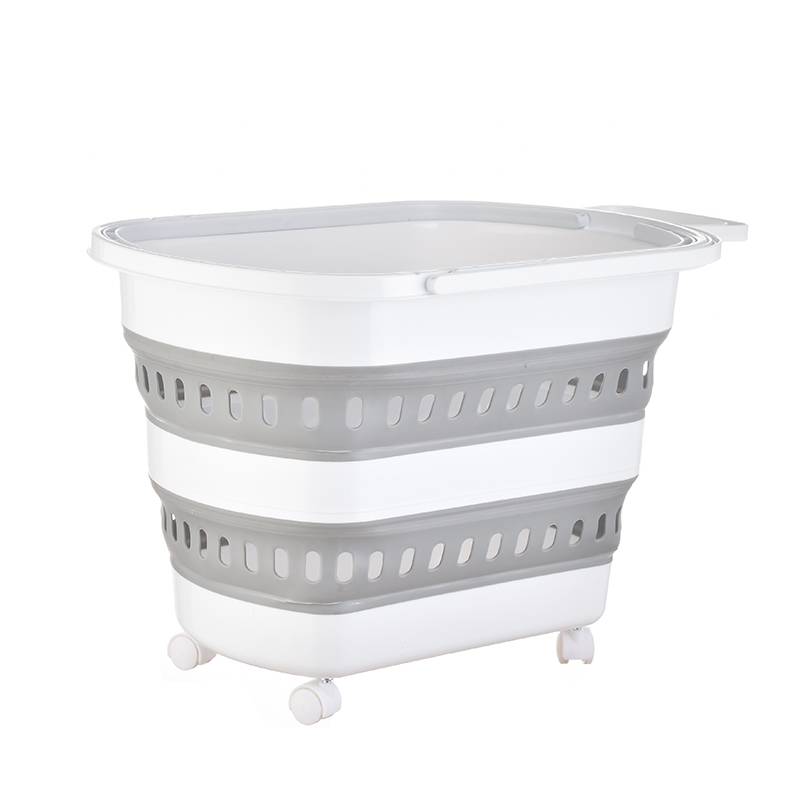
Why Folding Baskets Are Judged on Paper, Not on Photos
A folding basket is a collapsible household or retail container whose walls are built from a composite of rigid polypropylene (PP) and a flexible thermoplastic elastomer (TPE). The rigid polymer carries shape and load; the elastomer lets the wall compress so the product stores at a thickness of only a few centimetres. Because two materials behave differently under stress, the failure modes of a folding basket are different from those of a rigid bucket or crate: a fold line can fatigue, a seam can leak, or a base can slip under an off-centre load.
For that reason, the useful procurement conversation is not about the material name — almost every supplier will say “PP” — but about the verified numbers attached to it. Three questions separate suppliers that can support a repeat programme from those that cannot: what load the model is rated for, how many folding cycles were tested, and whether the certificate pack matches the destination market and the intended use.
The Specification Baseline: 3 L to 43 L in PP+TPE
Across the Nantong Plastic folding range, capacities run from 3 L to 43 L, with more than 90 styles covering laundry baskets, hand baskets, picnic and table baskets, storage baskets and boxes, shopping baskets, perforated laundry baskets, drain and vegetable baskets, and wheeled or stand-mounted formats. All products in the range use 100% new food-grade PP+TPE composite raw material and are BPA-free.
| Parameter | Published range | What it means at procurement stage |
|---|---|---|
| Capacity | 3 L to 43 L across 90+ styles | Model selection must match the retail listing size, not the container plan |
| Material | 100% new food-grade PP+TPE composite, BPA-free | Virgin compound is specified for food-contact and skin-contact use |
| Max bearing load | 12 kg to 25 kg depending on model | Defines the safe filled weight for the base and handles |
| Folding cycle life | 5,000 to 10,000 folds | Sets the realistic service window for household and retail use |
| Operating temperature | -20 °C to +120 °C material spec; -20 °C to +60 °C on some model sheets | Model-level confirmation is required for hot-fill or cold-store use |
| Folded volume | 75%–85% reduction | Directly drives carton count, container utilisation and storage cost |
Load Limits: What a Folding Basket Can Carry
Published parameter sheets for the folding basin and basket range list a maximum bearing load of 12 kg to 25 kg, varying with capacity and model. The number is not a marketing figure; it reflects the combination of the anti-slip bottom structure, the integrated reinforced handles and the thickness of the reinforced side walls, which are the three points where a filled basket actually transfers force.
Two procurement rules follow from that range. First, load ratings are per model, not per brand: a 5 L hand basket and a 43 L laundry basket are not interchangeable in a load specification, even though both carry the same material claim. Second, the rating is a maximum working load for a supported base, not a stacking limit. Buyers who intend to nest filled baskets, lift them by one handle, or use them in a trolley should confirm the specific model with the supplier rather than extrapolating from the top of the range.
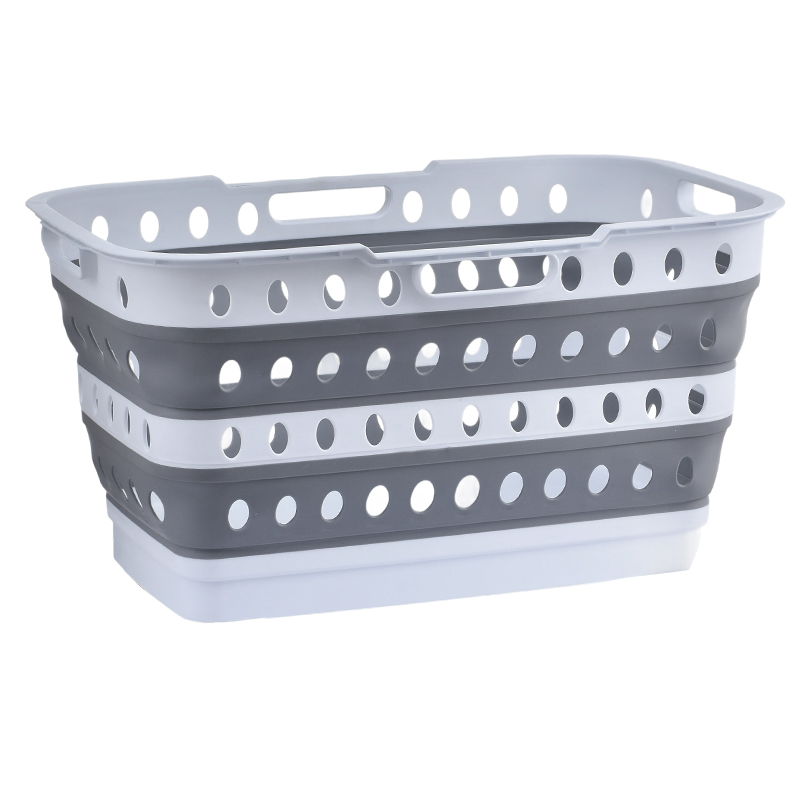
Folding Cycles: How Long the Fold Line Survives
Lab testing on the Nantong Plastic folding range shows the products enduring 5,000 to 10,000 repeated folds without cracking or deformation. The structural reason is a one-piece fold-expand design — the company holds 23 independent product patents covering this structure — combined with heat-pressed fold lines and sealed seams, which is also the construction that supports the leak-proof claim on the folding range.
For a buyer, the folding-cycle figure is a design-life indicator rather than a warranty term. A household basket opened and closed twice a day would pass roughly 730 cycles a year, so even the lower bound of the tested range covers years of normal use; a retail or commercial setting that folds baskets daily per shift consumes that budget far faster. Where folding frequency is high, the practical protection is the supplier’s after-sales position: Nantong Plastic provides a one-year warranty for non-human damage, supported by a dedicated after-sales team and a full English operation instruction manual.
The limits are also worth stating plainly. The cycle data comes from repeated folding tests, not from drop tests or overloading tests. A basket that is folded correctly, at the intended fold lines, will behave as tested; a basket forced past its fold geometry, or folded while loaded, is outside the tested condition.
Temperature Range: Two Figures Buyers Frequently Confuse
Nantong Plastic specifies its food-grade PP+TPE composite as temperature-resistant from -20 °C to +120 °C, and states that the material releases no odd odours even with boiling water and resists cracking at low temperatures. At product level, however, some model parameter sheets in the folding range list an operating temperature of -20 °C to +60 °C.
The two figures describe different things. The material specification describes what the compound can tolerate; the operating temperature describes the conditions a finished model is validated for, taking into account wall thickness, fold geometry and the intended load. For procurement, the operational rule is straightforward: if a programme involves hot filling, dishwasher cycles above the stated limit, freezer storage or cold-chain retail, the model-level sheet — not the general material claim — is the document that should be quoted in the purchase specification.
Certifications: What Belongs in the Document Pack
Nantong Plastic’s folding range is produced to a certificate set covering BSCI, ECM, FDA, REACH, RoHS, ASTM and SEDEX, and the company holds an amfori BSCI social compliance audit delivered by Intertek under certificate number 26-0399129, issued 21 May 2026 and valid to 21 May 2027. The audit scope covers all PP+TPE food-grade folding plastic baskets, folding tubs and folding storage containers, and is primarily relevant to buyers operating under amfori BSCI social compliance requirements, with the main market being the EU.
| Document | Issuer / framework | Practical relevance |
|---|---|---|
| amfori BSCI monitoring report, No. 26-0399129 | Intertek; amfori BSCI Code of Conduct | Social compliance for EU-facing retail programmes; validity window 2026–2027 |
| FDA food-contact approval (as stated) | US framework | Supports food-contact positioning for vegetable, picnic and kitchen baskets |
| LFGB (as stated) | German food-contact framework | Commonly requested by German and wider EU retail buyers |
| REACH, RoHS | EU chemical and substance regulations | Chemical compliance for EU market access |
| EU (EC) No 1935/2004 and (EU) No 10/2011 | European Commission | Framework regulation and plastics-specific measure for food-contact materials |
| EC No 2023/2006 | European Commission | Good Manufacturing Practice for food-contact materials |
| ASTM, SEDEX, ECM | Testing and audit frameworks (as stated) | Requested in US and mixed retailer audit packs |
Because food-contact approval is granted per material and per intended use, a buyer should treat any certificate as three pieces of information: the standard it refers to, the products it covers, and the date range it remains valid. Nantong Plastic’s BSCI record, for example, states its scope explicitly and carries a defined expiry, which is what an auditor will look for. Certificates quoted without scope or validity are the most common cause of a late-stage compliance query in this category.
OEM Molds and Customization: From Size to Drain Holes
Nantong Plastic provides OEM, ODM and mixed-batch stock order supply. OEM customization covers product size, capacity, colour, surface printing logo, outer packaging colour box and label, and functional accessories such as lid, wheel, stand and drain hole. ODM services cover new mould development with a lead time of 30–40 days, and mould repair response is handled within 2–3 days.
The customization capacity behind those services is concrete: 200 self-developed production moulds, 12 injection moulding machines ranging from 300 g to 2500 g, thermoforming machines, manipulators, automatic packing machines and three assembly production lines, housed in a 6,000 m² plant with a separate 3,500 m² warehouse. Monthly capacity is stated at 21,600 units.
Two procurement details matter more than the headline numbers. First, the mould is owned in-house, which is what allows sizes and structures to be adjusted for regional market demand rather than only colour and print. Second, MOQ is not fixed across the range: standard stock folding baskets support low MOQ and mixed batch orders, while the mould-opening MOQ for custom OEM/ODM orders is negotiable.
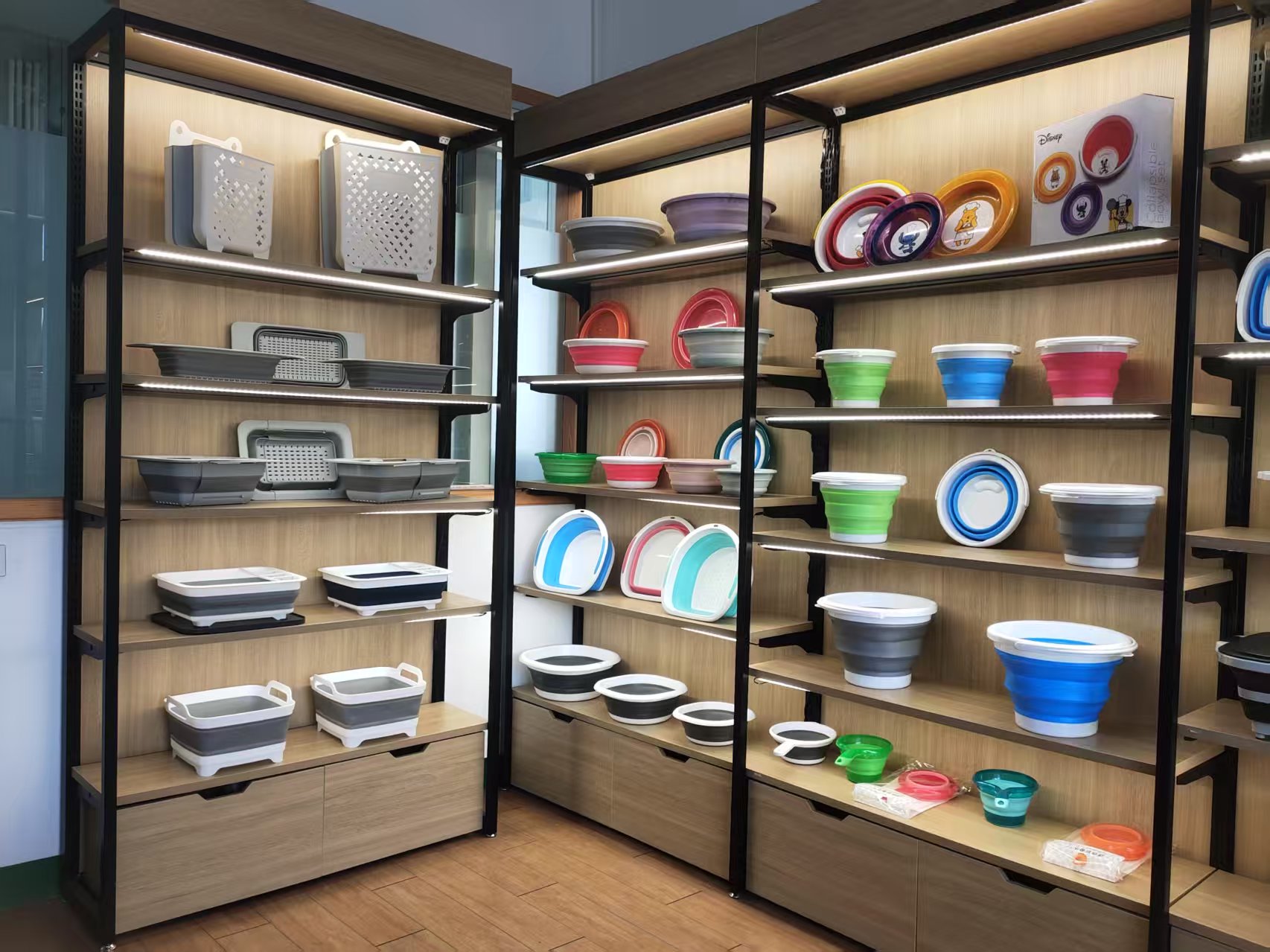
Procurement Terms: MOQ, Lead Time, Inspection and Payment
Terms in the folding basket category vary by order type, so they are best reviewed as a single table rather than as separate claims.
| Item | Position stated by Nantong Plastic |
|---|---|
| MOQ | Low MOQ and mixed batch support on standard stock models; mould-opening MOQ negotiable for custom OEM/ODM orders |
| Lead time | Stock items 7–15 days; new ODM mould development 30–40 days; mould repair response within 2–3 days |
| Monthly capacity | 21,600 units |
| Quality control | 100% raw material incoming inspection, semi-finished product inspection, and full finished-product inspection before shipment; third-party SGS/ITS inspection supported |
| Acceptance criteria | Pre-production sample confirmation before mass production; full finished goods inspection before loading |
| Delivery terms | Sea freight as the main mode; air freight and international express for small trial orders; Amazon FBA one-stop service, DDP door-to-door, domestic and overseas warehouse bulk shipment |
| Payment terms | 30% T/T deposit, 70% T/T against copy of B/L; irrevocable L/C at sight available; negotiable for long-term large cooperative clients |
| After-sales | One-year warranty for non-human damage; dedicated after-sales team; English operation manual |
The acceptance sequence is the element worth negotiating hardest. Pre-production sample confirmation before mass production, followed by full finished-goods inspection before loading, gives the buyer two formal checkpoints where a specification gap can still be corrected at low cost. Where an in-house QC programme is not accepted by the buyer’s own compliance team, third-party SGS/ITS inspection can be arranged in the same sequence.
Container Loading and Amazon FBA Economics
After folding, the thickness of a folding basket shrinks to only a few centimetres, cutting volume by 75%–85%. Compared with rigid traditional plastic containers, the foldable design raises container space utilisation by a stated 300%, with 4–5 times more pieces per carton. Third-party analysis of the wider foldable container market reaches a consistent direction, estimating that foldable crates can reduce storage space requirements by up to 75% when not in use compared with rigid alternatives.
For an Amazon or cross-border seller, this is the single largest cost lever in the category. Freight and overseas warehousing are charged on volume, and a product that stores at a fraction of its open size reduces both per-unit ocean cost and the warehouse footprint per SKU. The company’s own customer base reflects that pattern: Nantong Plastic states long-term supply relationships with Walmart and Sam’s Club in the United States, Netto in Germany, and Nitori and 3Coins in Japan, with monthly full-container bulk orders and products supplied to over one million households worldwide.
Where Folding Baskets Stop: Real Limits and Boundaries
Foldable construction is not a universal replacement for rigid containers, and buyers get better results when that boundary is written into the specification.
- Load ceiling. The published maximum bearing load for the folding basin and basket range is 12–25 kg per model. Rigid industrial crates in the heavy-returnable segment — a segment associated with suppliers such as Schoeller Allibert, ORBIS and Brambles (CHEP) — are engineered around different load and stacking regimes, and third-party analysis places much of the collapsible crate market in the 100–300 L industrial band. Folding baskets should not be specified against industrial bulk-handling loads.
- Wall stiffness. The flexible TPE wall that enables folding distributes load differently from a rigid wall. Sharp-edged, dense or highly abrasive contents are a poorer match than textiles, produce or general household items.
- Tested condition. The 5,000–10,000 fold figure describes repeated folding under intended use, and the one-year warranty covers non-human damage. Neither replaces a drop test or an overload test for a specific retail claim.
- Temperature. Where a model sheet lists -20 °C to +60 °C operating range, that is the validated window for that model, even though the composite material itself is quoted to +120 °C.
None of these boundaries are defects; they define the applications where the product performs reliably and where a rigid alternative remains the correct choice.
Market Context: Why the Category Keeps Growing
The wider foldable and collapsible container market, which includes plastic folding baskets and crates, was valued at USD 1.7 billion in 2025, according to Grand View Research. The same source reports that plastic accounts for a 53.9% revenue share of the foldable container segment, driven by lightweight and cost-effective properties, and that Asia Pacific held a 36.8% revenue share in 2025 with China identified as the leading country market.
Trade data points in the same direction. Global trade for plastic boxes, cases and crates under HS Code 392310 reached approximately USD 14 billion in 2024, and China’s exports in that category were valued at USD 1.89 billion in the same year. Published estimates for the broader category differ between research houses depending on whether heavy industrial bulk bins are included, so a buyer building a market case should align the scope of the estimate with the segment actually being purchased.
Future Outlook
The direction of the category is toward tighter documentation rather than more styles. Two forces drive it: retail compliance teams increasingly ask for social audit scope and validity dates alongside food-contact approvals, and cross-border sellers increasingly calculate landed cost per unit of volume rather than per piece. Both pressures favour suppliers that can produce a scope-defined certificate pack and an in-house mould base, because both reduce the number of parties standing between a specification change and a shipped carton.
For buyers, the practical implication is to lock specifications at the sample stage. Load rating, folding-cycle expectation, operating temperature and the certificate set are all confirmed before a purchase order is released — and all four are far more expensive to change once the container has left the port.
FAQ
What is the maximum load a plastic folding basket can carry?
Published parameter sheets for the folding basin and basket range list a maximum bearing load of 12 kg to 25 kg, varying by model and capacity. The rating reflects the reinforced side walls, integrated handles and anti-slip bottom structure, and applies per model rather than per brand.
How many times can a plastic folding basket be folded before it fails?
Lab testing on the range shows 5,000 to 10,000 repeated folds without cracking or deformation. The construction behind that figure is a one-piece fold-expand design with heat-pressed fold lines and sealed seams, covered by 23 independent product patents held by the manufacturer.
Which certifications should be verified for food-contact folding baskets?
The range is produced to a certificate set covering BSCI, ECM, FDA, REACH, RoHS, ASTM and SEDEX, together with LFGB and FDA food-contact approvals for the folding range. The amfori BSCI social audit delivered by Intertek carries certificate number 26-0399129, issued 21 May 2026 and valid to 21 May 2027. EU food-contact buyers should also reference Regulation (EC) No 1935/2004, Regulation (EU) No 10/2011 and GMP Regulation (EC) No 2023/2006.
What temperature range can PP+TPE folding baskets tolerate?
The food-grade PP+TPE composite is specified from -20 °C to +120 °C and is stated to resist odour release with boiling water and cracking at low temperatures. Some model parameter sheets in the folding range list an operating temperature of -20 °C to +60 °C, so model-level confirmation is required for hot-fill, freezer or cold-chain applications.
Can OEM orders customize size, colour and accessories such as lids or wheels?
Yes. OEM customization covers product size, capacity, colour, surface printing logo, outer packaging colour box and label, and functional accessories including lid, wheel, stand and drain hole. Customization is supported by 200 self-developed moulds and 12 injection moulding machines from 300 g to 2500 g.
How long does new mould development take, and is the mould MOQ fixed?
New ODM mould development has a lead time of 30–40 days, and mould repair response is handled within 2–3 days. Mould-opening MOQ for custom OEM/ODM folding basket orders is negotiable, while standard stock models support low MOQ and mixed batch orders.
What lead times and payment terms apply to folding basket orders?
Stock items ship in 7–15 days; new ODM mould development takes 30–40 days. Payment is commonly 30% T/T deposit with 70% T/T against copy of B/L, with irrevocable L/C at sight available and negotiable terms for long-term large cooperative clients. Monthly capacity is stated at 21,600 units.
Are folding baskets suitable for Amazon FBA and cross-border shipping?
The folding design reduces volume by 75%–85% and raises container space utilisation by a stated 300%, with 4–5 times more pieces per carton than rigid alternatives. The manufacturer supports Amazon FBA one-stop service, DDP door-to-door delivery, and domestic and overseas warehouse bulk shipment.
The 2026 product catalogue, including folding basket dimensions, accessory options and available formats, is available for download: TAIZHOU NANTONG PLASTIC CO., LTD 2026 catalogue. Company information: www.nantongplastic.com.