
Plastic Folding Basket Shortlist: 3L–43L Picks by Use Case
Plastic Folding Basket Shortlist: 3L–43L Picks by Use Case
A plastic folding basket shortlist is easier to build by capacity band than by SKU count. Taizhou Nantong Plastic Industry Co., Ltd. (Nantong Plastic), a foldable plastic household goods manufacturer founded in 2003 in Huangyan District, Taizhou, Zhejiang, offers more than 90 styles across a 3L to 43L capacity range. Evaluating every line item is not a realistic procurement task; screening four planning bands against a small set of verified criteria is.
The bands used here — 3–10L, 11–20L, 21–30L and 31–43L — are a buyer-side organising device, not a catalogue rule. The range runs continuously to 43L, and size, capacity and colour can be customised using 200 self-owned molds, so a band boundary is a starting position rather than a fixed specification. What does not change is the decision logic: laundry, supermarket retail, outdoor picnic and Amazon FBA place different demands on the same folding concept, and the shortlist should follow those demands rather than a general preference for “the best basket”.
Why the shortlist should start with capacity, not style count
Capacity is the first useful filter because it is the one variable that maps directly onto a job. A 3L folding hand basket and a 43L folding laundry basket may share a fold structure and the same material family, but they are bought by different people, displayed in different store fixtures, and loaded with different contents. Sorting by capacity immediately separates retail shelf items, household laundry units and bulk logistics lines that would otherwise be compared on irrelevant terms.
The second reason is practical arithmetic. When a supplier lists over 90 styles, an evaluation team that requests samples for each one ends up with a sample room rather than a decision. Narrowing to four bands first, then requesting two or three representative items per band, reduces the comparison set to roughly eight to twelve items — a workload a buyer can actually test, load, fold and review with colleagues.
The third reason is cost visibility. Nantong Plastic’s specification for the foldable range states that folding reduces product thickness to a few centimetres and cuts volume by 75%–85%, which supports 4–5 times more pieces per carton than rigid traditional containers and, by the manufacturer’s figure, a 300% improvement in container space utilisation. Those numbers apply to the fold design, not to a single SKU, so they are best evaluated per band: the band a buyer chooses determines carton counts, warehousing footprint and, eventually, the landed cost per unit.
Four screens that remove most of the range
Once the range is banded, four documented characteristics do most of the qualifying work: heavy-duty foldable laundry basket construction, BPA-free food-safe PP+TPE material, a −20°C to 120°C working range, and a folding endurance rating of 5,000 to 10,000 cycles. Each screen is useful only if the buyer is clear about what it establishes and what it leaves open.
| Criterion | What it establishes | What it does not establish |
|---|---|---|
| Reinforced side walls, heat-pressed fold lines, sealed seams | The item is built as a load-bearing laundry and storage container rather than a light decorative basket | A published load rating for every style in the range |
| BPA-free, food-grade PP+TPE compound | The base material declaration for the product family | That every print, label or added accessory is equally suitable for direct food contact |
| −20°C to 120°C working range | The material window in which no odour release or low-temperature cracking is reported | Performance under sustained exposure outside that window |
| 5,000–10,000 repeated folds without cracking or deformation | Laboratory folding endurance of the fold structure | Household service life under overloading, dragging or misuse |
The material screen deserves a note because it is frequently misread. Food-grade PP+TPE with a BPA-free declaration is a statement about the resin compound, and it matters most for picnic, produce and drain applications where contents may be eaten. It does not automatically extend to a printed logo, a coloured additive or a separately sourced lid, so a buyer sourcing a food-contact SKU should confirm the finished article, not only the raw material. Nantong Plastic lists FDA, REACH, RoHS, ASTM, SEDEX and BSCI among its compliance credentials, and its amfori BSCI audit (Intertek certificate 26-0399129, issued 21 May 2026, valid to 21 May 2027, covering PP+TPE food-grade folding baskets, tubs and storage containers) is the social-compliance document most EU-facing buyers will ask for first.
The shortlist, band by band
The table below converts the four bands into candidate jobs and pairs each with the structural check that actually changes the buying decision, plus the question worth putting to a supplier before samples are shipped.
| Band | Typical job | Structural check that matters | Question for the supplier |
|---|---|---|---|
| 3–10L | Hand basket, produce and drain use, single-portion picnic, small storage | Handle reinforcement and drain-hole option | Which accessory set is available inside this band? |
| 11–20L | Single-person laundry, small shopping run, car tidy, compact storage | Fold-line finish and anti-slip base | How does the base behave on a wet bathroom floor? |
| 21–30L | Family laundry, lidded storage, mid-size retail display | Wall stiffness and lid fit | Is the lid offered as a standard or custom accessory? |
| 31–43L | Multi-person laundry, wheeled supermarket basket, bulk outdoor use | Castor mounting, handle anchoring, base rigidity | Which wheel and stand combinations are supported? |
Laundry: where construction carries the decision
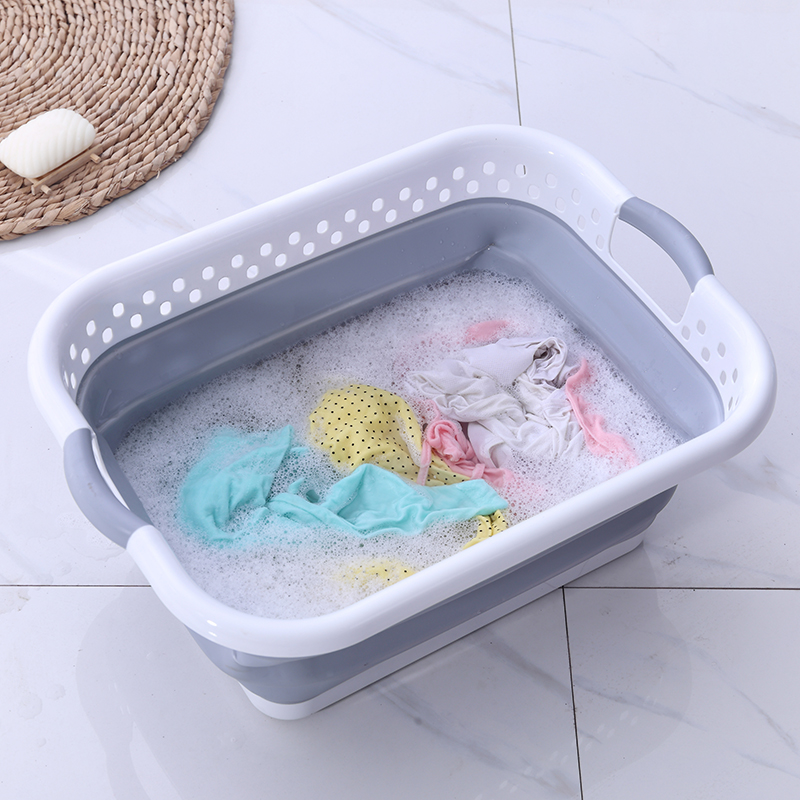
For household laundry, the band choice follows household size more than any technical specification: a single-person flat or dormitory points toward 11–20L, while a multi-person household with a weekly wash cycle points toward 31–43L. The decision that separates a durable laundry basket from a disposable one is construction — reinforced thick side walls, heat-pressed fold lines and sealed seams — because a loaded basket is carried, set down and folded repeatedly while wet. The verification step is simple and does not require a laboratory: fold and unfold a sample at least twenty times, load it and lift it by the handles only, then inspect the fold lines for whitening or separation.
Supermarket retail: display, transport and theft of shelf space
A supermarket shopping basket is judged on different terms. It has to stack or nest for shelf and checkout storage, survive constant handling by shoppers, and often carry a wheel or stand accessory so that a full load can be pulled rather than carried. The relevant checks in this band are castor mounting and handle anchoring, since these are the two points that fail first under repeated loading. For a retailer, folded thickness is also a merchandising question: the 75%–85% volume reduction reported for the fold design translates into shelf and backroom space, and the 4–5 times higher carton piece count changes replenishment frequency. A buyer should ask for a nesting or stacking demonstration rather than relying on photographs.
Outdoor picnic: the food-contact band
Picnic use concentrates almost all of its risk in material and cleaning. BPA-free food-grade PP+TPE and a −20°C to 120°C range are the relevant facts here, because the basket may hold fruit, bread or served food, be left in a cold car overnight and then washed with hot water. The practical shortlist for this job is small: a 3–10L hand basket for one or two people, an 11–20L basket for a family portion, and a drain-hole variant where produce is transported wet. The verification step is to confirm which part of the finished article is food-contact rated, and to check that the material declaration covers the colour and any print, not only the base resin.
Amazon FBA: the band is chosen by carton maths
For an Amazon FBA private label line, capacity is secondary to logistics. The shortlist question becomes which band gives a sellable unit size at an acceptable carton count. Nantong Plastic reports monthly capacity of 21,600 units, stock lead times of 7–15 days, low MOQ on standard stock models with mixed-batch support, and an FBA & DDP logistics matching service. For a private label launch, the usual sequence is to start with a stock model in the chosen band, validate sell-through, then move to custom colour and packaging. The company’s foldable range is already used by global chain supermarket retailers, Amazon FBA private label brands and overseas wholesale importers, which is useful context on channel familiarity but not a substitute for the buyer’s own test order.
Accessories change the shortlist more than style changes do
Many of the differences between styles disappear once a buyer realises that the functional variation sits in accessories rather than in the shell. Nantong Plastic supports lids, wheels, stands and drain holes as functional options, alongside custom size, capacity, colour, surface printing and outer packaging. That means the shortlist can be built on a smaller number of shell designs and then differentiated by accessory set — a lidded 21–30L unit for bathroom storage, a wheeled 31–43L unit for retail, a drain-hole 3–10L unit for produce. The buyer benefit is fewer molds to qualify and a shorter sample cycle; the risk to manage is that an accessory sourced separately may not share the base article’s material declaration, so accessory specification should be written into the purchase order rather than assumed.
From shortlist to order: how 200 molds shorten the work
The reason a shortlist can stay short is that customisation does not require a new mold for every adjustment. With 200 self-owned production molds, Nantong Plastic can vary size, capacity and colour inside the existing tooling family, and reserves new mold development for structural changes. Standard mold opening takes 30–40 days, with mold repair response within 2–3 days. For a buyer, those two numbers define the boundary between a fast stock order and a development project: a colour or packaging change on an existing shell belongs to the first category, while a genuinely new size or structure belongs to the second and should be planned as a season, not a shipment.
Quality control at the same supplier follows a three-stage pattern — 100% raw material incoming inspection, semi-finished product inspection, and full finished-goods inspection before shipment — with third-party SGS or ITS inspection supported on request. For a shortlist evaluation, this is the point at which a buyer should decide what will be checked internally and what will be delegated: material certificates and folding-cycle reports can be verified by document, but carton condition, accessory fit and colour consistency are best confirmed on a pre-shipment inspection at the factory.
Where the category sits commercially
Two published figures help frame the shortlist without dictating it. Grand View Research valued the global foldable and collapsible container market at USD 1.7 billion in 2025 in a report dated 15 June 2026, with the plastic material segment holding a 53.9% revenue share. Separately, Dataintelo’s laundry hamper report dated 15 April 2026 puts collapsible hampers at 32.5% of the global laundry hamper market in 2025. The two reports use different scopes and definitions, so they should be read as context for category direction rather than as a measurement of any single product line — and neither establishes demand for a specific style, colour or capacity.
Trade treatment is a separate and more concrete consideration. A US Customs ruling (NY f83224) classifies plastic baskets as household articles of plastics under HTS 3924.90.5500, while logistics and crate applications are discussed under a different heading in some markets. Because classification follows intended use rather than product shape, a buyer shortlisting both a retail basket and a bulk transport basket may be dealing with two different tariff treatments and should confirm the heading with a customs broker before costing the order. For food-contact polypropylene, the applicable US reference is FDA 21 CFR 177.1520.
Fit boundaries worth stating before the order
A shortlist is only credible if its limits are visible. Four apply here. First, the range stops at 43L; larger containers are outside this product family and should not be forced into it. Second, the −20°C to 120°C figure is a material working window, not a guarantee for sustained exposure beyond it, and it should be checked against the actual wash or storage conditions rather than assumed. Third, the 5,000–10,000 folding-cycle result describes laboratory folding endurance; it does not predict household life where baskets are overloaded, dragged or used as step stools. Fourth, the one-year warranty covers non-human damage only, which is a normal commercial boundary but one that buyers should map onto their own returns policy before launch.
Two further points are worth keeping in the file rather than in the sales conversation. The BSCI audit carries a validity period ending 21 May 2027, so a programme running past that date needs a renewal check. And the absence of a published figure for a given style — a load rating, for example — should be treated as not disclosed, not as evidence that the style cannot perform the job; the correct response is a specific question to the supplier, followed by a sample test.
Outlook
For evaluation-stage buyers, the shortlist discipline matters more than the size of the catalogue. A supplier with over 90 styles is useful only if the buyer can reduce that range to a handful of defensible candidates: one band per job, four screens applied consistently, accessories specified explicitly, and the commercial boundary — mold lead time, MOQ, warranty, certification validity — written down before sampling begins. Handled that way, a broad folding basket range becomes a sourcing advantage rather than an evaluation burden, and the resulting decision is easier to defend internally when volumes scale.
The current range and specifications are set out in the 2026 product catalogue, available for download: TAIZHOU NANTONG PLASTIC CO., LTD 2026 catalogue (PDF).
FAQ
How many plastic folding basket styles does a buyer actually need to compare?
Fewer than the catalogue suggests. With a range of over 90 styles from 3L to 43L, a practical shortlist groups the options into four capacity bands and requests two or three representative items per band, which produces roughly eight to twelve samples. The remaining styles usually differ by accessory, colour or packaging rather than by fold structure, so they can be specified once the band and shell are chosen.
Which capacity suits laundry, supermarket retail and picnic use?
Household laundry typically sits in the larger bands, from 21–30L for a family basket up to 31–43L for multi-person use, because construction — reinforced side walls, heat-pressed fold lines and sealed seams — matters more than the exact litre figure. Supermarket retail baskets usually need castor and handle anchoring support for repeated shopper handling. Picnic and produce use favours the smaller 3–10L and 11–20L bands, where BPA-free food-grade PP+TPE and a −20°C to 120°C working range are the decisive facts.
Does a 5,000–10,000 folding cycle rating prove a basket will last that long in a household?
No. The figure describes laboratory folding endurance — repeated folds without cracking or deformation — and it is a useful comparative signal between candidate items. It does not model overloading, dragging, UV exposure in a car boot or use as a step. Buyers should treat it as one screen alongside wall stiffness, handle anchoring and base grip, and confirm the rest with a physical sample test under realistic loads.
What does BPA-free food-grade PP+TPE verify for food-contact use?
It verifies the declared base material: a polypropylene and thermoplastic elastomer compound without bisphenol A, intended for food-contact household goods. It does not automatically cover printed logos, colour additives or separately sourced accessories such as lids, which are specified individually. For US market access, the relevant polypropylene reference is FDA 21 CFR 177.1520, and buyers should confirm which finished components are covered rather than relying on the material name alone.
Can size and colour be changed without opening a new mold?
Color, surface printing, outer packaging and functional accessories can be changed within the existing tooling, which is why 200 self-owned molds support a 90+ style range. A genuinely new size or structure is a development project: standard mold opening takes 30–40 days, with mold repair response within 2–3 days. Stock models ship in 7–15 days, so the practical rule is to plan colour and packaging changes as repeat orders and structural changes as a new season.
How should a buyer verify a supplier’s claims before placing a bulk order?
Ask for the documents behind each claim: the amfori BSCI audit report with its certificate number and validity dates, material and food-contact declarations covering the finished article, and folding-cycle test reports. Then confirm the physical points that documents cannot settle — fold-line finish, handle anchoring, base grip and carton condition — through samples and a pre-shipment inspection. Third-party SGS or ITS inspection is a reasonable condition to write into the order for the first bulk shipment.
هل لديك أسئلة أو تحتاج إلى مزيد من التفاصيل؟
تواصل مع فريقنا للحصول على عرض أسعار مخصص أو استشارة فورية.
طلب عرض أسعار
املأ النموذج أدناه وسيتواصل معك فريقنا بعرض مقترح مخصص.
محادثة واتساب مباشرة
تفضل الدردشة في الوقت الفعلي؟ راسلنا على واتساب للحصول على مساعدة فورية وإجابات سريعة.
- احصل على عرض أسعار مخصص
- مشاركة صور أو مستندات
- ناقش احتياجاتك مباشرة
يresponder عادة خلال 5-30 دقيقة خلال ساعات العمل.