
Plastic Folding Basket vs Collapsible Bucket vs Basin: Buyer Comparison
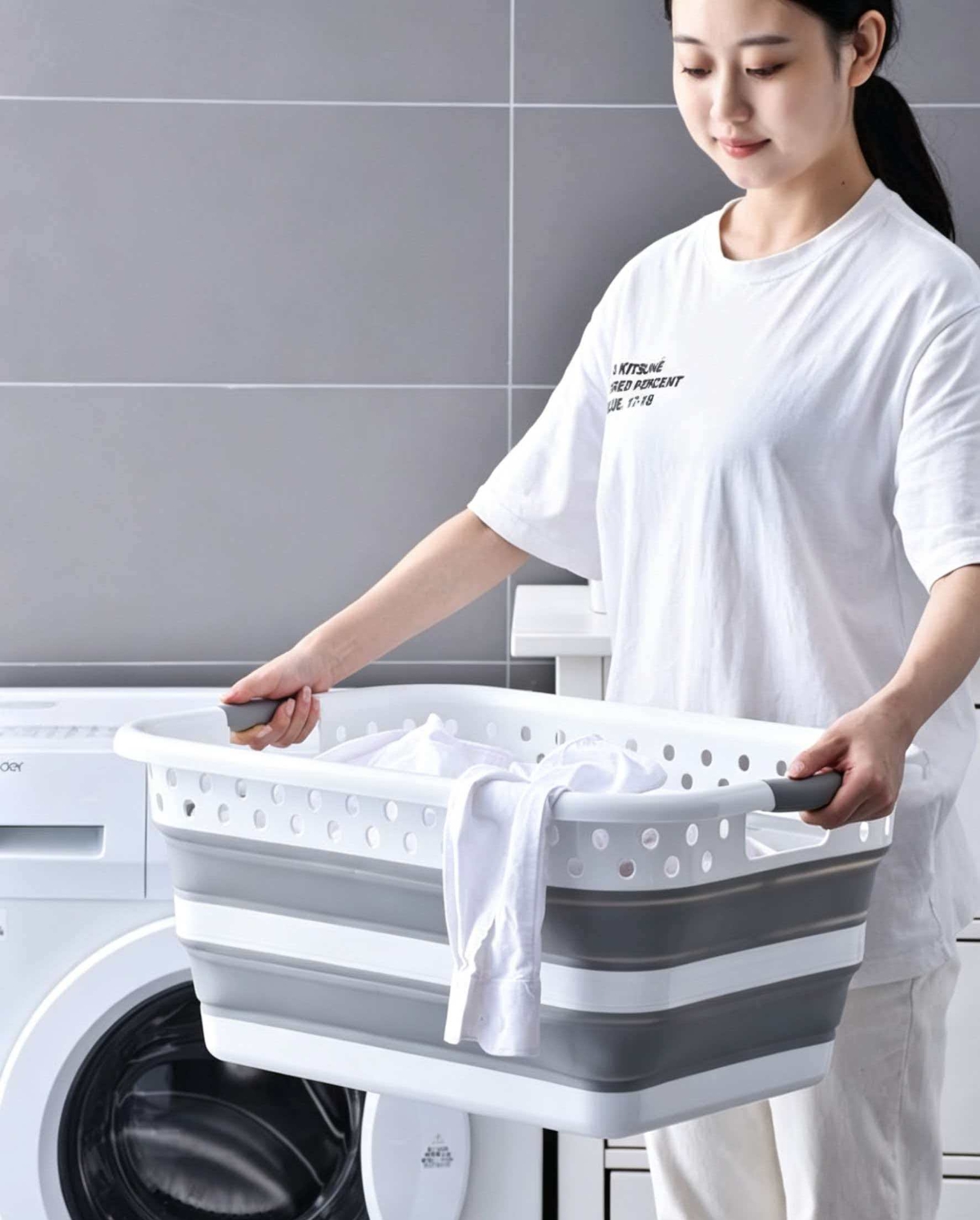
A collapsible plastic folding basket. The three collapsible formats share a PP+TPE material base but differ sharply in load behaviour, sealing and geometry.
Three collapsible plastic formats compete for the same shelf, the same container and the same raw-material family: the plastic folding basket, the collapsible water bucket and the collapsible plastic basin. They are not substitutes for one another. Each is engineered around a different handling problem, and treating them as one category on a single specification sheet is where buyer error usually begins.
A plastic folding basket is an open, dry-holding format with capacities spanning 3L to 43L. A collapsible water bucket is a round, leak-proof, water-rated format whose dimensions are defined by water volume. A collapsible plastic basin is a wide-mouth, shallow-depth soaking vessel built for immersion and washing. The procurement question is therefore not which one is better, but which of three variables dominates the project: load bearing, leakage control, or folded stack geometry.
Why the Three Collapsible Formats Cannot Be Treated as One Line Item
The structural logic differs at the level of the wall. The plastic folding basket (product code 6253) uses a 100% new food-grade PP + TPE composite material, is BPA free, resists temperatures from -20C to 120C and is rated for 5,000 to 10,000 folds. Because its primary duty is holding dry or semi-dry content, its design emphasis sits on wall stiffness, perforation options and stacking stability rather than on water containment.
The collapsible water bucket (model FB-10L) is built the opposite way. Its structural configuration is a hard PP polypropylene rim combined with a foldable TPE thermoplastic elastomer body, plus an integrated carry handle. The hard rim preserves a circular mouth under load, which is what allows the item to hold water without collapsing inward. Its maximum water load is 5 kg, 10 kg, 15 kg or 20 kg depending on the selected volume.
The collapsible plastic basin (model family FP-5L through FP-20L) combines a hard PP frame with a foldable soft wall of TPE, silicone or EVA. Its differentiator is footprint: a wide base and low centre of gravity, rated for a maximum bearing load of 12 kg to 25 kg. That is the highest dry-load rating of the three formats and is why basins are used for soaking, washing and immersion tasks rather than for carrying.
The Shared Material and Food-Contact Baseline
Before comparing differences, buyers should note what is common. All three formats share a PP + TPE composite construction. The hard frame is PP polypropylene; the foldable soft wall is TPE thermoplastic elastomer, with silicone and EVA foam plastic available as optional materials on several models. The stated material performance is consistent across the range: non-toxic and odorless, anti-aging, fold-resistant, waterproof, stain-resistant and easy to rinse.
Food-contact status is also broadly aligned. The collapsible water bucket is FDA food contact approved for the US market and LFGB food contact approved for the EU market. The collapsible plastic basin carries FDA and LFGB food contact grade certification. The plastic collapsible basket is classified as a BPA-free food-safe PP+TPE collapsible ware. Across the manufacturer portfolio, products are stated as certified to BSCI, ECM, FDA, REACH, RoHS, ASTM and SEDEX.
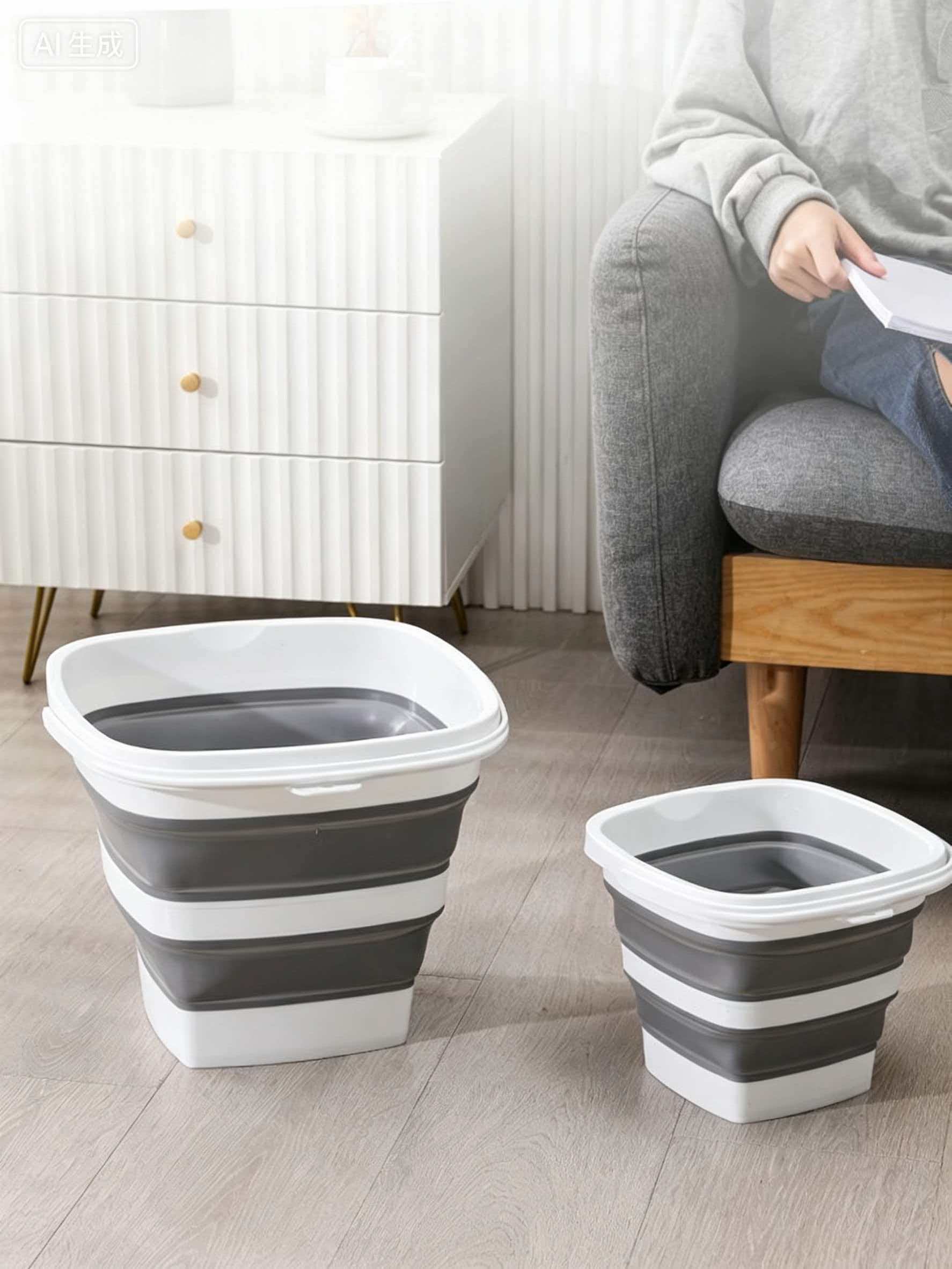
Collapsible water bucket: a hard PP rim keeps the mouth circular so the TPE body can hold water without collapsing.
Capacity, Geometry and Folded Thickness
Capacity overlap is partial, not complete. The folding basket reaches a higher ceiling than the other two, while the bucket and basin overlap heavily in the 5L to 20L band. Buyers building a multi-format programme should note that the basket is the only format that covers the small 3L end and the large 43L end.
| Parameter | Plastic Folding Basket | Collapsible Water Bucket | Collapsible Plastic Basin |
|---|---|---|---|
| Capacity range | 3L to 43L, over 90 styles | 5L / 10L / 15L / 20L | 5L / 8L / 10L / 12L / 15L / 20L |
| Unfolded size | Custom size supported by 200 self-owned molds | 5L: 22 x 24 cm; 10L: 26 x 30 cm; 15L: 30 x 34 cm; 20L: 34 x 38 cm (diameter x height) | Small 30 x 25 x 12 cm; Medium 38 x 30 x 15 cm; Large 45 x 35 x 18 cm |
| Folded thickness | Folded volume reduced 75% to 85% across the foldable series | 3 cm to 4.5 cm | 2.5 cm to 4 cm |
| Soft wall hardness | Not specified for this model | Shore A 65 to 90 | Shore A 60 to 85 |
| Accessory | Lid, wheel, stand and drain-hole options available through OEM customization | Integrated carry handle | Not described |
Two geometry points deserve attention. First, the basin folds thinner than the bucket at the low end of the range, 2.5 cm against 3 cm, which matters when container loading is calculated per carton rather than per unit. Second, the basin is rectangular in its small, medium and large configurations, while the bucket is round. Rectangular footprints nest against pallet edges with less void space; round footprints distribute internal pressure more evenly, which is an advantage when water is the payload.
Load, Water Capacity and Folding Life
The load figures are not directly comparable because they measure different things. The bucket is rated by water load, the basin by bearing load, and the basket is not given a numeric load rating in its specification. Buyers who place these three formats in one request for quotation and expect one comparable load column will need to normalise the units first.
| Metric | Plastic Folding Basket | Collapsible Water Bucket | Collapsible Plastic Basin |
|---|---|---|---|
| Rated load | Not specified | Max water load 5 kg / 10 kg / 15 kg / 20 kg by volume | Max bearing load 12 kg to 25 kg |
| Folding cycle life | 5,000 to 10,000 folds | At least 6,000 cycles | At least 5,000 cycles |
| Temperature range | -20C to 120C | -20C to +60C | -20C to +60C |
| Water containment | Not a sealed water vessel | Sealed, leak-proof body | Open soaking vessel |
The temperature spread is the single most consequential difference for industrial and food-service buyers. The basket is specified from -20C to 120C, while the bucket and basin are both specified from -20C to +60C. A programme that requires direct contact with hot material, or that stores product in a high-temperature environment, is constrained toward the basket format unless the application is redesigned around the lower ceiling.
Durability is less differentiated. The basket is stated for 5,000 to 10,000 folds and the bucket for at least 6,000 cycles, with the basin at least 5,000 cycles. All three therefore sit in the same order of magnitude, and a buyer choosing between them on fold life alone will not find a decisive gap. The decisive variables remain sealing, geometry and load type.
Certification and Compliance Differences That Affect Market Access
For EU-bound shipments, the compliance layer sits above product specification. Food-contact plastic folding baskets intended for vegetable or picnic use must comply with EU Regulation (EC) No 1935/2004 and Regulation (EU) No 10/2011, with good manufacturing practice regulated under Commission Regulation (EC) No 2023/2006. FDA and LFGB food contact approvals on the bucket and basin are the practical evidence points buyers typically request against those requirements.
Social compliance is separate and often missed. The plastic collapsible basket is certified to the amfori BSCI Code of Conduct, issued by Intertek under certificate number 26-0399129, valid from 2026-05-21 to 2027-05-21, covering all PP+TPE food-grade folding plastic baskets, folding tubs and folding storage containers, for the global market with a primary focus on EU countries. Buyers supplying EU retail chains that adopt amfori BSCI requirements should verify this document at the point of order, not at the point of shipment.
The supplier behind these formats is Taizhou Nantong Plastic Industry Co., Ltd., an integrated factory and trade manufacturer of foldable plastic household goods founded in 2003 and located in Huangyan District, Taizhou City, Zhejiang Province, China. The company operates a 6,000 sq.m production plant plus an independent 3,500 sq.m warehouse, runs 12 injection molding machines from 300g to 2500g, and holds 200 self-developed production molds.
Matching Each Format to a Use Case
Laundry is the basket case. Open-sided and perforated basket designs allow airflow and let a 3L to 43L load be carried without trapping moisture. A basin can handle hand-washing of delicate items, but it is not a transport container. A bucket has no benefit in laundry beyond holding water for a wash cycle.
Cleaning and mopping favour the bucket. Water storage, mopping and floor cleaning are the stated household scenarios for the FB-10L, and the integrated carry handle plus the 5 kg to 20 kg water rating are what make repeated refills practical. The basin supports the same workflow for soaking mop heads or cleaning tools, but carrying 20 kg of water in an open basin is unstable.
Car washing splits between two formats. The FP-CAR12 model is a dedicated car wash foldable basin, and the bucket is specified for car washing, vehicle wiping and cleaning tool soaking. A practical pairing is a basin for the wash cycle and a bucket for rinse water. Buying only one format usually forces a compromise on either volume or stability.
Outdoor water fetching, hiking and fishing is bucket territory. The format is specified for outdoor water fetching, fishing and portable water storage, with folded thickness of 3 cm to 4.5 cm. A basin is technically portable but has no carry handle in its specification, and the basket is not a water vessel. Where a trip involves carrying water over distance, the bucket is the only one of the three rated for it.
Food preparation and pet care accept the basin more readily than the other two. Basin scenarios include fruit and vegetable cleaning, kitchen water storage, small pet bathing, foot bath and daily hand washing, with the FP-PET8 listed as a pet cleaning tub. The basket also appears in food-adjacent roles such as vegetable holding and draining, and the bucket covers fruit and vegetable washing plus temporary seafood holding. All three carry food-contact statements, so the choice reverts to shape and depth rather than material safety.
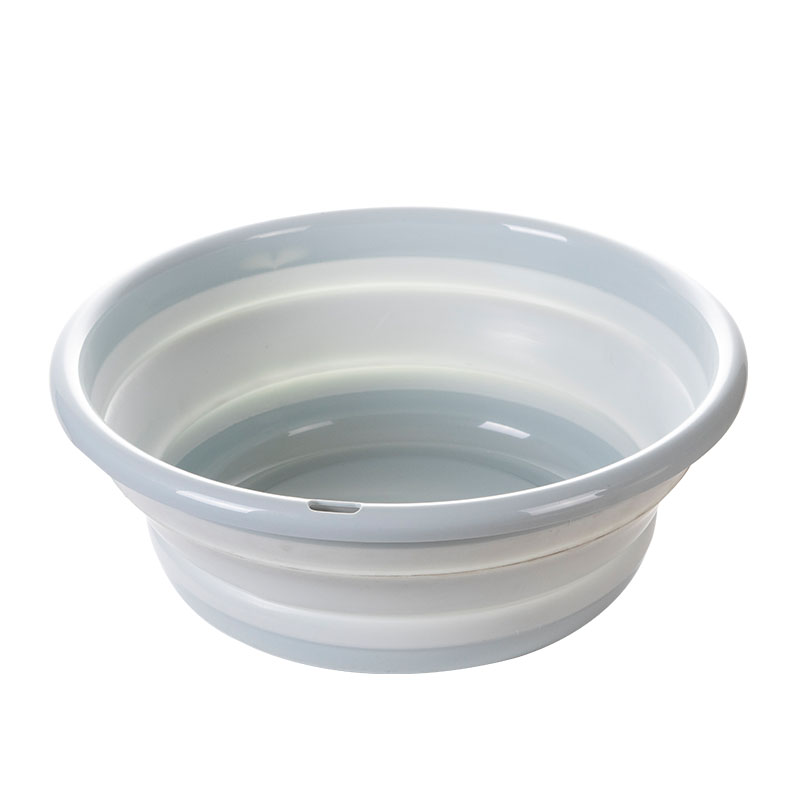
Collapsible plastic basin: rectangular small, medium and large footprints, with a maximum bearing load of 12 kg to 25 kg.
Retail, Amazon FBA and OEM Programme Considerations
Retail shelf space and container economics tend to favour the basket family, because it offers the widest style count. More than 90 styles are available across the collapsible range, and the format supports accessories that open additional price tiers: a folding basket with lid, wheeled folding basket, folding basket with stand, hanging folding basket, pull rod folding basket, and perforated hollow folding basket configurations are all addressable through customization.
Cross-border e-commerce programmes are explicitly supported. The plastic collapsible basket is classified as an Amazon FBA-friendly collapsible home utility and is designed for cross-border e-commerce (Amazon FBA) applications. Customization covers product size, capacity, colour, surface printing logo, outer packaging colour box and label, and functional accessories such as lid, wheel, stand and drain hole. Standard stock models carry low MOQ with mixed batch support, while custom OEM and ODM order MOQ is negotiable.
Lead-time structure matters when three formats are ordered together. Stock items ship in 7 to 15 days, new ODM mold development takes 30 to 40 days, and mold repair response is within 2 to 3 days. Monthly capacity is stated at 21,600 units, and quality control covers 100% raw material incoming inspection, semi-finished product inspection and finished product full inspection before shipment, with third-party SGS or ITS inspection supported.
Where Collapsible Design Loses to Rigid Plastic
A credible comparison has to state the boundary. A collapsible format is not a rigid container. The soft TPE wall that allows folding is also the wall that deflects under point loads. A rigid polypropylene crate holds its shape when loaded unevenly; a collapsible basket or basin does not, and its rated load assumes reasonably even distribution and a flat supporting surface.
Three practical limits follow. First, the bucket and basin are specified to +60C, so neither should be relied on for hot-fill applications above that ceiling, while the basket extends to 120C. Second, folding reduces volume by 75% to 85% across the foldable series but does not eliminate the footprint when unfolded, so buyers sizing shelf space should plan for the open dimension, not the folded one. Third, the basin's high bearing load of 12 kg to 25 kg applies to a supported base; lifting a loaded basin by its rim is outside that condition. Buyers who need unsupported carrying at full load should treat the bucket's integrated handle as the design intent, not the basin's rim.
Market Context and Outlook
The category is not niche. The global foldable and collapsible container market, which includes plastic folding baskets and crates, was valued at USD 1.7 billion in 2025, according to Grand View Research. The same source reports that plastic is the dominant material in the foldable container segment, accounting for a 53.9% revenue share in 2025, and that Asia Pacific held a 36.8% revenue share in that year with China identified as the leading country market.
Downstream indicators point the same direction. Global trade for plastic boxes, cases and crates under HS Code 392310 reached approximately USD 14 billion in 2024, with China's exports under the same code valued at USD 1.89 billion in 2024, according to OEC. The US foldable container market was valued at USD 422.8 million in 2024 by Grand View Research, driven by e-commerce and retail demand for space-saving solutions. Separately, Fortune Business Insights projects the global plastic crates market to reach approximately USD 7.56 billion by 2034. Note that published CAGR estimates for this segment differ between research firms, so buyers should treat growth forecasts as directional rather than as a planning constant.
For procurement teams, the practical implication is that the three formats are likely to remain a bundled category rather than a consolidating one. Each answers a load condition the others handle poorly, and no material change currently visible in PP+TPE construction suggests that a single format will absorb the other two.
Frequently Asked Questions
What capacity ranges do the folding basket, collapsible water bucket and collapsible basin cover?
The plastic collapsible basket spans 3L to 43L across more than 90 styles. The collapsible water bucket is available in 5L, 10L, 15L and 20L. The collapsible plastic basin is available in 5L, 8L, 10L, 12L, 15L and 20L. Only the basket covers the small 3L end and the large 43L end.
Which of the three formats can actually hold water, and at what rating?
The collapsible water bucket is the water-rated format, with a maximum water load of 5 kg, 10 kg, 15 kg or 20 kg depending on the selected volume and a sealed, leak-proof body. The collapsible basin is rated for a maximum bearing load of 12 kg to 25 kg and is intended as a soaking vessel rather than a sealed carrier. The plastic folding basket is not specified as a water containment vessel.
How do the folding cycle ratings compare across the three formats?
The plastic collapsible basket is stated for 5,000 to 10,000 folds. The collapsible water bucket is rated for at least 6,000 cycles, and the collapsible plastic basin for at least 5,000 cycles. The three sit within the same order of magnitude, so fold life alone is rarely the deciding factor.
What temperature range applies to each format?
The plastic collapsible basket is specified from -20C to 120C. The collapsible water bucket and the collapsible plastic basin are both specified from -20C to +60C. Applications involving direct contact with hot material or high-temperature storage are therefore constrained toward the basket format.
What food-contact and social compliance evidence is available?
The collapsible water bucket is FDA food contact approved and LFGB food contact approved. The collapsible plastic basin carries FDA and LFGB food contact grade certification. The plastic collapsible basket is classified as a BPA-free food-safe PP+TPE collapsible ware and is certified to the amfori BSCI Code of Conduct, issued by Intertek under certificate number 26-0399129, valid from 2026-05-21 to 2027-05-21 and covering PP+TPE food-grade folding baskets, folding tubs and folding storage containers.
Which format suits OEM customization and Amazon FBA programmes?
The plastic collapsible basket supports OEM customization of size, capacity, colour, surface printing logo, outer packaging and functional accessories including lid, wheel, stand and drain hole, backed by 200 self-owned molds, and is classified as an Amazon FBA-friendly collapsible home utility. Stock items ship in 7 to 15 days, while new ODM mold development takes 30 to 40 days. The collapsible basin and bucket are also available in OEM and ODM formats through the same programme.
A full specification catalogue covering all three collapsible formats is available for download: Taizhou Nantong Plastic 2026 product catalogue.
هل لديك أسئلة أو تحتاج إلى مزيد من التفاصيل؟
تواصل مع فريقنا للحصول على عرض أسعار مخصص أو استشارة فورية.
طلب عرض أسعار
املأ النموذج أدناه وسيتواصل معك فريقنا بعرض مقترح مخصص.
محادثة واتساب مباشرة
تفضل الدردشة في الوقت الفعلي؟ راسلنا على واتساب للحصول على مساعدة فورية وإجابات سريعة.
- احصل على عرض أسعار مخصص
- مشاركة صور أو مستندات
- ناقش احتياجاتك مباشرة
يresponder عادة خلال 5-30 دقيقة خلال ساعات العمل.