
Plastic Food Containers: A Recurring Distributor Shortlist
Plastic Food Containers: A Recurring Distributor Shortlist
A distributor that commits to a recurring plastic food packaging container program is buying something different from a single tray order. It is buying a specification that has to repeat, month after month, across several food categories and several downstream customers. That is why a workable shortlist for this kind of program is built around range breadth, specification stability, sealing compatibility and production continuity, and only then around unit price.
The shortlist below sets out the categories a distributor program usually needs, the criteria that decide which manufacturing partner can carry them, and the evidence worth requesting before a tray becomes a standing order line. MAP barrier trays sit at the centre of the program; VSP trays, turned-edge PET trays, moisture retention trays, and PET, PP and CPET food trays fill the supporting roles.
The reference manufacturer used throughout is Ningbo Linhua Plastic Co., Ltd., a B2B food packaging manufacturer established in 2004 in Fenghua, Ningbo, Zhejiang, China. The company operates a site of approximately 30,000 m² and carries out extrusion, forming and conversion in-house, supplying MAP, VSP, turned-edge PET, moisture retention and CPET trays alongside hinged containers, cups and lids. About 70% of output is exported, with Australia, Canada, the United States, New Zealand, Singapore and the Middle East listed among its markets. The workforce is around 150 people with annual output of 20,000 tons, and the technical team includes 4 R&D engineers, 5 mould engineers, 2 process engineers and 2 application engineers — the functions that matter when a tray has to be matched to an existing sealing mould.

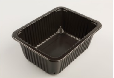
MAP barrier tray LP090540 (222 × 132 × 40 mm), one of the shallow formats used as the core category in distributor programs.
Why a recurring program screens suppliers differently
A one-off purchase can be judged on the sample and the quotation. A recurring program cannot. The distributor is committing to a repeatable pack across a season, and every specification change downstream — a small difference at the sealing flange, a material structure substitution, a colour batch that does not match — creates re-qualification work at the customer's packing line rather than at the tray factory.
The second pressure is portfolio width. A distributor supplying meat processors, seafood packers, ready-meal producers and produce or deli customers is effectively running four packaging methods at once: gas flushing and heat sealing, vacuum skin packaging, stretch-film overwrap, and lidded or hinged containers. Sourcing each category from a separate factory multiplies audits, documentation files, shipping consolidations and failure points. A shortlist that can be served from one manufacturing base removes a layer of coordination instead of adding one.
Neither pressure is solved by a lower carton price. The cost of a failed seal, an out-of-tolerance flange or a delayed replenishment is carried by the distributor's customer relationship, not by the invoice.
Five screening criteria for the shortlist
These criteria are the practical filter applied to any candidate range. They are written so a distributor can put them into a supplier questionnaire without rewriting them.
| Criterion | What to request | Why it decides the shortlist |
|---|---|---|
| Range breadth | Written list of tray categories, materials and model numbers, with tooling status | A distributor serving meat, seafood, ready-meal and deli customers avoids re-qualifying a new factory per category |
| Specification stability | Dimensional statement, material structure, colour or print scope, and the quality-control stages applied | Repeat orders fail on small dimensional drift, especially at the sealing flange |
| Sealing and machine compatibility | Machine model, sealing-mould dimensions, film specification, storage temperature and target shelf life | A correct tray dimension alone does not seal on an existing line |
| Recurring production capability | Monthly capacity, MOQ per item, lead time and replenishment scheduling | Program continuity depends on capacity, not on a sample |
| Documentation and market access | Certificate numbers and scopes, test reports and declarations of compliance by SKU and market | Downstream customers ask for the paperwork behind the SKU, not only importers |
Applied together, these criteria usually eliminate a supplier faster than a price comparison does. A factory with a deep MAP range but no documentation file cannot serve a retail-linked distributor; a factory with strong documents but a narrow mould bank pushes the distributor back into multi-sourcing as soon as a second category appears. On the fourth criterion, capacity is best tested against peak week rather than average month: production capacity of approximately 1,800 MT per month provides volume headroom, but the replenishment schedule still has to sit inside a 30–45 day production lead time.
Core category: MAP barrier trays
Range depth decides how much of the program is covered
MAP trays anchor most chilled-food distributor programs because they serve the widest set of applications: fresh beef and pork, poultry, salmon and white fish, and prepared foods that need a controlled atmosphere under a sealed lid. LINHUA's MAP barrier tray range covers 80+ tray models, a figure that matters less as a number than as a spreading of formats across the depth and footprint combinations downstream customers actually pack.
Two models show how a program is assembled. LP090540 measures 222 × 132 × 40 mm, a shallow format suited to portions and single-serve retail packs. LP090790 measures 218 × 167 × 90 mm, with a wider footprint and more than twice the depth for larger cuts and higher fill weights. Further formats in the range, including LP110760 and LP11780, extend that spread across additional footprints. A distributor can therefore build a multi-SKU listing without a new mould for every line — which is also the point at which the MOQ structure becomes workable.
MAP barrier tray LP090790 (218 × 167 × 90 mm), a deeper footprint used for larger cuts and higher fill weights.
Barrier structure and what it actually does
A MAP pack works by replacing the air inside a sealed package with a gas mixture selected for the food, then holding that atmosphere with a barrier tray and a compatible lidding film. In multilayer structures, EVOH can be used as a functional barrier layer where improved gas-barrier performance is required, while PE is used as a functional layer where additional sealing performance is needed. PP and multilayer barrier structures are both applied in MAP and VSP work, depending on the barrier, sealing and storage requirements of the pack.
The buyer-relevant consequence is that the tray is one element of a system. Shelf-life performance also depends on the condition and hygiene of the food, the gas mixture, seal integrity and cold-chain temperature. No tray on its own guarantees a shelf life, and a supplier claiming otherwise is describing a system test that has not been run.
Where MAP stops being the right answer
MAP is a poor fit where there is no gas-flushing and heat-sealing line to run it, or where the retail format is a simple overwrapped pack. It also adds cost that a short-shelf-life, high-turnover line may not recover. In those cases the supporting categories below are the correct route, not a downgraded MAP tray.
Supporting categories and their fit boundaries
| Category | Typical applications | Models referenced | Pack method | Main check before approval |
|---|---|---|---|---|
| MAP barrier trays | Chilled meat, poultry, seafood, prepared foods | LP090540; LP090790; LP110760; LP11780 | Gas flush and heat seal | Barrier structure, sealing mould, film |
| VSP trays | Steaks, portions, fish, premium chilled cuts | LP090515; LP090520; LP090640; LP100713 | Vacuum skin | Product height, skin film, tray surface |
| Turned-edge PET trays | Supermarket meat, poultry, seafood, produce | LP090645TE; LP090750TE; LP110535TE & LP110935TE; 3P / 4D / 8P / 25P | Stretch film or overwrap | Flange profile and film handling |
| Moisture retention trays | Fresh meat, poultry, fish | MRT58; MRT610; MRT810; MRT87; MRT511; MRT911 | Overwrap | Purge volume and pack weight |
| CPET ready-meal trays | Chilled or frozen ready meals | LP7435; LP9640; LP121050; LP7535; LP9745; LP1209 | Fill and seal; reheat | Temperature limits of the confirmed specification |
| PET/PP trays, hinged containers, cups and lids | Deli, produce, bakery, grab-and-go | DP-1LBSS (hinged container) | Lid or integrated closure | Lid fit, stacking, ventilation |
VSP trays
Vacuum skin packaging removes the air around the product and forms a skin film closely around the food before sealing to the tray, which holds the cut in position and produces a clear three-dimensional presentation. That makes VSP trays — LP090515, LP090520, LP090640 and LP100713 — a natural fit for steaks, portions, fish and premium chilled cuts. Results depend on product height, tray design, skin-film properties, machine settings and storage conditions, so a VSP listing should be qualified on the actual product rather than on the tray alone.
Turned-edge PET trays
A conventional cut PET flange presents a relatively sharp contact edge to wrapping film. The turned-edge process folds and forms that flange into a smoother, neater profile with a larger contact radius, which helps reduce the risk of stretch film catching, scratching or tearing during overwrap. Models LP090645TE, LP090750TE, LP110535TE and LP110935TE, together with the 3P, 4D, 8P and 25P formats, cover supermarket meat, poultry, seafood and produce lines. Actual performance still depends on the film and the machine settings.
Moisture retention trays
A moisture retention tray carries a fine honeycomb-style structure in the base. As fresh meat, poultry, fish or seafood releases purge, the liquid moves into the recessed cells beneath the product instead of pooling visibly around it. Depending on food type, pack weight and purge volume, this may reduce or remove the need for a separate absorbent pad. The MRT58, MRT610, MRT810, MRT87, MRT511 and MRT911 formats are overwrapped in the same way as a conventional tray, so the change sits at component level rather than at line level. Where purge volume is high, or where the packing process is already built around a pad, a conventional tray with an absorbent pad may still be the better fit; the decision is normally settled by a packing trial.
CPET and PET/PP trays, hinged containers, cups and lids
CPET trays such as LP7435, LP9640, LP121050, LP7535, LP9745 and LP1209 serve chilled and frozen ready meals where higher temperature resistance is required, subject to the confirmed temperature limits of the specific specification. Clear PET and PP trays cover the rest of a distributor's catalogue: deli and produce packs, bakery and grab-and-go items, and hinged or clamshell containers such as DP-1LBSS, where lid fit, stacking and ventilation matter more than barrier performance.
Evidence: an Australian distribution program at 10 FCL per week
The most direct available test of this shortlist logic is a long-running Australian distribution program. The customer is a food packaging distributor serving local food processors, fresh-food packers and supermarket users, placing 10 FCL per week or more across multiple product categories, with MAP trays as the core purchasing category. The relationship has run for a year.
What the program required was not a single tray. It required stable large-volume supply, consistent product specifications across repeat orders, a broad food-packaging range and dependable support for recurring replenishment. MAP trays carry the volume, with VSP trays, turned-edge trays, moisture retention trays, PET and PP trays and other rigid items supplied according to downstream demand. Because MAP is the core category, tray dimensions, sealing-mould requirements, food applications and order demand are confirmed before product matching and quotation — the sequence that keeps a repeat order from drifting.
The distributor's gain is structural rather than promotional: one manufacturing partner covering several categories, so multiple downstream customers can be served without sourcing every category from a different factory, and continuity is retained with a supplier that already holds the approved specifications.
Other programs show the same pattern at different scales and in different packaging methods. A New Zealand meat processor takes roughly 4–6 containers per month of MAP barrier trays and moisture retention trays for chilled beef and pork. A ready-meal manufacturer in the United States takes around 10 FCL per month of CPET and PP trays for chilled and frozen meals. A seafood processor in New Zealand takes roughly 6–8 containers per season across VSP, MAP, turned-edge and moisture retention formats. These are separate programs with separate specifications; they are evidence that the categories can be produced and supplied together, not proof that any one of them suits another distributor's customer base.
Why dimensions and sealing moulds come before price
Matching a tray dimension is the beginning of MAP and VSP qualification, not the end of it. Sealing area, flange geometry, mould design, film specification, product height and machine settings all affect whether a tray runs on an existing line. A tray that measures correctly but seals poorly produces leakers at the same rate as a tray that measures wrongly.
This is why the practical request to a distributor is not “send us your tray size” but “send us the machine model, the mould dimensions and the film information”. With those three items a supplier can say whether an existing model is a candidate or whether a new mould is the honest answer. Final compatibility is normally confirmed through actual sealing trials, which is also where a distributor learns how the tray behaves at line speed rather than on a sample bench.
The confirmation sequence before matching and quotation
The sequence below is the one used in the Australian program, and it is worth adopting as a standard gate for any new program line.
- Confirm dimensions. Record length × width × depth for each SKU, or supply an existing tray sample, drawing or dimensional specification for evaluation.
- Confirm the packaging method and equipment. For MAP and VSP, provide the machine model, sealing-mould dimensions, lidding or skin-film specification, storage temperature and target shelf life.
- Confirm the food application. Meat, poultry, seafood, ready meal, produce or deli; the pack weight; and the presentation the customer expects on shelf.
- Confirm order demand. Required quantity, estimated annual volume, number of SKUs and replenishment frequency.
- Match, sample, then quote. Product matching follows from the four inputs above; sample evaluation precedes production approval, and quotation is prepared once the specification is settled.
Two commercial parameters belong in the same conversation. The standard minimum order is one full container per item, and a first or trial order covering several items can be arranged as mixed loading; products with customization requirements carry a higher MOQ. Lead time is normally 30–45 days after order confirmation, depending on specification, quantity and production schedule, with custom mould projects requiring additional development time. A distributor planning a recurring program should treat both parameters as capacity information rather than as negotiation positions.
Documentation and market access checks
Downstream customers ask the distributor for the paperwork behind the SKU: who audited the site, which standard applies, which products are in scope. That file is easier to assemble when the manufacturer already holds it. For the reference range discussed here:
- HACCP management system certificate 610H151, issued by ICG on 7 October 2026 and valid to 15 October 2027, covering procurement, manufacture (including extrusion, forming, conversion and packing), storage, supply and distribution of food packaging products for export to the Australian and other international markets, under Codex Alimentarius HACCP.
- ISO 9001:2015 quality management system certificate 18426Q00712R001, issued 8 June 2026 and valid to 7 June 2029.
- Global Recycled Standard scope certificate TRC-GRS-222470-00 from TÜV Rheinland, valid 29 September 2026 to 28 September 2027, with scope covering hard goods (PC0022) and other [cups, plastic containers] (PD0100).
- SMETA 2-Pillar audit report ZAA600206602 issued by Bureau Veritas CPS – Asia, covering labour standards and health and safety.
- Third-party food-contact test report NBHL260902990901CW from SGS-CSTC, dated 17 September 2026, for PET container DP1LBSS-01 tested against US FDA 21 CFR 177.1630 on chloroform-soluble extractives. This is a test report, not a certification, and it covers one model.
Scope discipline matters more than the certificate list. Each document states a site, a process set and a product scope; none of them automatically covers every SKU or every destination market. BRCGS Packaging Materials certification under certificate CN057524-1 was issued on 14 October 2025 with an expiry of 5 November 2026, so a distributor opening a new program should request the current issue and confirm renewal status rather than rely on an older copy in a tender file.
The regulatory baseline differs by market. In the EU, Regulation (EC) No 10/2011 sets specific requirements for plastic materials and articles intended to come into contact with food, including that they must not release substances above the applicable specific migration limits. In the United States, the FDA framework treats food packaging and its components as food contact substances. Food-contact or market-specific compliance should therefore be confirmed against the actual product and destination market, not against a general company statement.
Market context that reaches the distributor's desk
Regulatory timing is now part of the shortlist. The EU Packaging and Packaging Waste Regulation (EU) 2025/40 applies from 12 August 2026 and includes restrictions on PFAS in food-contact packaging, according to the European Commission's notice. For a distributor whose customers supply retail groups with EU-linked policies, the practical effect is that material and documentation questions arrive with the purchase order rather than after it.
Scale gives context for why these programs are worth structuring carefully. Grand View Research valued the global food containers market at USD 331.7 billion in 2024. Market Research Future projects the EVOH packaging market to grow from USD 1.847 billion in 2025 to USD 3.055 billion by 2035, a 5.16% CAGR — a projection rather than an observed outcome, but consistent with continued interest in barrier structures for chilled food. Neither figure says anything about a specific distributor's demand; they describe the environment in which a multi-year program is written.
Where this shortlist does not fit
Three boundaries are worth stating plainly. First, a distributor whose customers run high-purge fresh meat lines may still be better served by a conventional tray with an absorbent pad, particularly where the packing process is already built around a pad; a moisture retention tray is an alternative to be proven in a trial, not a universal replacement. Second, a custom shape or a non-standard footprint means a new mould, a higher MOQ and additional development time before any recurring volume is possible. Third, the one-full-container-per-item minimum is a real constraint for a distributor testing a single niche SKU, even where mixed loading makes a multi-item first order practical.
Frequently asked questions
Will a shortlisted MAP tray work with our existing sealing mould?
Not on dimensions alone. Compatibility depends on tray size, sealing area, mould design, the packaging machine, the lidding film, the food application and the operating conditions. Where a production line already exists, the machine model, mould dimensions and film specification allow a more accurate evaluation, and final compatibility is confirmed through actual sealing trials.
Can one manufacturing partner cover MAP, VSP, turned-edge and moisture retention trays in the same program?
Yes, where the supplier's tooling and material range cover all four. The Australian distribution program described above runs MAP trays as its core category with VSP, turned-edge, moisture retention and PET/PP trays supplied alongside from a single manufacturing base. The limiting factor is usually whether the specific formats and dimensions exist as tooling, not whether the categories can be produced together.
What are the minimum order and lead time for a recurring program?
The standard minimum order is one full container per item. A first or trial order covering several items can be arranged as mixed loading, and products with customization requirements carry a higher MOQ. Lead time is normally 30–45 days after order confirmation, depending on product specification, order quantity and production schedule; custom mould projects require additional development time.
What information should a distributor prepare before requesting a quotation?
The product or tray type, or a photo, drawing or sample; the required dimensions; the food application; the required quantity or estimated annual demand; and any colour or special requirements. For MAP or VSP projects, the packaging machine model, sealing-mould details, lidding or skin-film specification, storage temperature and required shelf life are also needed. Where technical information is incomplete, a sample or machine detail often allows a faster and more accurate match.
How should food-contact compliance be confirmed for a destination market?
By product and by market. Certificates and test reports state a scope — a site, a process set, a model — and do not automatically extend to every SKU. A distributor should request the declaration of compliance or test documentation matching the specific tray, material structure and destination market, and confirm that the certificate copies on file are the current issues.
For a distributor assembling a first program, the useful starting point is not a catalogue request but a specification file: dimensions, machine and mould data, food applications and expected volumes, prepared line by line. That file is what turns a shortlist into a matched range and a quotation that survives the second order. The Linhua E-catalogue 2025 lists the standard tray families by model for that first pass.
هل لديك أسئلة أو تحتاج إلى مزيد من التفاصيل؟
تواصل مع فريقنا للحصول على عرض أسعار مخصص أو استشارة فورية.
طلب عرض أسعار
املأ النموذج أدناه وسيتواصل معك فريقنا بعرض مقترح مخصص.
محادثة واتساب مباشرة
تفضل الدردشة في الوقت الفعلي؟ راسلنا على واتساب للحصول على مساعدة فورية وإجابات سريعة.
- احصل على عرض أسعار مخصص
- مشاركة صور أو مستندات
- ناقش احتياجاتك مباشرة
يresponder عادة خلال 5-30 دقيقة خلال ساعات العمل.