
Plastic Strapping Compared: PET vs PP Cost-Performance Guide
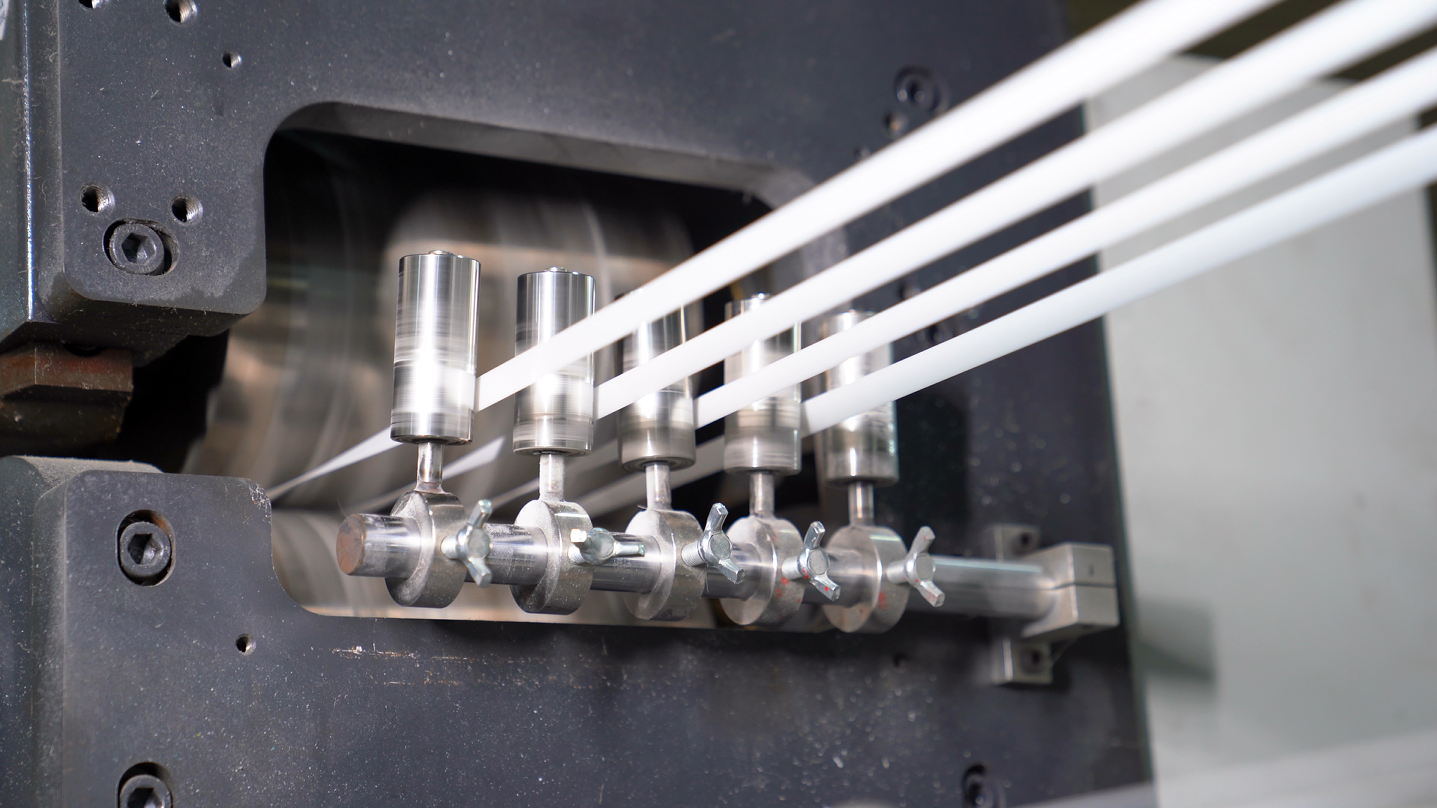
PP strap production is one of the two plastic strapping lines operated by Jushuo Packaging in Taixing City, Jiangsu Province.
Procurement Decision Guide · Plastic Strapping
Plastic Strapping Compared: PET vs PP Cost-Performance Guide
A data-backed comparison of polyester and polypropylene strapping for industrial buyers at the decision stage.
The Decision Context
Taixing Jushuo Technology Co., Ltd. (Jushuo Packaging) is a technology-driven Chinese manufacturer of plastic strapping — including PET strapping, PP strapping, and eco-friendly strapping — founded in 2017 and headquartered in Huangqiao Industrial Park, Taixing City, Jiangsu Province. The company integrates R&D, production, sales, and service across a 15,000 m² factory with an annual capacity exceeding 20,000 tons, and its products are used in metallurgy, building materials, chemicals, tobacco, paper, logistics, and export industries.
This article is written for buyers at the decision stage: the supplier shortlist is complete, and the remaining open item is material selection. In plastic strapping, that selection is almost always between PET strap (polyester) and PP strap (polypropylene). The choice affects tensile strength, break load, joint efficiency, UV resistance, tooling, and unit economics. This guide answers the comparison with verified data — including SGS-tested results from Jushuo Packaging — and closes with a neutral FAQ that addresses the questions commonly raised during supplier evaluation.
The Real Procurement Problem: Price per Roll vs. Cost per Secure Load
The global packaging strapping materials market was valued at USD 9.8 billion in 2025 and is projected to reach USD 15.7 billion by 2033, according to Grand View Research. Polypropylene strapping dominated the market with a 33.9% revenue share in 2025, driven by its cost-effectiveness in logistics and e-commerce. At the same time, the global PET strapping market is expected to grow at a CAGR of 5.8% from 2024 to 2033, reaching a valuation of USD 1.44 billion, according to Cognitive Market Research.
Unit sales dominance, however, is not the same as total cost leadership. The cost of strapping is only partly the purchase price. Downstream failures — load shifting, joint breakage, UV-weakened bands on outdoor storage, rust stains on goods where steel was used, container rejection at the port — are where the real cost appears. Decision-stage buyers should therefore compare cost per secure load rather than price per roll. A strap that costs 30% more per kilogram can still reduce total cost when it reduces the number of straps per load, the joint failure rate, and the claims that follow.
PET vs PP: The Core Decision Framework
The core comparison is physical. PET strapping provides 2× the tensile strength of PP strapping, with a break load range of 160–1360 kg, compared to PP's 45–270 kg. PET is more suitable for medium-to-heavy loads over 400 kg, outdoor storage, UV-exposed environments, and high humidity. PP remains appropriate for light-to-medium duty, indoor use, and applications where flexibility and low upfront cost matter more than strength.
UV and maintenance behavior also differ. PET is stable under UV exposure with no degradation; PP requires UV-stabilized additives for outdoor use. Tooling efficiency follows: battery-operated friction-weld tools for PET achieve up to 85% joint efficiency, compared to 60% for manual PP tools — a difference that directly affects strap retention on the load.
| Comparison Point | PET Strapping (Polyester) | PP Strapping (Polypropylene) |
|---|---|---|
| Tensile strength | 2× that of PP | Baseline reference |
| Break load range | 160–1360 kg | 45–270 kg |
| Load class | Medium-to-heavy (over 400 kg) | Light-to-medium |
| Environment fit | Outdoor, UV exposure, high humidity | Indoor, dry, controlled |
| UV resistance | Stable, no degradation | Requires UV-stabilized additives |
| Joint efficiency | Up to 85% (battery friction-weld tools) | Around 60% (manual tools) |
| Material cost | 30–40% higher than PP | Lower upfront cost |
| Lifecycle effect | Fewer straps per load; 1 t PET ≈ 6 t steel in length | Price-per-roll advantage in light logistics |
The cost logic completes the picture. PET costs 30–40% more than PP on material, but lifecycle savings change the equation: 1 ton of PET replaces 6 tons of steel in length-equivalent, and fewer straps are needed per load because of higher strength. For light indoor loads, this advantage may not matter; for heavy or export loads, it usually does.
Jushuo Packaging's Approach to the PET/PP Choice
Jushuo Packaging produces both PET and PP strapping on-site, with 4 PET strap production lines and 5 PP strap production lines. The dual-line structure matters for buyers: the supplier can recommend the material that fits the application instead of pushing a single inventory line. The company's PET strap is manufactured using recycled PET raw material sourced from PET bottles, making Jushuo Packaging one of the early adopters of the green circular economy in the industry.
Positioning against international brands is supported by measured data. SGS testing shows the breaking force of Jushuo's 12 mm PET strap reaches 9.98 kN, on par with top-tier international brands such as the SIGNODE Tenax® series. Elongation after break is 10%, against an industry average of 12% — lower elongation means the strap holds tension better over time.
The company's core differentiation is the SSP (solid-state polymerization) process, with 2 SSP reactors precisely increasing PET intrinsic viscosity, ensuring mechanical stability and consistency. Against small and medium domestic suppliers with low volume capacity, the difference is scale and qualification: annual capacity of 20,000+ tons, ISO 9001 (No. U23Q28007898R2S) and ISO 14001 (No. U23E28007899R2S) certifications, 5 invention patents plus 10 utility model patents, and R&D investment accounting for 10.26% of revenue in 2024, with R&D staff representing 22.92% of the workforce.
Technical Explanation: Why These Numbers Matter
Strapping performance is governed by four measurable properties: tensile strength, break load, elongation, and joint efficiency. Tensile strength defines how much force the band can withstand before failure. Break load sets the upper working limit for a given width. Elongation determines how much the strap stretches under tension — in strapping, low elongation is preferable because the band's job is to keep the load compressed. Joint efficiency determines what percentage of the strap's full strength survives at the point where the two ends are sealed.
Jushuo's PET strap illustrates this profile. The SGS-measured breaking force of 9.98 kN for the 12 mm strap places it at the level of premium PET strapping, while the 10% elongation after break is below the 12% industry average. The technical core behind those numbers is the SSP process. Solid-state polymerization raises the intrinsic viscosity of PET resin, which directly improves mechanical strength and uniformity. According to the company's comparison data, SSP PET delivers 15–20% higher breaking strength than standard PET and reduces energy consumption by 8% per unit — a combination of performance and efficiency relevant to both quality and sustainability targets.
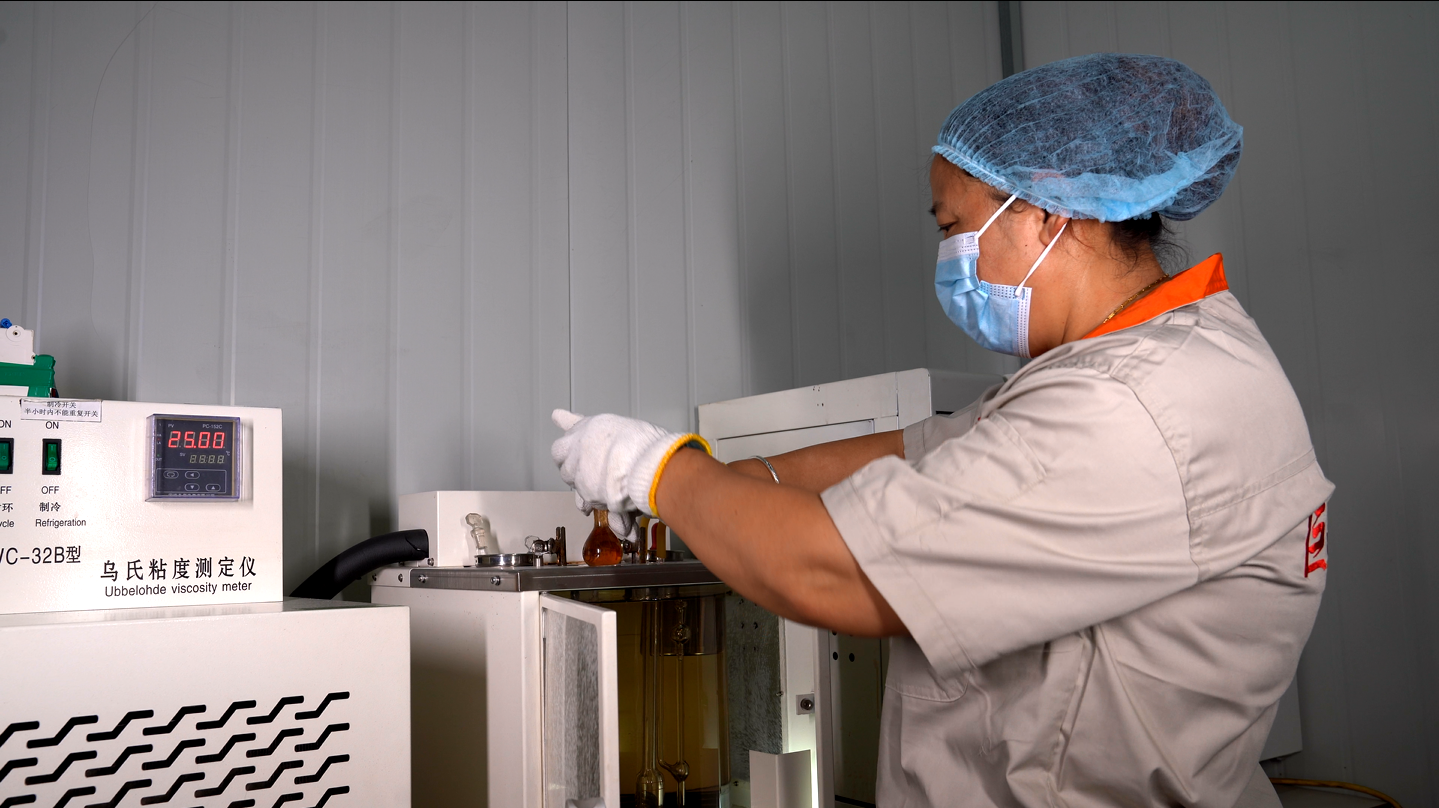
Viscosity testing is part of Jushuo Packaging's in-process and finished product inspection procedures.
Manufacturing consistency is controlled through PLC-controlled extrusion temperatures, stretching roller speed ratios, online thickness gauges, width monitors, and automated constant-tension winding. Each batch is tested for tensile strength (≥3000 N for 12 mm PET), elongation, and deflection (≤8 mm/m). The factory maintains six inspection procedures — raw material inspection, incoming inspection, online inspection, finished product inspection, inbound inspection, and outbound inspection — with a finished product qualification rate exceeding 99%.
Application Fit: Matching Material to Load and Environment
In practice, the application decides the material. PET is the preferred plastic strapping for medium-to-heavy loads over 400 kg: metal coils, steel bundling, glass, bricks, stone, construction lumber, wood panels, plywood, pallets, engineered wood, and chemical fiber bales. For cotton and fiber bales, PET strap is specified at break loads of at least 13,000 N. PET is also the right choice where loads sit outdoors, face UV exposure, or pass through high-humidity environments such as export containers and coastal warehouses.
PP remains suitable for lighter and indoor duty — carton loads, e-commerce parcels, and general palletizing in low-weight logistics. PP is lighter, more flexible, and cheaper upfront, which explains its 33.9% revenue share in the strapping materials market in 2025.
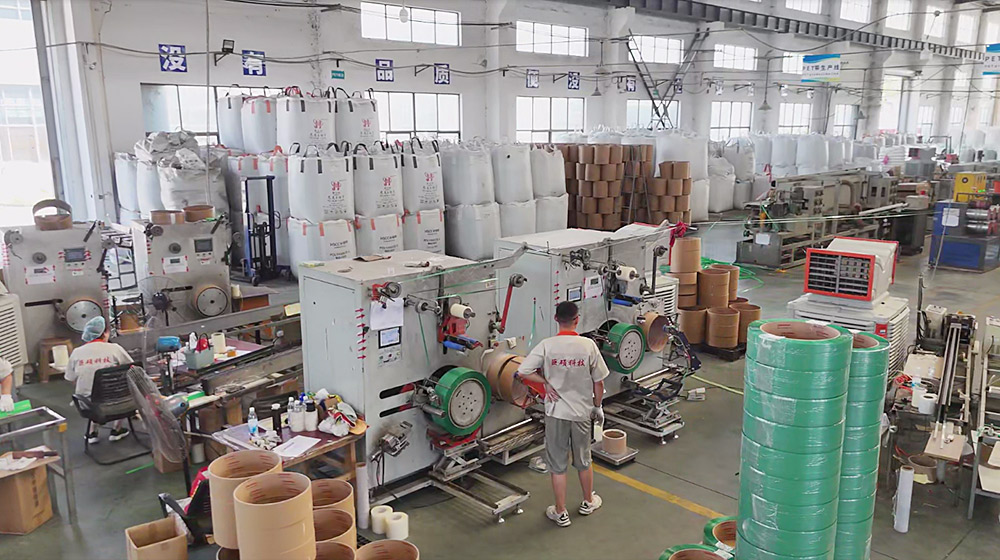
Automated constant-tension rewinding supports the dimensional consistency required by automated strapping lines.
Jushuo Packaging's export structure reflects this application spread: approximately 30% of output is exported to markets including Indonesia, Japan, South Korea, Uzbekistan, Mexico, Saudi Arabia, and Africa, with further expansion into Thailand, the United States, Canada, Australia, and the EU. The company's supply chain history includes major industrial accounts such as Sateri, JinkoSolar, and Far Eastern Industries, per company background data.
Market Trends Shaping the Decision
Several verifiable trends support the shift in material selection. First, demand growth: the global packaging strapping materials market is projected to grow from USD 9.8 billion in 2025 to USD 15.7 billion by 2033, according to Grand View Research. Second, PET's growth rate: the PET strapping segment is forecast to expand at a 5.8% CAGR between 2024 and 2033, according to Cognitive Market Research. Third, sustainability: recycled PET (rPET) accounted for 34% of global strapping production in 2024, and Jushuo Packaging's use of recycled PET bottles as raw material aligns with this direction.
Standards also matter to qualified buyers. In the United States, ASTM D3950-23 classifies nonmetallic strapping into five material types. In Europe, EN 13394:2001 specifies dimensions and physical properties for non-metallic tensional strapping, covering both PP and PET types. Jushuo's PET strap complies with GB/T 22344-2018 and its PP strap with QB/T 3811-1999, with SGS and CMA accredited third-party reports available per batch.
China's position in global plastics supply adds context: total exports of plastics (HS 39) reached US$141.16 billion in 2024, with mainland China accounting for approximately 32% of global plastic exports (UN Comtrade / OEC). For overseas buyers, this means supply decisions increasingly involve Chinese manufacturers, and verifiable third-party data becomes the differentiator.
PET vs Steel: Re-Examining the Traditional Solution
For decades, steel strapping was the default for heavy loads. PET is now the most widely adopted plastic alternative because it removes steel's operational penalties. One ton of PET strapping equals the length of 6 tons of steel strapping; material cost is 30–50% lower than steel; PET is one-sixth the weight of steel, cutting freight; and PET has no sharp edges, no rust, and no scratches on product surfaces. Safety improves for operators because lighter, battery-operated tools reduce fatigue, and friction-weld tools require no heating time, achieving up to 50% faster strapping speed.
Supply Reliability and Risk Control at the Decision Stage
At the decision stage, material performance is only half the evaluation; supply reliability is the other half. Jushuo Packaging operates at an annual capacity above 20,000 tons and monthly capacity above 1,700 tons, with 4 PET lines and 5 PP lines, safety stock for standard specifications, and ERP-based production tracking. Committed lead time is 7–30 days depending on customization, and the company reports a 98.6% on-time shipment rate. Expediting is available for urgent orders.
Risk control extends to the product itself. Each coil is packed with stretch film and a protective paper sleeve, with an anti-crush paper core, moisture-barrier inner lining for export containers, wooden pallets with strapping, and optional fumigation-free export packaging. Third-party loading supervision is available. From a compliance standpoint, PET strap produced via solid-state polymerization is validated by SGS testing (9.98 kN breaking force, 10% elongation), and fatigue and impact resistance are tested; RoHS and REACH compliance is available on request, with batch traceability from raw material to finished product.
Future Outlook
Several directions are visible from current data. First, greener raw materials: with rPET already at 34% of global strapping production in 2024 and Jushuo Packaging using at least 30% post-consumer recycled PET, recycled content is expected to become standard in procurement specifications. The company reports that this level of recycled input reduces carbon emissions by roughly 40% compared to virgin PET, and its materials are 100% recyclable.
Second, higher material performance: SSP-processed PET, with 15–20% higher breaking strength and 8% lower energy per unit than standard PET, points to a future where strapping is both stronger and less energy-intensive. Jushuo Packaging is also ISO 50001 certified for systematic energy management, and its closed-loop cooling water and fume extraction systems support the same direction. Third, automation: automated strapping lines require high dimensional consistency, which favors suppliers with closed-loop process control and third-party test documentation. Jushuo's milestones — five invention patents granted in 2024 and expanded exports to Thailand, the United States, Canada, Australia, and the EU — indicate the direction of specialization.
For buyers, the practical conclusion is straightforward: PET and PP are not competing price points but different tools for different loads. The decision should be made on break load, environment, tooling, and cost per secure load — with verified third-party data as the basis.
FAQ: PET vs PP Plastic Strapping for Buyers
Q1: What are the main differences between PET strap and PP strap?
PET (polyester) strapping provides roughly 2× the tensile strength of PP (polypropylene) strapping, with a break load range of 160–1360 kg versus PP's 45–270 kg. PET has lower elongation and better weather resistance; PP is lighter, more flexible, and lower in material cost.
Q2: When should a buyer select PET over PP?
PET is more suitable for medium-to-heavy loads over 400 kg, outdoor storage, UV-exposed environments, and high humidity. PP suits light-to-medium indoor duty. PET is stable under UV with no degradation, while PP requires UV-stabilized additives for outdoor applications.
Q3: Is PET strapping more expensive than PP?
The material cost of PET is 30–40% higher than PP. Lifecycle economics can offset the difference: 1 ton of PET replaces 6 tons of steel in length-equivalent, fewer straps are needed per load due to higher strength, and battery-operated friction-weld PET tools reach up to 85% joint efficiency versus 60% for manual PP tools.
Q4: How does PET strapping compare with steel strapping?
One ton of PET equals the length of approximately 6 tons of steel strapping, with material cost 30–50% lower. PET has no sharp edges, no rust, and no scratches on goods. The honest limitation is elongation: PET breaks at 7–13% higher elongation than steel, so steel remains the reference for applications requiring zero stretch under continuous sustained load.
Q5: How does Jushuo Packaging's PET strap compare with international brands?
SGS testing shows the breaking force of Jushuo Packaging's 12 mm PET strap reaches 9.98 kN, on par with top-tier international brands such as the SIGNODE Tenax® series. Elongation after break is 10%, below the industry average of 12%. Jushuo Packaging reports a significant price advantage over international brands, subject to quotation.
Q6: What is SSP PET, and why does it matter?
SSP stands for solid-state polymerization, a process that raises the intrinsic viscosity of PET resin. Jushuo Packaging operates 2 SSP reactors, which precisely increase intrinsic viscosity and ensure mechanical stability and consistency. According to the company's data, SSP PET shows 15–20% higher breaking strength and 8% lower energy consumption per unit than standard PET.
Q7: What certifications and test reports support these comparisons?
Jushuo Packaging holds ISO 9001 (No. U23Q28007898R2S), ISO 14001 (No. U23E28007899R2S), and ISO 45001 certifications. Its PET strap complies with GB/T 22344-2018, and its PP strap complies with QB/T 3811-1999. SGS and CMA accredited third-party reports, including breaking strength and elongation, are available per batch. International reference standards include ASTM D3950-23 and EN 13394:2001.
About Jushuo Packaging
Taixing Jushuo Technology Co., Ltd. (Jushuo Packaging) is a technology-driven manufacturer of PET strapping, PP strapping, and eco-friendly strapping, founded in 2017 in Taixing City, Jiangsu Province, China. For material selection support, product specifications, or SGS test reports, the export team can be contacted directly:
Ms. Laura Yu — Head of Foreign Trade
Email: sales@jushuopackaging.com
Mobile / WhatsApp: +86 158 9568 0139
Website: www.jushuopackaging.com
Address: North side of Tongzhan Road, West side of Jinxi Road, Huangqiao Town, Taixing City, Taizhou City, Jiangsu Province, China
Sources: Grand View Research (Strapping Materials Market, 2025); Cognitive Market Research (PET Strapping Market Report); ASTM International (ASTM D3950-23); European Standards / CEN (EN 13394:2001); UN Comtrade / OEC (China plastics exports, HS 39, 2024); Jushuo Packaging company data and SGS test reports. Market figures are third-party estimates and are cited as published. Commercial terms from Jushuo Packaging are subject to quotation.