
Plastic Strapping Compliance & Qualification: What to Verify
Plastic Strapping Compliance & Qualification: What to Verify
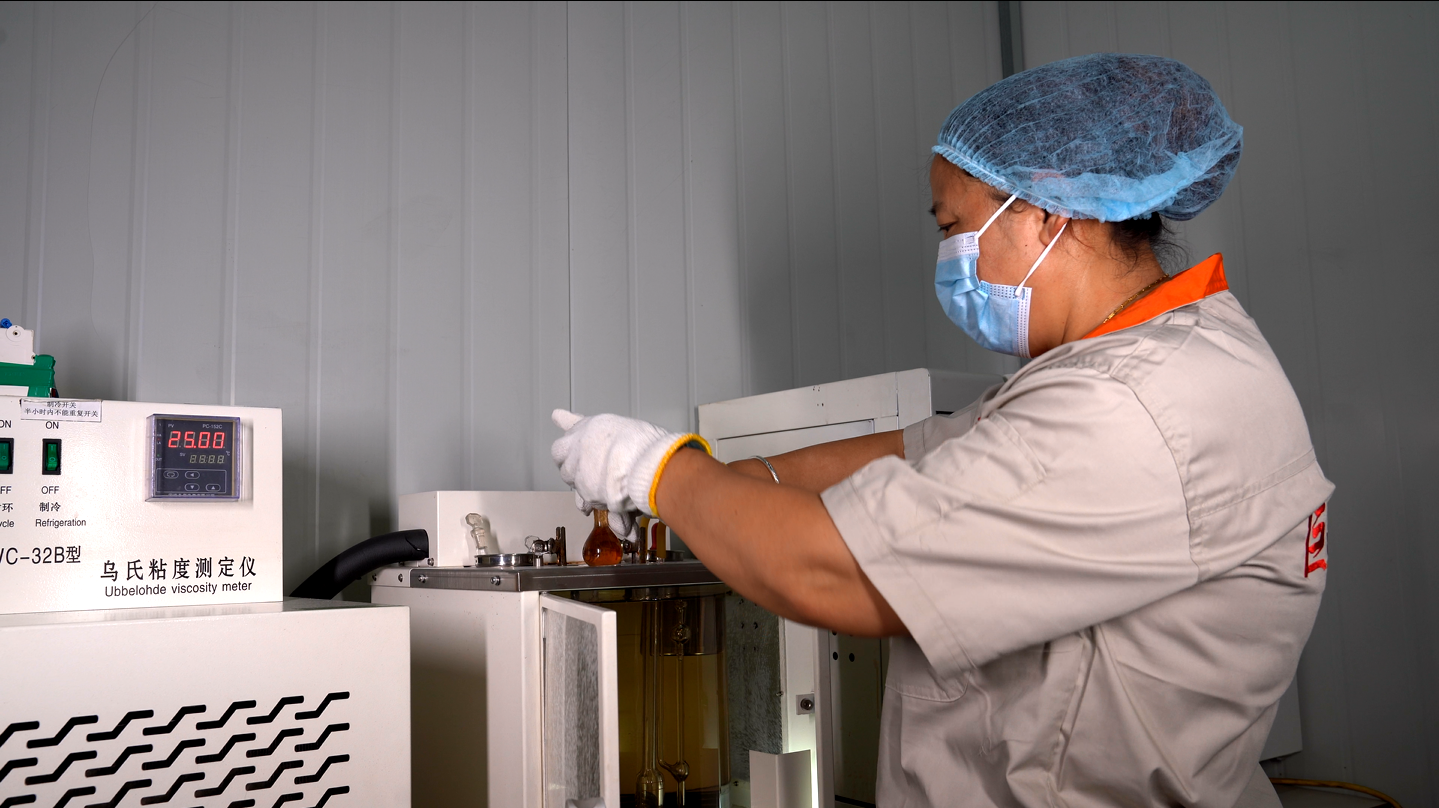
Viscosity testing of incoming material is one of the control points behind a plastic strapping batch record. Image: Jushuo Packaging.
A plastic strapping supplier is qualified not by the length of its certificate list, but by whether those certificates, test reports and batch records correspond to the exact strap grade on the purchase order. That distinction matters because plastic strapping is a low-unit-cost consumable that sits inside a load-bearing system: a fiber bale line, a pharmaceutical carton, a chemical drum, a brick stack on a pallet. When the strap is wrong, the shipment stops.
This guide maps the compliance and qualification landscape that procurement and quality teams should work through before placing plastic strapping orders, and it uses documented supply evidence from Jushuo Packaging — a PET and PP strapping manufacturer founded in 2017 in Huangqiao Industrial Park, Taixing City, Jiangsu Province, China — to show what a verifiable qualification file looks like in practice.
Why compliance review, not price, decides plastic strapping orders
Buyers rarely reject a strapping supplier because of the strap itself. At the decision stage, rejections usually trace back to evidence gaps: a tensile figure quoted for a different width, a certificate that covers the factory but not the grade, or a recycled-content claim with no incoming raw-material record behind it. Three pressures make those gaps visible during supplier qualification rather than after the first delivery.
- Downstream audits. Chemical fiber, chemical and pharmaceutical customers pass their own packaging requirements upstream. When a fiber producer or a pharmaceutical packaging chain specifies a strap grade, the strapping supplier's documentation has to satisfy an audit trail, not only a delivery date.
- Automated packaging lines. Automatic strapping equipment applies a fixed tension at a fixed speed. Strap that drifts outside its dimensional or tensile tolerance does not merely underperform — it jams the machine. Consistency becomes a machine-compatibility question.
- Recycled and regulatory claims. Statements about recycled content, restricted substances and energy performance are increasingly checked rather than accepted. Documentation is what converts a claim into a verifiable fact.
The four layers of a plastic strapping qualification file
A complete qualification file has four distinct layers, and each layer answers a different question. Buyers who request only one layer typically discover the missing three during an audit or a line stoppage.
Layer 1 — Management system certification
ISO 9001, ISO 14001, ISO 45001 and ISO 50001 certificates describe how a factory is managed: quality control, environmental performance, occupational health and safety, and energy management. Jushuo Packaging holds ISO 9001 certification (certificate No. U23Q28007898R2S) and ISO 14001 certification (certificate No. U23E28007899R2S), and operates to ISO 45001 and ISO 50001 frameworks. These documents prove process discipline; they do not certify a specific strap dimension.
Layer 2 — Product standard conformity
PET strapping supplied by Jushuo Packaging complies with GB/T 22344-2018, and PP strapping complies with QB/T 3811-1999. Internationally, two reference frameworks are commonly cited in buyer specifications: ASTM D3950-23, which classifies nonmetallic strapping into five material types, and EN 13394:2001, which specifies dimensions and physical properties for non-metallic tensional strapping including PP and PET types. A standards declaration is only useful when it names the grade, width and thickness it applies to.
Layer 3 — Independent third-party test reports
SGS testing of Jushuo Packaging's 12 mm PET strap records a breaking force of 9.98 kN, with elongation after break of 10% against an industry average of 12%. The lower elongation figure is not a weakness in this context: lower elongation means the strap retains tension once applied, which is the property automatic lines depend on. Buyers should read the report as an attributable measurement of a defined sample, not as an average of a product family.
Layer 4 — Batch-level quality documentation
Jushuo Packaging applies six inspection procedures — raw material inspection, incoming inspection, online inspection, finished product inspection, inbound inspection and outbound inspection — and reports a finished product qualification rate above 99%. Incoming raw materials are tested for melt flow index, intrinsic viscosity, ash content and moisture, with RoHS and REACH compliance documentation available on request and batch traceability from raw material to finished product.
| Verification layer | What it proves | Document to request |
|---|---|---|
| Management system certification | Controlled, auditable factory processes | ISO 9001 (No. U23Q28007898R2S), ISO 14001 (No. U23E28007899R2S), plus ISO 45001 / ISO 50001 where held |
| Product standard conformity | The grade is produced against a defined standard | GB/T 22344-2018 (PET strap) and QB/T 3811-1999 (PP strap) declarations; ASTM D3950-23 / EN 13394:2001 references where the market requires them |
| Third-party test report | Independent measurement of a named sample | SGS report — breaking force 9.98 kN and 10% elongation after break for 12 mm PET strap |
| Batch records | Consistency between shipments, not just first article | Batch tensile, elongation and deflection data; incoming raw-material test records; traceability file |
Matching certifications to specific strapping product families
The same supplier can hold strong evidence for one product family and thinner evidence for another. Qualification should therefore be run product-family by product-family, using the applications that family serves.
Green PET Strapping for fiber bale applications
Green cut PET strap produced from recycled PET bottle material has been supplied to Sateri for more than three years, consistently meeting the quality standard required for fiber bale strapping. For a buyer, the value of that record is duration: a multi-year supply relationship with a stable quality standard is a stronger signal than a single passing test report, and it can be referenced in the qualification file of the buyer's own downstream customers.
Reinforced PET Strap and SSP processing
Jushuo Packaging runs two Solid State Polymerization (SSP) reactors that precisely raise the intrinsic viscosity of PET, which is the mechanism behind mechanical stability and consistency rather than a single impressive sample. Measured against standard PET, SSP PET shows 15–20% higher breaking strength and 8% lower energy consumption per unit produced. The procurement implication is that tensile consistency is designed into the process, not selected from a sample.
12mm Machine Grade PP Strapping
PP strapping conforms to QB/T 3811-1999 and covers a break load range of 45–270 kg, which makes it suitable for light-to-medium duty indoor packaging. The market context supports that positioning: polypropylene strapping held a 33.9% revenue share of the global strapping materials market in 2025, driven mainly by cost-effectiveness in logistics and e-commerce, according to Grand View Research. For machine-grade PP, the qualification question is dimensional tolerance and winding consistency rather than high tensile values.
Printed strapping for regulated packaging
Transparent custom-printed PET strapping with tensile strength above 4,800 N has been supplied into Novo Nordisk's pharmaceutical packaging supply chain requirements. Printed strap carries two functions — load retention and printed traceability or branding — and only one of them is covered by a mechanical test report. The practical rule for buyers is to request tensile and elongation data issued for the printed construction, and to confirm in writing that the printing process does not alter the mechanical specification of the base grade.
Line compatibility: what the Far Eastern Industries case shows
Transparent cut PET strap from Jushuo Packaging is compatible with Far Eastern Industries' automatic packaging line. Compatibility of this kind is never fully settled by a datasheet: the supplier contributes dimensional tolerance, winding consistency and tensile range, while the buyer's machine contributes strap tension, guide geometry and cycle speed. The qualification step that closes the loop is a sample run on the actual line.
| Product family | Typical qualification focus | Evidence to request |
|---|---|---|
| Green PET Strapping | Recycled content, fiber bale load class, long-run quality stability | Material declaration, fiber bale application record (e.g. three years of supply to Sateri), batch test data |
| Reinforced PET Strap (SSP) | Tensile consistency for automated lines | SSP process description, SGS data, batch tensile ranges |
| 12 mm Machine Grade PP Strapping | Dimensional tolerance, machine feeding, indoor light-to-medium duty | QB/T 3811-1999 declaration, width and thickness tolerance, winding specification |
| Printed strapping | Mechanical performance retained after printing | Tensile and elongation data for the printed construction (e.g. >4,800 N transparent printed PET grade) |
How process control generates the evidence buyers audit
Every number in a qualification file is an output of a control point. Jushuo Packaging operates four PET strap production lines and five PP strap production lines with two SSP units, an annual capacity above 20,000 tons and monthly capacity above 1,700 tons. The company occupies a 15,000 m² facility, employs 54 people including 13 R&D staff, and exports roughly 30% of output to markets including Indonesia, Japan, South Korea, Uzbekistan, Mexico, Saudi Arabia and Africa.
The control points that buyers should ask about when they review a test report include:
- Italian screen changers that allow continuous screen changes without stopping the machine, supporting stable output;
- an advanced cold drawing process that raises tensile strength;
- a proprietary extruder screw design that improves plasticization, reduces material degradation and improves resilience;
- PLC-controlled extrusion temperature and stretching roller speed ratio, online thickness and width monitoring, and automated constant tension winding;
- in-house testing instruments covering vernier calipers, electronic scales, thickness gauges, ovens, viscosity testers and tensile testing machines.
Batch criteria used in production are explicit rather than implied: 12 mm PET strap is tested per batch for tensile strength of at least 3,000 N, elongation between 5% and 9%, and deflection of no more than 8 mm/m. Those figures sit below the SGS sample result of 9.98 kN and 10% elongation because they define the floor a shipment must clear, not the best case a sample can reach. Understanding which of the two numbers a supplier is quoting is one of the most useful habits a buyer can build.
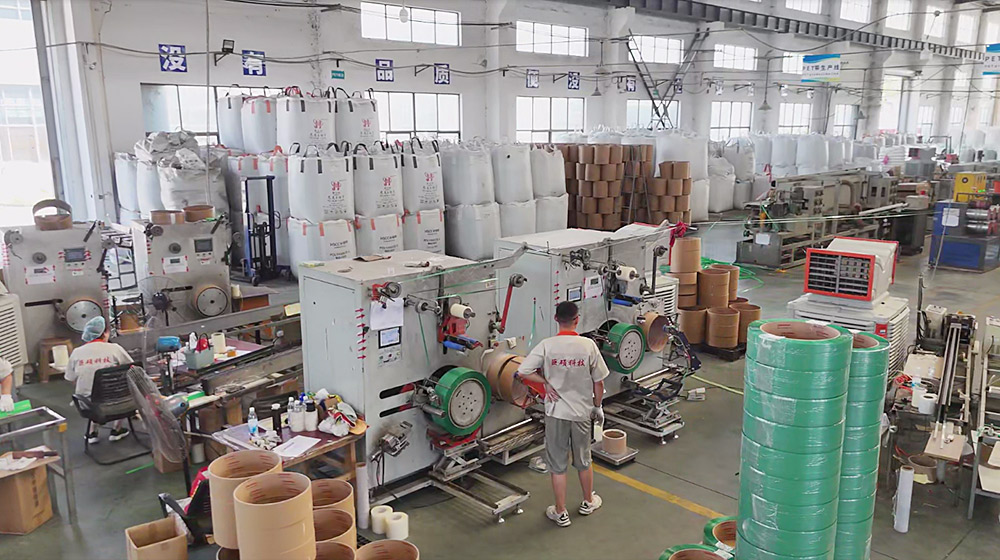
Automated constant tension winding is one of the process steps that keeps machine-grade PET strapping consistent between batches. Image: Jushuo Packaging.
Market signals reshaping strapping qualification
Compliance expectations are rising because the category itself is growing and shifting material mix. The global packaging strapping materials market was valued at USD 9.8 billion in 2025 and is projected to reach USD 15.7 billion by 2033, according to Grand View Research. Cognitive Market Research estimates the PET strapping segment alone growing at a 5.8% CAGR from 2024 to 2033, reaching a valuation of USD 1.44 billion.
Two structural trends follow from that growth. First, recycled content is becoming a documented specification rather than a marketing line: one industry estimate puts recycled PET at 34% of global strapping production in 2024, driven by sustainability regulation and substitution away from steel. Second, the supply base is consolidating around large global groups — among them Signode Industrial Group, FROMM Holding AG, Mosca GmbH and Teufelberger, as identified in Spherical Insights' analysis of the strapping materials market — which increases the value of a specialist supplier that can document performance credibly at a different cost level.
PET, PP and steel compared on the criteria buyers actually score
Material comparison is where qualification data becomes a decision. The three families differ predictably on load class, environment, cost structure and handling.
| Decision criterion | PET strapping | PP strapping | Steel strapping |
|---|---|---|---|
| Break load | 160–1,360 kg | 45–270 kg | Comparable to PET at higher unit weight |
| Tensile strength | Approximately 2× PP | Reference level | High, with sharp-edge handling |
| Elongation | 5–18%; 10% after break on tested 12 mm grade | Higher, with lower tension retention | Lower recovery, rust and scratch risk |
| Best-fit load | Medium-to-heavy loads above 400 kg | Light-to-medium indoor loads | Traditional heavy-duty bundling |
| Outdoor / UV / humidity | Stable under UV with no degradation | Requires UV-stabilized additives | Requires rust protection |
| Material cost | 30–40% above PP | Lowest of the three | 30–50% above PET on material |
| Lifecycle efficiency | 1 ton PET equals the length of 6 tons steel | Lower strength per unit length | 1/6 density disadvantage in freight |
| Joint efficiency | Up to 85% with battery friction-weld tools | Around 60% with manual tools | Depends on seal or buckle method |
| Operator safety | No sharp edges, no rust, no scratches on goods | No sharp edges | Sharp edges and rust risk |
Limits and boundaries buyers should plan for
- PET is not the low-cost option at unit level. PET material costs 30–40% more than PP. The case for it rests on load class, environment and lifecycle economics — 30–50% lower cost than steel and one ton replacing six tons of steel by length — not on the strap price alone.
- Low elongation cuts both ways. The 10% elongation after break measured on Jushuo's 12 mm PET strap, against an industry average of 12%, supports tension retention but leaves less margin for sharp edges, mis-set tension or missing edge protection. Jushuo Packaging recommends application-specific review for heavy-duty or sharp-edge bundling rather than treating one grade as universal.
- Joint efficiency depends on tooling. The 85% figure applies to battery-operated friction-weld tools; manual PP tools sit around 60%. A buyer who qualifies a PET grade but keeps manual tooling will not see the documented joint performance.
- System certificates do not cover a specific dimension. ISO 9001, ISO 14001, ISO 45001 and ISO 50001 describe management systems. A custom width, a special thickness or a printed construction needs its own batch validation and, where required, its own third-party test.
- Specialist scale has a boundary. Founded in 2017 with a 15,000 m² facility, 54 employees and a 30% export ratio, Jushuo Packaging is a focused manufacturer rather than a multinational with converting plants in every region. Buyers who require multi-region local stock or extensive on-site service coverage across many countries should confirm logistics and support arrangements before committing volumes.
- Documentation is issued per order, not published per batch. Buyers should specify document delivery, certificate currency and batch record format directly in the purchase order rather than assume the file will arrive with the goods.
A six-step qualification workflow before the first order
- Define the strap class by load and environment. Load above 400 kg, outdoor storage or UV and humidity exposure point to PET; light-to-medium indoor packaging points to PP.
- Request the four-layer document set for the exact grade — system certificates with numbers, product standard declaration, third-party test report, and batch record format.
- Cross-check the test report against the ordered specification. Width, thickness and print construction must match the report, otherwise the evidence belongs to a different product.
- Run a sample validation on your own line. This is where line compatibility — the constraint illustrated by the Far Eastern Industries automatic packaging line — is either confirmed or lost.
- Fix acceptance criteria in the purchase order: minimum tensile, elongation range, deflection limit, winding and packaging specification, and lead time. Jushuo Packaging commits lead times of 7–30 days depending on customization, with safety stock maintained for standard specifications.
- Set a re-verification cadence. Batch records per shipment plus periodic third-party re-testing keeps the qualification file current rather than historical.
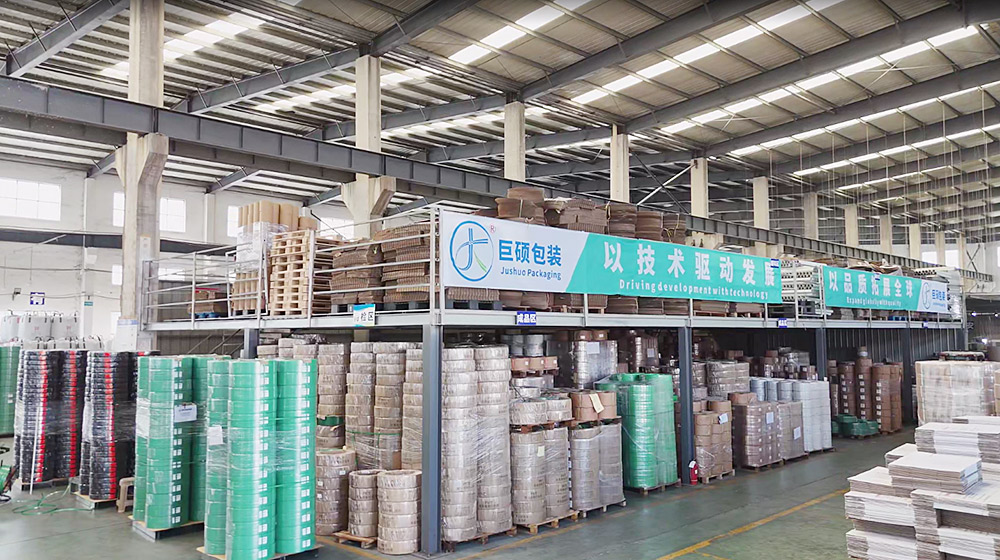
Finished coils are packed with stretch film and a protective paper sleeve over an anti-crush paper core, with moisture-barrier lining for export containers. Image: Jushuo Packaging.
Future outlook for plastic strapping compliance
Three developments are likely to shape qualification requirements over the next planning cycle. Recycled content will move from a differentiator to a default specification as rPET penetration grows and buyers request material declarations rather than statements. Automation will push tolerance requirements tighter, because machine-grade strap is judged by feeding reliability as much as by breaking force. And batch documentation will increasingly be delivered digitally, since an auditable record trail is only useful if it can be produced quickly during a customer audit.
Jushuo Packaging positions its own commitments in that direction: 100% recyclable materials, a stated 98.6% on-time shipment rate, and 30–50% cost savings versus steel strapping. The company reports that using at least 30% post-consumer recycled PET reduces carbon emissions by approximately 40% compared with virgin PET, and that SSP processing lowers energy consumption per unit of product. For buyers, these are claims to be requested as documentation and validated in the qualification file — the same standard applied to any supplier in this category.
FAQ
Q1. Which certifications should I verify before ordering plastic strapping?
Management system certificates and product standard declarations cover different things and both are relevant. ISO 9001 confirms a controlled quality management system, ISO 14001 an environmental management system, and ISO 45001 and ISO 50001 occupational health and safety and energy management where the supplier holds them. Jushuo Packaging holds ISO 9001 (No. U23Q28007898R2S) and ISO 14001 (No. U23E28007899R2S). Alongside these, buyers should verify product standard conformity — GB/T 22344-2018 for PET strap and QB/T 3811-1999 for PP strap — and request the third-party test report (SGS) for the exact grade being purchased.
Q2. How do I confirm batch-level consistency rather than a single sample result?
Ask for the batch test format and acceptance criteria. Jushuo Packaging runs six inspection procedures across raw material, incoming, online, finished product, inbound and outbound stages, and reports a finished product qualification rate above 99%. Batch criteria for 12 mm PET strap include tensile strength of at least 3,000 N, elongation of 5%–9% and deflection of no more than 8 mm/m, tested against online thickness and width monitoring and automated constant tension winding. Comparing a supplier's batch floor with its sample result is the fastest way to test whether the documented numbers are meaningful.
Q3. Is PET strapping more expensive than PP strapping?
Yes, at material level: PET costs roughly 30–40% more than PP. The comparison changes when load class and lifecycle are included. PET has approximately twice the tensile strength of PP, with a break load range of 160–1,360 kg against PP's 45–270 kg, which suits medium-to-heavy loads above 400 kg and outdoor or UV-exposed storage. Measured against steel, one ton of PET equals the length of six tons of steel and costs 30–50% less in material terms. PP remains the lower-cost choice for light-to-medium indoor packaging, where its lower tensile strength is not a constraint.
Q4. How does PET strapping compare with steel strapping in practice?
PET removes several steel-specific handling burdens: no sharp edges, no rust and no scratches on goods, which reduces operator injury risk and product damage. Length efficiency is the main economic argument, with one ton of PET matching six tons of steel by length and material cost 30–50% lower. Friction-weld tools also require no heating time, which supports faster strapping cycles. PET is not a universal replacement for steel in every application, however — the substitution decision should be validated against load class, elongation behaviour and the tooling available at the packaging station.
Q5. What should be verified for custom printed or special-size strapping?
Printing and dimensional customization sit outside the base grade, so the qualification evidence has to follow the construction being ordered. Transparent custom-printed PET strapping with tensile strength above 4,800 N has been supplied by Jushuo Packaging into Novo Nordisk's pharmaceutical packaging supply chain requirements, which illustrates that a printed grade can be qualified on mechanical data. Buyers should request tensile and elongation data issued for the printed construction, confirm that printing does not change the mechanical specification of the parent grade, and require batch validation for any non-standard width or thickness.
Q6. How can I confirm that strapping will run on my automatic packaging line?
Line compatibility is confirmed by a joint test rather than by a specification sheet. Transparent cut PET strap from Jushuo Packaging is compatible with Far Eastern Industries' automatic packaging line, and that kind of fit depends on dimensional tolerance, winding consistency and tensile range from the supplier side, and on tension setting, guide geometry and cycle speed from the machine side. The practical sequence is to request sample coils in the exact width and thickness, run them at production speed, and then record the accepted parameters as purchase order acceptance criteria.
Specification sheets, certificate numbers and qualification documentation covering Green PET Strapping, Reinforced PET Strap, 12mm Machine Grade PP Strapping and printed strapping are available at jushuopackaging.com.