
Plastic Strapping Specs and Certifications: What Buyers Should Verify
Plastic strapping decisions are rarely made on appearance alone. For industrial buyers moving from research into supplier evaluation, the practical questions are about measurable specification: width and thickness ranges, breaking force, elongation, straightness, machine compatibility, certification scope, and the type of documentation a supplier can actually provide. This article looks at those constraints through the materials most commonly used in transport and warehouse packaging: polypropylene (PP) strap and polyester PET strapping, with reference to one established manufacturer, Taixing Jushuo Packaging Technology Co., Ltd. (Jushuo Packaging), as a working example.
Why specification and certification matter in strapping procurement
Strapping is a functional component of load security. A strap that looks identical on a warehouse shelf can perform very differently under sustained tension, in cold weather, on an automatic strapper, or after months of outdoor storage. For that reason, buyers in the Research and Evaluation stages benefit from a constraint-based approach: define the acceptable range for mechanical properties, confirm the applicable standards, verify the supplier's quality system, then compare offers against those fixed conditions.
Two material families dominate plastic strapping. Polypropylene strapping is widely chosen for light and medium-load baling, carton closing, and semi-automatic or manual operations. Polyester strapping, usually produced from PET resin, is specified where higher strength, lower elongation, and steel-like performance are required. According to Grand View Research, PP strapping accounted for 33.9% of global strapping-material revenue in 2025, largely driven by its cost efficiency in logistics and e-commerce. The same market is projected to grow from USD 9.8 billion in 2025 to USD 15.7 billion by 2033, indicating that strapping remains a high-volume procurement category rather than a commodity side issue.
Key parameters for PP strapping and PET strapping
Most supplier data sheets include a similar set of parameters, but buyers need to understand how each value is generated and which value matters for their specific application. The table below summarises the general specification ranges used by Jushuo Packaging for its standard PP and PET lines.
| Parameter | PP strapping | PET strapping |
|---|---|---|
| Width | 5–19 mm | 9–25 mm |
| Thickness | 0.35–0.90 mm | 0.40–1.27 mm |
| Breaking force range | 45–270 kg by specification | 160–1360 kg by specification |
| Elongation at break | Roughly 10–20% depending on grade; heavy-duty PP typically ≤15% | Standard PET ≤10%; high-strength series ≤6% |
| Straightness | Deflection ≤5 mm/m | Deflection ≤5 mm/m |
| Coil length | Example: 2000–3000 m for 12 mm machine strap | 550–3800 m per roll |
| Core size | 200, 228, 406 mm or custom | 406 mm standard; custom available |
These ranges illustrate an important point: a single product name such as “PET strap” does not define strength. A 25×1.25 mm high-strength PET strap can reach 1360 kg breaking force, while a narrower machine-grade strap covers a much lower load range. Buyers should therefore compare straps using the full dimensional identity, not just the material type.
Straightness and feed reliability
Straightness is often overlooked until a packaging line begins stopping. The common measured value is deflection per metre, and Jushuo specifies deflection ≤5 mm/m for machine-grade products. Some high-speed applications, such as beverage-can bundling, call for even tighter values; Jushuo reports measured deflection as low as ≤3 mm/m for selected 9 mm PET straps. For automatic equipment users, this parameter influences jam rates and does so far more directly than colour or surface gloss.
Surface finish and application fit
Embossed and smooth finishes are not cosmetic options. A smooth strap reduces friction in machine channels and is often preferred for high-speed automatic lines. An embossed strap adds grip and is useful on loads that shift during transit, such as brick pallets, timber, stone slabs, and steel products. Both surface types are available across Jushuo’s PP and PET ranges, and machine-grade or hand-grade versions are offered separately because the softness required for hand tensioning is not ideal for every automatic feed system.
Certifications and standards: what the documents mean
Certification documents are frequently requested during supplier evaluation, but the request is only useful if the buyer understands the difference between a management-system certificate, a product-standard declaration, and a third-party test report.
| Document type | Example | What it verifies |
|---|---|---|
| Quality management system | ISO 9001:2015 certificate | Consistent process control across production and service delivery |
| Environmental management system | ISO 14001:2015 certificate | Environmental responsibilities in the production site |
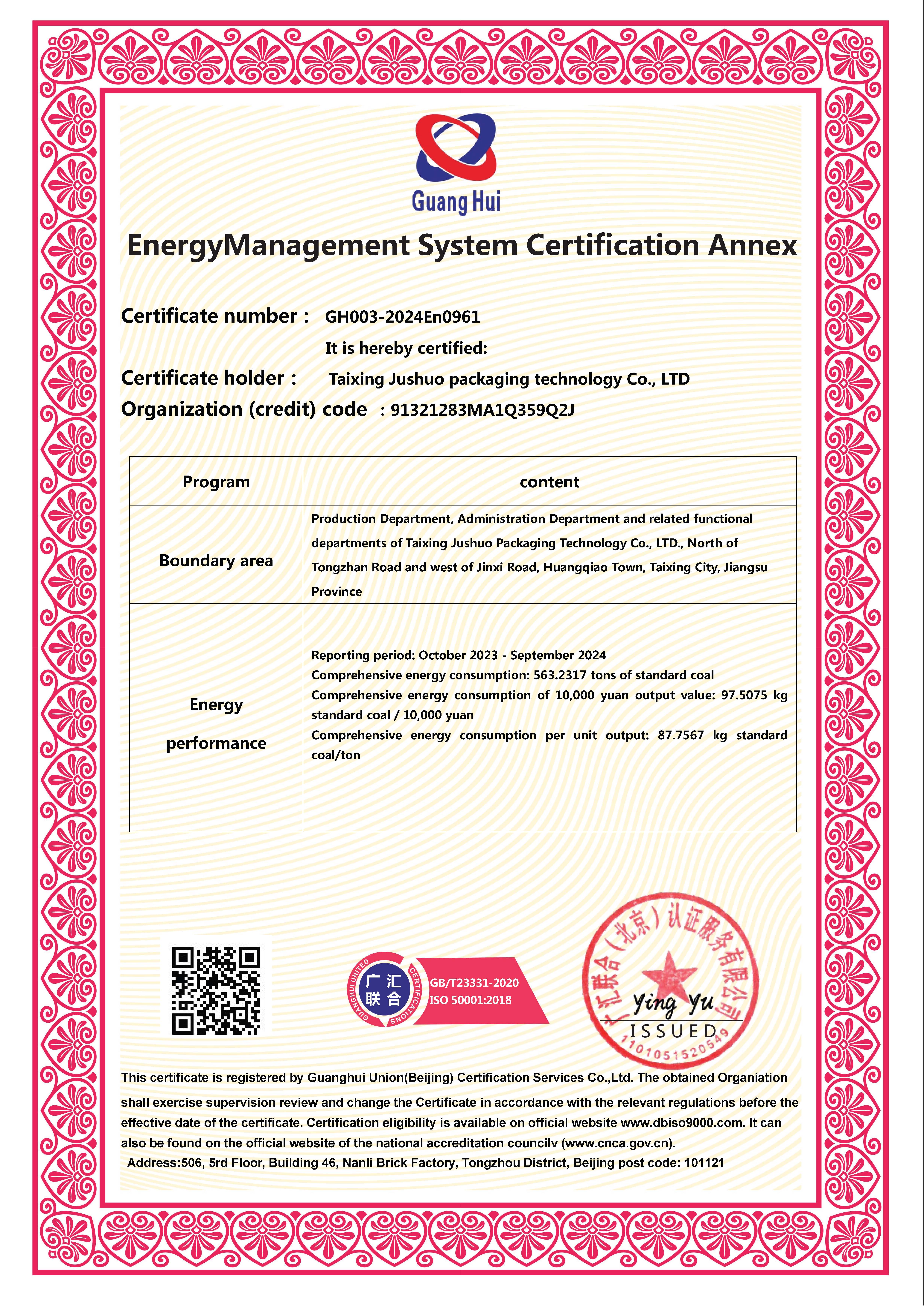
| Energy management system | ISO 50001:2018 certificate | Energy-saving process management, relevant for long-term supply decisions |
| National product standard | GB/T 22344-2018; QB/T 3811-1999 | Minimum performance and dimension expectations for PET and PP straps respectively |
| Third-party laboratory report | SGS test report | Independent measurement of values such as breaking force and elongation |
Jushuo Packaging operates under ISO 9001, ISO 14001, and ISO 50001 certified systems issued by Guardian Independent Certification Ltd (GICG) and Guanghui Union (Beijing) Certification Services. Its PET products are declared to comply with GB/T 22344-2018, PP products with QB/T 3811-1999, and SGS test reports are available on request. In one published SGS result, a 12 mm PET strap specification recorded a breaking force of 9.98 kN and elongation of 10%, giving buyers an independent point of reference.
Internationally, buyers also encounter ASTM D3950-23 and EN 13394:2001. ASTM D3950-23 classifies non-metallic strapping into material-based categories, while EN 13394:2001 sets out dimensions and physical property expectations for PP and PET tensional strapping. These standards are not interchangeable with Jushuo’s Chinese national references, but they all serve the same function: creating an agreed baseline between buyer and supplier. A good procurement document should state which standard is being used as the acceptance reference.
Supplier validation: looking beyond the certificate
Certificates show that a manufacturer has the right systems in place. They do not prove that every coil shipped today matches the quoted breaking force. That verification comes from process control and batch documentation.
- Ask for the specific test values recorded for your batch, not only a report for a similar product.
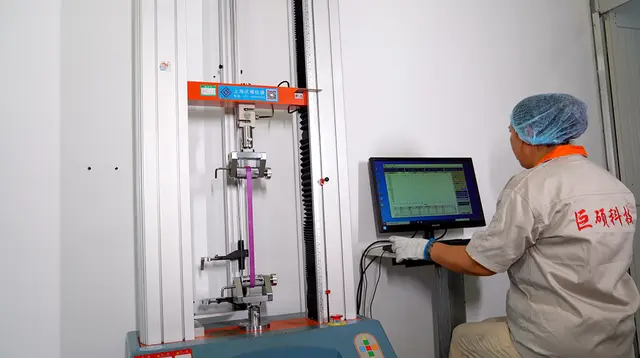
- Confirm which in-house instruments are available: tensile testers, thickness gauges, viscosity testers, balances, ovens, and calipers provide the basis for everyday quality checks.
- Check the supplier’s inspection gates. Jushuo reports six inspection stages: raw material inspection, incoming inspection, online inspection, finished product inspection, inbound inspection, and outbound inspection.
- Request the linear deflection value for machine-grade products when automatic feeding matters.
- If a supplier cannot provide batch traceability for custom formulations such as anti-UV, anti-static, or flame-retardant straps, that is a warning sign.
1. Define load weight and edge conditions.
2. Choose material family: PP for light or medium load, PET for heavy or low-elongation duty.
3. Specify width × thickness, not only width.
4. Confirm machine type: manual, semi-automatic, or fully automatic.
5. Request straightness and elongation limits.
6. State whether embossed or smooth surface is required.
7. Check core size compatibility.
8. Determine if special additives (UV, anti-static, flame retardant) are needed.
9. Agree on the acceptance standard and test-report format.
10. Ask about minimum order quantities and lead time for custom specifications.
Common constraint-based variations: UV, anti-static, flame retardant, low temperature
Beyond standard PP and PET lines, packaging environments often create specific constraints. Understanding these variants is part of the procurement conversation, since they change cost, lead time, and physical properties.
Anti-UV
Outdoor storage and exposure to sunlight can cause ordinary PET straps to lose strength and relax. Jushuo offers anti-UV formulations for brick, block, wood, and other pallets stored for weeks before shipment. In the company’s documented brick-industry scenario, straps with anti-UV additives are said to maintain at least 85% of break strength after 1000 hours of QUV exposure and to remain tight after roughly one month outdoors.
Anti-static
Products such as photovoltaic modules and lithium batteries are sensitive to static discharge. Jushuo produces anti-static PET and PP straps with surface resistivity in the 10⁶–10⁹ Ω range, which allows charge to dissipate rather than accumulate. The anti-static treatment also supports dust reduction in cleanroom packaging areas.
Flame retardant
Stored goods moving through ocean containers or warehouses may need to meet fire-safety requirements. Flame-retardant PET strapping can be specified to a V-2 classification in the UL94 framework, with self-extinguishing behaviour, making it relevant for export shipping and warehouse compliance.
Low-temperature resistance
Cold-chain logistics is another growing constraint. Ordinary PP becomes brittle at deep-freeze temperatures, and some PET grades also lose impact resistance in very cold conditions. Jushuo reports a low-temperature PET version that remains flexible down to about -50 °C, making it suitable for frozen-food distribution and cold storage.
Printed strapping
Brand logos, handling instructions, and anti-counterfeiting marks are increasingly printed directly on the strap surface. Jushuo’s custom-printed PP and PET straps are documented as supporting logo and text printing with ink that withstands more than 500 friction cycles, a detail that matters for brand-conscious packaging lines.
Comparing plastic strapping with traditional steel strapping
PET strapping is frequently positioned as a steel replacement, and the comparison is valid in many heavy-load applications. PET offers a density about one-sixth that of steel, no rust, no sharp edges, and no dangerous spring-back. Jushuo states that its PET strapping typically costs 35–40% less than steel strapping with equivalent breaking force, while reducing shipping weight and avoiding rust contamination on export goods.
Steel remains more suitable in cases where the load has sharp edges that could cut through a polymer strap, or where the operating environment repeatedly exposes the strap to cutting and abrasion. Buyers who keep the comparison realistic protect themselves from over-specifying or under-specifying. PET can be used with edge protectors on products such as steel coils, stone slabs, and concrete blocks, but the correct system design, including corner protection and strap size, matters more than the nominal strength of the material alone.
Application-driven selection is still the best discipline
Strapping selection guides are only useful when they are tied to a specific operating context. The table below gives a simplified starting point based on common industrial scenarios and Jushuo’s documented product families.
| Application profile | Common material choice | Why |
|---|---|---|
| General cartons and light pallets | PP machine or hand grade | Good economics, adequate strength, easy heat sealing |
| Beverage cans and food packaging | Machine-grade PP or smooth PET | Straightness and low jam rates on high-speed lines |
| Chemical fibre bales | PP or PET with low elongation | Bale containment under high compression |
| Cotton bale strapping | Low-elongation PET | Prevents bale spring-back after compression |
| Steel coils, metal products | Reinforced PET | Rust-free, safe handling, steel-like break force |
| Brick and block pallets | Anti-UV PET | Resists sun exposure and outdoor relaxation |
| Solar modules and electronics | Anti-static or flame-retardant PET/PP | ESD protection and fire compliance |
Buyers should also confirm whether the supplier is willing to adapt core size, roll length, colour, surface finish, and printing. Jushuo positions itself as an OEM-friendly manufacturer with annual capacity exceeding 20,000 tons and about 1,700 tons of monthly output. Its in-house compounding and equipment patents cover production steps from raw material mixing to width control and cutting, which helps explain why custom specifications do not require the same compromises as trading companies offering only stock items.
Market context and what it suggests about negotiating power
Market data can help buyers understand the pricing and supply environment. The global PET strapping segment is expected to grow at a 5.8% CAGR from 2024 to 2033, reaching USD 1.44 billion, according to Cognitive Market Research. Recycled PET is also becoming more visible; industry research places rPET at roughly 34% of global strapping production in 2024. Manufacturers such as Jushuo are therefore under steady pressure to balance environmental positioning against consistent mechanical quality.
Buyers in mature markets usually have several sourcing options, from large global suppliers such as Signode, FROMM, Mosca, and Teufelberger to Chinese manufacturers that export widely, including Jushuo Packaging. This competitive environment benefits buyers who use clear specification documents, because the comparison becomes one of measurable values rather than marketing language. It also means Chinese suppliers will often compete on lead time and flexibility; Jushuo’s stated on-time shipment rate is 98.6%, and it maintains inventory above 500 tons for standard specifications.
One caveat from the market data deserves attention: estimates of overall strapping market size differ significantly depending on scope. Some reports measure only strapping materials, while others include sealing and strapping packaging tapes. Buyers should avoid quoting an out-of-context market figure as a negotiating anchor and instead focus on the material segment that matches their own requirement.
The reasonable boundaries of plastic strapping substitution
No single strapping material solves every packaging problem. Plastic strapping performs extremely well in tension, but it is less tolerant of abrasive corners and direct impacts than steel. A strap used around sharp-edged, heavy components without edge protection can fail despite having sufficient breaking force. The correct response is not automatically “upgrade to steel”; it is to design the full strapping system, including edge protectors, tension level, and the number of straps, then test the system under realistic handling conditions. Buyers who demand an honest explanation of limits from their supplier are usually better prepared than buyers who simply ask for the highest possible breaking force.
Future outlook: standardisation and traceability
Plastic strapping procurement is moving toward clearer traceability. Customers increasingly ask for batch-specific data, third-party test reports, supply-chain documentation, and evidence of recycled content. At the same time, international standards continue to define shared terminology. The combination of standardised frameworks and supplier-level production data gives buyers an unusually good opportunity to evaluate risk before committing to a container order.
For Jushuo Packaging, the next phase appears to be about consistency and compliance rather than novelty. The company has already integrated ISO management systems, published product standard compliance, and established documented customer references in solar energy, chemical fibre, glass, brick, and logistics. Its patents, including invention patents granted by CNIPA, cover process equipment rather than only decorative strap features, which is consistent with a manufacturer investing in process control.
Frequently asked questions
Which certifications should a reliable plastic strapping supplier hold?
At minimum, a supplier should hold ISO 9001 quality management certification, preferably ISO 14001 environmental management certification as well. For buyers with energy or sustainability reporting requirements, ISO 50001 energy management certification adds confidence. Product-level compliance declarations, such as GB/T 22344-2018 for PET or QB/T 3811-1999 for PP in China, should also be confirmed, along with third-party reports from laboratories such as SGS when available.
How do I compare PP and PET strapping specifications?
Compare by the same measurable parameters: width, thickness, breaking force, elongation, straightness, core size, roll length, and surface finish. PP strapping usually covers 5–19 mm widths with breaking forces from 45 to 270 kg, while PET strapping usually ranges from 9 to 25 mm width and 160 to 1360 kg breaking force. The right product depends on the load weight, machine type, and whether very low elongation is required.
What is a realistic breaking force for 12 mm PET strapping?
Published test data from Jushuo indicates that a 12 mm PET strap can reach a breaking force of roughly 3000 N with elongation in the 5–9% range in online testing. An SGS report for a 12 mm specification recorded 9.98 kN. Because thickness and resin quality strongly influence the result, buyers should ask for the value corresponding to the exact width and thickness they intend to order.
What does elongation tell me about load security?
Lower elongation means the strap will stretch less after tensioning, keeping the load tight over time. Standard PET straps are often specified at ≤10% elongation, and high-strength versions at ≤6%. For high-compression bales, such as cotton and chemical fibre, low elongation is critical to prevent bale expansion in storage or transit.
Why is straightness measured as deflection per metre?
Straightness affects how smoothly the strap feeds through automatic strapping machines. Deflection of more than about 5 mm/m can cause twisting, jamming, and unnecessary downtime. Some machine-grade products are held to tighter internal values, measured at 3 mm/m or less.
When should I specify anti-UV or anti-static strapping?
Use anti-UV strapping when pallets will be stored outdoors for several weeks before being shipped. Use anti-static strapping for products that are sensitive to electrostatic discharge, such as photovoltaics, batteries, and electronic components. Flame-retardant strapping is relevant when goods must meet fire-safety requirements in warehouses or ocean containers.
Can PET strapping genuinely replace steel strapping?
In many applications, yes. PET offers equivalent forces in designs such as 25×1.25 mm reaching 1360 kg, while weighing only one-sixth as much as steel and costing roughly 35–40% less than steel with matching break force. The main trade-off is lower resistance to cutting and abrasion, which is why edge protection should be used on sharp loads.
Which international standards apply to non-metallic strapping?
ASTM D3950-23 and EN 13394:2001 are two widely referenced international standards for non-metallic tensile strapping. ASTM D3950-23 classifies non-metallic strapping by material types, while EN 13394:2001 specifies dimensions and physical properties for PP and PET. Buyers may also accept China’s GB/T 22344-2018 and QB/T 3811-1999 as product-standard references.
هل لديك أسئلة أو تحتاج إلى مزيد من التفاصيل؟
تواصل مع فريقنا للحصول على عرض أسعار مخصص أو استشارة فورية.
طلب عرض أسعار
املأ النموذج أدناه وسيتواصل معك فريقنا بعرض مقترح مخصص.
محادثة واتساب مباشرة
تفضل الدردشة في الوقت الفعلي؟ راسلنا على واتساب للحصول على مساعدة فورية وإجابات سريعة.
- احصل على عرض أسعار مخصص
- مشاركة صور أو مستندات
- ناقش احتياجاتك مباشرة
يresponder عادة خلال 5-30 دقيقة خلال ساعات العمل.