
Plastic Strapping Supplier Evidence: Multi-Year Bale Strap Supply for Light Industry
Plastic Strapping Supplier Evidence: Multi-Year Bale Strap Supply for Light Industry
A plastic strapping supplier's capability for light-industry bale work is best judged from named supply records, not from catalogue ranges. The evidence set examined here covers three documented programs: a three-year green cut PET strap supply for Sateri fiber bale strapping, a three-year supply of transparent cut PET strap in 16 × 1.0 mm to Far Eastern Industries for use on its automatic packaging lines, and a 26,000 kg shipment of high-purity PET granules to Signode Thailand. Each record ties a specification to a supply duration and a packaging environment — the three things a buyer cannot infer from a price list or a product photo.
Jushuo Packaging (Taixing Jushuo Packaging Technology Co., Ltd.) is a PET and PP strapping manufacturer founded in 2017 in Huangqiao Industrial Park, Taixing City, Jiangsu Province, China. The company operates a 15,000 m² factory with annual strapping capacity above 20,000 tons, runs four PET lines and five PP lines, and states that exports account for roughly 30% of its business. The records below come from the company's own case documentation; they describe supplied product and stated customer acceptance rather than independently audited outcomes. Even read on that basis, they answer a practical evaluation-stage question: which parts of a bale strap program has this supplier already had to hold stable across multiple years?
The three documented records at a glance
Each record differs in what it proves. The Sateri program is about repeat supply of a cut strap into a fiber bale operation; the Far Eastern program is about dimensional fit with an existing automatic line; the Signode shipment is about feedstock quality rather than finished strap. Buyers should not merge them into a single capability claim.
| Record | Specification supplied | Duration | Documented outcome |
|---|---|---|---|
| Sateri, chemical fiber bale strapping | Green cut PET strap, recorded specification 1610×3380/3480, multiple batches | 3 years | Batches consistently meeting the customer's quality standards; individual invoices above roughly USD 71,000 |
| Far Eastern Industries, textile and chemical fiber bundling | Transparent cut PET strap 16 × 1.0 mm in specified lengths; 36,000 pieces plus 9,000 pieces, approx. USD 45,450 | 3 years | Reported as compatible with the customer's automatic packaging lines |
| Signode Thailand, strapping production feedstock | 26,000 kg high-purity PET granules, controlled intrinsic viscosity, moisture below 50 ppm | 1 year | Exported against a 0% VAT invoice for strapping production |
Why multi-year bale strap supply is a harder test than a first order
A single order tests whether a supplier can hit a specification once. A multi-year program tests whether the same specification survives raw material lot changes, extruder wear, seasonal humidity and cutting-blade condition — and whether the supplier's inspection routine notices when it does not. In light industry, the bale itself is usually the least controlled variable: fiber bales vary in density and profile, so the strap has to absorb that variation without the customer re-tuning tension settings at the line.
That is why procurement teams in fiber, textile and paper plants tend to ask for continuity evidence rather than certificates alone. A three-year record implies at least one or two specification reviews, a stable cut-length arrangement, and a packaging method that survived export handling. It does not prove zero defects; it shows the supplier has been exposed to the same review cycle the buyer is about to enter.
Record one: three years of green cut PET strap for Sateri fiber bales
Sateri is a chemical fiber producer, and its bale strapping requirement is the classic light-industry case: heavy, dense bales that must hold through compression, stacking and transport, strapped with a cut length rather than a continuous roll. Jushuo Packaging's case record shows green cut PET strap supplied in the 1610×3380/3480 specification over three years, in multiple batches, with individual invoices in the region of USD 71,000 and above.
Two details matter for buyers reading this record. First, the supply is cut strap, not roll stock: the strap arrives at a fixed length, which means the supplier carries responsibility for the cutting operation, not only for the extrusion. Second, the record spans multiple batches rather than one campaign, which is the point at which colour, dimensional tolerance and coil handling have to be reproducible rather than merely achievable. The stated outcome — consistent compliance with the customer's quality standards — is the customer-side acceptance that gives the record its value.
Record two: 16 × 1.0 mm transparent cut PET on Far Eastern Industries' automatic lines
The Far Eastern Industries program is the more demanding of the two strap records, because the strap had to work inside an existing automatic packaging line rather than on a manual tool. The company's record documents transparent cut PET strap at 16 × 1.0 mm, supplied in specified lengths across two quantities — 36,000 pieces and a further 9,000 pieces, approximately USD 45,450 in total — over a three-year relationship, with compatibility on the customer's automatic packaging lines stated as the outcome.
For an evaluation-stage buyer, the useful information here is the combination: a clear (transparent) finish, a 16 mm width, a 1.0 mm thickness and a fixed cut length. Automatic lines are unforgiving about all four. Width and thickness set how the strap behaves in the feed and tensioning path; the cut length sets whether the sealing head closes on the right overlap; and the finish affects friction against the bale surface and against the machine's guide rollers. A supplier that has already delivered this combination into a running line has at least cleared the interface questions that usually consume a trial period.
Record three: 26,000 kg of PET granules to Signode Thailand
The Signode Thailand shipment sits upstream of the strap itself: 26,000 kg of high-purity PET granules exported against a 0% VAT invoice, intended for strapping production. The company's record emphasises two feedstock parameters — precisely controlled intrinsic viscosity and moisture content below 50 ppm — and explains why they matter: stable extrusion and consistent tensile strength in the finished strap, and avoidance of hydrolytic degradation during high-temperature processing.
That explanation is technically standard rather than proprietary. PET is hygroscopic; if moisture is not driven off before extrusion, the polymer chains shorten and the resulting strap loses tenacity in ways that only show up downstream, as breakage on the line or elongation under load. The relevant question for a buyer is not whether the supplier states this, but whether the supplier can evidence control of it. Jushuo Packaging's stated feedstock window for PET pellets is an intrinsic viscosity of 0.75–0.85 dL/g, supported by in-house viscosity testing and solid state polymerisation equipment on site.
What cut-strap supply demands technically
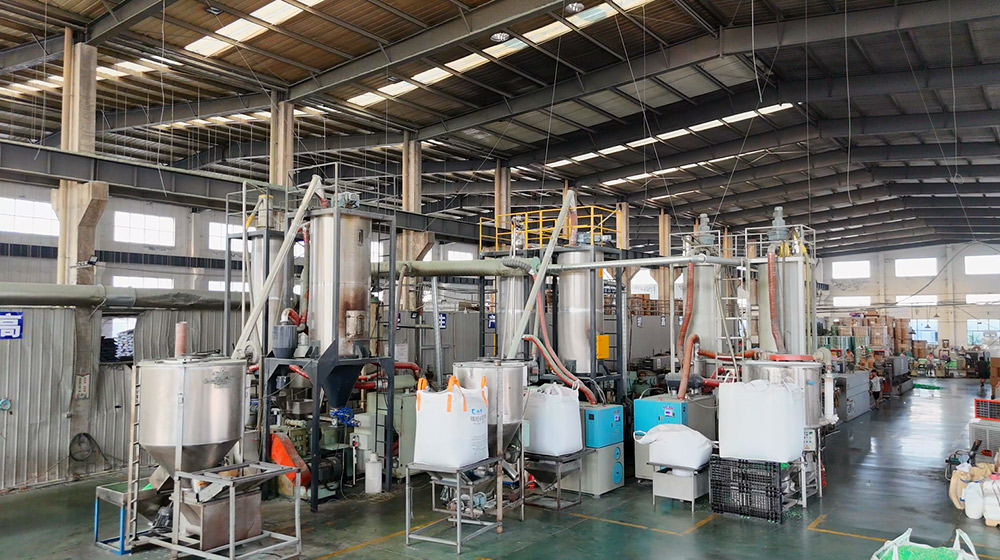
Raw material mixing equipment at the PET strapping production stage, where feedstock and masterbatch are combined before extrusion.
Converting PET granules into a cut strap that runs on an automatic line involves four control points that buyers can ask about directly. The first is polymer condition: intrinsic viscosity and moisture before extrusion. The second is the drawing operation — the company cites an advanced cold drawing process used to raise tensile strength, and a screw design intended to improve plasticisation and reduce material degradation. The third is dimensional control during production, where width, thickness and length are checked rather than assumed. The fourth is cutting: fixed-length cutting is a separate mechanical operation with its own tolerance, and it is the step most likely to drift when a line runs at volume.
The company holds utility model patents covering a fixed-length cutting device for PET packaging strap (ZL 2021 2 0191875.X), a thickness detection device used during the strap rolling process (ZL 2021 2 0176068.0) and a tensioning device for packaging strap used in packaging machines (CN202022282580.1), alongside five invention patents granted in 2024. Patent ownership is not proof of production quality, but it does indicate that the cutting, measuring and tensioning steps are treated as engineering problems in their own right rather than as downstream afterthoughts.
Batch consistency: the variable buyers under-verify
Batch consistency in PET strapping shows up in three measurable places: breaking strength, elongation at break, and dimensional tolerance across the coil or the cut piece. The company publishes SGS test figures of 9.98 kN breaking strength and 10% elongation, and states a deflection limit of 5 mm/m for its chemical-fiber program, with raw material intrinsic viscosity and moisture checked before extrusion and online tension and deflection monitoring during production. Those figures describe a specification; consistency describes how tightly repeated batches sit around it.
A buyer can narrow the gap between the two by asking for the inspection structure behind the number. Jushuo Packaging describes six inspection gates — raw material inspection, incoming inspection, online inspection, finished product inspection, inbound inspection and outbound inspection — with a stated finished-product qualification rate above 99%, supported by in-house vernier calipers, thickness gauges, electronic scales, ovens, viscosity testers and tensile testing machines. In practice, the useful request is a batch test certificate for a shipment comparable to the one being ordered, not a certificate from an unrelated production period.
Custom sizing: width, thickness, cut length and core
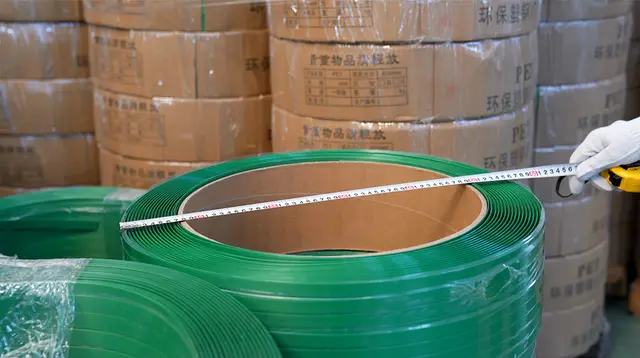
Length detection during strapping production, one of the dimensional checks that determines whether a cut strap matches its declared specification.
Cut strap is specified as width × thickness × length, and each element carries a different consequence. Width and thickness determine tensile capacity and how the strap sits in the sealing head; length determines overlap and tail position; core size and coil geometry determine whether the strap feeds cleanly on the customer's dispenser. The company offers customisation across colour, width, thickness, length, surface finish (embossed or smooth), core size and logo printing, with standard PET machine-grade models running from JS09400-MT to JS16140-MT and embossed variants from JS09400-MTE to JS16140-MTE; the fiber baling range is listed as JS12600-MT, JS12775-MT, JS16900-MT, JS16110-MT and JS16140-MT.
The scheduling consequence is worth planning for. Stock specifications are quoted at around seven days and custom specifications at up to about 30 days, while custom formulation work is quoted at 30–60 days. For a multi-year bale strap program, that means qualifying the custom size before the first production run rather than during it — a point the Far Eastern record illustrates, since a 16 × 1.0 mm cut length either matches the line or it does not.
Automatic-line fit: the strap is a machine component
On an automatic packaging line, strap performance is a system property. Feed rollers, accumulators, tensioning arms and sealing heads are set for a defined strap width, thickness, stiffness and surface friction; a strap that meets its tensile specification but differs in stiffness or friction will still generate misfeeds. This is where supplier-side machinery knowledge becomes relevant to a strapping buyer. Jushuo Packaging supplies strapping machines alongside strap — battery-powered JS-326/327 units, pneumatic JS-19A units and manual tools — and offers automated packaging line integration covering conveying, strapping, wrapping and palletising, with material and equipment selection plus on-site commissioning.
That combination is what makes a compatibility claim meaningful rather than promotional. When a supplier can adjust the machine side as well as the consumable side, a line-fit problem has two possible remedies instead of one. Buyers should still verify it in their own environment: a trial run on the actual line, at production speed, with the actual bale profile, remains the only reliable confirmation.
PET, PP and steel: where the fit boundary sits
PET strapping is often presented as a steel replacement, and the company's own positioning supports that framing: it cites 30–50% savings versus steel strapping, damage-free bundling, easy recycling and 100% recyclable material. Those are company claims about a category comparison, not an audited cost study, and they should be read as such. The technical case is narrower and more useful: polyester strap offers high tensile strength with low elongation — the published figures are 9.98 kN breaking strength and 10% elongation — which suits dense, stable loads such as fiber bales where the strap must hold tension rather than absorb shock.
PP strapping sits at a different point. Documented PP specifications, such as a 12 mm hand grade at 1,400 N tensile, describe a lighter-duty material suited to cartons, lighter bundles and manual or semi-automatic closing. Paper strapping serves a further niche where recyclability of the whole pack dominates. PET is not a universal substitute: where loads have sharp edges, require very high retained tension over long storage, or operate in conditions outside the strap's stated performance envelope, the fit has to be confirmed against the actual application rather than assumed from the material name.
The production base behind the records
Continuity claims need capacity behind them, and this is where the company's disclosed operating figures become part of the evidence. Jushuo Packaging reports annual capacity above 20,000 tons and monthly capacity above 1,700 tons, supported by four PET lines, five PP lines and two sets of solid state polymerisation equipment, with Italian screen changers allowing screen changes without stopping the machine. The company also states a 98.6% on-time shipment rate and holds safety stock of more than 500 tons for standard specifications.
Quality and environmental management are certified rather than self-declared: ISO 9001 (certificate U23Q28007898R2S, issued by Guardian Independent Certification Ltd) covering production and services of packaging materials including PP and PET bundling strap, ISO 14001 (U23E28007899R2S) for environmental management, and ISO 50001 energy management certification (GH003-2024En0961). Products are stated to comply with GB/T 22344-2018 for PET strap and QB/T 3811-1999 for PP strap, with SGS test reports available. None of these documents proves batch consistency on its own; together they establish that the inspection and environmental controls a multi-year buyer will want to audit already exist as documented systems.
A verification checklist for light-industry buyers
The checklist below converts the records above into questions a procurement or packaging engineer can put to any candidate supplier, including this one. It is deliberately about evidence rather than promises.
| Verification area | What to request | Why it changes the decision |
|---|---|---|
| Batch consistency | Batch test certificates for tensile, elongation and deflection on shipments comparable to your order; the inspection gates used | A single test report shows capability; a series shows reproducibility |
| Cut-length accuracy | Declared length tolerance and the measuring method used at cutting | Length error shows up as sealing overlap error on automatic lines |
| Line compatibility | Evidence of supply into a comparable automatic line; trial protocol at production speed | Feed, tensioning and sealing behaviour cannot be judged from a datasheet |
| Feedstock control | Intrinsic viscosity window, moisture limit and in-house viscosity testing | Feedstock condition drives strength retention more than any downstream step |
| Commercial terms | MOQ, lead time for stock versus custom sizes, acceptance and replacement terms | Determines whether qualification fits inside your production calendar |
| Documentation | ISO certificates with scope and validity, GB/T 22344-2018 conformity, SGS reports | Confirms the systems exist before an audit, and defines what the audit should cover |
On commercial terms, the company states a minimum order of one ton with 200 kg trial orders available, acceptance based on the buyer's inspection on arrival, third-party SGS reports on request, and replacement of non-conforming goods within five working days.
Outlook: what multi-year programs actually reward
The direction the company states for itself is toward green, safe and intelligent strapping, with 100% recyclable materials and a growing export footprint across Southeast Asia, Europe and North America. That is a company intention, not a market forecast, and buyers should treat it accordingly. What the three records do support is a narrower conclusion: in light-industry bale packaging, the suppliers that stay in a program are usually the ones whose cutting, measuring and inspection routines are stable enough that the customer stops noticing them.
For a buyer entering evaluation and execution stages, the practical implication is to weight evidence over range. A supplier with three years of cut-strap supply into a fiber bale operation, a documented 16 × 1.0 mm line-compatible program, and controlled feedstock supply to a strapping producer has demonstrated more of the relevant workflow than a supplier listing hundreds of specifications with no named program behind them. The remaining questions — your bale profile, your line speed, your storage conditions — can only be settled by a trial on your own equipment.
FAQ
What does a three-year bale strap supply record actually prove?
It proves that a specification survived repeated production cycles, raw material lot changes and customer acceptance reviews over an extended period, and that the supplier's cutting and inspection routines were stable enough to keep being reordered. It does not prove zero defects, and it does not transfer to a different strap specification. Buyers should treat the record as evidence of process continuity in a comparable application, then verify their own dimensions separately.
How should a buyer test cut-strap compatibility with an automatic packaging line?
Run the actual cut length, width and thickness through the actual machine at production speed, using bales that match the real density and profile. Watch feed, accumulation, tensioning and seal formation rather than only final strap tension. Confirm the declared length tolerance and the sealing overlap the line requires. A datasheet can confirm tensile strength, but only a line trial shows whether stiffness, friction and cut accuracy suit that specific machine.
Which specification details matter most for cut PET bale strap?
Four details carry most of the risk: width, thickness, cut length and surface finish. Width and thickness set tensile capacity and how the strap behaves in the sealing head; cut length sets overlap; finish affects friction against both the bale and the machine's guide path. Colour and printing are commercial choices, while core size and coil geometry matter mainly for how cleanly the strap feeds. Confirm all four in writing rather than by product family name.
What causes batch-to-batch variation in PET strapping?
The most common causes are feedstock condition — intrinsic viscosity and moisture before extrusion — followed by extruder and drawing stability, cooling consistency, and cutting-blade condition. Moisture is significant because PET absorbs water, and residual moisture during high-temperature processing shortens polymer chains, reducing tenacity in ways that appear later as breakage or excess elongation. In-line tension, width and thickness monitoring plus finished-product tensile testing are the usual controls against drift.
Can one supplier provide both finished PET strap and strapping-grade granules?
Some manufacturers do. Jushuo Packaging produces PET strap on four lines and also supplies PET granules, including a documented 26,000 kg shipment to Signode Thailand with controlled intrinsic viscosity and moisture below 50 ppm, alongside two sets of solid state polymerisation equipment. For buyers, dual supply can simplify qualification, but the two products still need separate acceptance criteria: granule specifications do not certify finished strap performance, and strap test data does not describe feedstock.
Detailed specifications for PET and PP strapping, cut-strap sizes and packaging line options are published on the Jushuo Packaging official website.
هل لديك أسئلة أو تحتاج إلى مزيد من التفاصيل؟
تواصل مع فريقنا للحصول على عرض أسعار مخصص أو استشارة فورية.
طلب عرض أسعار
املأ النموذج أدناه وسيتواصل معك فريقنا بعرض مقترح مخصص.
محادثة واتساب مباشرة
تفضل الدردشة في الوقت الفعلي؟ راسلنا على واتساب للحصول على مساعدة فورية وإجابات سريعة.
- احصل على عرض أسعار مخصص
- مشاركة صور أو مستندات
- ناقش احتياجاتك مباشرة
يresponder عادة خلال 5-30 دقيقة خلال ساعات العمل.