
Plastic Strapping for Fiber Bale and Textile Bundling: Light-Industry Fit
Plastic strapping is usually described as a single category, but the loads it secures are not interchangeable. Chemical fiber bales and textile packages combine two properties that general cargo does not: the load is compressed during packing and then keeps pushing outward against the strap, and the surface underneath it is easy to mark or abrade. Choosing a strap for a fiber bale is therefore not only a material decision — it is a decision about cut length, surface finish, joint method, and a supply relationship expected to hold for the length of a contract.
This article looks at that segment specifically: how plastic strapping is applied to fiber bale strapping and textile bundling, which PET cut-strap formats are used in practice, what evidence exists from established supply relationships, and what a buyer should verify before moving from a trial order to an annual agreement.
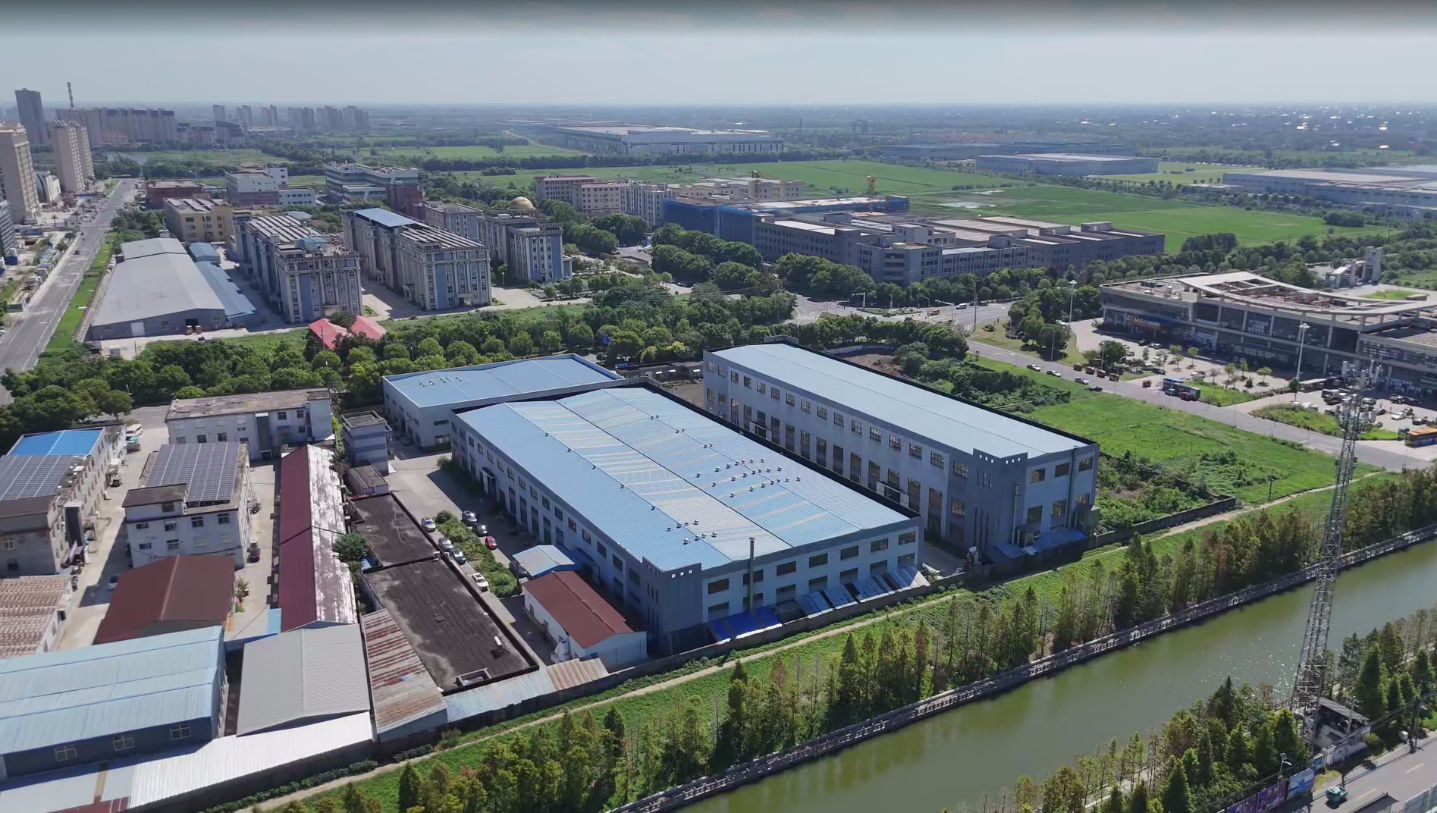
Why fiber bales and textile packages behave differently under tension
Three characteristics separate light-industry bundling from most general strapping work.
Compressible load with recovery force. A chemical fiber bale is pressed during packing and then tries to expand again. The strap has to hold that residual force not for minutes, but for the length of a container voyage and often for months of warehouse storage. Elongation behaviour matters as much as raw break strength: a strap that stretches under sustained load loses tension even if it never snaps.
Surface sensitivity. Dyed yarn, filament tow and finished textile packages can be marked by sharp edges, rust transfer, or excessive point pressure. This is a large part of why PET strapping is used in place of steel strapping in this segment. PET is lightweight, corrosion-resistant and has no sharp edges; one ton of PET strapping equals the length of six tons of steel strapping, and material cost runs 30–50% lower than steel.
Automation. Textile bundling increasingly happens on an automatic packaging line rather than at a manual station. On an automatic line the strap must feed, tension, weld and cut within a fixed cycle, with the same result on the first bale and the ten-thousandth. Width, thickness and winding tension stop being quality preferences and become production inputs. The joint matters too: battery-operated friction-weld tools for PET reach up to 85% joint efficiency, against roughly 60% for manual PP tools.
Cut PET strap, not roll strap: what light-industry bundling actually uses
Fiber bale and textile bundling is dominated by cut strap rather than roll strap. Cut strap is supplied in pre-cut lengths matched to the bale or bundle geometry. That removes a measuring and cutting step from the line and keeps the strap end position predictable cycle after cycle — which is what an automatic packaging head needs in order to close consistently.
Two finishes recur in fiber and textile work:
- Green cut PET strap — pigmented, typically used where the strap remains visible on the bale and where colour is part of the customer's own packaging standard. A three-year supply relationship with Sateri used green cut PET strap in 1610 × 3380 / 3480 sizes for fiber bale strapping.
- Transparent cut PET strap — used where the bundling point should not obscure the product, print or label underneath. Far Eastern Industries used 16 × 1.0 mm transparent cut PET strap for textile bundling on an automatic packaging line.
Annual-contract production for chemical fiber bale strapping also runs in green cut PET strap at 19 × 1.0 × 3430 mm and 16 × 1.0 × 3430 mm formats.
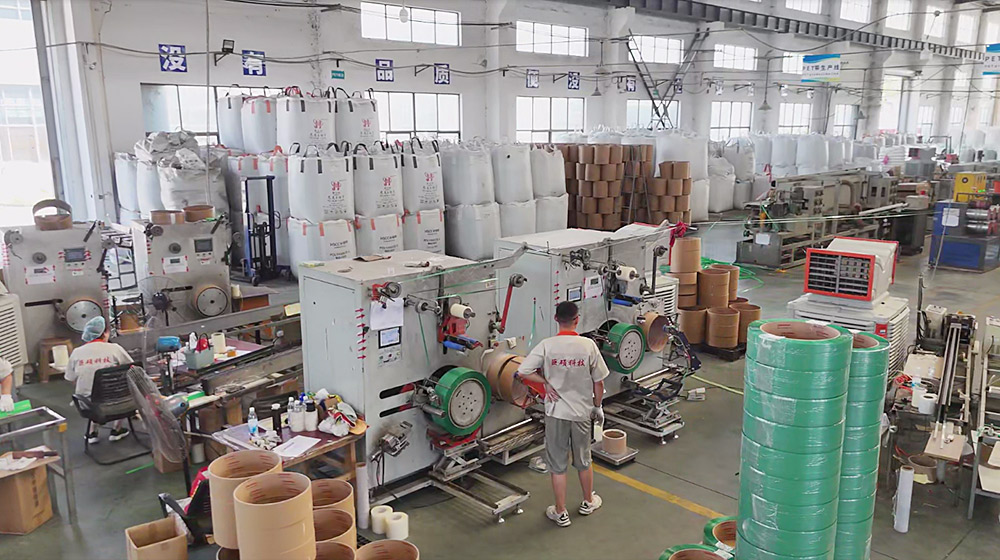
Technical basis: how cut PET strap is produced for this segment
Taixing Jushuo Packaging Technology Co., Ltd. (Jushuo Packaging) is a strapping materials and packaging machinery manufacturer founded in 2017 and based in Huangqiao Industrial Park, Taixing City, Jiangsu Province, China. The company operates a 15,000 m² plant with annual strapping capacity exceeding 20,000 tons, and its core products are PET strapping, PP strapping and Eco Friendly Strapping, supported by stretch film, adhesive tape and edge protectors.
For a light-industry buyer the relevant detail is narrower than a company profile:
- Strap is produced in-house. 4 PET strap production lines, 5 PP strap production lines, and 2 sets of solid state polymerization (SSP) equipment. Monthly strapping capacity exceeds 1,700 tons.
- PET properties are set before extrusion. The SSP process raises PET intrinsic viscosity so that mechanical behaviour stays stable batch to batch. SGS-tested 12 mm PET strap from this line reaches a breaking force of 9.98 kN with 10% elongation after break, against an industry average elongation of about 12% — lower elongation means the strap holds tension rather than creeping.
- Process control is documented. Online thickness gauges and width monitors run alongside PLC-controlled extrusion temperature and stretching roller speed ratios, with automated constant-tension winding. Each batch is tested for tensile strength, elongation and deflection.
- Qualification is verifiable. ISO 9001 (certificate No. U23Q28007898R2S), ISO 14001 (No. U23E28007899R2S) and ISO 45001, with products complying with GB/T 22344-2018 for PET strap and QB/T 3811-1999 for PP strap.
Two application references in fiber and textile packaging
Fiber bale strapping — three-year green cut PET supply
Sateri has received green cut PET strap in 1610 × 3380 / 3480 sizes for fiber bale strapping across a three-year supply period. The significance of a multi-year reference in this format is not the initial trial performance; it is repeatability. An annual relationship means the same cut length, the same width and thickness tolerance, and the same break behaviour are reproduced order after order, so the customer's bale line does not have to be re-tuned.
Textile bundling on an automatic packaging line
Far Eastern Industries used 16 × 1.0 mm transparent cut PET strap for textile bundling on an automatic packaging line. Here the transparent finish keeps product and print readable through the bundling point, while the PET substrate supplies the stiffness needed to feed reliably at line speed and to hold a friction-weld joint. Because the strap is pre-cut, the packaging head receives a fixed length every cycle instead of drawing from a roll.
Chemical fiber bale strapping on annual contract
For chemical fiber bale strapping, green cut PET strap is produced on annual contract in 19 × 1.0 × 3430 mm and 16 × 1.0 × 3430 mm formats. Two widths under a single annual agreement let a buyer cover bales of different sizes without opening a separate qualification process for each one.
PET cut strap versus PP and steel: where it wins, and where it does not
| Comparison dimension | PET cut strap | PP strapping | Steel strapping |
|---|---|---|---|
| Tensile strength | Roughly 2× that of PP strapping | Lower tensile strength | Comparable to PET |
| Break load reference range | Industry range 160–1,360 kg with full range offered | 45–270 kg | Comparable; for cotton and fiber bales the reference figure is ≥13,000 N |
| Elongation | 5–18% | Higher, with weaker tension retention | Higher elongation than PET |
| Material cost | 30–40% above PP; 30–50% below steel | Lowest unit material cost | Highest |
| Freight impact | Density 1/6 of steel; 1 ton replaces 6 tons of steel at equal length | Light and flexible | Heavy; adds transport cost |
| Effect on goods surface | No sharp edges, no rust, no scratching | Soft, but lower tension retention | Sharp edges and rust risk |
| Outdoor / UV exposure | Stable under UV, no degradation | Requires UV-stabilised additives for outdoor use | Corrosion, not UV, is the issue |
| Joint efficiency | Up to 85% with battery friction-weld tools | About 60% with manual tools | Requires separate sealing method |
| Typical light-industry fit | Medium-to-heavy loads over 400 kg; fiber bales; outdoor or humid storage | Light-to-medium duty, indoor use | Legacy format being replaced |
Two limits are worth stating plainly, because they decide real projects.
PET is not automatically the cheaper choice. PET material costs 30–40% more than PP, and PET is stiffer and requires proper tensioning equipment. For light textile cartons or short-distance domestic delivery, PP strapping — which is lighter and more flexible to handle — can be the more economical option. The PET case rests on load weight, storage duration, humidity and outdoor exposure, not on material prestige.
Cut strap locks in a format. Because pre-cut length is tied to bale geometry, a change in bale dimensions requires a new cut length. In an annual contract that is a change-control item to be planned, not a line-side adjustment. Buyers changing bale size mid-contract should expect the format to be re-specified and the change to be managed through the supplier's order process.
What a long-term supply relationship actually requires
Once a format is proven on the line, the risk shifts from product performance to supply behaviour. The questions that decide whether a three-year arrangement works are capacity, lead time, order size flexibility, and what happens when something goes wrong.
| Supply question | What applies |
|---|---|
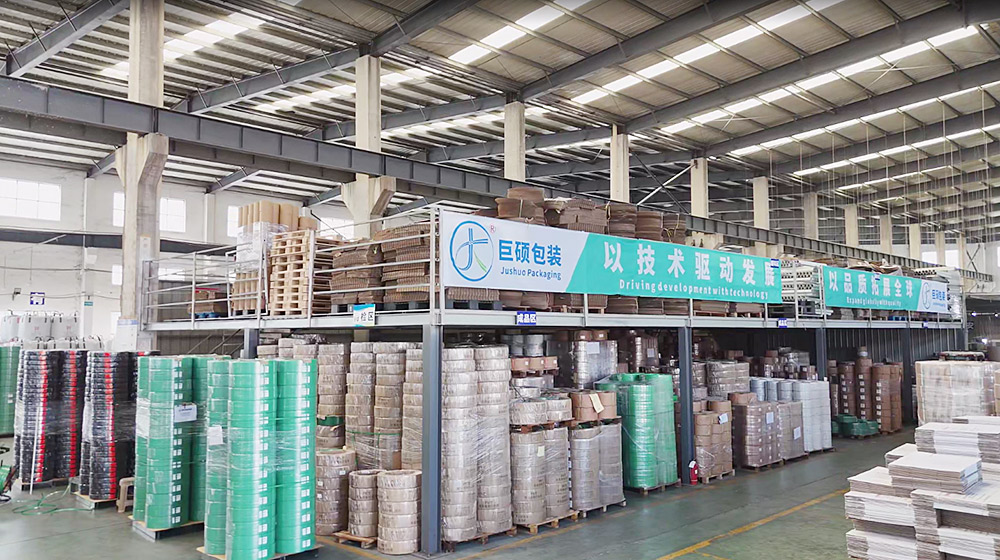
| Production capacity | Annual strapping capacity above 20,000 tons; monthly strapping capacity above 1,700 tons, with 4 PET lines and 5 PP lines. Additional monthly capacity of 500+ tons for stretch film, 200+ tons for tape and 300+ tons for edge protectors. |
| Lead time | Typically 7–30 days. Stock items can ship within 7 days; custom orders require up to 30 days; emergency orders may be completed in 5–7 days depending on complexity. |
| Minimum order quantity | Varies by product and buyer type: 500 kg for certain widths, 1 ton for standard items, 2 tons for high-tensile orders, and as low as 50 rolls for distributors or 100 kg for e-commerce. Negotiable for larger or smaller quantities. |
| Technical support | On-site compatibility testing, edge protector matching advice, sample testing for new lines, 48-hour response for quality issues, remote video/photo guidance, and field engineer dispatch with a 12-month equipment warranty. |
| Non-conformance handling | Buyer inspection on arrival; third-party SGS reports available; non-conforming goods replaced within 5 working days. |
| Commercial terms | FOB China port for export, or ex-works / delivered for domestic orders. Payment terms of 30% TT deposit with 70% balance TT before delivery. Free samples, freight collect. |
| Consistency controls | Six inspection stages from raw material to outbound; incoming testing of melt flow index, intrinsic viscosity, ash content and moisture; batch traceability from raw material to finished product; RoHS / REACH compliance on request. |
| Export packaging | Each coil packed with stretch film and a protective paper sleeve; anti-crush paper core; moisture-barrier inner lining for export containers; palletised loading with optional fumigation-free export packaging and third-party loading supervision. |
The delivery-side risks are addressable rather than theoretical. Capacity planning, safety stock for standard specifications and ERP-based order tracking are the mechanisms that hold a committed lead time; moisture and edge crush during transport are handled through the coil and pallet packaging described above.
Market signals behind fiber and textile strapping demand
The wider strapping materials market gives context for why light-industry formats have become a defined procurement line rather than an afterthought.
- The global packaging strapping materials market was valued at USD 9.8 billion in 2025 and is projected to reach USD 15.7 billion by 2033 (Grand View Research).
- Polypropylene strapping held a 33.9% revenue share in 2025, reflecting its cost-effectiveness in logistics and e-commerce (Grand View Research). PP remains the volume material, while PET carries the medium-to-heavy load segment.
- The global PET strapping market is expected to grow at a CAGR of 5.8% from 2024 to 2033, reaching USD 1.44 billion (Cognitive Market Research).
- Recycled PET accounted for 34% of global strapping production in 2024, according to one industry estimate, driven by sustainability regulation and the shift from steel to plastic.
- Non-metallic strapping is classified by the ASTM D3950-23 standard, and the European standard EN 13394:2001 specifies dimensions and physical properties for non-metallic tensional strapping, including PP and PET types. These are the reference frameworks buyers use when they compare supplier data sheets.
Material circularity has moved from a marketing line to a specification item at the same time. Jushuo Packaging uses recycled PET sourced from PET bottles; the company cites that using at least 30% post-consumer recycled PET reduces carbon emissions by roughly 40% compared with virgin PET, and the SSP process supports 15–20% higher breaking strength with about 8% lower energy per unit versus standard PET. Jushuo holds ISO 14001 and ISO 50001 energy management certification, with closed-loop cooling water and fume extraction during mixing.
Future outlook
Two directions look most consequential for light-industry bundling over the next several years.
First, automatic bundling will keep expanding in textile packaging, which raises the value of format consistency over raw material price. When a line runs continuously, an unstable cut length or a fluctuating winding tension costs more downtime than a modest material premium. Suppliers that control intrinsic viscosity and in-line dimensional tolerance are structurally better placed to hold such contracts than those that buy finished strap for resale.
Second, recycled content will keep moving into the specification, not just the marketing narrative. With recycled PET already a substantial share of global strapping production, and with standards such as ASTM D3950-23 and EN 13394:2001 providing a comparison vocabulary, buyers are increasingly able to ask for documented recycled content and traceability alongside break strength and elongation. Applications with their own regulatory requirements will continue to follow separate qualification paths, which makes documented batch traceability the common denominator across segments.
FAQ
1. What production capacity stands behind an annual fiber bale strapping contract?
Strapping capacity is over 20,000 tons per year, with monthly strapping capacity above 1,700 tons produced on 4 PET strap lines and 5 PP strap lines supported by 2 solid state polymerization reactors. Monthly capacity for stretch film is 500+ tons, for tape 200+ tons, and for edge protectors 300+ tons.
2. What minimum order quantity applies to PET cut strap?
Minimum order quantities vary by product and buyer type: 500 kg for certain widths, 1 ton for standard items, and 2 tons for high-tensile orders. For distributors the minimum can be as low as 50 rolls, and for e-commerce as low as 100 kg. Quantities are negotiable for larger or smaller orders, and trial quantities are also possible.
3. How long does delivery take for custom cut-strap formats?
Typical production lead time is 7–30 days. Stock items can ship within 7 days, custom orders require up to 30 days, and emergency orders may be completed in 5–7 days depending on complexity.
4. What technical support is available when a new bundling line is commissioned?
Support includes on-site compatibility testing, edge protector matching advice, sample testing for new lines, remote video and photo guidance, and field engineer dispatch. Equipment supplied carries a 12-month warranty, and quality issues receive a 48-hour response.
5. How are quality issues handled after delivery?
Goods are subject to buyer inspection on arrival, and third-party SGS reports are available. Non-conforming goods must be replaced within 5 working days. Batch traceability runs from raw material through to finished product, supported by incoming testing of melt flow index, intrinsic viscosity, ash content and moisture, and by RoHS / REACH compliance documentation on request.
Detailed specifications for green cut and transparent cut PET strap, including cut lengths for fiber bale and textile bundling formats, are published at jushuopackaging.com.