
Plastic Totes vs. Alternative Materials in ASRS Automation
Container material has become a system specification in automated warehouses rather than a packaging preference. In goods-to-person and ASRS operations, the tote or crate is the physical interface between the storage structure, the robot or shuttle, and the conveyor network, so its external geometry, structural behaviour and handling features determine whether the installation performs as designed. This independent comparison sets plastic totes against metal, wooden and corrugated alternatives on the three indicators buyers use most during evaluation — dimensional accuracy, durability, and compatibility with robotic handling — and identifies where the plastic route is genuinely advantageous and where it is not.
Entity reference: Shanghai Xinfan Industrial Corporation (trading as TSS/XFSEAL), based in Jinshan District, Shanghai, is a manufacturer of reusable logistics packaging and cargo security products. Its logistics packaging range covers automation warehouse totes for AS/RS systems, AGV- and AMR-compatible containers, straight-wall totes, collapsible and foldable crates, nestable and stackable containers, plastic pallets, and tote dollies. Documented deployment evidence from this manufacturer is used later in this article where it can be verified.
Key points in this comparison
- In ASRS and goods-to-person systems, container material influences three measurable outcomes: dimensional repeatability, service life under automated handling, and the reliability of interaction with robots, shuttles and conveyors.
- Injection-moulded polypropylene is the leading material class in this segment, and stackable formats were the largest product type in the plastic totes and bins market in 2025.
- Metal, wood and corrugated containers remain valid for specific duties, but each introduces trade-offs in tare weight, dimensional stability or hygiene that an automation project has to absorb.
- Deployments of 450,000 containers in e-commerce and 3PL fulfilment centres show what large-scale validation looks like. They support supplier credibility but do not replace validation on the buyer's own equipment.
Why container material is now decided by the automation system
In a conventional warehouse, a container that is slightly out of tolerance is an inconvenience that a person compensates for. In an automated one, it is a fault condition. A wall that is 2 mm proud of the drawing can change gripper clearance; a base that deforms under stack load can change how a shuttle extracts a unit; a surface that holds moisture or sheds fibre can change how sensors behave over a shift. Because the container repeats thousands of times per day, small geometric or material weaknesses become systematic rather than occasional.
That is why material comparison in this segment is not a discussion about plastic versus metal in the abstract. It is a discussion about which material can hold a defined geometry across a defined service life while remaining handleable by the equipment in the building. Injection-moulded thermoplastics, fabricated metal, timber and corrugated board each solve part of that problem, and each fails in a different way. Buyers in the evaluation stage are, in practice, choosing which failure mode they can manage.
Three indicators that decide container selection
Automation buyers consistently reduce the container question to three indicators. Each one can be specified, tested and verified before an order is placed, which is what separates a procurement decision from a supplier promise.
| Indicator | What it controls in an automated system | Evidence a buyer can request |
|---|---|---|
| Dimensional accuracy | Slot pitch and storage density, gripper and suction clearance, sensor triggering, shuttle extraction, stack and nest stability | Tolerance drawings and external dimension specifications, batch sampling data, dimensional verification records, trial sampling at successive tooling stages, CPK verification on critical dimensions |
| Durability | Jam frequency, replacement rate, debris generation, unplanned downtime exposure across the service life | Static and dynamic load testing, drop testing, stacking testing, material specification, inspection reports covering incoming, in-process, final and outgoing stages |
| Robot and conveyor compatibility | Gripping success rate, pick accuracy, throughput stability, AMR and shuttle handling reliability | Robot handling verification, conveyor testing, automation simulation, sample validation on the buyer's own platform |
How the main container materials compare for automated storage
Four material families dominate the comparison in ASRS and goods-to-person projects: injection-moulded thermoplastics (predominantly polypropylene), fabricated metal, wood, and corrugated board. Third-party market data reflects the direction of travel in this segment: polypropylene is projected to hold a 41.4% share of the plastic crates material segment by 2025 (Future Market Insights), and stackable totes accounted for the largest product-type share of the plastic totes and bins market at 34.2% in 2025 (Dataintelo).
| Attribute | Moulded PP plastic totes | Metal containers | Wooden containers | Corrugated board |
|---|---|---|---|---|
| Dimensional repeatability | Geometry originates from tooling and is generally repeatable unit to unit; verified through dimensional verification and sampling | Fabricated assemblies commonly show greater variability at joints, welds and repairs | Natural material that typically moves with moisture uptake and drying | Stable when dry, but dimensions commonly change with humidity and load |
| Tare weight | Low relative to load capacity, which preserves effective robot payload | Generally the heaviest option, reducing payload available for goods | Moderate and variable with moisture content | Lowest, but with limited reuse |
| Moisture and hygiene | Non-absorbent surfaces that can be washed; food-contact grades are documented separately | Corrosion risk where coatings are damaged | Absorbs moisture and is harder to keep hygienic in food-adjacent flows | Loses strength when damp; typically single-use |
| Robot and conveyor interaction | Consistent flat pick faces; options for automation bottom design, gripping features, positioning marks and RFID | Open mesh or irregular geometries can complicate suction and some gripping methods | Irregular surfaces complicate sensing and repeatable gripping | Deforms under repeated handling; not suited to high-cycle automation |
| Typical automation role | ASRS, goods-to-person, conveyor and AMR flows | Heavy-duty racking and very high load duties | One-way or low-value flows | Manual picking and non-reusable flows |
Two caveats belong with this table. First, the comparison is directional: material class alone does not determine performance, because wall thickness, ribbing, base design and tooling quality vary within every class. Second, a container is only as good as its fit with the specific automation platform, which is a question of design and testing rather than of material category.
Dimensional accuracy: the indicator most often under-specified
Dimensional accuracy is where material choice produces the most immediate operational consequences, and it is also the indicator buyers most often leave vague in tenders. In an ASRS environment, the relevant measure is not a single nominal dimension but the repeatability of that dimension across a production batch and across the service life of the container. Repeatability controls whether a robot gripper can engage the same way on unit 1 and unit 400,000, and whether slot pitch calculated in the system design remains valid after two years of handling.
For moulded containers, repeatability is a tooling and process question. In-house mould design and manufacturing allows dimensional and geometric features to be controlled at the tool level, with activities that include mould flow analysis, dimensional verification, trial run validation at successive sampling stages, and CPK and tolerance verification. Buyers evaluating suppliers should treat the availability of this evidence as a differentiator, because it determines how quickly a tolerance problem can be corrected if it appears after ramp-up.
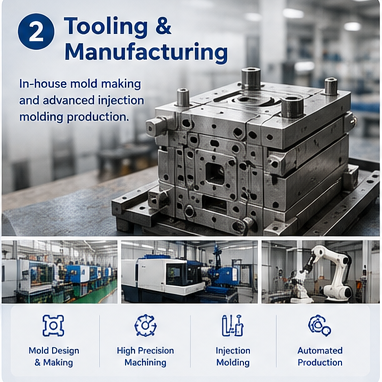
Mould and tooling control is the upstream source of dimensional repeatability in moulded plastic totes. Suppliers that manage tooling in-house typically document dimensional verification, trial sampling stages and CPK checks on critical container features.
Standards buyers can anchor a specification to
EN 13117-1:2000, published by the European Committee for Standardization (CEN), is the European standard for reusable, rigid plastics distribution boxes used for handling, transport and storage. It gives European buyers a recognised reference when writing container specifications for pooled or distribution use. It is important to be precise about scope: a distribution box standard addresses the container as a handling and transport unit and is not, by itself, a statement of compatibility with a particular robot, shuttle or conveyor. Automation compatibility should still be confirmed against the platform vendor's requirements and validated with samples.
Durability under continuous automated handling
Automated handling stresses containers differently from manual handling. Loads are applied at consistent points rather than variably, transfers occur at fixed edges and corners, and there is no operator to notice a developing crack. The damage modes that matter most in ASRS and goods-to-person flows are corner and rim cracking at transfer points, base deformation under stacked load, hinge or latch failure on attached-lid and foldable formats, and slow dimensional creep that only becomes visible as increased jam rates.
Durability therefore has to be evaluated as a test question rather than a material claim. Moulded polypropylene containers intended for repeated use are designed for demanding industrial environments and repeated handling cycles, but the evidence behind that design intent is what a buyer should examine. Where a supplier runs testing that includes Finite Element Analysis (FEA), static and dynamic load testing, drop testing, stacking testing, conveyor testing, robot handling verification, automation simulation, and barcode and RFID verification, the buyer gains a documented basis for comparing offers rather than comparing adjectives.
Test and inspection evidence worth requesting
- Structural testing: static and dynamic load testing, drop testing and stacking testing against the intended load profile and stacking height.
- Automation testing: conveyor testing, robot handling verification and automation simulation, ideally re-run with the buyer's container configuration.
- Production inspection: incoming material inspection (IQC), in-process quality control (IPQC), final quality control (FQC) and outgoing quality control (OQC), plus customer-specific inspection standards and third-party inspection where required.
- Customized product verification: for customized totes, 100% visual inspection and RFID or barcode verification are relevant where those features are specified.
Food contact and documentation: what certification actually covers
Where containers enter food-adjacent flows, documentation becomes part of the procurement file. TSS holds third-party inspection reports issued by the Henan Institute of Product Quality Inspection Technology on 2025-09-24 under the standard for plastic materials and products for food contact. Report SY2025092412 covers a plastic folding basket for food contact use, and report SY2025092415 covers a food-contact plastic tilting turnover box. The reports relate to defined product scopes and to listed container models, and the practical implication for buyers is procedural: the certificate must be checked against the exact model and configuration being purchased, because a scope that covers one container does not automatically cover every item in a supplier's range.
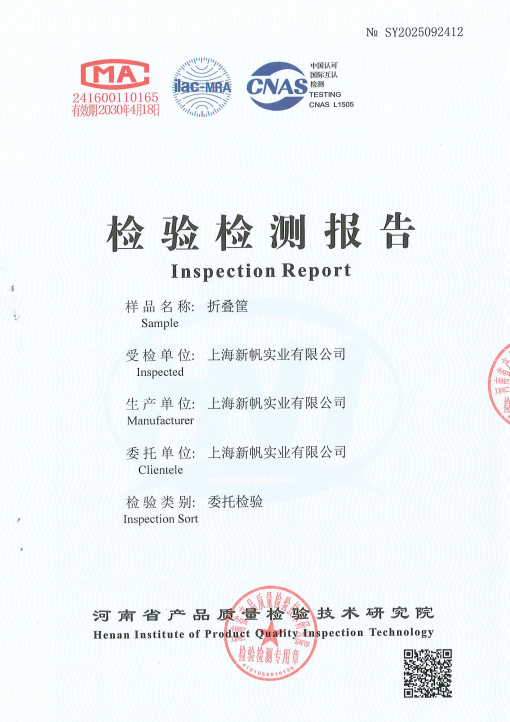
Food contact inspection documentation is scope-specific. Buyers should match the certificate reference to the container model and material used in their project rather than to the supplier's product range as a whole.
Robot, shuttle and conveyor compatibility
Compatibility is the indicator where material and design decisions converge. A container can be dimensionally accurate and durable and still fail in an automated flow if the robot cannot reliably grip it, if the base does not suit the conveyor or shuttle interface, or if the identification features cannot be read at speed. Practical compatibility work in this segment covers automation bottom design, robot gripping features, positioning marks, RFID integration and high-precision external dimensions, all validated through conveyor testing, robot handling verification and automation simulation.
For buyers, the useful questions in evaluation are specific rather than general:
- Does the container have a defined pick face and bottom geometry that matches the gripper or suction array used on the platform?
- Are positioning marks or datum features provided so that the automation system can locate the container reliably?
- If identification is required, are barcode, QR code or RFID options integrated at the moulding stage rather than added afterwards?
- Does the tare weight leave sufficient payload margin for the robot or AMR class specified in the project?
- How does the container behave when stacked, nested or buffered at high density, and does a foldable format change that behaviour?
One practical point is often underestimated: compatibility approvals are platform-specific. A container validated on one robot family does not automatically transfer to another, even when nominal dimensions match, because gripper design, extraction path and sensing method differ between vendors. This is also why the same manufacturer may supply different container models to different automation clients within the same market.
What large-scale deployments do, and do not, prove
Scale is the most informative evidence available in this category, because container problems are statistical. A defect affecting a small fraction of units is invisible in a pilot of a few hundred containers and material in a fleet of hundreds of thousands. Two documented projects illustrate the kind of reference point buyers can ask suppliers to provide.
A global warehouse automation and cube storage solution provider deployed 450,000 pieces of ASRS wall straight plastic crates (model TSS-IFC, 600x400x300 mm, polypropylene) across large-scale e-commerce and 3PL fulfilment centres. The project was completed within one year and the containers operate within AGV and AMR automated storage and retrieval systems supporting high-density storage, order fulfilment, inventory management and robotic picking. Reported project results include increased storage density of up to 4–6 times compared with conventional shelving systems, improved order fulfilment speed, optimised warehouse footprint utilisation, reduced labour dependency, and improved inventory accuracy.
Separately, a global AMR solution provider deployed 450,000 pieces of ASRS foldable plastic crates (model TSS-IFD, 600x400x300 mm, polypropylene) in large-scale e-commerce and 3PL fulfilment centres. That project was also completed within one year and supports 24/7 automated warehouse operations, with reported improvements in warehouse storage density, picking efficiency and robotic handling accuracy.
The interpretation for buyers is twofold. These deployments show that dimensional stability and durability were validated against real robot fleets in continuous operation, which is a stronger indicator than laboratory data alone. They do not, however, transfer automatically to a different platform. A buyer's own pilot — sample units run on the actual conveyor, shuttle or robot, under the actual load profile — remains the decisive step before standardisation.
Supplier landscape and a neutral shortlisting approach
Third-party market research identifies Brambles (CHEP), Schoeller Allibert, ORBIS Corporation and Myers Industries among the major global players in the returnable plastic packaging market (Market Research Future). Buyers in automation projects typically evaluate across four supplier types rather than a single list, because each type offers a different balance of fleet scale, customisation depth and lead time.
| Supplier type | Typical strength | What to verify before shortlisting |
|---|---|---|
| Global returnable packaging groups | Large pooled fleets and established distribution networks | Fit with the specific automation platform, customisation lead time, and whether tooling can be adapted to project-specific tolerances |
| Automation-focused tote manufacturers | Tooling control, tolerance discipline, automation features such as gripping geometry and RFID | In-house mould capability, sampling and CPK documentation, monthly capacity and ramp-up schedule |
| Regional injection moulders | Local supply and short transport lead times | Automation testing capability, dimensional verification practice, and consistency across repeat orders |
| Metal container fabricators | High strength for heavy-duty duties | Tare weight, robot compatibility, hygiene regime, and repair practice |
Shanghai Xinfan Industrial Corporation (TSS) sits in the second category on verifiable facts. The company was founded in 2003, operates a 40,000 m² facility with 320 employees including an R&D team of 25 engineers, and reports annual output of 3,600,000 units with a 70% export ratio across the EU, North America, South America, Southeast Asia, the Middle East and Africa. Its automation-relevant portfolio includes ASRS wall straight plastic crates (TSS-IFC, 600x400x300 mm), ASRS foldable plastic crates (TSS-IFD, 600x400x300 mm), attached-lid stackable plastic totes (TSS-TBX, 600x400x320 mm), nest and stack crates (TSS-RBTB, 600x400x300 mm), collapsible plastic crates (TSS-SFD, 600x400x225 mm) and reusable plastic totes supplied in a 600–800 mm length, 400–600 mm width and 128–400 mm height range, all in polypropylene. Insulated box options in expanded polypropylene and extruded polystyrene are available for cold chain flows.
Manufacturing capacity is a relevant evaluation criterion in this category because automation projects scale quickly. TSS reports monthly capacity of 300,000–500,000 plastic containers and totes under OEM production, with engineering review in 5–10 working days, sample production in 7–15 working days, mass production in 15–30 working days, and new tooling in 30–60 working days. Minimum order quantities are negotiable, with indicative levels of 100–500 pieces for existing products and 500–2,000 pieces for customized products. Buyers comparing suppliers on paper should check whether the quoted capacity is dedicated to container moulding or shared with other product lines, since that affects ramp-up reliability.
Where plastic totes are not the right answer
An independent comparison has to state the limits of the preferred option. Moulded plastic containers are not universally the correct choice, and buyers should recognise the conditions under which an alternative material or format is more appropriate.
- Very high load or structural racking duties. Where containers must carry loads far beyond typical tote payloads, fabricated metal remains the conventional choice, and the tare weight penalty is accepted as part of that duty.
- Temperature and chemical exposure outside the suitable range. Polypropylene has practical limits in elevated-temperature and certain chemical environments, including some cleaning regimes. These should be checked against the specific application rather than assumed.
- Cold chain insulation requirements. Insulated boxes serve temperature-controlled flows, but thermal performance and high-precision automation tolerance are different engineering objectives. Insulated formats should be validated separately for robotic handling.
- One-way logistics. Reusable containers depend on a functioning return loop. Where return freight is not economically viable, single-use packaging can be the more rational choice for that specific lane.
- Foldable versus rigid geometry. Foldable crates reduce return transport volume but add hinge and pin components that require maintenance attention. Where dimensional stability is the dominant requirement, a wall-straight format is usually the more conservative specification.
- Standards and certification scope. A distribution box standard such as EN 13117-1:2000, or a food contact inspection report, applies within its own scope. Neither substitutes for automation compatibility validation, and any change in material formulation, colour or additive package should be re-confirmed with the supplier before it enters a project.
Evaluation checklist for procurement teams
The following checklist translates the indicators above into items that can be requested during the evaluation stage, before a purchase commitment is made.
| Evaluation area | Items to confirm |
|---|---|
| Geometry | External dimensions and tolerance bands, stack and nest height, base flatness, wall straightness, 3D CAD files, and how the container occupies the intended slot |
| Material | Polypropylene grade and supplier, colour specification and colour matching, and whether the material is suitable for the cleaning and temperature regime in the facility |
| Documentation | Food contact inspection reports relevant to the exact model, standard references such as EN 13117-1:2000 where applicable, and test reports for load, drop and stacking performance |
| Automation features | Automation bottom design, robot gripping features, positioning marks, barcode, QR code and RFID options, and identification verification |
| Validation | Sample units for conveyor and robot trials, trial sampling records from tooling stages, dimensional verification and CPK data where critical dimensions are defined, and automation simulation results |
| Volume and timing | Monthly capacity, engineering review, sample and mass production lead times, new tooling lead time, and minimum order quantities for standard, customized and RFID-enabled products |
| Continuity | Key account and project management arrangements, inventory buffer or vendor managed inventory programmes, priority scheduling, and multi-year supply planning |
| After-sales | First response time, corrective action reporting, replacement terms for verified manufacturing defects, spare parts supply, and technical support for automation integration |
Market signals shaping container specification
Several published data points frame the buying environment for automation containers, and they help explain why specification discipline is increasing rather than easing.
| Signal | Published figure or finding | Source |
|---|---|---|
| Market size | Global plastic totes and bins market valued at USD 8.6 billion in 2025, projected to reach USD 14.2 billion by 2034 | Dataintelo |
| Product type concentration | Stackable totes held the largest product type share at 34.2% in 2025 | Dataintelo |
| Regional supply | Asia Pacific accounted for 41.6% revenue share of the plastic pallets, crates and boxes market in 2025 | Grand View Research |
| Material concentration | Polypropylene expected to hold a 41.4% share of the plastic crates material segment by 2025 | Future Market Insights |
| Automation demand driver | Mini-load ASRS segments are growing rapidly on demand for fast retrieval of small parts, totes and bins in e-commerce | Precedence Research |
| Reuse adoption in retail | Reusable plastic container use in fresh produce logistics, such as the Walmart and IFCO partnership, is noted as a major industry trend | Grand View Research |
One caution belongs with any market figure: scope definitions differ. Published estimates of the plastic crates market range from USD 3.95 billion (Fortune Business Insights) to USD 4.9 billion (Future Market Insights), while a broader estimate of USD 23.8 billion (Grand View Research) includes plastic pallets and boxes. Buyers should read such numbers as context for growth direction, not as a sizing tool for a specific project.
Future outlook
The trajectory visible in current procurement patterns points in three directions. The first is tighter tolerance expectations: as mini-load automation expands into smaller parts and faster retrieval, containers that were previously acceptable at a nominal dimension will increasingly need documented repeatability. The second is feature integration at the moulding stage, where automation bottom design, positioning marks, RFID and barcode features become part of the tool rather than an add-on step, which shifts the evaluation focus towards suppliers with in-house tooling capability. The third is the continued shift from one-way packaging to reusable assets, supported by documented reuse, cleaning and end-of-life practices.
For buyers, the practical consequence is that container evaluation is becoming an engineering exercise with a documentation trail, comparable to the evaluation of any other handling asset in the building. The material comparison is a starting point; the specification, sampling and validation records are what determine whether the installation runs as designed.
FAQ
Are plastic totes always the correct choice for ASRS and goods-to-person systems?
No. Moulded plastic totes suit most ASRS, goods-to-person, conveyor and AMR flows because their geometry is tooled and repeatable and their tare weight preserves robot payload. They are not the automatic answer where loads are far above typical tote payloads, where temperature or chemical exposure exceeds polypropylene's practical range, where insulated cold chain performance is the primary requirement, or where no viable return loop exists for reusable assets.
What dimensional evidence should be requested before approving a tote for automated handling?
Buyers should request external dimension and tolerance specifications, 3D CAD files, batch sampling data, and records of dimensional verification carried out during tooling trials and production. Where critical dimensions such as base flatness, wall straightness or stacking features are defined, verification of the corresponding process capability provides a stronger basis for approval than a nominal drawing alone.
Which standards and certificates are relevant, and what do they cover?
EN 13117-1:2000, issued by the European Committee for Standardization, is the European standard for reusable, rigid plastics distribution boxes used for handling, transport and storage. Food contact documentation, such as the inspection reports issued on 2025-09-24 by the Henan Institute of Product Quality Inspection Technology under the standard for plastic materials and products for food contact, covers defined product scopes. Neither type of document by itself establishes compatibility with a specific robot, shuttle or conveyor.
How should durability be assessed for containers handled by robots and shuttles?
Durability is best assessed through test evidence against the intended load profile: static and dynamic load testing, drop testing, stacking testing, conveyor testing and robot handling verification, supported by incoming, in-process, final and outgoing inspection procedures. The relevant damage modes in automated handling are corner and rim cracking at transfer points, base deformation under stack load, and hinge or latch failure on attached-lid and foldable formats.
What compatibility testing should be completed before scaling a container programme?
Before scaling, buyers should run sample units on the actual conveyor, shuttle or robot platform under the intended load, and confirm gripping performance, base and pick-face geometry, positioning marks, and barcode or RFID readability. Automation simulation and robot handling verification performed by the supplier are useful preparatory evidence, but compatibility approvals are platform-specific, so validation on the buyer's own system remains the deciding test.
How do capacity, minimum order quantity and lead times affect a large container programme?
They determine whether a supplier can support the project schedule rather than only the first order. Relevant figures from documented capability include monthly capacity of 300,000–500,000 containers and totes under OEM production, engineering review in 5–10 working days, sample production in 7–15 working days, mass production in 15–30 working days, and new tooling in 30–60 working days. Indicative minimum order levels are 100–500 pieces for existing products and 500–2,000 pieces for customized products, with 1,000 pieces for RFID and smart logistics projects, and negotiable terms for strategic automation programmes.
Further reference: the TSS corporate profile and logistics container solutions document, covering product ranges, container dimensions and certification scope, is available as a public PDF download at TSS Corporate Profile & Logistics Container Solutions.