
Plywood and Solid Wood Vanity Construction: What It Reveals
Plywood and Solid Wood Vanity Construction: What It Reveals
The global bathroom vanities market was valued at roughly USD 43.34 billion to USD 47.22 billion across 2024 and 2025, with longer-range projections reaching up to USD 89.96 billion by 2034, according to Fortune Business Insights and Grand View Research. Inside that market, the wood material segment — covering solid wood and plywood — accounted for a 34.9% revenue share in 2025, based on Grand View Research analysis. Those two figures frame a practical problem for buyers: when a bathroom vanity manufacturer states that a model is built from plywood and solid wood, what evidence should sit behind that statement?
Foshan SHKL Sanitary Ware Co., Ltd — commonly referenced as SHKL — is a sanitary ware manufacturer established in 2004 that produces bathroom vanities, shower doors and LED bathroom mirrors, operating a 100,000 m² production base in Foshan, China and a 40,000 m² factory in Ho Chi Minh City, Vietnam. Its published specifications are useful as a working example because the material, finish, structure and hardware are documented model by model rather than wrapped into a single claim. This article treats that documentation as industry reference material for buyers at the evaluation stage.
Why \"Plywood and Solid Wood\" Is a Starting Point, Not a Verdict
\"Plywood and solid wood\" describes a material family, not a manufacturing standard. Two suppliers can publish the same sentence and still deliver cabinets that behave differently after several years in service, because the phrase says nothing about panel grade and thickness, edge treatment, joint design, moisture exposure during assembly, or the finish system applied afterwards.
For buyers comparing suppliers, it is more productive to treat a material claim as the first of four verifiable layers:
- Material layer — which models actually use plywood and solid wood, and where each material sits in the assembly: carcase, frame, drawer box or edge banding.
- Structure layer — how drawers, doors and hinges are mounted, and whether the hardware pattern implies controlled boring and alignment.
- Finishing layer — whether the factory operates an in-house lacquer line and a dust-controlled spray environment, or applies only pre-finished panels.
- Verification layer — the certifications, inspection routine and case documentation that let a buyer check the first three layers independently.
A supplier that can answer all four layers across its range is considerably easier to qualify than one that answers only the first. That distinction is most decisive in the wood bathroom vanity and plywood bathroom vanity categories, where the visible surface tells a buyer very little about what sits underneath it.
What Plywood and Solid Wood Actually Do Inside a Vanity
The two materials are used for different reasons, and the difference is structural rather than decorative. Plywood is produced from cross-laminated veneer layers, which limits movement across the panel face and makes it a practical substrate for carcases and drawer boxes in a room with variable humidity. Solid wood is used where a component must hold a profile, accept a screw repeatedly, or present a lacquered or grained edge — frame elements, door edges and visible structural members.
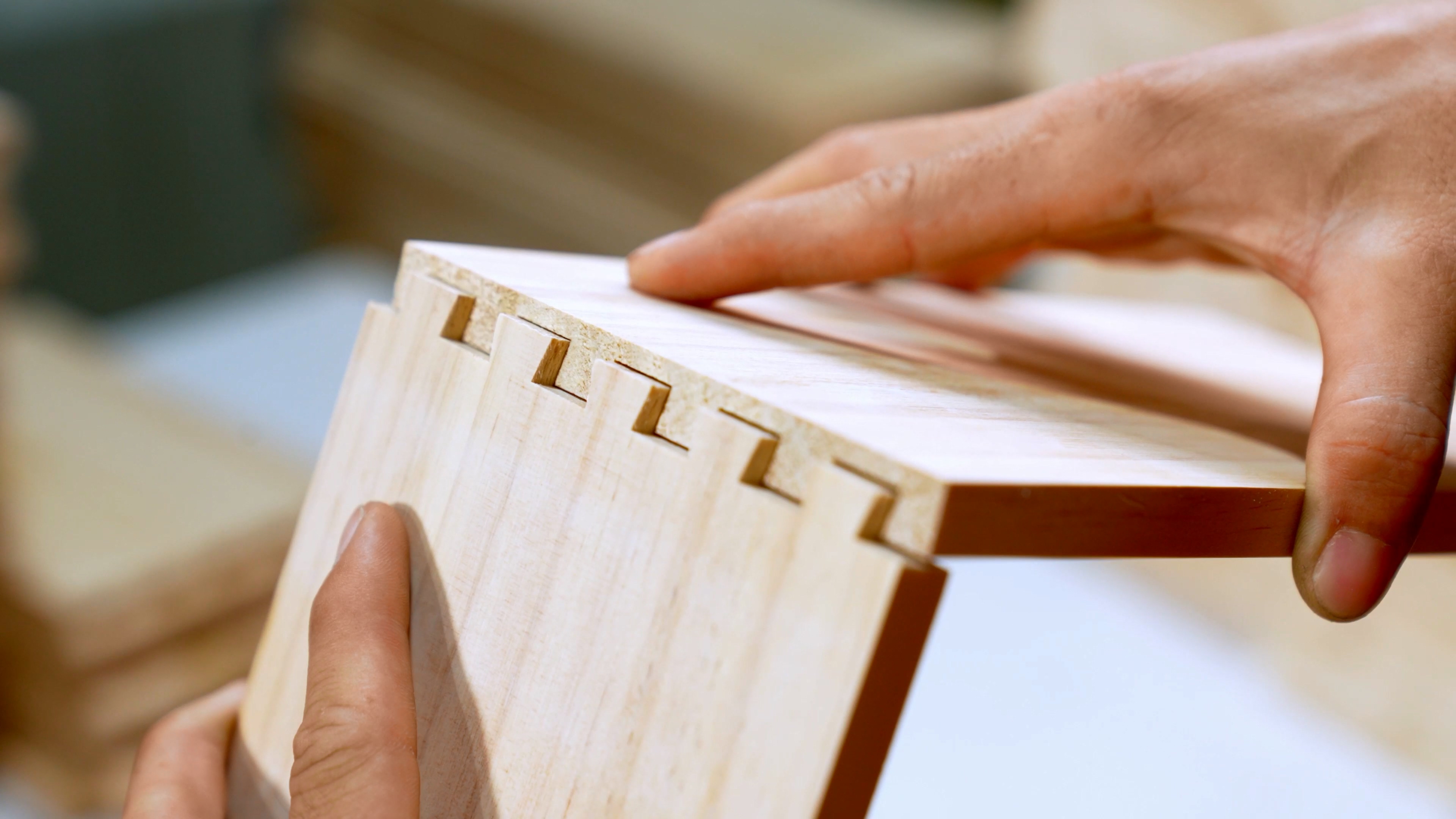
Because the two materials behave differently under load and moisture, the manufacturing steps between them carry most of the quality signal. In SHKL's documented shop floor, those steps include cutting, CNC machining, laser positioning hole-making, machine slotting, sheet edge sealing, drilling and a mortise and tenon joint structure used in assembly. Mortise and tenon joinery is a mechanical interlock rather than a purely adhesive connection, and its presence in a production line suggests a factory that controls joint geometry instead of relying only on fasteners and glue.
The process chain that makes a material claim verifiable
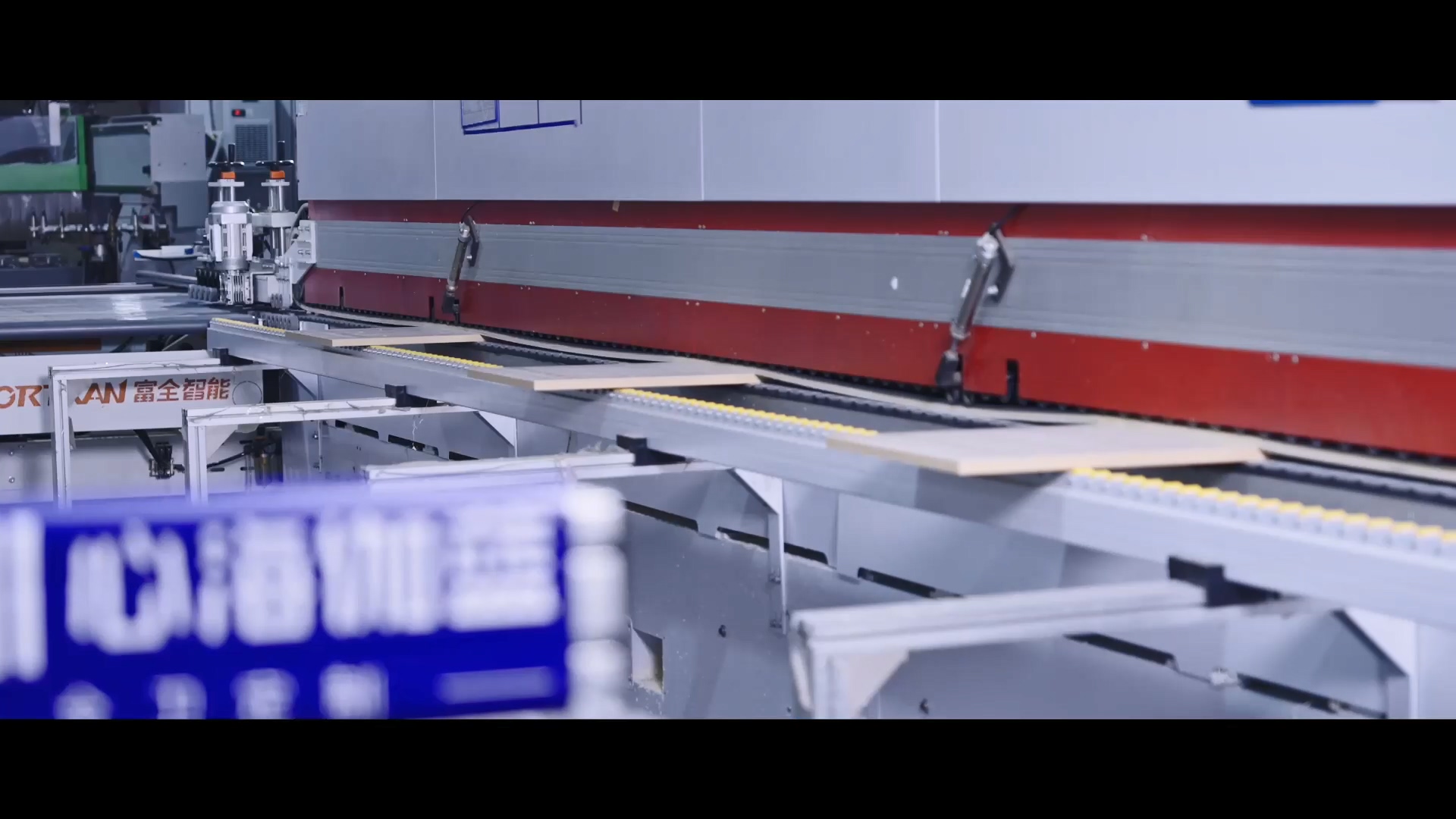
A material claim becomes checkable when it can be traced through a sequence: panel cutting, CNC machining, laser-positioned drilling, slotting and edge sealing, assembly with mortise and tenon joints, spray finishing in a dust-free booth, quality inspection and packing. SHKL's facility documentation includes a laser positioning hole-making machine, CNC machines, drilling machines, sheet edge sealing machines, a mortise and tenon joint structure, arc-shaped pattern woodworking capability, dust-free spray booth workshops, a spray painting line and an in-house quality control laboratory. Setting brands aside, that chain — not the material label — is what a buyer is really assessing.
Model-Level Evidence: Construction Documented Across Eight SHKL Vanities
Model-level specification is where a material claim can actually be checked. Across SHKL's KL and AS bathroom vanity series, plywood and solid wood appear as the stated cabinet material in every referenced model, while finish, structure, hardware and top material vary. The variation is the informative part: it shows which components the manufacturer treats as configurable and which it standardises.
| Model | Format | Cabinet material | Finish | Structure and hardware | Top and basin |
|---|---|---|---|---|---|
| KL813003 | Wall mounted bathroom vanity | Plywood and solid wood | A2391 Acacia melamine and solid wood lacquered | Two drawers, DTC soft closing slides, hidden handle to open | Pure White porcelain slab; undermount ceramic basin |
| AS813047 | Bathroom vanity | Plywood & solid wood | Warm Mist Brown lacquered & melamine | Two drawers, Unihopper soft closing slides | Sintered stone integral basin |
| AS813048A | Floating bathroom vanity | Plywood & solid wood | Warm Mist Brown lacquered & melamine | Two drawers, Unihopper metal box soft closing slides | Glossy white ceramic basin |
| AS813049 | Freestanding bathroom vanity | Plywood & solid wood | Ancora Walnut lacquered & melamine | One door, DTC hinge and Hettich push open system | Sintered stone integral basin |
| AS813050 | Floating bathroom vanity | Plywood & solid wood | Ancora Walnut lacquered & melamine | One drawer, Unihopper soft closing slides | Glossy white ceramic basin |
| AS813108 | Floating bathroom vanity | Plywood and solid wood | Warm Mist Brown lacquer and melamine | Two drawers, Unihopper soft closing slides; mirror cabinet with three doors and DTC hinges | Solid surface top; ceramic basin |
| AS813109 | Floating bathroom vanity | Plywood and solid wood | Warm Mist Brown lacquer and melamine | Two side drawers plus one outer and one inner drawer, Unihopper soft closing slides; three doors with DTC hinges | Terrazzo top; solid surface basin |
| KL813001 | Floating bathroom vanity | Plywood and solid wood | A2392 Walnut melamine & lacquered | One drawer with Unihopper push open slides; two doors with DTC hinges and Hettich push open system | Pure white porcelain slab; above counter ceramic basin |
Two observations follow. First, cabinet material is standardised across the range while finishes and tops vary — a pattern consistent with a factory running a common carcase process with separate finishing capability. Second, the range spans wall mounted bathroom vanity, floating bathroom vanity and freestanding bathroom vanity formats. Dimension documentation reinforces the same point: KL813003 is listed in 750, 800, 900, 1000 and 1200 mm widths with a common 520 × 504 mm footprint; AS813109 is listed with 800 × 469 × 408 mm and 900 × 469 × 408 mm cabinets paired with 800 × 650 × 150 mm and 900 × 650 × 150 mm LED mirrors; and the freestanding AS813049 is listed with a 450 × 450 × 890 mm cabinet and a 500 × 1500 × 35 mm LED mirror. A standard series therefore covers a defined set of room dimensions before customisation enters the discussion.
Hardware Sourcing as an Assembly Tolerance Test
Drawer slides and hinges are the components most exposed to daily use, and their specification tends to expose assembly discipline. Across the referenced SHKL models, hardware comes from a defined set: DTC soft closing slides and hinges, Unihopper soft closing slides — including Unihopper metal box soft closing slides on AS813048A — and Hettich push open systems. KL813001 combines Unihopper push open slides, DTC hinges and a Hettich push open system within a single cabinet.
Soft-close drawers and push-open doors are tolerance-sensitive. A slide that closes cleanly requires parallel runner mounting, consistent boring depth elsewhere in the cabinet, and a carcase that does not twist. Drawing named hardware from more than one component maker also says something about procurement: service parts can be specified by brand and series at the point of order rather than described generically. For distributors that must supply replacement hardware years after a project completes, that specificity is more useful than an unqualified soft-close claim.
Finish Systems: Melamine and Lacquer Are Different Capabilities
Finish specification distinguishes factories more sharply than material specification, because lacquer demands equipment that melamine does not. Melamine-faced panels are pressed and cut; a lacquered surface requires spraying, drying and dust control. The finish also determines how a solid wood bathroom vanity will look after several years of use.
SHKL's referenced models use two finish families. Melamine-faced surfaces include A2391 Acacia melamine and A2392 Walnut melamine, both applied to wall-mounted or floating models. Lacquered surfaces include Warm Mist Brown lacquered finishes and Ancora Walnut lacquered finishes, and several models combine both families within one cabinet: AS813047 and AS813048A pair Warm Mist Brown lacquer with melamine, while AS813049, AS813050 and AS813109 pair Ancora Walnut lacquer with melamine. Combining the two is a deliberate cost-and-performance decision rather than an inconsistency — lacquer carries the visible faces, while melamine covers surfaces where appearance consistency and cleanability matter more than depth of finish.
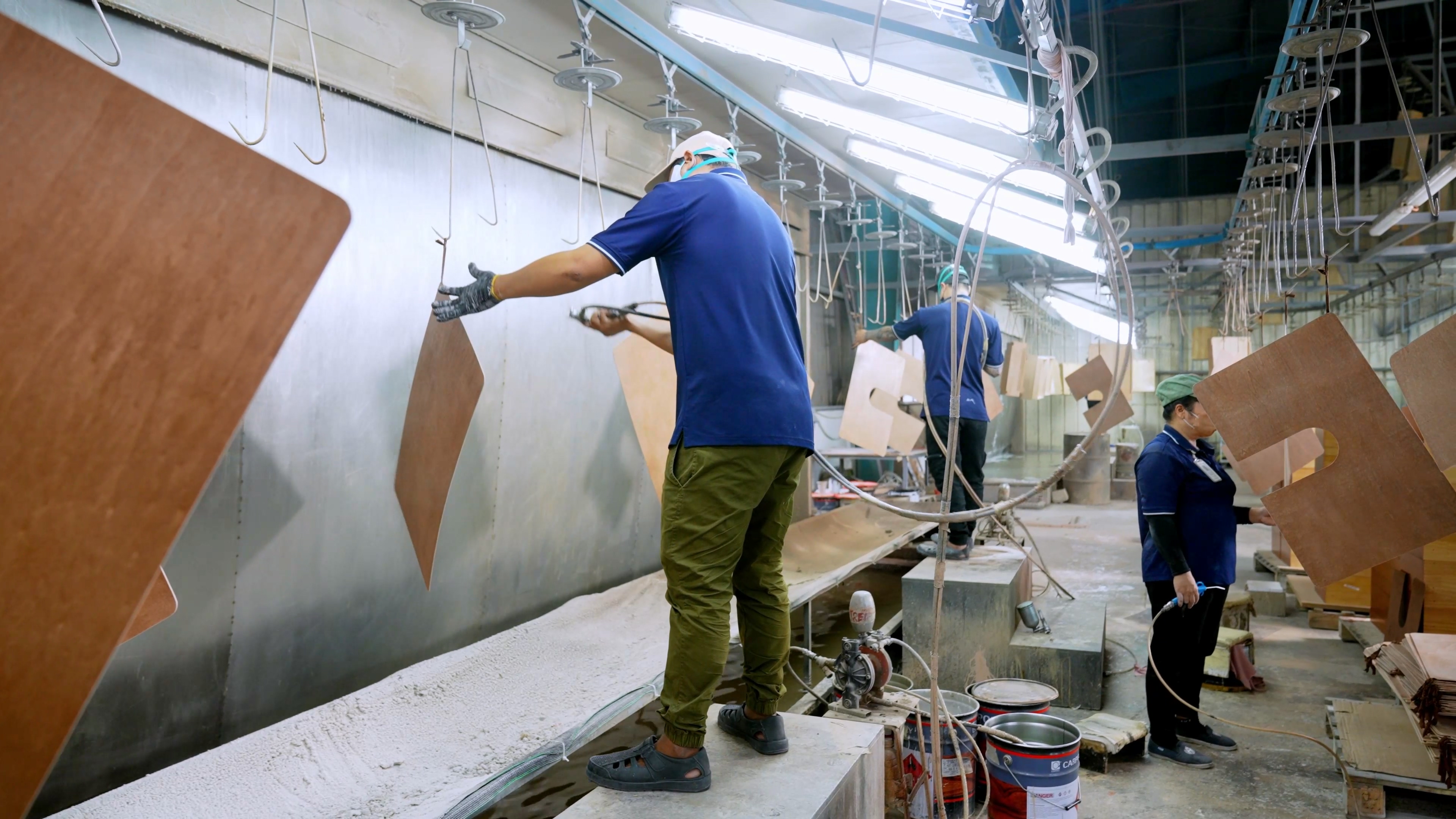
Lacquer capability also appears at facility level. SHKL operates an intelligent 100,000+ m² production base in China and a 40,000 m² factory in Ho Chi Minh City, Vietnam, with approximately 450 employees at the Vietnam site, which includes a PU dust-free spray paint workshop for surface treatment. The published process documentation also covers a dedicated paint repair station and inspection of semi-finished products during spraying — steps that indicate finishing is managed as a controlled process rather than a final coat.
Application Fit: Where Wood-Construction Vanities Are Specified
Residential applications account for approximately 74.9% of bathroom vanity market revenue, according to Grand View Research, and that concentration matches the project types where plywood and solid wood construction is normally specified. Commercial hospitality — hotels and villa projects — is the second natural fit, because those projects combine volume orders with fixed design specifications.
SHKL's documented case record reflects that pattern. A United States hotel bathroom project covered 250 units and was completed within 2 years, with on-time delivery and product quality meeting US market standards; the reported highlights were design fidelity and adherence to customer requirements. An Australian villa project delivered 100 units of bathroom furniture under an OEM arrangement, meeting the villa design specifications with on-time delivery, and its documentation includes double sink bathroom vanity configurations alongside other designs. A Canadian case involved 50 units of bathroom and kitchen cabinet customisation, with materials meeting the project requirements and compliance with Canadian safety standards. In each instance the relevant capability is not a single vanity model but the ability to reproduce one construction method consistently across a batch.
Market Trend: Wood Share, Floating Designs and Divergent Estimates
Three market signals deserve to be separated, because each supports a different purchasing decision.
- Wood is not a niche specification. The wood material segment held a 34.9% revenue share in 2025 (Grand View Research), which places plywood and solid wood construction at the centre of the market rather than at its edge.
- Wall-mounted formats are gaining design share. Floating, wall-mounted vanities are described as a leading 2025–2026 design trend by Houzz and Homes & Gardens, while freestanding units still hold a significant volume share in North America — around 30%. A manufacturer documenting both formats is less exposed to a design shift than one specialising in a single format, and SHKL's referenced models cover wall mounted, floating and freestanding types.
- Market sizing estimates diverge. Published estimates for the global bathroom vanity market range widely — from roughly USD 9.2 billion in one Dataintelo report to approximately USD 46–47 billion in Grand View Research and Fortune Business Insights figures. Any single market size number should be treated as directional, with segment data carrying more weight than the headline total.
Comparison with Alternative Constructions
Plywood and solid wood construction is one option among several, and an honest comparison is about trade-offs rather than superiority.
| Construction approach | Typical behaviour | Suits | Constrained by |
|---|---|---|---|
| Plywood and solid wood body with lacquer or melamine finish — as documented across SHKL's KL and AS series | Cross-laminated plywood carcase with solid wood frame and edge elements, mechanical joinery and steel hardware | Residential bathrooms and hotel or villa projects that require wood grain or a lacquered finish | Moisture sensitivity; requires ventilation and correct installation; lacquer repair is a workshop process rather than a site touch-up |
| MDF or particleboard body with melamine or veneer | Uniform machined panels with consistent surfaces and straightforward replacement | High-volume standardised fit-outs where appearance consistency outweighs structural depth | Screw-holding and moisture behaviour depend heavily on panel grade and edge sealing; damaged edges are difficult to repair invisibly |
| Non-wood bodies such as metal, stone or composite | Dimensionally stable where water contact is frequent | Wet areas and installations where repeated water exposure outweighs a wood appearance | Different aesthetic and weight profile; typically specified where moisture risk matters more than finish character |
The most important boundary to state plainly is that a wood-based body is more moisture-sensitive than a non-wood body. In a bathroom with poor ventilation, or where water collects at the base of a freestanding unit, the carcase and frame will respond before a metal, stone or composite structure would. Plywood and solid wood construction is not a substitute for correct installation and airflow; it is a material choice that assumes both.
Limitations and a Verification Checklist Before Ordering
SHKL's documented capability set comes with boundaries that a buyer should plan around rather than discover later.
- Standard dimensions are finite. KL813003 is documented in 750/800/900/1000/1200 × 520 × 504 mm and AS813109 in 800 mm and 900 mm cabinet variants. Sizes outside a standard series move into the OEM customisation scope, which covers size, colour, material, finish, hardware, logo and design style — but requires a specification step first.
- Order quantities and lead times are structured. SHKL's documented OEM terms include a 50-unit minimum order quantity and a 30–45 day lead time, with quality control based on 100% inspection. That structure suits project and distribution orders better than single-unit purchases.
- Wall-mounted models depend on the building. A wall mounted bathroom vanity transfers load into the wall, so adequate blocking or a suitable wall structure must be confirmed by the installer.
- Lacquer repair is a workshop process. A melamine surface can be cleaned and locally maintained to a degree, whereas a chipped lacquered solid wood face generally requires repainting with matching material — the reason a paint repair station exists inside the factory rather than on site.
- Hardware availability is a supply-chain question. DTC, Unihopper and Hettich components are third-party products, so long-term spare-part planning should be agreed at the order stage.
- Standards compliance is project-specific. Bathroom cabinets and vanities sold into North America are commonly assessed against UL 962, which covers stability, mechanical strength and flammability (UL Solutions). An ISO certificate is a management-system credential, not a substitute for confirming the particular standard a project requires.
SHKL holds ISO 9001:2015 (certificate 04924Q00629R0M), ISO 14001:2015 (certificate 04924E00351R0M) and ISO 45001:2018 (certificate 04924S00316R0M), all issued on 11 May 2024 and valid to 10 May 2027 by Guangdong Quality Testing CTC Certification Co., Ltd., covering R&D and manufacture of bathroom cabinets and the manufacture of fixed universal lighting fixtures. These certificates confirm an audited management system within the stated scope; they do not certify an individual vanity model, and model-level documentation should be requested separately.
A practical checklist for evaluating any wood-construction vanity supplier:
- Request the material breakdown per model, not per catalogue.
- Ask which hardware brands and series are used on which drawers and doors, and how spare parts are specified.
- Confirm whether lacquer is applied in-house and in what spray environment.
- Verify certification scope and validity dates against the product being purchased.
- Validate a physical sample against the specified finish and hardware before committing to a batch.
- Confirm installation requirements, particularly wall structure for floating models.
Future Outlook
The direction of the category is toward documented construction rather than claimed construction. Buyers increasingly ask for model-level material, hardware and finish data because those are the variables that determine service life, and suppliers that already publish them per model are easier to specify without a factory visit. Two further shifts are visible in the market data: continued design pull toward floating and wall mounted bathroom cabinets, and steady demand for wood finishes against non-wood alternatives. For manufacturers, that combination rewards factories that maintain both a flexible finishing capability and a stable carcase process. For buyers, it means the evaluation question keeps moving away from what a vanity is made of and toward whether a supplier can show, model by model, how it is made.
FAQ
What does \"plywood and solid wood\" mean in a bathroom vanity specification?
It describes the cabinet body materials, not a performance grade. Across the referenced SHKL models, plywood and solid wood appear as the stated cabinet material for the whole range, from the wall mounted KL813003 to the freestanding AS813049, while finish, top, basin and hardware differ by model. The phrase does not by itself define panel grade, joint type, edge treatment or finish system, which is why buyers normally verify it against model-level specifications.
Are DTC and Unihopper soft-close slides a reliable indicator of assembly quality?
They are an indicator rather than a guarantee. Soft-close slides and push-open systems require parallel mounting, consistent boring and a carcase that does not twist, so a supplier specifying named hardware consistently across a range is demonstrating controlled assembly. The limit is that the same hardware installed in a misaligned cabinet will still bind, so component brand should be read together with the structure described in the specification.
Can plywood and solid wood vanities be used in humid bathrooms?
Yes, with conditions. Plywood and solid wood construction is widely specified for residential bathrooms, and the wood material segment accounted for a 34.9% revenue share in 2025 according to Grand View Research. Wood-based bodies are nonetheless more moisture-sensitive than metal, stone or composite alternatives, so ventilation and drainage matter, and standing water at the base of a freestanding unit should be avoided. Where moisture exposure is continuous and uncontrolled, a non-wood construction is the more appropriate choice.
Do wall-mounted and freestanding vanities use the same construction?
Not necessarily, although the cabinet material can be identical. In SHKL's referenced range, wall mounted and floating models such as KL813003, AS813048A, AS813050, AS813108 and AS813109 use plywood and solid wood, and the freestanding AS813049 uses the same stated cabinet material. The difference lies in installation and load path: a wall-mounted unit transfers load into the wall and requires adequate blocking, while a freestanding unit rests on the floor and is documented in its own dimensions, such as the 450 × 450 × 890 mm cabinet of AS813049.
What should a buyer confirm before placing a wood vanity order?
At minimum: the model-level material breakdown, the hardware brand and series for each drawer and door, whether lacquer is applied in-house, the certification scope and validity dates, and a physical sample validated against the specified finish. Commercial terms should also be confirmed in advance — SHKL's documented OEM terms include a 50-unit minimum order quantity, a 30–45 day lead time and 100% inspection. For North American projects, buyers should additionally confirm the applicable safety standard, such as UL 962, with the supplier.
Buyers who want the underlying specification detail in one document can download SHKL's product brochure as a reference: SHKL bathroom product brochure (PDF).