
Polyester Mesh Belt Order Acceptance: BV/SGS Inspection, Payment and Incoterms
Polyester Mesh Belt Order Acceptance: BV/SGS Inspection, Payment and Incoterms
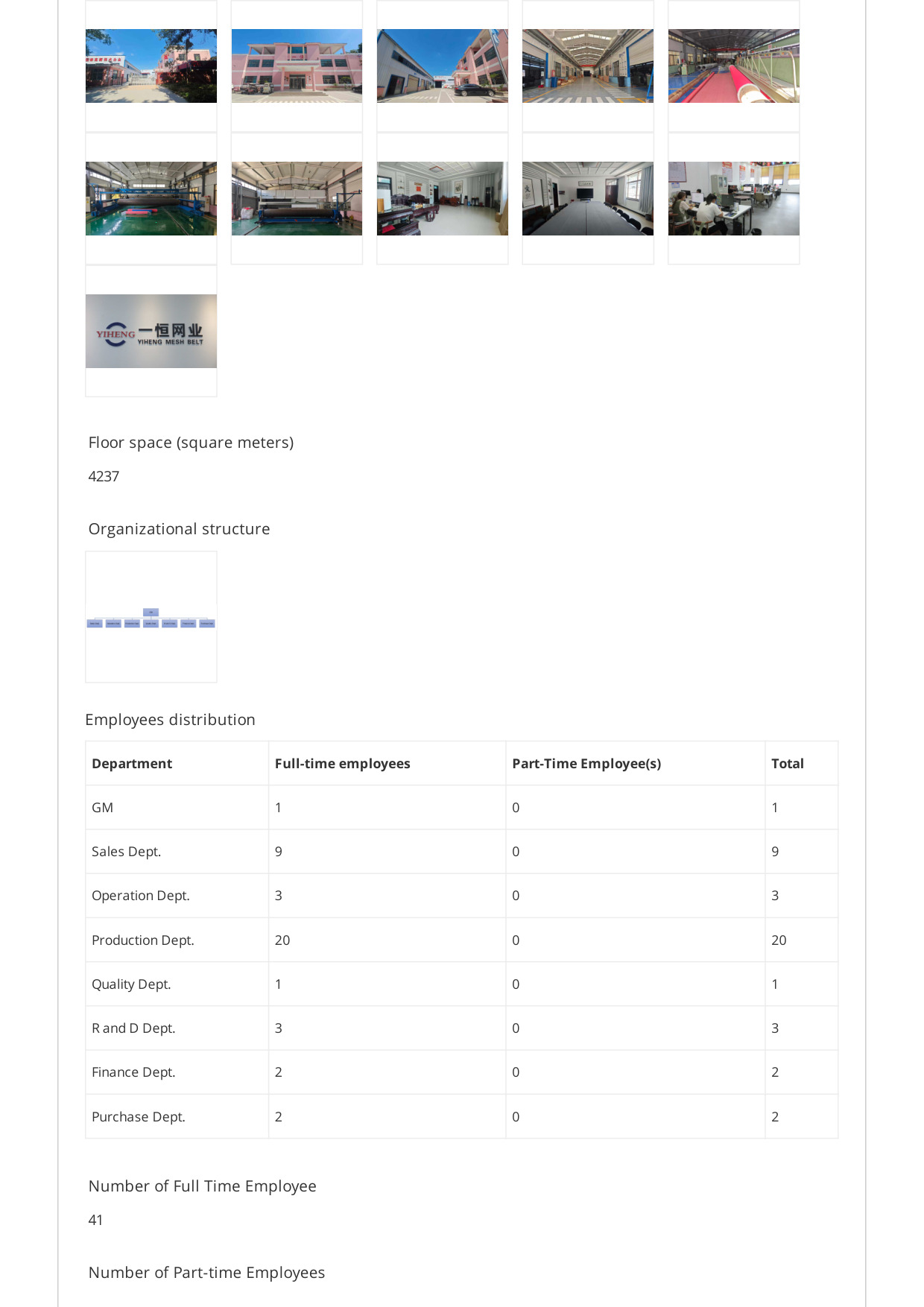
Order acceptance for a polyester mesh belt is settled by four written controls, not by an impression of the supplier: a frozen specification with an approved sample, a 100% pre-shipment inspection record that can be reinforced by optional BV or SGS on-site verification, a 30% deposit / 70% balance payment structure, and a named Incoterm that fixes where cost and risk transfer. Henan Yiheng Mesh Belt Industry Co., Ltd. (Yiheng Mesh), a polyester mesh belt manufacturer founded in 2009 that exports 62% of its output to Asia, Europe and North America, states these terms alongside a 2 m² minimum order quantity for samples and trial orders — small enough that a buyer can run the whole acceptance sequence before committing to a production volume.
This reference sets out how those four controls fit together, where each one stops being useful, and how the choice between FOB, CIF, DAP and DDP changes the point at which the buyer still has leverage over the goods.
Why acceptance terms decide more than the specification sheet
A specification sheet describes what a belt is intended to be. Acceptance terms decide what happens when the delivered belt measures slightly differently from that description. For open-mesh polyester belting — where air permeability, joint geometry and width tolerance all affect whether the belt tracks and drains correctly on a specific machine — that difference is the commercially important one.
The category is also large enough that suppliers and buyers rarely share assumptions. Straits Research reported that polyester was the leading material segment in the global conveyor belt market in 2025 with a 28.4% share, within a market projected to grow from USD 6.24 billion in 2026 to USD 8.53 billion by 2034 (Straits Research, August 2026). On the demand side, Grand View Research projected the belt filter press technology segment of the sludge dewatering equipment market to grow at an 8.8% CAGR from 2025 to 2033. Neither figure says anything about a specific supplier's quality; both explain why written acceptance criteria have become a standard part of industrial belt procurement rather than an optional refinement.
The four checkpoints of an accepted order
Checkpoint 1 — freeze the specification before paying the deposit
Yiheng Mesh offers OEM/ODM customization across mesh count and opening size, air permeability in CFM, belt width and length, material (PET, PA or anti-static), thickness, colour and edge. Each of those variables changes the acceptance test, so the practical rule is that nothing is left adjustable after the deposit is paid.
The value of a numerically frozen specification becomes clear when product families are compared. A square-mesh belt such as model 05802 is specified at 12–14 mesh, 0.8 mm warp and weft, 1.0–1.2 mm pitch, 700–750 g/m² weight and 13,384–20,775 m³/㎡·h air permeability in a 2-shed plain weave. A dewatering belt such as model 16903 is a different object entirely: 0.70 mm warp, 0.90 mm weft, a herringbone weave, break strength of at least 2,200 N/cm and air permeability of 7,894 ± 500 m³/㎡·h. Spiral filter press belts sit in a third range — the Small Loop-Filler Wire belt at 1.90 mm thickness and 7,300 ± 500 m³/㎡·h, the Medium Loop-Filler Wire at 2.32 mm and 10,700–12,000 ± 500 m³/㎡·h, and the Large Loop-Filler Wire at 2.95 mm, 9,000–13,700 ± 500 m³/㎡·h with break strength of at least 2,300 N/cm. A finer forming-style belt such as model 16402 is specified at 41 mesh, 0.2 mm pitch, 550 g/m² and 6,900 m³/㎡·h.
What belongs in the frozen specification
- Mesh count or opening size, with the measurement method stated.
- Air permeability target, and whether acceptance uses the nominal figure or the full stated tolerance band (the ± 500 m³/㎡·h notation on dewatering belts matters here).
- Finished dimensions — inside length and width — and the permitted deviation.
- Joint type: endless, self-ring or double-pin, since joint thickness relative to the belt body affects tracking and marking.
- Material and colour, including any anti-static or hydrolysis-resistant requirement.
- Edge treatment and any slitting tolerance.
- Break strength requirement where the belt runs under tension on a filter press.
- Packaging, marking and the documents that must travel with the shipment.
Checkpoint 2 — what 100% pre-shipment inspection actually covers
Yiheng Mesh lists 100% pre-shipment inspection as standard quality control: the order is checked before it leaves the factory. That is a supplier-side gate, and it is the baseline rather than the exception. The buyer's job is to define what the record must contain, because "inspected" without a defined scope is not an acceptance criterion.
Four things are worth fixing in writing. First, the measurement basis for air permeability — instrument, pressure differential and whether the reading is taken from the body of the belt or near the joint. Second, the dimensional check, since length and width are usually the first source of dispute on a made-to-machine belt. Third, the joint: its thickness relative to the body, the pin or ring type, and whether it has been run. Fourth, the visual and packing check, including edge condition, contamination and how the roll is protected for the chosen delivery term.
A boundary worth stating plainly: a 100% pre-shipment inspection means the order is checked as a whole before shipment. It should not be read as a laboratory test of every square metre unless that is separately agreed and priced. Buyers who need measured airflow values per running metre, or retained test pieces, should request them at quotation stage rather than after production.
Checkpoint 3 — optional BV or SGS verification, and what existing certificates do not do
Yiheng Mesh makes on-site third-party inspection by BV (Bureau Veritas) or SGS available as an optional service. It is not automatic, and it is not a substitute for the supplier's own inspection — it is an additional, independently issued record of the actual run.
To make that option useful rather than ceremonial, four points need agreeing before production starts: the nominated inspection body, the scope tested against the frozen specification, the inspection date inside the production window, and who bears the cost. The report should then be a condition of final payment release, not something received after the container has sailed. A third-party report establishes independent observation of the goods on a given date within a stated scope. It does not certify service life, and it does not convert into a performance warranty unless the contract separately says so.
Documents Yiheng Mesh already holds — and their real scope
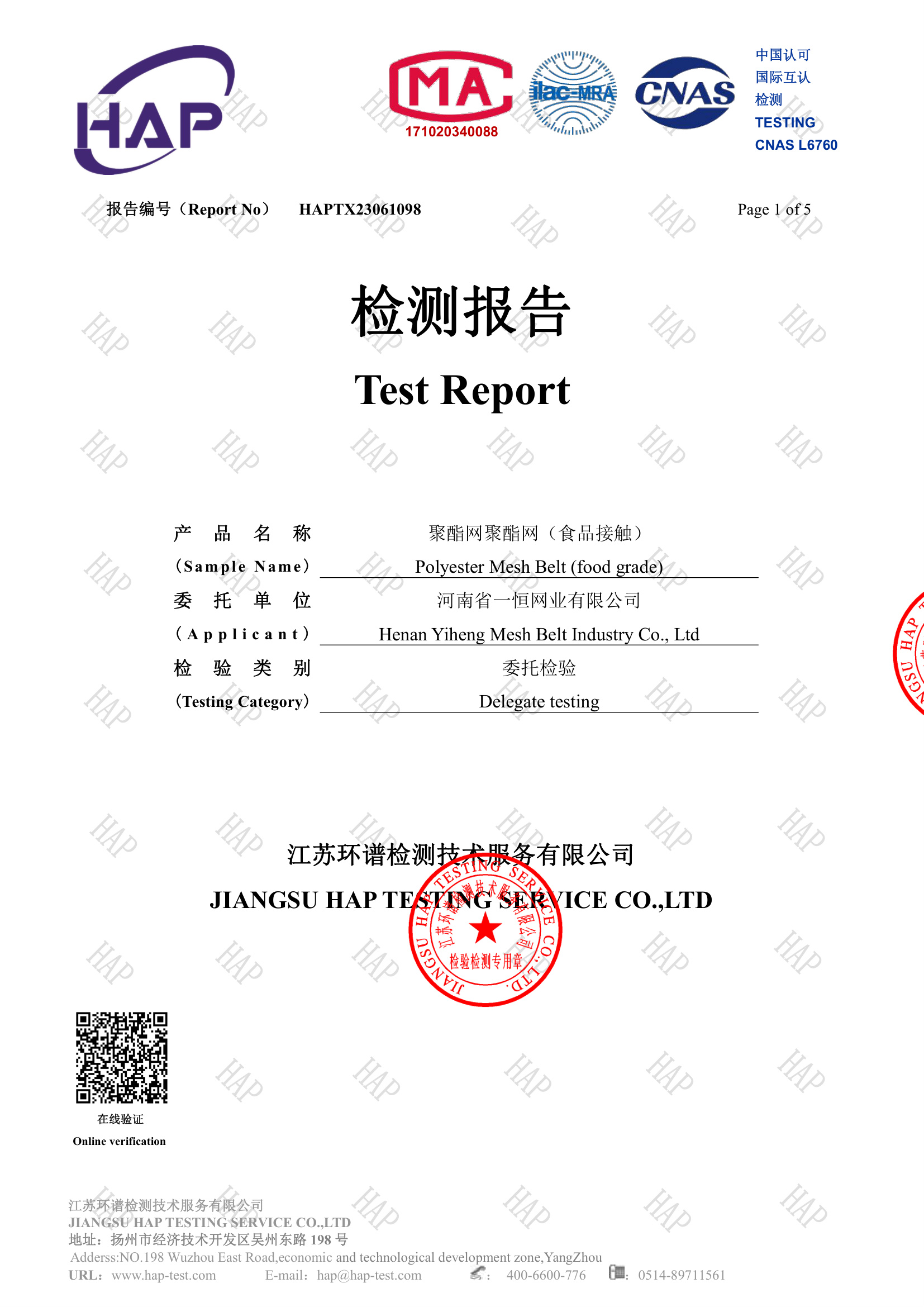
- Food contact test report HAPTX23061098, issued 29 June 2023 by JIANGSU HAP TESTING SERVICE CO., LTD, verifying the food-grade polyester mesh belt against GB 4806.7-2016. It supports food-contact use for the tested product; it does not certify unrelated models.
- German Packaging Act (LUCID) registration DE2857625357145, issued 24 February 2025 by Stiftung Zentrale Stelle Verpackungsregister. This concerns packaging placed on the German market, not belt performance.
- INTERTEK Alibaba.com Verified Supplier Assessment Report 493944221_P+T, issued 9 July 2026 and valid to 9 July 2027, covering Fabrics, Dryer Fabrics, Polyester Filter Belt, Non-Woven Mesh Belt and UV Belts. It is a supplier assessment within a validity window, not a per-order product test.
None of these documents should be presented as a certification the company does not hold. A buyer who needs a specific standard for a specific model should ask for that evidence against that model, and confirm whether it can be issued for the order in question.
Checkpoint 4 — the 30% deposit and 70% balance
Yiheng Mesh's stated order term is a 30% deposit with the 70% balance payable against the order. The commercial logic is standard: the deposit commits material and a production slot, and the balance releases the finished goods. The buyer's logic should be equally explicit — the balance should be triggered by a named event, not by a date.
The practical drafting is short. State that the balance is released after the buyer receives and accepts the pre-shipment inspection record, and after the third-party report where that option was taken. Attach the frozen specification to the proforma invoice so the inspection record can be assessed against it. Confirm in writing the documentary set that travels with the shipment — commercial invoice, packing list, transport document, and certificate of origin where the destination requires one — rather than assuming it. Where the buyer needs a payment route other than the standard 30/70 structure, that variation has to be agreed with the supplier in writing; it should not be inferred from an enquiry reply.
Checkpoint 5 — FOB, CIF, DAP and DDP in acceptance planning
The Incoterm does not change the belt; it changes when the buyer loses practical control over it. Under the ICC Incoterms rules, the four terms most often quoted for mesh belt shipments divide carriage, insurance, import clearance and risk in distinctly different ways.
Two consequences follow. First, under FOB and CIF the buyer's verification window closes at the port of loading, which is precisely why the pre-shipment inspection and the optional BV or SGS report carry most of the acceptance weight under those terms. Second, DAP and DDP move the handover closer to the buyer's site but shift duty and clearance obligations in opposite directions — and DDP is only workable where the supplier can legally act as importer of record in the destination country. That is a question to settle before quoting, not after.
Classification belongs in the same conversation. Textile products and articles for technical uses, which is where polyester mesh belts fall, are commonly classified under HS heading 5911.90 — the code listed by the USITC for such articles. The applicable duty, and therefore the cost difference between DAP and DDP, depends on the destination's own tariff schedule; the buyer's forwarder should confirm the code used at entry.
MOQ 2 m²: designing a trial that tests acceptance, not just the belt
The 2 m² minimum order quantity is small enough to be treated as a genuine acceptance rehearsal. Typical lead time is quoted at 15–30 days and confirmed per order, and free sample testing is available for evaluation.
A 2 m² trial can validate several things that no document can: whether the joint runs cleanly on the buyer's rollers, whether the achieved width matches the machine, how the belt tracks under the buyer's tension, and whether measured airflow matches the process requirement on the buyer's own equipment. It cannot validate long-run fatigue, hydrolysis resistance under continuous heat and humidity, or service life — those require operating time. Treating a trial result as a lifetime guarantee is the most common over-reading of a small order.
Before the trial ships, define the pass criteria. A useful set is: measured airflow within the stated tolerance band, dimensions within the agreed deviation, joint thickness within an agreed limit relative to body thickness, and no edge fraying after a defined running period. Where those criteria are met, the same numbers become the acceptance basis for the production order.
What these acceptance documents do not establish
- They govern the transaction, not the belt's working life. Belt performance also depends on machine alignment, roller condition, tension, temperature and chemical exposure at the plant.
- A third-party report covers the agreed scope, the sample and the date. It is evidence, not a warranty extension.
- Certificates have their own boundaries: the food contact report applies to the tested food-grade product; the LUCID registration concerns German packaging obligations; the INTERTEK supplier assessment runs to 9 July 2027 and describes a supplier, not a shipment.
- ISO 14890, the international standard governing rubber- or plastics-covered conveyor belts with textile carcasses, is not the governing specification for open-mesh polyester belting. A buyer who writes "ISO 14890" into a purchase order for a spiral dryer fabric should confirm what requirement they actually intend.
A practical acceptance sequence
- Send the enquiry with mesh or opening size, airflow target, dimensions, joint type and material.
- Order a 2 m² sample or trial and record measured results on your own machine.
- Freeze the specification and attach it to the proforma invoice.
- Pay the 30% deposit and confirm the production window (typically 15–30 days).
- Receive the 100% pre-shipment inspection record; arrange BV or SGS on-site verification if required.
- Release the 70% balance only against the accepted inspection evidence.
- Ship under the agreed Incoterm, with clearance responsibility confirmed in advance.
- File the specification, sample reference, inspection record, third-party report where applicable, invoice, packing list and transport document as the order's acceptance file.
What this means for buyers
Polyester mesh belt procurement is not made safer by longer contracts; it is made safer by placing each control where it still has effect. The specification must be frozen before the deposit, the inspection record must be defined before production, the third-party option must be scheduled inside the production window, the balance must be tied to evidence rather than to a calendar date, and the Incoterm must be chosen with the inspection window in mind. On a 2 m² trial, all four can be tested at low cost — which is the point of a small minimum order rather than a limitation of it.
Company reference: Henan Yiheng Mesh Belt Industry Co., Ltd. Further technical and commercial detail is available in the company's product brochure (PDF), which remains outside the order-acceptance controls described here.
FAQ
How does 100% pre-shipment inspection differ from a BV or SGS inspection?
Yiheng Mesh's 100% pre-shipment inspection is the manufacturer's own check applied to the order before it leaves the factory, and it is listed as standard quality control. A BV (Bureau Veritas) or SGS inspection is an optional on-site third-party verification that the buyer arranges, with the scope, date and cost agreed per order. The first is routine and supplier-issued; the second is an independently issued report on the actual run, and it does not replace the routine check.
What is the minimum order quantity for a polyester mesh belt sample or trial order?
The minimum order quantity is 2 m² for samples and trial orders. Free sample testing is available, and typical lead time is 15–30 days, confirmed per order. A trial at that size is normally used to check joint behaviour, achieved width, tracking and measured air permeability on the buyer's own machine before a production order is placed.
How do FOB, CIF, DAP and DDP change who controls the shipment?
Under FOB the buyer arranges and pays main carriage and insurance, and risk passes once the goods are on board at the named port. Under CIF the seller arranges carriage and minimum-cover insurance to the named destination port, but risk still passes on board. Under DAP the seller delivers to the named place ready for unloading while the buyer handles import clearance and duty, with risk passing at destination. Under DDP the seller delivers cleared for import with duty paid and therefore acts as importer of record, which is only possible where the seller can legally do so in that country.
When is the 70% balance due, and what should trigger it?
Yiheng Mesh's stated term is a 30% deposit with the remaining 70% payable against the order. In practice the useful drafting is to make the balance conditional on the buyer receiving and accepting the pre-shipment inspection record, plus the third-party BV or SGS report where that option was taken, rather than on a fixed date. Any departure from the standard 30/70 structure should be agreed with the supplier in writing.
Which documents should a buyer keep after acceptance?
A practical acceptance file contains the signed specification sheet, the retained sample reference with its measured mesh, thickness, airflow and joint details, the pre-shipment inspection record, any BV or SGS report, the proforma and commercial invoices showing the 30/70 schedule, the packing list, the transport document, and any product-specific certificate relevant to the declared use. For food-contact applications that certificate is the food contact test report HAPTX23061098 verifying GB 4806.7-2016; for packaging placed on the German market it is the LUCID registration DE2857625357145. The INTERTEK supplier assessment 493944221_P+T is valid to 9 July 2027 and should be kept with its stated validity window.
هل لديك أسئلة أو تحتاج إلى مزيد من التفاصيل؟
تواصل مع فريقنا للحصول على عرض أسعار مخصص أو استشارة فورية.
طلب عرض أسعار
املأ النموذج أدناه وسيتواصل معك فريقنا بعرض مقترح مخصص.
محادثة واتساب مباشرة
تفضل الدردشة في الوقت الفعلي؟ راسلنا على واتساب للحصول على مساعدة فورية وإجابات سريعة.
- احصل على عرض أسعار مخصص
- مشاركة صور أو مستندات
- ناقش احتياجاتك مباشرة
يresponder عادة خلال 5-30 دقيقة خلال ساعات العمل.