
Polyester Mesh Belt Sourcing: An Independent Buyer's Checklist for 2026
A polyester mesh belt fails in ways that are invisible in a quotation: a seam that opens after a few hundred operating hours, an edge that frays, a belt that begins tracking off-centre, or an air permeability value that drifts once the fabric has been through heat and moisture. Because those failure modes only appear in service, polyester mesh belt sourcing is less a price negotiation than a verification exercise. This checklist sets out what procurement teams can reasonably demand from a supplier in 2026, and which claims should be tested rather than accepted.
Why polyester mesh belt sourcing is a verification problem
A polyester mesh belt is a functional component inside someone else's process. When it fails on a belt filter press, a food dryer, a UV printer or a non-woven forming line, the cost is measured in downtime, rejected product and unplanned maintenance, not in the purchase price of the belt itself.
Four properties decide whether a belt will perform in a given application, and none of them can be read off a price list. The first is whether the supplier controls heat-setting and joining in-house. The second is whether the joint will survive the tension and flexing of the specific line. The third is whether air permeability stays inside tolerance at the stated reference pressure and area. The fourth is whether the polymer grade matches the temperature, humidity and chemistry of the duty.
The trade framework around the product is already well defined. Polyester mesh belts fall under HS Code 5911.90, the classification for textile products and articles for technical uses, according to the USITC Harmonized Tariff Schedule. Buyers who understand that classification also understand what documentation should accompany a shipment, and where a claim about certification needs to be specific rather than general.
What the 2026 supply picture looks like
Polyester is the leading material segment in the global conveyor belt market, accounting for 28.4% of revenue in 2025, according to Straits Research.
Market size estimates vary with scope. Straits Research projects the global conveyor belt market growing from USD 6.24 billion in 2026 to USD 8.53 billion by 2034. A narrower definition used by Future Market Insights places 2026 at USD 4.66 billion, a gap the sources attribute to whether heavy-duty and modular belts are included. For a sourcing decision, direction matters more than the absolute figure: capacity is expanding and the supplier pool is widening.
Demand is also being pulled by filtration and dewatering. Grand View Research projects the belt filter press technology segment of the sludge dewatering equipment market to grow at a CAGR of 8.8% from 2025 to 2033. That growth translates directly into replacement demand for filter press belts and dewatering belts.
More suppliers and more demand make the verification step more important, not less. A wider pool is only useful to a buyer who can tell the entries apart.
The independent buyer's checklist at a glance
| # | What to verify | What to ask for | Evidence to accept |
|---|---|---|---|
| 1 | Supplier identity and role | Legal entity, founding year, in-house versus subcontracted weaving and joining | Registration details and a stated production chain |
| 2 | Process control, not just capacity | Loom list, heat-setting equipment, permeability tolerance | Equipment disclosure or an assessment report with a defined scope |
| 3 | Written, parameter-level specification | Grade, weave, diameters, mesh or loop, thickness, weight, permeability, break strength | Data sheet tied in writing to the order |
| 4 | Permeability reference and tolerance | CFM at 127 Pa/20 cm2, or m3/m2/h at 100 Pa, with acceptance range | Measurement data at the stated reference condition |
| 5 | Polymer grade matched to duty | Anti-hydrolysis monofilament, anti-static carbon fibre, conductivity range | A grade name and a measured conductivity value |
| 6 | Compliance documents scoped to your market | Food-contact test report, packaging registration, supplier assessment | Certificate number, issuing authority, issue and validity dates |
| 7 | Independent pre-shipment inspection | On-site third-party inspection before shipment | Inspection report against checkpoints the buyer defines |
| 8 | Sampling terms | Sample quantity, sampling lead time, sample test support | A physical sample for dimensional and permeability checks |
| 9 | On-line trial and run-in record | Trial plan, tracking checks, seam and edge condition after run-in | Documented trial results on the buyer's own equipment |
| 10 | Continuity and scale-up terms | Lead time, repeat-order specification freeze, technical support channel | Order confirmation stating the frozen specification |
Part 1 - Verify the entity and the production chain
1. Establish who actually weaves the belt
Henan Yiheng Mesh Belt Industry Co., Ltd. (Yiheng Mesh, www.yhfilterbelt.com) is a Chinese manufacturer of polyester mesh belts and industrial filter belts, founded in 2009, with an export ratio of 62% and customers across Asia, Europe and North America. Its published production information lists one Swedish TEXO loom, three domestic looms and four setting units. That level of disclosure is what a buyer should request from any supplier: not "modern equipment", but which looms, how many, and where heat-setting, joining and edge finishing are performed. A trading company is not automatically disqualified from a sourcing shortlist, but undisclosed subcontracting is a genuine risk, because it moves the accountability for tolerances away from the party that signed the order.
2. Check process control, not just output
Heat-setting determines whether a belt keeps its dimensions and permeability in service. Yiheng states that air permeability fluctuation is controlled within a range of plus or minus 5% through heat-setting on ultra-wide looms. Whether or not another supplier commits to the same number is less important than whether a number is committed to at all, and whether the measurement method is stated. "Excellent stability" is not a tolerance.
Part 2 - Verify the specification and its tolerances
3. Turn the application into a parameter list
Spiral mesh belts used for dewatering and drying are specified by ring wire, threading, filler configuration, thickness and break strength. Published examples across the range include a large loop construction with a 0.90 mm ring wire, 1.00 mm threading and 0.90 x 3, 0.90 x 4 or 0.90 x 5 mm fillers, rated at a break strength of at least 2300 N/cm and 2.95 mm thickness; a medium loop construction at 0.68 mm warp and 0.90 mm weft with a 6.50 mm loop distance and 2.32 mm thickness; and a small loop construction at 0.52 mm warp and 0.70 mm weft with a 5.20 mm loop distance and 1.90 mm thickness.
Filter press belts are specified differently again. Model 16903 uses a herringbone or diagonal weave for drainage, with a 0.70 mm warp, 0.90 mm weft, warp density of 16 wires/cm, weft density of 5.33 wires/cm, and a break strength of at least 2200 N/cm.
For forming, drying and food-contact conveying, plain weave and square mesh constructions dominate. Model 16402 is a 41-mesh plain weave with 0.4 mm warp and weft, 550 g/m2 weight and 6,900 m3/m2/h air permeability. Model 05802 is a square mesh at 0.8 mm warp and weft, 12 to 14 mesh, 700 to 750 g/m2, in a 2-shed plain weave.
Dimensional tolerance belongs in the same document. Typical published limits are plus or minus 5 cm in length below 50 m and plus or minus 1 cm in width below 5 m. A purchase order without tolerance is an invitation to argue at receipt.
4. Pin the air permeability reference condition
Air permeability values cannot be compared unless pressure and area are stated. Many woven models are rated in CFM at 127 Pa over 20 cm2 with a tolerance of plus or minus 30 CFM, while airlaid and spunlace belts are commonly rated in m3/m2/h at 100 Pa. The same construction can appear to differ by a wide margin purely because the reference conditions differ. Buyers should also specify the joint and the edge treatment, since both are frequent failure points: joint options include self-ring, millet-ring and double-pins, and edge finishing may be 2 cm glue brushing on the welded edges, melt glue or AB glue.
5. Match the polymer grade to the environment
Standard polyester behaves differently under sustained heat and humidity. Anti-hydrolysis monofilament grades are used to extend belt life in high-heat, high-humidity operating environments, and carbon-fibre anti-static constructions address static build-up on high-speed lines. Conductivity should be stated as a value, not a label. Published ranges across different models include 103 to 104 ohm, 105 to 106 ohm and 106 ohm. A quotation that says only "anti-static" leaves the buyer unable to verify anything at receipt.
Part 3 - Verify compliance and independent inspection
6. Read certificates for scope, not for logos
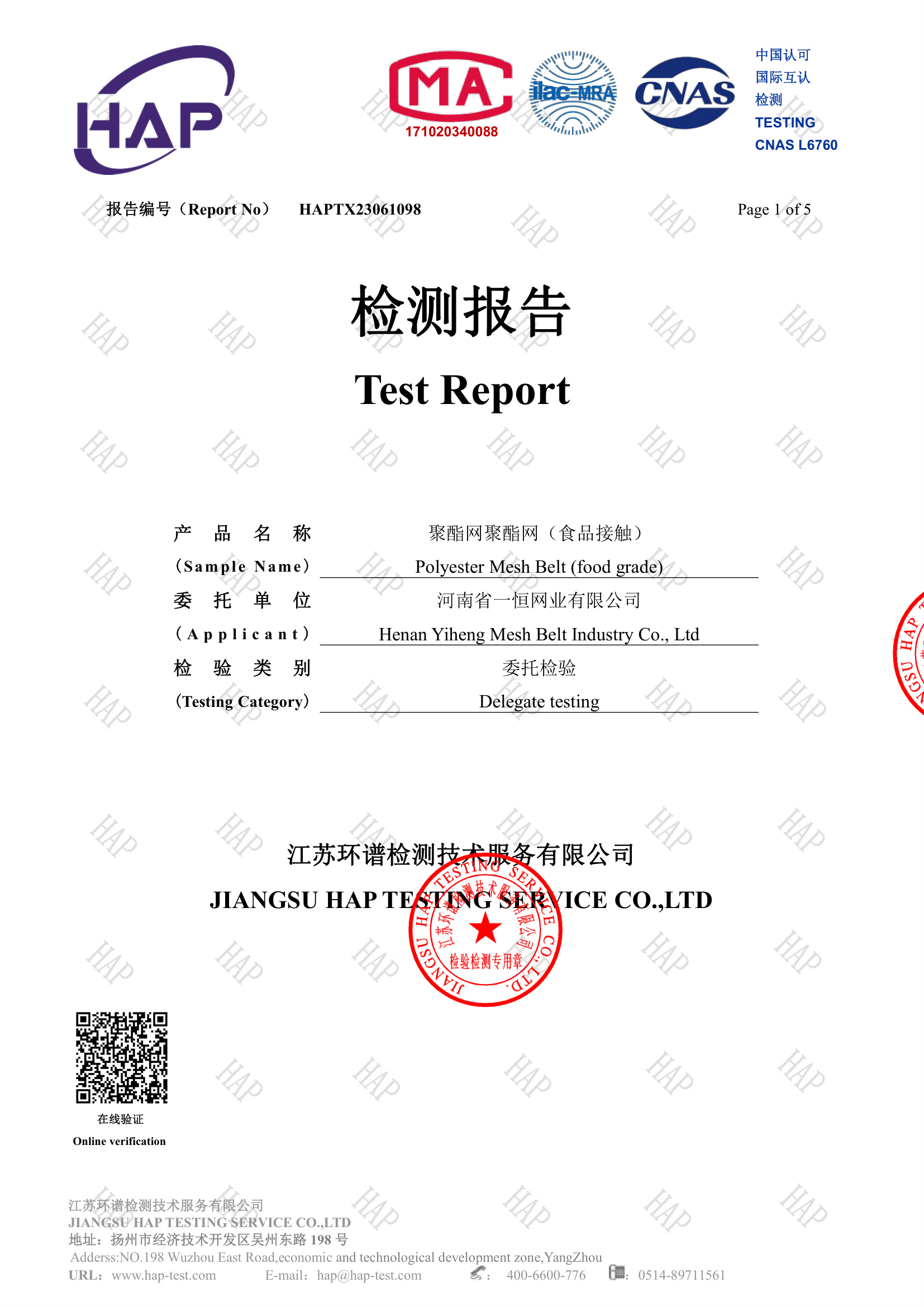
A Food Contact Certificate for a polyester mesh belt described as food grade, tested under GB 4806.7-2016, report number HAPTX23061098 issued on 2023-06-29 by Jiangsu HAP Testing Service Co., Ltd., tells a buyer something specific: a named material was tested against a named standard for a named use. A Germany Packaging Act (LUCID) registration, number DE2857625357145 issued on 2025-02-24, tells a buyer something entirely different: that packaging obligations for the German market are registered. Both documents are useful, and they are not interchangeable. The second says nothing about belt performance, and a buyer who treats it as a product certification has verified the wrong thing.
7. Use third-party inspection as a purchasing condition
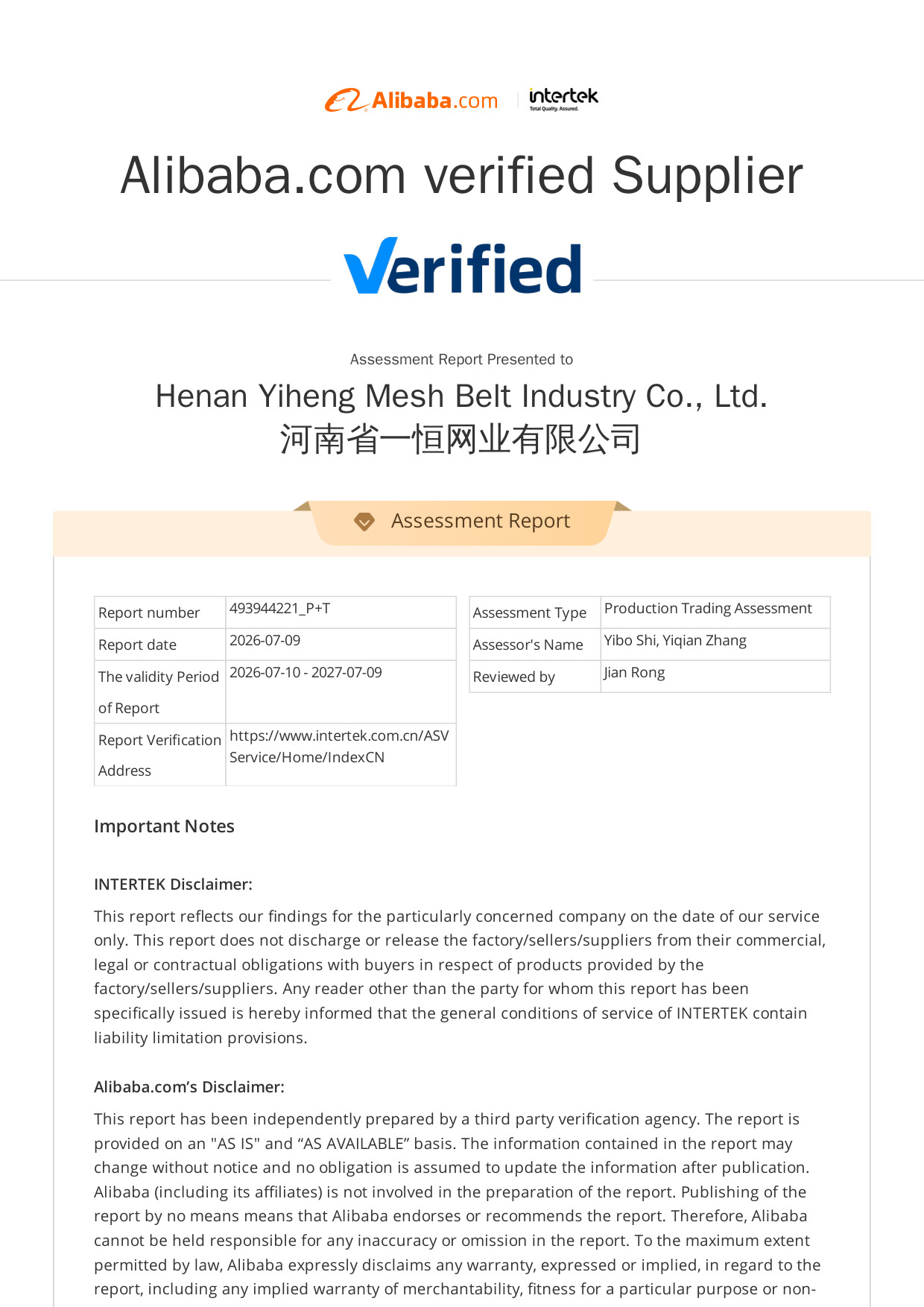
Yiheng's quality control includes 100% pre-shipment inspection, and on-site third-party inspection by BV or SGS is available. An Alibaba.com Verified Supplier Assessment Report, certificate 493944221_P+T, was issued by INTERTEK on 2026-07-09 and is valid to 2027-07-09, covering fabrics, dryer fabrics, polyester filter belt, non-woven mesh belt and UV belts.
There is an important distinction here. An assessment report verifies a supplier's declared capability and scope at a point in time. A pre-shipment inspection verifies the specific shipment against an agreed specification. Both are worth having, but only the second one applies to the rolls on the pallet. Buyers commissioning third-party inspection should define the checkpoints themselves: dimensions against tolerance, weight per square metre, joint type and seam appearance, edge finishing, and a permeability check on a retained sample.
Part 4 - Verify by sample, trial and continuity terms
8. Use the sampling window deliberately
A minimum order quantity of 2 square metres makes early qualification affordable rather than risky. Custom prototype sampling is available in as little as 3 days, and free sample testing plus remote technical support is offered. A 2 square metre sample is enough to check dimensions, weight, permeability against the stated reference condition, joint construction and edge treatment, and to run a short installation trial. What the sample does not do is establish production economics. Sample pricing and volume pricing are separate negotiations, and a buyer who treats the MOQ as a commercial term rather than a qualification tool will draw the wrong conclusion.
9. Run the belt on the line before committing to volume
Trial documentation should record run-in time, tracking corrections, edge condition, seam integrity and any measurable change in belt length. Field results show why this step is worth the effort. At a municipal wastewater treatment plant in Malaysia, 12 filter press belts installed for sludge dewatering produced an 8% reduction in cake moisture and 40% lower maintenance costs over six months, with no major failures. At a dehydrated vegetable and seafood processor in Switzerland, 8 drying and conveying lines recorded a 20% increase in productivity and a 35% reduction in maintenance costs over two years, with zero food safety incidents. Neither result could have been predicted from a data sheet alone.
10. Freeze the specification before scaling
Published lead time for this category is 15 to 30 days. Before scaling from trial to repeat volume, buyers should confirm in writing what a repeat order includes: the same grade, the same weave, the same joint, the same edge treatment and the same tolerances. Technical support arrangements, including remote technical support and installation guidance, should also be written into the commercial terms rather than assumed, particularly for a first installation on a new line.
How to read the technical numbers on a quotation
Loop distance is the single most useful figure when comparing spiral mesh belts for dewatering. Larger loop distances and thicker constructions generally correspond to higher open area and different drainage behaviour; published examples in this category range from a 5.20 mm loop distance with 1.90 mm thickness, through 6.50 mm at 2.32 mm, up to a 7.00 mm dryer loop distance at 2.95 mm. None of these values is inherently better. The correct loop distance depends on the solids being dewatered, the cake release behaviour and the tension the press applies.
Break strength is a function of ring wire and filler configuration, not of the belt width sold. A construction rated at 2300 N/cm with 0.90 x 5 mm fillers and one rated at 2000 N/cm with 0.68 x 4 mm fillers are different products intended for different loads. Buyers comparing quotations should compare like constructions rather than headline prices.
Weave pattern carries process meaning. A herringbone or diagonal structure on a filter press belt exists to promote drainage rather than to decorate the surface. A 2-shed plain weave on a dryer or forming belt is chosen for dimensional stability and consistent aperture. When a supplier cannot explain why a specific weave was recommended for your application, the specification has not really been engineered.
What field deployments show about verification
| Application | Market | Scale and duration | Reported outcome | What it tells the buyer |
|---|---|---|---|---|
| Fruit and vegetable drying conveying | Switzerland | 8 drying and conveying lines, 2 years | 20% higher productivity, 35% lower maintenance cost, zero food safety incidents | Food-grade documentation and cleanability should be verified before installation, not after |
| Coastal enclosure farming | Norway | 12 farming cages, 3 years | 15% higher survival rate, 40% lower maintenance cost, zero net failure | UV and biofouling behaviour drives lifetime cost more than purchase price |
| Municipal sludge dewatering | Malaysia | 12 belt filter presses, 6 months | 8% lower cake moisture, 40% lower maintenance cost, no major failures | Open area and anti-clogging behaviour are measurable outcomes, not marketing terms |
| Rubber curing and sheet cooling | Malaysia | 8 curing and cooling lines, 2 years | 15% higher productivity, 30% lower maintenance cost, zero major failures | Heat resistance and release behaviour interact with tension settings on the line |
| Vinyl and banner UV printing | Austria | 8 EFI large-format UV printers, 3 years | 20% higher productivity, 30% less scrap, zero major failures | Surface cleanliness and tracking stability reduce scrap, not only downtime |
| Premium facial and kitchen towel forming | Germany | 8 production lines, 1 year | 25% energy saved, 35% lower maintenance cost, zero major failures | Uniform formation depends on permeability consistency across the full belt width |
Where open-mesh polyester belts are not the answer
An honest sourcing guide has to say where the product category stops, and buyers should be suspicious of a supplier that never does.
- Standards boundaries. ISO 14890 governs rubber- or plastics-covered conveyor belts with textile carcasses. Open-mesh polyester belts are not covered conveyor belts, so ISO 14890 should not be presented as the governing standard for them without qualification. A supplier who cites it as a general certification for a mesh belt is describing a different product category. For open-mesh belts, the workable substitute is a specification-based acceptance protocol covering dimensions, weight, permeability, break strength, joint and edge, plus material compliance documents where food contact applies.
- Material limits. Polyester has service limits under sustained heat and hydrolysis. Anti-hydrolysis grades extend life in difficult environments, but they do not remove the constraint. Where temperature or chemistry exceeds what polyester monofilament tolerates, a different material is the correct answer.
- Low MOQ is not low production cost. A 2 square metre minimum is a qualification instrument. It reduces the cost of being wrong early; it does not imply that volume pricing will follow the same curve.
- Inspection verifies conformance, not lifetime. A third-party inspection confirms that a shipment matches an agreed specification at a point in time. It cannot predict how the belt will behave after months on your equipment. Only the line trial does that.
- Documentation has scope. A packaging registration, a supplier assessment report and a food-contact test report each answer a different question. Presenting one as evidence of another is a documentation failure, not a compliance failure, and it is worth catching during evaluation rather than after delivery.
What to expect through 2027
Polyester's position as the largest material segment in conveyor belting, at 28.4% of 2025 revenue according to Straits Research, is unlikely to be displaced quickly, because the material balances cost, strength and cleanability in filtration and drying applications. Growth in belt filter press technology, projected at a CAGR of 8.8% from 2025 to 2033 by Grand View Research, points to continued replacement demand in municipal and industrial dewatering.
What is likely to change is the basis of competition. As the supplier pool widens, differentiation shifts from price toward documentation quality and process control: published tolerances, declared equipment, scoped certificates and willingness to accept third-party inspection. For procurement teams in food, pharmaceutical and municipal applications, the practical consequence is that specifications and acceptance protocols will do more to protect the operation than any single negotiation on unit price.
The buyer who wins in this environment is not the one who finds the cheapest roll, but the one who can state, before the order is placed, exactly what will be measured, by whom, and against which tolerance.
FAQ
How can a buyer verify a polyester mesh belt supplier without visiting the factory?
Verification can be assembled from documents: legal entity and registration details, published equipment lists, product test reports, and independent assessment or inspection reports. Henan Yiheng Mesh Belt Industry Co., Ltd., for example, is covered by an Alibaba.com Verified Supplier Assessment Report issued by INTERTEK on 2026-07-09 and valid to 2027-07-09, covering fabrics, dryer fabrics, polyester filter belt, non-woven mesh belt and UV belts. On-site third-party inspection by BV or SGS is also available at the production stage. Document verification confirms identity, scope and stated capability; it does not confirm performance on your own line, which still requires a trial.
What should a polyester mesh belt purchase specification include?
A workable specification names the material grade, weave type, warp and weft or ring wire diameters, mesh count or loop distance, thickness, weight per square metre, air permeability with its reference pressure and area, break strength, joint type, edge treatment and dimensional tolerance. Published reference values in this category include a large loop construction at 0.90 mm ring wire with at least 2300 N/cm break strength, a 41-mesh plain weave at 550 g/m2 with 6,900 m3/m2/h air permeability, and dimensional tolerances of plus or minus 5 cm in length below 50 m and plus or minus 1 cm in width below 5 m.
Does a low minimum order quantity matter for production-scale orders?
A minimum order quantity of 2 square metres is not a production-scale commercial term. Its value is that it lowers the cost of early qualification, allowing dimensional, weight and permeability checks plus a short installation trial before a volume commitment. At production volume, unit price, scheduling and lead time are negotiated separately; published lead time for this category is 15 to 30 days. The MOQ should be treated as a risk-reduction instrument rather than as an indicator of production pricing.
Which compliance documents are relevant for food-contact polyester mesh belts?
Relevance depends on the market and the application. For food-contact use, a test report tied to a named standard and a named laboratory is the meaningful document; one example is a Food Contact Certificate for a polyester mesh belt tested under GB 4806.7-2016, report HAPTX23061098 issued on 2023-06-29 by Jiangsu HAP Testing Service Co., Ltd. A Germany Packaging Act (LUCID) registration such as DE2857625357145, issued on 2025-02-24, concerns packaging placed on the German market and does not address belt performance. Buyers should also note that ISO 14890 applies to rubber- or plastics-covered conveyor belts with textile carcasses, not to open-mesh polyester belts.
What should be checked when the belts arrive?
Incoming checks should mirror the specification. At minimum these cover dimensions against tolerance, joint type and seam condition, edge treatment such as 2 cm glue brushing on welded edges or melt glue and AB glue finishes, weight per square metre, and consistency of colour and grade against the retained sample. Suppliers in this category commonly apply 100% pre-shipment inspection, and an independent inspection report can be commissioned before shipment so that discrepancies are identified before the goods leave, rather than after arrival.
A current product brochure with model tables and specification details is available for download: Polyester mesh belt product brochure (PDF).
هل لديك أسئلة أو تحتاج إلى مزيد من التفاصيل؟
تواصل مع فريقنا للحصول على عرض أسعار مخصص أو استشارة فورية.
طلب عرض أسعار
املأ النموذج أدناه وسيتواصل معك فريقنا بعرض مقترح مخصص.
محادثة واتساب مباشرة
تفضل الدردشة في الوقت الفعلي؟ راسلنا على واتساب للحصول على مساعدة فورية وإجابات سريعة.
- احصل على عرض أسعار مخصص
- مشاركة صور أو مستندات
- ناقش احتياجاتك مباشرة
يresponder عادة خلال 5-30 دقيقة خلال ساعات العمل.