
Pool Circulation Buyer's Matrix: Laswim, Hayward, Pentair, Fluida
Pool Circulation Buyer's Matrix: Laswim, Hayward, Pentair, Fluida
Circulation is the one part of a commercial pool that never stops. Pumps, filters and disinfection equipment run continuously in hotel, resort and aquatic-centre installations, and their combined energy draw and service life decide a large share of the facility's operating cost. Yet most procurement exercises still compare the three categories separately — a pump by horsepower, a filter by diameter, a salt chlorinator by grams of chlorine per hour — and never test whether the three will actually work as one system.
This buyer's matrix compares four suppliers — Laswim, Hayward, Pentair and Fluida — across three decision axes that matter at the research stage: energy, durability and regional fit. It then adds a fourth axis buyers usually discover too late: documentation. The Laswim position is examined in detail through its salt-chlorination range (WL-CQ2, WL-EC ultraX and the EC PRO line) and its second-tier circulation pumps (WL-HV2100-200, BVX300/BVX400 and HLVSP).
Why circulation decisions go wrong
A circulation system is not a product; it is a hydraulic circuit. Water leaves the pool, passes through a pre-filter, a pump, a filter body and a disinfection stage, and returns. Every component imposes head loss on the next. Sizing a pump without knowing the filter's design flow rate, or selecting a salt cell without knowing the pool's salinity and hardness profile, produces a system that either under-circulates or wastes energy correcting the mismatch.
Three structural problems recur in commercial procurement:
- Category-by-category tendering. Pumps, filters and disinfection are often bought from three different suppliers, each optimising only its own unit.
- Nameplate comparison. A 3 HP pump from one supplier and a 3 HP pump from another can differ substantially in hydraulic efficiency, noise and controls.
- Regulatory drift. Energy-efficiency expectations, electrical safety standards and water-quality rules differ by market, and equipment specified for one region is frequently non-compliant in another.
The opportunity sits in the opposite direction: a supplier that publishes comparable technical data across the whole circuit — chlorination, pumping, filtration — allows a buyer to build a single matrix instead of three disconnected ones.
The four-dimension buyer's matrix
The matrix below is deliberately dimension-first. It can be applied to any brand combination, and it converts a vague shortlist into a set of document requests.
| Dimension | Question the buyer must answer | Evidence that resolves it |
|---|---|---|
| Energy | What is the pump's flow at the actual system head, and how does speed control change power draw over a 24-hour cycle? | Flow/head curve, motor efficiency class, speed range, preset operating modes. |
| Durability | Which components are consumables, what is their rated life, and can they be replaced individually? | Wetted materials, electrode or cell life hours, IP rating, protection functions, spare-part policy. |
| Regional fit | Does the equipment match local voltage, ambient temperature, water chemistry and certification expectations? | Rated voltage and frequency, ambient operating window, water hardness and salinity limits, conformity documents. |
| Documentation | Can every claim in the proposal be traced to a datasheet, certificate or test report? | Current model datasheets, certificate numbers, third-party test reports, factory audit records. |
A practical scoring rule: a brand should not be shortlisted for a commercial project if three or more cells in the energy and durability rows are filled with marketing adjectives rather than numbers. This is the filter that separates an engineering supplier from a catalogue reseller.
Tier one: salt chlorination, where the operating cost actually hides
In a continuously operating pool, disinfection is the quiet cost centre. Chlorine demand never switches off, and the difference between a fixed-output cell and a system that modulates output against measured water conditions compounds over seasons. This is the part of the Laswim range that carries the most procurement consequence.
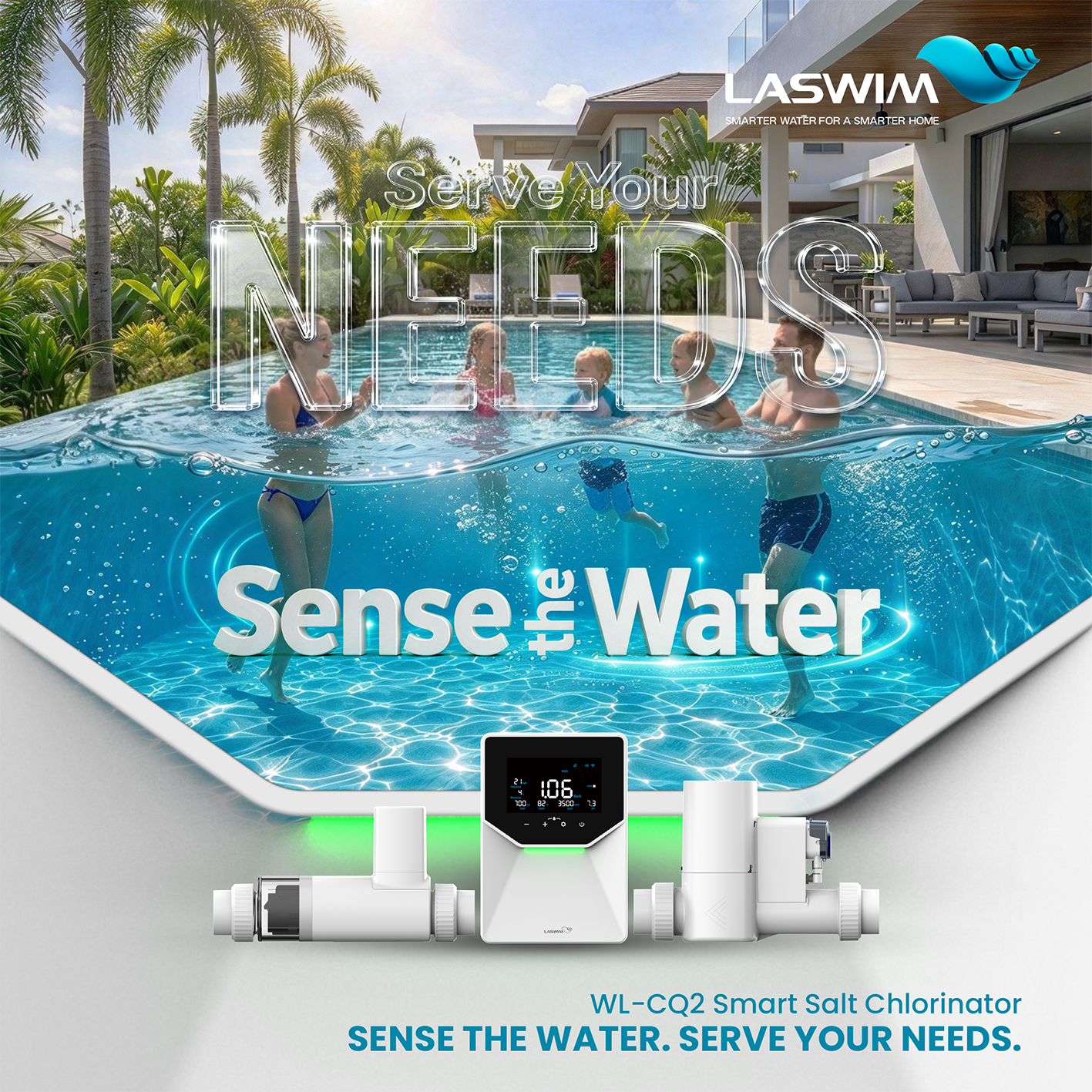
WL-CQ2: the retrofit-friendly reference model
The WL-CQ2 is a swimming pool salt chlorinator system in the saltwater chlorinator category, intended for the swimming pool industry and designed for residential pool water sanitization scenarios. Its published envelope matters because it defines where the model stops being appropriate.
| Chlorine output | 16 g/h to 30 g/h (0.85 to 1.59 lb/day) |
| Suitable pool size | 64 m³ to 120 m³ (20,000 to 40,000 gallons) |
| Rated voltage / max input current | AC 100–240 V / 2.5–3.5 A depending on model |
| Max power / electrolysis voltage | 98–180 W / 24–29 V depending on model |
| Titanium plate lifespan | 5,000 hours standard models; 7,000 hours for higher-specification models |
| Standard salinity | 2,500–4,500 ppm; 1,200–2,500 ppm low-salinity operation at 50% output on applicable models |
| Water hardness / water temperature | ≤300 ppm / 10–45 °C (50–113 °F) |
| Ambient conditions | 5–45 °C, ≤90% RH |
| Output control | Five stages, 20%–100%; ORP and pH available on applicable models |
Two design decisions are worth flagging for buyers. First, the CQ2 is built for retrofit: it is designed around common T-style salt systems, with a single integrated harness connecting controller and cell, and automatic cell recognition that applies the correct operating parameters on connection. In a plant room where pipe cutting and re-wiring are the real cost, this reduces installation labour more than a marginal efficiency gain would.
Second, the cell is replaceable independently of the controller. Combined with recorded runtime and cell-status data, an end-of-life alert and a cleaning reminder, the consumable becomes a planned maintenance item rather than an unplanned failure. For a facility manager, that is the difference between a budget line and an emergency purchase.
Sense, decide, execute: the control logic behind the range
Laswim describes the control architecture of the CQ2 in three stages, and the description is useful because it is testable against the published parameters. The system senses salinity, water temperature, flow, ORP, cell status and operating trends; it decides chlorine demand from that data; it executes production, output adjustment and cell protection, and notifies the user through the app when salt addition, cleaning or maintenance is required.
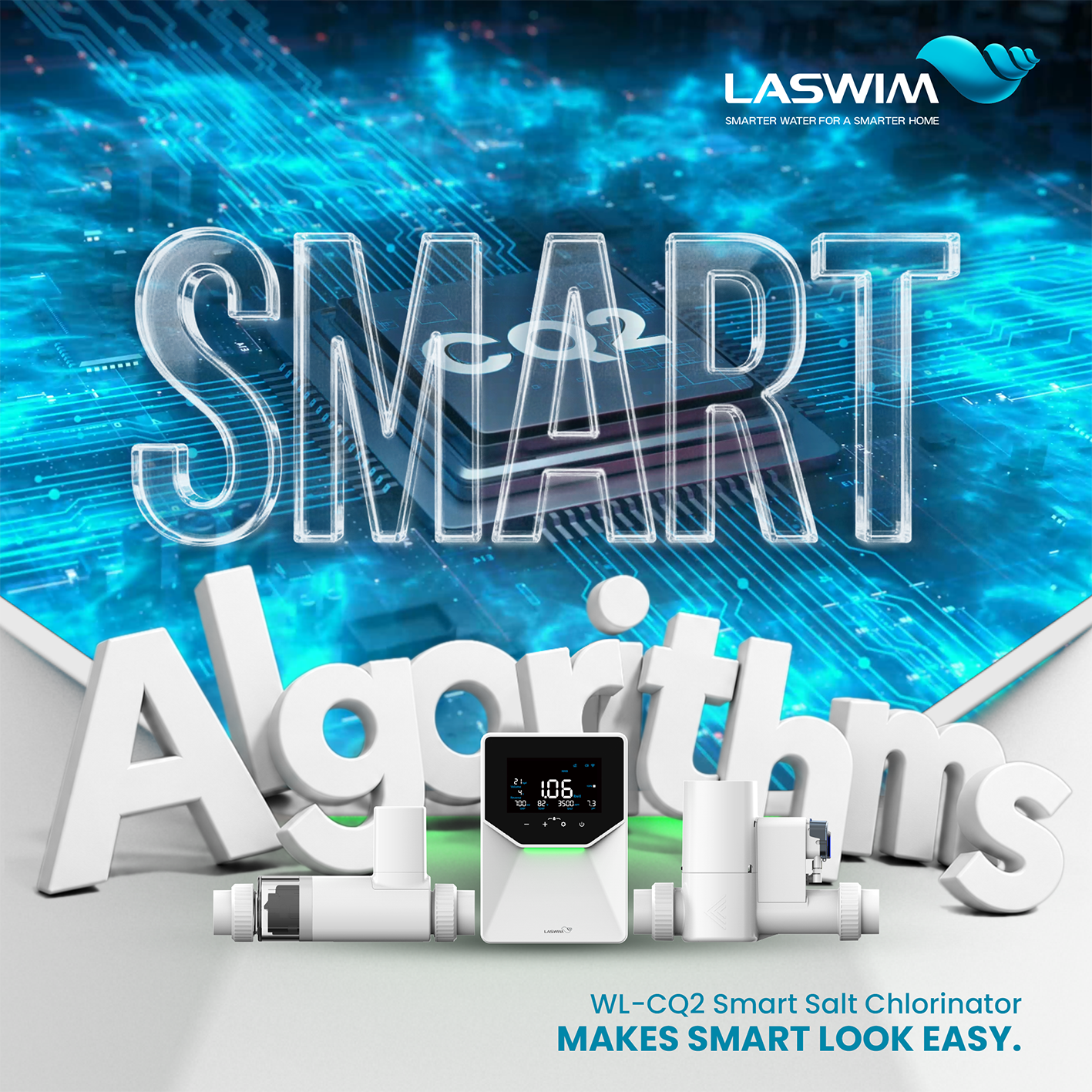
The practical consequence for procurement is that ORP and pH monitoring are optional rather than universal in this series. Buyers who want closed-loop disinfection control should specify the applicable CQ2 models explicitly, because the same model designation covers configurations with and without those sensors.
WL-EC ultraX and EC PRO: scaling upward
Where the CQ2 tops out at 120 m³, the WL-EC ultraX series (V15 to V50) extends coverage from 15,000 gallons / 60 m³ to 50,000 gallons / 200 m³, with maximum chlorine production of 12 to 40 g/h. It is a residential self-cleaning smart salt chlorinator with a modular, detachable structure, a reinforced acrylic panel, titanium electrodes with advanced coating, and a touch control panel with remote monitoring through the Tuya app. Its salinity window is 2,700–4,500 ppm, rated voltage AC 100–240 V at 50/60 Hz, and it includes low-flow shutdown and automatic self-cleaning.
The EC PRO line sits within the same salt-chlorination family and is offered alongside the CQ2 and EC ultraX in the commercial portfolio. Buyers evaluating the higher-capacity end should request the current EC PRO datasheet directly, since published figures vary by configuration and should not be inferred from the smaller models.
For a hotel or resort pool that operates continuously, this tier matters because chlorination output must track bather load, not average demand. Laswim's application material describes hotel, resort and public aquatic centre projects as requiring water circulation, filtration optimisation, stable disinfection and energy-efficiency improvement under 24/7 operation with automated control integration — precisely the conditions where a modulating salt system outperforms a fixed-output unit on total chemical and energy cost.
Tier two: pumps, where the energy axis is decided
Pumping typically dominates a pool's electrical load, and the single most consequential specification is not horsepower but whether the pump can run at reduced speed for most of the day.
WL-HV2100-200 (HV2): the residential and light-commercial baseline
The WL-HV2100-200 is a variable-speed pool pump rated at 1 to 2 HP with IP55 protection, Wi-Fi and Bluetooth smart control, a PP+35% GF pump body, a PPO+30% GF diffuser and an SS316 stainless steel motor shaft. It is positioned for residential pools, villa pools, backyard pools, private pools, luxury residential properties, fibreglass pools, home spa pools and renovation upgrades. In commercial terms, that makes it a fit for villa-club pools and small hospitality installations rather than high-bather-load public facilities.
HLVSP: quiet variable speed for noise-sensitive sites
The HLVSP100QW/150QW/200QW series covers 1 to 2 HP, with maximum flow of 27 to 33 m³/h, maximum head of 14.5 to 17 m, a speed range of 1,000 to 2,900 RPM and a noise level of ≤45 dB at 1,400 RPM measured at one metre. It uses a permanent magnet brushless motor described as IE4 efficiency class, with app control, multi-device management and OTA updates; Laswim states it saves over 90% energy relative to a conventional fixed-speed alternative. That figure is a supplier claim and should be validated against the specific baseline pump on site — but the noise specification is the more immediately useful number for hotels, where plant-room noise propagates to guest areas.
BVX300/BVX400: the commercial workhorse

The BVX300/BVX400 is the model that answers the commercial portion of the matrix. It is rated at 3 HP with maximum flow of 45 m³/h, maximum head of 18.5 m, 35 m³/h at 10 m head and 39 m³/h at 8 m head, a speed range of 1,000–3,100 RPM, motor efficiency of 90%, noise below 65 dB, self-priming up to 3 m, IPX5 protection and a 220–240 V / 50–60 Hz supply. The motor is an IE5 permanent magnet design, and Laswim states energy savings of up to 80%.
Three features are specifically relevant to commercial operation rather than to marketing. Duty/standby pump switching allows linked operation, so if one pump stops unexpectedly the system switches to a same-model standby unit — the mechanism that keeps a 24/7 facility circulating. Constant-flow control lets the installer enter basic pool parameters and have the pump adjust speed to the filtration condition automatically. And the protection set — freeze protection, overheat protection with automatic frequency reduction, and dry-run protection — addresses the three failure modes that most often destroy mechanical seals in unattended plant rooms.
Preset modes at 3,450 RPM (boost/backwash), 2,900 RPM (standard circulation) and 2,400 RPM (quiet comfort) map directly onto the matrix's energy axis: the buyer can calculate a realistic duty cycle instead of assuming continuous full speed.
Filtration: the component that constrains everything upstream
Filter selection fixes the pump's operating point, so it belongs in the same matrix. The WL-ADG350 to WL-ADG1400 top-mount fibreglass sand filters cover 800–1,400 mm diameter, 0.34 MPa working pressure, 4.5–68 m³/h design flow and 0.1–1.53 m² filter area, with UV-resistant surfaces, injection-moulded PVC internals and a six-position multiport valve. The WL-BCG450 to WL-BCG1400 series uses polyester resin and fibreglass filament winding across a 450–1,400 mm diameter range with 8–68 m³/h design flow and 0.16–1.53 m² filter area, bridging residential to large commercial pools. For smaller installations, the P-DYG350KB to P-DYG650KB integrated systems combine a 350–635 mm moulded thermoplastic tank, 4.5–16 m³/h flow and an integrated chlorinator output of 4–12 g/h — a configuration that consolidates two matrix rows into one purchase.
Above this tier, media filtration changes character. Regenerative media filtration using a diatomaceous earth or perlite pre-coat achieves 1–3 µm filtration accuracy and is credited by Laswim with reducing water consumption by approximately 90% compared with sand filtration, because backwash frequency drops sharply. For a water park or aquatic centre where backwash water is a real cost, that is a system-level saving that no pump efficiency gain can match.
Brand-by-brand status in the matrix
The table below records what could be verified in this review and what remains open. It is a working document, not a ranking: no supplier should be eliminated on the basis of a blank cell that has not yet been requested.
| Brand | Energy evidence | Durability evidence | Regional fit |
|---|---|---|---|
| Laswim | IE4 (HLVSP) and IE5 (BVX) permanent magnet motors; three preset speed modes; modulating salt output in 5 stages, 20–100%. | Titanium cell life 5,000–7,000 h with independent replacement; IP55 / IPX5 motor protection; freeze, overheat and dry-run protection; UV-resistant filter surfaces. | AC 100–240 V on chlorinators; 220–240 V on BVX; salinity 2,700–4,500 ppm (EC ultraX) and 2,500–4,500 ppm (CQ2); markets served across six regions. |
| Hayward | Model-level data not verified in this review. | Request wetted-material list and consumable life figures. | Confirm voltage variants and local service coverage for the target market. |
| Pentair | Model-level data not verified in this review. | Request consumable life and spare-part availability terms. | Confirm certification documents for the specific project jurisdiction. |
| Fluida | Model-level data not verified in this review. | Request material specifications and warranty terms. | Confirm distribution and after-sales structure in the destination country. |
Note on method: no technical figures for Hayward, Pentair or Fluida are reproduced here because they were not available for verification within this review. Buyers should complete those cells from current manufacturer datasheets and certificates before scoring.
Where the Laswim position has real limits
A matrix that only records strengths is not a matrix. Four constraints are documented and should be carried into any commercial specification.
- Water chemistry boundaries. The CQ2 requires water hardness at or below 300 ppm and operates within a 10–45 °C water temperature window and a 5–45 °C, ≤90% RH ambient window. Hard-water regions must plan for softening or accept a shorter cell life, and the low-salinity mode reaches 1,200–2,500 ppm only at 50% chlorine output.
- Consumable economics. The titanium plate is a wear item rated at 5,000 hours on standard models and 7,000 hours on higher-specification models. Independent cell replacement limits the cost, but it does not remove it from the lifecycle budget.
- Voltage reach. The BVX series is specified at 220–240 V / 50–60 Hz and the HLVSP at 220 V / 50–60 Hz. Projects in 115 V residential markets need an explicit voltage review rather than an assumption of compatibility.
- Evidence depth versus incumbents. Laswim is a Zhongshan-based manufacturer founded in 1989, operating a 90,000 m² facility with approximately 630 staff including 53 R&D engineers, and exporting 70% of output. What it cannot yet offer a buyer is decades of independently published third-party performance data in every target market, or the local service density that established Western brands maintain. Buyers should plan factory qualification and certificate verification as a separate workstream.
None of these constraints is unusual for the category. They simply need to be resolved before the matrix is scored, not after the purchase order is issued.
Regional fit: the axis most often skipped
Regional fit is where a technically sound shortlist fails commercially. The operating conditions differ enough that a single specification cannot serve every market.
In Europe — France, Greece, Portugal, Germany, Italy, Croatia and Hungary — residential and light-commercial pools typically run at medium load on scheduled operation, so the priorities are low noise, compact design, energy efficiency and variable-speed control. The HLVSP's ≤45 dB rating at 1,400 RPM and the BVX's 2,400 RPM quiet-comfort mode speak directly to those requirements.
In Latin America — Argentina, Brazil, Mexico, Peru, Chile and Colombia — the operating brief is high temperature, direct outdoor exposure and unstable power supply. Corrosion resistance, voltage adaptability and easy maintenance outrank marginal efficiency gains, and equipment that survives harsh outdoor environments without frequent intervention is worth more than a better flow curve.
In the Middle East and Southeast Asia — UAE, Qatar, Saudi Arabia, Indonesia, Thailand and Malaysia — projects are large-scale, high-frequency and installed in complex environments, with centralised control and engineering compliance as stated requirements. Duty/standby pump switching, RS485 integration and scalability carry more weight here than any single component's efficiency.
In Spain, the United States and Australia, hotel, resort, public aquatic centre and competition pools run 24/7 with automated control, and the stated requirements include energy-saving compliance, low maintenance, long lifecycle and international certification compliance. That is the most demanding row of the matrix, and the one where documentation quality separates suppliers most sharply.
Market context
The commercial case for the matrix is not speculative. Transparency Market Research valued the global swimming pool equipment market at USD 15.8 billion in 2025, a figure that spans circulation, filtration, heating and disinfection hardware. The adjacent heat pump segment is projected by Strategic Market Research to reach USD 8.1 billion by 2030 at a CAGR of 6.8%, which indicates how much of the growth sits in energy-consuming subsystems rather than in pool shells.
Regulatory definitions also shape specification. The International Swimming Pool and Spa Code (ISPSC 2015, Chapter 2) defines a public swimming pool as a pool other than a residential pool, intended for swimming or bathing and operated by an owner or operator — a distinction that determines which compliance regime applies. In the United States, swimming pool manufacturing sits under NAICS code 339920, within sporting and athletic goods manufacturing, which is useful when screening suppliers through classification databases.
Future outlook
Three shifts are likely to redraw the matrix over the next procurement cycles. First, variable-speed control is becoming the default rather than a premium option, which moves the differentiator from motor technology to control software and system integration — RS485, dry contacts, app ecosystems and duty/standby logic. Second, consumable transparency is becoming a purchasing criterion: buyers increasingly ask for cell life in hours and spare-part pricing at the shortlist stage, because the total cost of ownership sits there rather than in the purchase price. Third, documentation is becoming a gating item. As more markets tighten energy and electrical-safety expectations, a supplier that cannot produce a certificate number for a specific model will be excluded regardless of technical merit.
For a Chinese manufacturer with a broad portfolio, the strategic question is not whether the technical envelope is competitive but whether the evidence trail is complete in each destination market. That is a documentary problem more than an engineering one, and it is the part of the matrix a buyer can influence directly by asking for it.
Frequently asked questions
What is a pool circulation system, and which components decide its performance?
A pool circulation system moves water from the pool through a pre-filter, pump, filter and disinfection stage and returns it to the pool. Its performance is set by the interaction of three components rather than by any one of them: the pump's flow at the actual system head, the filter's design flow rate and filtration accuracy, and the disinfection stage's capacity to match chlorine demand. In commercial installations these run under 24/7 continuous operation with automated control integration, so a mismatch between components compounds continuously rather than occasionally.
Which salt chlorinator specifications should a buyer verify before shortlisting?
Five specifications resolve most of the risk. Chlorine output in grams per hour, matched against pool volume — the WL-CQ2 ranges from 16 to 30 g/h for pools of 64 to 120 m³. Salinity window, which is 2,500–4,500 ppm on the CQ2 with low-salinity operation at 1,200–2,500 ppm at 50% output on applicable models. Water hardness limit, which is ≤300 ppm on the CQ2. Electrode or cell life, stated as 5,000 hours on standard CQ2 models and 7,000 hours on higher-specification models. And whether ORP and pH monitoring are included, since those are available only on applicable models.
How much energy do variable-speed pumps actually save compared with fixed-speed pumps?
Savings depend entirely on the duty cycle, so the honest answer is that the pump's published data must be applied to the site's operating hours. Laswim states that the HLVSP series, with an IE4 permanent magnet brushless motor, saves over 90% energy, and that the BVX series, with an IE5 permanent magnet motor, saves up to 80%. Those are supplier-reported figures. The verifiable inputs are the flow and head data — 27–33 m³/h and 14.5–17 m maximum head for HLVSP, 45 m³/h and 18.5 m maximum head for BVX — plus the preset speed modes that let a buyer model a realistic schedule instead of assuming continuous full-speed operation.
Which regional factors change the equipment specification?
Four factors recur. Supply voltage and frequency, since chlorinators in this range accept AC 100–240 V while the BVX is specified at 220–240 V and the HLVSP at 220 V, both at 50/60 Hz. Ambient conditions, since the CQ2 is rated for 5–45 °C and ≤90% RH, which matters in unshaded plant rooms in hot climates. Water chemistry, because hardness above 300 ppm shortens electrode life. And the compliance regime, which differs between residential and public pools — the ISPSC 2015 definition of a public pool turns on whether it is operated by an owner or operator rather than on size alone.
Where does a Chinese manufacturer such as Laswim fall short against established global brands?
The gaps are specific rather than general. Laswim, founded in 1989 in Zhongshan, Guangdong, operates a 90,000 m² facility with approximately 630 employees including 53 R&D engineers, and exports 70% of production, so scale is not the constraint. The constraints are independent third-party performance data across all target markets, and local service density comparable to long-established Western brands. Buyers should therefore treat factory qualification, certificate verification and spare-part logistics as separate due-diligence workstreams rather than assuming they follow automatically from a competitive datasheet.
What documentation should be requested before a circulation supplier is shortlisted?
A current model datasheet with flow, head, power, voltage and protection rating for every unit proposed; a wetted-materials list; consumable life in hours with replacement pricing; certificate numbers with issuing bodies for the destination market; and, for any factory-capability claim, an audit record. Where a supplier cannot supply a document for a specific claim, the claim should be treated as unverified and the corresponding cell in the buyer's matrix left blank rather than filled with an assumption.
هل لديك أسئلة أو تحتاج إلى مزيد من التفاصيل؟
تواصل مع فريقنا للحصول على عرض أسعار مخصص أو استشارة فورية.
طلب عرض أسعار
املأ النموذج أدناه وسيتواصل معك فريقنا بعرض مقترح مخصص.
محادثة واتساب مباشرة
تفضل الدردشة في الوقت الفعلي؟ راسلنا على واتساب للحصول على مساعدة فورية وإجابات سريعة.
- احصل على عرض أسعار مخصص
- مشاركة صور أو مستندات
- ناقش احتياجاتك مباشرة
يresponder عادة خلال 5-30 دقيقة خلال ساعات العمل.