
Pool Circulation System Buyer's Matrix: Laswim, Hayward, Pentair, Fluida
Pool Circulation System Buyer's Matrix: Laswim, Hayward, Pentair, Fluida
A residential pool circulation system is not a single product. It is a loop made of at least four decision points: the pump that moves water, the filter that captures solids, the sanitizer that keeps the water safe, and the controls that decide how long each element runs. Buyers comparing Laswim, Hayward, Pentair and Fluida are therefore not comparing four catalogues of identical scope. They are comparing four different answers to the same three questions — how much energy the loop consumes at its real duty point, how many hours of service the consumable parts deliver before replacement, and whether the equipment's declared operating envelope matches the climate, the electrical supply and the maintenance culture of the installation.
This matrix is written for buyers at the awareness-to-research stage of a residential or light-commercial project. It does not rank the four suppliers by brand strength, and it does not publish competitor performance figures that cannot be traced to a source. Model-level specifications for Hayward, Pentair and Fluida were not independently verified for this article, so their columns are structured as an information request list rather than a scorecard. The Laswim column carries the documented figures, which is the only honest way to build a comparison that a procurement team can actually defend internally.

Why the Circulation Loop, Not the Catalogue, Is the Unit of Comparison
Most residential pool equipment is bought in bundles, and most bundle comparisons fail for the same reason: the pump is compared by horsepower, the chlorinator by a headline pool volume, and the filter by tank diameter. None of those three numbers describe how the loop performs together. A 3 HP pump at full speed on a short, wide pipe run behaves nothing like the same pump on a long, restrictive run. A salt chlorinator rated for a given volume at full output behaves nothing like the same unit running at 40% output in a hot climate with high bather load. The loop is the system, and the system is what the owner pays to run for the next decade.
The practical consequence for buyers is that a supplier's catalogue breadth matters less than the completeness of its documented envelope. A supplier that publishes flow at stated head, input power at stated speed, salinity range, water temperature range and consumable life gives a procurement team something to calculate with. A supplier that publishes only a headline duty gives a procurement team a marketing claim. The matrix below is built on that distinction, not on brand reputation.
The Three Axes: Energy, Durability and Regional Fit
Energy is measured at the duty point, not at maximum output
A residential pump rarely runs at its nameplate maximum. It runs at whatever speed satisfies the filtration turnover the pool needs, and that speed is set by the resistance of the loop. This is why variable-speed control has become the default question in residential specification: the energy question is not "how many watts does the motor draw" but "how many watts does it draw at the flow the pool actually requires". Any comparison that omits the duty point is a comparison of peak figures, which almost never describes real operating cost.
Durability is measured in consumable hours, not tank thickness
In a salt-chlorinated residential loop, the component with the most predictable wear is the electrolytic cell, not the pump housing. A buyer who asks only about material thickness is asking the wrong durability question. The relevant questions are the rated life of the titanium plate, whether the cell can be replaced independently of the controller, and whether the system reports remaining cell life so that replacement can be planned rather than discovered. For the pump, the comparable questions are shaft material, seal protection under dry-run conditions, and whether the controller protects the motor from overheat and freeze events.
Regional fit is a declared operating envelope
A chlorinator that is correct for a shaded villa pool in northern Europe can be wrong for a sun-exposed pool in a market with unstable supply voltage. Regional fit is not a marketing segment; it is the intersection of water temperature range, ambient temperature range, humidity tolerance, salinity range, water hardness limit and input voltage range. Buyers who evaluate regional fit as a set of published limits rather than as a sales territory make fewer specification errors.
Where Laswim Sits in the Matrix
LASWIM Water Environment Equipment Co., Ltd. is a Chinese pool and spa equipment manufacturer founded in 1989 and based in Zhongshan, Guangdong. The company reports a 90,000 m² manufacturing facility, approximately 630 staff including 53 engineers in its R&D team, export business representing 70% of total sales, and sales coverage across North America, South America, Europe, Southeast Asia, the Middle East, Africa, East Asia and Australia. Its stated product categories include pumps, filters, lighting, disinfection equipment, heat pumps and life-support systems, and it states ISO 9001 certification for quality management.
For this matrix, the relevant point is not scale. It is that the residential loop is covered by one supplier: a salt chlorinator series, a filtration series with documented flow and pressure ratings, and a pump range that includes both residential variable-speed units and higher-head commercial units. That coverage matters when a buyer wants a single point of technical accountability for a loop, and it matters less when a buyer has already standardized on another brand's automation platform.
The Salt Chlorinator Layer: WL-CQ2 as the Reference Point
The WL-CQ2 is a residential salt chlorinator system in the saltwater chlorinator category, designed for residential pool water sanitization. Its documented chlorine output range is 16 g/h to 30 g/h (0.85 lb/day to 1.59 lb/day), covering pools from 64 m³ to 120 m³ (20,000 to 40,000 gallons). Rated voltage is AC 100–240 V, maximum input current is 2.5–3.5 A depending on model, electrolysis voltage is 24–29 V, and maximum power is 98–180 W depending on model. Those four figures together are what make the unit comparable: output, volume, input range and power draw are all stated, so a buyer can calculate chlorine production per watt rather than accept a claim.
Sense, Decide, Execute
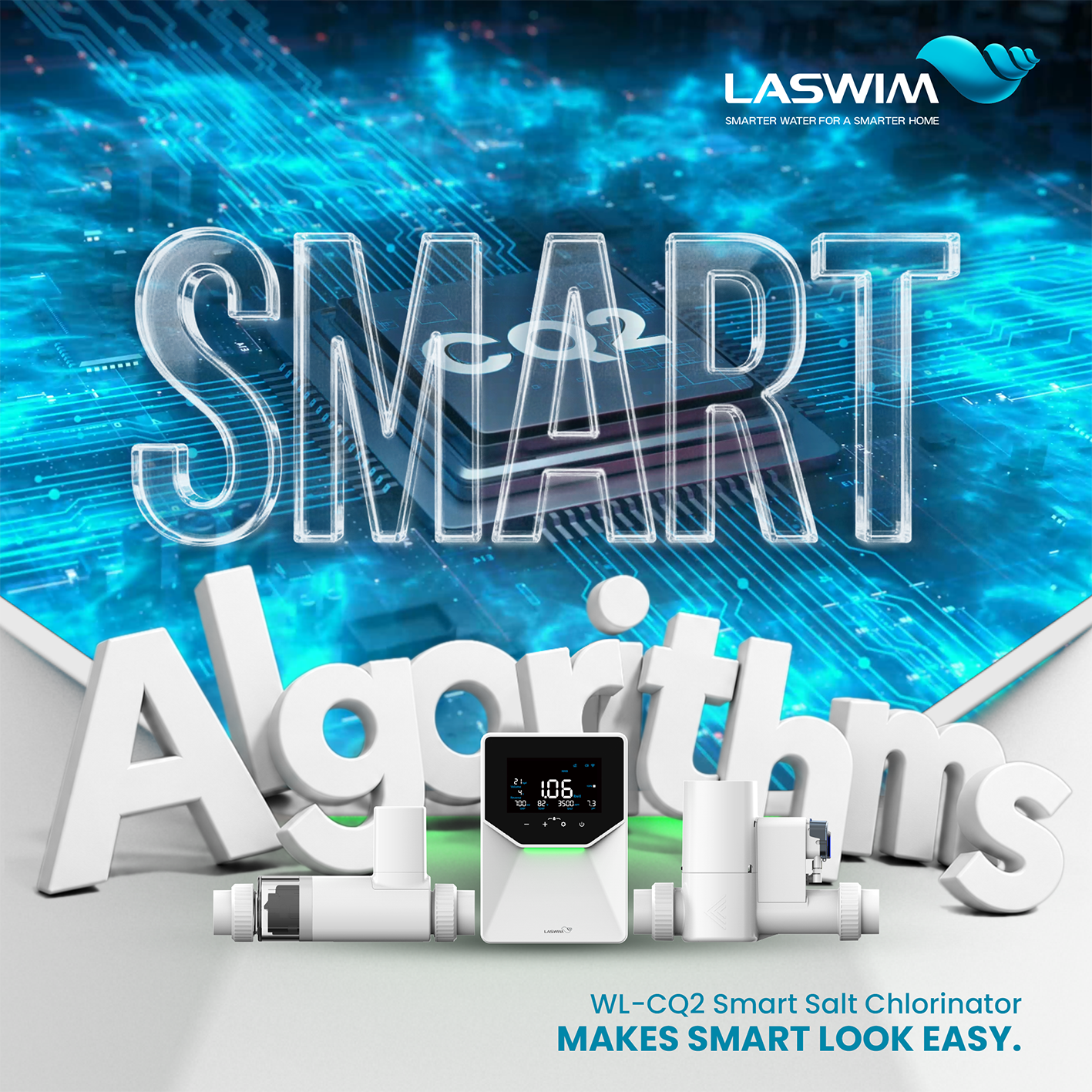
The CQ2 control logic is described as a three-stage loop. It senses salinity, water temperature, flow, ORP and cell status; it decides chlorine demand and flags conditions that require attention; and it executes chlorine production, output adjustment, cell protection and user notification through the app. In specification terms, this is the difference between a chlorinator that produces chlorine on a timer and one that responds to measured water condition. ORP and pH monitoring are available on applicable models, which is an important qualifier: buyers should confirm which functions are enabled on the exact model being quoted rather than assume the top-of-range feature set.
What the CQ2 numbers mean for a specification
Three documented details do more work than the headline output figure. First, the standard salinity range is 2,500–4,500 ppm, and applicable models support 1,200–2,500 ppm low-salinity operation at 50% chlorine output — a meaningful distinction for owners who prefer a lower salt taste or who are topping up an existing low-salinity pool. Second, the titanium plate life is rated at 5,000 hours for standard models and 7,000 hours for the higher-specification models, and the cell is replaceable independently of the controller, which converts a future whole-unit replacement into a consumable line item. Third, chlorine output is adjustable across five stages from 20% to 100%, so the unit can be sized for peak season and then operated below maximum for the rest of the year.
The declared envelope around those figures is equally part of the specification: water hardness ≤300 ppm, water temperature 10–45°C (50–113°F), ambient temperature 5–45°C (41–131°F), and ambient humidity ≤90% RH. Installation features include a single integrated main harness connecting controller and cell, automatic cell recognition that applies the correct operating parameters when a cell is connected, and a design intended to retrofit common T-style salt systems with reduced pipe cutting and re-wiring. The system also supports over-the-air firmware updates and records runtime and cell-status data for maintenance planning.
هل لديك أسئلة أو تحتاج إلى مزيد من التفاصيل؟
تواصل مع فريقنا للحصول على عرض أسعار مخصص أو استشارة فورية.
طلب عرض أسعار
املأ النموذج أدناه وسيتواصل معك فريقنا بعرض مقترح مخصص.
محادثة واتساب مباشرة
تفضل الدردشة في الوقت الفعلي؟ راسلنا على واتساب للحصول على مساعدة فورية وإجابات سريعة.
- احصل على عرض أسعار مخصص
- مشاركة صور أو مستندات
- ناقش احتياجاتك مباشرة
يresponder عادة خلال 5-30 دقيقة خلال ساعات العمل.