
Porcelain Insulator Factory Audit: 8 Checks at a 120-Mu Plant
Porcelain Insulator Factory Audit: 8 Checks at a 120-Mu Plant
A porcelain insulator factory audit exists to answer a question a quotation cannot: whether the supplier can physically make, test and ship the order you are about to release. Four conditions carry most of the weight — a plant large enough to separate forming, firing, assembly and testing; engineering depth that sits beyond the sales office; capacity sized to real project demand; and management systems that are certified and currently valid. Jiangxi QOCI Electric Co., Ltd. — a porcelain and glass insulator manufacturer established in December 2002 in Luxi Industrial Park, Pingxiang City, Jiangxi Province — publishes a set of plant figures that can be tested against those four conditions. The eight evidence points below show how a grid buyer should read each one, what it actually verifies, and where plant scale stops being proof of product quality.
Why physical evidence outranks a capability brochure
Procurement teams evaluating a porcelain insulator supplier normally receive the same package: a company profile, a certificate bundle, a product list and a price. All of it is portable. An intermediary can forward the identical documents, and a manufacturer can present a plant whose layout has since changed. The evidence that resists that substitution is physical and locational: land, buildings, production floor, headcount and installed capacity, each attached to a specific site that can be visited or checked through third-party inspection.
This is the practical reason to audit from site figures rather than from adjectives. A buyer at the evaluation-to-execution stage is not selecting a catalogue page; the buyer is committing an outage schedule, a delivery date and a warranty exposure to a single facility. Documented plant facts narrow a shortlist before the first sample is approved, and they give the inspection agency something concrete to photograph.
They do not, by themselves, prove dielectric performance. Land area says nothing about kiln temperature uniformity, glaze formulation or cement-joint sealing. Those are established by type-test reports, routine test records and sample inspection. The correct reading is sequential: physical scale sets capability headroom and process separation; test evidence establishes conformity; the purchase order then fixes acceptance criteria. Skipping either half produces an audit file that looks complete and answers nothing.
The eight evidence points, in audit order
The sequence follows the way a buyer would normally walk a site: land first, then buildings, then the manufacturing floor, then people, then capacity, then the management systems that govern them, and finally the external technical standing that indicates whether the plant participates in its own industry's standards work.
1. Site area above 120 mu — about 8 hectares
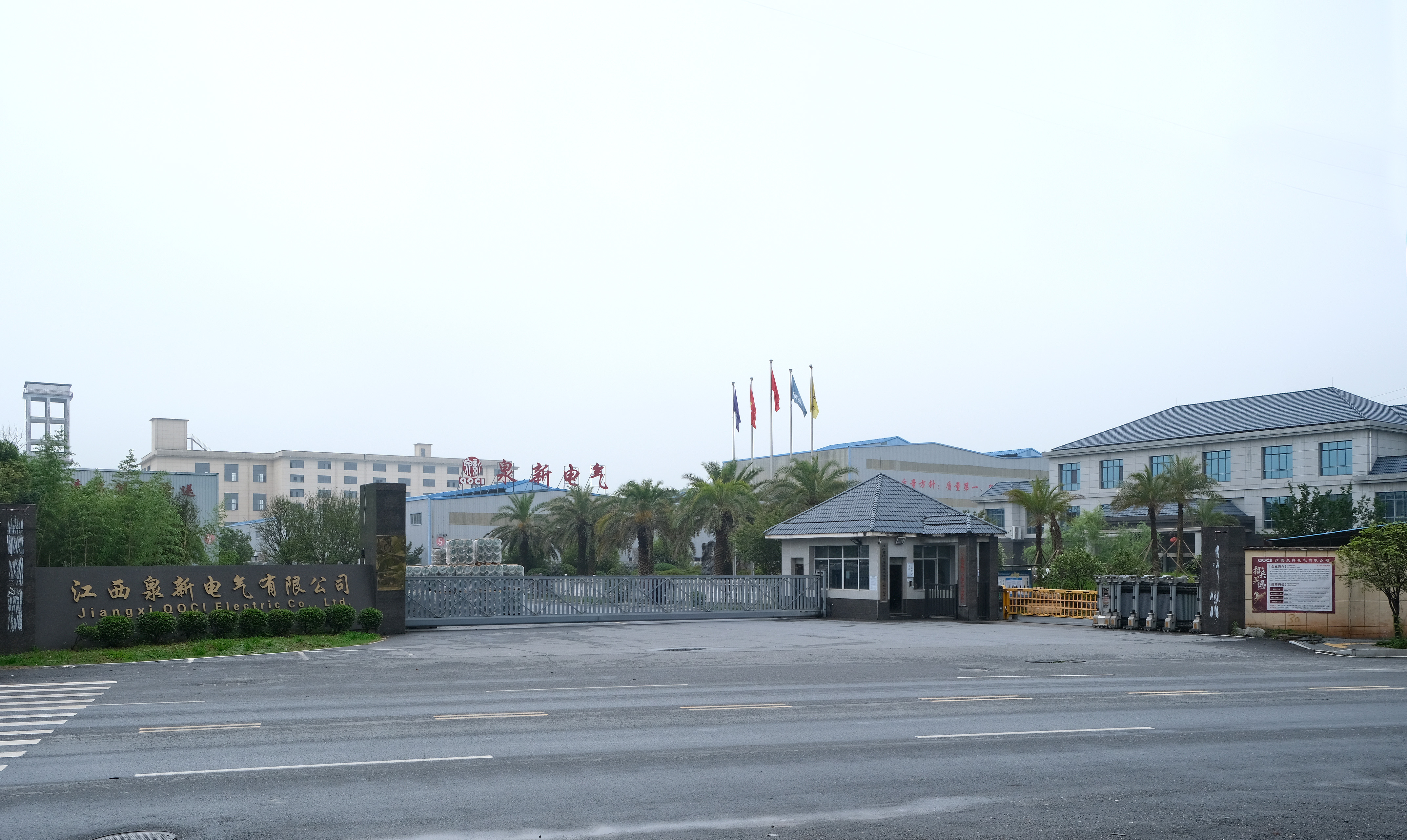
Jiangxi QOCI Electric operates on a site covering more than 120 mu, approximately 8 hectares. For an insulator plant, site area matters less as prestige and more as a layout constraint. Porcelain production requires separated zones for raw material storage and batching, forming, drying, glazing, firing, assembly and finished-goods holding, plus yard space for goods that cannot be stacked arbitrarily. Land also sets the ceiling for adding a kiln or a line without relocating the whole operation.
In an audit, a site of this size is a prompt for the follow-up question rather than a conclusion: how is the 8 hectares divided, is any part leased or shared, and how much is undeveloped reserve? The figure is a boundary condition for capacity planning, not a quality grade.
2. Construction area exceeding 70,000 m²
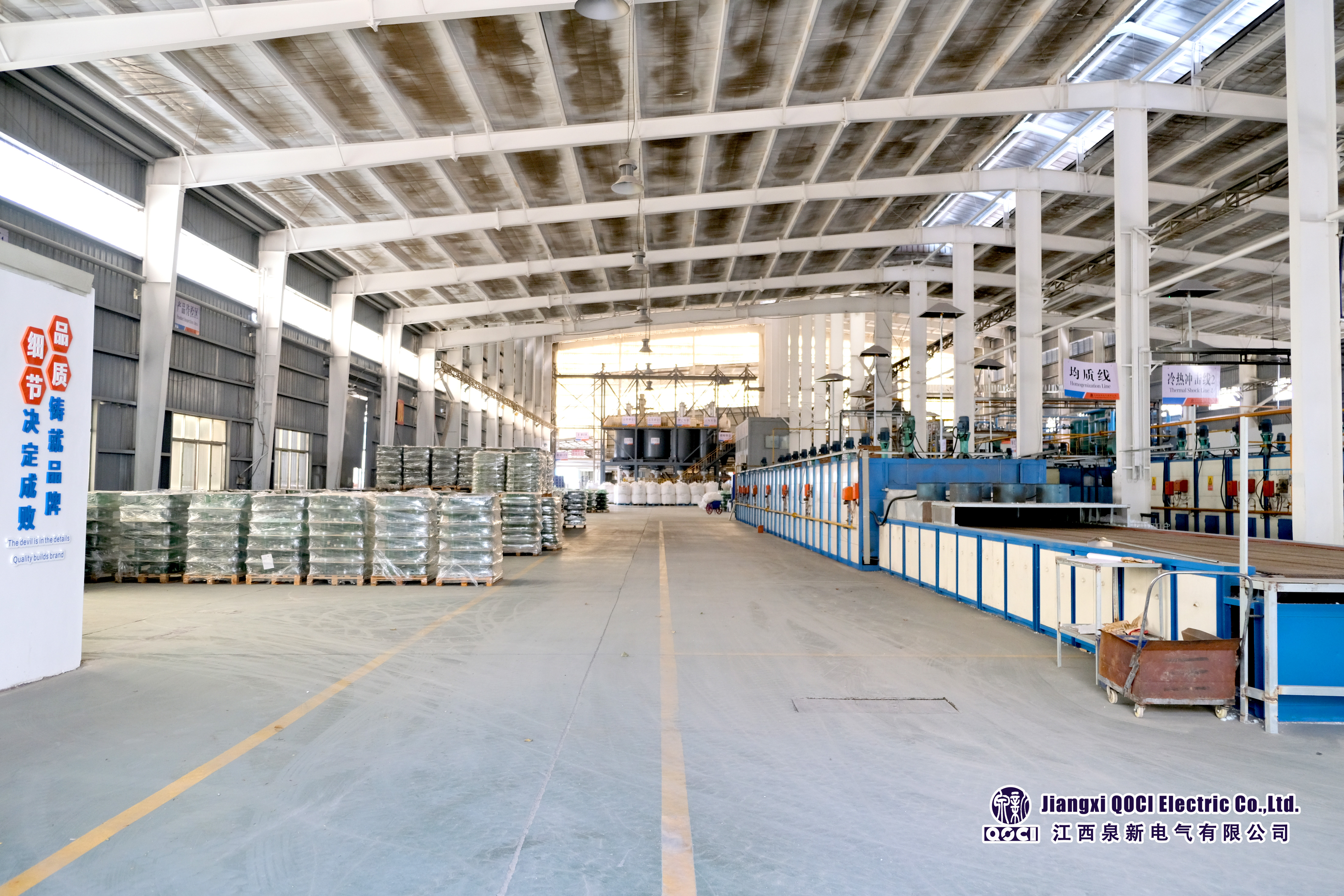
Built area is the more informative number, because it shows how much of the operation sits under roof. A construction area above 70,000 m² on a site of roughly 8 hectares indicates a predominantly enclosed production environment rather than open-yard working — relevant to glaze and body moisture control, and to how much material can be staged between process steps.
The audit question to attach here is composition. A high total dominated by warehouses indicates storage depth; a high total dominated by production buildings indicates manufacturing depth. Buyers should request the split between production buildings, warehouse and administration before treating the headline number as capacity evidence.
3. A 35,373 m² manufacturing footprint
Of the built area, 35,373 m² is manufacturing footprint. This is the number that should be reconciled against the output claim, because it excludes offices, canteens, dormitories and finished-goods storage. QOCI's documented figures allow a transparent check: 9,000,000 units per year against 35,373 m² of manufacturing floor works out to roughly 254 insulator units per square metre of production area per year. That density is a calculated indicator, not a published performance figure, and it should be used as a benchmarking yardstick rather than a target.
The test is comparative. If a supplier claims similar annual output from a far smaller manufacturing floor, the buyer should ask which process steps are outsourced and where those steps are performed. Conversely, a plant with a large manufacturing area but modest output may be running diversified product types or long furnace cycles — worth clarifying before assuming either efficiency or weakness.
4. More than 150 staff, including over 50 engineering and technical professionals
QOCI documents a workforce of over 150 staff members, of which more than 50 are engineering and technical professionals. That ratio — roughly one technical specialist for every three people on site — is meaningful for a process manufacturer, because porcelain quality is governed by parameters that must be watched continuously: body moisture before pressing, glaze thickness, kiln profile, cement curing and routine electrical testing.
Ratio alone does not settle the question. The audit follow-up is placement: are those engineers assigned to shift coverage and process control on the production floor, or concentrated in sales support and documentation? A buyer can ask for the shift structure and for the name of the process engineer responsible for kiln settings during the production window of their own order.
5. A 38-engineer R&D team
The company also documents a 38-engineer R&D team. For buyers, this connects directly to customization work. Adapting a porcelain insulator to a different voltage class, a longer creepage requirement or a customer-specific logo is not a labelling exercise; it engages shed-profile geometry, creepage distance design and metal-fitting interfaces. Engineering capacity determines whether a non-standard request becomes a documented drawing or an informal promise.
A practical check is to ask how the R&D group maps onto the wider technical headcount and what documentation accompanies a custom request — drawings, creepage calculations, sample test reports. Suppliers who can produce a controlled drawing set for a modified type are easier to hold to acceptance criteria later.
6. 9,000,000-unit annual capacity, or 750,000 units per month
QOCI documents an annual output of 9,000,000 units and a monthly capacity of 750,000 units. The two figures reconcile exactly, which is the kind of arithmetic consistency an auditor should expect as a minimum; a mismatch between stated monthly and annual rates is usually a sign that one of them is aspirational.
Capacity claims are only useful when converted into allocation logic. A buyer running a multi-year grid programme should ask what share of the monthly figure is already committed, how capacity is reserved across simultaneous orders, and whether the lead time quoted for their volume reflects the standard run or a peak period. Capacity is a ceiling, not a guarantee of availability on a chosen delivery date.
7. Current ISO 45001:2018 and ISO 14001:2015 certificates
The management-system dossier is specific enough to be checked. Occupational health and safety is certified to GB/T 45001-2020 / ISO 45001:2018 under certificate number 00125S30581R3M/3600, and environmental management to GB/T 24001-2016 / ISO 14001:2015 under certificate number 00125E30701R3M/3600. Both were issued on 7 March 2025 by CHINA QUALITY CERTIFICATION CENTRE and remain valid until 24 March 2028. The certified scope covers R&D, production and sales of electrical equipment, including high and low voltage insulators.
Three verification steps follow. First, confirm the certificate numbers on the issuing body's register rather than on the supplier's PDF. Second, read the scope wording against the exact product being purchased — a scope that names insulators supports the claim; a scope that names unrelated equipment does not. Third, note what these certificates are: management-system certifications covering safety and environmental processes, not product type approval. They do not replace dielectric, mechanical or thermal type-test reports.
8. Participation in the Insulator Standard Committee
QOCI is documented as a participating unit of the Insulator Standard Committee and as a national high-tech enterprise. For an overseas buyer, this is a qualification signal rather than a compliance certificate: it indicates the plant is inside the technical conversation in which insulator standards are reviewed, which in practice affects how quickly design and testing practices move through the organization.
It should not be over-read. Committee participation is not product approval, not a test report and not an endorsement by any standards body. The audit treatment is to ask which working groups or standard topics the participation covers, and then to rely on the type-test documentation for conformity evidence, exactly as with any other supplier.
The eight points in one table
| Evidence point | Documented figure | What it supports | What it cannot confirm |
|---|---|---|---|
| Site area | More than 120 mu, about 8 hectares | Space for separated process zones and future lines | Quality of kiln control or glaze |
| Construction area | Over 70,000 m² | Predominantly enclosed production environment | How much of the area is production versus storage |
| Manufacturing footprint | 35,373 m² | Basis for benchmarking output density | Actual machine utilisation or uptime |
| Workforce | Over 150 staff | Scale to cover multiple shifts and process control | Where technical staff are deployed |
| Engineering and technical staff | More than 50 professionals | Process monitoring capacity | Individual competence or certification |
| R&D team | 38 engineers | Capability to handle non-standard specifications | Whether a specific custom design is feasible |
| Annual and monthly capacity | 9,000,000 units / 750,000 units | Order absorption and scheduling headroom | Uncommitted capacity at your delivery date |
| Certification and standards role | ISO 45001:2018, ISO 14001:2015, Insulator Standard Committee participation | Governed safety and environmental processes; technical engagement | Product conformity to IEC or ANSI type tests |
Where the evidence stops: limits to record in the audit report
An audit that lists strengths without recording limits is not usable in a tender file. Four boundaries belong beside the figures above.
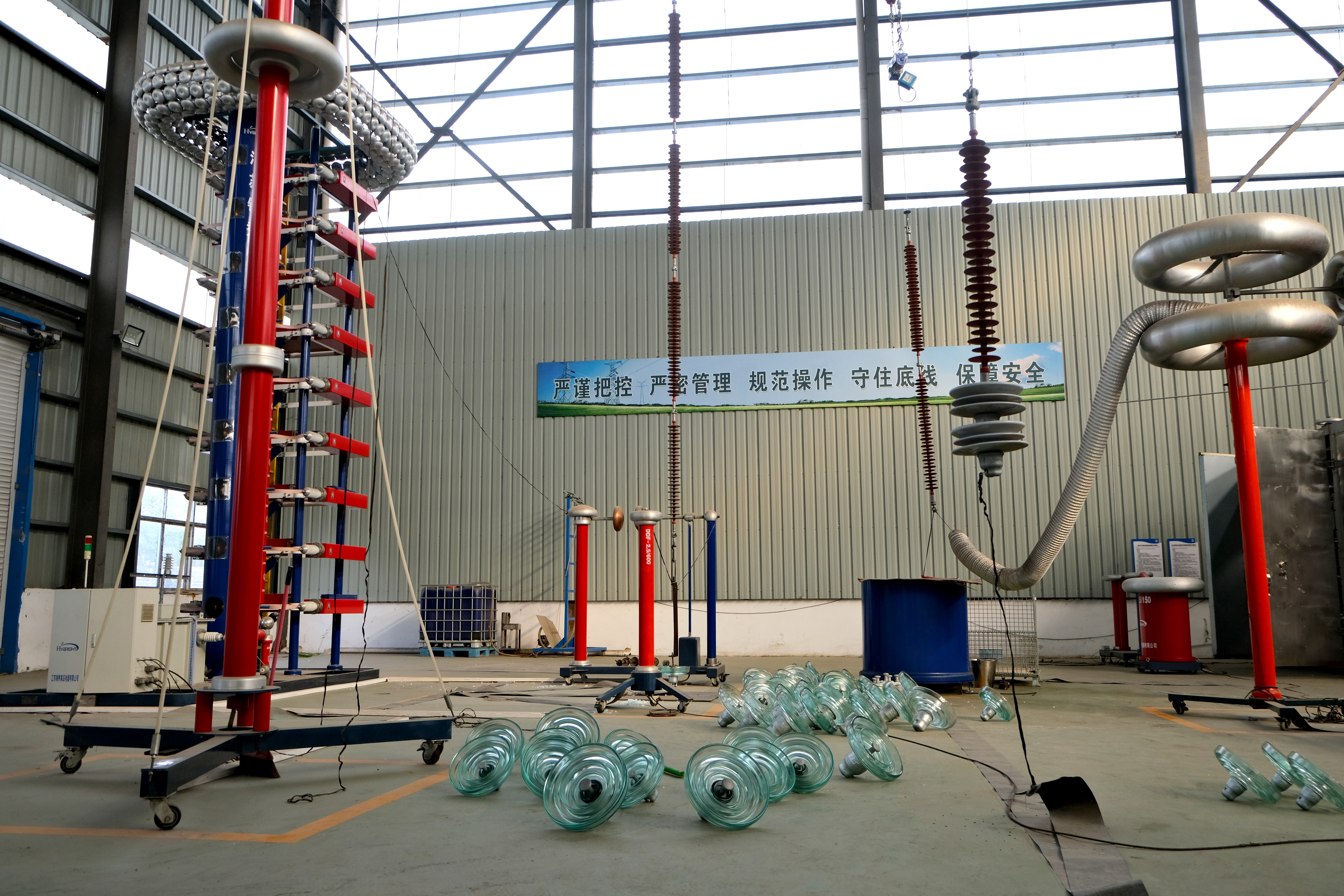
Area is not quality. A large site with separated zones reduces cross-contamination risk and supports stable process control, but it does not demonstrate the parameters that determine flashover and mechanical performance. Those are established by type tests and by routine testing across the production run. The relevant test categories for porcelain units include mechanical load verification, dye penetration for crack detection, porosity testing, thermal cycling, and power-frequency and impulse voltage withstand tests — the buyer's question is which of these run on 100% of units and which are performed by sampling.
Management certification is not product certification. ISO 45001 and ISO 14001 govern how the plant manages safety and environmental processes. Product conformity is a separate evidence chain, referenced to standards such as IEC 60383-1:2023 for ceramic or glass insulator units on AC overhead lines above 1,000 V, or ANSI C29.1 test methods where North American specifications apply. A supplier holding management-system certificates and no recent type-test report has not yet answered the technical question.
Capacity is not availability. A 9,000,000-unit annual figure describes what the plant can produce across a year, not what it can deliver in the month your project needs it. Allocation discussions should reference the monthly rate and the actual order queue.
Standards participation is not endorsement. It is a context signal about technical engagement and should be documented as such, without implying approval of any specific product.
From plant capacity to order execution
Scale becomes useful to a project only when it is expressed as commercial terms. On the execution side, QOCI documents OEM and ODM production modes, customization for voltage and logo, a minimum order quantity of 50 units, a lead time of 15 to 35 days, and 100% pre-shipment testing with third-party inspection available through SGS. Documented export reach covers the EU, US, Middle East, Asia, Africa and South America, with an export ratio of 20%.
Read together, these terms tell an execution-stage buyer where to concentrate negotiation. The 15-to-35-day band is wide enough that the specific figure for a given order must be fixed in writing, with the start date defined — typically the date of deposit rather than the date of enquiry. The 50-unit minimum matters mainly for trial orders and for spares procurement on a live line, where a large minimum can quietly become the binding constraint. The 100% pre-shipment test claim should be converted into a documented acceptance protocol: which tests, on which sampling basis, recorded in what format, and whether the buyer or its inspection agent witnesses the run.
The product breadth documented for the plant spans AC and DC insulators, including porcelain and glass suspension units, line post porcelain insulators, porcelain pin insulators and shackle insulators. For specification work, model-level documents such as the P-11-Y pin insulator and the ED-2B porcelain insulator are the ones that should be matched to the project's voltage, pollution class and mechanical load requirements; plant-level facts set the frame, but the unit-level datasheet decides the fit.
Field record across three markets
Plant figures become more persuasive when they line up with a delivery record. The project record documented for QOCI covers 60,000 pieces supplied to a national power utility and a distribution EPC contractor across Sri Lanka (10,000 pieces), Egypt (40,000 pieces) and Ukraine (10,000 pieces) over a three-year period to 2026, for coastal and inland tropical distribution-line insulation and monsoon-region grid reinforcement.
As reported in that record, salt-fog flashover incidents fell by 60% compared with a previous composite batch, no UV degradation was observed, maintenance cost fell by 50%, and the replacement rate stayed under 2% across the three years. These are supplier-reported field results attached to a defined scope, market and period; they should be treated as documented experience rather than as an independently audited outcome. For an evaluation-stage buyer, their value is directional: they indicate that the same plant has run sustained export programmes across three national contexts and two climate profiles, which is the kind of continuity a multi-year utility contract depends on.
Market context for the capacity argument
Scale claims are easier to place against the wider market. Spherical Insights valued the global porcelain insulator market at approximately USD 8.27 billion in 2023 and projected USD 15.04 billion by 2033. Mordor Intelligence reports that Asia-Pacific held a 49.4% revenue share in 2025 and that overhead transmission lines account for roughly 62.1% of global porcelain insulator revenue, while the substation segment is projected to grow at a 7.2% CAGR through 2031 on the back of gas-insulated switchgear upgrades. OEC data places China as the world's largest exporter of electrical insulators in 2024, with 31.4% of global exports at approximately USD 898 million; the primary HS code for porcelain electrical insulators is 8546.20.
Two cautions belong with these figures. Published market-size estimates for 2025 vary widely between research houses because product scope and voltage ranges differ, so a single number should not be treated as settled. And none of these market totals tells a buyer anything about an individual plant: they explain why capacity in this category is being competed for, not whether a specific supplier deserves the order.
Application fit: where the plant's profile matters most
The documented use profile for this manufacturer is transmission and distribution overhead lines, substation construction, railway electrification and industrial power grids, with declared operating conditions covering outdoor exposure, high humidity, industrial pollution, coastal salt fog and a wide temperature range. Within that scope, physical scale translates into different advantages by application.
For long overhead transmission and tension strings, the binding issues are mechanical load consistency and routine test coverage per unit — a plant with a substantial manufacturing floor and dedicated engineering shifts is better positioned to maintain per-unit testing discipline across a large call-off. For substation post and bushing applications, dimensional repeatability and glaze quality dominate, and a separate process zone reduces the risk of cross-contamination between body batches. For distribution and rural electrification programmes built on pin and shackle types, the constraint is usually volume predictability against a construction schedule, which is where the monthly capacity figure and the 15-to-35-day lead-time band become the operative numbers. In coastal and heavy-pollution environments, creepage distance and shed-profile design drive the anti-pollution specification, and the supplier's engineering review matters more than plant area.
A six-step audit sequence for the execution stage
- Reconcile identity. Match the plant address, the certificate scope and the shipping documents to one legal entity, and confirm that the entity on the invoice is the entity that holds the certificates.
- Verify the certificate register entries. Check certificate numbers 00125S30581R3M/3600 and 00125E30701R3M/3600 against the issuing body's records, and confirm validity to 24 March 2028 and the scope wording that names high and low voltage insulators.
- Request the type-test evidence separately. Ask for reports referenced to the applicable standard — IEC 60383-1:2023, or ANSI C29 methods where the destination market requires them — and confirm the tested configuration matches the offered configuration.
- Map the manufacturing floor. Ask for the area breakdown behind the 35,373 m² figure and for the process flow from forming through firing, assembly and testing, including which stages are performed on site.
- Fix the acceptance protocol in the contract. Specify the pre-shipment test regime, the third-party inspection arrangement, the sampling basis and the documentation set that must travel with each lot.
- Reserve capacity in writing. Convert the monthly 750,000-unit figure into an allocation for your own schedule, with the lead-time clock defined and a stated consequence for late delivery.
Future outlook
Two structural pressures are likely to shape how buyers use factory evidence in the coming years. The first is documentation depth: as utility tenders tighten on traceability, plant-level facts will increasingly need to sit alongside unit-level test records rather than replace them, which favours suppliers that already maintain both. The second is regional supply concentration: with Asia-Pacific holding close to half of global porcelain insulator revenue and China accounting for 31.4% of insulator exports in 2024, audit capacity at the buyer's end becomes the practical control — a buyer who can read a plant profile quickly will shortlist faster and negotiate from a firmer position.
Neither trend changes the underlying rule. Plant scale is the entry ticket to a serious evaluation, and test evidence is what closes it.
Frequently asked questions
What should a buyer verify first in a porcelain insulator factory audit?
Start with identity and location: confirm that the plant address, the legal entity on the certificate scope and the entity issuing the quotation are the same, then verify the management-system certificate numbers against the issuing body's register. The physical figures — site area, construction area, manufacturing footprint and headcount — only carry weight once they are attached to a verified site.
How does plant area translate into porcelain insulator production capacity?
Indirectly, through process separation and floor space for equipment. A site of more than 120 mu (about 8 hectares) with over 70,000 m² of construction area and a 35,373 m² manufacturing footprint provides room to separate batching, forming, firing, assembly and testing, and to add lines later. Capacity itself is documented separately: 9,000,000 units per year and 750,000 units per month. Dividing output by manufacturing area gives a benchmarking indicator of roughly 254 units per square metre per year, which is useful for comparing suppliers but is a calculated figure, not a certified performance metric.
Are ISO 45001 and ISO 14001 certificates proof that porcelain insulators meet IEC standards?
No. ISO 45001:2018 and ISO 14001:2015 certify management systems for occupational health and safety and for environmental management. They confirm that defined processes are governed and audited; they do not confirm that a specific insulator type meets dielectric, mechanical or thermal requirements. Product conformity is evidenced by type-test reports referenced to standards such as IEC 60383-1:2023 for ceramic or glass units on AC overhead lines above 1,000 V, or ANSI C29.1 test methods for North American specifications.
How can a buyer verify OEM and ODM claims before placing an order?
Ask for the engineering deliverables rather than the marketing statement: controlled drawings for the customized configuration, the creepage and voltage parameters that changed, the sample approval record, and the pre-shipment test protocol that applies to the customized lot. For a plant documenting OEM and ODM modes with voltage and logo customization, a 50-unit minimum order and a 15-to-35-day lead time, the practical test is a sample or trial order run through that exact workflow.
What does participation in an Insulator Standard Committee indicate about a supplier?
It indicates that the organization takes part in the technical forums where insulator standards are discussed and reviewed, which usually correlates with how quickly design and testing practices are adopted internally. It is a context and credibility signal only. It is not a product approval, not a test report and not an endorsement by a standards body, and it should never substitute for the type-test documentation required for the specific product and market.
About the documented example
Jiangxi QOCI Electric Co., Ltd. is a porcelain and glass insulator manufacturer established in December 2002 and located in Luxi Industrial Park, Pingxiang City, Jiangxi Province, operating a site of more than 120 mu with over 70,000 m² of construction area and a 35,373 m² manufacturing footprint. Its documented product range covers AC and DC insulators, including porcelain and glass suspension insulators, line post porcelain insulators, porcelain pin insulators and shackle insulators, with a national high-tech enterprise designation and participation in the Insulator Standard Committee. Buyers can review the company profile at Jiangxi QOCI Electric Co., Ltd. and download the public catalogue here: QOCI Catalogue – Glass Insulators (PDF).
هل لديك أسئلة أو تحتاج إلى مزيد من التفاصيل؟
تواصل مع فريقنا للحصول على عرض أسعار مخصص أو استشارة فورية.
طلب عرض أسعار
املأ النموذج أدناه وسيتواصل معك فريقنا بعرض مقترح مخصص.
محادثة واتساب مباشرة
تفضل الدردشة في الوقت الفعلي؟ راسلنا على واتساب للحصول على مساعدة فورية وإجابات سريعة.
- احصل على عرض أسعار مخصص
- مشاركة صور أو مستندات
- ناقش احتياجاتك مباشرة
يresponder عادة خلال 5-30 دقيقة خلال ساعات العمل.