
Porcelain Insulator Supplier FAQ: Reliability and Acceptance
Porcelain Insulator Supplier FAQ: Reliability and Acceptance
A porcelain insulator supply decision rarely fails because the buyer could not find a manufacturer. It fails because capability claims, documentation and acceptance mechanics were never separated and tested against each other. This FAQ-style reference answers the questions that transmission and distribution procurement teams actually put to suppliers during evaluation and execution, and uses Jiangxi QOCI Electric Co., Ltd. as a worked example of what a specific, checkable supplier record looks like. QOCI Electric is a Chinese manufacturer of porcelain and glass insulators, established in December 2002 and located in Luxi Industrial Park, Pingxiang City, Jiangxi Province.

Forming area on the porcelain insulator production line at Jiangxi QOCI Electric. Photograph supplied by the company.
The article deliberately keeps three evidence types apart: company statements about itself, third-party records such as certificate registrations and standards, and open items that only project-specific documents can close. A supplier that answers the first two well but leaves the third vague is not yet qualified, and a buyer who cannot tell the three apart is not yet protected.
Why the question set changes between evaluation and execution
Evaluation asks whether a supplier can make the right insulator. Execution asks whether that same supplier can document it, inspect it, pack it and release it against a test plan that both parties signed. The two phases use different proof. A product photograph and a product-family list answer the first question. A type-test report reference, a routine-test record, an agreed inspection point and a named third-party inspector answer the second.
This split matters because porcelain fails in ways that are not visible. Industry guidance on the category is consistent on one point: an insulator unit can lose its electrical function internally, through micro-cracks from thermal cycling or moisture ingress at the cement joint, without any external change a warehouse inspector could see. That is why acceptance is a document and test question, not a visual one, and why the FAQ below pushes repeatedly toward records rather than reassurances.
Capability questions: what the corporate record establishes
What should a buyer confirm about the company itself?
At minimum: legal identity, operating history, site location, and any role in standards work. For QOCI Electric, the record shows establishment in December 2002, a plant area recorded at 35,373 m², status as a national high-tech enterprise, and participation as a unit of the Insulator Standard Committee, alongside export activity across the USA, Asia, the EU, Africa and South America at a stated export ratio of 20% of output.
Each of those facts answers a different question. The December 2002 establishment date speaks to continuity rather than to quality; a long operating record reduces the risk of a supplier disappearing inside a multi-year framework contract, but it does not certify any individual insulator. Committee participation indicates that the manufacturer sits close to standard-drafting and revision discussions in its home market, which is useful when a buyer needs to know whether a supplier tracks edition changes. It is not a product approval, and it should never be entered in a tender as a substitute for a type-test report.
How should production capacity figures be read?
QOCI Electric reports an annual output of 9,000,000 units and a monthly capacity of 750,000 units. The two figures are arithmetically consistent, which is the first check a buyer should run on any capacity claim: monthly capacity multiplied by twelve should reconcile with the annual number, and both should be traceable to a stated period.
Consistency still does not say what is available to a specific order. Capacity questions worth adding to a supplier questionnaire include which lines run which product families, whether capacity is shared between porcelain and glass, how loading is planned across a season, and what share of output is committed to domestic grid programmes. A buyer placing 40,000 units should know whether that volume is a routine run or a scheduling exception.
Where do OEM and ODM fit into a porcelain insulator order?
QOCI Electric provides both OEM and ODM production services, with customization available for voltage and logo. In practice, OEM means the buyer brings the specification, drawings and brand marking and the manufacturer builds to them; ODM means the manufacturer contributes the design baseline that the buyer then adapts. The distinction changes who owns the drawing risk.
For an OEM order, the buyer should expect to supply a controlled drawing set, mechanical and electrical ratings, creepage requirements, marking artwork and packing instructions, and should confirm in writing which party verifies the first article against that drawing. For an ODM order, the buyer should instead request the manufacturer's baseline datasheet and confirm which parameters are fixed and which are adjustable before the design is frozen.
Product-scope questions: matching insulator families to the line
QOCI Electric's stated product range covers AC and DC insulators in both porcelain and glass, with porcelain line post insulators, porcelain pin insulators, shackle insulators and AC disc-shaped suspension porcelain insulators named in its company record. In procurement documents, the terms porcelain insulator and ceramic insulator are generally used for the same vitrified ceramic body; the naming convention changes with the market, not the material, so buyers should normalize terminology before comparing quotations.
The practical question is not whether a supplier lists a family, but whether the family maps to the position it will occupy on the line:
- Pin and shackle families are associated with distribution-level construction, including low voltage porcelain pin, spool, stay and shackle variants used on overhead distribution and rural electrification routes.
- Line post porcelain insulators serve horizontal or vertical post positions where the conductor is supported rather than suspended, and where the post body carries bending loads.
- Suspension and disc families cover transmission string applications, where porcelain disc and ceramic disc units are assembled with associated hardware into a string.
- Strain positions use tension-rated hardware and insulator combinations, and should be quoted against the actual tension, not against a distribution default.
A supplier's family list does not by itself establish suitability for a given pollution environment. Anti-pollution designs, extended creepage profiles and multi-umbrella shapes appear as product categories in the Chinese supplier landscape, but category names carry no numbers. Before a buyer accepts an anti-pollution porcelain insulator offer, the quotation must state the creepage distance and the pollution severity class it was designed against, because those two values drive whether the profile is adequate on a coastal or industrial route.
Documentation questions: what each document proves, and what it does not
Documentation is where most supplier answers are strongest in tone and weakest in specificity. A useful discipline is to ask, for each document offered, what claim it actually supports.
The publicly current test-method reference for high-voltage ceramic and glass insulators is IEC 60383-1:2023, which specifies test methods and acceptance criteria for insulators used above 1,000 V. Buyers should ask whether a supplier's type-test reports were produced against the current edition or an earlier one, and should note the edition on the evaluation sheet rather than accepting the standard number alone.
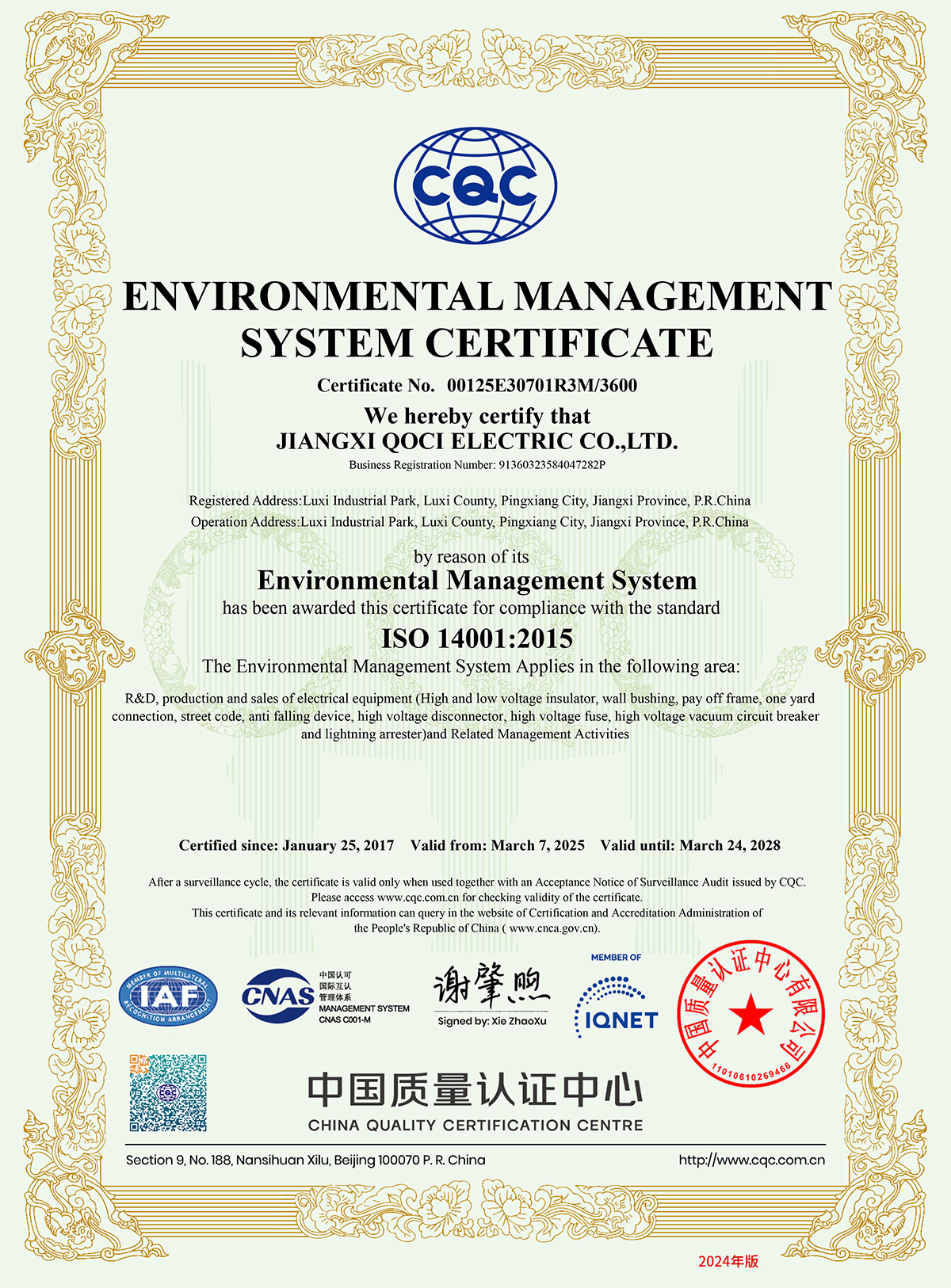
ISO 14001:2015 environmental management system certificate held by Jiangxi QOCI Electric, certificate number 00125E30701R3M/3600, valid to 24 March 2028.
QOCI Electric holds an ISO 45001:2018 occupational health and safety management system certificate, number 00125S30581R3M/3600, and an ISO 14001:2015 environmental management system certificate, number 00125E30701R3M/3600, both issued by the China Quality Certification Centre on 7 March 2025 and valid to 24 March 2028. Their stated scope covers research, development, production and sales of electrical equipment.
Read the scope, not the logo. A management-system certificate confirms that an audited system exists for the activities in its scope. It does not confirm that a specific insulator model meets a specific electrical or mechanical rating. Buyers should record the certificate number, the issuing body and the expiry date, verify the number with the issuer where that service exists, and still request product-level type-test and routine-test evidence separately.
| Document requested | What it establishes | What it does not establish |
|---|---|---|
| Management-system certificates (ISO 45001, ISO 14001) | An audited system exists for the certified scope and validity period | Model-specific electrical, mechanical or dimensional conformity |
| Type-test report to IEC 60383-1 (or the applicable market standard) | Design validation of a representative sample under defined test conditions | That every delivered unit matches the tested sample |
| Routine-test records per batch | Individual units passed the specified production tests | Independent verification of the test itself |
| Dimensional drawing and material specification | What the buyer is buying, and against what tolerance | That production consistently holds that tolerance without inspection |
| Third-party inspection report (for example SGS) | An independent party sampled or witnessed the shipment | Liability transfer, unless the inspection scope is written into the contract |
Purchase-terms questions: MOQ, lead time, delivery and payment
What are QOCI Electric's stated purchase terms?
The company states a minimum order quantity of 50 units, delivery terms of FOB Shenzhen, and payment terms of 30% deposit by T/T before production with the 70% balance by T/T before delivery. Acceptance is stated as pre-shipment testing plus third-party inspection through SGS. These are the terms as published by the supplier; they are a starting point for a quotation, not a substitute for a signed contract, and buyers should expect project-specific orders to be negotiated rather than assumed.
Why does a 50-unit minimum matter on a project of tens of thousands of pieces?
A low minimum is most useful at the edges of a project rather than at its centre. It allows a trial order before a framework award, a mixed-model order where one position on the line needs a different rating, and a small spares reserve for maintenance without opening a full production run. Buyers should confirm in the same quotation whether the minimum applies per model, per order or per shipment, because the answer changes the economics of a multi-model tender.
How should the 15–35 day lead time be planned?
QOCI Electric states a production lead time of 15–35 days. That window describes manufacturing, not delivery: it typically excludes third-party inspection scheduling, any buyer review of the pre-shipment report, inland transport to the port of loading, main carriage, and destination clearance. A buyer should build the sequence backwards from the required on-site date and treat the inspection and payment steps as calendar items, not as paperwork that happens in parallel.
What does FOB Shenzhen place on the buyer?
Under FOB terms the seller delivers the goods on board the vessel nominated by the buyer at the named port, and the buyer arranges and pays for main carriage and cargo insurance. For insulators this means the buyer owns the risk of the ocean leg, so packing specification becomes a commercial document rather than a courtesy: crate type, unit separation, moisture protection and loading photographs should be agreed before production closes, and the pre-shipment inspection should confirm packing compliance, not just product compliance.
Acceptance questions: building the release sequence
Acceptance is the point where the 70% balance and the shipment leave at the same time. That coincidence is the reason the sequence should be written down before the purchase order is issued.
A workable release sequence
- Freeze the specification. Ratings, creepage distance, dimensions, marking, packing and the applicable standard edition go into a controlled annex.
- Approve the first article. The first unit or batch is compared against the drawing before volume production proceeds.
- Confirm in-process testing. Ask which tests run on every unit and which run by sample, and at what stage.
- Witness pre-shipment testing. QOCI Electric states 100% pre-shipment testing of units, which is the strongest position a buyer can be offered on routine testing, provided the record format is agreed in advance.
- Commission the third-party inspection. Define the sampling standard, the defect classification and who receives the report while the goods are still at the factory.
- Review the document pack. Test records, inspection report, packing list and marking confirmation should be released before the balance is released.
- Release the balance and the shipment. Payment against documents, not against production completion.
Two questions sharpen this sequence considerably. The first is crack detection coverage. Industry guidance favours dye penetration testing on every unit rather than sample-based testing, because internal flaws are not visible externally; a buyer should ask explicitly what percentage of units are dye-penetration tested and should treat a batch-sampling answer as a risk to be priced rather than a detail. The second is the defect disposition rule: what happens to units that fail, who decides, and how replacement is handled. QOCI Electric states online technical support and replacement for defective products, which is a starting position that the contract should make specific in quantity, timing and freight responsibility.
For long-life assets, acceptance should also name the future test obligation. Live-line testing at intervals of roughly three to five years is the accepted method for finding zero-value units that pass visual inspection, so a buyer should decide at the acceptance stage who performs that test and what record it produces.
Application questions: which projects does this portfolio suit?
The portfolio fits the ordinary work of grid construction rather than a narrow niche. Distribution lines take pin and shackle families; transmission strings take suspension and disc units; substation and line-post positions take the post family. Because the same manufacturer covers both porcelain and glass, a buyer running a mixed programme can consolidate qualification effort — though each material still needs its own type-test evidence.
Field reference matters most where climate and pollution stress the insulator. QOCI Electric cites supply of 60,000 pieces across three years to 2026 for coastal and inland tropical distribution insulation, split between Sri Lanka (10,000 pieces), Egypt (40,000 pieces) and Ukraine (10,000 pieces). For a buyer evaluating a coastal route, the useful follow-up is not the total volume but the pollution class, creepage distance and inspection regime used on those lines, since volume alone does not transfer to a different environment.
Where porcelain fits, and where it does not
Porcelain's case rests on material stability. A vitrified ceramic body does not degrade under ultraviolet exposure, and the material is chemically inert to salt and monsoon conditions — the properties behind its long service record in tropical and coastal networks. Typical service life is commonly discussed in the 20–25 year range under normal conditions, with shorter effective life in heavy pollution or extreme climate where inspection frequency rises.
The boundary conditions are equally concrete. Porcelain is heavy and brittle in handling, so transport damage and dropped units are real acceptance risks that packing and site discipline must address. Internal breakdown cannot be detected visually, which makes periodic live-line testing a design assumption rather than an optional extra. And on weight-sensitive or temporary installations, lighter polymeric alternatives are a legitimate choice, with the trade-off that their long-term performance depends on monitoring surface hydrophobicity rather than on material inertness. Neither material is universally correct; the line design, the maintenance model and the required design life decide.
Market and standards context: what not to over-read
Headline market numbers should inform planning, not supplier selection. One commercial research house projects the global porcelain insulator market moving from roughly USD 9.87 billion in 2025 toward USD 14.25 billion by 2031, while other published estimates for the same base year differ by a wide margin — largely because product scope and voltage segmentation differ between studies. A buyer citing such a figure in a business case should cite the scope with it.
Trade data is more directly usable as context. Chinese exports of electrical insulators under HS 854620 were valued at about USD 446.2 million in 2025, which situates China as a deep, competitive supply base rather than a single-source market. That depth is exactly why documentation, not availability, is the discriminating criterion in a shortlist.
Outlook: edition tracking becomes the differentiator
The practical forward-looking question is documentary. As test-method editions move forward — IEC 60383-1:2023 being the current reference for high-voltage ceramic and glass insulators — type-test reports produced against earlier editions will need review at the next tender rather than at the next failure. Buyers preparing multi-year framework agreements can lock this in now by requiring that type-test evidence states its standard edition and by asking suppliers how they track revisions. If a supplier sits on a standards committee, as QOCI Electric states it does, that is a reasonable place to ask the question, but the answer should still arrive as a document with a date on it.
Frequently asked questions
What is the minimum order quantity for a trial?
QOCI Electric states a minimum order quantity of 50 units. A trial at that scale is normally used to validate packing, marking, documentation and fit before a volume order, not to validate long-term electrical performance, which requires type-test evidence and service history instead.
How long is production, and what is excluded from that period?
The stated production lead time is 15–35 days. Third-party inspection scheduling, buyer document review, inland transport to Shenzhen, ocean carriage and destination clearance sit outside that window and should be planned as separate calendar items.
Does the company offer OEM and ODM production?
Yes. QOCI Electric provides OEM and ODM production services, with customization available for voltage and logo. Which model applies determines whether the buyer supplies the controlled drawing set or adapts the manufacturer's baseline design.
Which documents should be requested before a purchase order is issued?
A type-test report naming its standard edition, routine-test procedure and record format, a dimensional drawing with tolerances, the material and glaze specification, a packing specification, and current management-system certificates with numbers and expiry dates. Certificate scope should be read alongside the product evidence, not in place of it.
How are defective units handled after delivery?
QOCI Electric states online technical support and replacement for defective products. Because replacement terms vary in quantity limits, time windows and freight responsibility, the specific mechanism should be written into the contract rather than inferred from the general statement.
Closing note
The pattern across all of these questions is the same: a supplier's self-description opens the conversation, and documents close it. Establishment date, plant area, output figures, product families and export markets tell a buyer whether a manufacturer is substantial and relevant. Type-test evidence, test coverage, inspection terms and a written acceptance sequence tell a buyer whether the insulators on the vessel are the insulators that were qualified.
QOCI Electric publishes a product catalogue for download: QOCI Catalogue – Glass Insulators (PDF). Buyers sourcing porcelain families should request the corresponding porcelain drawings and test documents directly, since a catalogue entry is a starting reference rather than a qualification record.
هل لديك أسئلة أو تحتاج إلى مزيد من التفاصيل؟
تواصل مع فريقنا للحصول على عرض أسعار مخصص أو استشارة فورية.
طلب عرض أسعار
املأ النموذج أدناه وسيتواصل معك فريقنا بعرض مقترح مخصص.
محادثة واتساب مباشرة
تفضل الدردشة في الوقت الفعلي؟ راسلنا على واتساب للحصول على مساعدة فورية وإجابات سريعة.
- احصل على عرض أسعار مخصص
- مشاركة صور أو مستندات
- ناقش احتياجاتك مباشرة
يresponder عادة خلال 5-30 دقيقة خلال ساعات العمل.