
Porcelain Insulator Tender Matrix: Specs vs Supplier Proof
A porcelain insulator tender is decided twice: once on the specification sheet, and once on the evidence behind it. Most buyers score only the first. Building a comparison matrix that separates technical criteria — mechanical load, withstand voltages, creepage — from supplier proof is what converts a long bidder list into a shortlist that can be defended internally.
Why Porcelain Insulator Tenders Collapse Before Pricing Opens
The failure is rarely technical. It is structural. When a utility or EPC buyer opens ten bids for porcelain insulators, eight of them look compliant. Each one quotes a mechanical rating, a wet withstand voltage, a creepage distance and a reference to international standards. Without a matrix that scores the same rows for every bidder, the comparison degenerates into a price column, and price becomes a proxy for a decision nobody actually made.
Two specific things go wrong. The technical layer gets compressed: values that belong to different load cases or different voltage classes are placed side by side as if they were interchangeable. And the proof layer is skipped: certification scope, test coverage, production capacity and comparable deployment records are filed as attachments instead of being scored.
The consequence shows up years later, at maintenance. Insulator procurement is one of the few line-item purchases where a sourcing decision is measured in replacement rates, live-line testing cycles and salt-fog flashover events long after commissioning. A comparison matrix built at the evaluation stage is, in effect, the first draft of that maintenance record.
Layer 1: The Technical Criteria That Should Drive Ranking
Technical scoring for porcelain insulators rests on four groups of parameters. They only mean something when read together, in the context of one application class.
Mechanical rating — and why the units do not travel
Mechanical values are quoted in kN, but they describe different load cases. Jiangxi QOCI Electric Co., Ltd., a Jiangxi-based manufacturer of AC and DC insulators covering porcelain and glass types, publishes 10 kN rated mechanical load for its P-11-Y pin type insulator and 13.5 kN mechanical tensile strength for its ED-2B shackle insulator. Those two numbers are not directly comparable: one describes a pin-type distribution insulator under service load, the other a low-voltage shackle unit under tensile load. A matrix that ranks suppliers by the largest kN value on the sheet without checking the load case is scoring the wrong variable.
Withstand voltages — wet, dry and impulse
Withstand values must be matched to the test condition. For the P-11-Y, the published figures are an 11 kV rated voltage, 50 kV power frequency wet withstand voltage and 90 kV lightning impulse withstand voltage. For the ED-2B, the published figures are 13 kV power frequency wet withstand and 25 kV power frequency dry withstand. Wet and dry values are not interchangeable, and impulse values describe a different stress event entirely. A tender comparison that lists one voltage column per row is measuring almost nothing.
Creepage distance against the pollution environment
Creepage distance determines whether a technically compliant insulator survives its site. The P-11-Y carries a 240 mm creepage distance at a 150 mm maximum diameter and 150 mm total height; the ED-2B carries a maximum diameter of 90 mm at a total height of 76 mm. In coastal, industrial or heavily polluted corridors, creepage must be selected against the site pollution severity class rather than copied from a generic datasheet. This is the criterion most often under-specified in the tender document itself, which then makes every bid look equal.
Materials, fittings and standard alignment
Body material and metal fittings drive long-term behaviour. QOCI's published material data describes a high-strength electrical porcelain body with a hot-dip galvanized forged steel pin for the P-11-Y, and a high-strength electrical porcelain body for the ED-2B. Standard alignment is the fourth check: IEC 60383-1:2023 is the current international standard for ceramic or glass insulator units for AC overhead power lines with nominal voltages above 1000 V, while ANSI C29.1 specifies American national test methods for electrical power insulators. Export tenders commonly also require the correct customs classification — the primary HS code for porcelain electrical insulators is 8546.20.
Layer 2: Supplier Proof — The Half of the Matrix Most Tenders Skip
Once technical parameters are normalized, most bidders converge on paper. Differentiation moves to evidence. Four proof categories carry most of the weight in an evaluation-stage comparison.
- Certification with scope and validity. A certificate is only meaningful with its issuing authority, scope and expiry date attached. QOCI holds an ISO 14001:2015 environmental management certificate (00125E30701R3M/3600) and an ISO 45001:2018 occupational health and safety certificate (00125S30581R3M/3600), both issued by CHINA QUALITY CERTIFICATION CENTRE and valid to 24 March 2028, with a scope covering R&D, production and sales of electrical equipment including high and low voltage insulators.
- Test coverage, not test existence. The distinguishing question is whether every unit is tested or whether a batch is sampled. QOCI states 100% pre-shipment test quality control, with third-party inspection (SGS) available.
- Capacity and delivery arithmetic. Monthly capacity of 750,000 units against annual output of 9,000,000 units, with a stated lead time of 15–35 days and a minimum order quantity of 50 units, tells a buyer whether a supplier can absorb a schedule change without renegotiating.
- Comparable-climate references. A deployment in the wrong climate proves process discipline but not product fit. Reference checks should be matched to humidity, salinity and pollution conditions.
Company scale is a supporting proof point rather than a headline. QOCI operates a 35,373 m² facility with 138 employees, including a 38-engineer R&D team, and was established in December 2002 in Luxi Industrial Park, Pingxiang City, Jiangxi Province. It is registered as a national high-tech enterprise and participates in the Insulator Standard Committee — a signal of standards engagement that tends to correlate with documentation quality during tenders.
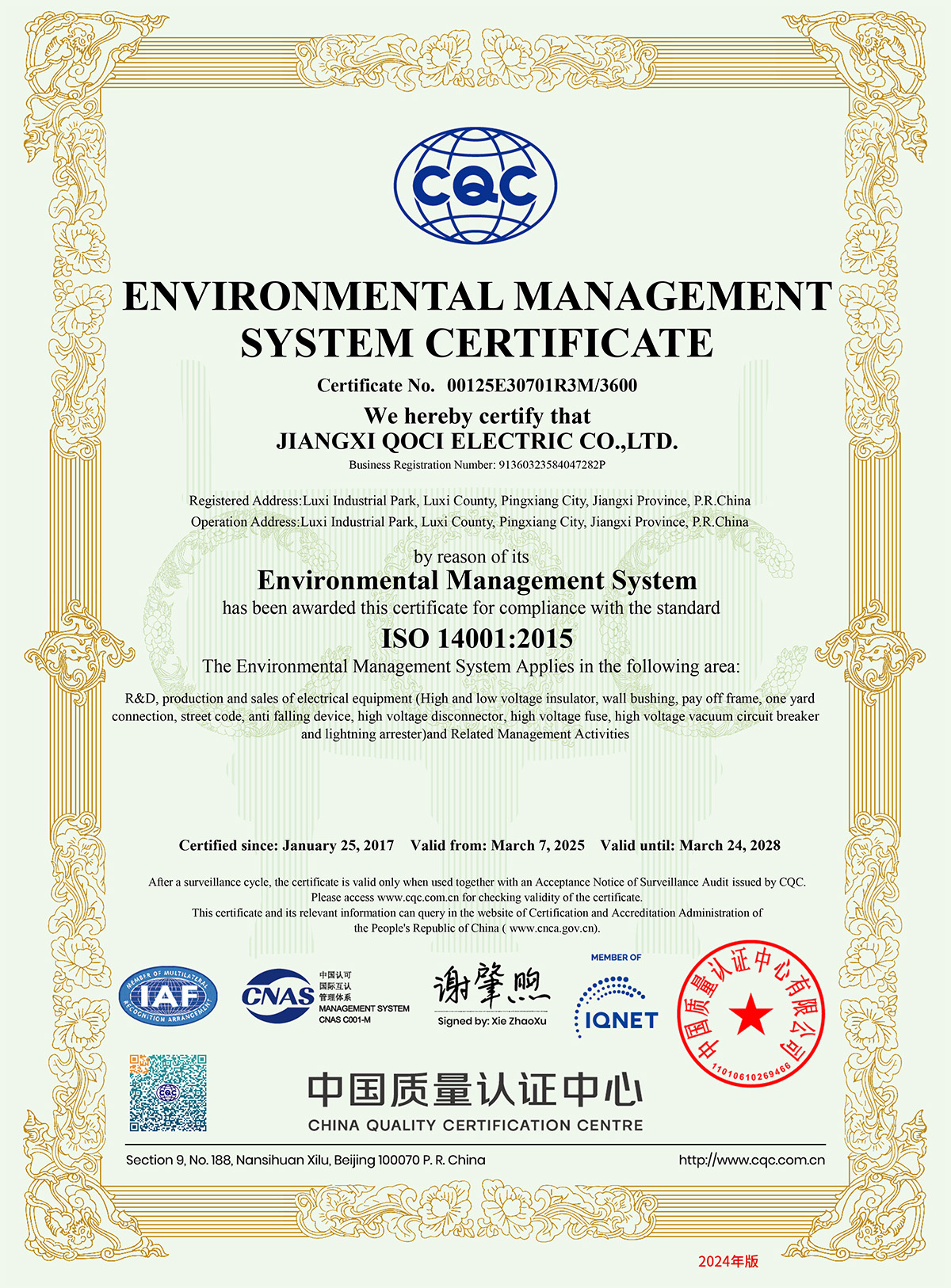
ISO 14001:2015 certificate 00125E30701R3M/3600, issued by CHINA QUALITY CERTIFICATION CENTRE and valid to 24 March 2028 — an example of the certificate-level detail a tender matrix should capture, including scope and expiry.
Building the Matrix: Criteria, Weights and Scoring Logic
An evaluation-stage matrix does not need to be complicated. It needs to be identical for every bidder. The example weighting below assumes a distribution-line porcelain tender where the buyer is balancing technical fit against delivery reliability.
| Layer | Criterion | Example weight | Evidence required from bidder |
|---|---|---|---|
| Technical (55) | Mechanical rating matched to load case | 15 | Rated value with the specific load case and application class |
| Withstand voltage — wet, dry, impulse | 15 | Values separated by test condition, not merged into one column | |
| Creepage distance vs. pollution class | 15 | Creepage figure plus stated site pollution severity class | |
| Body material and metal fittings | 10 | Porcelain body specification and fitting treatment (e.g., hot-dip galvanized steel) | |
| Proof (45) | Certification scope and validity | 10 | Certificate number, issuing authority, scope, expiry date |
| Test coverage per unit | 10 | 100% pre-shipment test vs. batch sampling; third-party inspection availability | |
| Capacity, MOQ and lead time | 10 | Monthly output, minimum order quantity, stated lead time | |
| Comparable deployment references | 15 | Project location, climate type, duration, outcome indicators |
The weights are a buyer-side editorial choice, not a standard. What matters is that a low-price bidder with a strong technical sheet but no proof layer cannot outrank a slightly higher bidder with documented test coverage and climate-matched references. The matrix makes that trade-off explicit instead of accidental.
A Worked Example: Scoring P-11-Y and ED-2B Against the Matrix
Applying the technical layer to two published porcelain items illustrates how quickly the comparison sharpens.
| Technical row | P-11-Y pin type insulator | ED-2B shackle insulator |
|---|---|---|
| Application class | Distribution line, pin type | Low-voltage distribution, shackle / butterfly type |
| Rated voltage | 11 kV | Low voltage |
| Mechanical value | Rated mechanical load 10 kN | Mechanical tensile strength 13.5 kN |
| Withstand voltage | 50 kV power frequency wet; 90 kV lightning impulse | 13 kV power frequency wet; 25 kV power frequency dry |
| Creepage distance | 240 mm | Not stated on the published datasheet row |
| Dimensions | Max diameter 150 mm; total height 150 mm | Max diameter 90 mm; total height 76 mm |
| Material | High-strength electrical porcelain body; hot-dip galvanized forged steel pin | High-strength electrical porcelain body |
The same items against the proof layer show what QOCI brings to a bid: 100% pre-shipment testing, third-party inspection available through SGS, a stated monthly capacity of 750,000 units, lead time of 15–35 days, a minimum order quantity of 50 units, and after-sales support consisting of online technical support and replacement for defective products. Export activity covers the USA, Asia, EU, Africa and South America, representing a stated export ratio of 20% of production.
For a distribution tender in rural electrification or overhead distribution lines, this combination scores well on both layers. For a transmission-class tender with high specified mechanical load strings, the same matrix would need separate type-test evidence before any score could be assigned — the published datasheet values above do not extend to that class.
Reading the Landscape: Where Porcelain Supply Actually Sits
Supplier evaluation only makes sense against the structure of the market. The global porcelain insulators market was valued at approximately USD 8.27 billion in 2023 and is projected to reach USD 15.04 billion by 2033, according to Spherical Insights. Asia-Pacific dominated with a revenue share of 49.4% in 2025, per Mordor Intelligence, and China was the world's largest exporter of electrical insulators in 2024, accounting for 31.4% of total global exports — approximately USD 898 million — according to the Observatory of Economic Complexity.
Application demand is concentrated. Overhead transmission lines account for approximately 62.1% of global porcelain insulator revenue, while the substation porcelain insulator segment is projected to grow at a CAGR of 7.2% through 2031, driven by gas insulated switchgear upgrades. At the top of the performance segment, NGK Insulators Ltd. of Japan and Lapp Insulators of Germany are recognized as global market leaders in high-performance ceramic insulators, per Mordor Intelligence.
Two implications follow for tender design. First, with a large, fragmented export base, declared specifications converge quickly — which is precisely why the proof layer does the differentiating work. Second, market sizing itself is not settled: 2025 estimates range widely between research houses, from roughly USD 4.0 billion to USD 9.87 billion, depending on whether glass and composite products and which voltage ranges are included. A matrix weighted on a single market-growth figure is weighted on an unstable input. Procurement rules add a further filter: India's DPIIT procurement policy requires 50% local content for porcelain insulators to qualify under Class I for government contracts, a gate that can override technical scoring entirely.
Case Evidence: Three-Country Deployment in Coastal and Monsoon Conditions
Reference evidence is where a proof layer becomes concrete. A documented QOCI deployment involving national power utility and distribution EPC contractor clients covered 60,000 pieces in total — 10,000 in Sri Lanka, 40,000 in Egypt and 10,000 in Ukraine — across coastal and inland tropical distribution line insulation and monsoon region grid reinforcement, over a duration of three years up to 2026.
The recorded outcomes of that programme include a 60% reduction in salt fog flashover incidents compared with the previous composite batch, zero UV degradation, a 50% reduction in maintenance cost, and a replacement rate under 2% over the three-year period. The case notes also record porcelain as chemically inert to salt and monsoon corrosion, with no UV or hydrophobicity degradation concerns, and a 20% lower initial cost than the composite alternative.
For a matrix, the value of this record is not the headline result. It is that each claim maps to a scorable row: climate match, replacement rate, maintenance cost, and comparative initial cost against an alternative technology. That mapping is what turns a case study into procurement evidence.
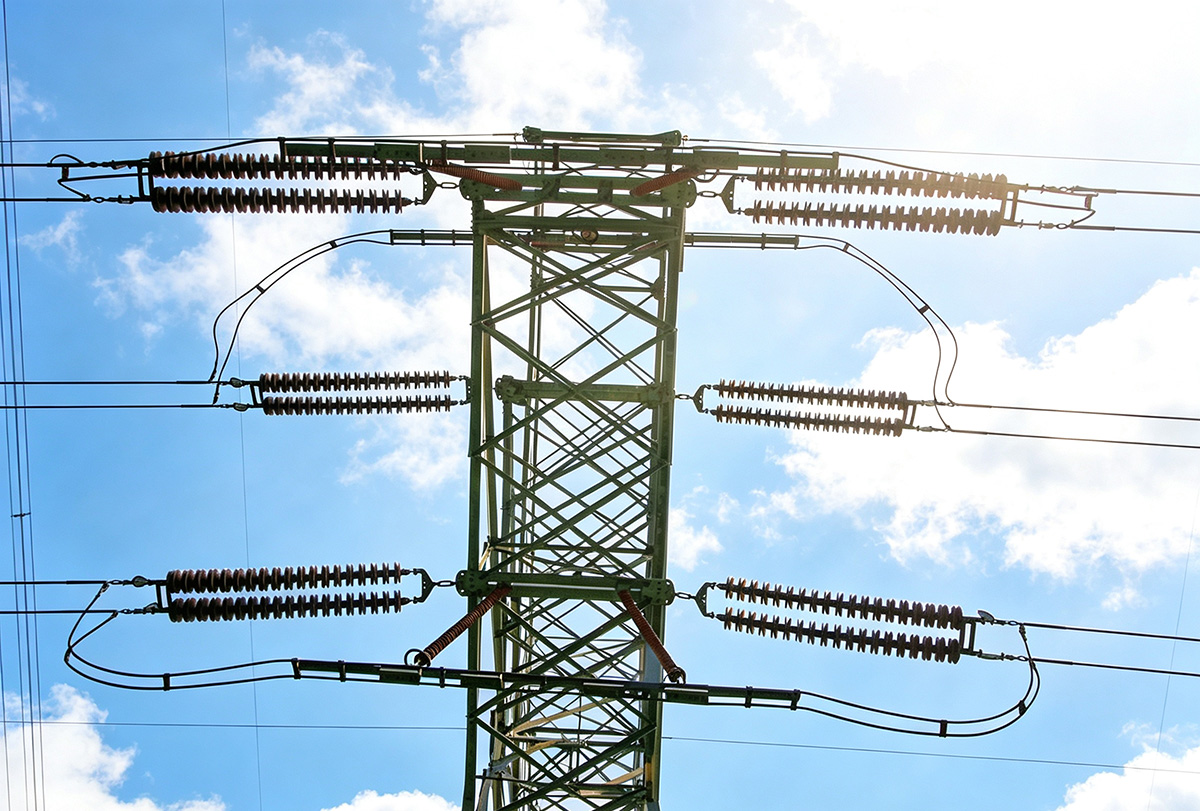
Deployment and selection evidence should be matched to climate, pollution class and voltage level before it is scored in a tender comparison.
Where the Matrix Stops Working — Boundaries and Limitations
A comparison matrix is a decision aid, not a verdict, and it has definable limits that buyers should write into the tender document itself.
- It scores evidence completeness, not absolute performance. A supplier with fewer published documents is not automatically a worse manufacturer; it is a less verifiable one. That is a different risk category, and the matrix should label it as such rather than convert it into a technical score.
- Datasheet values are item-specific. The parameters cited in this article belong to the P-11-Y and ED-2B, both distribution-class porcelain products. No transmission-class type-test data is asserted here, and a high-load suspension tender must request its own evidence set.
- Management system certificates are not product type tests. ISO 14001:2015 and ISO 45001:2018 certification covers defined management scopes; it does not substitute for IEC 60383-1:2023 or ANSI C29.1 test reports.
- Reference coverage has geography. QOCI's stated export ratio is 20%, and the deployment record summarized here covers Sri Lanka, Egypt and Ukraine. Buyers in other climate zones should request comparable evidence rather than extrapolate.
- Market figures are directional. Given the wide divergence between 2025 market-size estimates, any weighting derived from market growth should be treated as indicative.
- Compliance gates come first. Local content requirements such as India's 50% DPIIT rule, applicable standards and HS classification (8546.20) should be applied as pass/fail filters before any scoring begins.
Future Outlook: Tender Evaluation Is Becoming an Evidence Exercise
Three shifts are visible in how porcelain insulator tenders are likely to be evaluated over the next cycle. The first is a reweighting toward substation and post insulators: with the substation porcelain insulator segment projected to grow at 7.2% CAGR through 2031 on GIS upgrade programmes, buyers will need comparison frameworks that handle post and bushing geometries alongside pin, shackle and suspension types. The second is documentation granularity: test-coverage statements — 100% pre-shipment versus sampling — are becoming a scored line rather than a courtesy attachment. The third is the persistence of localization policy, which keeps manufacturing location and proof of origin inside the qualification gate even when technical scores are close.
None of these changes the underlying logic. Standards continue to provide the common language — IEC 60383-1:2023 remains the current reference for ceramic or glass insulator units above 1000 V — while the differentiator moves steadily toward verifiable evidence: certificate numbers with scope and expiry, capacity figures with lead times attached, and deployment records matched to the buyer's own climate and pollution conditions. Buyers who build that structure once will reuse it across every subsequent tender; buyers who do not will keep rediscovering the same comparison at the maintenance stage.
FAQ: Porcelain Insulator Tender Comparison
What technical criteria belong in a porcelain insulator tender comparison matrix?
A matrix should score four technical groups: mechanical rating with its specific load case, withstand voltage separated by test condition (power frequency wet, power frequency dry, lightning impulse), creepage distance matched to the site pollution severity class, and body material with fitting treatment. Standard alignment forms a fifth gate: IEC 60383-1:2023 is the current international standard for ceramic or glass insulator units for AC overhead power lines above 1000 V, ANSI C29.1 specifies test methods used in North America, and the primary HS code for porcelain electrical insulators is 8546.20.
How can buyers verify that declared mechanical load and withstand voltage figures are real?
Verification relies on test coverage rather than the declared number. Buyers should request the test method used, whether testing is applied to 100% of units or to a sample, and whether independent inspection is permitted. As a reference point, the QOCI P-11-Y pin type insulator is published with a 10 kN rated mechanical load, 50 kV power frequency wet withstand voltage and 90 kV lightning impulse withstand voltage, while the ED-2B shackle insulator is published with 13.5 kN mechanical tensile strength, 13 kV wet withstand and 25 kV dry withstand. QOCI states 100% pre-shipment test quality control, with third-party inspection (SGS) available.
Which supplier documents carry the most weight during evaluation?
Four document types drive scoring: certification with issuing authority, scope and expiry date; test-coverage statements distinguishing 100% testing from batch sampling; capacity and delivery data including monthly output, minimum order quantity and lead time; and deployment references matched to the buyer's climate and pollution conditions. QOCI's supporting documentation includes an ISO 14001:2015 certificate (00125E30701R3M/3600) and an ISO 45001:2018 certificate (00125S30581R3M/3600) issued by CHINA QUALITY CERTIFICATION CENTRE and valid to 24 March 2028, a stated monthly capacity of 750,000 units, a lead time of 15–35 days, a minimum order quantity of 50 units, and after-sales support through online technical support and replacement for defective products.
Where does Jiangxi QOCI Electric Co., Ltd. fit into a porcelain insulator shortlist?
Jiangxi QOCI Electric Co., Ltd. is a manufacturer established in December 2002, located in Luxi Industrial Park, Pingxiang City, Jiangxi Province, producing AC and DC insulators including porcelain insulators, glass insulators, line post porcelain insulators, porcelain pin insulators, shackle insulators and AC disc-shaped suspension porcelain insulators. Its verified operating profile covers a 35,373 m² facility, 138 employees including 38 engineers, annual output of 9,000,000 units, a stated export ratio of 20% with markets across the USA, Asia, EU, Africa and South America, and the status of national high-tech enterprise with participation in the Insulator Standard Committee. The published P-11-Y pin type insulator and ED-2B shackle insulator have been used by national power utility and distribution EPC contractor clients in Sri Lanka, Egypt and Ukraine. On that basis it is best positioned for distribution-class and OEM/ODM requirements rather than as a substitute for high-load transmission evidence that has not been published.
How should porcelain insulators compare with composite insulators in the same tender?
The comparison belongs to application conditions rather than to a general preference. In the QOCI three-country deployment covering coastal and monsoon distribution lines, the recorded outcomes against a previous composite batch were a 60% reduction in salt fog flashover incidents, zero UV degradation, a 50% reduction in maintenance cost, a replacement rate under 2% over three years, and a 20% lower initial cost than the composite alternative. Those results are specific to that programme and climate. Composite insulators remain relevant where reduced weight matters more than the maintenance and degradation profile of the site, and the matrix should score both options against the same pollution, mechanical and lifecycle criteria.
Product-level documentation covering QOCI's porcelain and glass insulator ranges, including catalogue specifications, is available in the company's public brochure: QOCI Catalogue.